Chapter 10: Sustaining Terrestrial
Biodiversity


     The Ecosystem Approach
     Case Study: The Reintroduction of the Gray Wolf to Yel
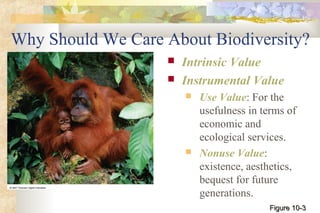
Why Should We Care About Biodiversity?
                      Intrinsic Value
                      Instrumental Value
                          Use Value: For the
                           usefulness in terms of
                           economic and
                           ecological services.
                          Nonuse Value:
                           existence, aesthetics,
                           bequest for future
                           generations.
                                          Figure 10-3
Types of Forests
                  Old-growth forest: uncut or
                   regenerated forest that has not
                   been seriously disturbed for
                   several hundred years.
                      22% of world’s forest.
                      Hosts many species with
                       specialized niches.


                                                 Figure 10-5
Types of Forests


       Second-growth forest: a stand of trees resulting
        from natural secondary succession.
       Tree plantation: planted stands of a particular
        tree species.
                                                  Figure 10-6
Animation: Hubbard Brook
Experiment


              PLAY
            ANIMATION
Forest Benefits
1.   Influence local climates:   4.   Roots hold soil: reduce
     cooler and moister due           erosion
     to transpiration            5.   Watershed protection:
2.   Global biogeochemical            absorb, hold and slowly
     cycles: provide a sink           release water,
     for CO2                          controlling floods
3.   Release O2                  6.   Provide habitat for many
                                      organisms
Tropical Deforestation
   Agriculture
   Logging
   Mining
   Hydroelectric power development
Tropical Deforestation: Causes


                                 Fig. 11-18 p. 212
Reducing Tropical Deforestation
  Encourage protection of large tracts
Sustainable tropical agriculture
  Debt-for-nature swaps
   Reduce illegal
   cutting
    Reducing poverty and population growth


            Refer to Fig. 11-19 p. 213
Amazon Rainforest
                              Satellite
            image of deforestation in
            the Amazon region,
            taken from the Brazilian
            state of Para on July 15,
            1986.
         http://www.bsrsi.msu.edu/rf
            rc/index.html
Boreal Deforestation
   Alaska, Canada, Scandinavia, North Russia
   11% of earth’s land area – world’s largest biome
   Frequently clear cut
   Primary source of industrial wood and wood
    fiber
   Annual loss twice the Amazonian rainforest of
    Brazil
Temperate Forests
   Have been holding steady or increasing in recent
    years
   Biodiversity lower than in virgin forests
   Reasons include:
       Secondary succession of abandoned farms
       Commercial planting
       Government protection
Results of Deforestation
1.    Threatens native people and cultures
2.    Decreased soil fertility
3.    Soil erosion
4.    Increased sedimentation in streams
5.    Formation of deserts in dry areas
6.    Unregulated water – droughts and floods
7.    Species extinction
8.    Migrating species affected
9.    Regional and global climate change
10.   Increased CO2 in atmosphere

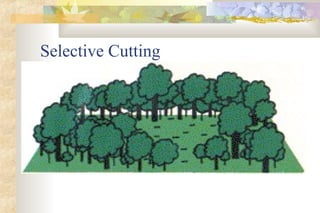
         Selective Cutting
    The hard maple forest is
    managed under a selection
    system. Individual trees are
    harvested from stands on a 28
    year cycle. Specific trees are
    retained in these stands for
    biodiversity and wildlife
    habitat purposes.
Selective Cutting
Clear cutting
Clear cutting
Ten year old
clear cut –
Tongass
National Forest,
Alaska
US FS photo 1979
Western Red cedar stump, Washington
USFS photo
Logging debris in creek, Umpqua
National Forest, Oregon USFS photo
Planting after clear cut – Jack Pine


Tree Plantation – one species and even aged stand
Shelterwood Cutting
Shelterwood Cutting – Lake Superior
Strip Cutting   Forestry in Idaho
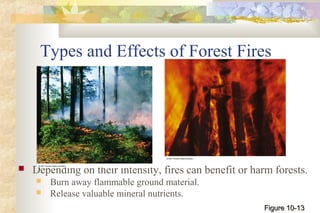
Types and Effects of Forest Fires


   Depending on their intensity, fires can benefit or harm forests.
       Burn away flammable ground material.
       Release valuable mineral nutrients.
                                                         Figure 10-13
Kenya’s Green Belt Movement:
Individuals Matter

      Wangari Maathai founded
       the Green Belt Movement.
      The main goal is to
       organize poor women to
       plant (for fuelwood) and
       protect millions of trees.
      In 2004, awarded Nobel
       peace prize.
                                    Figure 10-10A
The Green Belt Movement
   Wangari Maathai
    talks about the Billion Tree Campaign
   Earth Focus: Wangari Maathai

Chapter 10:Biodiversity/Forests/Forest Management

  • 1.
    Chapter 10: SustainingTerrestrial Biodiversity The Ecosystem Approach Case Study: The Reintroduction of the Gray Wolf to Yel
  • 2.
    Why Should WeCare About Biodiversity?  Intrinsic Value  Instrumental Value  Use Value: For the usefulness in terms of economic and ecological services.  Nonuse Value: existence, aesthetics, bequest for future generations. Figure 10-3
  • 3.
    Types of Forests  Old-growth forest: uncut or regenerated forest that has not been seriously disturbed for several hundred years.  22% of world’s forest.  Hosts many species with specialized niches. Figure 10-5
  • 4.
    Types of Forests  Second-growth forest: a stand of trees resulting from natural secondary succession.  Tree plantation: planted stands of a particular tree species. Figure 10-6
  • 5.
  • 6.
    Forest Benefits 1. Influence local climates: 4. Roots hold soil: reduce cooler and moister due erosion to transpiration 5. Watershed protection: 2. Global biogeochemical absorb, hold and slowly cycles: provide a sink release water, for CO2 controlling floods 3. Release O2 6. Provide habitat for many organisms
  • 7.
    Tropical Deforestation  Agriculture  Logging  Mining  Hydroelectric power development
  • 8.
  • 9.
    Reducing Tropical Deforestation Encourage protection of large tracts Sustainable tropical agriculture Debt-for-nature swaps Reduce illegal cutting Reducing poverty and population growth Refer to Fig. 11-19 p. 213
  • 10.
    Amazon Rainforest Satellite image of deforestation in the Amazon region, taken from the Brazilian state of Para on July 15, 1986. http://www.bsrsi.msu.edu/rf rc/index.html
  • 11.
    Boreal Deforestation  Alaska, Canada, Scandinavia, North Russia  11% of earth’s land area – world’s largest biome  Frequently clear cut  Primary source of industrial wood and wood fiber  Annual loss twice the Amazonian rainforest of Brazil
  • 12.
    Temperate Forests  Have been holding steady or increasing in recent years  Biodiversity lower than in virgin forests  Reasons include:  Secondary succession of abandoned farms  Commercial planting  Government protection
  • 13.
    Results of Deforestation 1. Threatens native people and cultures 2. Decreased soil fertility 3. Soil erosion 4. Increased sedimentation in streams 5. Formation of deserts in dry areas 6. Unregulated water – droughts and floods 7. Species extinction 8. Migrating species affected 9. Regional and global climate change 10. Increased CO2 in atmosphere
  • 14.
    Selective Cutting The hard maple forest is managed under a selection system. Individual trees are harvested from stands on a 28 year cycle. Specific trees are retained in these stands for biodiversity and wildlife habitat purposes.
  • 15.
  • 16.
  • 17.
  • 18.
    Ten year old clearcut – Tongass National Forest, Alaska US FS photo 1979
  • 19.
    Western Red cedarstump, Washington USFS photo
  • 20.
    Logging debris increek, Umpqua National Forest, Oregon USFS photo
  • 21.
    Planting after clearcut – Jack Pine Tree Plantation – one species and even aged stand
  • 22.
  • 23.
  • 24.
    Strip Cutting Forestry in Idaho
  • 25.
    Types and Effectsof Forest Fires  Depending on their intensity, fires can benefit or harm forests.  Burn away flammable ground material.  Release valuable mineral nutrients. Figure 10-13
  • 26.
    Kenya’s Green BeltMovement: Individuals Matter  Wangari Maathai founded the Green Belt Movement.  The main goal is to organize poor women to plant (for fuelwood) and protect millions of trees.  In 2004, awarded Nobel peace prize. Figure 10-10A
  • 27.
    The Green BeltMovement  Wangari Maathai talks about the Billion Tree Campaign  Earth Focus: Wangari Maathai