VCE Environmental ScienceUnit 3: Biodiversity ManagementOutcome 3“Explain how scientific data is applied to the assessment of environmental risk in ensuring biodiversity.”
Key Skills:use qualitative methods, including simple indices, to assess levels of biodiversity and levels of threatuse methods to assess environmental impactuse statistical techniques and apply the precautionary principle to assess and manage biodiversityuse risk analysis in evaluating the probability of extinctionundertake practical activities such as student designed and conducted investigations that provide primary and/or secondary data; methods of recording and processing information; evaluation of data and procedures; methods of reporting practical activities and/or other investigations and suggestions for improvement
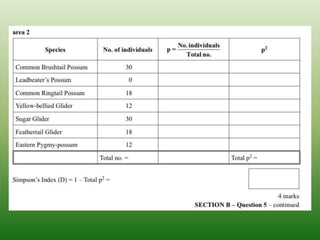
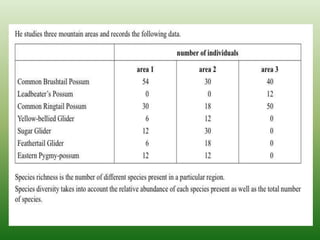
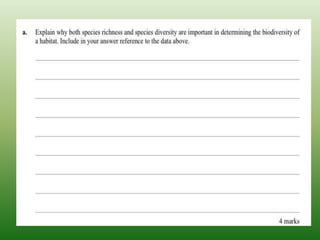
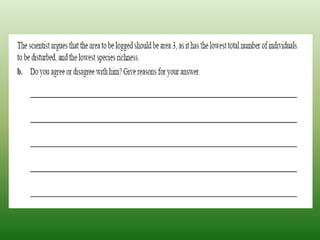
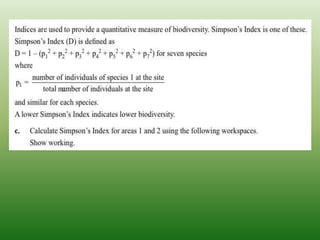
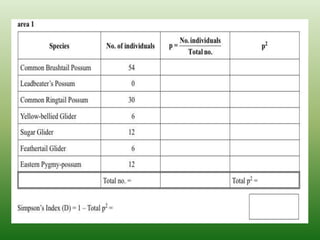
Indices for Biodiversity Assessment Species RichnessSpecies diversity – quadrats and transectsLevel of endemismSimpson’s IndexShanon-Weiner Index
Assessing Environmental ImpactEnvironmental Impact Assessment legislation requires the developer to produce an “Environmental Impact Statement” or a “Environmental Effects Statement”.The aim of the EIA is to carefully consider and describe possible effects, promote greater awareness of environmental values, encourage sustainable development and provide for informed public decision-making.
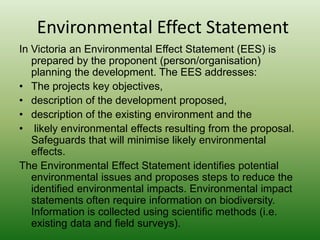
Environmental Effect StatementIn Victoria an Environmental Effect Statement (EES) is prepared by the proponent (person/organisation) planning the development. The EES addresses:The projects key objectives, description of the development proposed, description of the existing environment and the likely environmental effects resulting from the proposal. Safeguards that will minimise likely environmental effects. The Environmental Effect Statement identifies potential environmental issues and proposes steps to reduce the identified environmental impacts. Environmental impact statements often require information on biodiversity. Information is collected using scientific methods (i.e. existing data and field surveys).
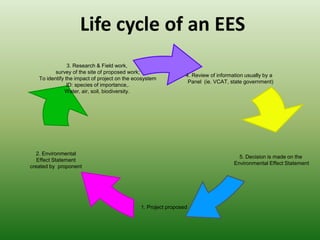
Life cycle of an EES
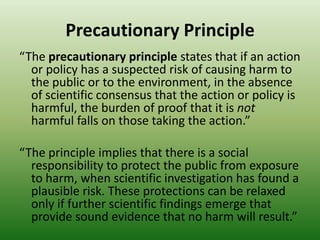
Precautionary Principle“The precautionary principle states that if an action or policy has a suspected risk of causing harm to the public or to the environment, in the absence of scientific consensus that the action or policy is harmful, the burden of proof that it is not harmful falls on those taking the action.”“The principle implies that there is a social responsibility to protect the public from exposure to harm, when scientific investigation has found a plausible risk. These protections can be relaxed only if further scientific findings emerge that provide sound evidence that no harm will result.”
Risk AnalysisHypothesis testing.- Comparison of conditions using information or data. Comparison is made between sites and within sites. In vegetation management comparisons are made using different scientific techniques:- Quadrats and line transects.- Species counts to identify abundance or richness.
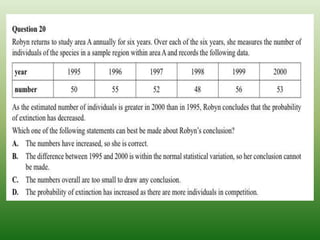
Null HypothesisHypothesis testing works by collecting data and measuring how probable the data are, assuming the null hypothesis is true. If the data are very improbable (usually defined as observed less than 5% of the time), then the experimenter concludes that the null hypothesis is false. If the data do not contradict the null hypothesis, then no conclusion is made. In this case, the null hypothesis could be true or false; the data give insufficient evidence to make any conclusion.
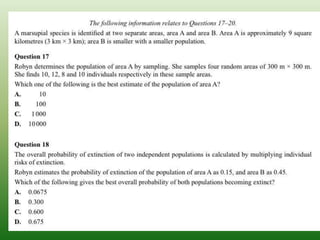
An example of Null HypothesisFor example, a specific development may increase the risk of extinction of a particular species. The null hypothesis would be that “This development has no effect on the species”.An EIS may demonstrate that there is significant risk (by reducing the habitat or increasing predation) so the null hypothesis is rejected.
Collecting DataQuadrats and transectsDiet, reproduction, behaviour
Recording and Processing DataStatistical analysis
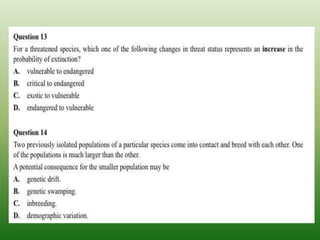
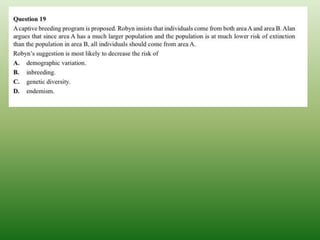
Population Viability AnalysisPopulation Viability Analysis (PVA) = determining the threats faced by a species and evaluating the likelihood that it will persist for a given time into the future.PVA is used because it links planning, research and data collection, assessment of vulnerability and the ranking of management options.A PVA includes:Ecosystems: Habitat type and availability.Breeding and longevity: Birth and death rates. Demographics; age structure of populations.External influences: weather events.
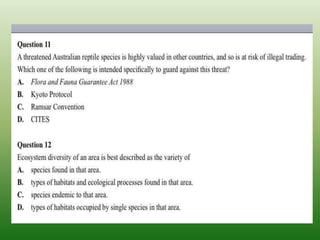
Strategies for Protecting BiodiversityCITES – trade of speciesWorld Heritage AreasRamsar convention (1993) – significant wetlands.JAMBA and CAMBA - migratory bird agreement between Japan and China and Australia.Environmental Protection and Biodiversity Conservation Act (1999)Victoria Flora and Fauna Guarantee Act (1999).
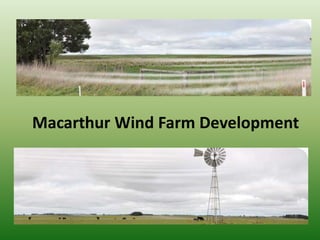
Macarthur Wind Farm Development
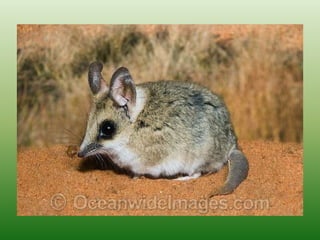
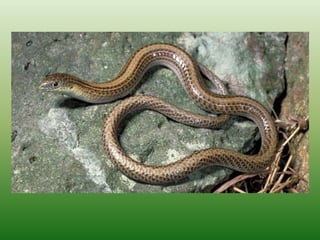
Macarthur Wind Farm DevelopmentTwo threatened fauna species have been identified: Striped Legless Lizard (Delmaimpar) is recognised as “Threatened” under the Commonwealth EPBC Acthttp://www.environment.gov.au/biodiversity/threatened/publications/recovery/striped-legless-lizard/index.htmlFat-tailed Dunnart (Sminthopsiscrassicaudata) is recognised as “Near Threatened” under the Victorian FFG.
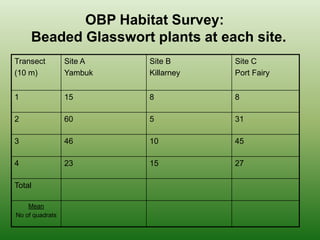
A practical activity:	You are a part of the Orange-bellied Parrot recovery team and are required to conduct field surveys to provide biodiversity information on three sites that a new coastal housing development is proposed on.  You conduct your survey using line transects . Your survey must consider the impact  on food plants Beaded Glasswort (Sarcocorniaquinqueflora) on the Orange-bellied Parrot population.  Compare the abundance of this plant at each of the sites and make recommendations based on your findings.Examine the number of quadrats at each site to statistically test the difference between sites.Calculate the mean species abundance of Orange-bellied Parrot food plants beaded glasswort.			Mean (total) / No of quadrats3. 	Answer the question and refer to the data to justify your answers.
OBP Habitat Survey:  Beaded Glasswort plants at each site.
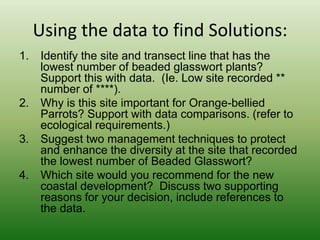
Using the data to find Solutions:Identify the site and transect line that has the lowest number of beaded glasswort plants? Support this with data.  (Ie. Low site recorded ** number of ****).Why is this site important for Orange-bellied Parrots? Support with data comparisons. (refer to ecological requirements.)Suggest two management techniques to protect and enhance the diversity at the site that recorded the lowest number of Beaded Glasswort?Which site would you recommend for the new coastal development?  Discuss two supporting reasons for your decision, include references to the data.
Biodiversity Management

Biodiversity Management

  • 1.
    VCE Environmental ScienceUnit3: Biodiversity ManagementOutcome 3“Explain how scientific data is applied to the assessment of environmental risk in ensuring biodiversity.”
  • 2.
    Key Skills:use qualitativemethods, including simple indices, to assess levels of biodiversity and levels of threatuse methods to assess environmental impactuse statistical techniques and apply the precautionary principle to assess and manage biodiversityuse risk analysis in evaluating the probability of extinctionundertake practical activities such as student designed and conducted investigations that provide primary and/or secondary data; methods of recording and processing information; evaluation of data and procedures; methods of reporting practical activities and/or other investigations and suggestions for improvement
  • 4.
    Indices for BiodiversityAssessment Species RichnessSpecies diversity – quadrats and transectsLevel of endemismSimpson’s IndexShanon-Weiner Index
  • 6.
    Assessing Environmental ImpactEnvironmentalImpact Assessment legislation requires the developer to produce an “Environmental Impact Statement” or a “Environmental Effects Statement”.The aim of the EIA is to carefully consider and describe possible effects, promote greater awareness of environmental values, encourage sustainable development and provide for informed public decision-making.
  • 8.
    Environmental Effect StatementInVictoria an Environmental Effect Statement (EES) is prepared by the proponent (person/organisation) planning the development. The EES addresses:The projects key objectives, description of the development proposed, description of the existing environment and the likely environmental effects resulting from the proposal. Safeguards that will minimise likely environmental effects. The Environmental Effect Statement identifies potential environmental issues and proposes steps to reduce the identified environmental impacts. Environmental impact statements often require information on biodiversity. Information is collected using scientific methods (i.e. existing data and field surveys).
  • 9.
  • 13.
    Precautionary Principle“The precautionaryprinciple states that if an action or policy has a suspected risk of causing harm to the public or to the environment, in the absence of scientific consensus that the action or policy is harmful, the burden of proof that it is not harmful falls on those taking the action.”“The principle implies that there is a social responsibility to protect the public from exposure to harm, when scientific investigation has found a plausible risk. These protections can be relaxed only if further scientific findings emerge that provide sound evidence that no harm will result.”
  • 16.
    Risk AnalysisHypothesis testing.-Comparison of conditions using information or data. Comparison is made between sites and within sites. In vegetation management comparisons are made using different scientific techniques:- Quadrats and line transects.- Species counts to identify abundance or richness.
  • 17.
    Null HypothesisHypothesis testingworks by collecting data and measuring how probable the data are, assuming the null hypothesis is true. If the data are very improbable (usually defined as observed less than 5% of the time), then the experimenter concludes that the null hypothesis is false. If the data do not contradict the null hypothesis, then no conclusion is made. In this case, the null hypothesis could be true or false; the data give insufficient evidence to make any conclusion.
  • 18.
    An example ofNull HypothesisFor example, a specific development may increase the risk of extinction of a particular species. The null hypothesis would be that “This development has no effect on the species”.An EIS may demonstrate that there is significant risk (by reducing the habitat or increasing predation) so the null hypothesis is rejected.
  • 23.
    Collecting DataQuadrats andtransectsDiet, reproduction, behaviour
  • 24.
    Recording and ProcessingDataStatistical analysis
  • 25.
    Population Viability AnalysisPopulationViability Analysis (PVA) = determining the threats faced by a species and evaluating the likelihood that it will persist for a given time into the future.PVA is used because it links planning, research and data collection, assessment of vulnerability and the ranking of management options.A PVA includes:Ecosystems: Habitat type and availability.Breeding and longevity: Birth and death rates. Demographics; age structure of populations.External influences: weather events.
  • 26.
    Strategies for ProtectingBiodiversityCITES – trade of speciesWorld Heritage AreasRamsar convention (1993) – significant wetlands.JAMBA and CAMBA - migratory bird agreement between Japan and China and Australia.Environmental Protection and Biodiversity Conservation Act (1999)Victoria Flora and Fauna Guarantee Act (1999).
  • 27.
  • 28.
    Macarthur Wind FarmDevelopmentTwo threatened fauna species have been identified: Striped Legless Lizard (Delmaimpar) is recognised as “Threatened” under the Commonwealth EPBC Acthttp://www.environment.gov.au/biodiversity/threatened/publications/recovery/striped-legless-lizard/index.htmlFat-tailed Dunnart (Sminthopsiscrassicaudata) is recognised as “Near Threatened” under the Victorian FFG.
  • 41.
    A practical activity: Youare a part of the Orange-bellied Parrot recovery team and are required to conduct field surveys to provide biodiversity information on three sites that a new coastal housing development is proposed on. You conduct your survey using line transects . Your survey must consider the impact on food plants Beaded Glasswort (Sarcocorniaquinqueflora) on the Orange-bellied Parrot population. Compare the abundance of this plant at each of the sites and make recommendations based on your findings.Examine the number of quadrats at each site to statistically test the difference between sites.Calculate the mean species abundance of Orange-bellied Parrot food plants beaded glasswort. Mean (total) / No of quadrats3. Answer the question and refer to the data to justify your answers.
  • 43.
    OBP Habitat Survey: Beaded Glasswort plants at each site.
  • 44.
    Using the datato find Solutions:Identify the site and transect line that has the lowest number of beaded glasswort plants? Support this with data. (Ie. Low site recorded ** number of ****).Why is this site important for Orange-bellied Parrots? Support with data comparisons. (refer to ecological requirements.)Suggest two management techniques to protect and enhance the diversity at the site that recorded the lowest number of Beaded Glasswort?Which site would you recommend for the new coastal development? Discuss two supporting reasons for your decision, include references to the data.