What is biodiversity and how is it
measured?
• What is Biodiversity?
– The variation that exists in the natural
world at all levels of biological organization
– All organisms in a defined area, all of their
variations and all of their interactions with
each other and with the physical
environment
Levels of Biodiversity
1. Genetic diversity: the gene pool within
a population
2. Species diversity: the number and
types of species in an area
3. Higher taxonomic diversity
4. Community Diversity
5. Ecosystem diversity (Habitat diversity)
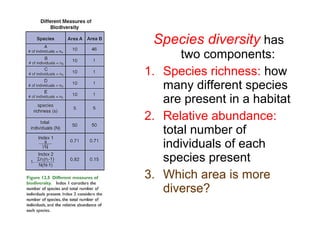
Species diversity
has two components:
1. Species richness: how many different
species are present in a habitat
2. Relative abundance: total number of
individuals of each species present
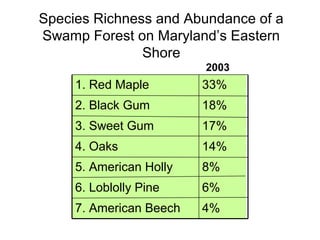
Species Richness and Abundance of a
Swamp Forest on Maryland’s Eastern
Shore
4%
6%
8%
14%
17%
18%
33%
7. American Beech
6. Loblolly Pine
5. American Holly
4. Oaks
3. Sweet Gum
2. Black Gum
1. Red Maple
2003
Species diversity has
two components:
1. Species richness: how
many different species
are present in a habitat
2. Relative abundance:
total number of
individuals of each
species present
3. Which area is more
diverse?
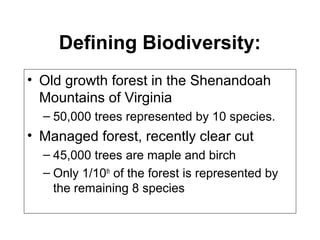
Defining Biodiversity:
• Old growth forest in the Shenandoah
Mountains of Virginia
– 50,000 trees represented by 10 species.
• Managed forest, recently clear cut
– 45,000 trees are maple and birch
– Only 1/10th
of the forest is represented by
the remaining 8 species
Importance of Taxonomy
Naming Species
1. Naming things upon which we depend for
food and medicine means survival.
2. Important to measuring biodiversity
3. Conservation
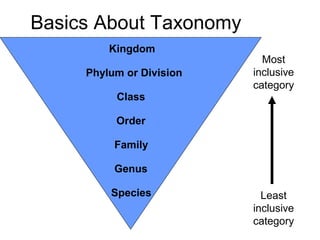
Basics About Taxonomy
Kingdom
Phylum or Division
Class
Order
Family
Genus
Species
Most
inclusive
category
Least
inclusive
category
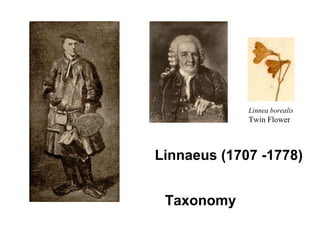
Linnaeus (1707 -1778)
Taxonomy
Linnea borealis
Twin Flower
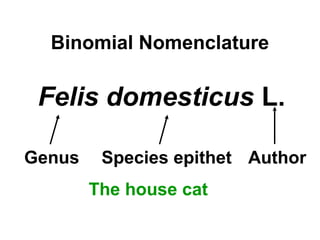
Binomial Nomenclature
Felis domesticus L.
Genus Species epithet Author
The house cat
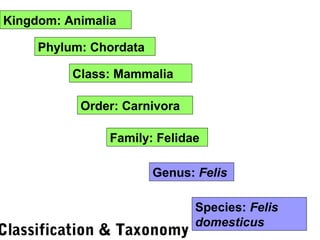
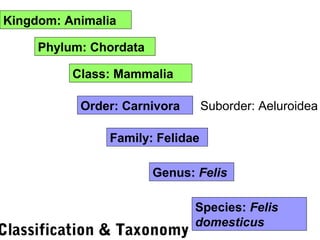
Kingdom: Animalia
Phylum: Chordata
Class: Mammalia
Order: Carnivora
Family: Felidae
Genus: Felis
Species: Felis
domesticus
Classification & Taxonomy
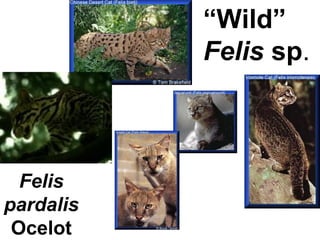
“Wild”
Felis sp.
Felis
pardalis
Ocelot
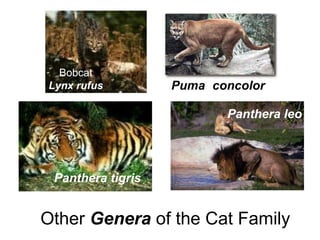
Bobcat
Lynx rufus
Panthera tigris
Panthera leo
Puma concolor
Other Genera of the Cat Family
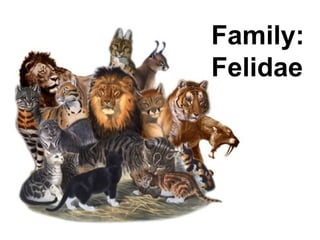
Family:
Felidae
Kingdom: Animalia
Phylum: Chordata
Class: Mammalia
Order: Carnivora
Family: Felidae
Genus: Felis
Species: Felis
domesticus
Classification & Taxonomy
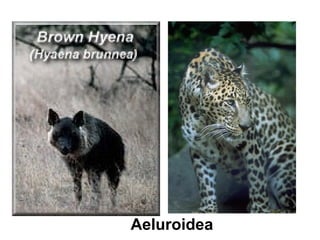
Suborder: Aeluroidea
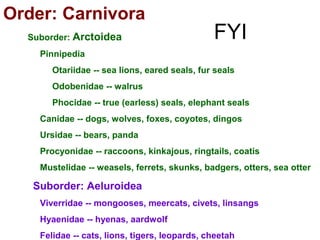
Order: Carnivora
Suborder: Arctoidea
Pinnipedia
Otariidae -- sea lions, eared seals, fur seals
Odobenidae -- walrus
Phocidae -- true (earless) seals, elephant seals
Canidae -- dogs, wolves, foxes, coyotes, dingos
Ursidae -- bears, panda
Procyonidae -- raccoons, kinkajous, ringtails, coatis
Mustelidae -- weasels, ferrets, skunks, badgers, otters, sea otter
Suborder: Aeluroidea
Viverridae -- mongooses, meercats, civets, linsangs
Hyaenidae -- hyenas, aardwolf
Felidae -- cats, lions, tigers, leopards, cheetah
FYI
Aeluroidea
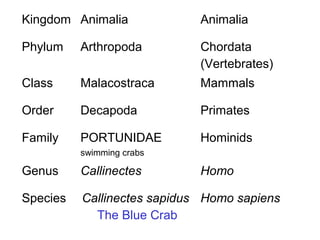
Kingdom Animalia Animalia
Phylum Arthropoda Chordata
(Vertebrates)
Class Malacostraca Mammals
Order Decapoda Primates
Family PORTUNIDAE
swimming crabs
Hominids
Genus Callinectes Homo
Species Callinectes sapidus
The Blue Crab
Homo sapiens
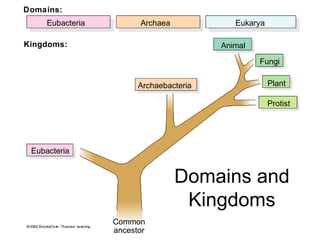
Eubacteria
Archaebacteria
Animal
Fungi
Plant
Protist
Common
ancestor
Domains:
Kingdoms:
Eubacteria Archaea Eukarya
Domains and
Kingdoms
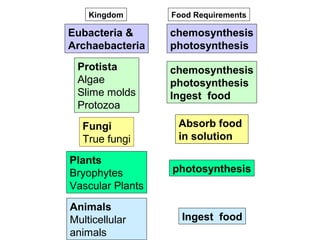
Eubacteria &
Archaebacteria
Protista
Algae
Slime molds
Protozoa
Fungi
True fungi
Plants
Bryophytes
Vascular Plants
Animals
Multicellular
animals
Absorb food
in solution
photosynthesis
Ingest food
Food Requirements
chemosynthesis
photosynthesis
chemosynthesis
photosynthesis
Ingest food
Kingdom
What you need to know about
Classification
• The order of classification
• Binomial nomenclature (genus,
species)
• The three Domains
• The five Kingdoms
• The ecological role of each kingdom
• The scientific name of the Blue Crab
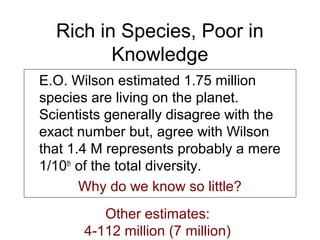
Rich in Species, Poor in
Knowledge
E.O. Wilson estimated 1.75 million
species are living on the planet.
Scientists generally disagree with the
exact number but, agree with Wilson
that 1.4 M represents probably a mere
1/10th
of the total diversity.
Why do we know so little?
Other estimates:
4-112 million (7 million)
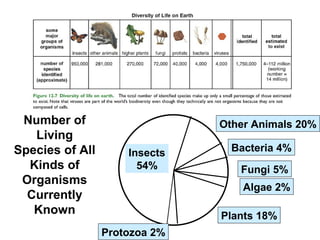
Number of
Living
Species of All
Kinds of
Organisms
Currently
Known
Insects
54%
Other Animals 20%
Bacteria 4%
Fungi 5%
Algae 2%
Plants 18%
Protozoa 2%
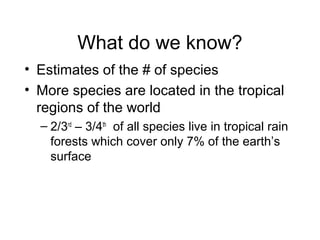
What do we know?
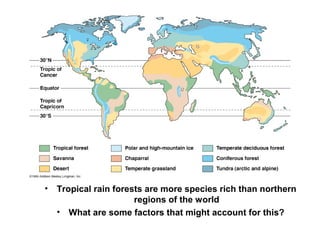
• Estimates of the # of species
• More species are located in the tropical
regions of the world
– 2/3rd
– 3/4th
of all species live in tropical rain
forests which cover only 7% of the earth’s
surface
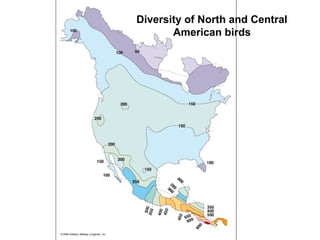
Diversity of North and Central
American birds
Why do we know so little?
1. Not all species have been discovered
– #’s are biased toward animal species
– Know more about species in developed Nations
– Not all species are named as a result of unclear
species concepts in taxonomy
2. On-going extinction: species loss in tropical
forest is estimated at 6000/year,
• Tropical rain forests are more species rich than northern
regions of the world
• What are some factors that might account for this?
Some factors that affect the
biodiversity of an area
1. Historical Events
– Time
2. Habitat conditions
3. Habitat structure
4. Climate stability
5. Competition
– Predators
– Keystone species
6. Disturbance
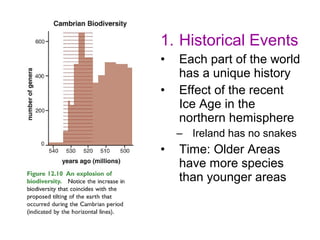
1. Historical Events
• Each part of the world
has a unique history
• Effect of the recent
Ice Age in the
northern hemisphere
– Ireland has no snakes
• Time: Older Areas
have more species
than younger areas
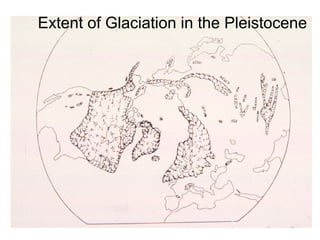
Extent of Glaciation in the Pleistocene
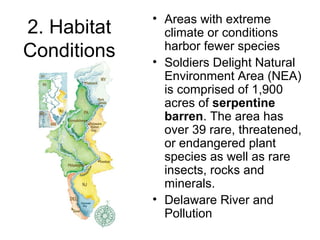
2. Habitat
Conditions
• Areas with extreme
climate or conditions
harbor fewer species
• Soldiers Delight Natural
Environment Area (NEA)
is comprised of 1,900
acres of serpentine
barren. The area has
over 39 rare, threatened,
or endangered plant
species as well as rare
insects, rocks and
minerals.
• Delaware River and
Pollution
3. Habitat Structure
• Terrain that is simple, uniform, and
without much physical variation tends to
have fewer species than a complicated
terrain with wet and dry spots
• Ecologists call these microhabitats
• A piece of property with a patch of forest,
a small wetland, and a field with harbor a
greater diversity than the same sized
property that is covered with only forest.
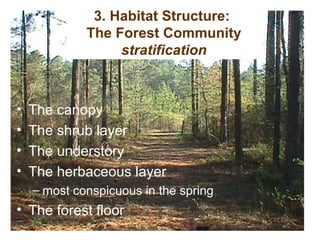
3. Habitat Structure:
The Forest Community
stratification
• The canopy
• The shrub layer
• The understory
• The herbaceous layer
– most conspicuous in the spring
• The forest floor
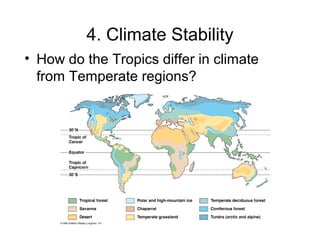
4. Climate Stability
• How do the Tropics differ in climate
from Temperate regions?
5. Competition Among Species
• Predators can enhance an area by
reducing the population size of prey
species
• Other species have a chance to get
established
• Keystone Species have a large effect on
the other species of a community
– Oysters of the Chesapeake Bay
– Vital as water filters, provide habitat, income
for watermen
6. The Nature of Disturbance
1. Damage communities
2. Remove organisms
3. Alter resource availability
Fire
Flooding
Storms and Hurricanes
Tornados
Ice Storms
6. Disturbance
1. Create opportunities for the
colonization of new species
2. Disturbance is a natural part of the life
of a community: most communities
are always in recovery from
disturbance
3. Humans as agents of disturbance
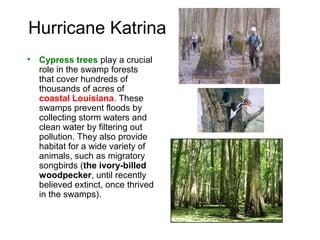
Hurricane Katrina
• Cypress trees play a crucial
role in the swamp forests
that cover hundreds of
thousands of acres of
coastal Louisiana. These
swamps prevent floods by
collecting storm waters and
clean water by filtering out
pollution. They also provide
habitat for a wide variety of
animals, such as migratory
songbirds (the ivory-billed
woodpecker, until recently
believed extinct, once thrived
in the swamps).
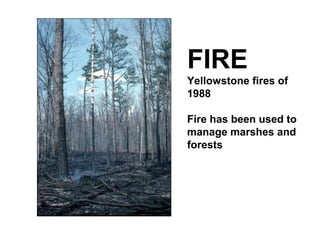
FIRE
Yellowstone fires of
1988
Fire has been used to
manage marshes and
forests
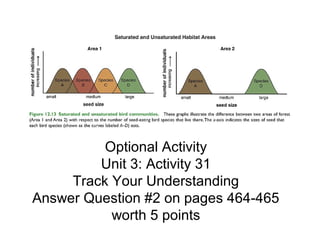
Optional Activity
Unit 3: Activity 31
Track Your Understanding
Answer Question #2 on pages 464-465
worth 5 points
Species Extinction:
Past and Present
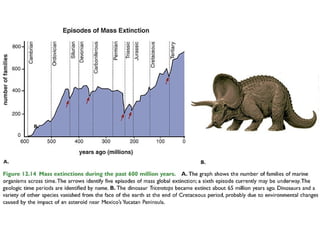
• Extinction is a biological reality
• Extinction and evolution are intricately related
• Five mass extinctions in the earth’s history
– 99% of species that have ever existed are now
extinct
• Each mass extinction is followed by a rise in
biodiversity of a new set of species
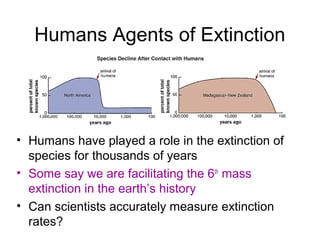
Humans Agents of Extinction
• Humans have played a role in the extinction of
species for thousands of years
• Some say we are facilitating the 6th
mass
extinction in the earth’s history
• Can scientists accurately measure extinction
rates?
Estimates of Extinction Rates
“the logic of loss”
• Estimating rates is difficult at best
• Most accurate estimates are for birds
and mammals
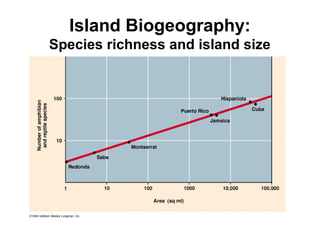
• Species-area relationships from Island
Biogeography
– # species is related to size of habitat
– Estimate habitat loss
– 90% habitat loss: 50% species loss
Island Biogeography:
Species richness and island size
Conserving the
Biodiversity of the Commons
• Conserving the world’s biodiversity is
based on principles of biology
– Population biology
– Conservation biology
Principles of Population Biology
1. Small populations are more likely to
become extinct than large populations
2. To understand a population it is
important to consider factors such as
its age structure and sex ratio
3. Populations must be monitored to
determine the effects of a
conservation plan
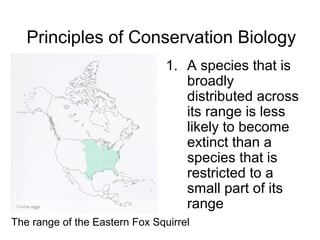
Principles of Conservation Biology
1. A species that is
broadly
distributed across
its range is less
likely to become
extinct than a
species that is
restricted to a
small part of its
range
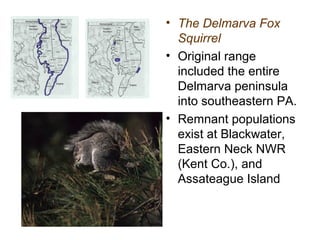
The range of the Eastern Fox Squirrel
• The Delmarva Fox
Squirrel
• Original range
included the entire
Delmarva peninsula
into southeastern PA.
• Remnant populations
exist at Blackwater,
Eastern Neck NWR
(Kent Co.), and
Assateague Island
Principles of Conservation Biology
2. Characteristics of habitats that favor
species preservation:
a. Large rather than small; Bigger is better
b. Close together rather than far apart
c. Whole rather than internally fragmented
d. Linked by corridors rather than isolated
e. Inaccessible rather than easily accessible
to people
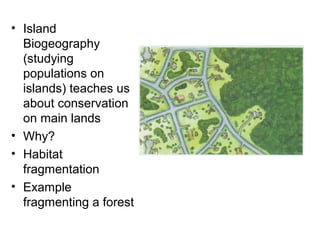
• Island
Biogeography
(studying
populations on
islands) teaches us
about conservation
on main lands
• Why?
• Habitat
fragmentation
• Example
fragmenting a forest
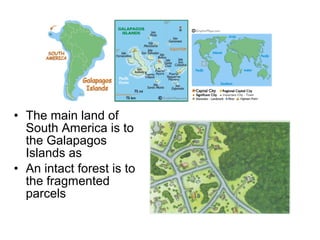
• The main land of
South America is to
the Galapagos
Islands as
• An intact forest is to
the fragmented
parcels
Dooms species by confining them to
small, island-like parcels of habitat
surrounded by an ocean of human
impact. This often leads to:
– Inbreeding within small populations
– Roads, fences, houses, clear-cuts create
barriers to dispersal and reproduction
– More susceptible to environmental
fluctuations and catastrophes
When habitats become islands
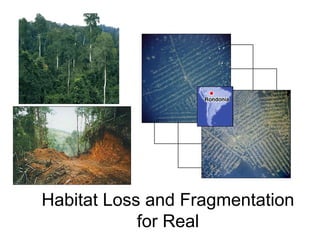
Habitat Loss and Fragmentation
for Real
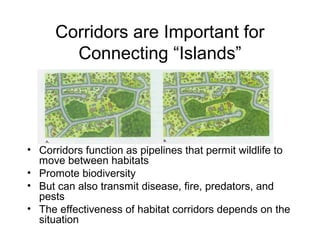
Corridors are Important for
Connecting “Islands”
• Corridors function as pipelines that permit wildlife to
move between habitats
• Promote biodiversity
• But can also transmit disease, fire, predators, and
pests
• The effectiveness of habitat corridors depends on the
situation
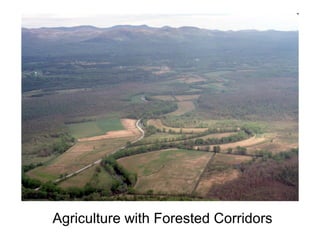
Agriculture with Forested Corridors
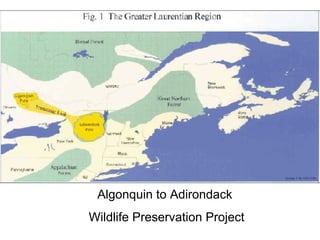
Algonquin to Adirondack
Wildlife Preservation Project
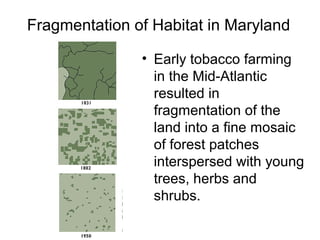
Fragmentation of Habitat in Maryland
• Early tobacco farming
in the Mid-Atlantic
resulted in
fragmentation of the
land into a fine mosaic
of forest patches
interspersed with young
trees, herbs and
shrubs.
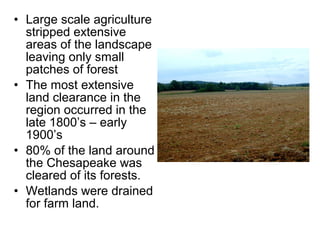
• Large scale agriculture
stripped extensive
areas of the landscape
leaving only small
patches of forest
• The most extensive
land clearance in the
region occurred in the
late 1800’s – early
1900’s
• 80% of the land around
the Chesapeake was
cleared of its forests.
• Wetlands were drained
for farm land.
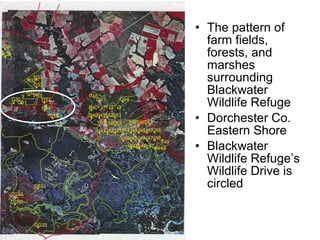
• The pattern of
farm fields,
forests, and
marshes
surrounding
Blackwater
Wildlife Refuge
• Dorchester Co.
Eastern Shore
• Blackwater
Wildlife Refuge’s
Wildlife Drive is
circled

Biodiversity 12

  • 1.
    What is biodiversityand how is it measured? • What is Biodiversity? – The variation that exists in the natural world at all levels of biological organization – All organisms in a defined area, all of their variations and all of their interactions with each other and with the physical environment
  • 2.
    Levels of Biodiversity 1.Genetic diversity: the gene pool within a population 2. Species diversity: the number and types of species in an area 3. Higher taxonomic diversity 4. Community Diversity 5. Ecosystem diversity (Habitat diversity)
  • 3.
    Species diversity has twocomponents: 1. Species richness: how many different species are present in a habitat 2. Relative abundance: total number of individuals of each species present
  • 4.
    Species Richness andAbundance of a Swamp Forest on Maryland’s Eastern Shore 4% 6% 8% 14% 17% 18% 33% 7. American Beech 6. Loblolly Pine 5. American Holly 4. Oaks 3. Sweet Gum 2. Black Gum 1. Red Maple 2003
  • 5.
    Species diversity has twocomponents: 1. Species richness: how many different species are present in a habitat 2. Relative abundance: total number of individuals of each species present 3. Which area is more diverse?
  • 6.
    Defining Biodiversity: • Oldgrowth forest in the Shenandoah Mountains of Virginia – 50,000 trees represented by 10 species. • Managed forest, recently clear cut – 45,000 trees are maple and birch – Only 1/10th of the forest is represented by the remaining 8 species
  • 7.
    Importance of Taxonomy NamingSpecies 1. Naming things upon which we depend for food and medicine means survival. 2. Important to measuring biodiversity 3. Conservation
  • 8.
    Basics About Taxonomy Kingdom Phylumor Division Class Order Family Genus Species Most inclusive category Least inclusive category
  • 9.
  • 10.
    Binomial Nomenclature Felis domesticusL. Genus Species epithet Author The house cat
  • 11.
    Kingdom: Animalia Phylum: Chordata Class:Mammalia Order: Carnivora Family: Felidae Genus: Felis Species: Felis domesticus Classification & Taxonomy
  • 12.
  • 13.
    Bobcat Lynx rufus Panthera tigris Pantheraleo Puma concolor Other Genera of the Cat Family
  • 14.
  • 15.
    Kingdom: Animalia Phylum: Chordata Class:Mammalia Order: Carnivora Family: Felidae Genus: Felis Species: Felis domesticus Classification & Taxonomy Suborder: Aeluroidea
  • 16.
    Order: Carnivora Suborder: Arctoidea Pinnipedia Otariidae-- sea lions, eared seals, fur seals Odobenidae -- walrus Phocidae -- true (earless) seals, elephant seals Canidae -- dogs, wolves, foxes, coyotes, dingos Ursidae -- bears, panda Procyonidae -- raccoons, kinkajous, ringtails, coatis Mustelidae -- weasels, ferrets, skunks, badgers, otters, sea otter Suborder: Aeluroidea Viverridae -- mongooses, meercats, civets, linsangs Hyaenidae -- hyenas, aardwolf Felidae -- cats, lions, tigers, leopards, cheetah FYI
  • 17.
  • 18.
    Kingdom Animalia Animalia PhylumArthropoda Chordata (Vertebrates) Class Malacostraca Mammals Order Decapoda Primates Family PORTUNIDAE swimming crabs Hominids Genus Callinectes Homo Species Callinectes sapidus The Blue Crab Homo sapiens
  • 19.
  • 20.
    Eubacteria & Archaebacteria Protista Algae Slime molds Protozoa Fungi Truefungi Plants Bryophytes Vascular Plants Animals Multicellular animals Absorb food in solution photosynthesis Ingest food Food Requirements chemosynthesis photosynthesis chemosynthesis photosynthesis Ingest food Kingdom
  • 21.
    What you needto know about Classification • The order of classification • Binomial nomenclature (genus, species) • The three Domains • The five Kingdoms • The ecological role of each kingdom • The scientific name of the Blue Crab
  • 22.
    Rich in Species,Poor in Knowledge E.O. Wilson estimated 1.75 million species are living on the planet. Scientists generally disagree with the exact number but, agree with Wilson that 1.4 M represents probably a mere 1/10th of the total diversity. Why do we know so little? Other estimates: 4-112 million (7 million)
  • 23.
    Number of Living Species ofAll Kinds of Organisms Currently Known Insects 54% Other Animals 20% Bacteria 4% Fungi 5% Algae 2% Plants 18% Protozoa 2%
  • 24.
    What do weknow? • Estimates of the # of species • More species are located in the tropical regions of the world – 2/3rd – 3/4th of all species live in tropical rain forests which cover only 7% of the earth’s surface
  • 25.
    Diversity of Northand Central American birds
  • 26.
    Why do weknow so little? 1. Not all species have been discovered – #’s are biased toward animal species – Know more about species in developed Nations – Not all species are named as a result of unclear species concepts in taxonomy 2. On-going extinction: species loss in tropical forest is estimated at 6000/year,
  • 27.
    • Tropical rainforests are more species rich than northern regions of the world • What are some factors that might account for this?
  • 28.
    Some factors thataffect the biodiversity of an area 1. Historical Events – Time 2. Habitat conditions 3. Habitat structure 4. Climate stability 5. Competition – Predators – Keystone species 6. Disturbance
  • 29.
    1. Historical Events •Each part of the world has a unique history • Effect of the recent Ice Age in the northern hemisphere – Ireland has no snakes • Time: Older Areas have more species than younger areas
  • 30.
    Extent of Glaciationin the Pleistocene
  • 31.
    2. Habitat Conditions • Areaswith extreme climate or conditions harbor fewer species • Soldiers Delight Natural Environment Area (NEA) is comprised of 1,900 acres of serpentine barren. The area has over 39 rare, threatened, or endangered plant species as well as rare insects, rocks and minerals. • Delaware River and Pollution
  • 32.
    3. Habitat Structure •Terrain that is simple, uniform, and without much physical variation tends to have fewer species than a complicated terrain with wet and dry spots • Ecologists call these microhabitats • A piece of property with a patch of forest, a small wetland, and a field with harbor a greater diversity than the same sized property that is covered with only forest.
  • 33.
    3. Habitat Structure: TheForest Community stratification • The canopy • The shrub layer • The understory • The herbaceous layer – most conspicuous in the spring • The forest floor
  • 34.
    4. Climate Stability •How do the Tropics differ in climate from Temperate regions?
  • 35.
    5. Competition AmongSpecies • Predators can enhance an area by reducing the population size of prey species • Other species have a chance to get established • Keystone Species have a large effect on the other species of a community – Oysters of the Chesapeake Bay – Vital as water filters, provide habitat, income for watermen
  • 36.
    6. The Natureof Disturbance 1. Damage communities 2. Remove organisms 3. Alter resource availability Fire Flooding Storms and Hurricanes Tornados Ice Storms
  • 37.
    6. Disturbance 1. Createopportunities for the colonization of new species 2. Disturbance is a natural part of the life of a community: most communities are always in recovery from disturbance 3. Humans as agents of disturbance
  • 38.
    Hurricane Katrina • Cypresstrees play a crucial role in the swamp forests that cover hundreds of thousands of acres of coastal Louisiana. These swamps prevent floods by collecting storm waters and clean water by filtering out pollution. They also provide habitat for a wide variety of animals, such as migratory songbirds (the ivory-billed woodpecker, until recently believed extinct, once thrived in the swamps).
  • 39.
    FIRE Yellowstone fires of 1988 Firehas been used to manage marshes and forests
  • 40.
    Optional Activity Unit 3:Activity 31 Track Your Understanding Answer Question #2 on pages 464-465 worth 5 points
  • 41.
    Species Extinction: Past andPresent • Extinction is a biological reality • Extinction and evolution are intricately related • Five mass extinctions in the earth’s history – 99% of species that have ever existed are now extinct • Each mass extinction is followed by a rise in biodiversity of a new set of species
  • 43.
    Humans Agents ofExtinction • Humans have played a role in the extinction of species for thousands of years • Some say we are facilitating the 6th mass extinction in the earth’s history • Can scientists accurately measure extinction rates?
  • 44.
    Estimates of ExtinctionRates “the logic of loss” • Estimating rates is difficult at best • Most accurate estimates are for birds and mammals • Species-area relationships from Island Biogeography – # species is related to size of habitat – Estimate habitat loss – 90% habitat loss: 50% species loss
  • 45.
  • 46.
    Conserving the Biodiversity ofthe Commons • Conserving the world’s biodiversity is based on principles of biology – Population biology – Conservation biology
  • 47.
    Principles of PopulationBiology 1. Small populations are more likely to become extinct than large populations 2. To understand a population it is important to consider factors such as its age structure and sex ratio 3. Populations must be monitored to determine the effects of a conservation plan
  • 48.
    Principles of ConservationBiology 1. A species that is broadly distributed across its range is less likely to become extinct than a species that is restricted to a small part of its range The range of the Eastern Fox Squirrel
  • 49.
    • The DelmarvaFox Squirrel • Original range included the entire Delmarva peninsula into southeastern PA. • Remnant populations exist at Blackwater, Eastern Neck NWR (Kent Co.), and Assateague Island
  • 50.
    Principles of ConservationBiology 2. Characteristics of habitats that favor species preservation: a. Large rather than small; Bigger is better b. Close together rather than far apart c. Whole rather than internally fragmented d. Linked by corridors rather than isolated e. Inaccessible rather than easily accessible to people
  • 51.
    • Island Biogeography (studying populations on islands)teaches us about conservation on main lands • Why? • Habitat fragmentation • Example fragmenting a forest
  • 52.
    • The mainland of South America is to the Galapagos Islands as • An intact forest is to the fragmented parcels
  • 53.
    Dooms species byconfining them to small, island-like parcels of habitat surrounded by an ocean of human impact. This often leads to: – Inbreeding within small populations – Roads, fences, houses, clear-cuts create barriers to dispersal and reproduction – More susceptible to environmental fluctuations and catastrophes When habitats become islands
  • 54.
    Habitat Loss andFragmentation for Real
  • 55.
    Corridors are Importantfor Connecting “Islands” • Corridors function as pipelines that permit wildlife to move between habitats • Promote biodiversity • But can also transmit disease, fire, predators, and pests • The effectiveness of habitat corridors depends on the situation
  • 56.
  • 57.
  • 58.
    Fragmentation of Habitatin Maryland • Early tobacco farming in the Mid-Atlantic resulted in fragmentation of the land into a fine mosaic of forest patches interspersed with young trees, herbs and shrubs.
  • 59.
    • Large scaleagriculture stripped extensive areas of the landscape leaving only small patches of forest • The most extensive land clearance in the region occurred in the late 1800’s – early 1900’s • 80% of the land around the Chesapeake was cleared of its forests. • Wetlands were drained for farm land.
  • 60.
    • The patternof farm fields, forests, and marshes surrounding Blackwater Wildlife Refuge • Dorchester Co. Eastern Shore • Blackwater Wildlife Refuge’s Wildlife Drive is circled

Editor's Notes

  • #26 Figure 55.4 Species density of North and Central American birds. Biogeographers often plot latitudinal trends in numbers of species on maps that illustrate how many species occupy different geographic areas. In this species-density map for breeding species of North and Central American birds, we can see that fewer than 100 species are found in arctic areas, whereas more than 600 species occupy some tropical regions.
  • #40 Grasslands and chapparals are dependant on regular burning By mimicking natural disturbance when necessary, for example using prescribed fire in the sandplains.
  • #46 Figure 53.22 Species richness and island size . This species-area graph illustrates that the number of amphibian and reptile species found on West Indian islands is closely related to island size. Large islands harbor more species because greater habitat diversity allows greater resource partitioning among the resident species, reducing the likelihood of competitive exclusion.
  • #57 …We’d like to see the lowlands look more like this, with vegetated riparian areas, upland corridors, and large areas of restored forest.