B I O D I V E R S I T Y
B S N – 2 A : G R O U P II
What Is BIodIversIty?
• Biodiversity is the variability among living organisms from all
sources, including terrestrial, marine, and other aquatic
ecosystems and the ecological complexes of which they are
part; this includes diversity within species, between species,
and of ecosystems.
• It's the sum of all the different species of animals, plants,
fungi, and microbial organisms living on Earth and the variety
of habitats in which they live.
Decisions humans make that influence biodiversity affect
the well-being of themselves and others.
BENEFITSOFBIODIVERSITY
Biodiversity plays an important role in the way ecosystems
function and in the services they provide.
The following is a list of some of the benefits, or services, of
biodiversity:
• Provisioning services such as food, clean water,
timber, fiber, and genetic resources
• Regulating services such as climate, floods, disease,
water quality and pollination
• Cultural services such as recreational, aesthetic, and
spiritual benefits
• Supporting services such as soil formation, and
nutrient cycling
TYPESOFBIODIVERSITY
Biodiversity includes three main types:
1. Diversity Within Species (Genetic Diversity)
2. Between Species (Species Diversity)
3. Between Ecosystems (Ecosystem Diversity)
GENETICDIVERSITY
• Every species on Earth is related to every other species
through genetic connections. The more closely related any
two species are, the more genetic information they will share,
and the more similar they will appear.
• An organism’s closest relatives are members of its own
species with which it has the potential to mate and produce
offspring.
• Members of a species share genes, the bits of biochemical
information that determine, in part, how the animals look,
behave and live
Genetic diversity is vital because the more genes are in a population, the more likely
that one of those genes will prove helpful in the face of threats such as climate
change or a new disease.
Genetic diversity is related to the ability of a species to adapt to a changing
environment.
SPECIESDIVERSITY
• Species diversity is the variety of species within a habitat or a
region. Species are the basic units of biological classification
and thus the normal measure of biological diversity.
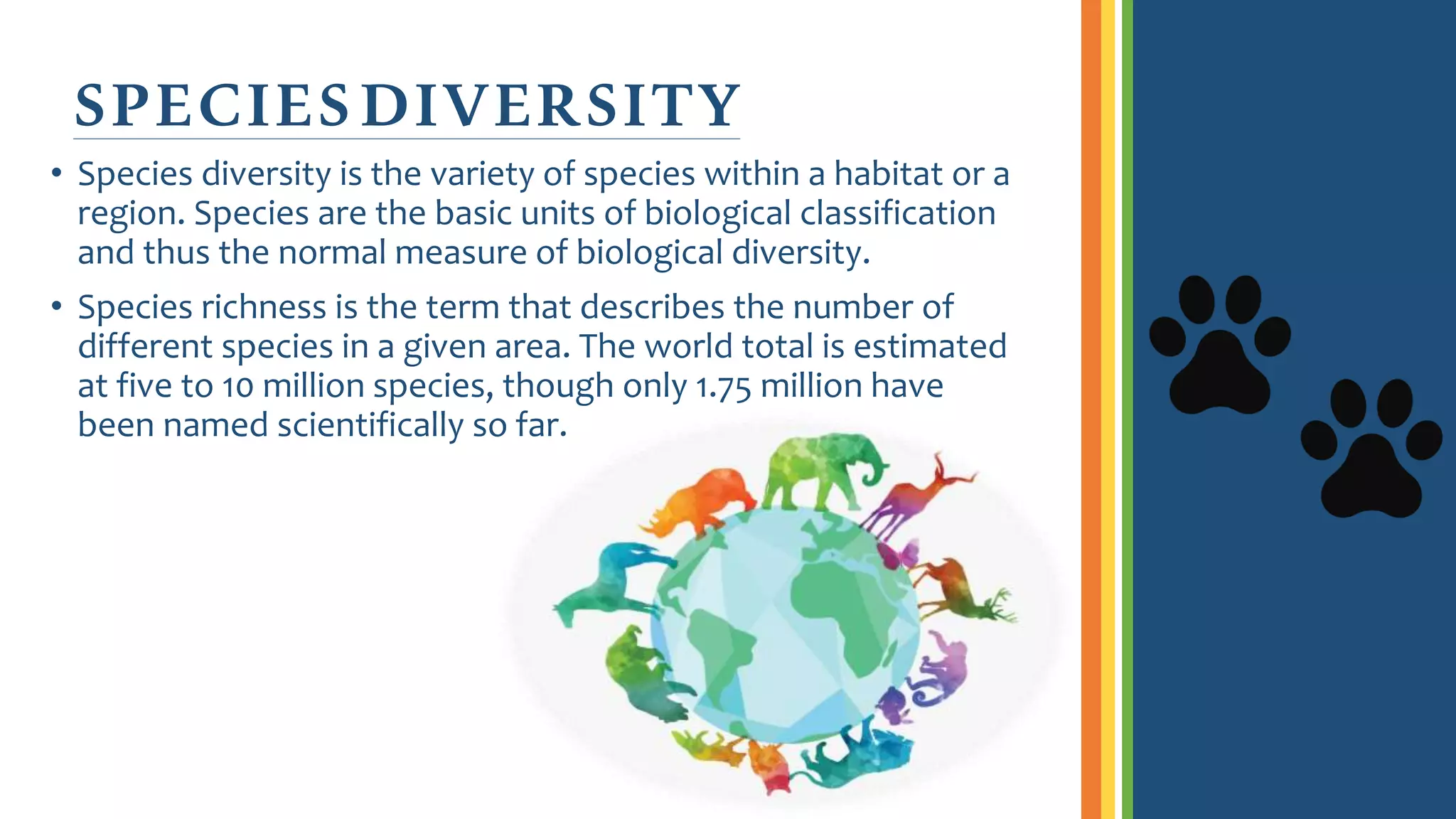
• Species richness is the term that describes the number of
different species in a given area. The world total is estimated
at five to 10 million species, though only 1.75 million have
been named scientifically so far.
ECOLOGICALDIVERSITY
• It is the intricate network of different species present in local
ecosystems and the dynamic interplay between them.
• An ecosystem consists of organisms from many different
species living together in a region and their connections
through the flow of energy, nutrients and matter.
• The ultimate source of energy in almost every ecosystem is
the sun. The sun’s radiant energy is converted to chemical
energy by plants. That energy flows through the systems
when animals eat the plants and then are eaten, in turn, by
other animals.
An ecosystem is a collection of living components (microbes, plants, animals and fungi)
and nonliving components (climate and chemicals) that are connected by energy flow.
Biodiversity is not evenly distributed, rather it varies greatly across the globe
as well as within regions. Among other factors, the diversity of all living
things (biota) depends on temperature, precipitation, altitude, soils,
geography, and the presence of other species.
1. Latitudinal gradients
There is an increase in biodiversity from the poles to the tropics. Thus localities at
lower latitudes have more species than localities at higher latitudes. This is often
referred to as the latitudinal gradient in species diversity. Several ecological
factors may contribute to the gradient, but the ultimate factor is the greater
mean temperature at the equator compared to that of the poles
2. Hotspots
A biodiversity hotspot is a region with a high level of endemic species that have
experienced great habitat loss. The term hotspot was introduced in 1988 by
Norman Myers.
While hotspots are spread all over the world, the majority are forest areas and
most are located in the tropics
DISTRIBUTION
The total number of terrestrial species is estimated to be around 8.7 million while
the number of oceanic species is much lower, estimated at 2.2 million.
Other estimates include:
• 220,000 vascular plants, estimated using the species-area relation method
• 0.7-1 million marine species
• 10–30 million insects; (of some 0.9 million we know today)
• 5–10 million bacteria
• 1.5-3 million fungi, estimates based on data from the tropics, long-term non-
tropical sites and molecular studies that have revealed cryptic speciation. Some
0.075 million species of fungi had been documented by 2001)
• 1 million mites
Since the rate of extinction has increased, many extant species may become
extinct before they are described. Not surprisingly, in the animalia the most
studied groups are birds and mammals, whereas fishes and arthropods are the
least studied animals groups.
NUMBER OF SPECIES
The 11 main direct threats to conservation are:
1. Residential & Commercial Development
• Housing & Urban Areas.
• Commercial & Industrial Areas
• Tourism & Recreational Areas
2. Farming Activities
• Agriculture
• Aquaculture
3. Energy Production & Mining
• Renewable Energy Production (Geothermal, Solar, Wind, & Tidal Farms)
• Non-renewable Energy Production (Oil And Gas Drilling)
• Mining
THREATS
4. Transportation & Service Corridors
• Service Corridors (Electrical & Phone Wires, Aqueducts, Oil & Gas Pipelines)
• Transport Corridors (Roads, Railroads, Shipping Lanes, And Flight Paths)
• Collisions With The Vehicles Using The Corridors
• Associated Accidents And Catastrophes (Oil Spills, Electrocution, Fire)
5. Biological Resource Usages
• Hunting
• Persecution
• Plant Destruction Or Removal
• Logging Or Wood Harvesting
• Fishing
6. Human Intrusions
• Recreational Activities
• War, Civil Unrest, & Military Exercises
• Illegal Activities
THREATS
7. Natural System Modifications
• Fire Suppression Or Creation
• Water Management
• Removing/Reducing Human Maintenance
8. Invasive & Problematic Species, Pathogens, & Genes
• Invasive Species (Feral Horses & Household Pets, Miconia Tree)
• Problematic Native Species
• Introduced Genetic Material Pathogens & Microbes
9. Pollution
• Household Sewage & Urban Wastewater
• Industrial & Military
• Agricultural & Forestry Effluents
• Garbage & Solid Waste
• Air-borne Pollutants
• Excess Energy (Sonar That Disturbs Whales, Heated Water From Power Plants,
Beach Lights Disorienting Turtles, Atmospheric Radiation From Ozone Holes)
THREATS
10. Catastrophic Geological Events
• Earthquakes, Tsunamis, Avalanches, Landslides, & Volcanic Eruptions And Gas
Emissions
11. Climate Changes
• Ecosystem Encroachment
• Changes In Geochemical Regimes
• Changes In Temperature Regimes
• Changes In Precipitation & Hydrological Regimes
• Severe Weather Events
THREATS
• Protected areas are meant for affording protection to wild animals and their
habitat which also includes forest reserves and biosphere reserves.
• Protected areas have been set up all over the world with the specific aim of
protecting and conserving plants and animals.
1. National Parks
National park and nature reserves are the areas selected by governments or
private organizations for special protection against damage or degradation with
the objective of biodiversity and landscape conservation. A limit is placed on the
number of visitors permitted to enter certain fragile areas. Designated trails or
roads are created.
The visitors are allowed to enter only for study, cultural and recreation purposes.
Forestry operations, grazing of animals and hunting of animals are regulated and
the exploitation of habitat or wildlife is banned.
PROTECTED AREAS
2. Wildlife Sanctuary
Wildlife sanctuaries aim only at the conservation of species and have the
following features:
The Boundaries Of The Sanctuaries Are Not Limited By State Legislation.
The Killing, Hunting Or Capturing Of Any Species Is Prohibited Except By Or
Under The Control Of The Highest Authority In The Department Which Is
Responsible For The Management Of The Sanctuary.
Private Ownership May Be Allowed.
Forestry And Other Usages Can Also Be Permitted.
3. Forest Reserves
The forests play a vital role in harboring more than 45,000 floral and 81,000
faunal species of which 5150 floral and 1837 faunal species are endemic. Plant and
animal species confined to a specific geographical area are called endemic
species. In reserved forests, rights to activities like hunting and grazing are
sometimes given to communities living on the fringes of the forest, who sustain
their livelihood partially or wholly from forest resources or products.
PROTECTED AREAS
4. Zoological Parks
In zoological parks or zoos, live animals are kept for public recreation, education
and conservation purposes. Modern zoos offer veterinary facilities, provide
opportunities for threatened species to breed in captivity and usually build
environments that simulate the native habitats of the animals in their care. Zoos
play a major role in creating awareness about the need to conserve nature.
5. Botanical gardens
In botanical gardens, plants are grown and displayed primarily for scientific and
educational purposes. They consist of a collection of living plants, grown
outdoors or under glass in greenhouses and conservatories. Also, a botanical
garden may include a collection of dried plants or herbarium and such facilities as
lecture rooms, laboratories, libraries, museums and experimental or research
plantings.
PROTECTED AREAS
T H A N K Y O U
G R O U P II M E M B E R S :
E l l e n H e r n a n d o
K a t e G a l a n g
M a r c N a v a r r o
B i a n c a M a n l a p a z
N h a t h a n E s p i n o s a
R a e v e n D u e n a s
C a r l a D e l a T o r r e

Biodiversity = Science, Technology and Society Group-2

  • 1.
    B I OD I V E R S I T Y B S N – 2 A : G R O U P II
  • 2.
    What Is BIodIversIty? •Biodiversity is the variability among living organisms from all sources, including terrestrial, marine, and other aquatic ecosystems and the ecological complexes of which they are part; this includes diversity within species, between species, and of ecosystems. • It's the sum of all the different species of animals, plants, fungi, and microbial organisms living on Earth and the variety of habitats in which they live. Decisions humans make that influence biodiversity affect the well-being of themselves and others.
  • 3.
    BENEFITSOFBIODIVERSITY Biodiversity plays animportant role in the way ecosystems function and in the services they provide. The following is a list of some of the benefits, or services, of biodiversity: • Provisioning services such as food, clean water, timber, fiber, and genetic resources • Regulating services such as climate, floods, disease, water quality and pollination • Cultural services such as recreational, aesthetic, and spiritual benefits • Supporting services such as soil formation, and nutrient cycling
  • 4.
    TYPESOFBIODIVERSITY Biodiversity includes threemain types: 1. Diversity Within Species (Genetic Diversity) 2. Between Species (Species Diversity) 3. Between Ecosystems (Ecosystem Diversity)
  • 5.
    GENETICDIVERSITY • Every specieson Earth is related to every other species through genetic connections. The more closely related any two species are, the more genetic information they will share, and the more similar they will appear. • An organism’s closest relatives are members of its own species with which it has the potential to mate and produce offspring. • Members of a species share genes, the bits of biochemical information that determine, in part, how the animals look, behave and live Genetic diversity is vital because the more genes are in a population, the more likely that one of those genes will prove helpful in the face of threats such as climate change or a new disease. Genetic diversity is related to the ability of a species to adapt to a changing environment.
  • 6.
    SPECIESDIVERSITY • Species diversityis the variety of species within a habitat or a region. Species are the basic units of biological classification and thus the normal measure of biological diversity. • Species richness is the term that describes the number of different species in a given area. The world total is estimated at five to 10 million species, though only 1.75 million have been named scientifically so far.
  • 7.
    ECOLOGICALDIVERSITY • It isthe intricate network of different species present in local ecosystems and the dynamic interplay between them. • An ecosystem consists of organisms from many different species living together in a region and their connections through the flow of energy, nutrients and matter. • The ultimate source of energy in almost every ecosystem is the sun. The sun’s radiant energy is converted to chemical energy by plants. That energy flows through the systems when animals eat the plants and then are eaten, in turn, by other animals. An ecosystem is a collection of living components (microbes, plants, animals and fungi) and nonliving components (climate and chemicals) that are connected by energy flow.
  • 8.
    Biodiversity is notevenly distributed, rather it varies greatly across the globe as well as within regions. Among other factors, the diversity of all living things (biota) depends on temperature, precipitation, altitude, soils, geography, and the presence of other species. 1. Latitudinal gradients There is an increase in biodiversity from the poles to the tropics. Thus localities at lower latitudes have more species than localities at higher latitudes. This is often referred to as the latitudinal gradient in species diversity. Several ecological factors may contribute to the gradient, but the ultimate factor is the greater mean temperature at the equator compared to that of the poles 2. Hotspots A biodiversity hotspot is a region with a high level of endemic species that have experienced great habitat loss. The term hotspot was introduced in 1988 by Norman Myers. While hotspots are spread all over the world, the majority are forest areas and most are located in the tropics DISTRIBUTION
  • 9.
    The total numberof terrestrial species is estimated to be around 8.7 million while the number of oceanic species is much lower, estimated at 2.2 million. Other estimates include: • 220,000 vascular plants, estimated using the species-area relation method • 0.7-1 million marine species • 10–30 million insects; (of some 0.9 million we know today) • 5–10 million bacteria • 1.5-3 million fungi, estimates based on data from the tropics, long-term non- tropical sites and molecular studies that have revealed cryptic speciation. Some 0.075 million species of fungi had been documented by 2001) • 1 million mites Since the rate of extinction has increased, many extant species may become extinct before they are described. Not surprisingly, in the animalia the most studied groups are birds and mammals, whereas fishes and arthropods are the least studied animals groups. NUMBER OF SPECIES
  • 10.
    The 11 maindirect threats to conservation are: 1. Residential & Commercial Development • Housing & Urban Areas. • Commercial & Industrial Areas • Tourism & Recreational Areas 2. Farming Activities • Agriculture • Aquaculture 3. Energy Production & Mining • Renewable Energy Production (Geothermal, Solar, Wind, & Tidal Farms) • Non-renewable Energy Production (Oil And Gas Drilling) • Mining THREATS
  • 11.
    4. Transportation &Service Corridors • Service Corridors (Electrical & Phone Wires, Aqueducts, Oil & Gas Pipelines) • Transport Corridors (Roads, Railroads, Shipping Lanes, And Flight Paths) • Collisions With The Vehicles Using The Corridors • Associated Accidents And Catastrophes (Oil Spills, Electrocution, Fire) 5. Biological Resource Usages • Hunting • Persecution • Plant Destruction Or Removal • Logging Or Wood Harvesting • Fishing 6. Human Intrusions • Recreational Activities • War, Civil Unrest, & Military Exercises • Illegal Activities THREATS
  • 12.
    7. Natural SystemModifications • Fire Suppression Or Creation • Water Management • Removing/Reducing Human Maintenance 8. Invasive & Problematic Species, Pathogens, & Genes • Invasive Species (Feral Horses & Household Pets, Miconia Tree) • Problematic Native Species • Introduced Genetic Material Pathogens & Microbes 9. Pollution • Household Sewage & Urban Wastewater • Industrial & Military • Agricultural & Forestry Effluents • Garbage & Solid Waste • Air-borne Pollutants • Excess Energy (Sonar That Disturbs Whales, Heated Water From Power Plants, Beach Lights Disorienting Turtles, Atmospheric Radiation From Ozone Holes) THREATS
  • 13.
    10. Catastrophic GeologicalEvents • Earthquakes, Tsunamis, Avalanches, Landslides, & Volcanic Eruptions And Gas Emissions 11. Climate Changes • Ecosystem Encroachment • Changes In Geochemical Regimes • Changes In Temperature Regimes • Changes In Precipitation & Hydrological Regimes • Severe Weather Events THREATS
  • 14.
    • Protected areasare meant for affording protection to wild animals and their habitat which also includes forest reserves and biosphere reserves. • Protected areas have been set up all over the world with the specific aim of protecting and conserving plants and animals. 1. National Parks National park and nature reserves are the areas selected by governments or private organizations for special protection against damage or degradation with the objective of biodiversity and landscape conservation. A limit is placed on the number of visitors permitted to enter certain fragile areas. Designated trails or roads are created. The visitors are allowed to enter only for study, cultural and recreation purposes. Forestry operations, grazing of animals and hunting of animals are regulated and the exploitation of habitat or wildlife is banned. PROTECTED AREAS
  • 15.
    2. Wildlife Sanctuary Wildlifesanctuaries aim only at the conservation of species and have the following features: The Boundaries Of The Sanctuaries Are Not Limited By State Legislation. The Killing, Hunting Or Capturing Of Any Species Is Prohibited Except By Or Under The Control Of The Highest Authority In The Department Which Is Responsible For The Management Of The Sanctuary. Private Ownership May Be Allowed. Forestry And Other Usages Can Also Be Permitted. 3. Forest Reserves The forests play a vital role in harboring more than 45,000 floral and 81,000 faunal species of which 5150 floral and 1837 faunal species are endemic. Plant and animal species confined to a specific geographical area are called endemic species. In reserved forests, rights to activities like hunting and grazing are sometimes given to communities living on the fringes of the forest, who sustain their livelihood partially or wholly from forest resources or products. PROTECTED AREAS
  • 16.
    4. Zoological Parks Inzoological parks or zoos, live animals are kept for public recreation, education and conservation purposes. Modern zoos offer veterinary facilities, provide opportunities for threatened species to breed in captivity and usually build environments that simulate the native habitats of the animals in their care. Zoos play a major role in creating awareness about the need to conserve nature. 5. Botanical gardens In botanical gardens, plants are grown and displayed primarily for scientific and educational purposes. They consist of a collection of living plants, grown outdoors or under glass in greenhouses and conservatories. Also, a botanical garden may include a collection of dried plants or herbarium and such facilities as lecture rooms, laboratories, libraries, museums and experimental or research plantings. PROTECTED AREAS
  • 19.
    T H AN K Y O U G R O U P II M E M B E R S : E l l e n H e r n a n d o K a t e G a l a n g M a r c N a v a r r o B i a n c a M a n l a p a z N h a t h a n E s p i n o s a R a e v e n D u e n a s C a r l a D e l a T o r r e