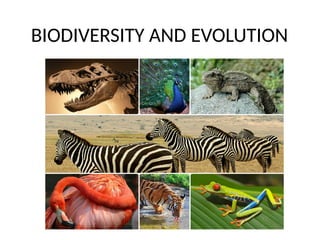
What is Biodiversity?
Itis the variety of earth’s species, the genes they
contain, the ecosystems in which they live, and the
ecosystems processes such as energy flow and
nutrient cycling that sustain all life.
Biodiversity is a vital renewable resource.
It is this biodiversity that sustains us and our
economies.
3.
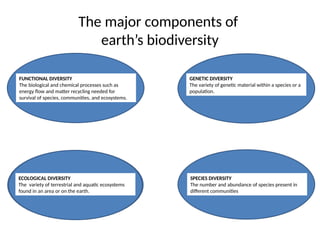
The major componentsof
earth’s biodiversity
FUNCTIONAL DIVERSITY
The biological and chemical processes such as
energy flow and matter recycling needed for
survival of species, communities, and ecosystems.
ECOLOGICAL DIVERSITY
The variety of terrestrial and aquatic ecosystems
found in an area or on the earth.
GENETIC DIVERSITY
The variety of genetic material within a species or a
population.
SPECIES DIVERSITY
The number and abundance of species present in
different communities
4.
Species; where dothey come from?
• Biological Evolution by Natural Selection
explains how life changes over time.
– Study of the Fossil Record
– Biological Evolution (genes changing in populations)
– Natural Selection (certain traits out survive others)
– Major scientific theory that explains how life has changed
over the last 3.5 billion years
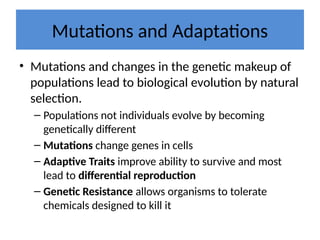
Mutations and Adaptations
•Mutations and changes in the genetic makeup of
populations lead to biological evolution by natural
selection.
– Populations not individuals evolve by becoming
genetically different
– Mutations change genes in cells
– Adaptive Traits improve ability to survive and most
lead to differential reproduction
– Genetic Resistance allows organisms to tolerate
chemicals designed to kill it
Humans as Evidenceof Successful Adaptation
• Three Major adaptations
– Strong opposable
thumbs
– Ability to walk upright
– Complex brain
These adaptations helped
us develop technologies,
tools, and devices, to help
our survival.
10.
Adaption through NaturalSelection has
limits.
Can adaptations to new environmental conditions through natural
selection allow our bodies to adapt to current pollution problems?
– NO, according to scientists in this field.
• First, environmental changes can lead to adaptations
only for genetic traits already present in a population’s
gene pool or for traits resulting from mutations.
• Second, even if a trait is present in populations, the
populations ability to adapt may be limited by it’s
reproductive capacity.
• Species that reproduce quickly adapt in a short time
• Species that reproduce slowly adapt in a long time
11.
Three Common Mythsabout Evolution
through Natural Selection
• 1. It is “Survival of the Fittest” not “Survival of the
strongest”. (reproductive success)
• 2. Organisms develop traits because they need or
want them. (genes are already present)
• 3. Evolution by natural selection involves some grand
plan of nature in which species become more
perfectly adapted. (appears to be random)
12.
Geological Processes andClimate Change
Affect Evolution
• Location of continents and oceans influence climate which determine
where animals and plants can live
• Movement of continents allows species to move, adapt, and form
new species through natural selection, or become extinct.
• Earthquakes and volcanoes can separate and Isolate populations, or
destroy and habitats wiping out populations.
• Climate change can occur rapidly killing off species and allowing other
species to fill their roles. This also changes areas of habitability.
• Asteroid impacts have also affected evolution through natural
selection
• Plate Tectonic Movement
• Earth in 100 million years
13.
How do newSpecies Evolve?
• Speciation – two species arise from one
– Species evolve to a point they cannot reproduce successfully
• Geographic Isolation – different groups of the same
population of a species become physically isolated from one
another for long periods
• Reproductive Isolation – mutation and change by natural
selection operate independently in the gene pools of
geographically isolated populations.
Humans are playing an increasing role in the process of
speciation by shuffling genes through artificial selection, and
genetic engineering.
Extinction
where an entirespecies ceases to exist
• Can affect one species or many
• Endemic Species are especially
susceptible to extinction
• Background Extinction is where
species disappear at a slow rate
• Mass Extinction is where large
numbers of species are wiped out
Extinction is a natural process, but
much evidence indicates humans are
major contributors to premature
extinction.
Golden Toads located in Costa Rica’s
Monteverde Cloud Forest Reserve have
become extinct due to changes in
climate. It’s habitat has dried up due to
changes in climate.
16.
Species Diversity
• Thenumber of different species contained in a community.
• It is made up of Species Richness and Species Evenness.
• Communities with high species richness tend to have low species
evenness. Communities with low species richness tend to have high
species eveness.
Examples:
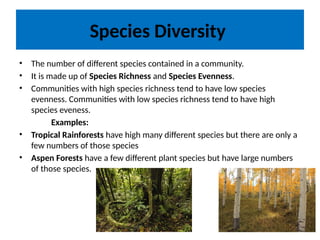
• Tropical Rainforests have high many different species but there are only a
few numbers of those species
• Aspen Forests have a few different plant species but have large numbers
of those species.
17.
Species Rich Ecosystemstend to be More
Productive and Sustainable
• Study by David Tillman and colleagues at the University of
Minnesota found that communities with high species richness
produced more, were more drought resistant, and were more
resistant to insect invasion. They also consumed more carbon
and nitrogen making them key players in those cycles.
18.
Roles Species Playin Ecosystems
• Ecological Niche
– Fundamental Niche – the possible niche that a
species can occupy
– Realized Niche – the actual niche or range in
which a species actually exists
– Where an organism lives and what it does in the
ecosystem.
– Niches can be occupied by a native or nonnative
species
Generalists and Specialist
•Generalists are organisms that have the ability
to survive in a wide range of habitats. This
may include the ability to utilize a wide variety
of food, shelter, etc.
• Specialists are species that survive in very
specific habitats. They have adapted to eat
very specific items and live in very specific
habitats
22.
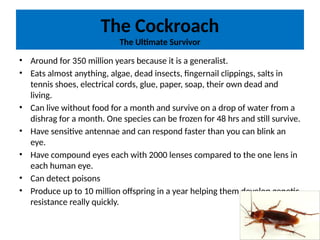
The Cockroach
The UltimateSurvivor
• Around for 350 million years because it is a generalist.
• Eats almost anything, algae, dead insects, fingernail clippings, salts in
tennis shoes, electrical cords, glue, paper, soap, their own dead and
living.
• Can live without food for a month and survive on a drop of water from a
dishrag for a month. One species can be frozen for 48 hrs and still survive.
• Have sensitive antennae and can respond faster than you can blink an
eye.
• Have compound eyes each with 2000 lenses compared to the one lens in
each human eye.
• Can detect poisons
• Produce up to 10 million offspring in a year helping them develop genetic
resistance really quickly.
23.
Indicator Species
• Serveas biological smoke alarms.
• Indicator species provide warnings of damage
to a community or ecosystem.
• Trout are only present in clean highly
oxygenated waters.
• Birds and Butterflies are highly susceptible to
pesticides and habitat fragmentation.
• Canary in the coal mine
24.
Importance of Amphibians
•Amphibians are sensitive environmental indicators
• They eat more insects than birds
• They are a vital food sources for other organisms
• They are genetic storehouses for pharmaceutical products. Painkillers, antibiotics,
burn treatments, and heart disease
• Amphibian populations have been declining across the globe. They are
susceptible to the following:
– Habitat fragmentation
– Prolonged drought
– Pollution
– Increases in UV radiation
– Parasites
– Viral and Fungal disease
– Climate change
– Over hunting
25.
Keystone and FoundationSpecies
Keystone Species – have a large effect on types
and abundances of other species in an
ecosystems. Example: Alligator
Foundation Species – play a major role in
shaping communities by creating and enhancing
their habitats. Example: Elephant
26.
Protecting Sharks
• Sharksremove injured and sick animals from the ocean
• Sharks almost never get cancer
• Sharks have highly effective immune systems which allow wounds
to heal without becoming infected
• Media portrays sharks as people eating monsters.
• A few species of sharks injure approximately 60-100 people
worldwide annually.
• Poverty kills 11 million, tobacco kills 5 million, and air pollution
kills 3 million people each year.
• Ecological studies have shown that declines in shark populations
have led to declines in bay scallop populations in the Atlantic
Ocean.
27.
Species Richness onIslands
• Refered to as Species Equilibrim Model or Theory of Island
Biogeography
• It is determined by 2 factors
– Rate at which new species immigrate to the island
– Rate at which species become extinct from the island
• Model projects that at some point these two factors balance and
determine the islands average # of species over time.
• Small islands tend to have fewer species and fewer resources.
Therefore, low immigration and high extinction rates which are
opposite for large islands.
• Islands closer to a mainland have higher species richness
• This also occurs when habitats are fragmented for development.