Biodegradable Polymers
Elaheh Entezar-Almahdi, Pharm-D
Ph.D Student of Pharmaceutics, Shiraz University of Medical Sciences
1
Biodegradable Polymers
 Biodegradable polymers are defined as polymers comprised of
monomers linked to one another through functional groups and
have unstable links in the backbone.
 They are broken down into biologically acceptable molecules that
are metabolized and removed from the body via normal metabolic
pathways.
2
Classification of biodegradable polymers
3
Degradation vs. Biodegradation
 Polymer degradation is a change in the properties – tensile strength, color,
shape, etc. of a polymer or polymer based product under the influence of one
or more environmental factors such as heat, light or chemicals.
 The term 'biodegradation' is limited to the description of chemical processes
(chemical changes that alter either the molecular weight or solubility of the
polymer)
 ‘Bioerosion' may be restricted to refer to physical processes that result in
weight loss of a polymer device.
 The bioerosion of polymers is basically of two types:
1) Bulk erosion
2) Surface erosion
4
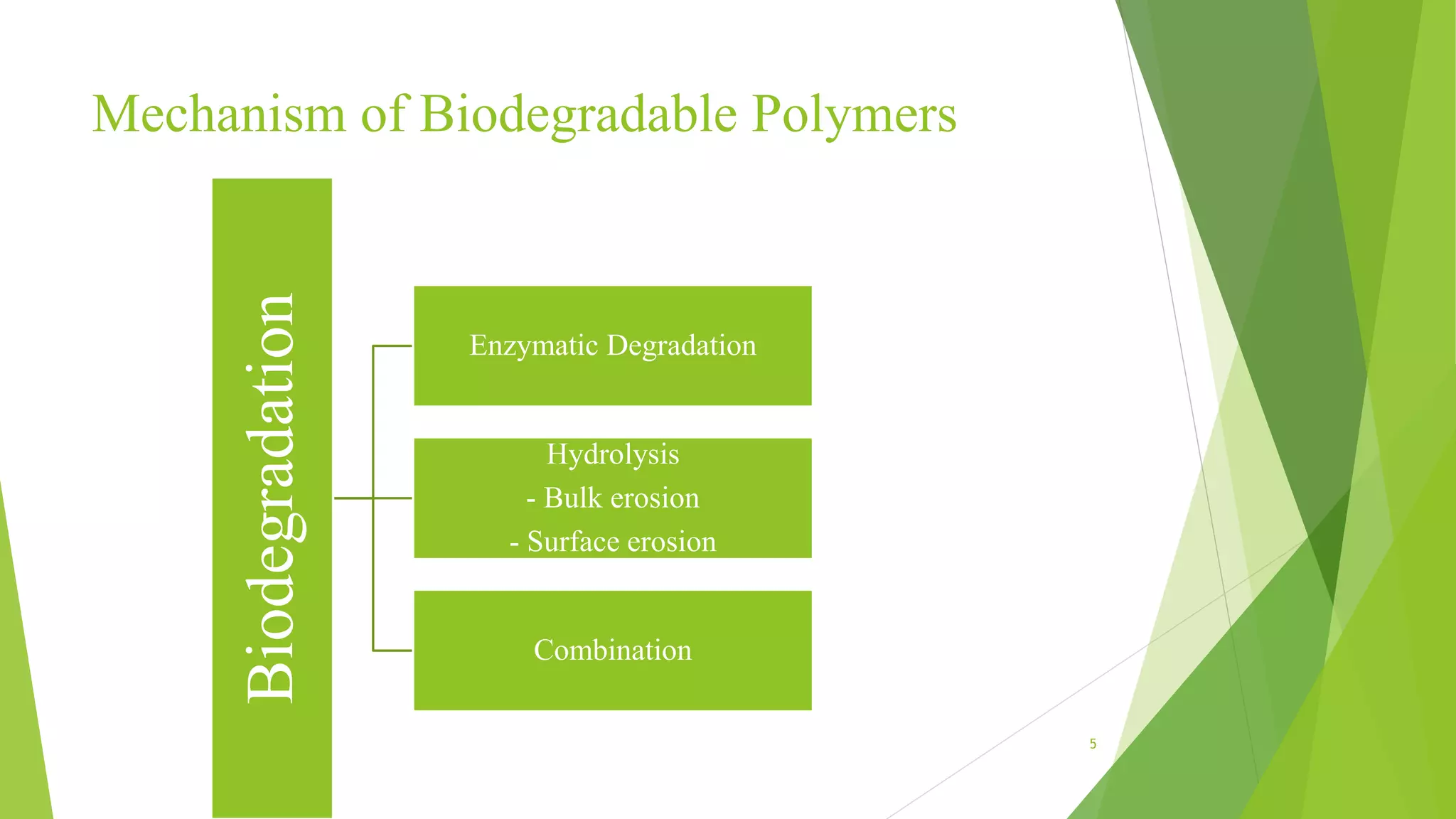
Mechanism of Biodegradable Polymers
Biodegradation
Enzymatic Degradation
Hydrolysis
- Bulk erosion
- Surface erosion
Combination
5
Enzymatic Degradation
 Mechanism I
Cleavage of Crosslinks
 Mechanism II
Transformation of Side
Chains
 Mechanism III
Cleavage of Backbone
6
Types of Hydrolysis
(Bioerosion)
 Bulk Erosion
Examples:
Polylactic Acid (PLA)
Polyglycolic Acid (PGA)
 Surface Erosion
Examples:
Polyanhydrides
Polyorthoesters
7
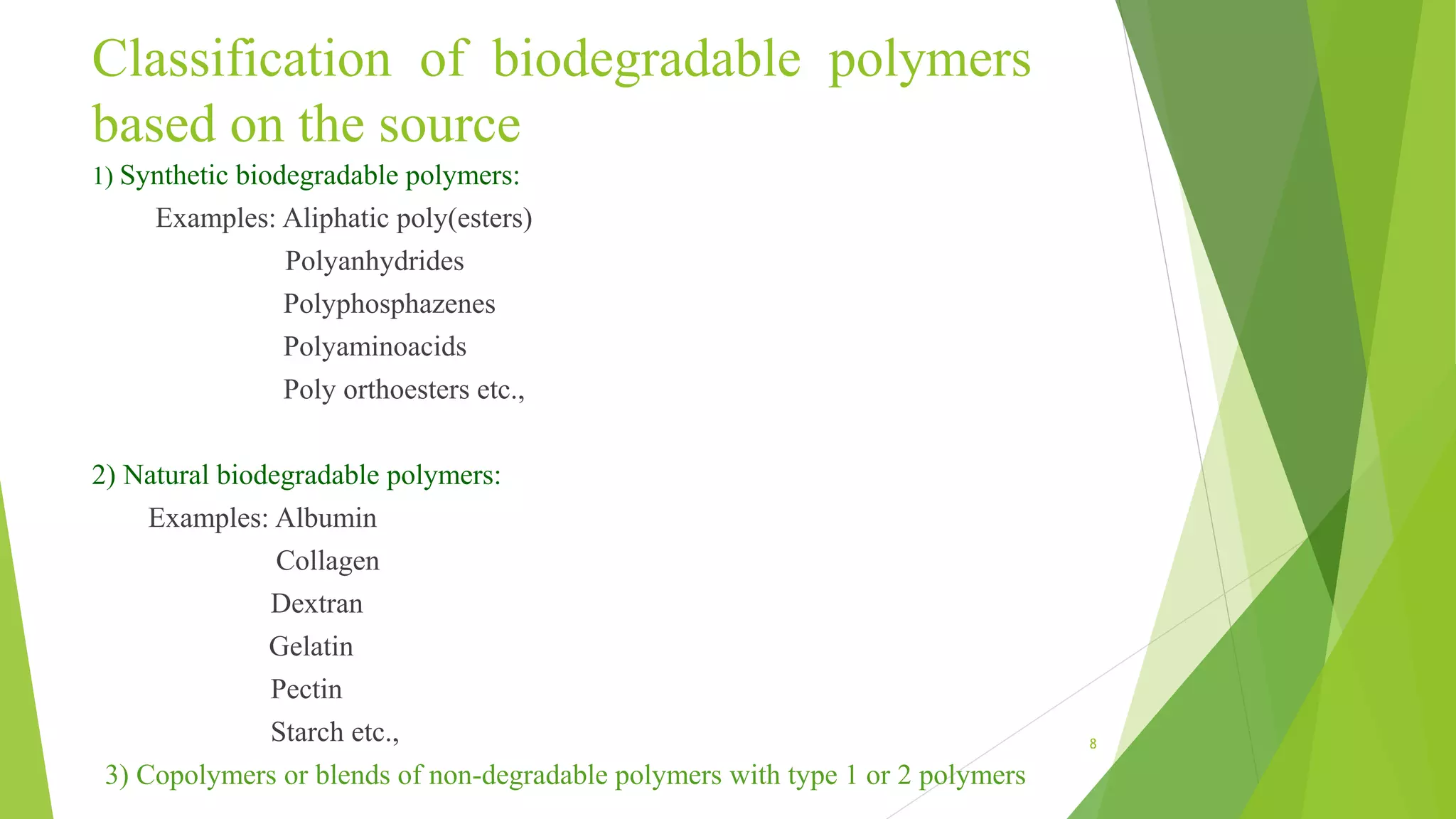
Classification of biodegradable polymers
based on the source
1) Synthetic biodegradable polymers:
Examples: Aliphatic poly(esters)
Polyanhydrides
Polyphosphazenes
Polyaminoacids
Poly orthoesters etc.,
2) Natural biodegradable polymers:
Examples: Albumin
Collagen
Dextran
Gelatin
Pectin
Starch etc.,
3) Copolymers or blends of non-degradable polymers with type 1 or 2 polymers
8
Synthetic Biodegradable Polymers
9
1) Aliphatic poly(esters)
 These are prepared by ring opening and polymerization of cyclic ester.
 Aliphatic polyesters include:
a) POLY (GLYCOLIC ACID)
b) POLY (LACTIC ACID)
c)POLY (CAPROLACTONE)
10
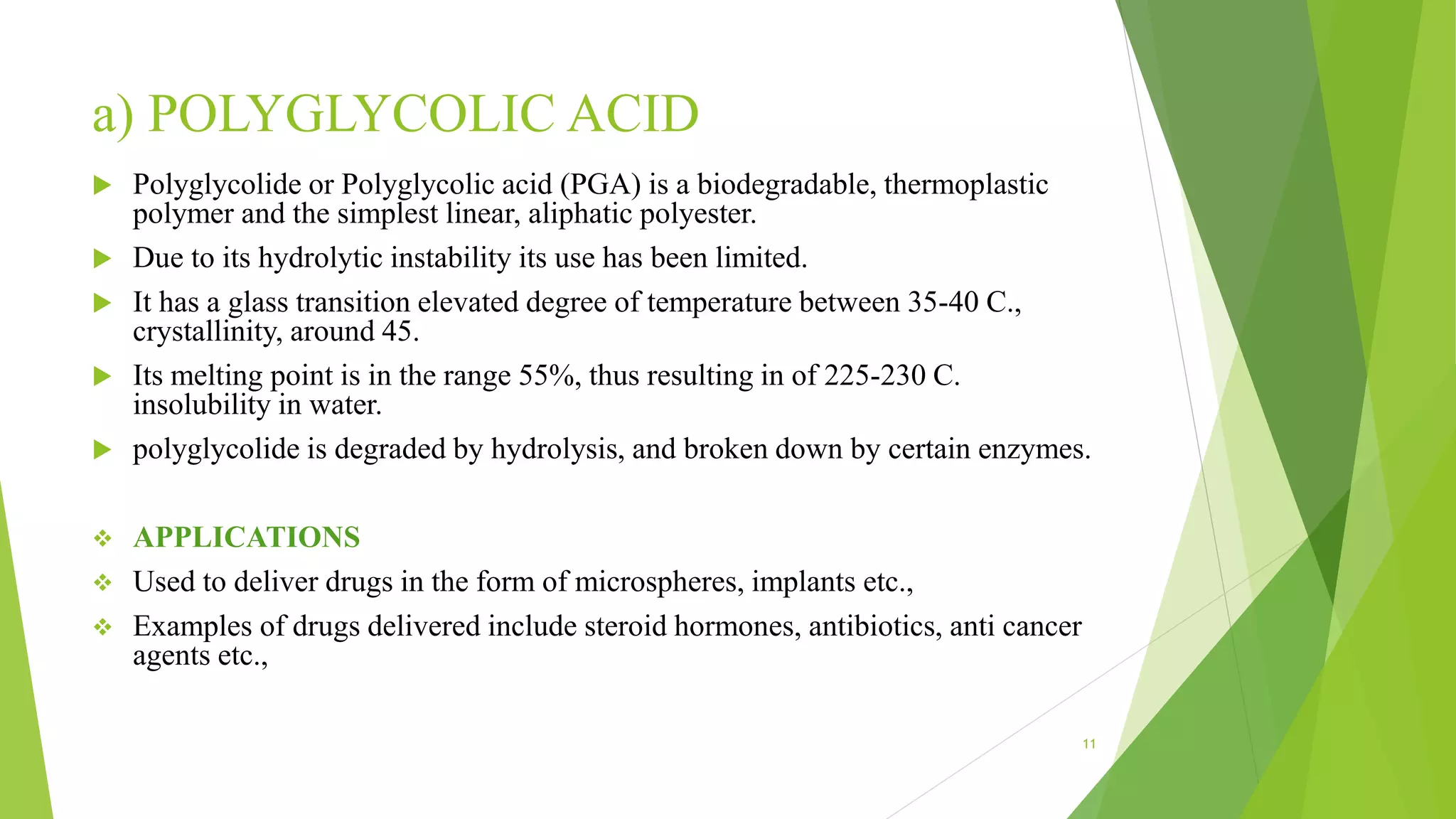
a) POLYGLYCOLIC ACID
 Polyglycolide or Polyglycolic acid (PGA) is a biodegradable, thermoplastic
polymer and the simplest linear, aliphatic polyester.
 Due to its hydrolytic instability its use has been limited.
 It has a glass transition elevated degree of temperature between 35-40 C.,
crystallinity, around 45.
 Its melting point is in the range 55%, thus resulting in of 225-230 C.
insolubility in water.
 polyglycolide is degraded by hydrolysis, and broken down by certain enzymes.
 APPLICATIONS
 Used to deliver drugs in the form of microspheres, implants etc.,
 Examples of drugs delivered include steroid hormones, antibiotics, anti cancer
agents etc.,
11
b) POLYLACTIC ACID
 Polylactic acid or polylactide (PLA) is a thermoplastic aliphatic polyester
derived from renewable resources, such as corn starch, tapioca products (roots,
chips or starch) or sugarcane.
 It can biodegrade under certain conditions, such as the presence of oxygen, and
is difficult to recycle.
 Highly crystalline, high melting point, low solubility.
 Bacterial fermentation is used to produce lactic acid from corn starch or cane
sugar.
 APPLICATIONS
 PLA is used in the preparation of sutures or orthopaedic devices.
12
Cont’D
13
Catalysed by acid or base
(NaOH) is commonly used
The resistance of PLA to attack from bacteria and fungi
is an advantage for food packaging applications
14
c) POLYCAPROLACTONE
 Polycaprolactone (PCL) is a biodegradable polyester.
 It has a low melting point of around 60 C.
 It has a glass transition temperature of about −60 C.
 slower degradation rate than PLA.
 It remains active as long as a year for drug delivery.
 APPLICATIONS
 Drug delivery applications of PCL includes:
 Cyclosporin in the form of nanoparticles
 Ciprofloxacin in the form of dental implants
15
2) Poly anhydrides
 Highly reactive and hydrolytically unstable.
 Degrade by surface degradation without the need for catalysts.
 Aliphatic (CH2 in backbone and side chains) polyanhydrides degrade within
days.
 Aromatic (benzene ring as the side chain) polyanhydrides degrade over several
years.
 Excellent biocompatibility.
 Drug loaded devices prepared by compression molding or microencapsulation.
 Suitable for short term drug delivery.
 Used for vaccination and localized tumor therapy.
16
3) Polyphosphazenes
 Its hydrolytic stability/instability is determined by change in side group
attached to macromolecular backbone.
 Used in the construction of soft tissue prosthesis, tissue like coatings, as
material for blood vessel prosthesis.
 Used for immobilization of antigen or enzyme.
 Use for drug delivery under investigation
 Based on side chain these are of 3 types:
 Hydrophobic phosphazenes
 Hydrophilic phosphazenes
 Amphiphilic phosphazenes
17
4) Polyaminoacids
 Aminoacid side-chains offer sites for drug attachment.
 Low-level systemic toxicity owing to their similarity to naturally occurring amino
acids.
 Investigated as suture materials.
 Artificial skin substitutes.
 Limited applicability as biomaterials due to limited solubility and processibility.
 Drug delivery (difficult to predict drug release rate due to swelling)
 Polymers containing more than three or more amino acids may trigger antigenic
response.
 Tyrosine derived polycarbonates developed as high-strength degradable
orthopaedic implants.
18
5) Poly (hydroxy alkanoates)- PHAs
 PHAs are produced by a wide range of microorganisms, including Pseudomonas,
Bacillus, Rhodobacter, cyanobacteria and marine algae, using a range of carbon
sources.
 PHAs degrade via a variety of mechanisms:
in bacteria: enzymatic hydrolysis
in animals or in the environment: enzymatic or
chemical hydrolysis
19
Accumulation of PHA in rhodobacter sphaeroides
R = C1–C13alkyl group (all Rstereochemistry)
n = 1 –4
m = 100 –30,000
Natural Biodegradable Polymers
20
 Natural polymers are an attractive class of biodegradable polymers as they are:
Derived from
natural sources
Relatively cheap
Easily available
21
1) Collagen
 Collagen is the most widely found protein in mammals and is the major
provider of strength to tissue.
 The number of biomedical applications in which collagen have been utilized is
too high; it not only has been explored for use in various types of surgery,
cosmetics, and drug delivery, but also in bioprosthetic implants and tissue
engineering of multiple organs as well.
 It is used as sutures ,Dressings, etc.
 Disadvantages
 Poor dimensional stability. Variability in drug release kinetics.
 Poor mechanical strength.
 APPLICATIONS
 Majorly used in ocular drug delivery system
22
2) Albumin
 It is a major plasma protein component.
 It accounts for more than 55% of total protein in human plasma.
 It is used to design particulate drug delivery systems.
 APPLICATIONS
 Albumin micro-spheres are used to deliver drugs like Insulin, Sulphadiazene,
5-fluorouracil, Prednisolone etc.
 It is mainly used in chemotherapy, to achieve high local drug concentration for
relatively longer time.
23
3) Dextran
 Dextran is a complex branched polysaccharide made of many glucose
molecules joined into chains of varying lengths.
 It consists of α-D-1,6-glucose-linked glucan with side-chains linked to the
backbone of Polymer. Its Mol.wt ranges from 1000 to 200,000 Daltons.
 APPLICATIONS
 Used for colonic delivery of drug in the form of gels.
 Replacement of Blood loss.
 Thrombosis Prophylaxis.
 Improvement of Rheology.
24
4) Chitosan
 It consists of β-1-4 linked 2 amino-2-deoxy gluco –pyranose moieties.
 Commercially manufactured by N-deacetylation of Chitin which is obtained
from Mollusc shells.
 It is soluble only in acidic pH i.e. when amino group is protonated.
 Thereby it readily adheres to bio membranes.
 It is degraded mainly by Glycosidases & lysozymes.
 ADVANTAGES
Free availability, Biocompatibility, Biodegradability, Bioadhesive, unique
properties.
25
5) Gelatin
 Gelatin is a mixture of peptides and proteins produced by partial hydrolysis of
collagen, extracted from the boiled bones, connective tissues, organs and some
intestines of animals. Gelatin is an irreversible hydrolyzed form of collagen,
Physicochemical properties depends on the source of collagen, extraction
method and thermal degradation.
 APPLICATIONS
 Employed as coating material.
 Gelatin micropellets are used for oral controlled delivery of drugs.
26
FACTORS AFFECTING
BIODEGRADATION OF POLYMERS
 Morphological factors
• Shape & size
• Variation of diffusion coefficient and mechanical stresses
 Chemical factors
• Chemical structure & composition
• Presence of ionic group and configuration structure
• Molecular weight and presence of low molecular weight compounds
 Physical factors
• Processing condition
• Sterilization process 27
ADVANTAGES OF BIODEGRADABLE
POLYMERS
 Localized delivery of drug
 Sustained delivery of drug
 Stabilization of drug
 Decrease in dosing frequency
 Reduce side effects
 Improved patient compliance
 Controllable degradation rate
28
APPLICATIONS OF BIODEGRADABLE
POLYMERS
 Polymer system for gene therapy.
 Biodegradable polymer for ocular, tissue engineering, vascular, orthopedic,
skin adhesive & surgical glues.
 Bio degradable drug system for therapeutic agents such as anti tumor,
antipsychotic agent, anti-inflammatory agent.
 Polymeric materials are used in and on soil to improve aeration, and promote
plant growth and health.
 Many biomaterials, especially heart valve replacements and blood vessels, are
made of polymers like Dacron, Teflon and polyurethane.
29
CONCLUSION
 Numerous synthetic biodegradable polymers are available and still being
developed for sustained and targeted drug delivery applications.
 Biodegradable polymers have proven their potential for the development of
new, advanced and efficient DDS and capable of delivering a wide range of
bioactive materials.
 However, only few have entered the market since many drugs faces the
problem of sensitivity to heat, shear forces and interaction between polymers.
 These problems can be overcome by fully understanding the degradation
mechanism to adjust the release profile.
30
References
 www.sigmaaldrich.com/materials-science/
 Martin’s Physical Pharmacy and Pharmaceutical Sciences, Sixth Edition
 Applied Biopharmaceutics and Pharmacokinetics, Fifth Edition, Shargel
 Environmental silicate nano- biocomposites. Chapter 2: Biodegradable Polymers, L.
Avérous and E. Pollet
31

Biodegradable polymers

  • 1.
    Biodegradable Polymers Elaheh Entezar-Almahdi,Pharm-D Ph.D Student of Pharmaceutics, Shiraz University of Medical Sciences 1
  • 2.
    Biodegradable Polymers  Biodegradablepolymers are defined as polymers comprised of monomers linked to one another through functional groups and have unstable links in the backbone.  They are broken down into biologically acceptable molecules that are metabolized and removed from the body via normal metabolic pathways. 2
  • 3.
  • 4.
    Degradation vs. Biodegradation Polymer degradation is a change in the properties – tensile strength, color, shape, etc. of a polymer or polymer based product under the influence of one or more environmental factors such as heat, light or chemicals.  The term 'biodegradation' is limited to the description of chemical processes (chemical changes that alter either the molecular weight or solubility of the polymer)  ‘Bioerosion' may be restricted to refer to physical processes that result in weight loss of a polymer device.  The bioerosion of polymers is basically of two types: 1) Bulk erosion 2) Surface erosion 4
  • 5.
    Mechanism of BiodegradablePolymers Biodegradation Enzymatic Degradation Hydrolysis - Bulk erosion - Surface erosion Combination 5
  • 6.
    Enzymatic Degradation  MechanismI Cleavage of Crosslinks  Mechanism II Transformation of Side Chains  Mechanism III Cleavage of Backbone 6
  • 7.
    Types of Hydrolysis (Bioerosion) Bulk Erosion Examples: Polylactic Acid (PLA) Polyglycolic Acid (PGA)  Surface Erosion Examples: Polyanhydrides Polyorthoesters 7
  • 8.
    Classification of biodegradablepolymers based on the source 1) Synthetic biodegradable polymers: Examples: Aliphatic poly(esters) Polyanhydrides Polyphosphazenes Polyaminoacids Poly orthoesters etc., 2) Natural biodegradable polymers: Examples: Albumin Collagen Dextran Gelatin Pectin Starch etc., 3) Copolymers or blends of non-degradable polymers with type 1 or 2 polymers 8
  • 9.
  • 10.
    1) Aliphatic poly(esters) These are prepared by ring opening and polymerization of cyclic ester.  Aliphatic polyesters include: a) POLY (GLYCOLIC ACID) b) POLY (LACTIC ACID) c)POLY (CAPROLACTONE) 10
  • 11.
    a) POLYGLYCOLIC ACID Polyglycolide or Polyglycolic acid (PGA) is a biodegradable, thermoplastic polymer and the simplest linear, aliphatic polyester.  Due to its hydrolytic instability its use has been limited.  It has a glass transition elevated degree of temperature between 35-40 C., crystallinity, around 45.  Its melting point is in the range 55%, thus resulting in of 225-230 C. insolubility in water.  polyglycolide is degraded by hydrolysis, and broken down by certain enzymes.  APPLICATIONS  Used to deliver drugs in the form of microspheres, implants etc.,  Examples of drugs delivered include steroid hormones, antibiotics, anti cancer agents etc., 11
  • 12.
    b) POLYLACTIC ACID Polylactic acid or polylactide (PLA) is a thermoplastic aliphatic polyester derived from renewable resources, such as corn starch, tapioca products (roots, chips or starch) or sugarcane.  It can biodegrade under certain conditions, such as the presence of oxygen, and is difficult to recycle.  Highly crystalline, high melting point, low solubility.  Bacterial fermentation is used to produce lactic acid from corn starch or cane sugar.  APPLICATIONS  PLA is used in the preparation of sutures or orthopaedic devices. 12
  • 13.
    Cont’D 13 Catalysed by acidor base (NaOH) is commonly used The resistance of PLA to attack from bacteria and fungi is an advantage for food packaging applications
  • 14.
  • 15.
    c) POLYCAPROLACTONE  Polycaprolactone(PCL) is a biodegradable polyester.  It has a low melting point of around 60 C.  It has a glass transition temperature of about −60 C.  slower degradation rate than PLA.  It remains active as long as a year for drug delivery.  APPLICATIONS  Drug delivery applications of PCL includes:  Cyclosporin in the form of nanoparticles  Ciprofloxacin in the form of dental implants 15
  • 16.
    2) Poly anhydrides Highly reactive and hydrolytically unstable.  Degrade by surface degradation without the need for catalysts.  Aliphatic (CH2 in backbone and side chains) polyanhydrides degrade within days.  Aromatic (benzene ring as the side chain) polyanhydrides degrade over several years.  Excellent biocompatibility.  Drug loaded devices prepared by compression molding or microencapsulation.  Suitable for short term drug delivery.  Used for vaccination and localized tumor therapy. 16
  • 17.
    3) Polyphosphazenes  Itshydrolytic stability/instability is determined by change in side group attached to macromolecular backbone.  Used in the construction of soft tissue prosthesis, tissue like coatings, as material for blood vessel prosthesis.  Used for immobilization of antigen or enzyme.  Use for drug delivery under investigation  Based on side chain these are of 3 types:  Hydrophobic phosphazenes  Hydrophilic phosphazenes  Amphiphilic phosphazenes 17
  • 18.
    4) Polyaminoacids  Aminoacidside-chains offer sites for drug attachment.  Low-level systemic toxicity owing to their similarity to naturally occurring amino acids.  Investigated as suture materials.  Artificial skin substitutes.  Limited applicability as biomaterials due to limited solubility and processibility.  Drug delivery (difficult to predict drug release rate due to swelling)  Polymers containing more than three or more amino acids may trigger antigenic response.  Tyrosine derived polycarbonates developed as high-strength degradable orthopaedic implants. 18
  • 19.
    5) Poly (hydroxyalkanoates)- PHAs  PHAs are produced by a wide range of microorganisms, including Pseudomonas, Bacillus, Rhodobacter, cyanobacteria and marine algae, using a range of carbon sources.  PHAs degrade via a variety of mechanisms: in bacteria: enzymatic hydrolysis in animals or in the environment: enzymatic or chemical hydrolysis 19 Accumulation of PHA in rhodobacter sphaeroides R = C1–C13alkyl group (all Rstereochemistry) n = 1 –4 m = 100 –30,000
  • 20.
  • 21.
     Natural polymersare an attractive class of biodegradable polymers as they are: Derived from natural sources Relatively cheap Easily available 21
  • 22.
    1) Collagen  Collagenis the most widely found protein in mammals and is the major provider of strength to tissue.  The number of biomedical applications in which collagen have been utilized is too high; it not only has been explored for use in various types of surgery, cosmetics, and drug delivery, but also in bioprosthetic implants and tissue engineering of multiple organs as well.  It is used as sutures ,Dressings, etc.  Disadvantages  Poor dimensional stability. Variability in drug release kinetics.  Poor mechanical strength.  APPLICATIONS  Majorly used in ocular drug delivery system 22
  • 23.
    2) Albumin  Itis a major plasma protein component.  It accounts for more than 55% of total protein in human plasma.  It is used to design particulate drug delivery systems.  APPLICATIONS  Albumin micro-spheres are used to deliver drugs like Insulin, Sulphadiazene, 5-fluorouracil, Prednisolone etc.  It is mainly used in chemotherapy, to achieve high local drug concentration for relatively longer time. 23
  • 24.
    3) Dextran  Dextranis a complex branched polysaccharide made of many glucose molecules joined into chains of varying lengths.  It consists of α-D-1,6-glucose-linked glucan with side-chains linked to the backbone of Polymer. Its Mol.wt ranges from 1000 to 200,000 Daltons.  APPLICATIONS  Used for colonic delivery of drug in the form of gels.  Replacement of Blood loss.  Thrombosis Prophylaxis.  Improvement of Rheology. 24
  • 25.
    4) Chitosan  Itconsists of β-1-4 linked 2 amino-2-deoxy gluco –pyranose moieties.  Commercially manufactured by N-deacetylation of Chitin which is obtained from Mollusc shells.  It is soluble only in acidic pH i.e. when amino group is protonated.  Thereby it readily adheres to bio membranes.  It is degraded mainly by Glycosidases & lysozymes.  ADVANTAGES Free availability, Biocompatibility, Biodegradability, Bioadhesive, unique properties. 25
  • 26.
    5) Gelatin  Gelatinis a mixture of peptides and proteins produced by partial hydrolysis of collagen, extracted from the boiled bones, connective tissues, organs and some intestines of animals. Gelatin is an irreversible hydrolyzed form of collagen, Physicochemical properties depends on the source of collagen, extraction method and thermal degradation.  APPLICATIONS  Employed as coating material.  Gelatin micropellets are used for oral controlled delivery of drugs. 26
  • 27.
    FACTORS AFFECTING BIODEGRADATION OFPOLYMERS  Morphological factors • Shape & size • Variation of diffusion coefficient and mechanical stresses  Chemical factors • Chemical structure & composition • Presence of ionic group and configuration structure • Molecular weight and presence of low molecular weight compounds  Physical factors • Processing condition • Sterilization process 27
  • 28.
    ADVANTAGES OF BIODEGRADABLE POLYMERS Localized delivery of drug  Sustained delivery of drug  Stabilization of drug  Decrease in dosing frequency  Reduce side effects  Improved patient compliance  Controllable degradation rate 28
  • 29.
    APPLICATIONS OF BIODEGRADABLE POLYMERS Polymer system for gene therapy.  Biodegradable polymer for ocular, tissue engineering, vascular, orthopedic, skin adhesive & surgical glues.  Bio degradable drug system for therapeutic agents such as anti tumor, antipsychotic agent, anti-inflammatory agent.  Polymeric materials are used in and on soil to improve aeration, and promote plant growth and health.  Many biomaterials, especially heart valve replacements and blood vessels, are made of polymers like Dacron, Teflon and polyurethane. 29
  • 30.
    CONCLUSION  Numerous syntheticbiodegradable polymers are available and still being developed for sustained and targeted drug delivery applications.  Biodegradable polymers have proven their potential for the development of new, advanced and efficient DDS and capable of delivering a wide range of bioactive materials.  However, only few have entered the market since many drugs faces the problem of sensitivity to heat, shear forces and interaction between polymers.  These problems can be overcome by fully understanding the degradation mechanism to adjust the release profile. 30
  • 31.
    References  www.sigmaaldrich.com/materials-science/  Martin’sPhysical Pharmacy and Pharmaceutical Sciences, Sixth Edition  Applied Biopharmaceutics and Pharmacokinetics, Fifth Edition, Shargel  Environmental silicate nano- biocomposites. Chapter 2: Biodegradable Polymers, L. Avérous and E. Pollet 31