CARRIERS FOR
DRUG DELIVERY :
POLYMERS /
CO-POLYMERS
PREPARED BY :
SACHIN
24/MIP/SPS/22
M.PHARM (INDUSTRIAL PHARMACY)
INTRODUCTION
OF POLYMERS
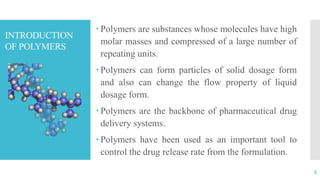
 Polymers are substances whose molecules have high
molar masses and compressed of a large number of
repeating units.
 Polymers can form particles of solid dosage form
and also can change the flow property of liquid
dosage form.
 Polymers are the backbone of pharmaceutical drug
delivery systems.
 Polymers have been used as an important tool to
control the drug release rate from the formulation.
2
3
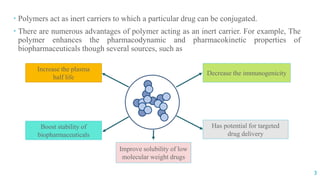
 Polymers act as inert carriers to which a particular drug can be conjugated.
 There are numerous advantages of polymer acting as an inert carrier. For example, The
polymer enhances the pharmacodynamic and pharmacokinetic properties of
biopharmaceuticals though several sources, such as
Increase the plasma
half life
Boost stability of
biopharmaceuticals
Decrease the immunogenicity
Has potential for targeted
drug delivery
Improve solubility of low
molecular weight drugs
ROLE OF
POLYMERS IN
DRUG DELIVERY
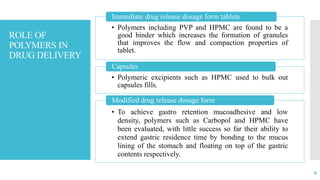
• Polymers including PVP and HPMC are found to be a
good binder which increases the formation of granules
that improves the flow and compaction properties of
tablet.
Immediate drug release dosage form tablets
• Polymeric excipients such as HPMC used to bulk out
capsules fills.
Capsules
• To achieve gastro retention mucoadhesive and low
density, polymers such as Carbopol and HPMC have
been evaluated, with little success so far their ability to
extend gastric residence time by bonding to the mucus
lining of the stomach and floating on top of the gastric
contents respectively.
Modified drug release dosage form
4
5
• Extended and sustained release dosage forms prolong the time that systemic
drug levels are within the therapeutic range and thus reduce the number of
doses the patient must take to maintain a therapeutic effect there by
increasing compliance.
• The most commonly used water insoluble polymers for extended release
applications are the ammonium ethacrylate copolymers cellulose
derivatives ethyl cellulose and cellulose acetate and polyvinyl derivatives.
Extended release dosage forms
• Gastro retentive dosage forms offer an alternative strategy for achieving
extended release profile in which the formulation will remain in the
stomach for prolonged periods, releasing the drug insitu, which will then
dissolve in the liquid contents and slowly pass into the small intestine.
Gastro retentive dosage forms
CLASSIFICATIONOF POLYMERS (kharagpurcollege.ac.in) 6
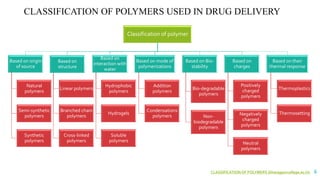
CLASSIFICATION OF POLYMERS USED IN DRUG DELIVERY
Classification of polymer
Based on origin
of source
Natural
polymers
Semi-synthetic
polymers
Synthetic
polymers
Based on
structure
Linear polymers
Branched chain
polymers
Cross-linked
polymers
Based on
interaction with
water
Hydrophobic
polymers
Hydrogels
Soluble
polymers
Based on mode of
polymerizations
Addition
polymers
Condensations
polymers
Based on Bio-
stability
Bio-degradable
polymers
Non-
biodegradable
polymers
Based on
charges
Positively
charged
polymers
Negatively
charged
polymers
Neutral
polymers
Based on their
thermal response
Thermoplastics
Thermosetting
CLASSIFICATION
OF POLYMERS
7
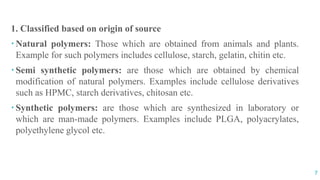
1. Classified based on origin of source
 Natural polymers: Those which are obtained from animals and plants.
Example for such polymers includes cellulose, starch, gelatin, chitin etc.
 Semi synthetic polymers: are those which are obtained by chemical
modification of natural polymers. Examples include cellulose derivatives
such as HPMC, starch derivatives, chitosan etc.
 Synthetic polymers: are those which are synthesized in laboratory or
which are man-made polymers. Examples include PLGA, polyacrylates,
polyethylene glycol etc.
8
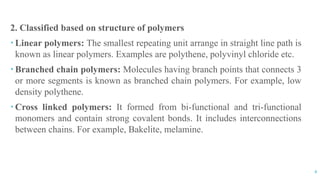
2. Classified based on structure of polymers
 Linear polymers: The smallest repeating unit arrange in straight line path is
known as linear polymers. Examples are polythene, polyvinyl chloride etc.
 Branched chain polymers: Molecules having branch points that connects 3
or more segments is known as branched chain polymers. For example, low
density polythene.
 Cross linked polymers: It formed from bi-functional and tri-functional
monomers and contain strong covalent bonds. It includes interconnections
between chains. For example, Bakelite, melamine.
9
3. Classified based on interaction with water
 Hydrophobic polymers: These are material that are insoluble in water or
other polar solvents. For example polystyrene, polyvinylchloride,
polyethylene etc.
 Hydrogels polymers: They swell but do not dissolve when brought in
contact with water. For example polyvinyl pyrrolidone.
 Soluble polymers: These are moderate molecular weight cross-linked
polymers that dissolve in water. For example HPMC, polyethylene glycol,
polyvinyl alcohol.
10
4. Classified based on reaction mode of polymerization:
 Addition polymers: The monomer molecules bond to each other without
the loss of any other atoms. One form of polymer is converted into another
form of polymer without loss of atoms from molecule. For example
polyvinyl chloride, polyethylene, polystyrene.
 Condensation polymers: Two different monomers combine with the loss of
small molecule, usually water. For example polyesters, polyamide.
11
5. Classified based on Bio-stability:
 Biodegradable polymers: These polymer are degraded by body system as a
result of natural biological processes. For example Polyesters,
polyanhydrides, polyamides.
 Non-biodegradable polymers: These polymer are not degraded by body
system itself. For example Ethyl cellulose, HPMC, acrylic polymers,
silicones.
DOI: 10.4172/2329-9053.1000107 12
6. Classified based on charges :
 Positively charged polymers: The surface of these polymers contain
positive charge. For example, Chitosan.
 Negatively charged polymers: The surface of these polymers contain
negative charge. Examples includes sodium alginate, Carbopol,
polyacrylates, sodium carboxy methyl cellulose etc.
 Neutral polymers: These are also known as non ionic polymers. Examples
are Hydroxyethyl cellulose, HPMC, PVP, PVA, eudragit analogues etc.
13
7. Classified based on their thermal response :
 Thermoplastics: These are those polymers that can be heat-softened or
plasticized in order to process into a desired form. Examples include
polystyrene, polyesters and polyvinyl chloride, etc.
 Thermosetting: polymers are those whose individual chains have been
chemically linked by covalent bonds during polymerization or by
subsequent chemical or thermal treatment during fabrication. Once formed,
these crosslinked networks resist heat softening, mechanical deformation,
and solvent attack, but cannot be thermally processed. Examples include
epoxy, resins, and unsaturated polyesters.
Khar R.K., Vyas S.P., Ahmad F.J., Jain G.K., “The Theory and Practice of Industrial Pharmacy”, Fourth edition, Published by CBS publishers 14
2. SYNTHETIC POLYMERS (with their major functions)
• Polyacrylic acid (Carbopol) Matrix, bio adhesive
• Poly (MMA/MAA) Enteric
• Poly (MMA/DEAMA) Matrix, membrane
• Poly (MMA/EA) Membrane
• Poly(vinyl acetate phthalate) Enteric
• Poly(vinyl alcohol) Matrix
• Poly(vinylpyrrolidone) Binder
• Poly(lactic acid) Biodegradable
• Poly(glycolic acid) Biodegradable
• Poly(lactic/glycolic acid) Biodegradable
• Poly(orthoester) Biodegradable
• Poly(glutamic acid) Biodegradable
• Polyethylene glycol Binder
• Polyethylene oxide Matrix, binder
• Poly(dimethyl silicone) Matrix, membrane
• Poly(hydroxyethyl methacrylate) Matrix, membrane
• Poly(ethylene/vinyl acetate) Matrix, membrane
• Poly(ethylene/vinyl alcohol) Matrix, membrane
• Polybutadiene Adhesive/matrix
• Poly(anhydride) Bio erodible
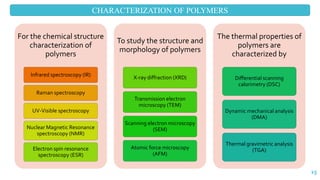
CHARACTERIZATION OF POLYMERS
15
For the chemical structure
characterization of
polymers
Infrared spectroscopy (IR)
Raman spectroscopy
UV-Visible spectroscopy
Nuclear Magnetic Resonance
spectroscopy (NMR)
Electron spin resonance
spectroscopy (ESR)
To study the structure and
morphology of polymers
X-ray diffraction (XRD)
Transmission electron
microscopy (TEM)
Scanning electron microscopy
(SEM)
Atomic force microscopy
(AFM)
The thermal properties of
polymers are
characterized by
Differential scanning
calorimetry (DSC)
Dynamic mechanical analysis
(DMA)
Thermal gravimetric analysis
(TGA)
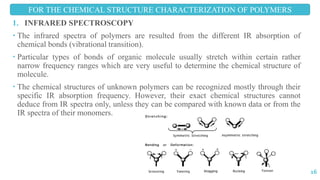
1. INFRARED SPECTROSCOPY
 The infrared spectra of polymers are resulted from the different IR absorption of
chemical bonds (vibrational transition).
 Particular types of bonds of organic molecule usually stretch within certain rather
narrow frequency ranges which are very useful to determine the chemical structure of
molecule.
 The chemical structures of unknown polymers can be recognized mostly through their
specific IR absorption frequency. However, their exact chemical structures cannot
deduce from IR spectra only, unless they can be compared with known data or from the
IR spectra of their monomers.
FOR THE CHEMICAL STRUCTURE CHARACTERIZATION OF POLYMERS
16
17
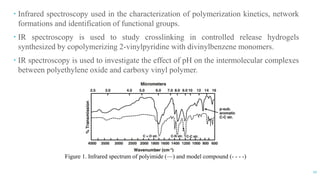
 Infrared spectroscopy used in the characterization of polymerization kinetics, network
formations and identification of functional groups.
 IR spectroscopy is used to study crosslinking in controlled release hydrogels
synthesized by copolymerizing 2-vinylpyridine with divinylbenzene monomers.
 IR spectroscopy is used to investigate the effect of pH on the intermolecular complexes
between polyethylene oxide and carboxy vinyl polymer.
Figure 1. Infrared spectrum of polyimide (—) and model compound (- - - -)
2. RAMAN SPECTROSCOPY
 Like IR spectroscopy, It derives from vibrational transitions in molecules.
 Raman spectroscopy involves the inelastic scattering of photons rather than their direct
absorption or emission.
 When visible light impinges on molecules, the light is scattered. The frequency of the
scattered light varies according to the vibrational modes of the scattering molecules. This
referred to as the Raman effect.
 Whereas IR absorption spectra are indicative of unsymmetric bond stretching and
bending, the Raman effect responds to the symmetric vibrational modes.
 Polar groups of a molecule give the most intense IR signals whereas nonpolar ones give
rise to most intense Raman signals. Thus IR and Raman spectroscopy are complementary.
18
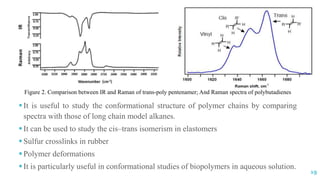
Figure 2. Comparison between IR and Raman of trans-poly pentenamer; And Raman spectra of polybutadienes
It is useful to study the conformational structure of polymer chains by comparing
spectra with those of long chain model alkanes.
It can be used to study the cis–trans isomerism in elastomers
Sulfur crosslinks in rubber
Polymer deformations
It is particularly useful in conformational studies of biopolymers in aqueous solution.
19
3. UV-VISIBLE SPECTROSCOPY
 UV–Visible spectroscopy is used to detect the chromophores of matter qualitatively and
quantitatively when the matter undergoes n to π and π to π transition upon light irradiation.
 Because of its sensitivity, UV–Vis spectroscopy has been particularly useful in identifying
the impurities in polymers such as residual monomer, inhibitors, antioxidant, and so on.
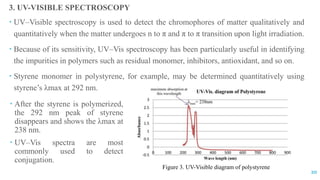
 Styrene monomer in polystyrene, for example, may be determined quantitatively using
styrene’s λmax at 292 nm.
20
 After the styrene is polymerized,
the 292 nm peak of styrene
disappears and shows the λmax at
238 nm.
 UV–Vis spectra are most
commonly used to detect
conjugation.
Figure 3. UV-Visible diagram of polystyrene
4. NMR SPECTROSCOPY
 The proton environment in the molecule can be
determined by the nuclear magnetic resonance
spectroscopy. Each proton in the molecule has its
unique chemical shift d. It is usually expressed in parts
per million (ppm) by frequency.
 Chemical structures can be identified from a
combination of chemical shift data and spin–spin
splitting; derived from proton–proton interaction.
Thus, the NMR is useful to study polymer
stereochemistry and monomer sequencing.
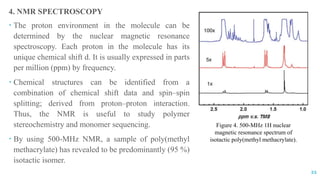
 By using 500-MHz NMR, a sample of poly(methyl
methacrylate) has revealed to be predominantly (95 %)
isotactic isomer.
21
Figure 4. 500-MHz 1H nuclear
magnetic resonance spectrum of
isotactic poly(methyl methacrylate).
5. ELECTRON SPIN RESONANCE
 ESR works on the same principle as NMR except that microwave rather than radio wave
frequencies are employed, and spin transitions of unpaired electrons rather than nuclei
recorded.
 The NMR spectra record the absorption directly, but ESR spectrometers plot the first
derivative of the absorption curve.
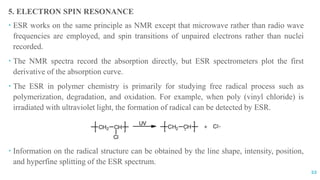
 The ESR in polymer chemistry is primarily for studying free radical process such as
polymerization, degradation, and oxidation. For example, when poly (vinyl chloride) is
irradiated with ultraviolet light, the formation of radical can be detected by ESR.
 Information on the radical structure can be obtained by the line shape, intensity, position,
and hyperfine splitting of the ESR spectrum.
22
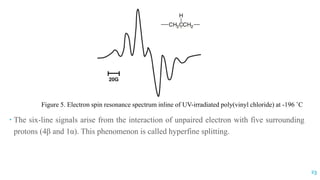
 The six-line signals arise from the interaction of unpaired electron with five surrounding
protons (4β and 1α). This phenomenon is called hyperfine splitting.
Figure 5. Electron spin resonance spectrum inline of UV-irradiated poly(vinyl chloride) at -196 ˚C
23
1. TRANSMISSION ELECTRON MICROSCOPY
• TEM is a very powerful tool to study the morphology of polymer.
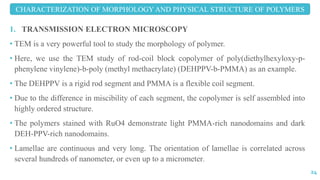
• Here, we use the TEM study of rod-coil block copolymer of poly(diethylhexyloxy-p-
phenylene vinylene)-b-poly (methyl methacrylate) (DEHPPV-b-PMMA) as an example.
• The DEHPPV is a rigid rod segment and PMMA is a flexible coil segment.
• Due to the difference in miscibility of each segment, the copolymer is self assembled into
highly ordered structure.
• The polymers stained with RuO4 demonstrate light PMMA-rich nanodomains and dark
DEH-PPV-rich nanodomains.
• Lamellae are continuous and very long. The orientation of lamellae is correlated across
several hundreds of nanometer, or even up to a micrometer.
CHARACTERIZATION OF MORPHOLOGY AND PHYSICAL STRUCTURE OF POLYMERS
24
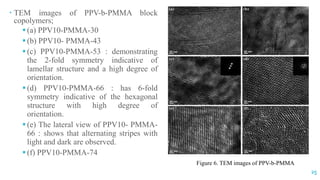
 TEM images of PPV-b-PMMA block
copolymers;
(a) PPV10-PMMA-30
(b) PPV10- PMMA-43
(c) PPV10-PMMA-53 : demonstrating
the 2-fold symmetry indicative of
lamellar structure and a high degree of
orientation.
(d) PPV10-PMMA-66 : has 6-fold
symmetry indicative of the hexagonal
structure with high degree of
orientation.
(e) The lateral view of PPV10- PMMA-
66 : shows that alternating stripes with
light and dark are observed.
(f) PPV10-PMMA-74
Figure 6. TEM images of PPV-b-PMMA
25
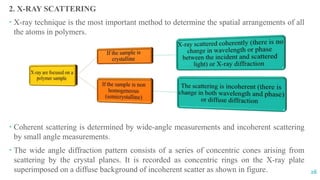
2. X-RAY SCATTERING
 X-ray technique is the most important method to determine the spatial arrangements of all
the atoms in polymers.
 Coherent scattering is determined by wide-angle measurements and incoherent scattering
by small angle measurements.
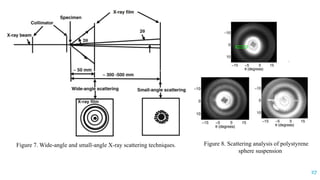
 The wide angle diffraction pattern consists of a series of concentric cones arising from
scattering by the crystal planes. It is recorded as concentric rings on the X-ray plate
superimposed on a diffuse background of incoherent scatter as shown in figure. 26
Figure 7. Wide-angle and small-angle X-ray scattering techniques. Figure 8. Scattering analysis of polystyrene
sphere suspension
27
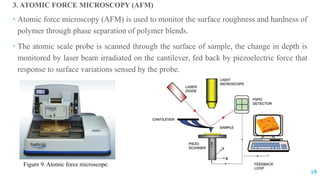
3. ATOMIC FORCE MICROSCOPY (AFM)
 Atomic force microscopy (AFM) is used to monitor the surface roughness and hardness of
polymer through phase separation of polymer blends.
 The atomic scale probe is scanned through the surface of sample, the change in depth is
monitored by laser beam irradiated on the cantilever, fed back by piezoelectric force that
response to surface variations sensed by the probe.
Figure 9. Atomic force microscope.
28
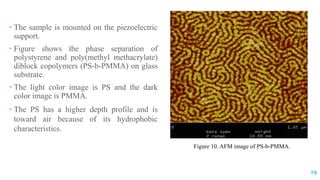
 The sample is mounted on the piezoelectric
support.
 Figure shows the phase separation of
polystyrene and poly(methyl methacrylate)
diblock copolymers (PS-b-PMMA) on glass
substrate.
 The light color image is PS and the dark
color image is PMMA.
 The PS has a higher depth profile and is
toward air because of its hydrophobic
characteristics.
Figure 10. AFM image of PS-b-PMMA.
29
CHARACTERIZATION OF THERMAL PROPERTIES OF POLYMERS
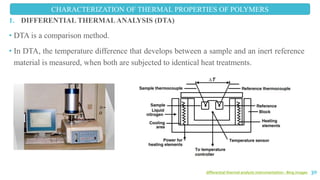
1. DIFFERENTIAL THERMALANALYSIS (DTA)
• DTA is a comparison method.
• In DTA, the temperature difference that develops between a sample and an inert reference
material is measured, when both are subjected to identical heat treatments.
differential thermal analysis instrumentation - Bing images 30
31
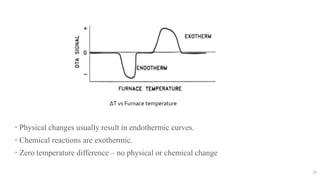
 Physical changes usually result in endothermic curves.
 Chemical reactions are exothermic.
 Zero temperature difference – no physical or chemical change
∆T vs Furnace temperature
32
APPLICATIONS OF DTA
 Determination of melting point.
 Identification of products since no two products have identical curves.
 Detection of impurities in sample compound.
 Quality control.
images differential scanning calorimetry - Bing images 33
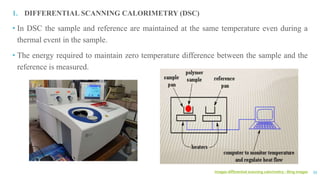
1. DIFFERENTIAL SCANNING CALORIMETRY (DSC)
• In DSC the sample and reference are maintained at the same temperature even during a
thermal event in the sample.
• The energy required to maintain zero temperature difference between the sample and the
reference is measured.
34
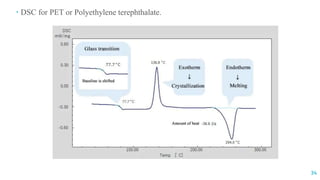
 DSC for PET or Polyethylene terephthalate.
35
APPLICATIONS OF DSC
 Composition of polymers can be determined.
 Melting point and glass transition temperature can be determined.
 Characterization of membranes, lipids and nucleic acids.
 To determine thermal degradation and impurities.
 DSC also used to study polymorphic transitions.
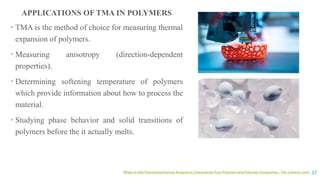
2. THERMOMECHANICAL ANALYSIS (TMA)
 TMA employs a sensitive probe in contact with the surface of a polymer sample under a
defined load.
 As the sample is heated, the probe senses thermal transition such as Tg or Tm by detecting
either a change in volume or a change in modulus.
 TMA is generally more sensitive than DSC or DTA for detecting thermal transitions,
especially for thermoset because the TMA probe is in direct contact with the sample.
Figure 11. TMA of phenolic resin (PF5110) cured epoxy resin. 36
When to Use Thermomechanical Analysis to Characterize Your Polymers and Polymer Composites – TAL (ctherm.com) 37
APPLICATIONS OF TMA IN POLYMERS
 TMA is the method of choice for measuring thermal
expansion of polymers.
 Measuring anisotropy (direction-dependent
properties).
 Determining softening temperature of polymers
which provide information about how to process the
material.
 Studying phase behavior and solid transitions of
polymers before the it actually melts.
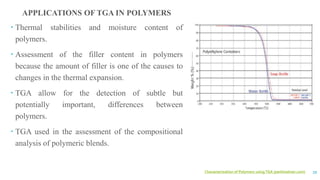
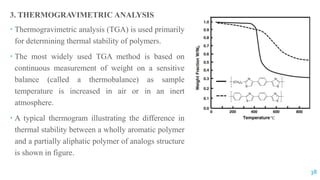
3. THERMOGRAVIMETRIC ANALYSIS
 Thermogravimetric analysis (TGA) is used primarily
for determining thermal stability of polymers.
 The most widely used TGA method is based on
continuous measurement of weight on a sensitive
balance (called a thermobalance) as sample
temperature is increased in air or in an inert
atmosphere.
 A typical thermogram illustrating the difference in
thermal stability between a wholly aromatic polymer
and a partially aliphatic polymer of analogs structure
is shown in figure.
38
Characterization of Polymers usingTGA (perkinelmer.com) 39
APPLICATIONS OF TGA IN POLYMERS
 Thermal stabilities and moisture content of
polymers.
 Assessment of the filler content in polymers
because the amount of filler is one of the causes to
changes in the thermal expansion.
 TGA allow for the detection of subtle but
potentially important, differences between
polymers.
 TGA used in the assessment of the compositional
analysis of polymeric blends.
REFERENCES
 Bikales N.M., “Characterization of Polymers”, Published by Wiley-Inter
science, New York, 1971.
 Khar R.K., Vyas S.P., Ahmad F.J., Jain G.K., “The Theory and Practice of
Industrial Pharmacy”, Fourth edition, Published by CBS publishers.
 Robinson J.R., Lee V.H., “Controlled Drug Delivery Systems, Second
edition, Vol 29, Published by CRC Press, Marcel Dekker, NY.
 Wise D.L., “Handbook of pharmaceutical Controlled Release
Technology”, Third edition, Published by CRC Press, Marcel Dekker,
NY.
 Chien Y.W., “Novel Drug Delivery System”, Second edition, Vol 50,
Published by CRC Press New York.
 Kuptsov A.H., Zhizhin G.N., “Handbook of Fourier Transform Raman
and Infrared Spectra of Polymers” First edition, Published by Elsevier
Science.
 Classification of Polymers & their Characteristics. -YouTube
40
THANK YOU

CARRIERS FOR DRUG DELIVERY.pptx

  • 1.
    CARRIERS FOR DRUG DELIVERY: POLYMERS / CO-POLYMERS PREPARED BY : SACHIN 24/MIP/SPS/22 M.PHARM (INDUSTRIAL PHARMACY)
  • 2.
    INTRODUCTION OF POLYMERS  Polymersare substances whose molecules have high molar masses and compressed of a large number of repeating units.  Polymers can form particles of solid dosage form and also can change the flow property of liquid dosage form.  Polymers are the backbone of pharmaceutical drug delivery systems.  Polymers have been used as an important tool to control the drug release rate from the formulation. 2
  • 3.
    3  Polymers actas inert carriers to which a particular drug can be conjugated.  There are numerous advantages of polymer acting as an inert carrier. For example, The polymer enhances the pharmacodynamic and pharmacokinetic properties of biopharmaceuticals though several sources, such as Increase the plasma half life Boost stability of biopharmaceuticals Decrease the immunogenicity Has potential for targeted drug delivery Improve solubility of low molecular weight drugs
  • 4.
    ROLE OF POLYMERS IN DRUGDELIVERY • Polymers including PVP and HPMC are found to be a good binder which increases the formation of granules that improves the flow and compaction properties of tablet. Immediate drug release dosage form tablets • Polymeric excipients such as HPMC used to bulk out capsules fills. Capsules • To achieve gastro retention mucoadhesive and low density, polymers such as Carbopol and HPMC have been evaluated, with little success so far their ability to extend gastric residence time by bonding to the mucus lining of the stomach and floating on top of the gastric contents respectively. Modified drug release dosage form 4
  • 5.
    5 • Extended andsustained release dosage forms prolong the time that systemic drug levels are within the therapeutic range and thus reduce the number of doses the patient must take to maintain a therapeutic effect there by increasing compliance. • The most commonly used water insoluble polymers for extended release applications are the ammonium ethacrylate copolymers cellulose derivatives ethyl cellulose and cellulose acetate and polyvinyl derivatives. Extended release dosage forms • Gastro retentive dosage forms offer an alternative strategy for achieving extended release profile in which the formulation will remain in the stomach for prolonged periods, releasing the drug insitu, which will then dissolve in the liquid contents and slowly pass into the small intestine. Gastro retentive dosage forms
  • 6.
    CLASSIFICATIONOF POLYMERS (kharagpurcollege.ac.in)6 CLASSIFICATION OF POLYMERS USED IN DRUG DELIVERY Classification of polymer Based on origin of source Natural polymers Semi-synthetic polymers Synthetic polymers Based on structure Linear polymers Branched chain polymers Cross-linked polymers Based on interaction with water Hydrophobic polymers Hydrogels Soluble polymers Based on mode of polymerizations Addition polymers Condensations polymers Based on Bio- stability Bio-degradable polymers Non- biodegradable polymers Based on charges Positively charged polymers Negatively charged polymers Neutral polymers Based on their thermal response Thermoplastics Thermosetting
  • 7.
    CLASSIFICATION OF POLYMERS 7 1. Classifiedbased on origin of source  Natural polymers: Those which are obtained from animals and plants. Example for such polymers includes cellulose, starch, gelatin, chitin etc.  Semi synthetic polymers: are those which are obtained by chemical modification of natural polymers. Examples include cellulose derivatives such as HPMC, starch derivatives, chitosan etc.  Synthetic polymers: are those which are synthesized in laboratory or which are man-made polymers. Examples include PLGA, polyacrylates, polyethylene glycol etc.
  • 8.
    8 2. Classified basedon structure of polymers  Linear polymers: The smallest repeating unit arrange in straight line path is known as linear polymers. Examples are polythene, polyvinyl chloride etc.  Branched chain polymers: Molecules having branch points that connects 3 or more segments is known as branched chain polymers. For example, low density polythene.  Cross linked polymers: It formed from bi-functional and tri-functional monomers and contain strong covalent bonds. It includes interconnections between chains. For example, Bakelite, melamine.
  • 9.
    9 3. Classified basedon interaction with water  Hydrophobic polymers: These are material that are insoluble in water or other polar solvents. For example polystyrene, polyvinylchloride, polyethylene etc.  Hydrogels polymers: They swell but do not dissolve when brought in contact with water. For example polyvinyl pyrrolidone.  Soluble polymers: These are moderate molecular weight cross-linked polymers that dissolve in water. For example HPMC, polyethylene glycol, polyvinyl alcohol.
  • 10.
    10 4. Classified basedon reaction mode of polymerization:  Addition polymers: The monomer molecules bond to each other without the loss of any other atoms. One form of polymer is converted into another form of polymer without loss of atoms from molecule. For example polyvinyl chloride, polyethylene, polystyrene.  Condensation polymers: Two different monomers combine with the loss of small molecule, usually water. For example polyesters, polyamide.
  • 11.
    11 5. Classified basedon Bio-stability:  Biodegradable polymers: These polymer are degraded by body system as a result of natural biological processes. For example Polyesters, polyanhydrides, polyamides.  Non-biodegradable polymers: These polymer are not degraded by body system itself. For example Ethyl cellulose, HPMC, acrylic polymers, silicones.
  • 12.
    DOI: 10.4172/2329-9053.1000107 12 6.Classified based on charges :  Positively charged polymers: The surface of these polymers contain positive charge. For example, Chitosan.  Negatively charged polymers: The surface of these polymers contain negative charge. Examples includes sodium alginate, Carbopol, polyacrylates, sodium carboxy methyl cellulose etc.  Neutral polymers: These are also known as non ionic polymers. Examples are Hydroxyethyl cellulose, HPMC, PVP, PVA, eudragit analogues etc.
  • 13.
    13 7. Classified basedon their thermal response :  Thermoplastics: These are those polymers that can be heat-softened or plasticized in order to process into a desired form. Examples include polystyrene, polyesters and polyvinyl chloride, etc.  Thermosetting: polymers are those whose individual chains have been chemically linked by covalent bonds during polymerization or by subsequent chemical or thermal treatment during fabrication. Once formed, these crosslinked networks resist heat softening, mechanical deformation, and solvent attack, but cannot be thermally processed. Examples include epoxy, resins, and unsaturated polyesters.
  • 14.
    Khar R.K., VyasS.P., Ahmad F.J., Jain G.K., “The Theory and Practice of Industrial Pharmacy”, Fourth edition, Published by CBS publishers 14 2. SYNTHETIC POLYMERS (with their major functions) • Polyacrylic acid (Carbopol) Matrix, bio adhesive • Poly (MMA/MAA) Enteric • Poly (MMA/DEAMA) Matrix, membrane • Poly (MMA/EA) Membrane • Poly(vinyl acetate phthalate) Enteric • Poly(vinyl alcohol) Matrix • Poly(vinylpyrrolidone) Binder • Poly(lactic acid) Biodegradable • Poly(glycolic acid) Biodegradable • Poly(lactic/glycolic acid) Biodegradable • Poly(orthoester) Biodegradable • Poly(glutamic acid) Biodegradable • Polyethylene glycol Binder • Polyethylene oxide Matrix, binder • Poly(dimethyl silicone) Matrix, membrane • Poly(hydroxyethyl methacrylate) Matrix, membrane • Poly(ethylene/vinyl acetate) Matrix, membrane • Poly(ethylene/vinyl alcohol) Matrix, membrane • Polybutadiene Adhesive/matrix • Poly(anhydride) Bio erodible
  • 15.
    CHARACTERIZATION OF POLYMERS 15 Forthe chemical structure characterization of polymers Infrared spectroscopy (IR) Raman spectroscopy UV-Visible spectroscopy Nuclear Magnetic Resonance spectroscopy (NMR) Electron spin resonance spectroscopy (ESR) To study the structure and morphology of polymers X-ray diffraction (XRD) Transmission electron microscopy (TEM) Scanning electron microscopy (SEM) Atomic force microscopy (AFM) The thermal properties of polymers are characterized by Differential scanning calorimetry (DSC) Dynamic mechanical analysis (DMA) Thermal gravimetric analysis (TGA)
  • 16.
    1. INFRARED SPECTROSCOPY The infrared spectra of polymers are resulted from the different IR absorption of chemical bonds (vibrational transition).  Particular types of bonds of organic molecule usually stretch within certain rather narrow frequency ranges which are very useful to determine the chemical structure of molecule.  The chemical structures of unknown polymers can be recognized mostly through their specific IR absorption frequency. However, their exact chemical structures cannot deduce from IR spectra only, unless they can be compared with known data or from the IR spectra of their monomers. FOR THE CHEMICAL STRUCTURE CHARACTERIZATION OF POLYMERS 16
  • 17.
    17  Infrared spectroscopyused in the characterization of polymerization kinetics, network formations and identification of functional groups.  IR spectroscopy is used to study crosslinking in controlled release hydrogels synthesized by copolymerizing 2-vinylpyridine with divinylbenzene monomers.  IR spectroscopy is used to investigate the effect of pH on the intermolecular complexes between polyethylene oxide and carboxy vinyl polymer. Figure 1. Infrared spectrum of polyimide (—) and model compound (- - - -)
  • 18.
    2. RAMAN SPECTROSCOPY Like IR spectroscopy, It derives from vibrational transitions in molecules.  Raman spectroscopy involves the inelastic scattering of photons rather than their direct absorption or emission.  When visible light impinges on molecules, the light is scattered. The frequency of the scattered light varies according to the vibrational modes of the scattering molecules. This referred to as the Raman effect.  Whereas IR absorption spectra are indicative of unsymmetric bond stretching and bending, the Raman effect responds to the symmetric vibrational modes.  Polar groups of a molecule give the most intense IR signals whereas nonpolar ones give rise to most intense Raman signals. Thus IR and Raman spectroscopy are complementary. 18
  • 19.
    Figure 2. Comparisonbetween IR and Raman of trans-poly pentenamer; And Raman spectra of polybutadienes It is useful to study the conformational structure of polymer chains by comparing spectra with those of long chain model alkanes. It can be used to study the cis–trans isomerism in elastomers Sulfur crosslinks in rubber Polymer deformations It is particularly useful in conformational studies of biopolymers in aqueous solution. 19
  • 20.
    3. UV-VISIBLE SPECTROSCOPY UV–Visible spectroscopy is used to detect the chromophores of matter qualitatively and quantitatively when the matter undergoes n to π and π to π transition upon light irradiation.  Because of its sensitivity, UV–Vis spectroscopy has been particularly useful in identifying the impurities in polymers such as residual monomer, inhibitors, antioxidant, and so on.  Styrene monomer in polystyrene, for example, may be determined quantitatively using styrene’s λmax at 292 nm. 20  After the styrene is polymerized, the 292 nm peak of styrene disappears and shows the λmax at 238 nm.  UV–Vis spectra are most commonly used to detect conjugation. Figure 3. UV-Visible diagram of polystyrene
  • 21.
    4. NMR SPECTROSCOPY The proton environment in the molecule can be determined by the nuclear magnetic resonance spectroscopy. Each proton in the molecule has its unique chemical shift d. It is usually expressed in parts per million (ppm) by frequency.  Chemical structures can be identified from a combination of chemical shift data and spin–spin splitting; derived from proton–proton interaction. Thus, the NMR is useful to study polymer stereochemistry and monomer sequencing.  By using 500-MHz NMR, a sample of poly(methyl methacrylate) has revealed to be predominantly (95 %) isotactic isomer. 21 Figure 4. 500-MHz 1H nuclear magnetic resonance spectrum of isotactic poly(methyl methacrylate).
  • 22.
    5. ELECTRON SPINRESONANCE  ESR works on the same principle as NMR except that microwave rather than radio wave frequencies are employed, and spin transitions of unpaired electrons rather than nuclei recorded.  The NMR spectra record the absorption directly, but ESR spectrometers plot the first derivative of the absorption curve.  The ESR in polymer chemistry is primarily for studying free radical process such as polymerization, degradation, and oxidation. For example, when poly (vinyl chloride) is irradiated with ultraviolet light, the formation of radical can be detected by ESR.  Information on the radical structure can be obtained by the line shape, intensity, position, and hyperfine splitting of the ESR spectrum. 22
  • 23.
     The six-linesignals arise from the interaction of unpaired electron with five surrounding protons (4β and 1α). This phenomenon is called hyperfine splitting. Figure 5. Electron spin resonance spectrum inline of UV-irradiated poly(vinyl chloride) at -196 ˚C 23
  • 24.
    1. TRANSMISSION ELECTRONMICROSCOPY • TEM is a very powerful tool to study the morphology of polymer. • Here, we use the TEM study of rod-coil block copolymer of poly(diethylhexyloxy-p- phenylene vinylene)-b-poly (methyl methacrylate) (DEHPPV-b-PMMA) as an example. • The DEHPPV is a rigid rod segment and PMMA is a flexible coil segment. • Due to the difference in miscibility of each segment, the copolymer is self assembled into highly ordered structure. • The polymers stained with RuO4 demonstrate light PMMA-rich nanodomains and dark DEH-PPV-rich nanodomains. • Lamellae are continuous and very long. The orientation of lamellae is correlated across several hundreds of nanometer, or even up to a micrometer. CHARACTERIZATION OF MORPHOLOGY AND PHYSICAL STRUCTURE OF POLYMERS 24
  • 25.
     TEM imagesof PPV-b-PMMA block copolymers; (a) PPV10-PMMA-30 (b) PPV10- PMMA-43 (c) PPV10-PMMA-53 : demonstrating the 2-fold symmetry indicative of lamellar structure and a high degree of orientation. (d) PPV10-PMMA-66 : has 6-fold symmetry indicative of the hexagonal structure with high degree of orientation. (e) The lateral view of PPV10- PMMA- 66 : shows that alternating stripes with light and dark are observed. (f) PPV10-PMMA-74 Figure 6. TEM images of PPV-b-PMMA 25
  • 26.
    2. X-RAY SCATTERING X-ray technique is the most important method to determine the spatial arrangements of all the atoms in polymers.  Coherent scattering is determined by wide-angle measurements and incoherent scattering by small angle measurements.  The wide angle diffraction pattern consists of a series of concentric cones arising from scattering by the crystal planes. It is recorded as concentric rings on the X-ray plate superimposed on a diffuse background of incoherent scatter as shown in figure. 26
  • 27.
    Figure 7. Wide-angleand small-angle X-ray scattering techniques. Figure 8. Scattering analysis of polystyrene sphere suspension 27
  • 28.
    3. ATOMIC FORCEMICROSCOPY (AFM)  Atomic force microscopy (AFM) is used to monitor the surface roughness and hardness of polymer through phase separation of polymer blends.  The atomic scale probe is scanned through the surface of sample, the change in depth is monitored by laser beam irradiated on the cantilever, fed back by piezoelectric force that response to surface variations sensed by the probe. Figure 9. Atomic force microscope. 28
  • 29.
     The sampleis mounted on the piezoelectric support.  Figure shows the phase separation of polystyrene and poly(methyl methacrylate) diblock copolymers (PS-b-PMMA) on glass substrate.  The light color image is PS and the dark color image is PMMA.  The PS has a higher depth profile and is toward air because of its hydrophobic characteristics. Figure 10. AFM image of PS-b-PMMA. 29
  • 30.
    CHARACTERIZATION OF THERMALPROPERTIES OF POLYMERS 1. DIFFERENTIAL THERMALANALYSIS (DTA) • DTA is a comparison method. • In DTA, the temperature difference that develops between a sample and an inert reference material is measured, when both are subjected to identical heat treatments. differential thermal analysis instrumentation - Bing images 30
  • 31.
    31  Physical changesusually result in endothermic curves.  Chemical reactions are exothermic.  Zero temperature difference – no physical or chemical change ∆T vs Furnace temperature
  • 32.
    32 APPLICATIONS OF DTA Determination of melting point.  Identification of products since no two products have identical curves.  Detection of impurities in sample compound.  Quality control.
  • 33.
    images differential scanningcalorimetry - Bing images 33 1. DIFFERENTIAL SCANNING CALORIMETRY (DSC) • In DSC the sample and reference are maintained at the same temperature even during a thermal event in the sample. • The energy required to maintain zero temperature difference between the sample and the reference is measured.
  • 34.
    34  DSC forPET or Polyethylene terephthalate.
  • 35.
    35 APPLICATIONS OF DSC Composition of polymers can be determined.  Melting point and glass transition temperature can be determined.  Characterization of membranes, lipids and nucleic acids.  To determine thermal degradation and impurities.  DSC also used to study polymorphic transitions.
  • 36.
    2. THERMOMECHANICAL ANALYSIS(TMA)  TMA employs a sensitive probe in contact with the surface of a polymer sample under a defined load.  As the sample is heated, the probe senses thermal transition such as Tg or Tm by detecting either a change in volume or a change in modulus.  TMA is generally more sensitive than DSC or DTA for detecting thermal transitions, especially for thermoset because the TMA probe is in direct contact with the sample. Figure 11. TMA of phenolic resin (PF5110) cured epoxy resin. 36
  • 37.
    When to UseThermomechanical Analysis to Characterize Your Polymers and Polymer Composites – TAL (ctherm.com) 37 APPLICATIONS OF TMA IN POLYMERS  TMA is the method of choice for measuring thermal expansion of polymers.  Measuring anisotropy (direction-dependent properties).  Determining softening temperature of polymers which provide information about how to process the material.  Studying phase behavior and solid transitions of polymers before the it actually melts.
  • 38.
    3. THERMOGRAVIMETRIC ANALYSIS Thermogravimetric analysis (TGA) is used primarily for determining thermal stability of polymers.  The most widely used TGA method is based on continuous measurement of weight on a sensitive balance (called a thermobalance) as sample temperature is increased in air or in an inert atmosphere.  A typical thermogram illustrating the difference in thermal stability between a wholly aromatic polymer and a partially aliphatic polymer of analogs structure is shown in figure. 38
  • 39.
    Characterization of PolymersusingTGA (perkinelmer.com) 39 APPLICATIONS OF TGA IN POLYMERS  Thermal stabilities and moisture content of polymers.  Assessment of the filler content in polymers because the amount of filler is one of the causes to changes in the thermal expansion.  TGA allow for the detection of subtle but potentially important, differences between polymers.  TGA used in the assessment of the compositional analysis of polymeric blends.
  • 40.
    REFERENCES  Bikales N.M.,“Characterization of Polymers”, Published by Wiley-Inter science, New York, 1971.  Khar R.K., Vyas S.P., Ahmad F.J., Jain G.K., “The Theory and Practice of Industrial Pharmacy”, Fourth edition, Published by CBS publishers.  Robinson J.R., Lee V.H., “Controlled Drug Delivery Systems, Second edition, Vol 29, Published by CRC Press, Marcel Dekker, NY.  Wise D.L., “Handbook of pharmaceutical Controlled Release Technology”, Third edition, Published by CRC Press, Marcel Dekker, NY.  Chien Y.W., “Novel Drug Delivery System”, Second edition, Vol 50, Published by CRC Press New York.  Kuptsov A.H., Zhizhin G.N., “Handbook of Fourier Transform Raman and Infrared Spectra of Polymers” First edition, Published by Elsevier Science.  Classification of Polymers & their Characteristics. -YouTube 40
  • 41.