Biodegradable Polymers:
Chemistry, Degradation and Applications
Azizul Haque Juel
ID : 161-32-308
Department of Textile Engineering
Daffodil International University
What is Polymer Degradation?
polymers were synthesized
from glycolic acid in 1920s
At that time, polymer degradation was
viewed negatively as a process where
properties and performance deteriorated
with time.
Why Would a Medical Practitioner Like a Material
to Degrade in the Body?
BONE+PLATE
BONE PLATE
Time
MechanicalStrength
Degradable Polymer
Plate
 Do not require a
second surgery for
removal
 Avoid stress shielding
 Offer tremendous
potential as the basis
for controlled drug
delivery
Biodegradable Polymers
 Carbonyl bond to
O
N
S
R1 C X
O
R2
OH2
R1 C OH
O
+HX R2
Where X= O, N, S
R1 C O
O
R2
Ester
R1 C NH
O
R2
Amide
R1 C S
O
R2
A.
Thioester
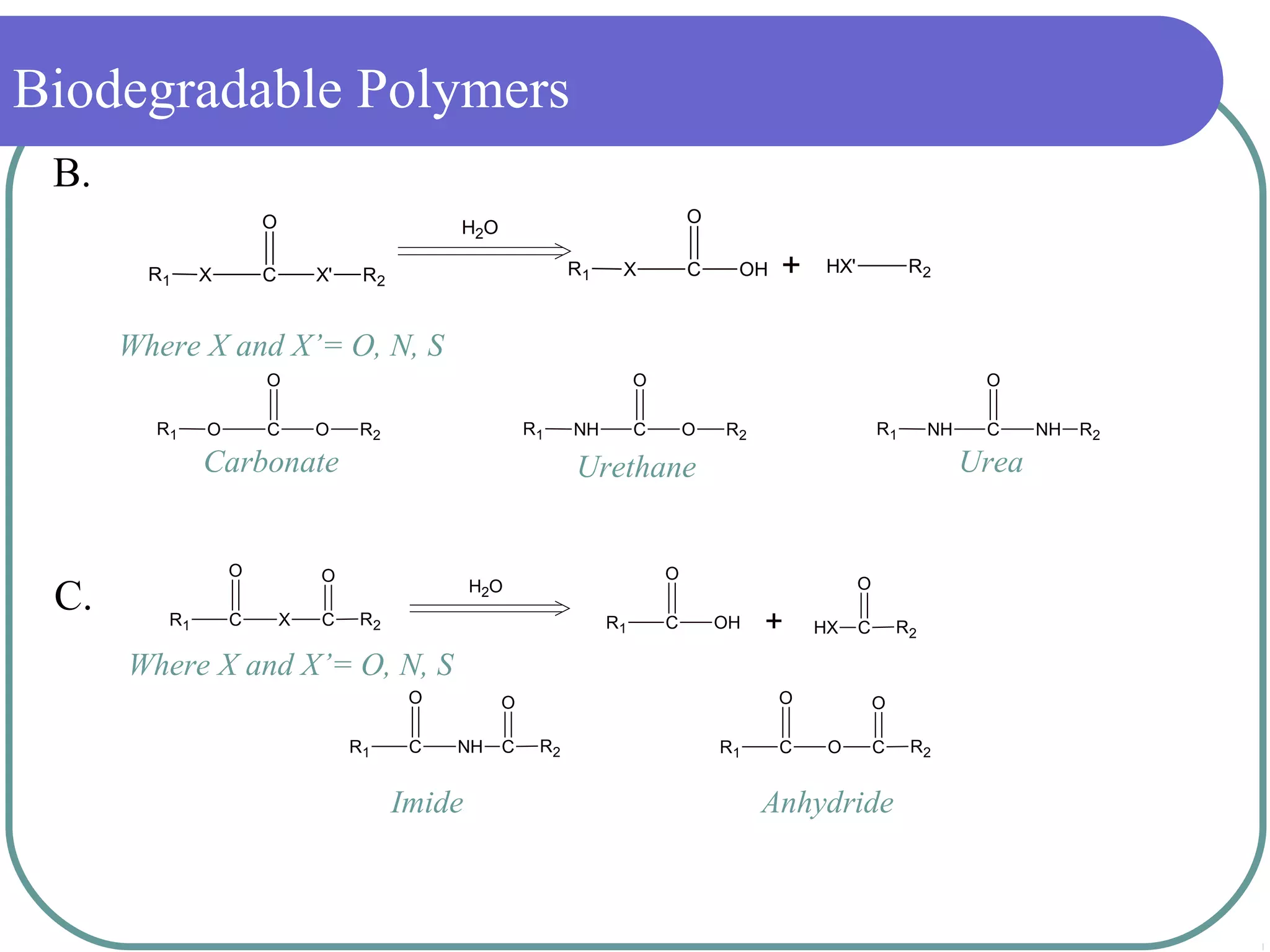
X C X'
O
R2R1
OH2
+ HX' R2X C OH
O
R1
Where X and X’= O, N, S
B.
O C O
O
R2R1 NH C O
O
R2R1 NH C NH
O
R2R1
Carbonate Urethane Urea
C. R1 C X
O
C
O
R2
OH2
+R1 C OH
O
HX C
O
R2
R1 C NH
O
C
O
R2 R1 C O
O
C
O
R2
Imide Anhydride
Where X and X’= O, N, S
Biodegradable Polymers
Acetal:
Hemiacetal:
Ether
Nitrile
Phosphonate
Polycyanocrylate
OH2
+C
O
H H
R' OHO C O
H
H
R R' R OH +
OC
C
C C
C
OH
OH
OH
OH
OH OHC
C
C C
OH
OH
OH
OH
H2O
+
C==O
H
H2O
R C O C R'
H H
H H
OH2
R C OH
H
H
R' C OH
H
H
+
R C R
C N
H
R C R
C O
H
NH2
R C R
C O
H
OH
OH2 OH2
RO P OR'
O
OR''
OH P OH
O
OR''
OH2
+ +R OH OH R'
R C C C C R'
CN
C
OR''
CN
H
H
O C
OR'''
O
H
H
OH2
R C C C
CN
C
OR''
H
H
O
H
H
OH C R'
CN
C
OR'''
O
+
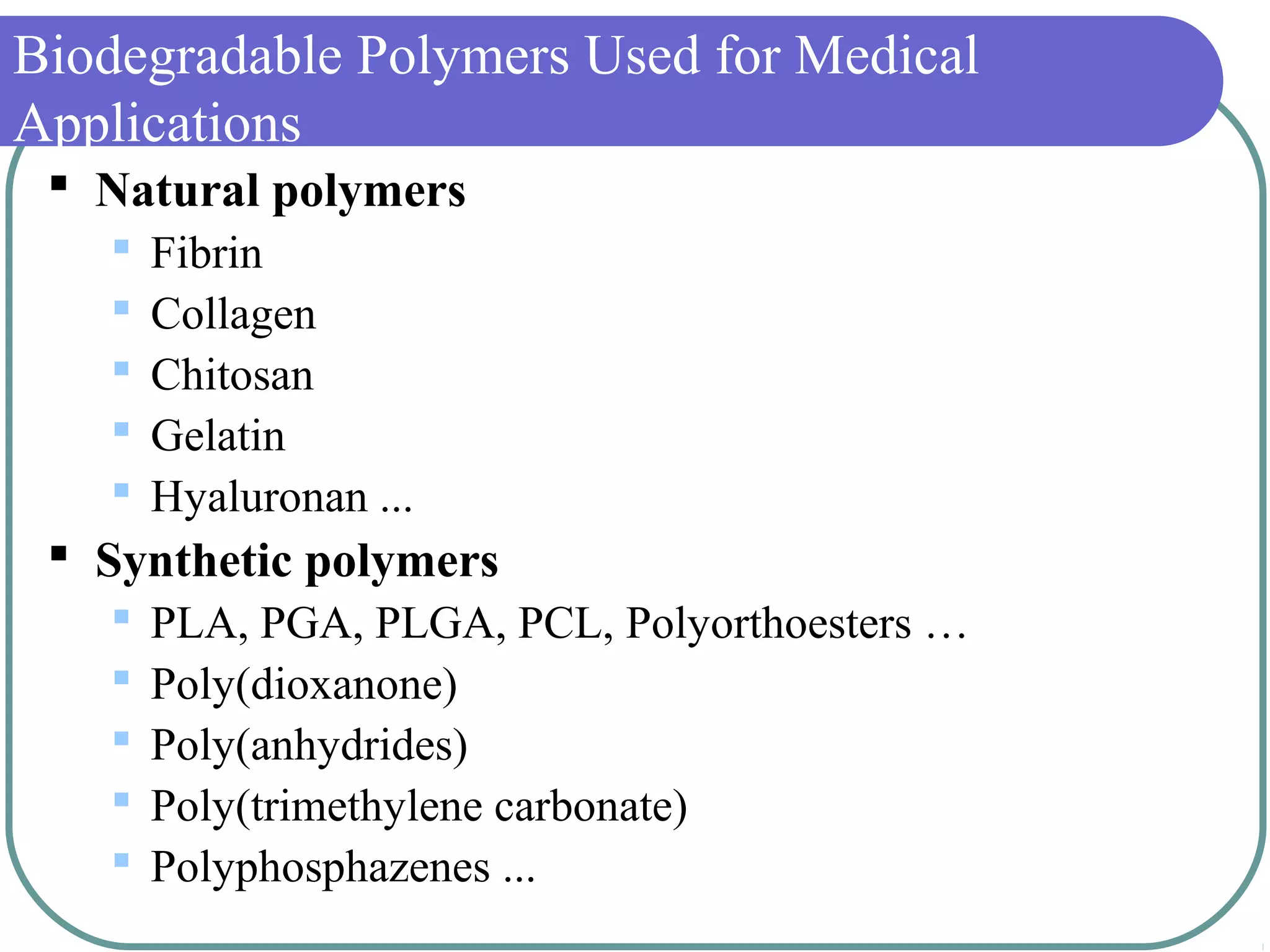
Biodegradable Polymers Used for Medical
Applications
 Natural polymers
 Fibrin
 Collagen
 Chitosan
 Gelatin
 Hyaluronan ...
 Synthetic polymers
 PLA, PGA, PLGA, PCL, Polyorthoesters …
 Poly(dioxanone)
 Poly(anhydrides)
 Poly(trimethylene carbonate)
 Polyphosphazenes ...
Synthetic or Natural Biodegradable Polymers
Why Do We Prefer Synthetic Ones?
 Tailor-able properties
 Predictable lot-to-lot uniformity
 Free from concerns of immunogenicity
 Reliable source of raw materials
Degradation Mechanisms
 Enzymatic degradation
 Hydrolysis
(depend on main chain structure: anhydride > ester >
carbonate)
 Homogenous degradation
 Heterogenous degradation
Degradation can be divided into 4 steps:
• water sorption
• reduction of mechanical properties (modulus &
strength)
• reduction of molar mass
• weight loss
Degradation Schemes
 Surface erosion (poly(ortho)esters and polyanhydrides)
 Sample is eroded from the surface
 Mass loss is faster than the ingress of water into the bulk
 Bulk degradation (PLA,PGA,PLGA, PCL)
 Degradation takes place throughout the whole of the
sample
 Ingress of water is faster than the rate of degradation
Polymer Degradation by Erosion (1)
Erodible Matrices or Micro/Nanospheres
 (a)
Bulk-eroding system
 (b)
Surface-eroding system
General Fabrication Techniques
Molding (formation of drug matrix)
 compression molding
 melt molding
 solvent casting
Molding ( compression molding ) (1)
 Polymer and drug particles are milled to a particle
size range of 90 to 150 µm
 Drug / Polymer mix is compressed at ~30,000 psi
 Formation of some types of tablet / matrix
Molding ( melt molding / casting ) (1)
 Polymer is heated to ~10°C above it melting point ( Tm
) to form a viscous liquid
 Mix drug into the polymer melt
 Shaped by injection molding
Molding ( melt molding / casting ) (2)
Advantages
 More uniform distribution of drug in polymer
 Wide range of shapes possible
Disadvantages
 Thermal instability of drugs (heat inactivation)
 Drug / polymer interaction at high temperature
 Cost
Molding ( Solvent casting ) (1)
 Co-dissolve drug and polymer in an organic solvent
 Pour the drug / polymer solution into a mold chilled
under dry ice
 Allow solvent to evaporate
 Formation of a drug-polymer matrix
Molding ( Solvent casting ) (2)
Advantages
 Simplicity
 Room temperature operation
 Suitable for heat sensitive drugs
Disadvantages
 Possible non-uniform drug distribution
 Proper solvents for drugs and polymers
 Fragility of the system
 Unwanted matrix porosity
 Use of organic solvents / Solvent residues
Polyesters
Comparison
PropertiesProperties PLAPLA PSPS PVCPVC PPPP
Yield Strength, MPa 49 49 35 35
Elongation, % 2.5 2.5 3.0 10
Tensile Modulus, GPa 3.2 3.4 2.6 1.4
Flexural Strength, MPa 70 80 90 49
Mobley, D. P. Plastics from Microbes. 1994
Factors Influence the Degradation Behavior
 Chemical Structure and Chemical Composition
 Distribution of Repeat Units in Multimers
 Molecular Weight
 Polydispersity
 Presence of Low Mw Compounds (monomer, oligomers, solvents, plasticizers, etc)
 Presence of Ionic Groups
 Presence of Chain Defects
 Presence of Unexpected Units
 Configurational Structure
 Morphology (crystallinity, presence of microstructure, orientation and residue stress)
 Processing methods & Conditions
 Method of Sterilization
 Annealing
 Storage History
 Site of Implantation
 Absorbed Compounds
 Physiochemical Factors (shape, size)
 Mechanism of Hydrolysis (enzymes vs water)
Poly(lactide-co-glycolide) (PLGA)
(JBMR, 11:711, 1977)
Factors That Accelerate Polymer
Degradation
 More hydrophilic backbone.
 More hydrophilic endgroups.
 More reactive hydrolytic groups in the backbone.
 Less crystallinity.
 More porosity.
 Smaller device size.
Methods of Studying Polymer Degradation
 Morphological changes (swelling, deformation, bubbling,
disappearance…)
 Weight lose
 Thermal behavior changes
 Differential Scanning Calorimetry (DSC)
 Molecular weight changes
 Dilute solution viscosity
 Size exclusion chromatograpgy(SEC)
 Gel permeation chromatography(GPC)
 MALDI mass spectroscopy
 Change in chemistry
 Infared spectroscopy (IR)
 Nuclear Magnetic Resonance Spectroscopy (NMR)
 TOF-SIMS
Medical Applications of Biodegradable Polymers
 Wound management
 Sutures
 Staples
 Clips
 Adhesives
 Surgical meshes
 Orthopedic devices
 Pins
 Rods
 Screws
 Tacks
 Ligaments
 Dental applications
 Guided tissue
regeneration Membrane
 Void filler following
tooth extraction
 Cardiovascular applications
 Stents
 Intestinal applications
 Anastomosis rings
 Drug delivery system
 Tissue engineering

Biodegradable Polymers

  • 1.
  • 2.
    Azizul Haque Juel ID: 161-32-308 Department of Textile Engineering Daffodil International University
  • 3.
    What is PolymerDegradation? polymers were synthesized from glycolic acid in 1920s At that time, polymer degradation was viewed negatively as a process where properties and performance deteriorated with time.
  • 4.
    Why Would aMedical Practitioner Like a Material to Degrade in the Body? BONE+PLATE BONE PLATE Time MechanicalStrength Degradable Polymer Plate  Do not require a second surgery for removal  Avoid stress shielding  Offer tremendous potential as the basis for controlled drug delivery
  • 5.
    Biodegradable Polymers  Carbonylbond to O N S R1 C X O R2 OH2 R1 C OH O +HX R2 Where X= O, N, S R1 C O O R2 Ester R1 C NH O R2 Amide R1 C S O R2 A. Thioester
  • 6.
    X C X' O R2R1 OH2 +HX' R2X C OH O R1 Where X and X’= O, N, S B. O C O O R2R1 NH C O O R2R1 NH C NH O R2R1 Carbonate Urethane Urea C. R1 C X O C O R2 OH2 +R1 C OH O HX C O R2 R1 C NH O C O R2 R1 C O O C O R2 Imide Anhydride Where X and X’= O, N, S Biodegradable Polymers
  • 7.
    Biodegradable Polymers Acetal: Hemiacetal: Ether Nitrile Phosphonate Polycyanocrylate OH2 +C O H H R'OHO C O H H R R' R OH + OC C C C C OH OH OH OH OH OHC C C C OH OH OH OH H2O + C==O H H2O R C O C R' H H H H OH2 R C OH H H R' C OH H H + R C R C N H R C R C O H NH2 R C R C O H OH OH2 OH2 RO P OR' O OR'' OH P OH O OR'' OH2 + +R OH OH R' R C C C C R' CN C OR'' CN H H O C OR''' O H H OH2 R C C C CN C OR'' H H O H H OH C R' CN C OR''' O +
  • 8.
    Biodegradable Polymers Usedfor Medical Applications  Natural polymers  Fibrin  Collagen  Chitosan  Gelatin  Hyaluronan ...  Synthetic polymers  PLA, PGA, PLGA, PCL, Polyorthoesters …  Poly(dioxanone)  Poly(anhydrides)  Poly(trimethylene carbonate)  Polyphosphazenes ...
  • 9.
    Synthetic or NaturalBiodegradable Polymers Why Do We Prefer Synthetic Ones?  Tailor-able properties  Predictable lot-to-lot uniformity  Free from concerns of immunogenicity  Reliable source of raw materials
  • 10.
    Degradation Mechanisms  Enzymaticdegradation  Hydrolysis (depend on main chain structure: anhydride > ester > carbonate)  Homogenous degradation  Heterogenous degradation
  • 11.
    Degradation can bedivided into 4 steps: • water sorption • reduction of mechanical properties (modulus & strength) • reduction of molar mass • weight loss
  • 12.
    Degradation Schemes  Surfaceerosion (poly(ortho)esters and polyanhydrides)  Sample is eroded from the surface  Mass loss is faster than the ingress of water into the bulk  Bulk degradation (PLA,PGA,PLGA, PCL)  Degradation takes place throughout the whole of the sample  Ingress of water is faster than the rate of degradation
  • 13.
  • 14.
    Erodible Matrices orMicro/Nanospheres  (a) Bulk-eroding system  (b) Surface-eroding system
  • 15.
    General Fabrication Techniques Molding(formation of drug matrix)  compression molding  melt molding  solvent casting
  • 16.
    Molding ( compressionmolding ) (1)  Polymer and drug particles are milled to a particle size range of 90 to 150 µm  Drug / Polymer mix is compressed at ~30,000 psi  Formation of some types of tablet / matrix
  • 17.
    Molding ( meltmolding / casting ) (1)  Polymer is heated to ~10°C above it melting point ( Tm ) to form a viscous liquid  Mix drug into the polymer melt  Shaped by injection molding
  • 18.
    Molding ( meltmolding / casting ) (2) Advantages  More uniform distribution of drug in polymer  Wide range of shapes possible Disadvantages  Thermal instability of drugs (heat inactivation)  Drug / polymer interaction at high temperature  Cost
  • 19.
    Molding ( Solventcasting ) (1)  Co-dissolve drug and polymer in an organic solvent  Pour the drug / polymer solution into a mold chilled under dry ice  Allow solvent to evaporate  Formation of a drug-polymer matrix
  • 20.
    Molding ( Solventcasting ) (2) Advantages  Simplicity  Room temperature operation  Suitable for heat sensitive drugs Disadvantages  Possible non-uniform drug distribution  Proper solvents for drugs and polymers  Fragility of the system  Unwanted matrix porosity  Use of organic solvents / Solvent residues
  • 21.
  • 22.
    Comparison PropertiesProperties PLAPLA PSPSPVCPVC PPPP Yield Strength, MPa 49 49 35 35 Elongation, % 2.5 2.5 3.0 10 Tensile Modulus, GPa 3.2 3.4 2.6 1.4 Flexural Strength, MPa 70 80 90 49 Mobley, D. P. Plastics from Microbes. 1994
  • 23.
    Factors Influence theDegradation Behavior  Chemical Structure and Chemical Composition  Distribution of Repeat Units in Multimers  Molecular Weight  Polydispersity  Presence of Low Mw Compounds (monomer, oligomers, solvents, plasticizers, etc)  Presence of Ionic Groups  Presence of Chain Defects  Presence of Unexpected Units  Configurational Structure  Morphology (crystallinity, presence of microstructure, orientation and residue stress)  Processing methods & Conditions  Method of Sterilization  Annealing  Storage History  Site of Implantation  Absorbed Compounds  Physiochemical Factors (shape, size)  Mechanism of Hydrolysis (enzymes vs water)
  • 24.
  • 25.
    Factors That AcceleratePolymer Degradation  More hydrophilic backbone.  More hydrophilic endgroups.  More reactive hydrolytic groups in the backbone.  Less crystallinity.  More porosity.  Smaller device size.
  • 26.
    Methods of StudyingPolymer Degradation  Morphological changes (swelling, deformation, bubbling, disappearance…)  Weight lose  Thermal behavior changes  Differential Scanning Calorimetry (DSC)  Molecular weight changes  Dilute solution viscosity  Size exclusion chromatograpgy(SEC)  Gel permeation chromatography(GPC)  MALDI mass spectroscopy  Change in chemistry  Infared spectroscopy (IR)  Nuclear Magnetic Resonance Spectroscopy (NMR)  TOF-SIMS
  • 27.
    Medical Applications ofBiodegradable Polymers  Wound management  Sutures  Staples  Clips  Adhesives  Surgical meshes  Orthopedic devices  Pins  Rods  Screws  Tacks  Ligaments  Dental applications  Guided tissue regeneration Membrane  Void filler following tooth extraction  Cardiovascular applications  Stents  Intestinal applications  Anastomosis rings  Drug delivery system  Tissue engineering