RECOMBINANT PROTEIN : AN
OVERVIEW
Dr. Deepa G Muricken
Assistant Professor
Department of Biochemistry
St. Mary’s College Thrissur
• Recombinant protein is a manipulated form of protein, which is generated in various ways
to produce large quantities of proteins
• Modify gene sequences and manufacture useful commercial products.
• The formation of recombinant protein is carried out in specialized vehicles known as
vectors.
• Many of notable proteins are generated from recombinant DNA, using biomolecular
engineering
• In many cases, recombinant human proteins have replaced the original animal-derived
version used in medicine.
INTRODUCTION
Recombinant protein, Deepa G Muricken, St. Mary’s College Thrissur
Examples of Human recombinants
Human growth hormone (rHGH)
human insulin (BHI): Humulin from Lilly and Novolin from Novo Nordisk among
others largely replaced bovine and porcine insulin for human therapy.
•Follicle-stimulating hormone (FSH) as a recombinant gonadotropin
preparation replaced Serono's Pergonal which was previously isolated from post-
menopausal female urine
•Factor VIII:
•Erythropoietin
•Glucocerebrosidase:
•Interferon (IF)
Animal recombinants
Bovine somatotropin (bST)
•Porcine somatotropin (pST)
•Bovine Chymosin
Viral recombinants
•Envelope protein of the hepatitis B virus
•HPV Vaccine proteins
Recombinant protein, Deepa G Muricken, St. Mary’s College Thrissur
WHY RECOMBINANTS ????
INSTEAD OF OTHER SOURCES
• Eg: Insulin can be isolated from different sources like bovine, porcine, hog, sheep
etc. They have similar structure but slight different in sequences.
• Can cause allergy in some people.
• Have to do animal slaughter to isolate insulin.
• Very less amount of insulin production
• Requires more time.
• All these problems are solved by recombinant insulin production
Recombinant protein, Deepa G Muricken, St. Mary’s College Thrissur
PRODUCTION OF RECOMBINANT PROTEIN
Recombinant protein, Deepa G Muricken, St. Mary’s College Thrissur
PRODUCTION OF RECOMBINANT BOWMAN BIRK
INHIBITOR IN E.coli
The BBIs of horse gram (Dolichos biflorus)
HQSTD
E
P S E S
R
V
1
H D
M D
D
D
H
S
v
R
M D
Recombinant protein, Deepa G Muricken, St. Mary’s College Thrissur
• The Bowman-Birk Inhibitors are considered as universal
cancer chemopreventive agents
• It is still unknown whether the anti-tumoral and radio-
protective activities of BBIs are correlated to the inhibitory
activity of trypsin/chymotrypsin or other enzymes or to the
capability of interacting with other macromolecules.
Bowman-Birk Inhibitor Concentrate (BBIC) achieved
Investigational New Drug status from FDA in 1992
Recombinant protein, Deepa G Muricken, St. Mary’s College Thrissur
1. NdeI Digestion
2. Ligation pRSET-rHGI
3025bps
PT7
MCS
HGI-III
F1 origin
Ampicillin
NdeI
pRSET-rHGI
3157 bps
PT7
MCS
HGI-III
F1 origin
Ampicillin
NdeINdeI
BamHI
HindIII
HindIII
ATG GAT CAT CAT CAG TCA ACT GAT GAG CCC TCT GAG TCT TCA AAA CCA TGC
TGT GAT CAG TGC GCA TGC ACA AAG TCA ATC CCT CCT CAA TGC CGC TGT ACG
GAC GTT AGG CTG AAT TCG TGC CAT TCA GCT TGC AGT TCT TGT GTT TGC ACA TTT
TCG ATT CCT GCA CAG TGT GTT TGT GTT GAC ATG AAG GAC TTC TGC TAC GCA
CCT TGC AAA TCT TCA CAT GAT GAT
PROTEIN SEQUENCE
M D H H Q S T D E P S E S S K P C C D Q C A C T K S I P P Q C R C T D V R L N S C H S
A C S S C V C T F S I P A Q C V C V D M K D F C Y A P C K S S H D D
Cloning of HGI-III gene in pRSETC
Recombinant protein, Deepa G Muricken, St. Mary’s College Thrissur
Functional expression and purification of
recombinant HGI (rHGI)
rHGI was expressed in BL21 (DE3)pLys S cells , induced with IPTG
1 M 2
kDa
43.0
29.0
20.0
14.3
6.5
Cell free extracts of pRSET-rHGI.
Recombinant protein, Deepa G Muricken, St. Mary’s College Thrissur
Cell lysis: rupture cell wall / plasma membrane,
--> release contents (organelles, proteins…)
1. Physical means
2. Sonication
3. Osmotic shock
PURIFICATION STRATEGIES
Recombinant protein, Deepa G Muricken, St. Mary’s College Thrissur
MainTypes of MolecularInteractions
HydrogenBonds
HydrophobicInteractions(waxy residues:Ileu, Leu,Val, Phe,Trp)
Ionic Interactions(charged residues:Asp- Glu- S- Lys+ Arg+ His+)
Purification strategy depends on:
 Solubility
 Charge
 Molecular weight
 Affinity
Recombinant protein, Deepa G Muricken, St. Mary’s College Thrissur
Characteristic Procedure
Solubility: 1. Salting in
2. Salting out eg: Ammonium sulphate
precipitation
Ionic charge: 1. Ion exchange chromatography
2. Electrophoresis
3. Isoelectric focusing
Polarity: 1. Adsorption chromatography
2. Paper chromatography
3. Reverse-phase chromatography
4. Hydrophobic interaction
chromatography
Molecular size: 1. Dialysis
2. Gel electrophoresis
3. Gel filtration chromatography
4. Ultracentrifugation
Binding specificity: 1. Affinity chromatography
Recombinant protein, Deepa G Muricken, St. Mary’s College Thrissur
1
2
0 5 10 15 20 25 30 35 40
0.5
1.0
1.5
2.0
2.5
3.0
Elution vol (mL)
A230
200
400
600
800
Trypsininhibitoryactivity(TIU/mL)
Trypsin sepharose affinity chromatography profile of rHGI. ( ) TIU/mL, (▲) A 230.
Inset: Native PAGE (10 % T, 2.7 % C) of rHGI at pH 8.3. The gels were stained for A:
protein; B: trypsin and C: chymotrypsin by APNE zymography
SDS-PAGE (15%T, 2.7%C) profile of purified HGIs.
AFFINITY CHROMATOGRAPHY
Different types of affinity chromatography: His Tag, GST fusion protein, Maltose binding
protein, specific affinities like antigen- antibody reactions, enzyme – substrate interactions
etc.
43
29
20
14
6,5
kDa
Recombinant protein, Deepa G Muricken, St. Mary’s College Thrissur
Gel Filtration Chromatography
0 20 40 60 80 100 120 140 160 180 200
0.5
1.0
1.5
2.0
2.5
3.0
vol ml
230nm
100
120
140
160
180
200
220
240
260
280
300
TIU/ml
An elution profile
• Gel-filtration of the protein mixture. 5 ml of protein
mixture was loaded onto a Sephadex G-50 column
equilibrated with buffer (50 mM Tris HCl, pH 7.5).
The column was eluted with buffer at ~1 ml/min,
collecting 2.5 ml fractions. The absorbance of each
fraction was measured at 230 nm and 280 nm.
Recombinant protein, Deepa G Muricken, St. Mary’s College Thrissur
Ion exchange chromatography
• Ion exchange resins contain charged groups.
• If these groups are acidic in nature they interact with positively charged proteins and
are called cation exchangers
• If these groups are basic in nature, they interact with negatively charged molecules and
are called anion exchangers.
DEAE cellulose
anion exchanger
CH2-CH2 -NH+(CH2CH2) -
-
-
-
Negatively charged
(acidic) protein or
enzyme
CM cellulose
cation exchanger
CH2-COO-
CH2-COO-
+
+
+ Positively charged
(basic) protein or
enzyme
CH2-CH2 -NH+(CH2CH2)
Recombinant protein, Deepa G Muricken, St. Mary’s College Thrissur
Ion exchange chromatography
CM cellulose
cation exchanger
CH2-COO-
CH2-COO-
+
+
+
+
To elute our protein of interest, add increasingly higher amount of salt (increase the ionic
strength). Na+ will interact with the cation resin and Cl- will interact with our positively
charged protein to elute off the column.
CM cellulose
cation exchanger
CH2-COO-
CH2-COO-
+
+
+
+
Na+
Na+
Cl-
Na+2
Cl-
Cl-
Cl-
Na+2
+ Increasing [NaCl]
of the elution
buffer
Recombinant protein, Deepa G Muricken, St. Mary’s College Thrissur
Centrifugation
Separate proteins by size or density
Differential centrifugation - separates large from small particles
Isopycnic (sucrose-density) centrifugation - separates particles of
different densities
Purification of viral
coat protein
Recombinant protein, Deepa G Muricken, St. Mary’s College Thrissur
Differential Centrifugation
Recombinant protein, Deepa G Muricken, St. Mary’s College Thrissur
Final purification methods
• Initial methods included fractionation methods like salt precipitation, precipitation using
organic solvents, membrane filtration etc.
• Secondary fractionation included ion exchange chromatography, gel filtration, adsorption,
affinity methods etc.
• The protein intended for drugs and similar uses has to be extremely pure and should be free
from even traces of other proteins from the source.
• Polishing steps has to be performed in final round like HPLC gel filtration, reverse phase
HPLC, ion exchange HPLC etc.
Recombinant protein, Deepa G Muricken, St. Mary’s College Thrissur
9.3849.293
A230
B
A
Size-exclusion chromatography of seed HGI-III and rHGI. The
purified proteins were dissolved in 0.1M Tris-HCl, pH 7.5 and
loaded on to a BIOSEP-SEC-S 3000 column
HPLC Profile of Size-exclusion
BIOSEP-SEC-S 3000 column
Recombinant protein, Deepa G Muricken, St. Mary’s College Thrissur
Applications
Recombinant protein, Deepa G Muricken, St. Mary’s College Thrissur
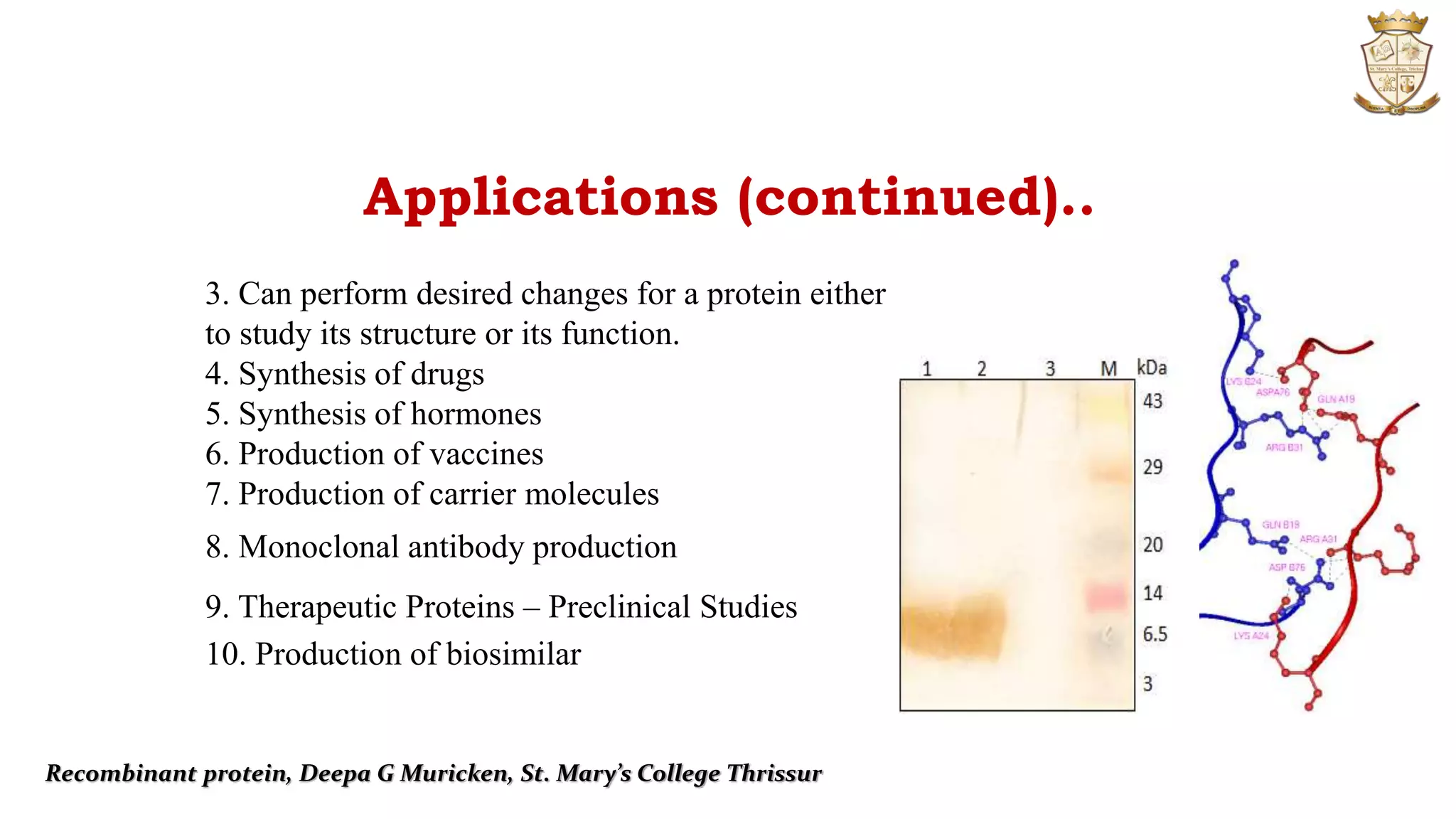
3. Can perform desired changes for a protein either
to study its structure or its function.
4. Synthesis of drugs
5. Synthesis of hormones
6. Production of vaccines
7. Production of carrier molecules
8. Monoclonal antibody production
9. Therapeutic Proteins – Preclinical Studies
10. Production of biosimilar
Applications (continued)..
Recombinant protein, Deepa G Muricken, St. Mary’s College Thrissur
Biochemistry:Recombinant Protein : An Overview

Biochemistry:Recombinant Protein : An Overview

  • 1.
    RECOMBINANT PROTEIN :AN OVERVIEW Dr. Deepa G Muricken Assistant Professor Department of Biochemistry St. Mary’s College Thrissur
  • 2.
    • Recombinant proteinis a manipulated form of protein, which is generated in various ways to produce large quantities of proteins • Modify gene sequences and manufacture useful commercial products. • The formation of recombinant protein is carried out in specialized vehicles known as vectors. • Many of notable proteins are generated from recombinant DNA, using biomolecular engineering • In many cases, recombinant human proteins have replaced the original animal-derived version used in medicine. INTRODUCTION Recombinant protein, Deepa G Muricken, St. Mary’s College Thrissur
  • 3.
    Examples of Humanrecombinants Human growth hormone (rHGH) human insulin (BHI): Humulin from Lilly and Novolin from Novo Nordisk among others largely replaced bovine and porcine insulin for human therapy. •Follicle-stimulating hormone (FSH) as a recombinant gonadotropin preparation replaced Serono's Pergonal which was previously isolated from post- menopausal female urine •Factor VIII: •Erythropoietin •Glucocerebrosidase: •Interferon (IF) Animal recombinants Bovine somatotropin (bST) •Porcine somatotropin (pST) •Bovine Chymosin Viral recombinants •Envelope protein of the hepatitis B virus •HPV Vaccine proteins Recombinant protein, Deepa G Muricken, St. Mary’s College Thrissur
  • 4.
    WHY RECOMBINANTS ???? INSTEADOF OTHER SOURCES • Eg: Insulin can be isolated from different sources like bovine, porcine, hog, sheep etc. They have similar structure but slight different in sequences. • Can cause allergy in some people. • Have to do animal slaughter to isolate insulin. • Very less amount of insulin production • Requires more time. • All these problems are solved by recombinant insulin production Recombinant protein, Deepa G Muricken, St. Mary’s College Thrissur
  • 5.
    PRODUCTION OF RECOMBINANTPROTEIN Recombinant protein, Deepa G Muricken, St. Mary’s College Thrissur
  • 6.
    Recombinant protein, DeepaG Muricken, St. Mary’s College Thrissur
  • 7.
    PRODUCTION OF RECOMBINANTBOWMAN BIRK INHIBITOR IN E.coli The BBIs of horse gram (Dolichos biflorus) HQSTD E P S E S R V 1 H D M D D D H S v R M D Recombinant protein, Deepa G Muricken, St. Mary’s College Thrissur
  • 8.
    • The Bowman-BirkInhibitors are considered as universal cancer chemopreventive agents • It is still unknown whether the anti-tumoral and radio- protective activities of BBIs are correlated to the inhibitory activity of trypsin/chymotrypsin or other enzymes or to the capability of interacting with other macromolecules. Bowman-Birk Inhibitor Concentrate (BBIC) achieved Investigational New Drug status from FDA in 1992 Recombinant protein, Deepa G Muricken, St. Mary’s College Thrissur
  • 9.
    1. NdeI Digestion 2.Ligation pRSET-rHGI 3025bps PT7 MCS HGI-III F1 origin Ampicillin NdeI pRSET-rHGI 3157 bps PT7 MCS HGI-III F1 origin Ampicillin NdeINdeI BamHI HindIII HindIII ATG GAT CAT CAT CAG TCA ACT GAT GAG CCC TCT GAG TCT TCA AAA CCA TGC TGT GAT CAG TGC GCA TGC ACA AAG TCA ATC CCT CCT CAA TGC CGC TGT ACG GAC GTT AGG CTG AAT TCG TGC CAT TCA GCT TGC AGT TCT TGT GTT TGC ACA TTT TCG ATT CCT GCA CAG TGT GTT TGT GTT GAC ATG AAG GAC TTC TGC TAC GCA CCT TGC AAA TCT TCA CAT GAT GAT PROTEIN SEQUENCE M D H H Q S T D E P S E S S K P C C D Q C A C T K S I P P Q C R C T D V R L N S C H S A C S S C V C T F S I P A Q C V C V D M K D F C Y A P C K S S H D D Cloning of HGI-III gene in pRSETC Recombinant protein, Deepa G Muricken, St. Mary’s College Thrissur
  • 10.
    Functional expression andpurification of recombinant HGI (rHGI) rHGI was expressed in BL21 (DE3)pLys S cells , induced with IPTG 1 M 2 kDa 43.0 29.0 20.0 14.3 6.5 Cell free extracts of pRSET-rHGI. Recombinant protein, Deepa G Muricken, St. Mary’s College Thrissur
  • 11.
    Cell lysis: rupturecell wall / plasma membrane, --> release contents (organelles, proteins…) 1. Physical means 2. Sonication 3. Osmotic shock PURIFICATION STRATEGIES Recombinant protein, Deepa G Muricken, St. Mary’s College Thrissur
  • 12.
    MainTypes of MolecularInteractions HydrogenBonds HydrophobicInteractions(waxyresidues:Ileu, Leu,Val, Phe,Trp) Ionic Interactions(charged residues:Asp- Glu- S- Lys+ Arg+ His+) Purification strategy depends on:  Solubility  Charge  Molecular weight  Affinity Recombinant protein, Deepa G Muricken, St. Mary’s College Thrissur
  • 13.
    Characteristic Procedure Solubility: 1.Salting in 2. Salting out eg: Ammonium sulphate precipitation Ionic charge: 1. Ion exchange chromatography 2. Electrophoresis 3. Isoelectric focusing Polarity: 1. Adsorption chromatography 2. Paper chromatography 3. Reverse-phase chromatography 4. Hydrophobic interaction chromatography Molecular size: 1. Dialysis 2. Gel electrophoresis 3. Gel filtration chromatography 4. Ultracentrifugation Binding specificity: 1. Affinity chromatography Recombinant protein, Deepa G Muricken, St. Mary’s College Thrissur
  • 14.
    1 2 0 5 1015 20 25 30 35 40 0.5 1.0 1.5 2.0 2.5 3.0 Elution vol (mL) A230 200 400 600 800 Trypsininhibitoryactivity(TIU/mL) Trypsin sepharose affinity chromatography profile of rHGI. ( ) TIU/mL, (▲) A 230. Inset: Native PAGE (10 % T, 2.7 % C) of rHGI at pH 8.3. The gels were stained for A: protein; B: trypsin and C: chymotrypsin by APNE zymography SDS-PAGE (15%T, 2.7%C) profile of purified HGIs. AFFINITY CHROMATOGRAPHY Different types of affinity chromatography: His Tag, GST fusion protein, Maltose binding protein, specific affinities like antigen- antibody reactions, enzyme – substrate interactions etc. 43 29 20 14 6,5 kDa Recombinant protein, Deepa G Muricken, St. Mary’s College Thrissur
  • 15.
    Gel Filtration Chromatography 020 40 60 80 100 120 140 160 180 200 0.5 1.0 1.5 2.0 2.5 3.0 vol ml 230nm 100 120 140 160 180 200 220 240 260 280 300 TIU/ml An elution profile • Gel-filtration of the protein mixture. 5 ml of protein mixture was loaded onto a Sephadex G-50 column equilibrated with buffer (50 mM Tris HCl, pH 7.5). The column was eluted with buffer at ~1 ml/min, collecting 2.5 ml fractions. The absorbance of each fraction was measured at 230 nm and 280 nm. Recombinant protein, Deepa G Muricken, St. Mary’s College Thrissur
  • 16.
    Ion exchange chromatography •Ion exchange resins contain charged groups. • If these groups are acidic in nature they interact with positively charged proteins and are called cation exchangers • If these groups are basic in nature, they interact with negatively charged molecules and are called anion exchangers. DEAE cellulose anion exchanger CH2-CH2 -NH+(CH2CH2) - - - - Negatively charged (acidic) protein or enzyme CM cellulose cation exchanger CH2-COO- CH2-COO- + + + Positively charged (basic) protein or enzyme CH2-CH2 -NH+(CH2CH2) Recombinant protein, Deepa G Muricken, St. Mary’s College Thrissur
  • 17.
    Ion exchange chromatography CMcellulose cation exchanger CH2-COO- CH2-COO- + + + + To elute our protein of interest, add increasingly higher amount of salt (increase the ionic strength). Na+ will interact with the cation resin and Cl- will interact with our positively charged protein to elute off the column. CM cellulose cation exchanger CH2-COO- CH2-COO- + + + + Na+ Na+ Cl- Na+2 Cl- Cl- Cl- Na+2 + Increasing [NaCl] of the elution buffer Recombinant protein, Deepa G Muricken, St. Mary’s College Thrissur
  • 18.
    Centrifugation Separate proteins bysize or density Differential centrifugation - separates large from small particles Isopycnic (sucrose-density) centrifugation - separates particles of different densities Purification of viral coat protein Recombinant protein, Deepa G Muricken, St. Mary’s College Thrissur
  • 19.
    Differential Centrifugation Recombinant protein,Deepa G Muricken, St. Mary’s College Thrissur
  • 20.
    Final purification methods •Initial methods included fractionation methods like salt precipitation, precipitation using organic solvents, membrane filtration etc. • Secondary fractionation included ion exchange chromatography, gel filtration, adsorption, affinity methods etc. • The protein intended for drugs and similar uses has to be extremely pure and should be free from even traces of other proteins from the source. • Polishing steps has to be performed in final round like HPLC gel filtration, reverse phase HPLC, ion exchange HPLC etc. Recombinant protein, Deepa G Muricken, St. Mary’s College Thrissur
  • 21.
    9.3849.293 A230 B A Size-exclusion chromatography ofseed HGI-III and rHGI. The purified proteins were dissolved in 0.1M Tris-HCl, pH 7.5 and loaded on to a BIOSEP-SEC-S 3000 column HPLC Profile of Size-exclusion BIOSEP-SEC-S 3000 column Recombinant protein, Deepa G Muricken, St. Mary’s College Thrissur
  • 22.
    Applications Recombinant protein, DeepaG Muricken, St. Mary’s College Thrissur
  • 23.
    3. Can performdesired changes for a protein either to study its structure or its function. 4. Synthesis of drugs 5. Synthesis of hormones 6. Production of vaccines 7. Production of carrier molecules 8. Monoclonal antibody production 9. Therapeutic Proteins – Preclinical Studies 10. Production of biosimilar Applications (continued).. Recombinant protein, Deepa G Muricken, St. Mary’s College Thrissur