Dr. N. SAI BHASKAR REDDY
BIOCHAR &
SOIL ENVIRONMENT
5 Feb 2016
BIOCHAR
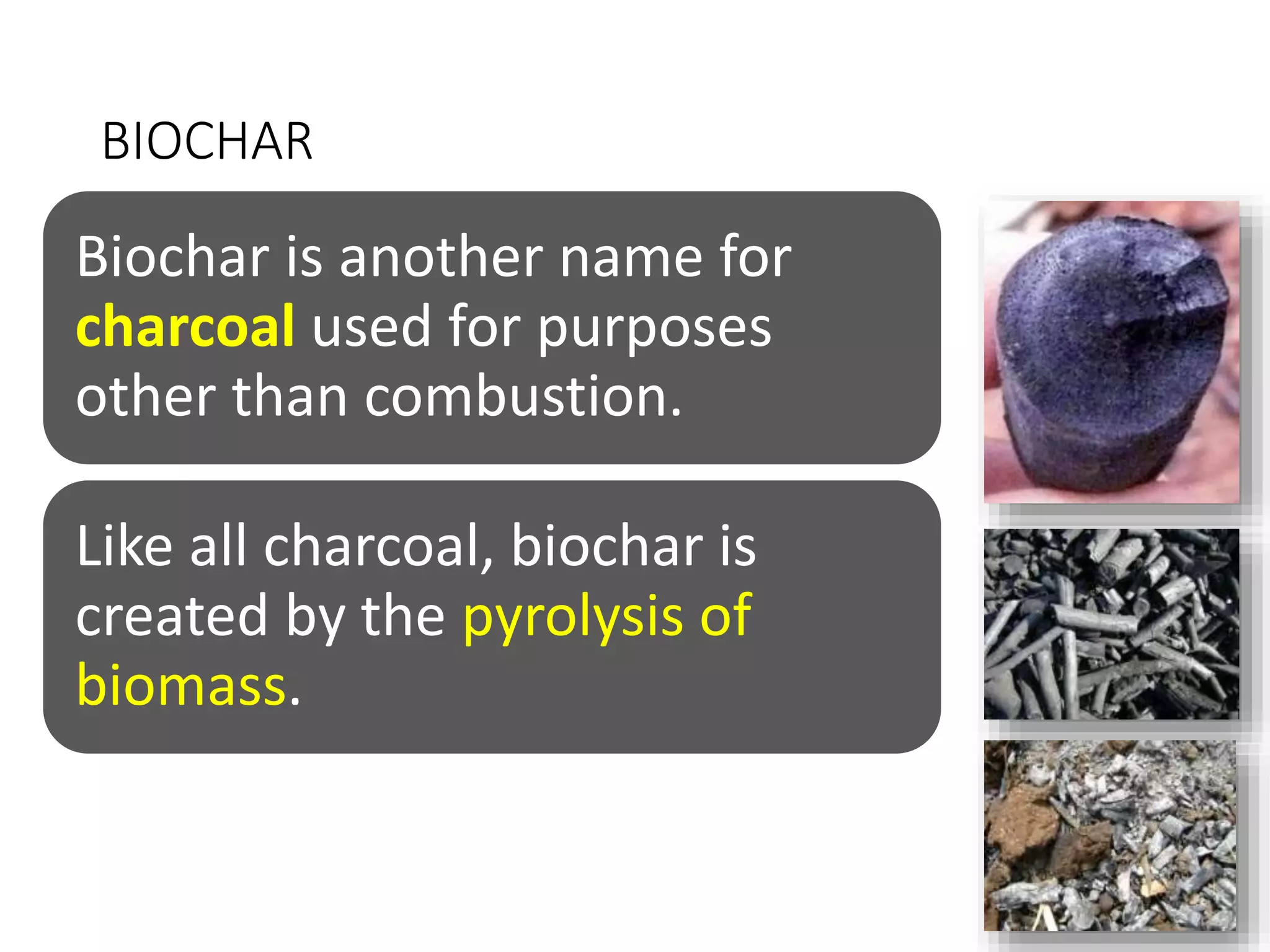
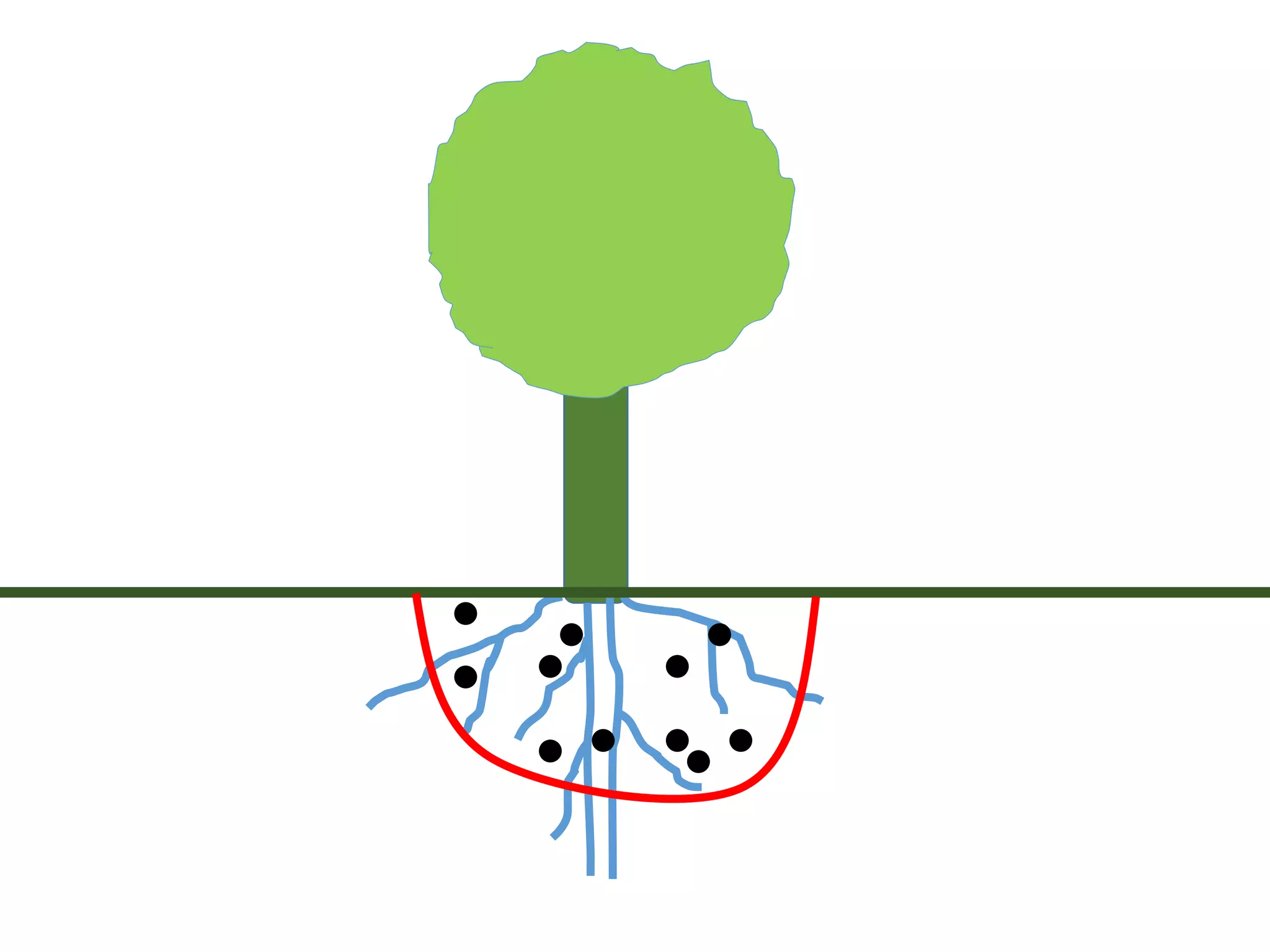
Biochar is another name for
charcoal used for purposes
other than combustion.
Like all charcoal, biochar is
created by the pyrolysis of
biomass.
BIOCHARS
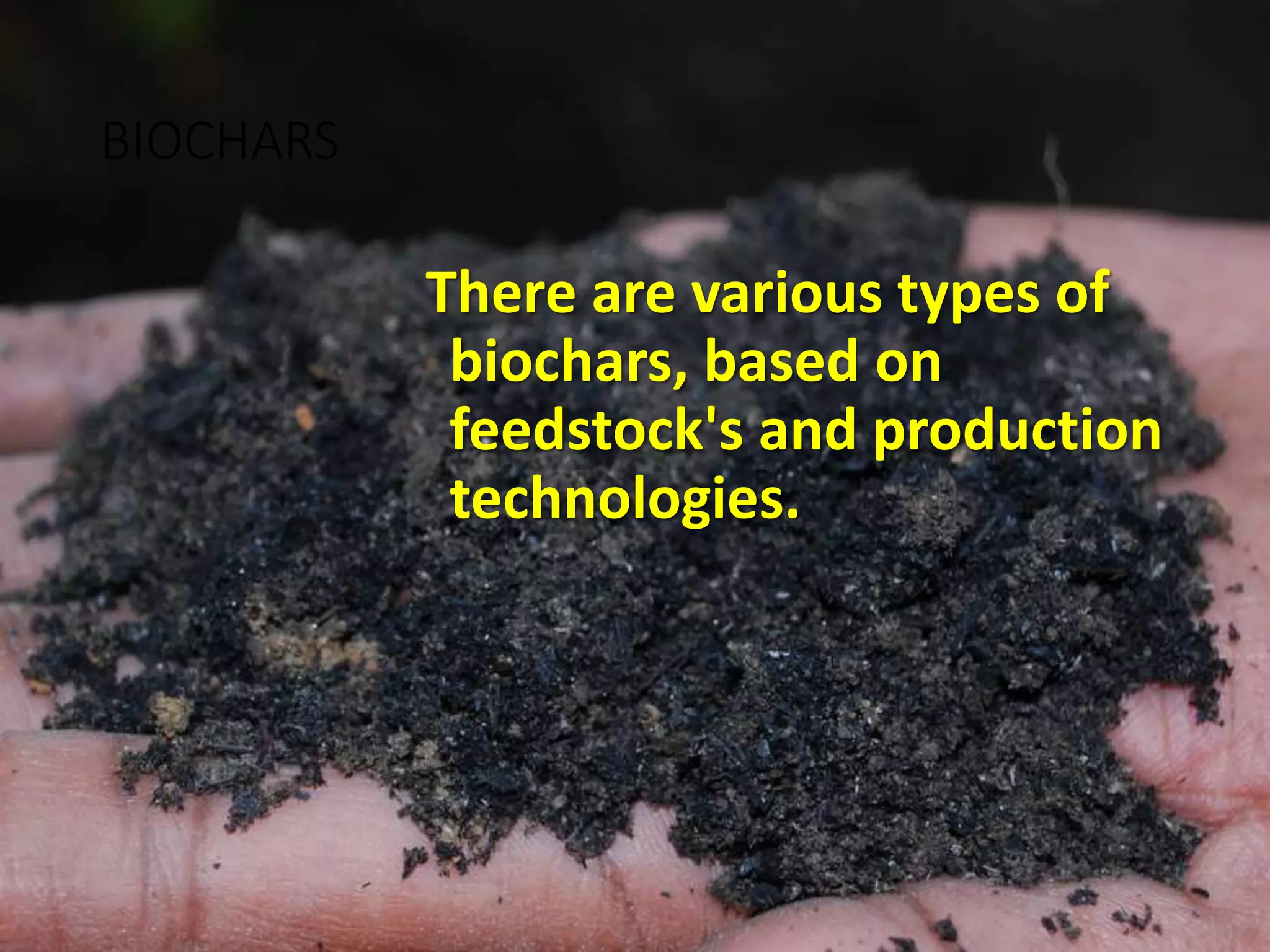
There are various types of
biochars, based on
feedstock's and production
technologies.
Biochar as
Growth
promoter
Soil
conditioner
Soil
amendment
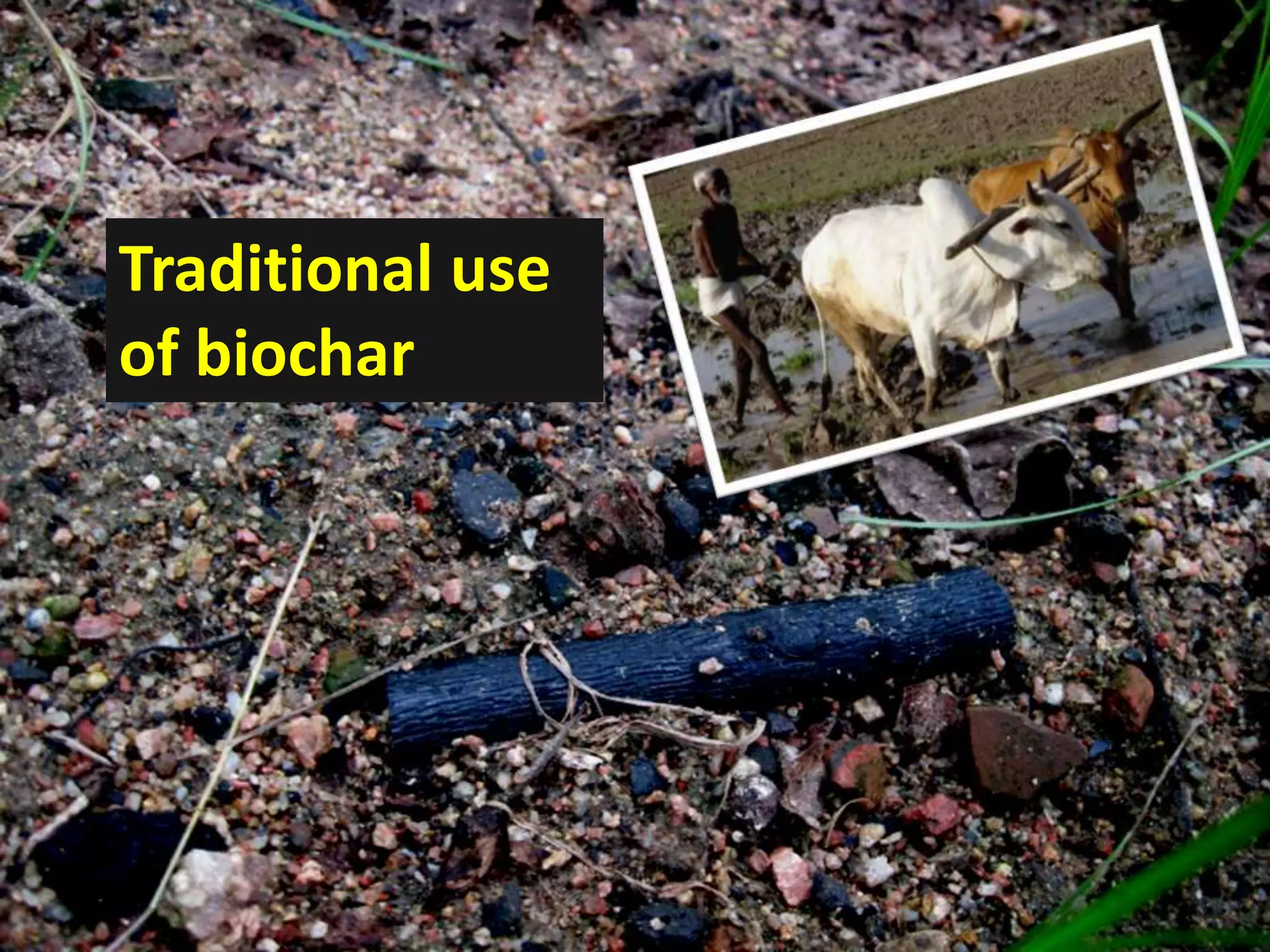
Traditional use
of biochar
BIOCHARCULTURE
Biocharculture is a holistic approach that has
been historically tested, traditionally practiced,
is culturally integral, economically viable,
socially responsible, environmentally
sustainable, and agreeable as a policy.
The uses of biochar—as part of
biocharculture—include its application in the
areas of soil management, livestock, biomass
energy, water purification, green habitats,
sanitation, food, health, etc.
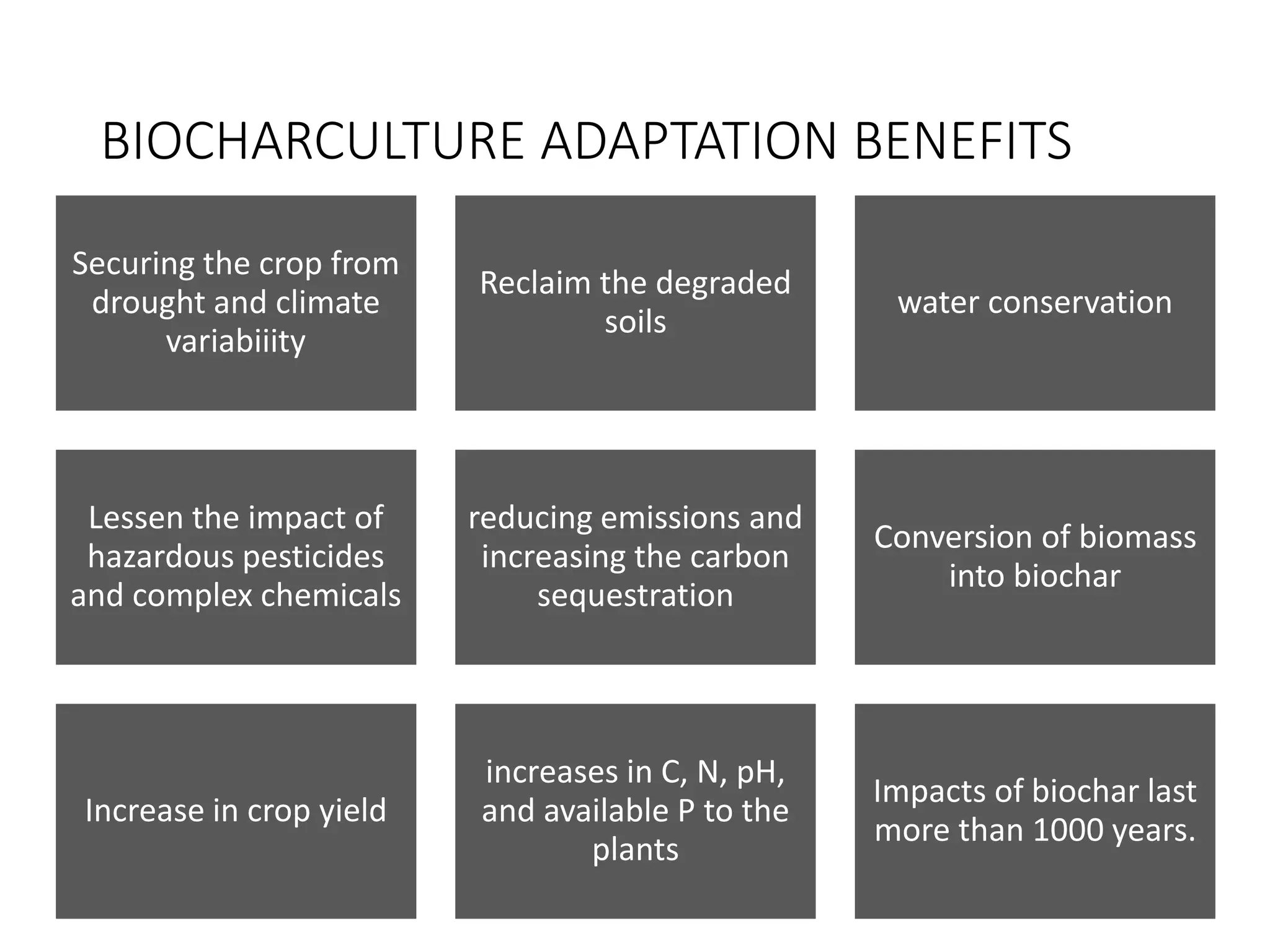
BIOCHARCULTURE ADAPTATION BENEFITS
Securing the crop from
drought and climate
variabiiity
Reclaim the degraded
soils
water conservation
Lessen the impact of
hazardous pesticides
and complex chemicals
reducing emissions and
increasing the carbon
sequestration
Conversion of biomass
into biochar
Increase in crop yield
increases in C, N, pH,
and available P to the
plants
Impacts of biochar last
more than 1000 years.
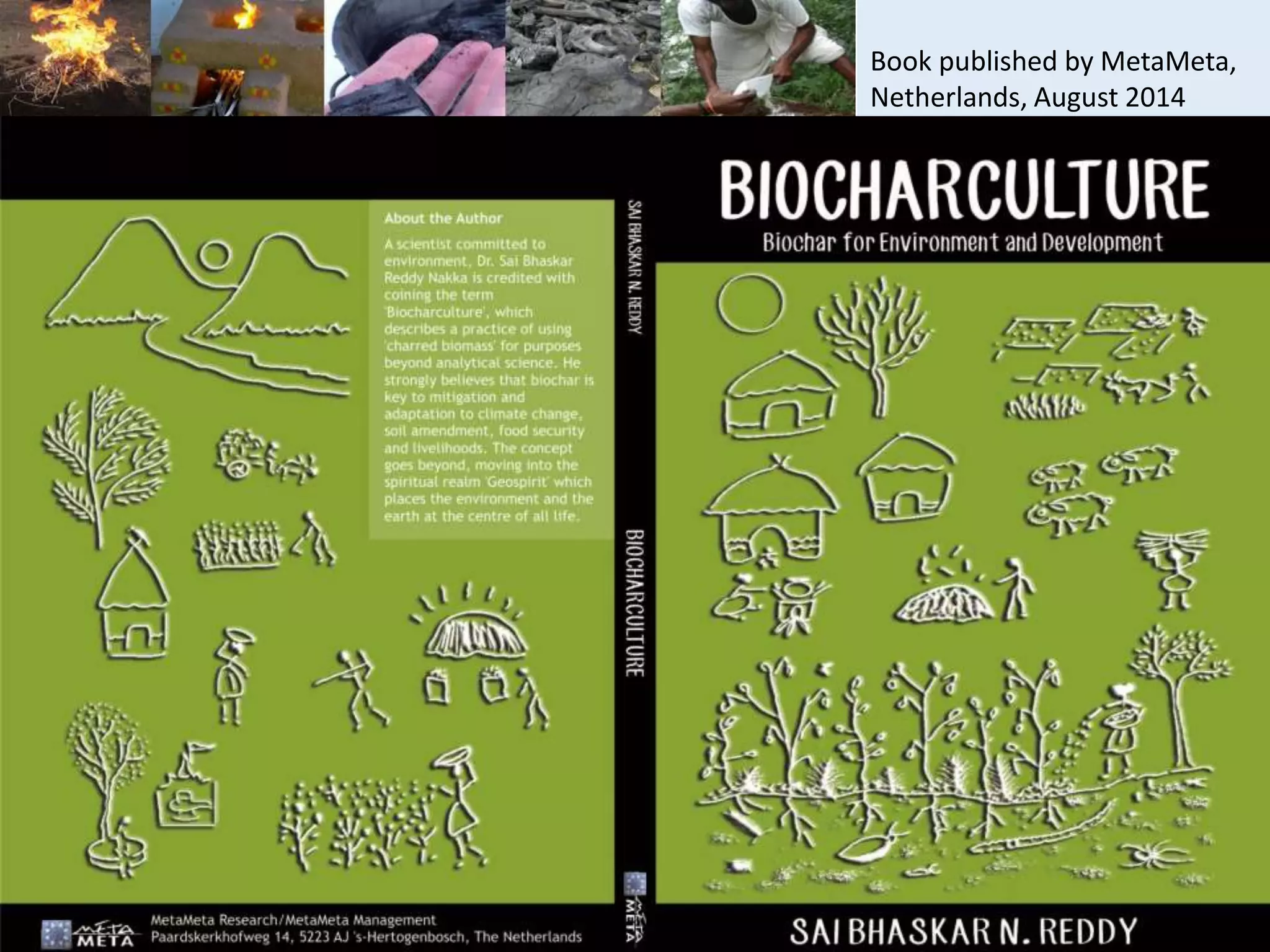
Book published by MetaMeta,
Netherlands, August 2014
SUSTAINABILITY OF BIOCHAR
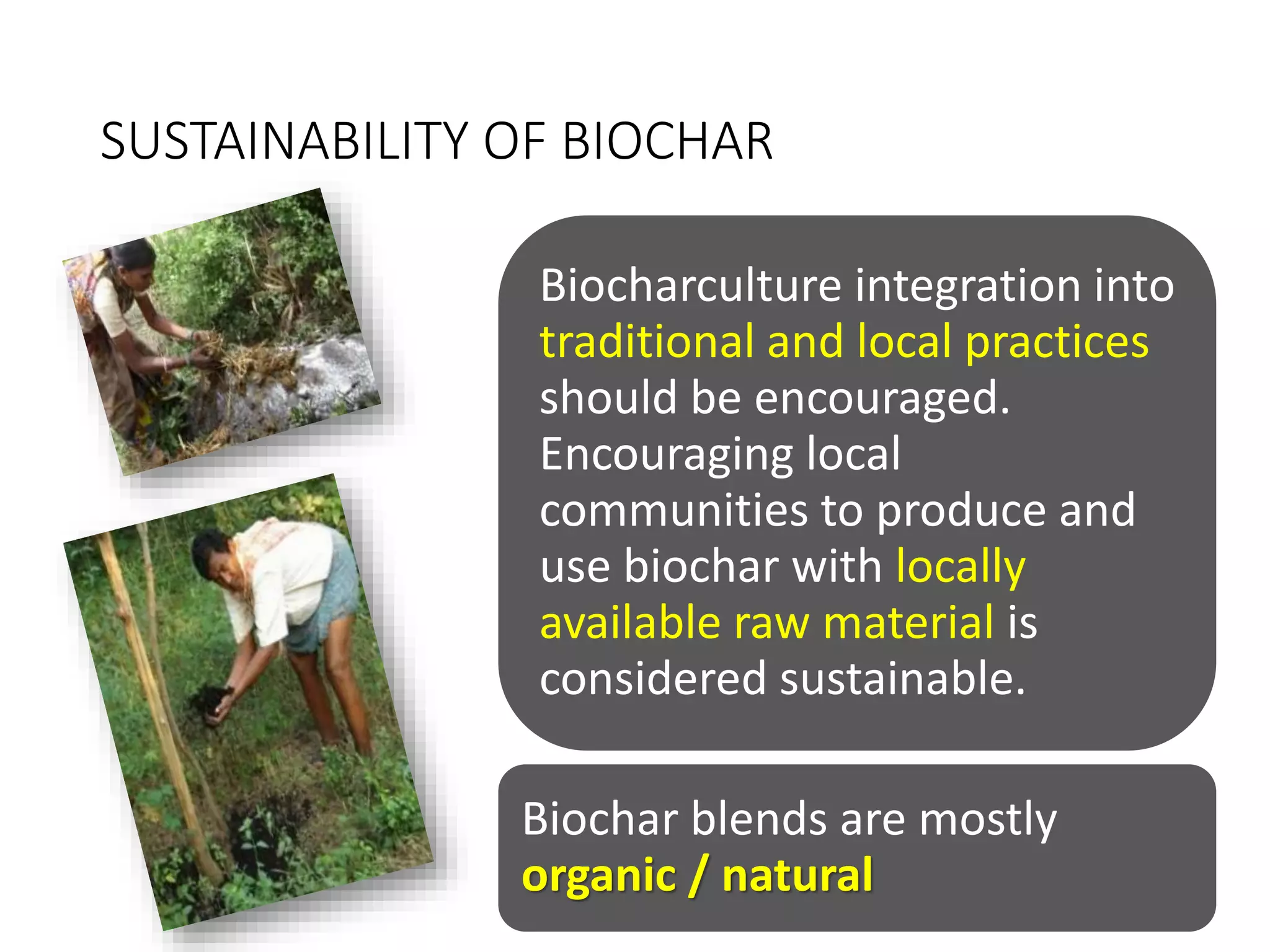
Biocharculture integration into
traditional and local practices
should be encouraged.
Encouraging local
communities to produce and
use biochar with locally
available raw material is
considered sustainable.
Biochar blends are mostly
organic / natural
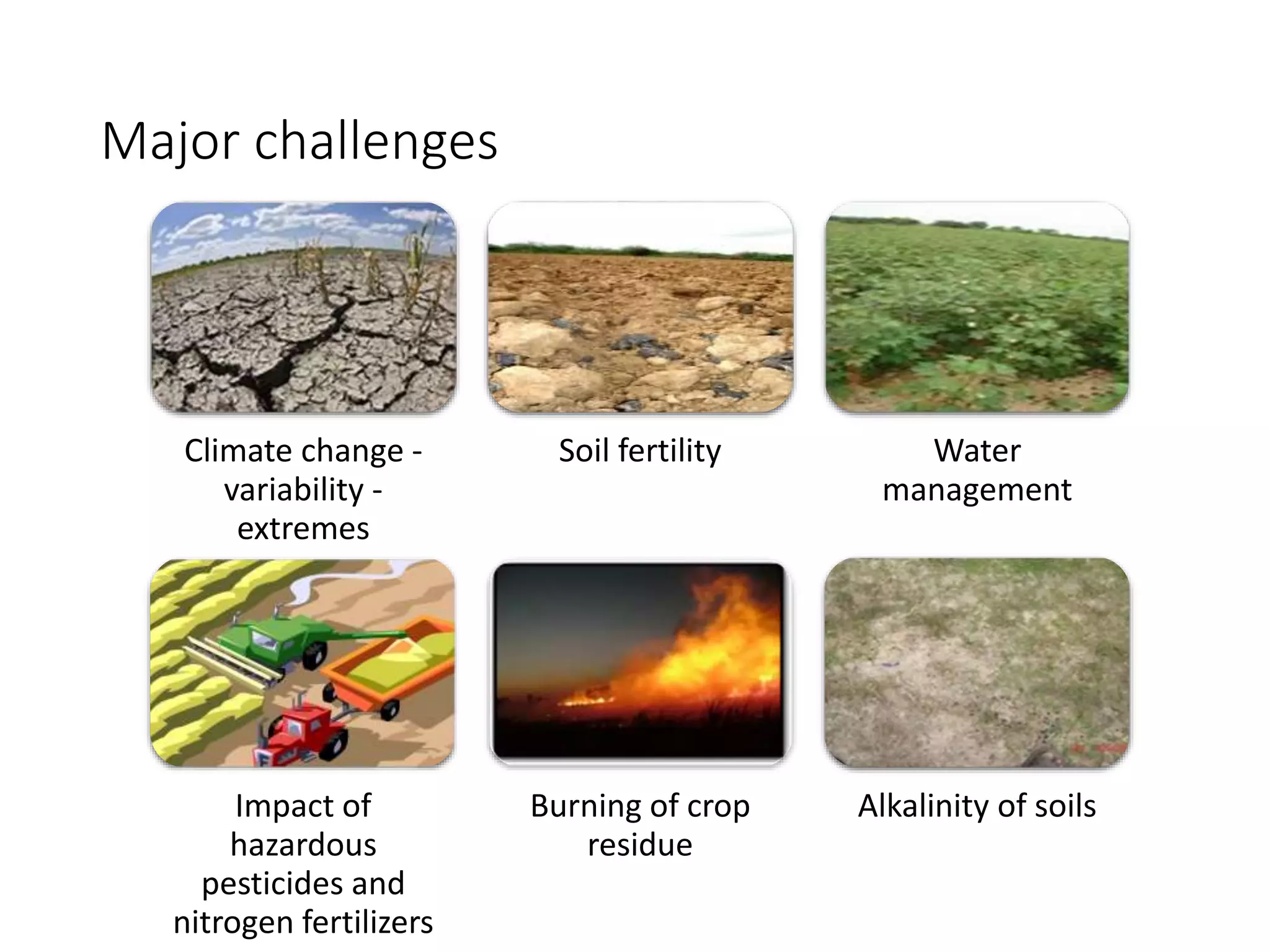
Major challenges
Climate change -
variability -
extremes
Soil fertility Water
management
Impact of
hazardous
pesticides and
nitrogen fertilizers
Burning of crop
residue
Alkalinity of soils
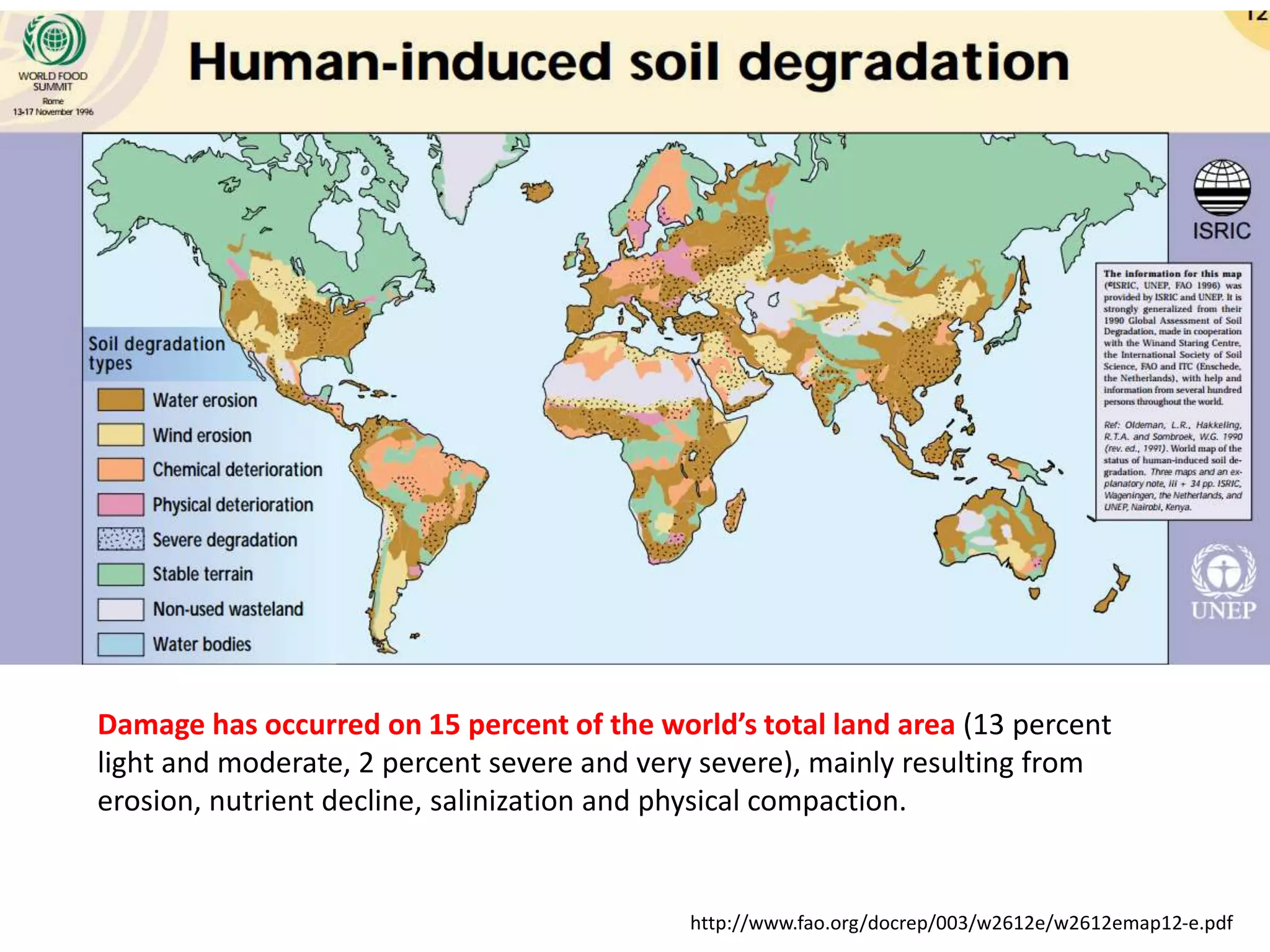
http://www.fao.org/docrep/003/w2612e/w2612emap12-e.pdf
Damage has occurred on 15 percent of the world’s total land area (13 percent
light and moderate, 2 percent severe and very severe), mainly resulting from
erosion, nutrient decline, salinization and physical compaction.
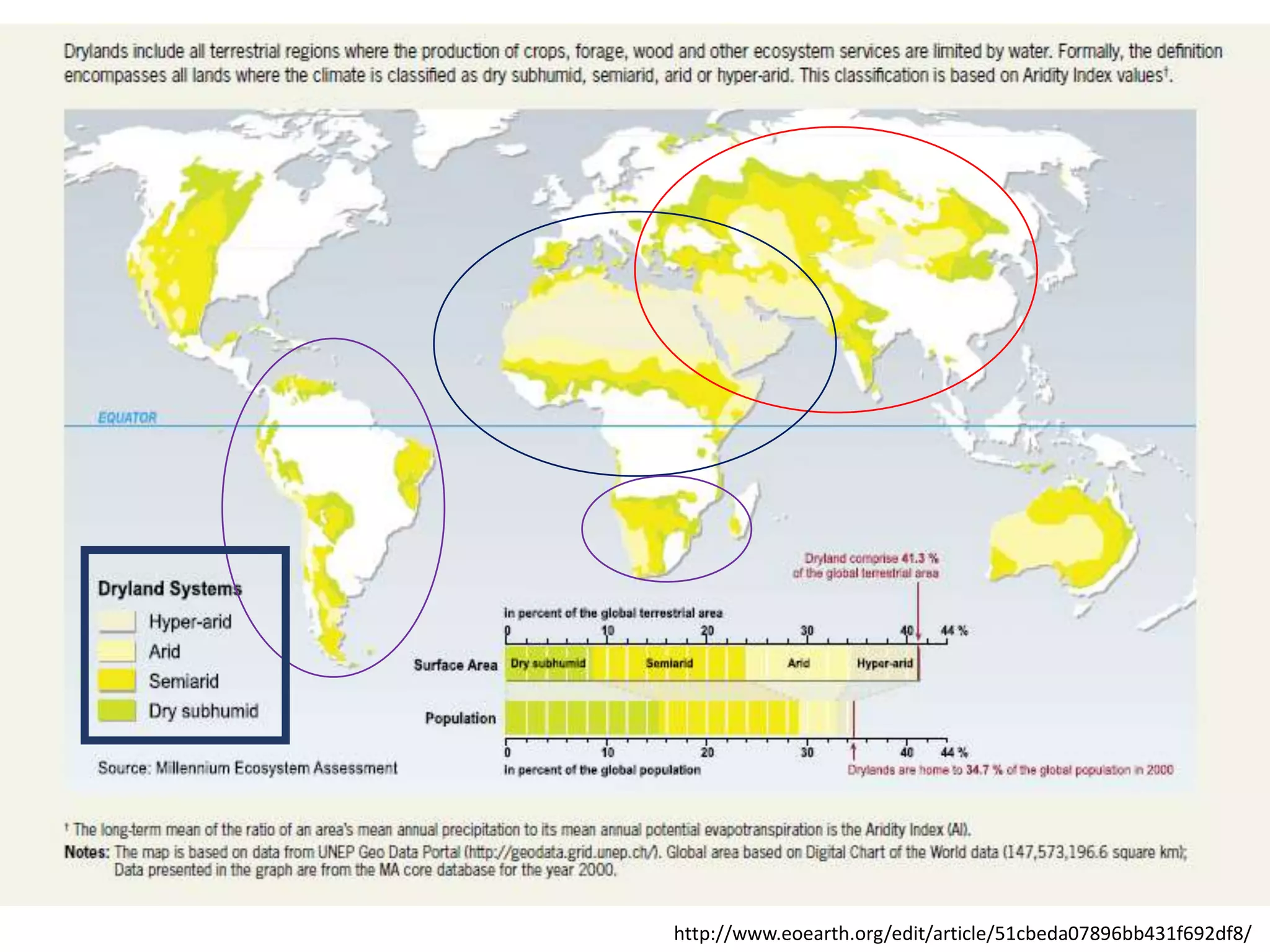
http://www.eoearth.org/edit/article/51cbeda07896bb431f692df8/
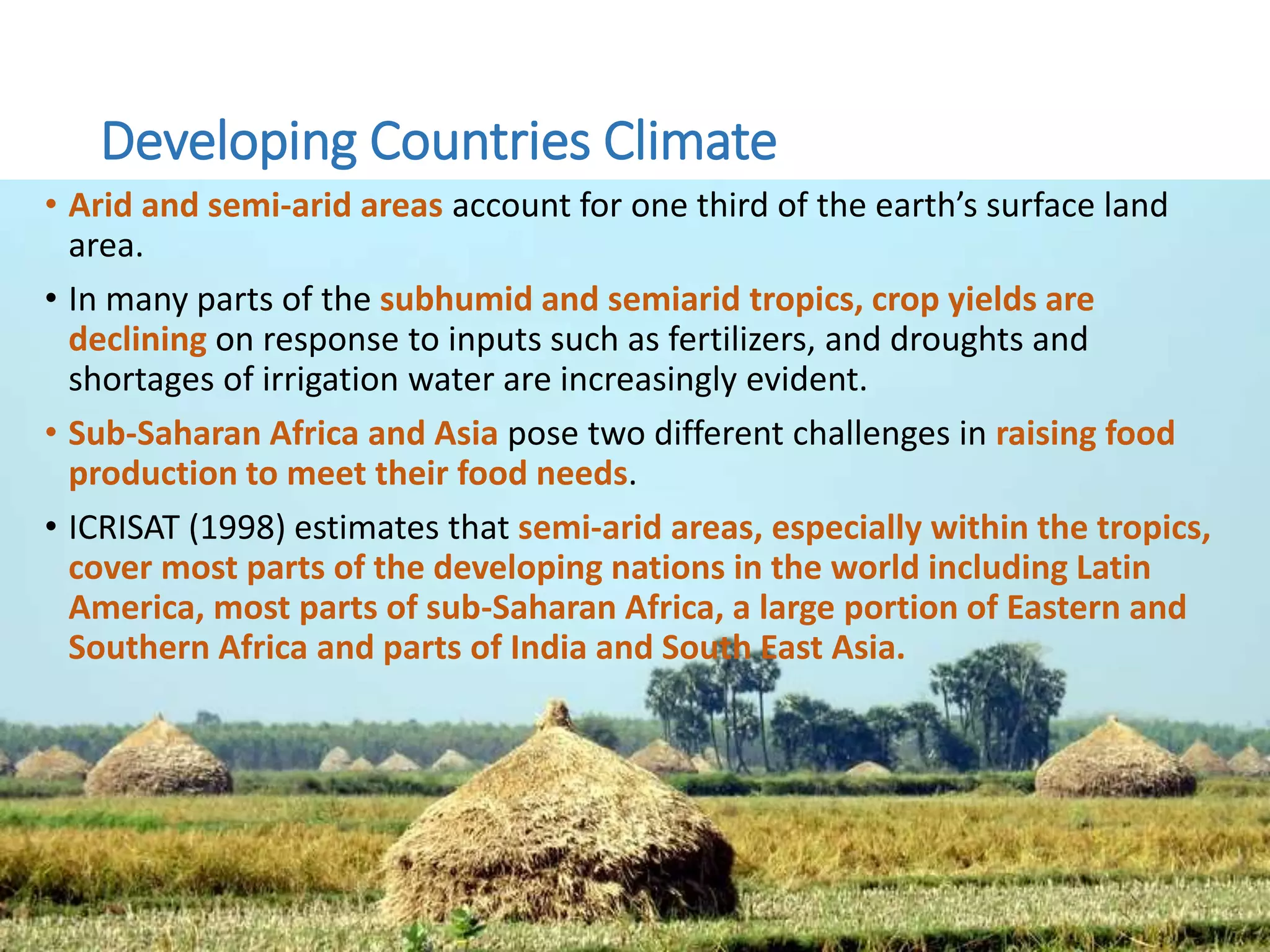
Developing Countries Climate
• Arid and semi-arid areas account for one third of the earth’s surface land
area.
• In many parts of the subhumid and semiarid tropics, crop yields are
declining on response to inputs such as fertilizers, and droughts and
shortages of irrigation water are increasingly evident.
• Sub-Saharan Africa and Asia pose two different challenges in raising food
production to meet their food needs.
• ICRISAT (1998) estimates that semi-arid areas, especially within the tropics,
cover most parts of the developing nations in the world including Latin
America, most parts of sub-Saharan Africa, a large portion of Eastern and
Southern Africa and parts of India and South East Asia.
By 2030 ensure sustainable food production systems and implement resilient agricultural
practices that increase productivity and production, that help maintain ecosystems, that
strengthen capacity for adaptation to climate change, extreme weather, drought, flooding
and other disasters, and that progressively improve land and soil quality
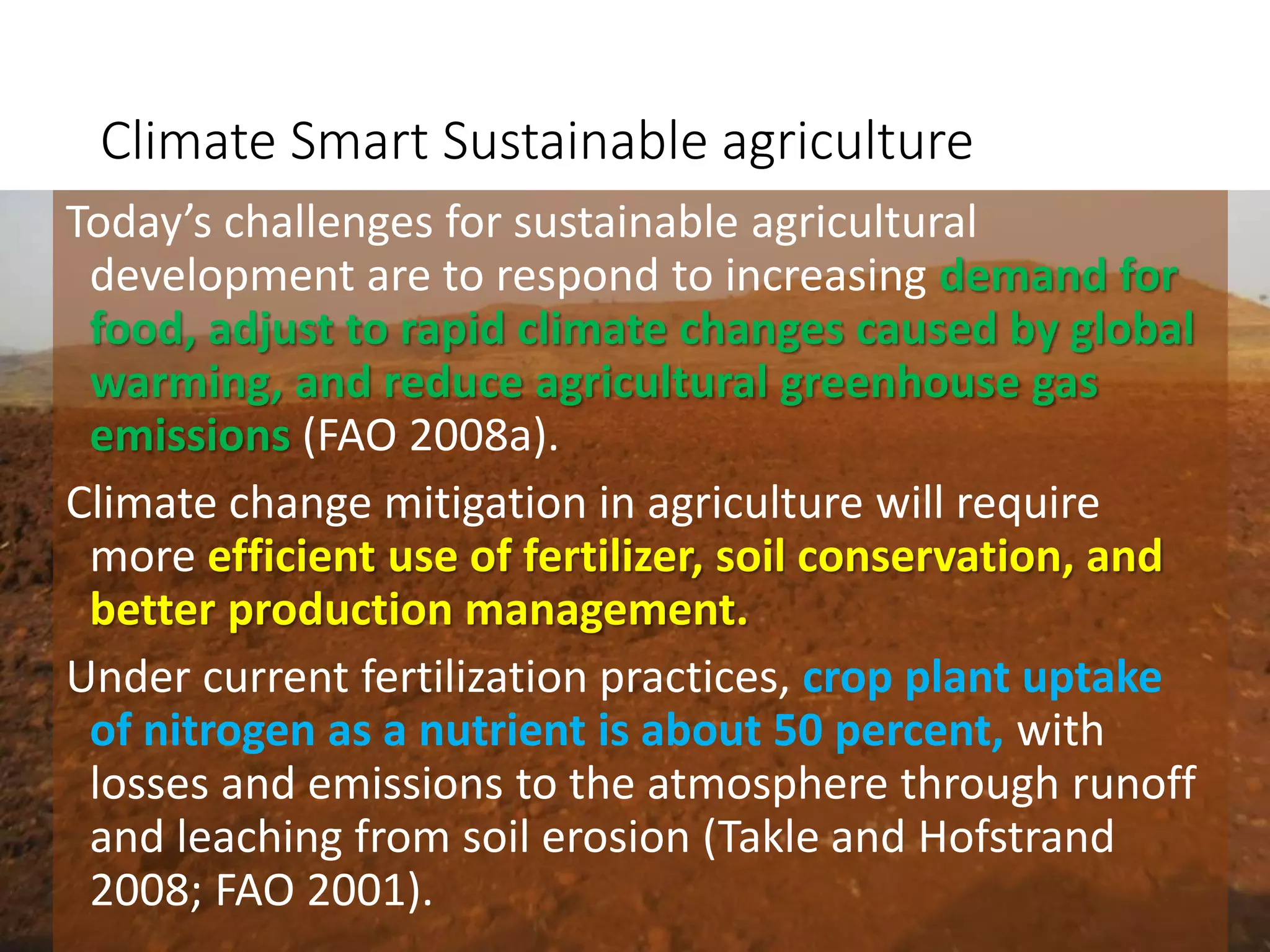
Climate Smart Sustainable agriculture
Today’s challenges for sustainable agricultural
development are to respond to increasing demand for
food, adjust to rapid climate changes caused by global
warming, and reduce agricultural greenhouse gas
emissions (FAO 2008a).
Climate change mitigation in agriculture will require
more efficient use of fertilizer, soil conservation, and
better production management.
Under current fertilization practices, crop plant uptake
of nitrogen as a nutrient is about 50 percent, with
losses and emissions to the atmosphere through runoff
and leaching from soil erosion (Takle and Hofstrand
2008; FAO 2001).
BENEFITS OF BIOCHAR
SOIL IMPROVEMENT
SOIL CONSERVATION
CROP YIELD INCREASE
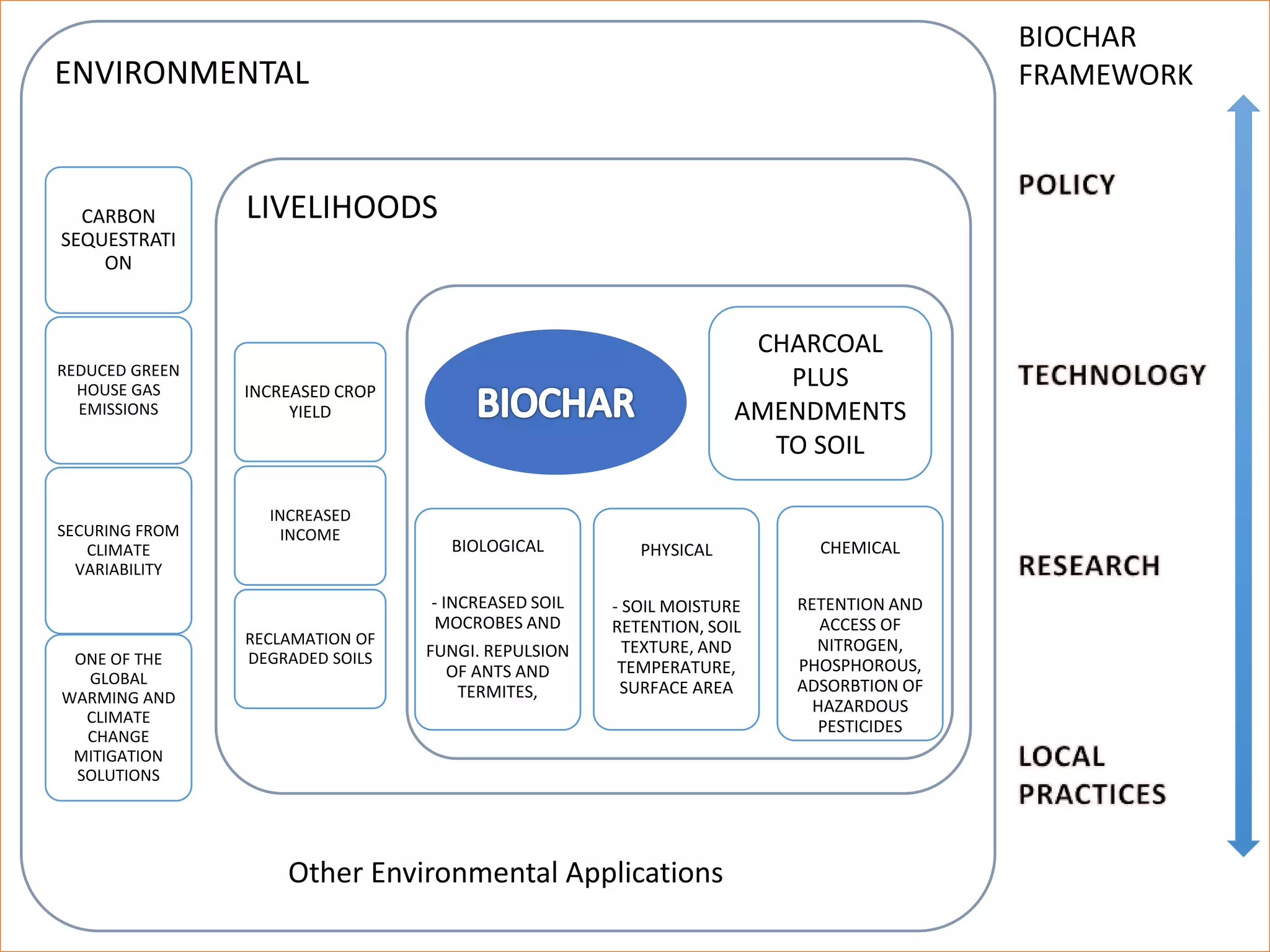
ENVIRONMENTAL
CARBON
SEQUESTRATI
ON
REDUCED GREEN
HOUSE GAS
EMISSIONS
SECURING FROM
CLIMATE
VARIABILITY
ONE OF THE
GLOBAL
WARMING AND
CLIMATE
CHANGE
MITIGATION
SOLUTIONS
LIVELIHOODS
INCREASED CROP
YIELD
INCREASED
INCOME
RECLAMATION OF
DEGRADED SOILS
BIOLOGICAL
- INCREASED SOIL
MOCROBES AND
FUNGI. REPULSION
OF ANTS AND
TERMITES,
PHYSICAL
- SOIL MOISTURE
RETENTION, SOIL
TEXTURE, AND
TEMPERATURE,
SURFACE AREA
CHEMICAL
RETENTION AND
ACCESS OF
NITROGEN,
PHOSPHOROUS,
ADSORBTION OF
HAZARDOUS
PESTICIDES
CHARCOAL
PLUS
AMENDMENTS
TO SOIL
BIOCHAR
FRAMEWORK
Other Environmental Applications
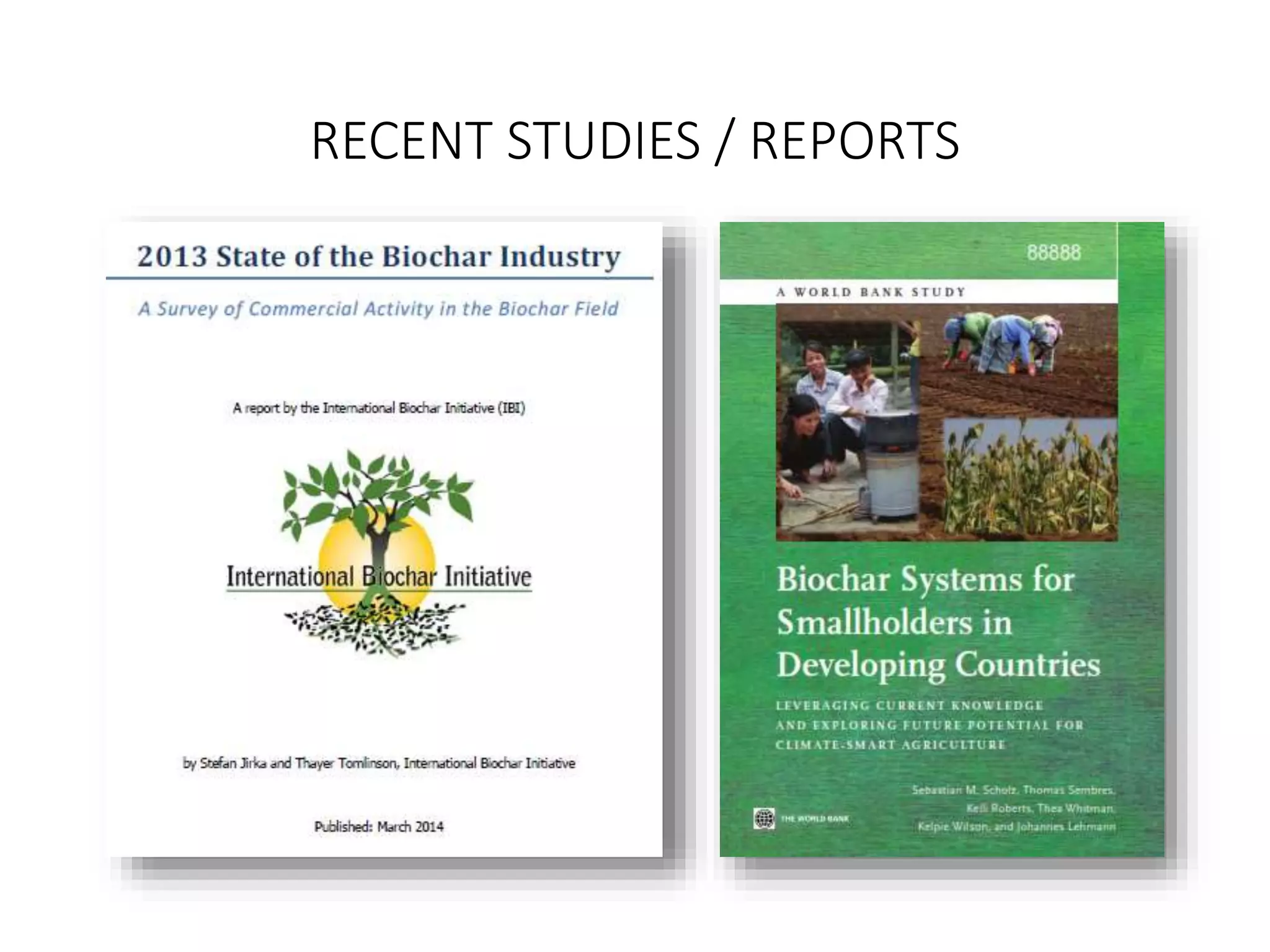
RECENT STUDIES / REPORTS
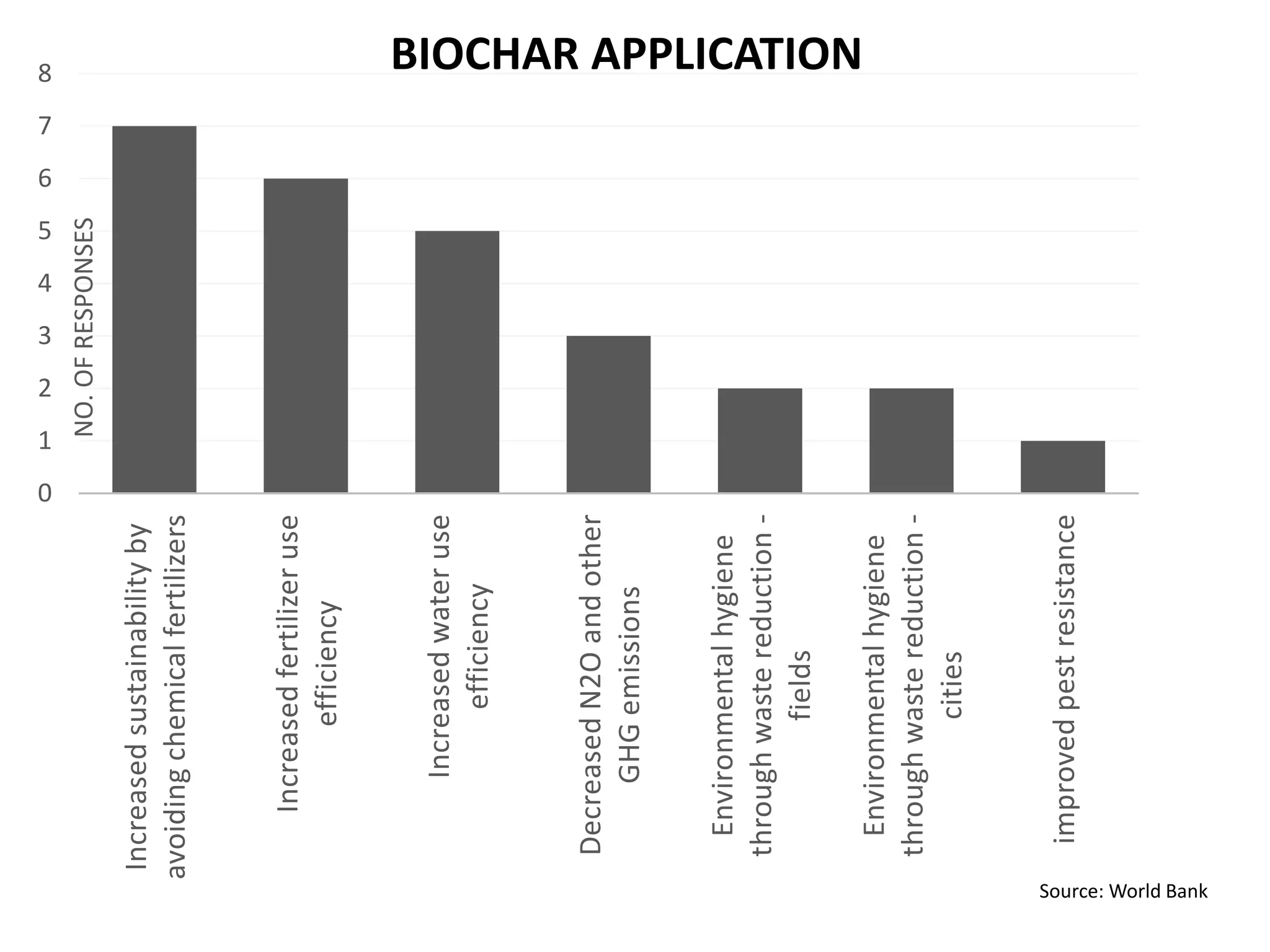
0
1
2
3
4
5
6
7
8
Increasedsustainabilityby
avoidingchemicalfertilizers
Increasedfertilizeruse
efficiency
Increasedwateruse
efficiency
DecreasedN2Oandother
GHGemissions
Environmentalhygiene
throughwastereduction-
fields
Environmentalhygiene
throughwastereduction-
cities
improvedpestresistance
NO.OFRESPONSES
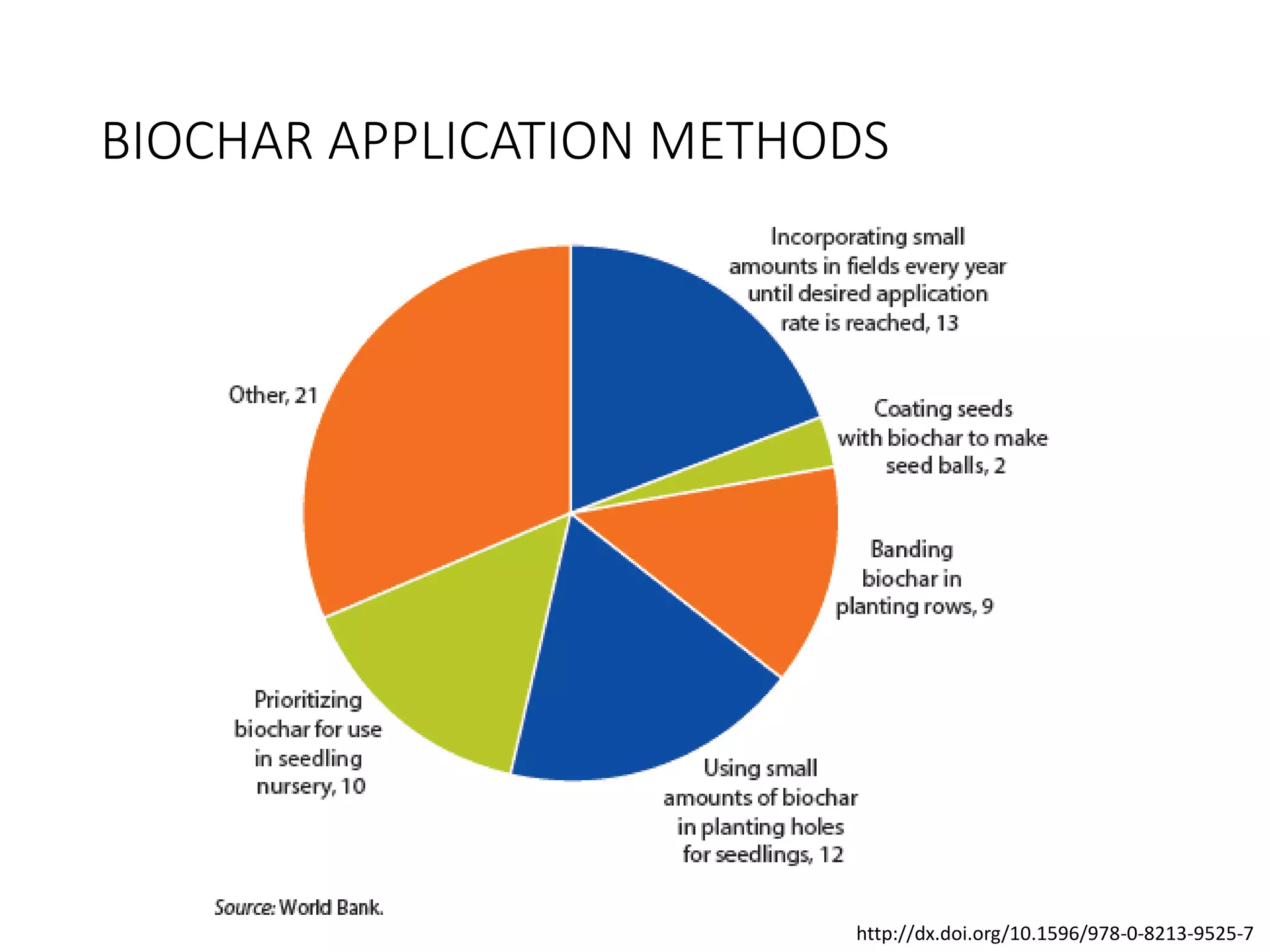
BIOCHAR APPLICATION
Source: World Bank
•
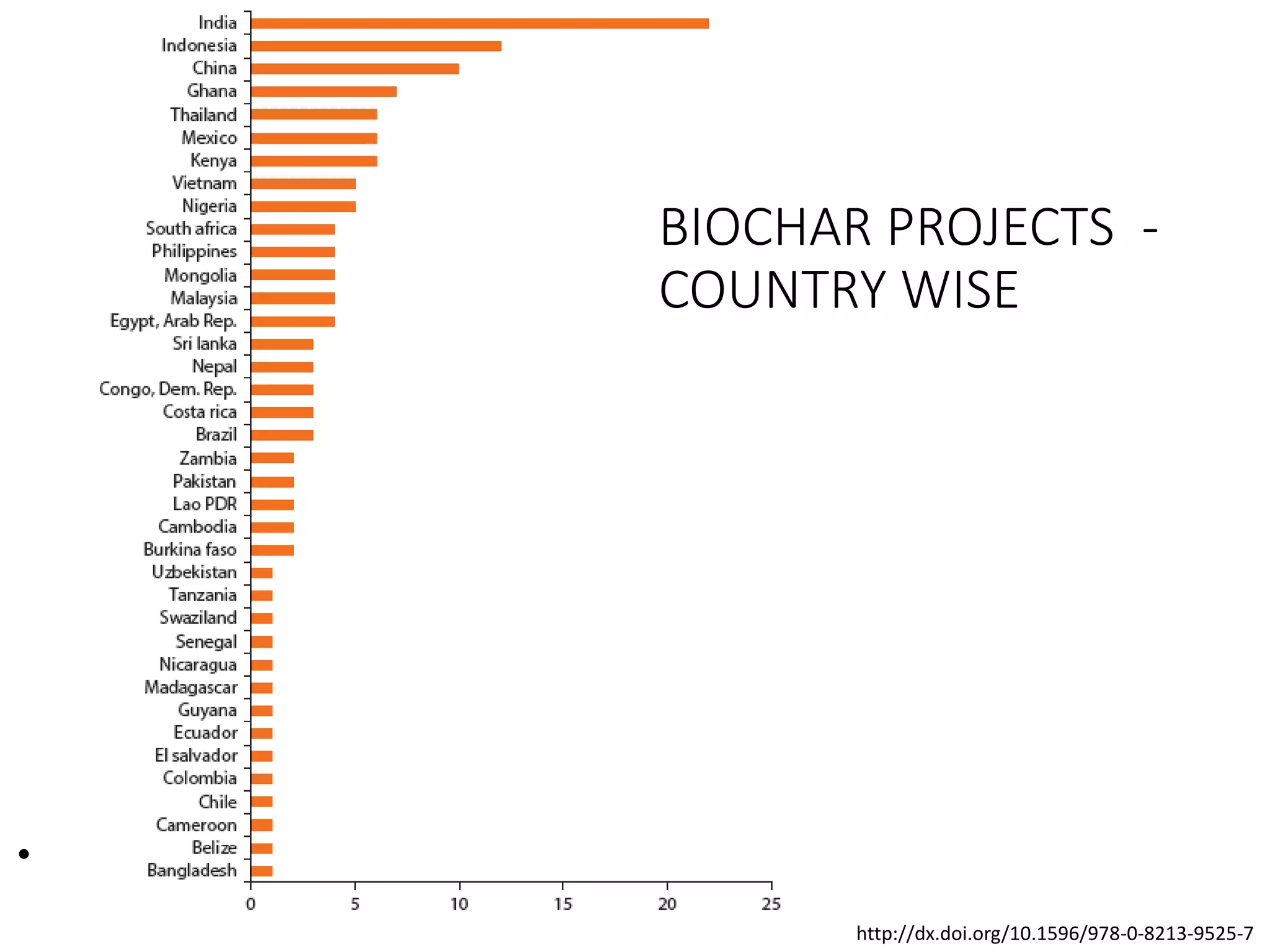
BIOCHAR PROJECTS -
COUNTRY WISE
http://dx.doi.org/10.1596/978-0-8213-9525-7
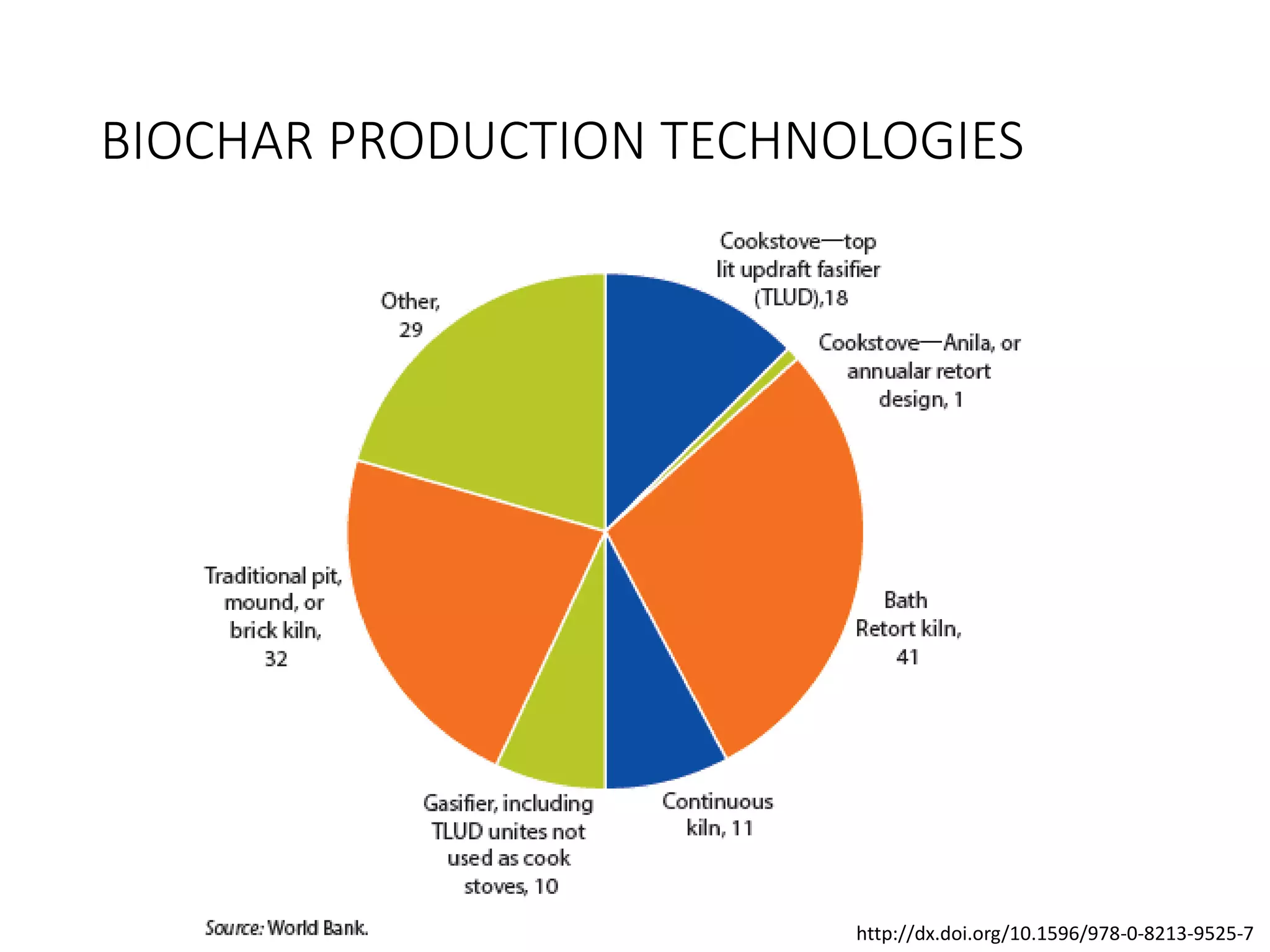
BIOCHAR PRODUCTION TECHNOLOGIES
http://dx.doi.org/10.1596/978-0-8213-9525-7
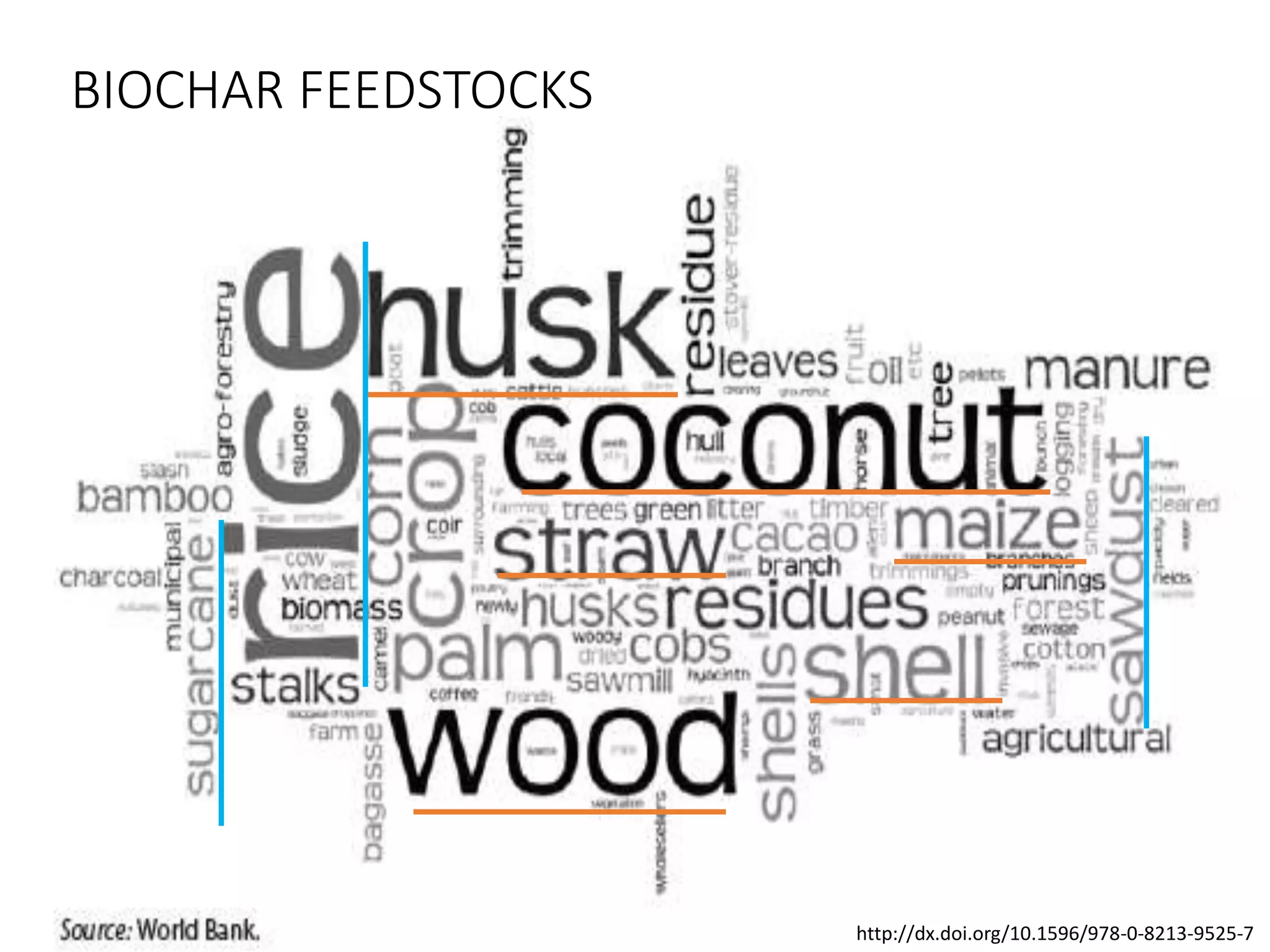
BIOCHAR FEEDSTOCKS
http://dx.doi.org/10.1596/978-0-8213-9525-7
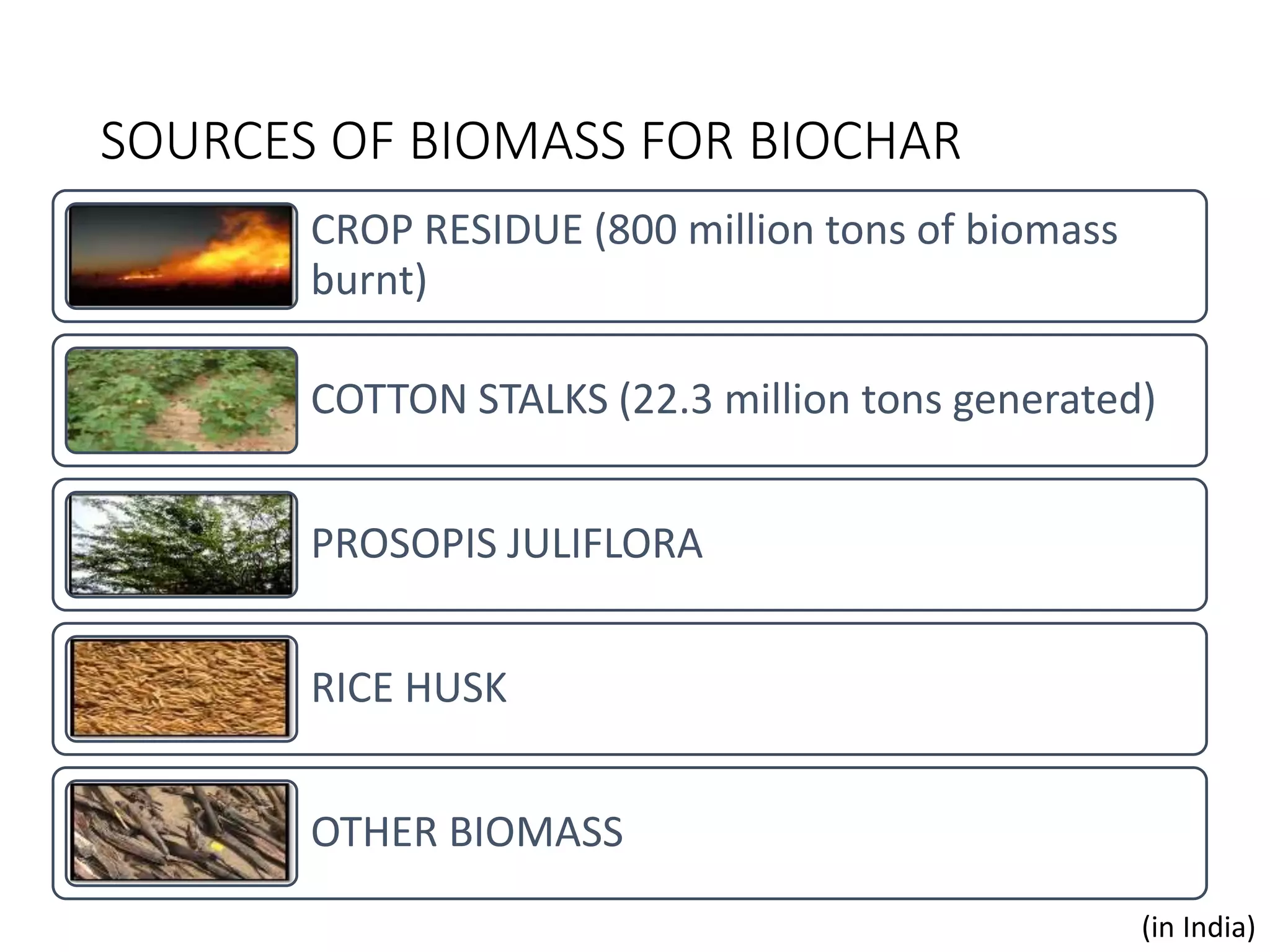
SOURCES OF BIOMASS FOR BIOCHAR
CROP RESIDUE (800 million tons of biomass
burnt)
COTTON STALKS (22.3 million tons generated)
PROSOPIS JULIFLORA
RICE HUSK
OTHER BIOMASS
(in India)
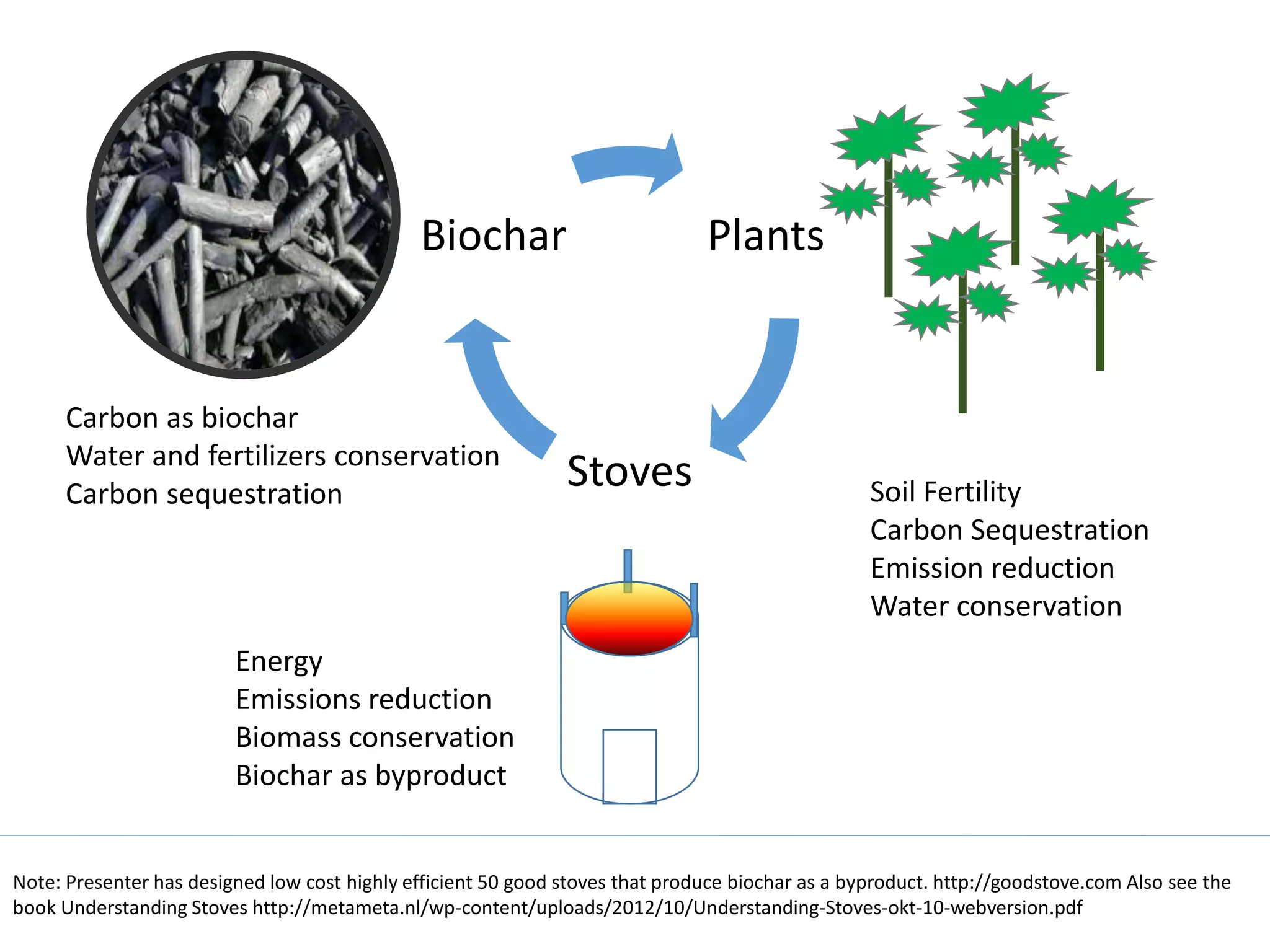
Plants
Stoves
Biochar
Soil Fertility
Carbon Sequestration
Emission reduction
Water conservation
Energy
Emissions reduction
Biomass conservation
Biochar as byproduct
Carbon as biochar
Water and fertilizers conservation
Carbon sequestration
Note: Presenter has designed low cost highly efficient 50 good stoves that produce biochar as a byproduct. http://goodstove.com Also see the
book Understanding Stoves http://metameta.nl/wp-content/uploads/2012/10/Understanding-Stoves-okt-10-webversion.pdf
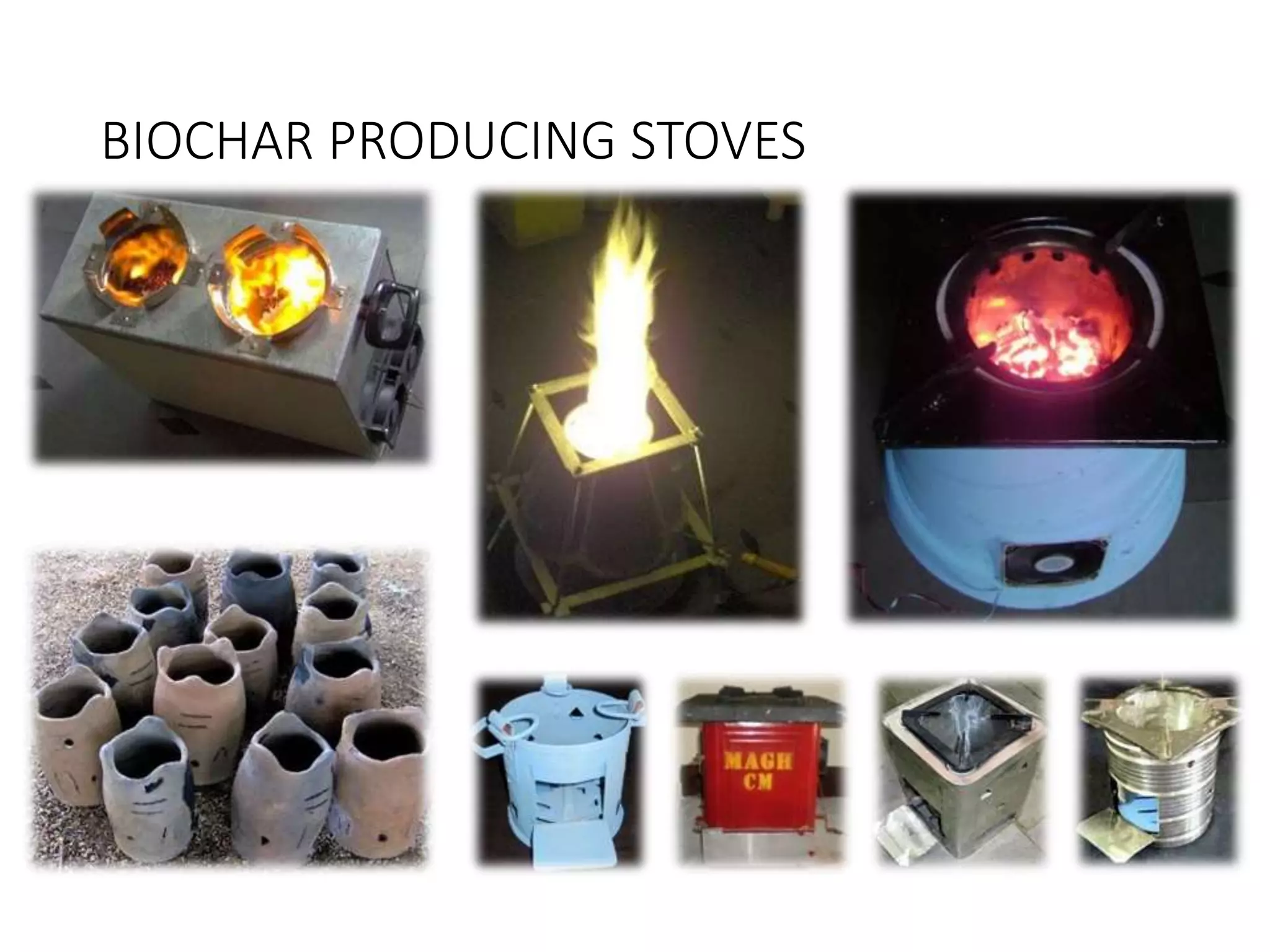
BIOCHAR PRODUCING STOVES
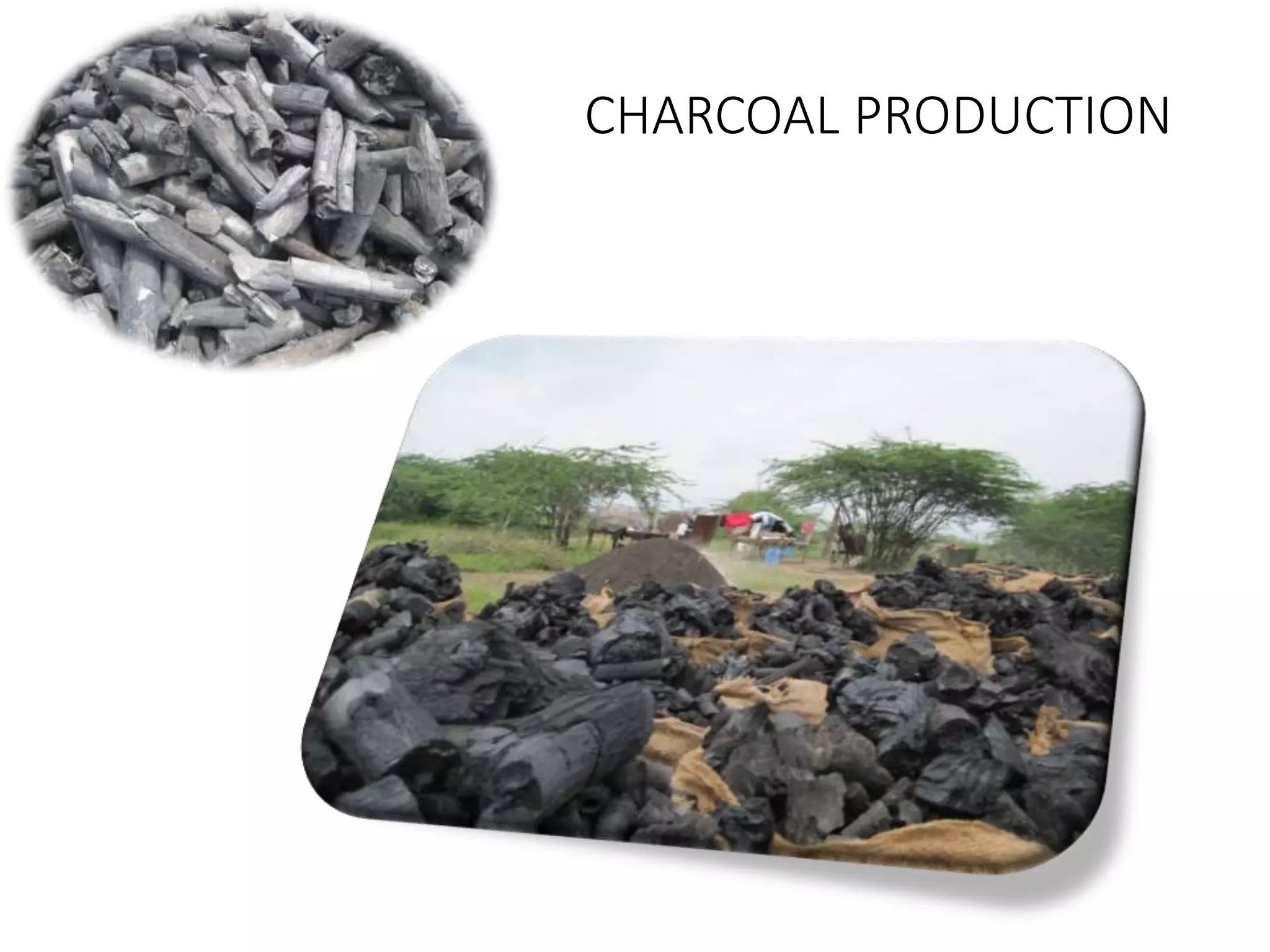
CHARCOAL PRODUCTION
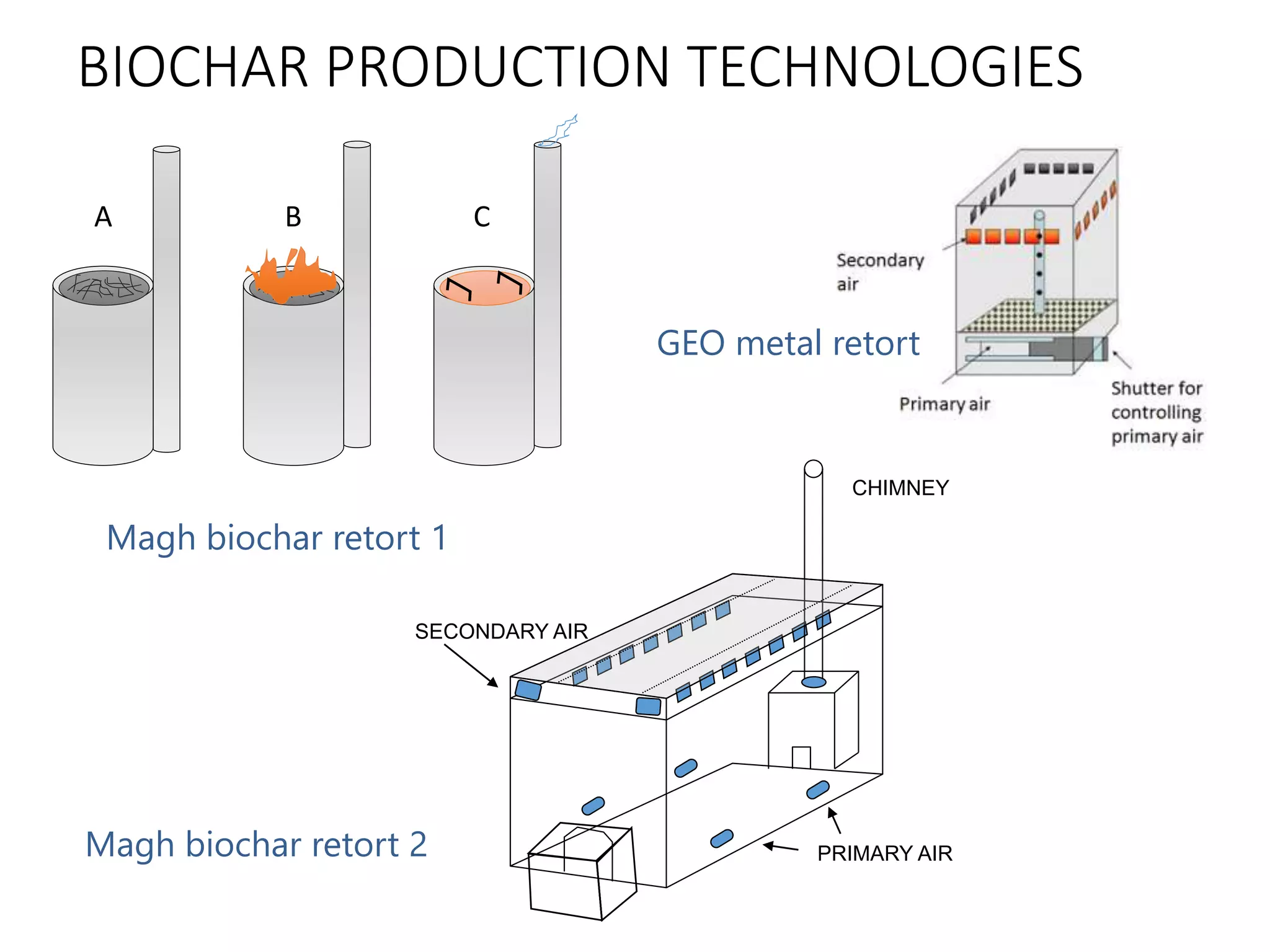
A B C
CHIMNEY
PRIMARY AIR
SECONDARY AIR
GEO metal retort
Magh biochar retort 2
Magh biochar retort 1
BIOCHAR PRODUCTION TECHNOLOGIES
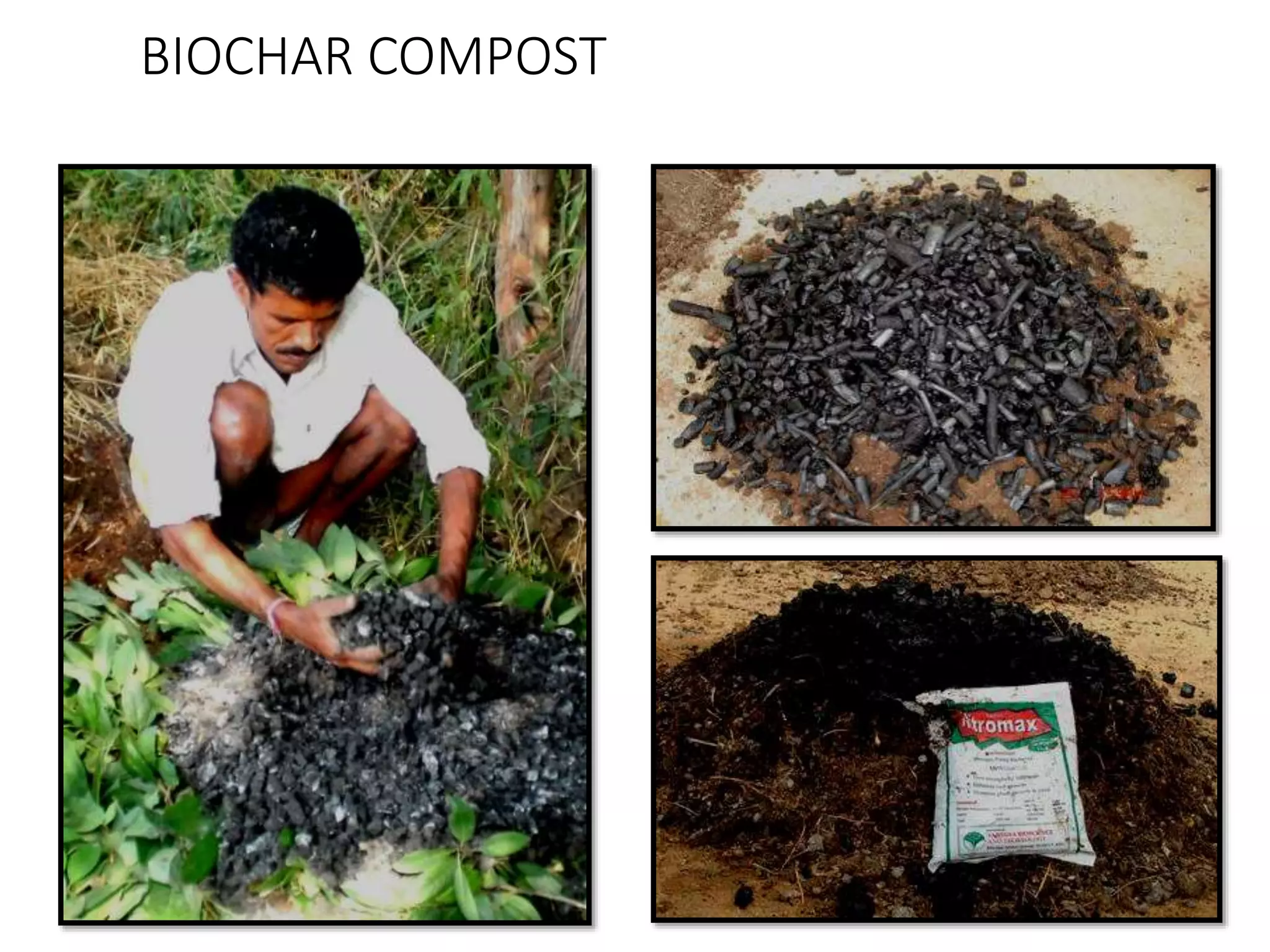
BIOCHAR COMPOST
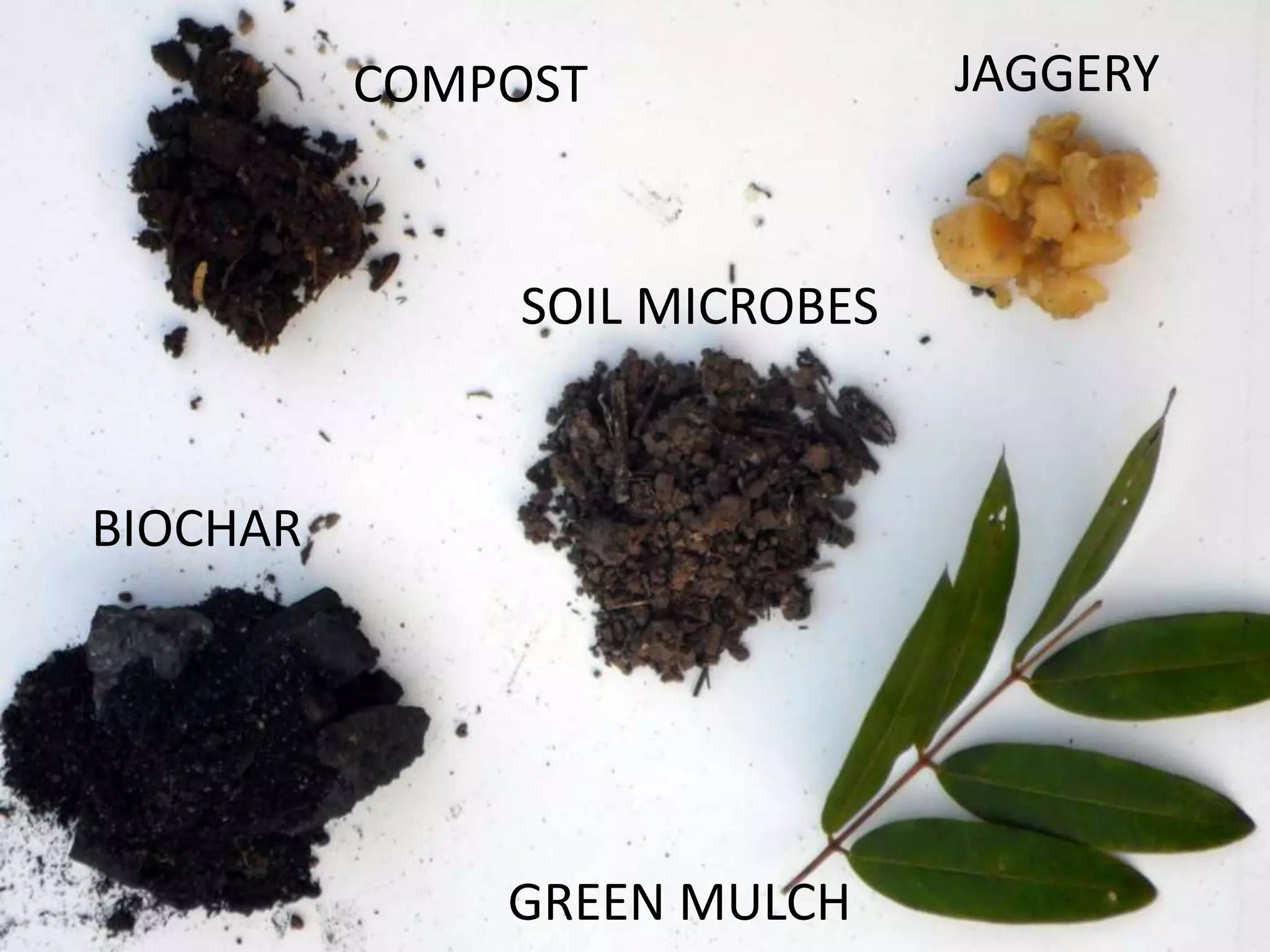
JAGGERYCOMPOST
BIOCHAR
SOIL MICROBES
GREEN MULCH
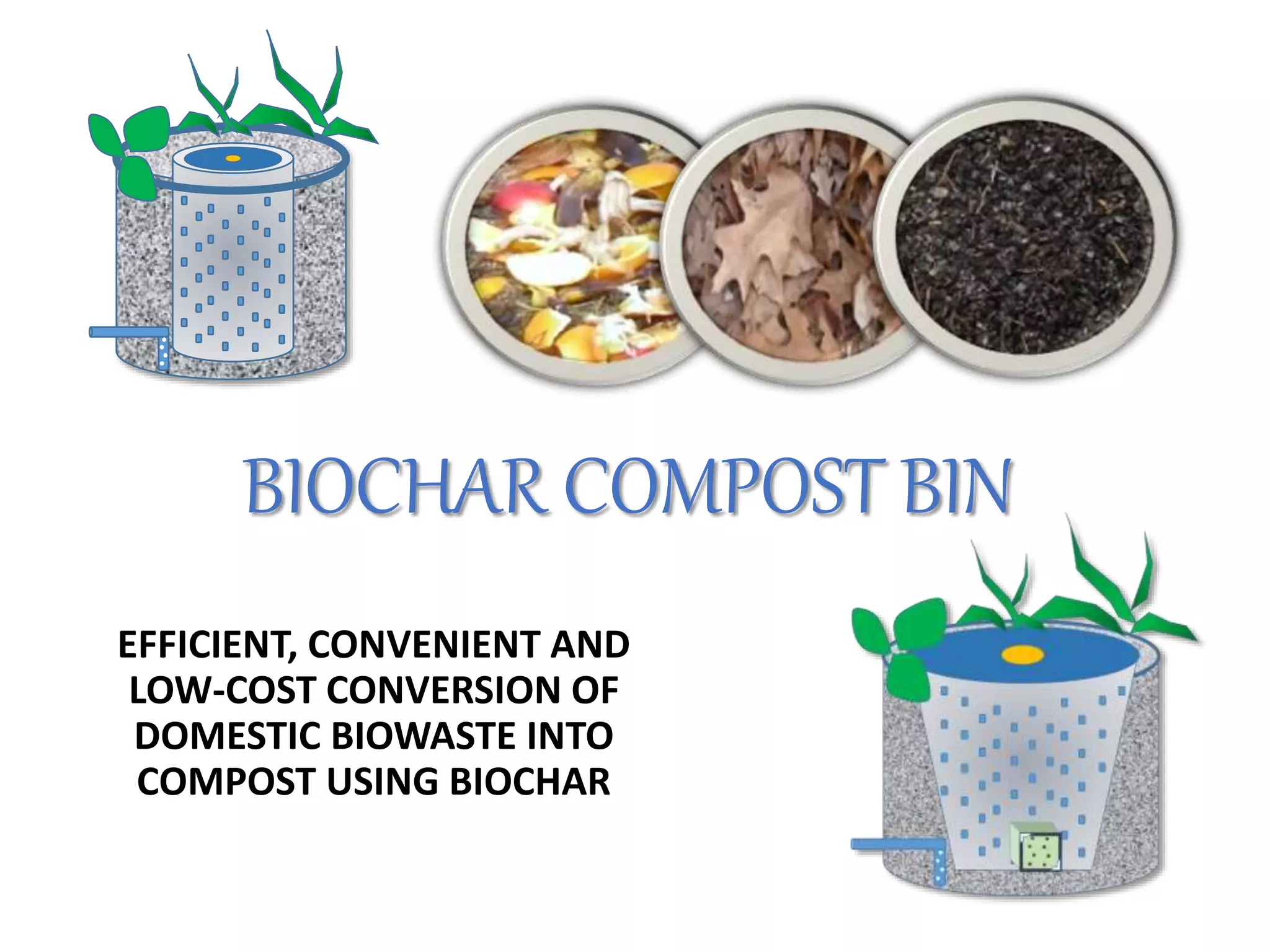
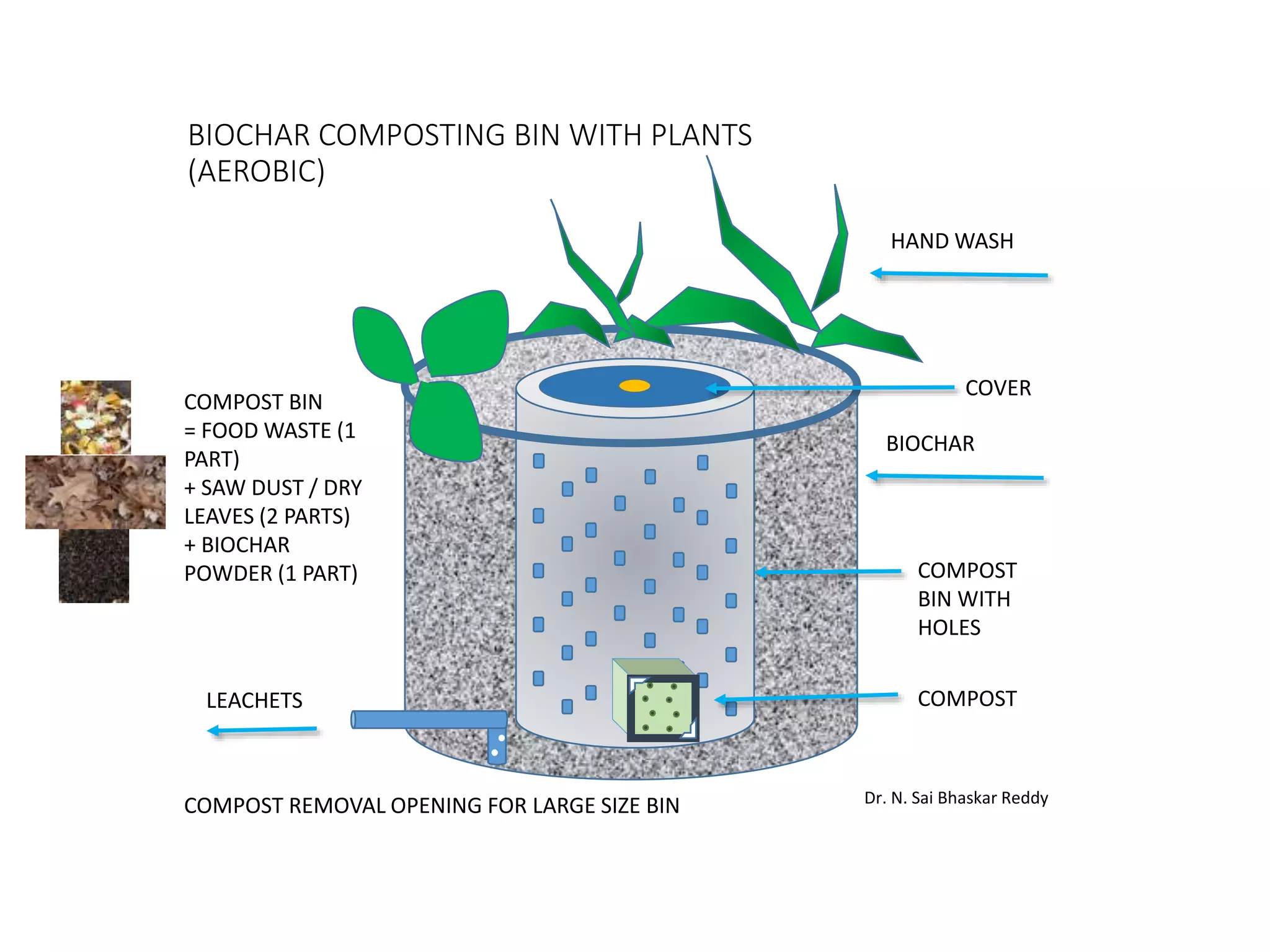
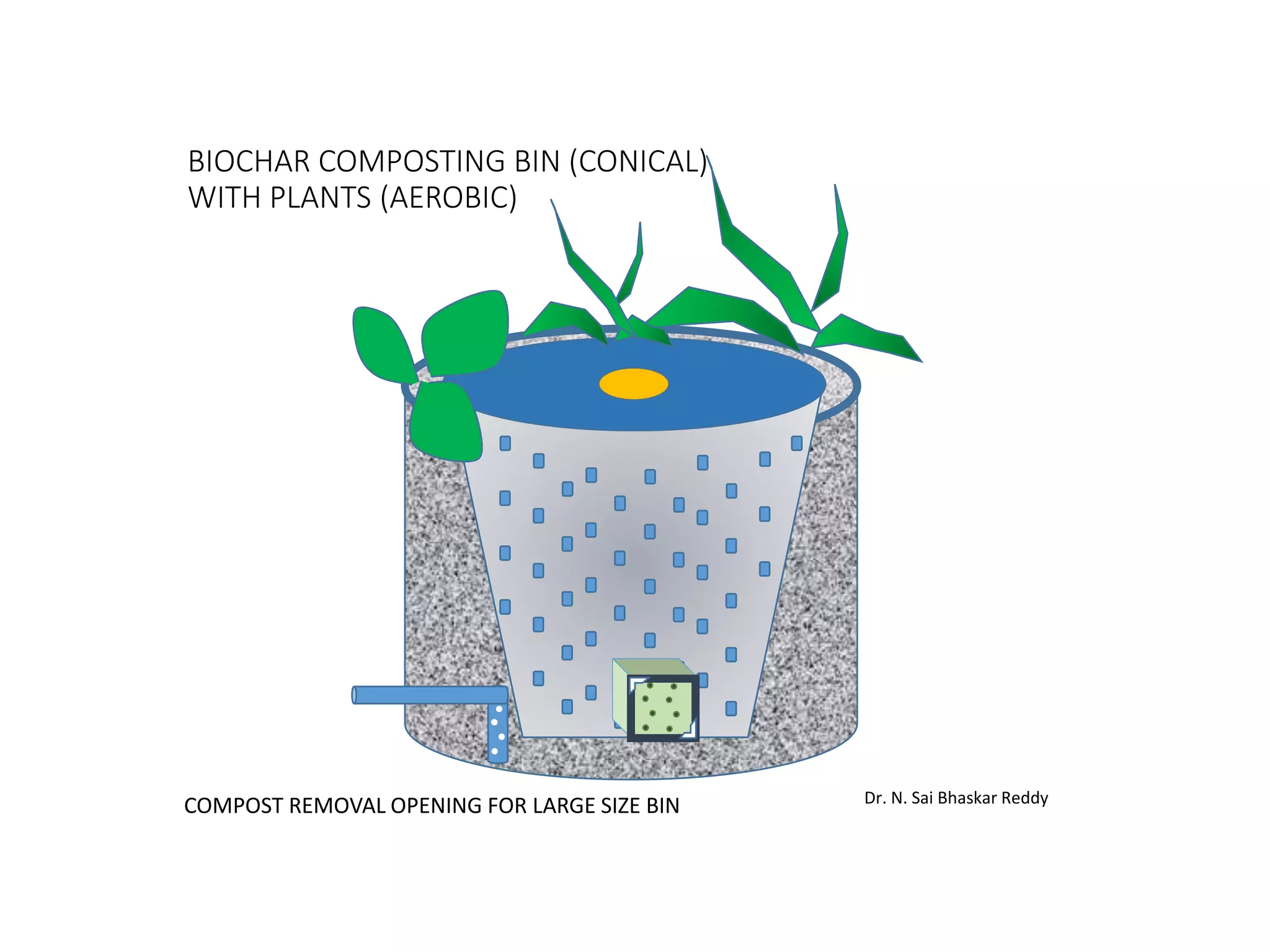
BIOCHAR COMPOST BIN
EFFICIENT, CONVENIENT AND
LOW-COST CONVERSION OF
DOMESTIC BIOWASTE INTO
COMPOST USING BIOCHAR
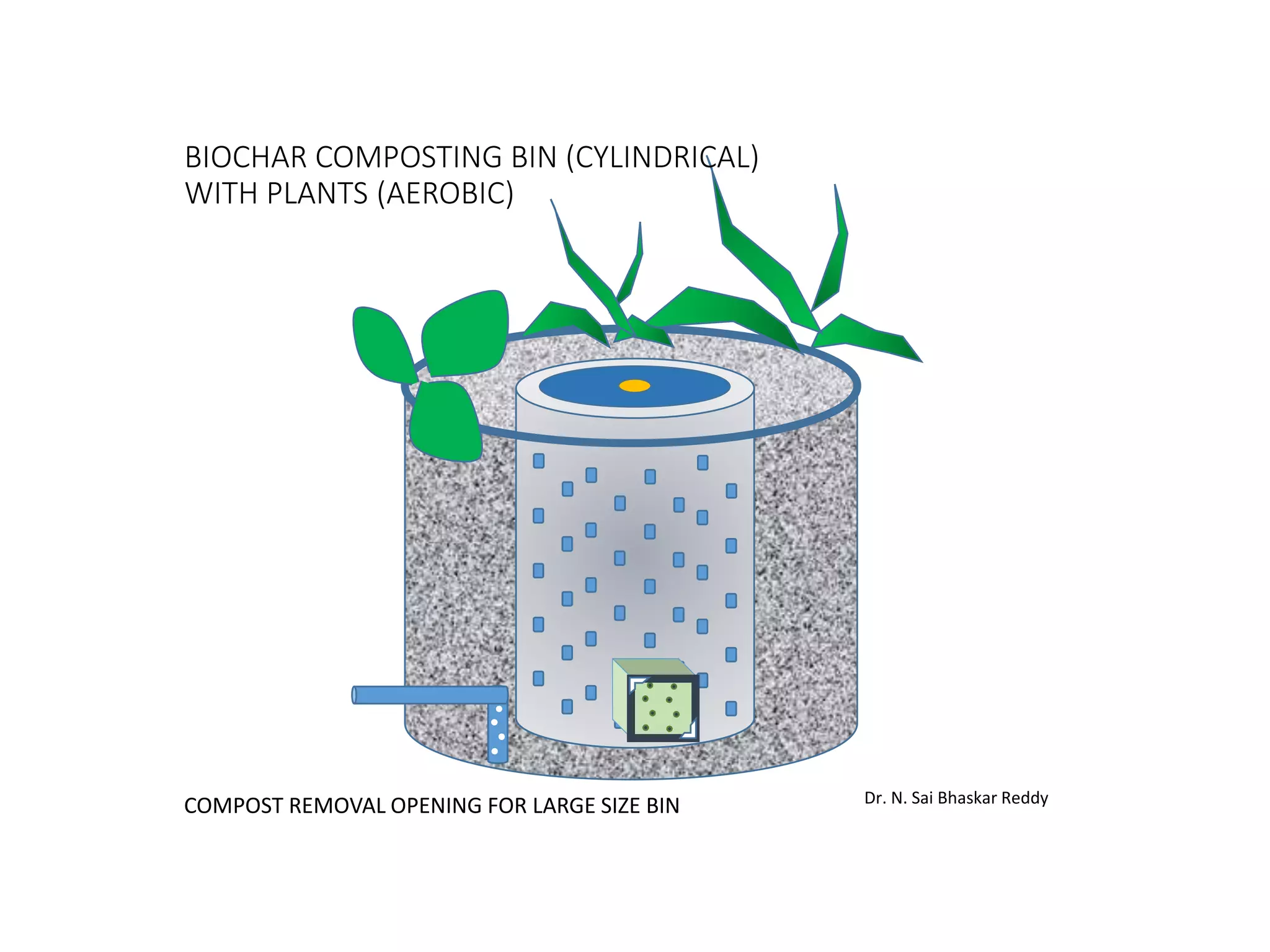
COMPOST REMOVAL OPENING FOR LARGE SIZE BIN Dr. N. Sai Bhaskar Reddy
BIOCHAR COMPOSTING BIN (CYLINDRICAL)
WITH PLANTS (AEROBIC)
BIOCHAR COMPOSTING BIN WITH PLANTS
(AEROBIC)
BIOCHAR
LEACHETS
COMPOST
BIN WITH
HOLES
COMPOST BIN
= FOOD WASTE (1
PART)
+ SAW DUST / DRY
LEAVES (2 PARTS)
+ BIOCHAR
POWDER (1 PART)
COMPOST
COVER
COMPOST REMOVAL OPENING FOR LARGE SIZE BIN
HAND WASH
Dr. N. Sai Bhaskar Reddy
BIOCHAR COMPOSTING BIN (CONICAL)
WITH PLANTS (AEROBIC)
COMPOST REMOVAL OPENING FOR LARGE SIZE BIN Dr. N. Sai Bhaskar Reddy
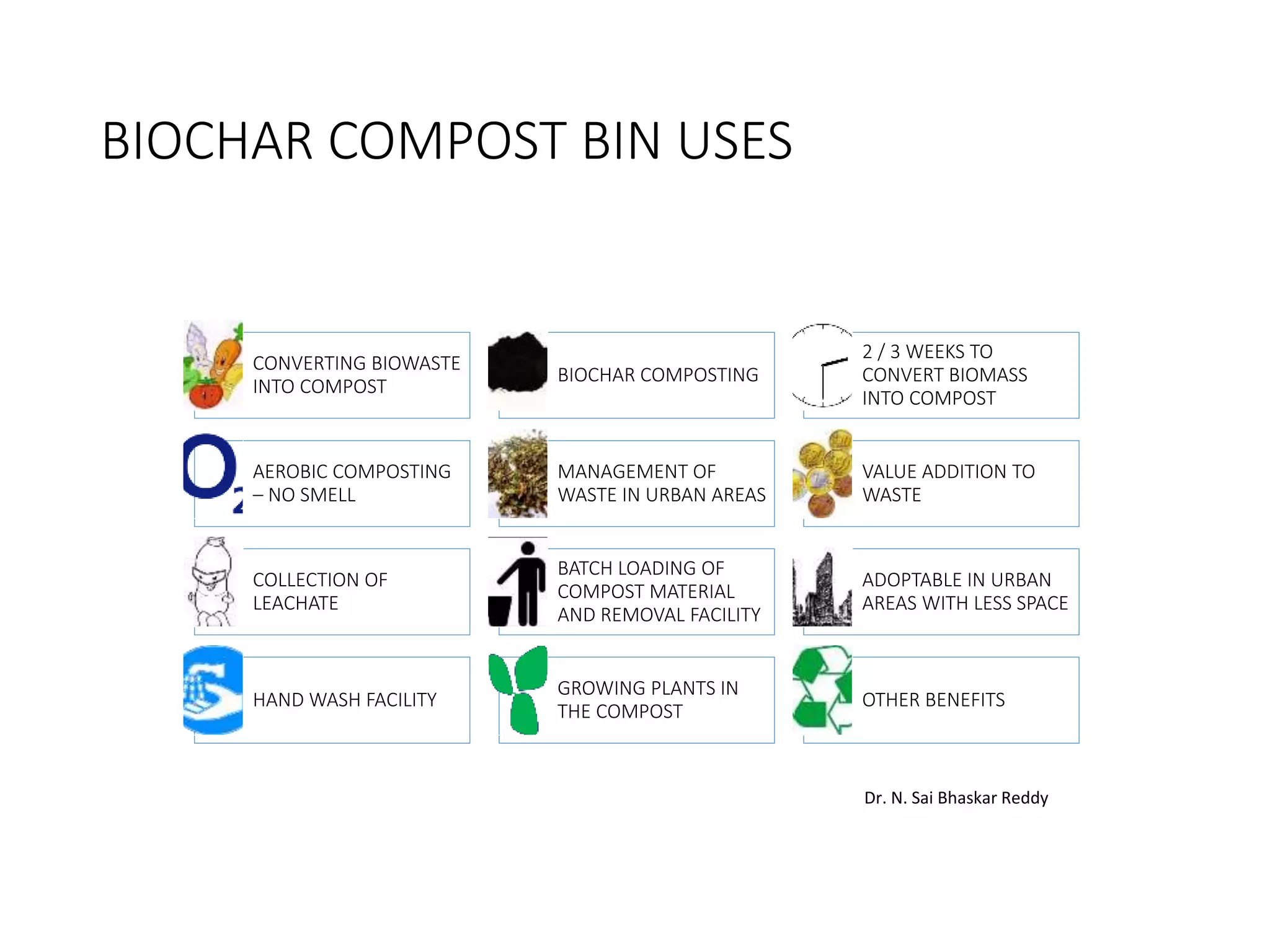
BIOCHAR COMPOST BIN USES
CONVERTING BIOWASTE
INTO COMPOST
BIOCHAR COMPOSTING
2 / 3 WEEKS TO
CONVERT BIOMASS
INTO COMPOST
AEROBIC COMPOSTING
– NO SMELL
MANAGEMENT OF
WASTE IN URBAN AREAS
VALUE ADDITION TO
WASTE
COLLECTION OF
LEACHATE
BATCH LOADING OF
COMPOST MATERIAL
AND REMOVAL FACILITY
ADOPTABLE IN URBAN
AREAS WITH LESS SPACE
HAND WASH FACILITY
GROWING PLANTS IN
THE COMPOST
OTHER BENEFITS
Dr. N. Sai Bhaskar Reddy
http://dx.doi.org/10.1596/978-0-8213-9525-7
BIOCHAR APPLICATION METHODS
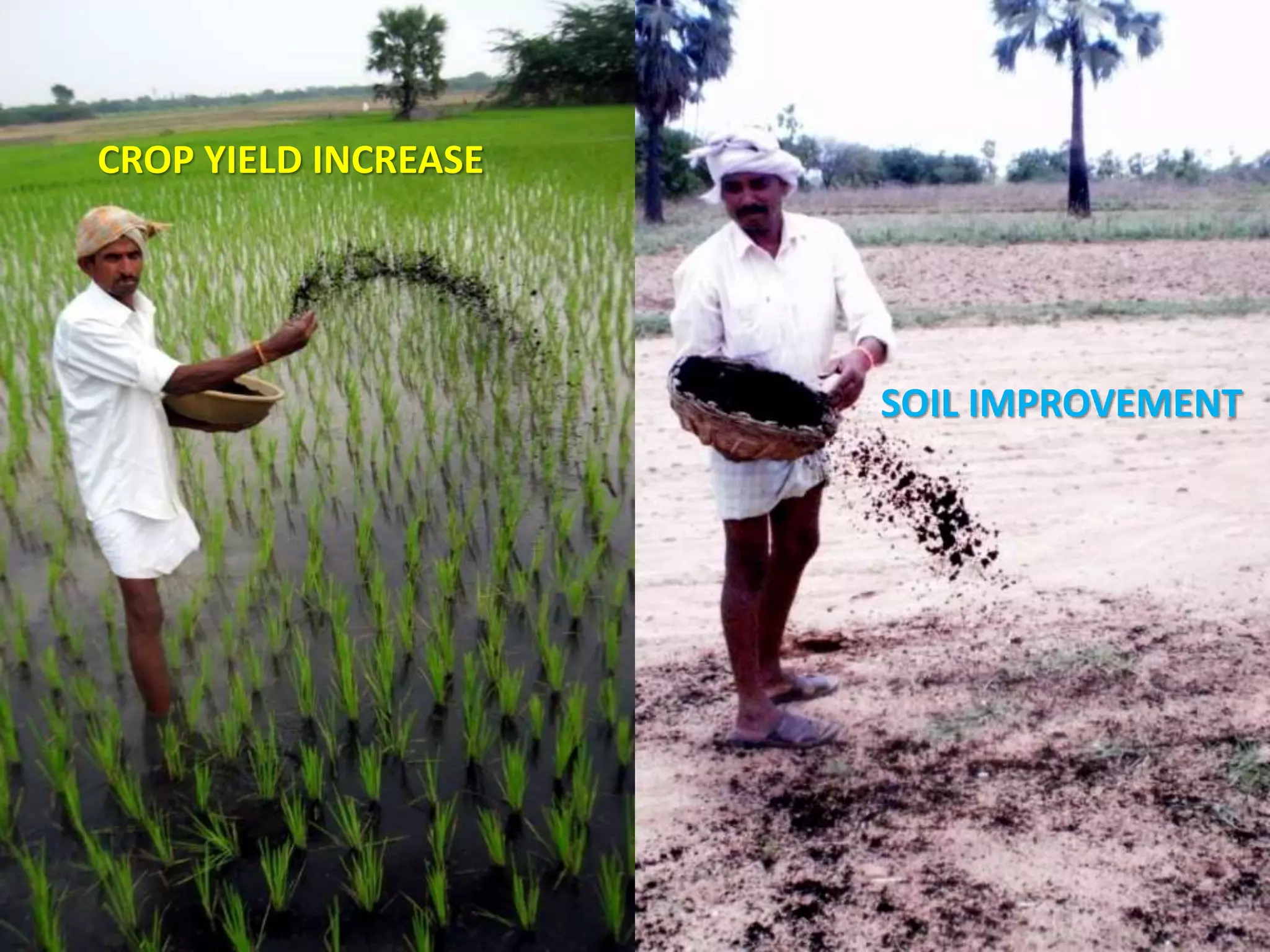
CROP YIELD INCREASE
SOIL IMPROVEMENT
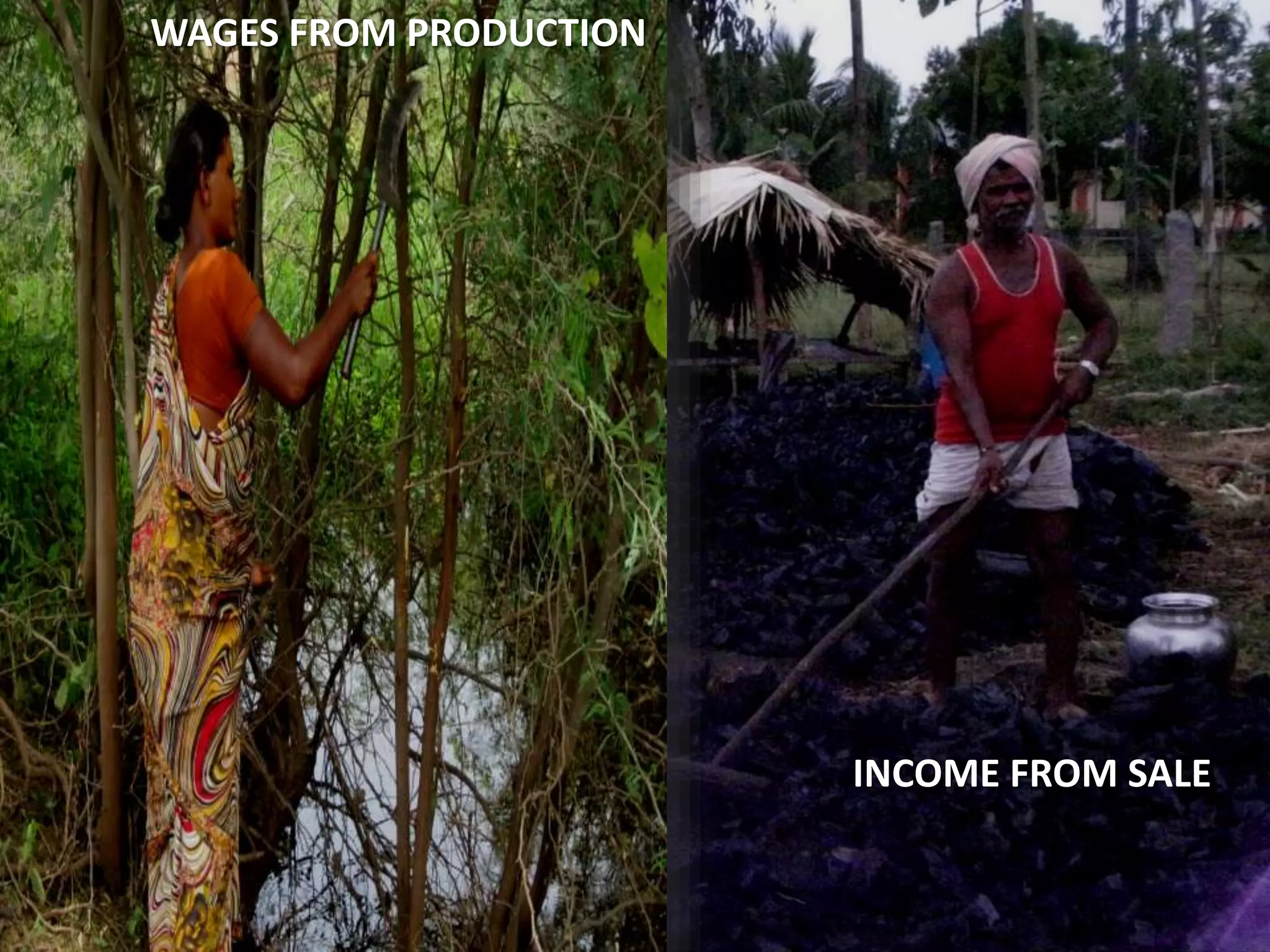
WAGES FROM PRODUCTION
INCOME FROM SALE
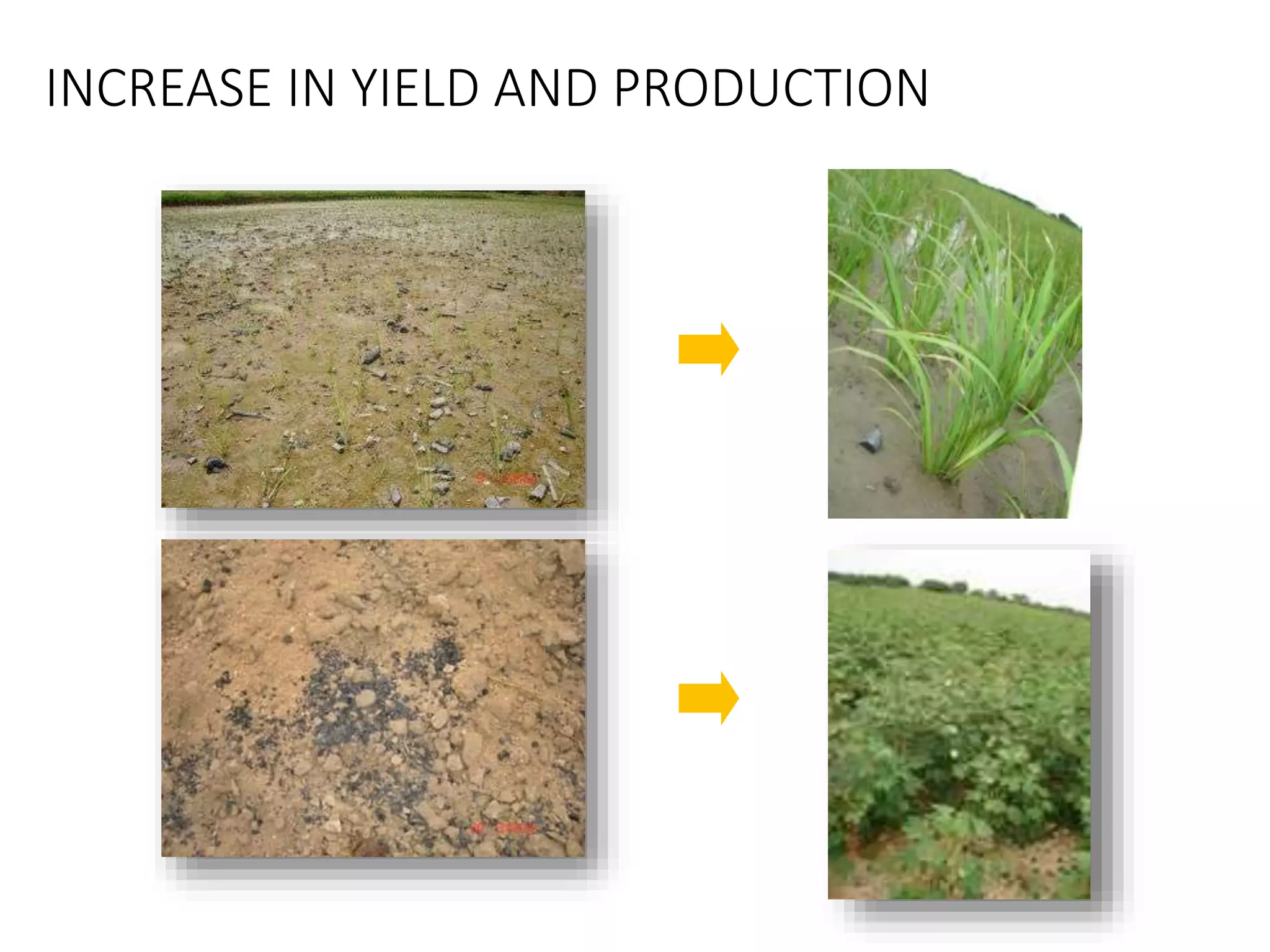
INCREASE IN YIELD AND PRODUCTION
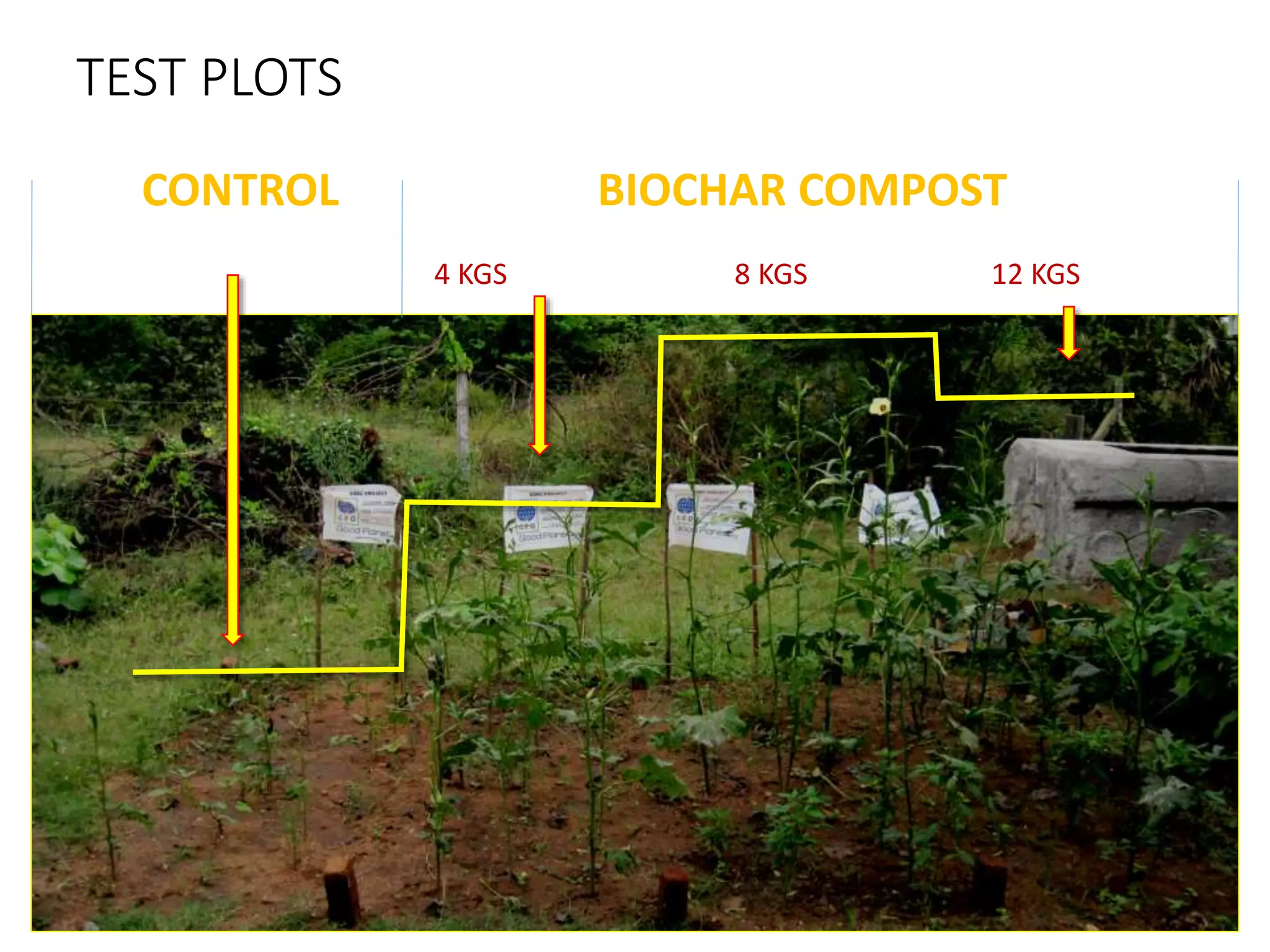
TEST PLOTS
CONTROL BIOCHAR COMPOST
4 KGS 8 KGS 12 KGS
All farmers can adopt
biochar, and one need not be
in a hurry to apply large
quantities to achieve a
bumper yield. Annual
incremental application is
more sustainable for the
farmer and for the
environment.
Biochar application reduces the burden of farmers in several
ways, namely by maintaining and enhancing soil fertility.
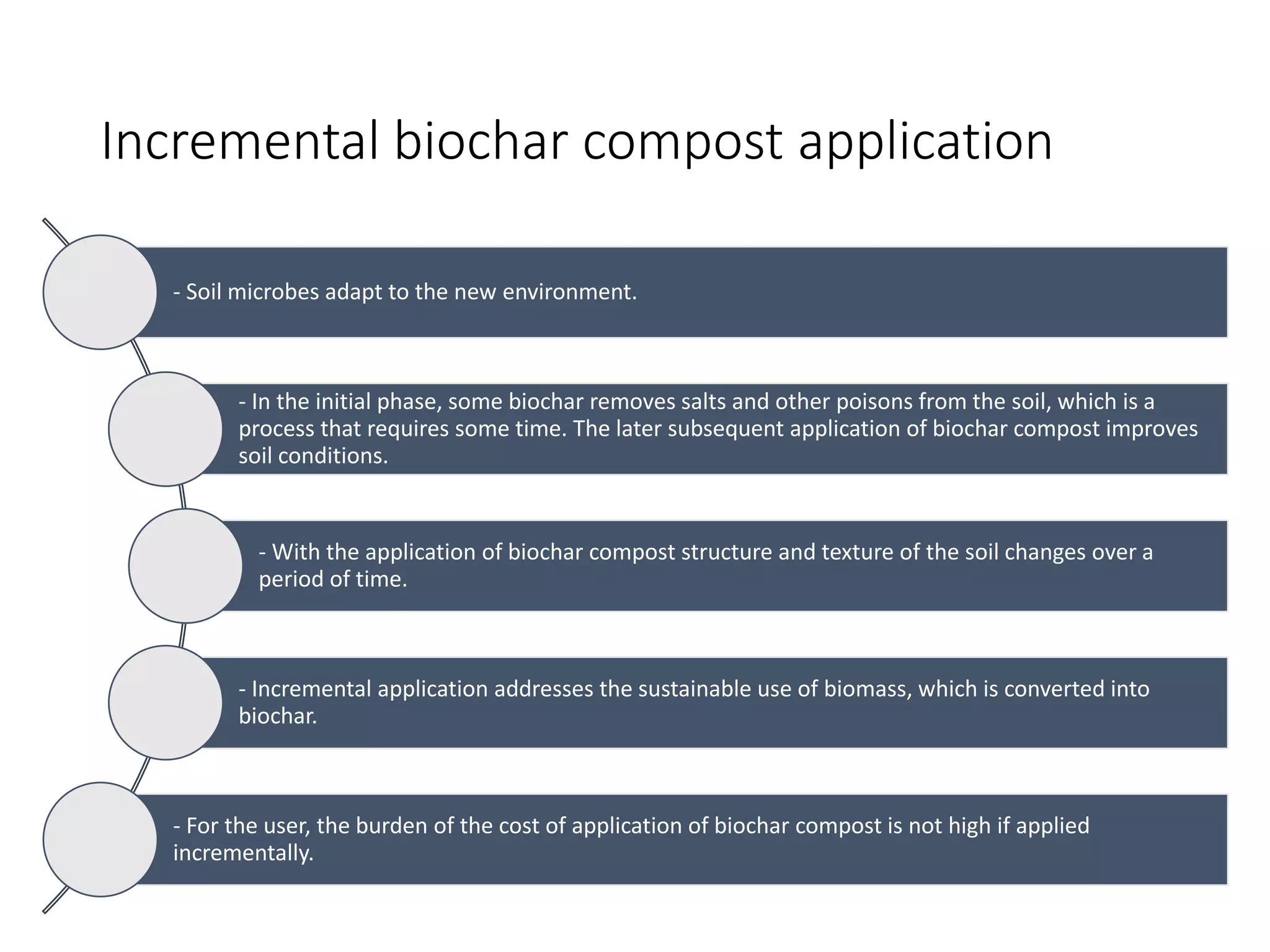
Incremental biochar compost application
- Soil microbes adapt to the new environment.
- In the initial phase, some biochar removes salts and other poisons from the soil, which is a
process that requires some time. The later subsequent application of biochar compost improves
soil conditions.
- With the application of biochar compost structure and texture of the soil changes over a
period of time.
- Incremental application addresses the sustainable use of biomass, which is converted into
biochar.
- For the user, the burden of the cost of application of biochar compost is not high if applied
incrementally.
Biochar protects and enhances
both macro and micro biodiversity.
Microbial habitats are enhanced
through the unique structure and
properties of biochar. Biochar-
amended soils have higher
microbial biodiversity.
Biochar amended soils show high
levels of microbial biodiversity.
Biochar is like a coral reef for the
soil, creating a great habitat for all
soil life diversity.
Biochar and soil microbes minimize
the use of purchasing inputs and
maximize the efficiency of soil
microbes use.
The author has developed an area
with 200 species of plants
conserved on half–an-acre of land
to develop soil microbial culture
for inoculation into biochar.
Physical - Biochar reduces soil bulk density.
- Biochar increases soil aeration.
- Biochar changes the soil structure and texture
through changes in physical and chemical properties.
- Biochar lessens the hardening of soils.
- Biochar helps to reclaim degraded soils.
- Increased Cation Exchange Capacity.
Chemical - Biochar reduces soil acidity by increasing pH (also called the liming effect).
- Biochar helps soil retain nutrients and fertilizers (Lehmann, 2006 in Hansen, 2008).
- The application of biochar improves soil fertility via two mechanisms: (1) by adding
nutrients to the soil (such as K, to a limited extent P, and micronutrients); (2) by
retaining nutrients from other sources including nutrients from the soil itself.
- Biochar increases C, N, and P availability to plants, because biochar absorbs and
slowly releases fertilizer.
- Biochar increases in the soil levels of available Ca, Mg, P, and K.
- Biochar helps to prevent fertilizer runoff and leaching, allowing the use of less
fertilizer and diminishing agricultural pollution to the surrounding environment.
Biochar mitigates the impact of hazardous pesticides and nitrogen fertilizers on the
local environment and ecology.
- Biochar absorbs complex fertilizers and pesticides in soil, thus lessening their
impacts.
Biological - Biochar increases soil microbial respiration by creating
space for soil microbes.
- It increases soil biodiversity and soil-life density in the
presence of organic carbon.
- Biochar increases arbuscular mycorrhizae fungi. Soil
aggregation also improves due to increased fungal hyphae.
Biochar helps to lessen the impacts of termites on the
biomass in agricultural field.
The presence and density of earthworms increase in soil
treated with biochar over time.
Ants are more repellent to the freshly added biochar, and
over a period of time the biochar’s impact on ants lessens.
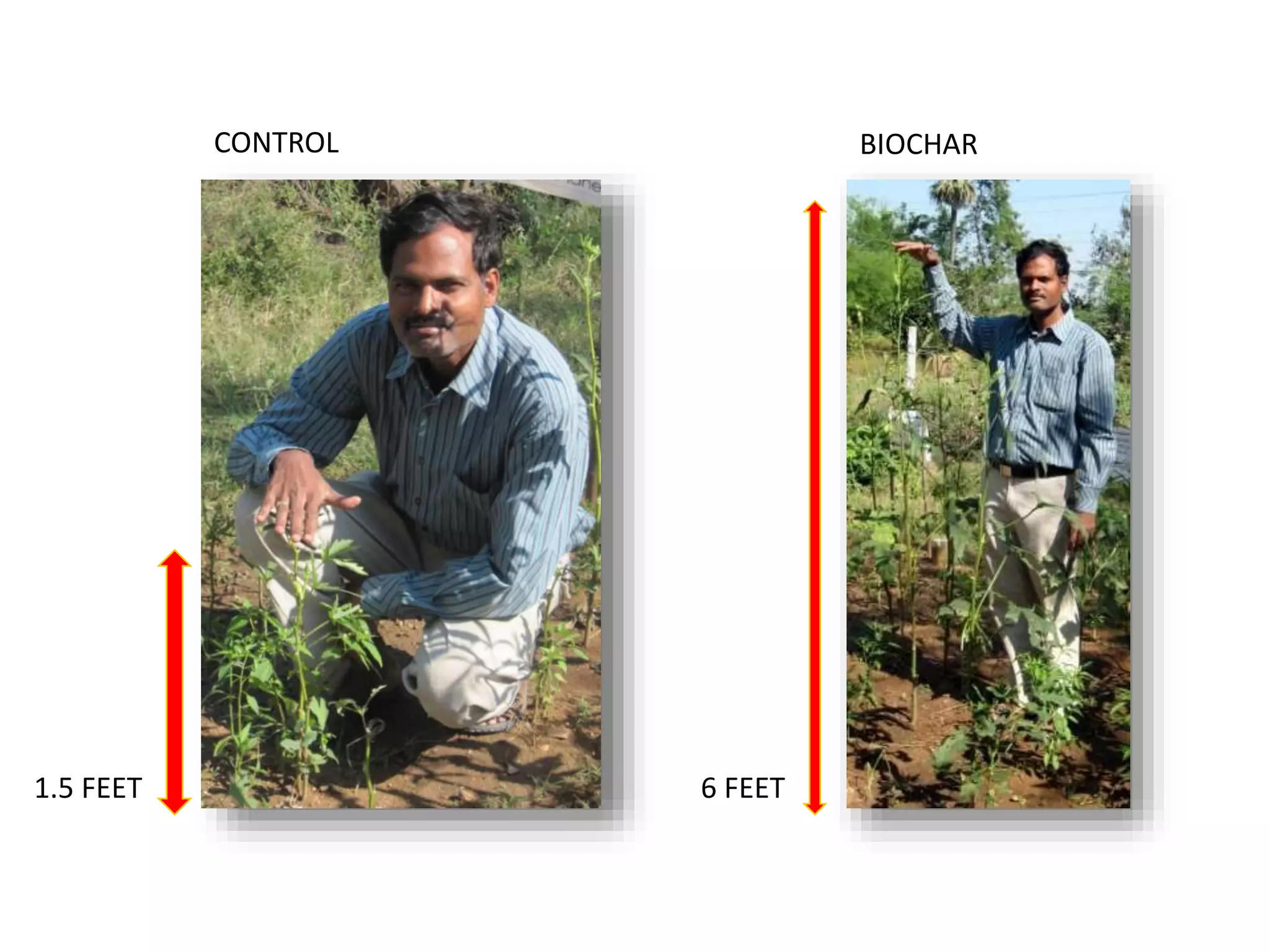
1.5 FEET 6 FEET
CONTROL BIOCHAR
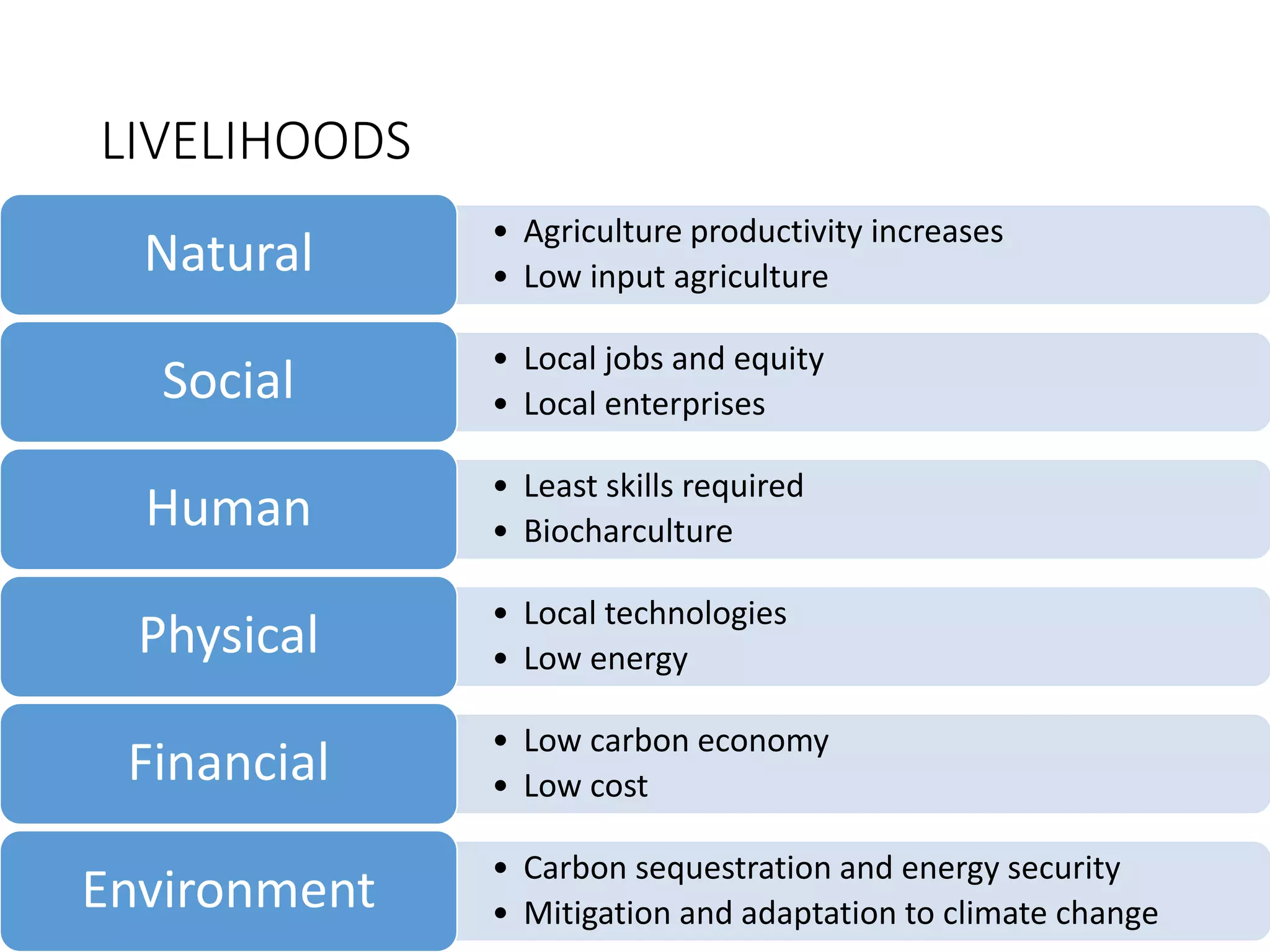
LIVELIHOODS
• Agriculture productivity increases
• Low input agricultureNatural
• Local jobs and equity
• Local enterprisesSocial
• Least skills required
• BiocharcultureHuman
• Local technologies
• Low energyPhysical
• Low carbon economy
• Low costFinancial
• Carbon sequestration and energy security
• Mitigation and adaptation to climate changeEnvironment
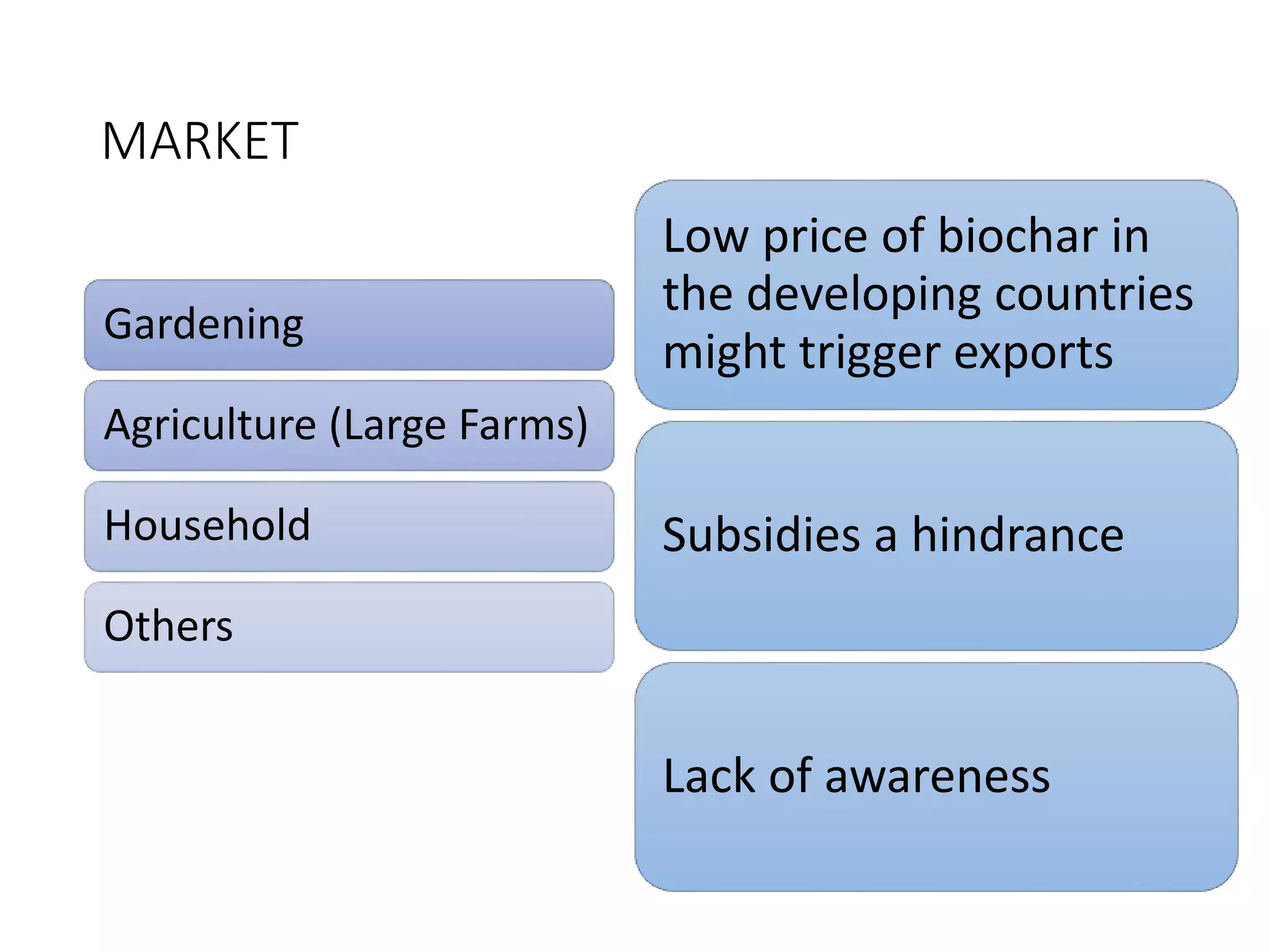
MARKET
Low price of biochar in
the developing countries
might trigger exports
Subsidies a hindrance
Lack of awareness
Gardening
Agriculture (Large Farms)
Household
Others
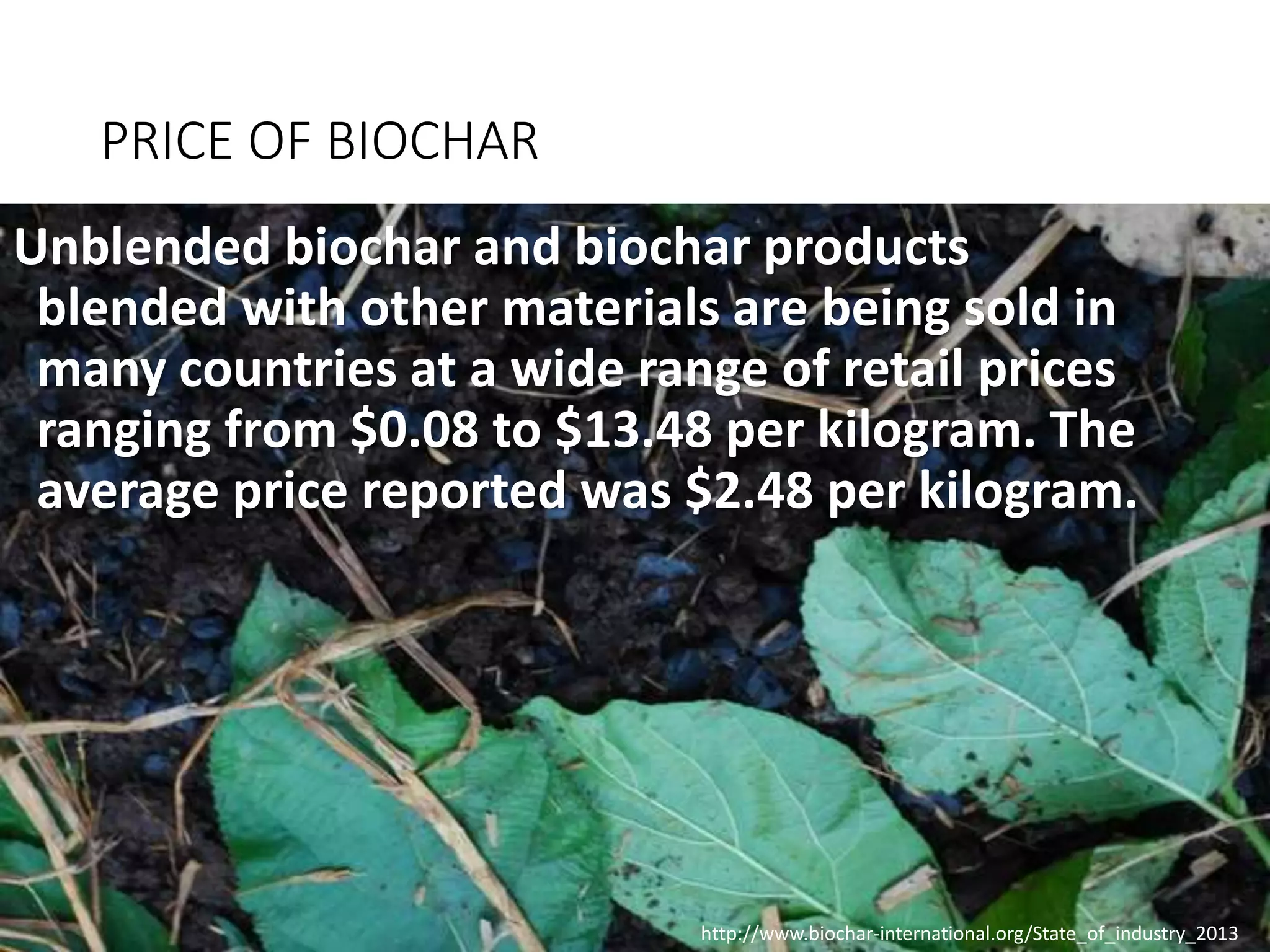
PRICE OF BIOCHAR
Unblended biochar and biochar products
blended with other materials are being sold in
many countries at a wide range of retail prices
ranging from $0.08 to $13.48 per kilogram. The
average price reported was $2.48 per kilogram.
http://www.biochar-international.org/State_of_industry_2013
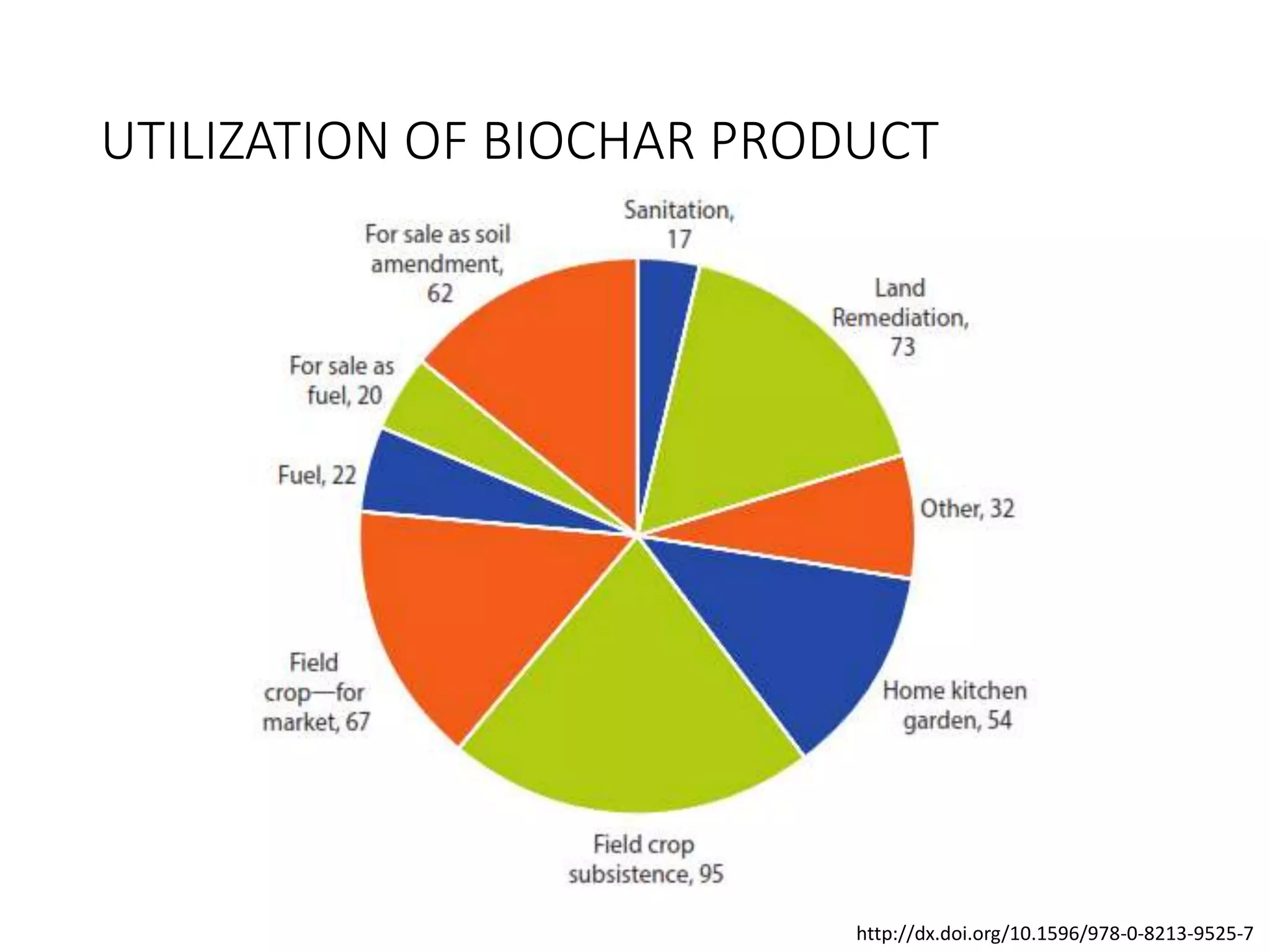
http://dx.doi.org/10.1596/978-0-8213-9525-7
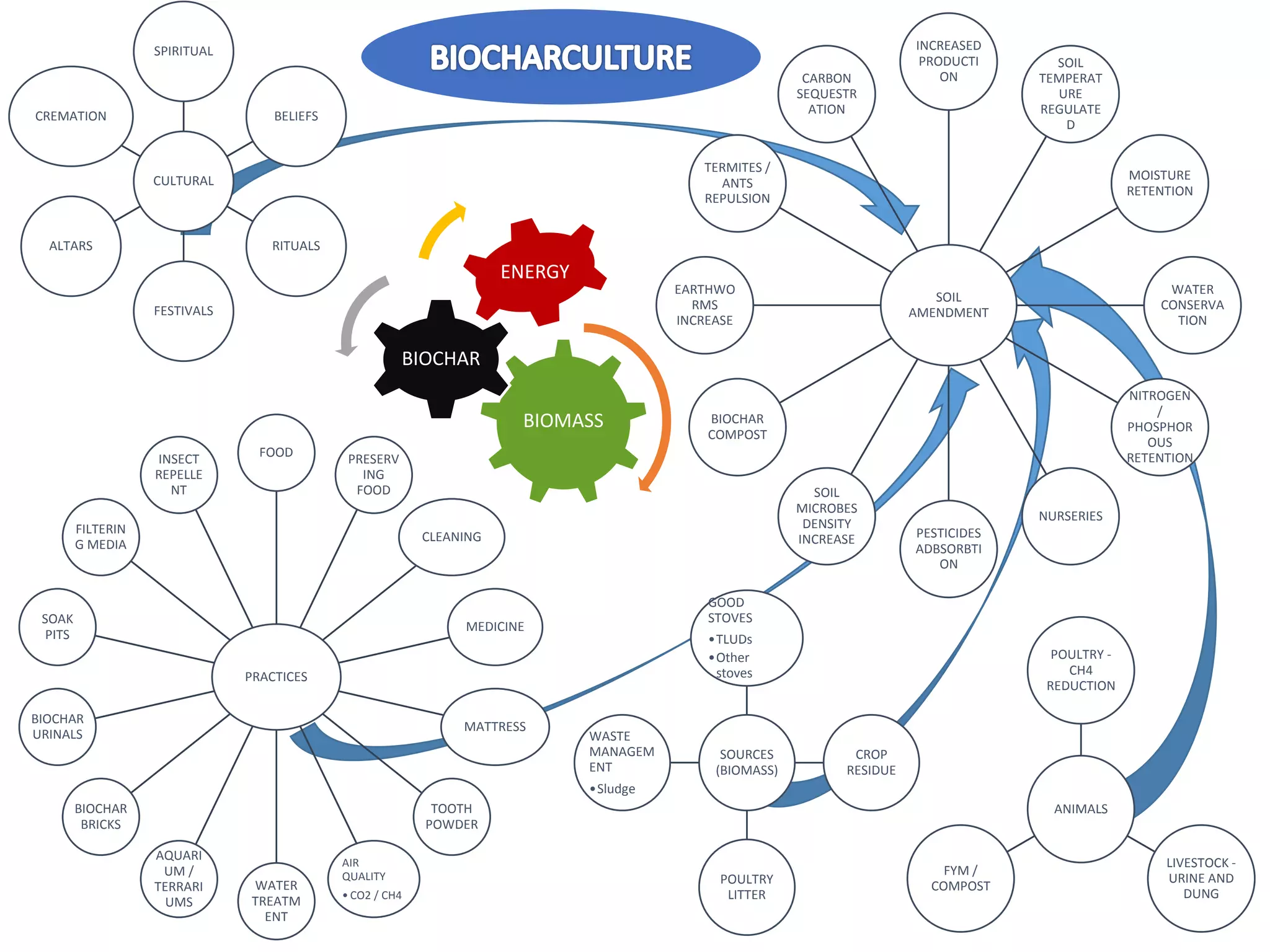
UTILIZATION OF BIOCHAR PRODUCT
CULTURAL
SPIRITUAL
BELIEFS
RITUALS
FESTIVALS
ALTARS
CREMATION
SOURCES
(BIOMASS)
GOOD
STOVES
•TLUDs
•Other
stoves
CROP
RESIDUE
POULTRY
LITTER
WASTE
MANAGEM
ENT
•Sludge
PRACTICES
FOOD PRESERV
ING
FOOD
CLEANING
MEDICINE
MATTRESS
TOOTH
POWDER
AIR
QUALITY
• CO2 / CH4
WATER
TREATM
ENT
AQUARI
UM /
TERRARI
UMS
BIOCHAR
BRICKS
BIOCHAR
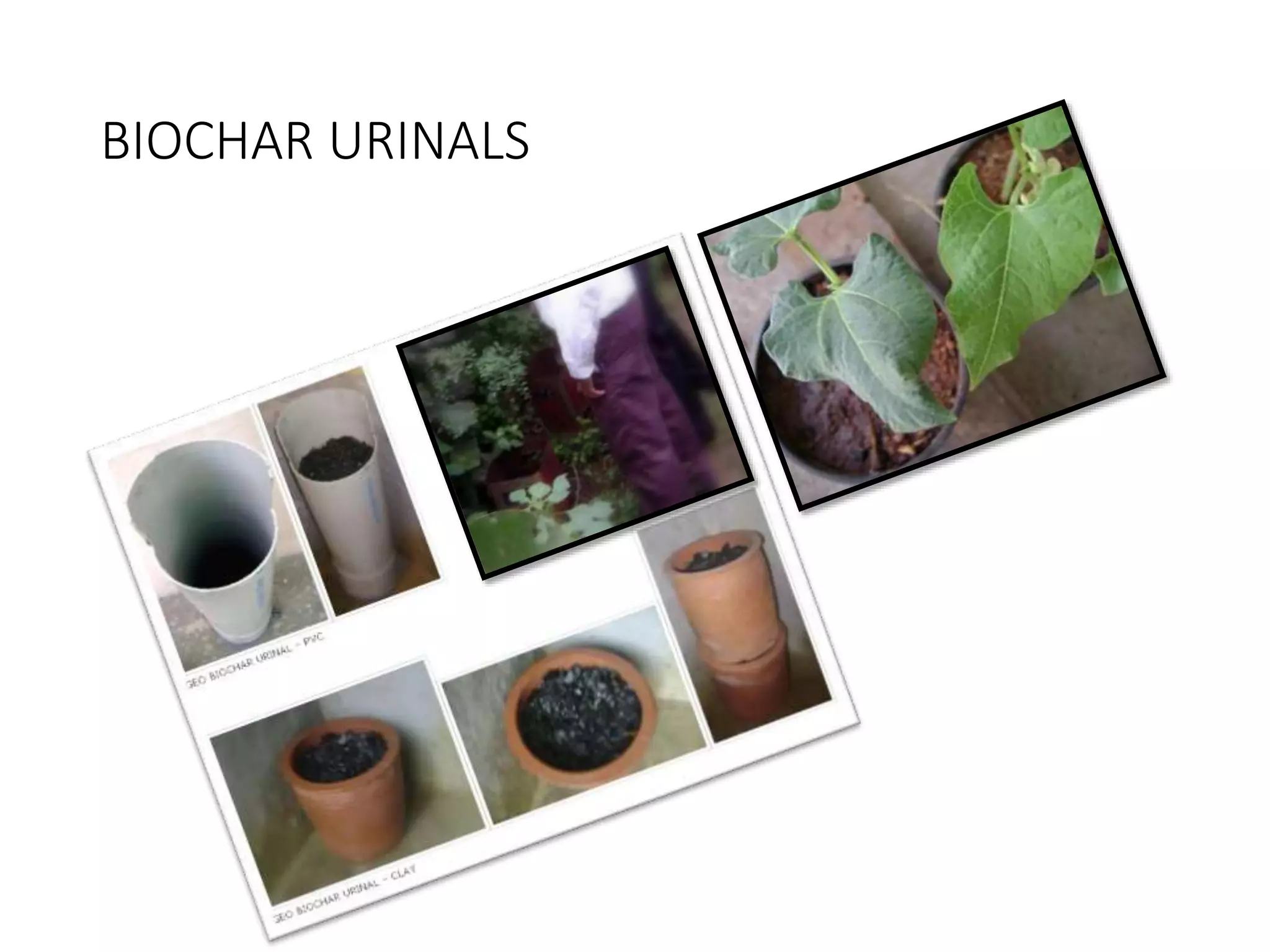
URINALS
SOAK
PITS
FILTERIN
G MEDIA
INSECT
REPELLE
NT
SOIL
AMENDMENT
INCREASED
PRODUCTI
ON
SOIL
TEMPERAT
URE
REGULATE
D
MOISTURE
RETENTION
WATER
CONSERVA
TION
NITROGEN
/
PHOSPHOR
OUS
RETENTION
NURSERIES
PESTICIDES
ADBSORBTI
ON
SOIL
MICROBES
DENSITY
INCREASE
BIOCHAR
COMPOST
EARTHWO
RMS
INCREASE
TERMITES /
ANTS
REPULSION
CARBON
SEQUESTR
ATION
ANIMALS
POULTRY -
CH4
REDUCTION
LIVESTOCK -
URINE AND
DUNG
FYM /
COMPOST
BIOMASS
BIOCHAR
ENERGY
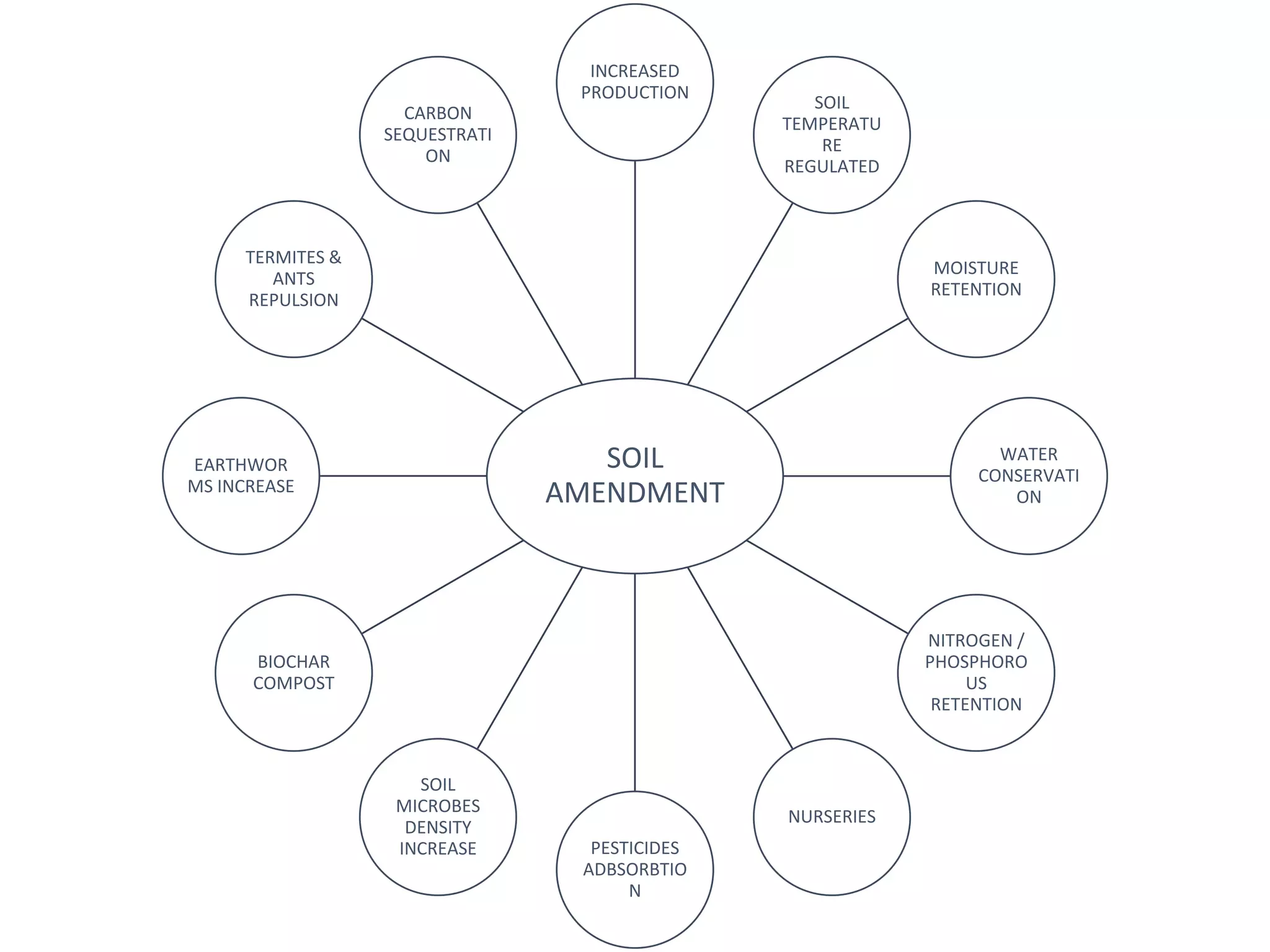
SOIL
AMENDMENT
INCREASED
PRODUCTION
SOIL
TEMPERATU
RE
REGULATED
MOISTURE
RETENTION
WATER
CONSERVATI
ON
NITROGEN /
PHOSPHORO
US
RETENTION
NURSERIES
PESTICIDES
ADBSORBTIO
N
SOIL
MICROBES
DENSITY
INCREASE
BIOCHAR
COMPOST
EARTHWOR
MS INCREASE
TERMITES &
ANTS
REPULSION
CARBON
SEQUESTRATI
ON
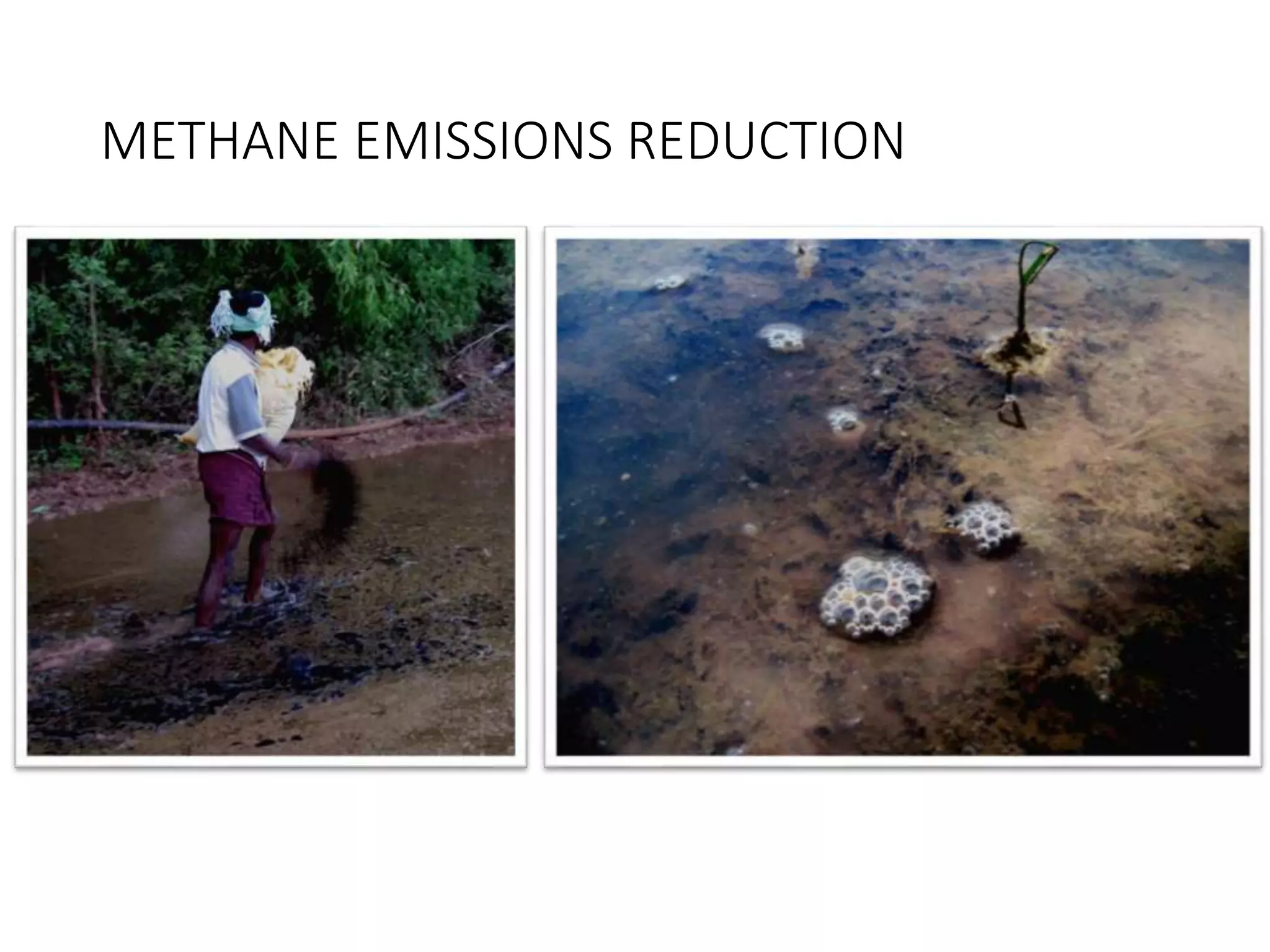
METHANE EMISSIONS REDUCTION
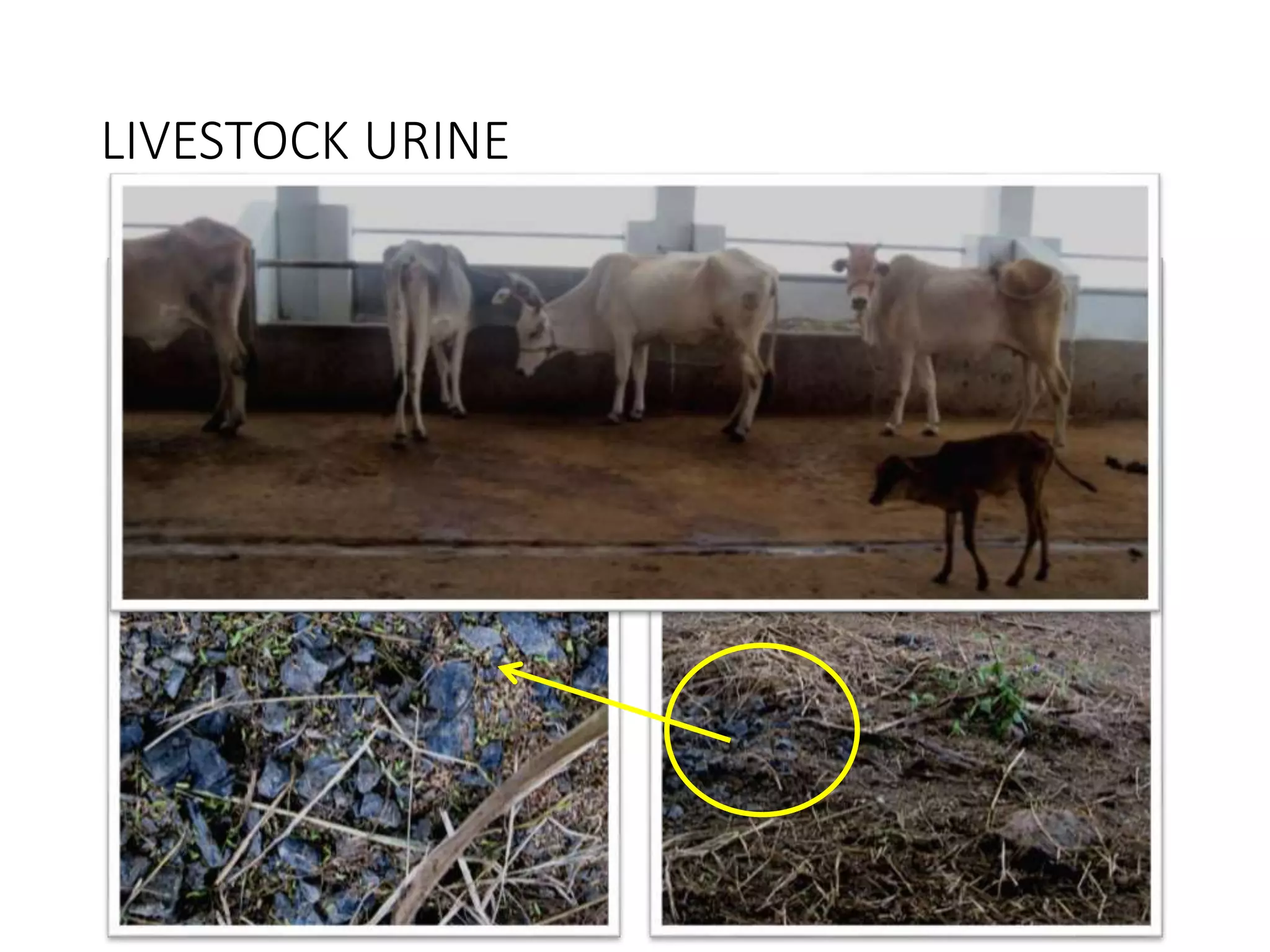
LIVESTOCK URINE
BIOCHAR URINALS
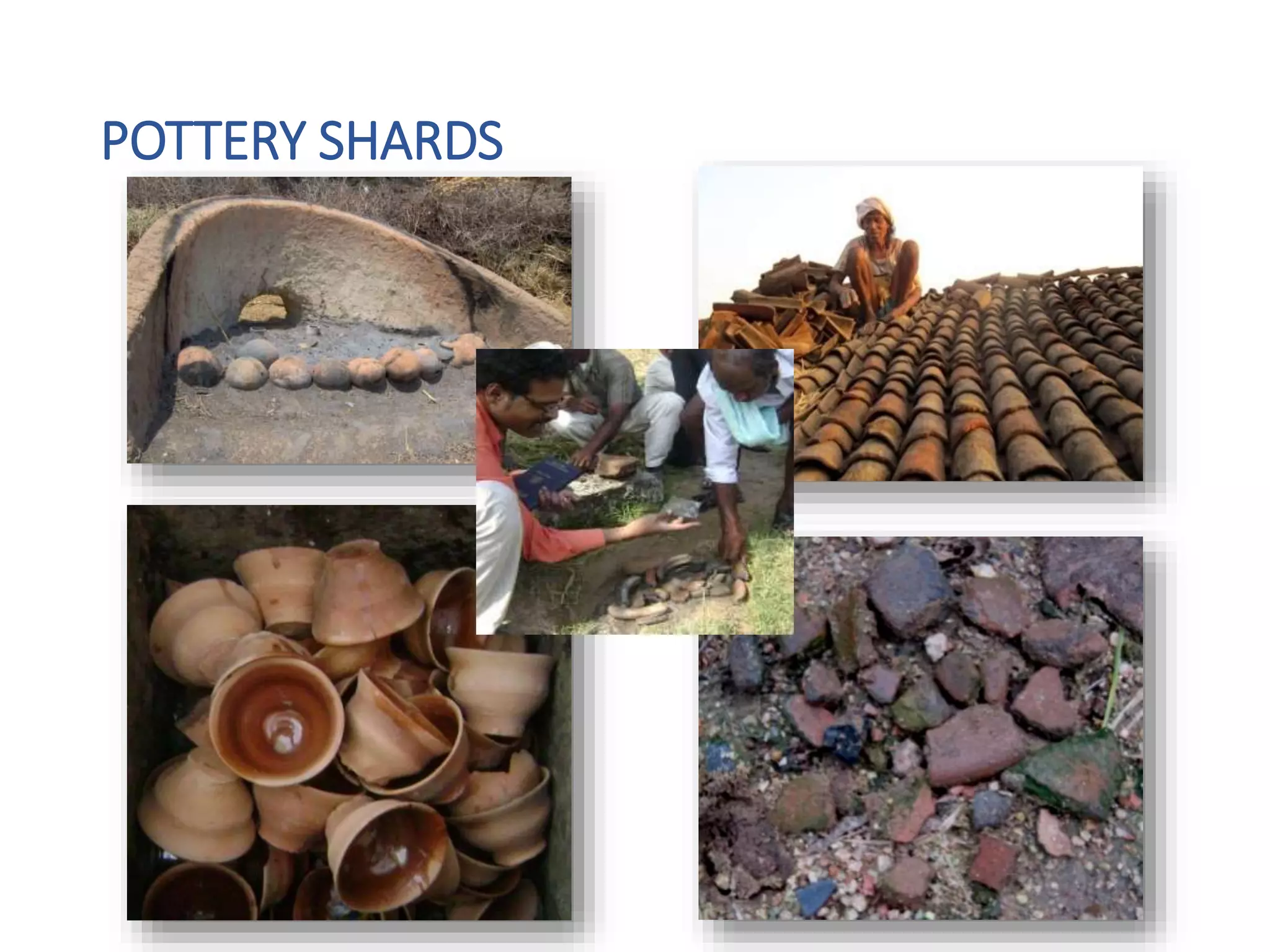
POTTERY SHARDS
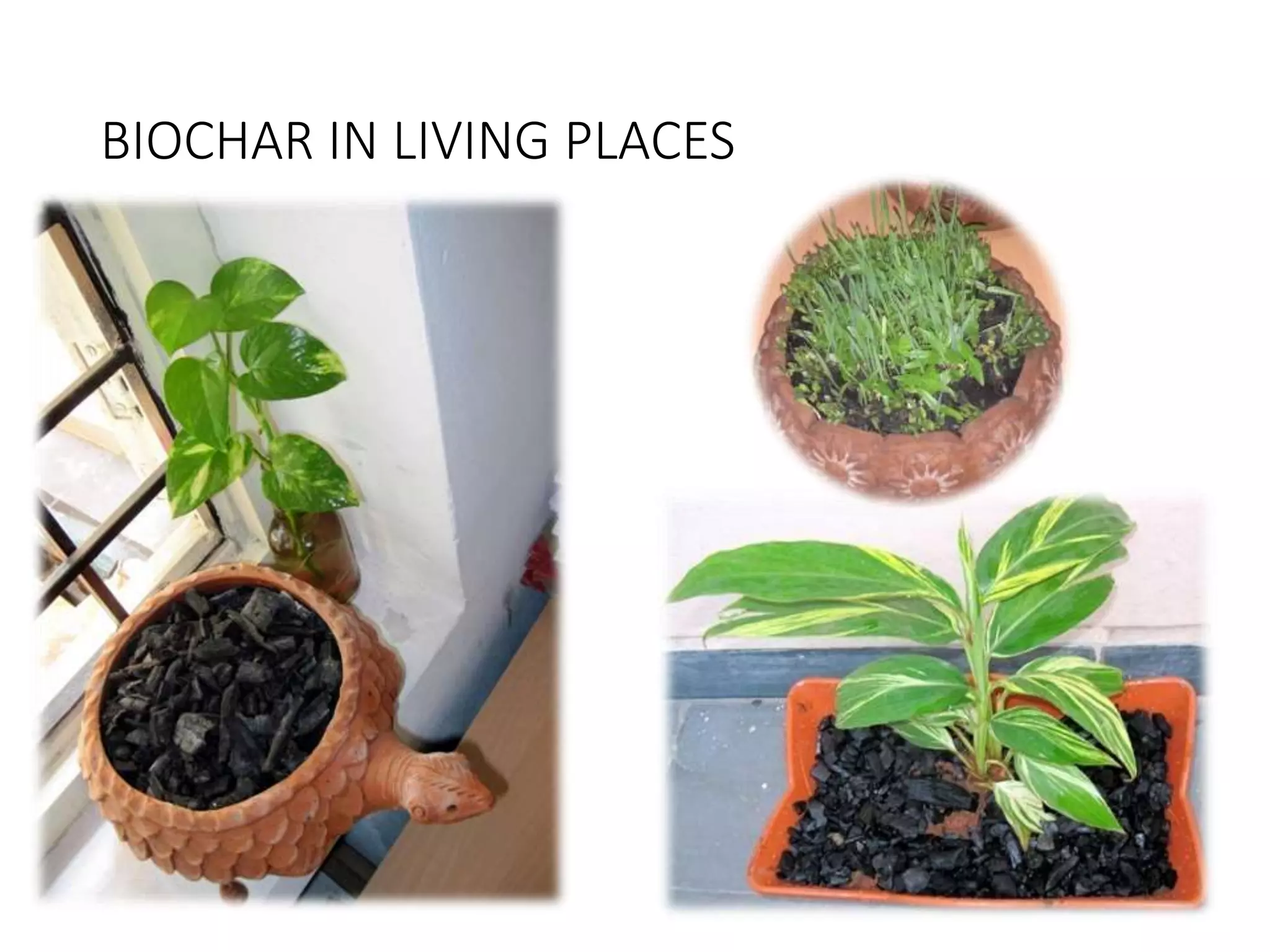
BIOCHAR IN LIVING PLACES
W
A
T
E
R
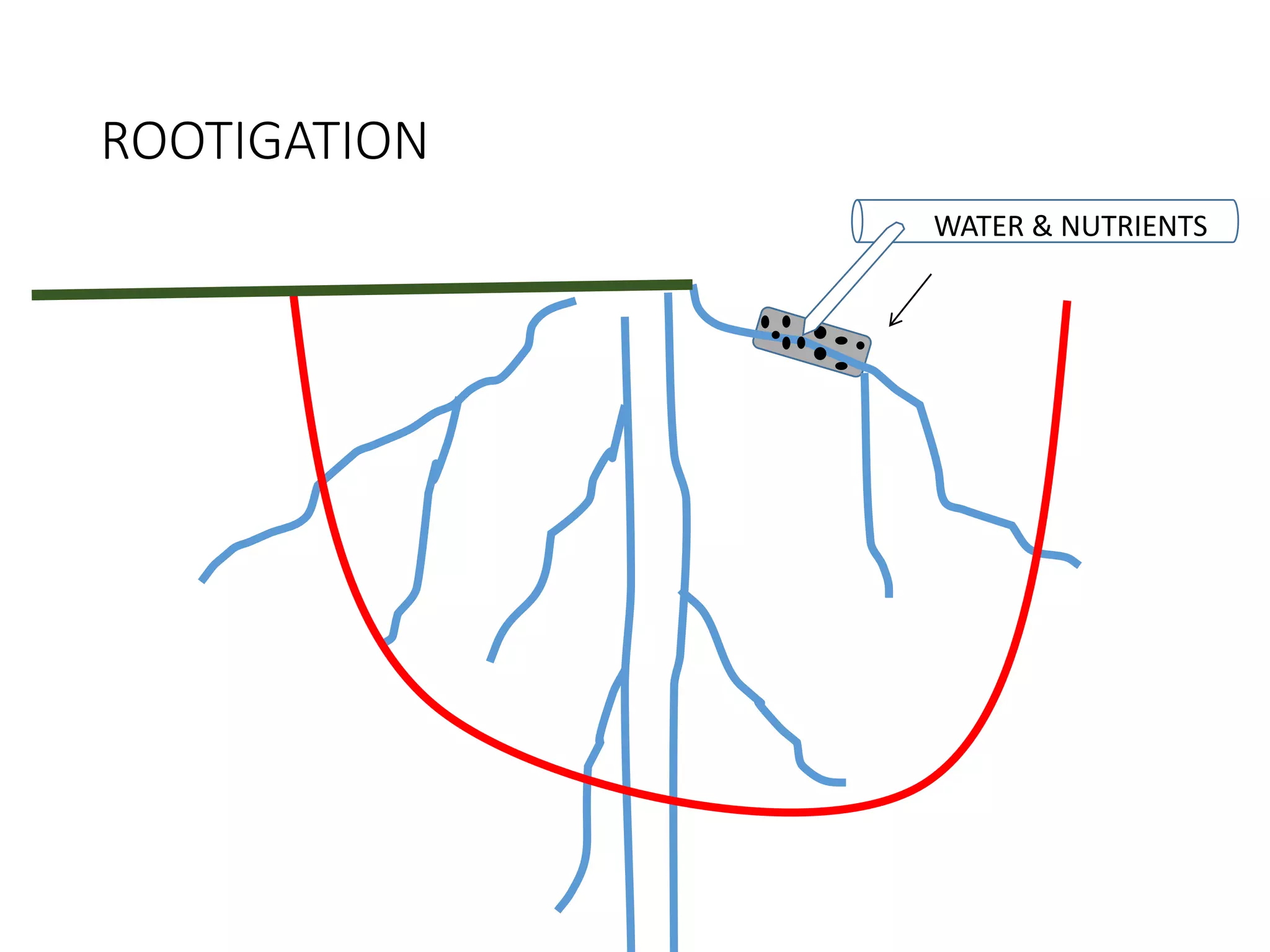
WATER & NUTRIENTS
ROOTIGATION
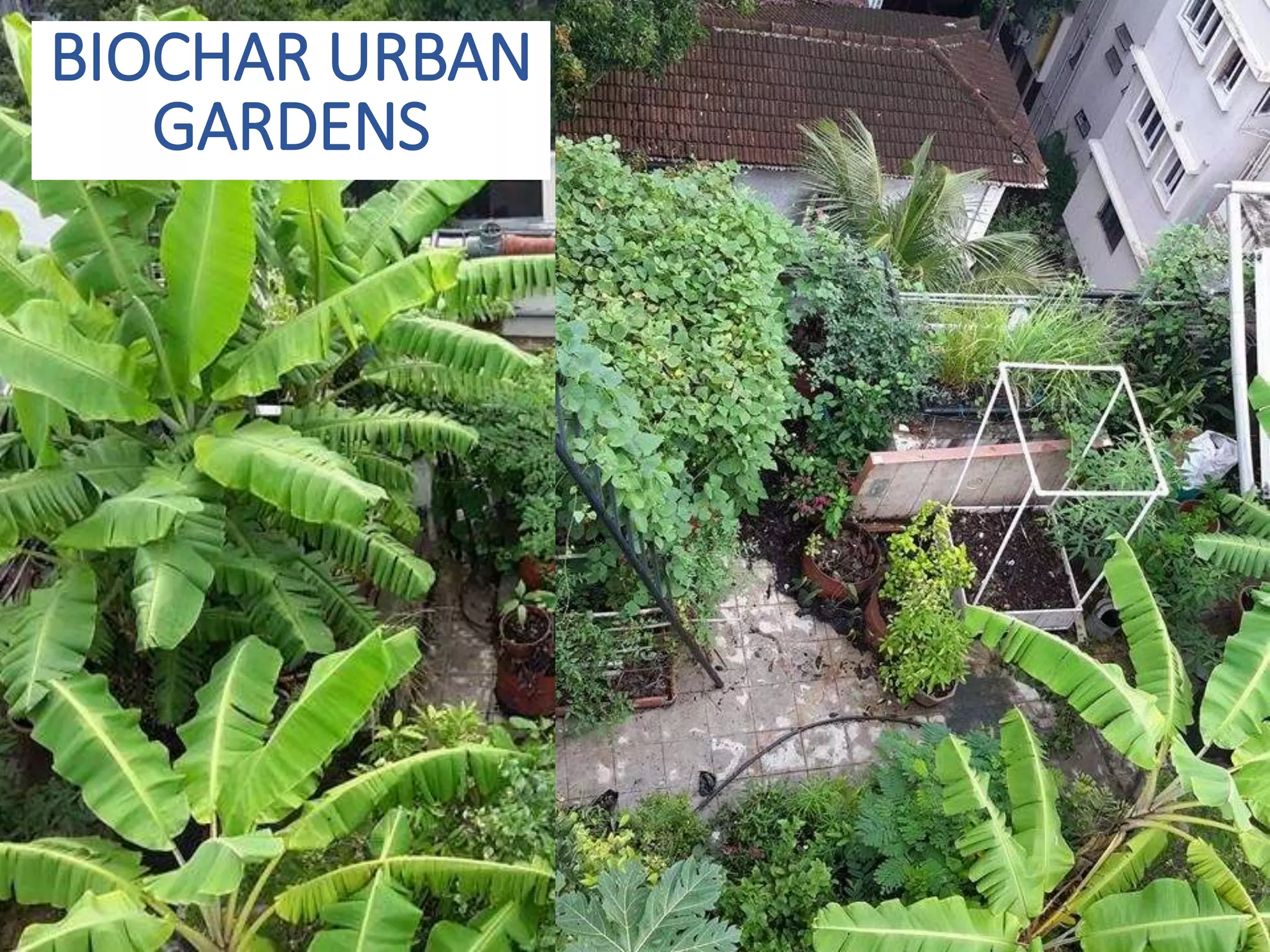
BIOCHAR URBAN
GARDENS
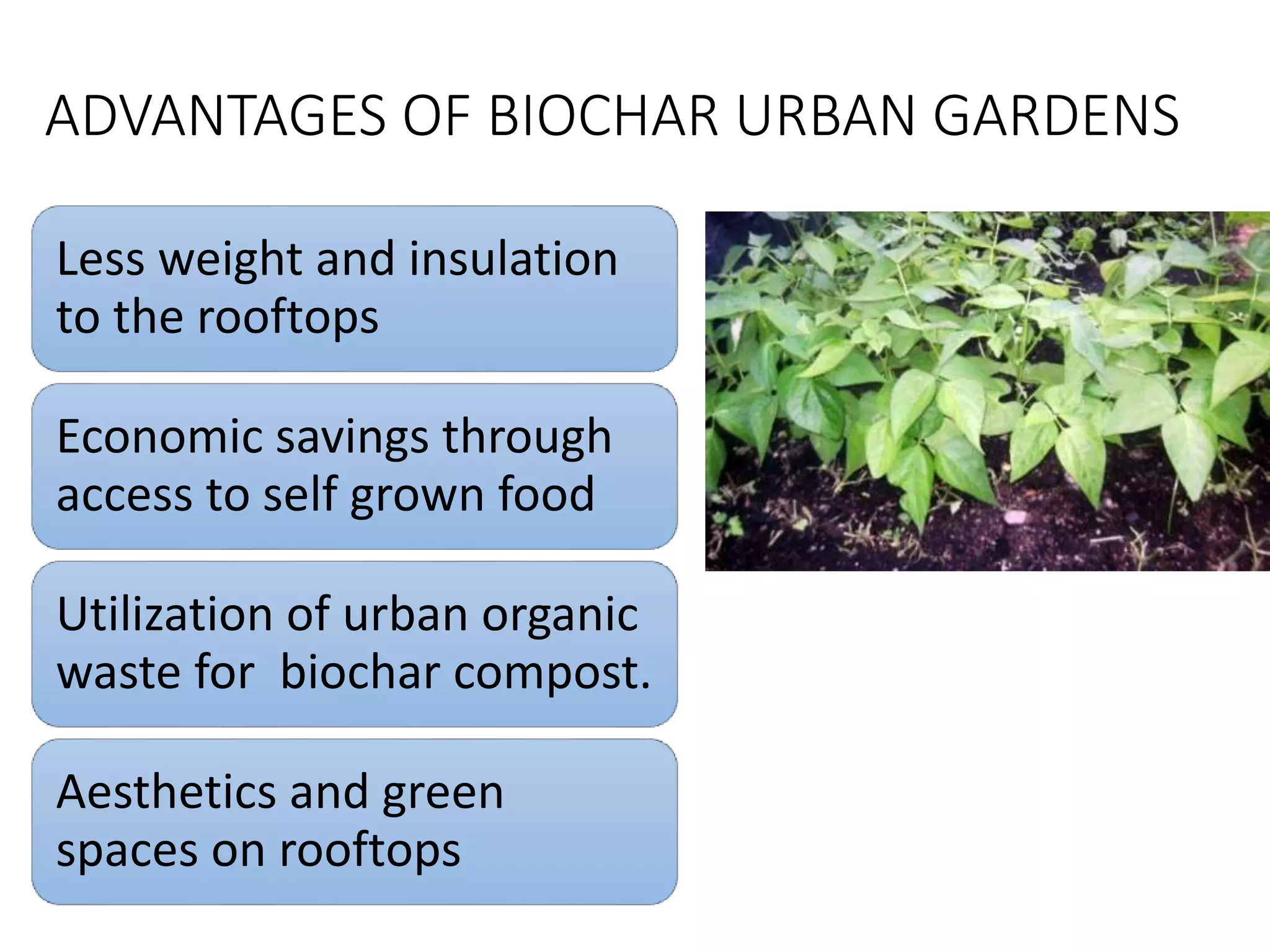
ADVANTAGES OF BIOCHAR URBAN GARDENS
Less weight and insulation
to the rooftops
Economic savings through
access to self grown food
Utilization of urban organic
waste for biochar compost.
Aesthetics and green
spaces on rooftops
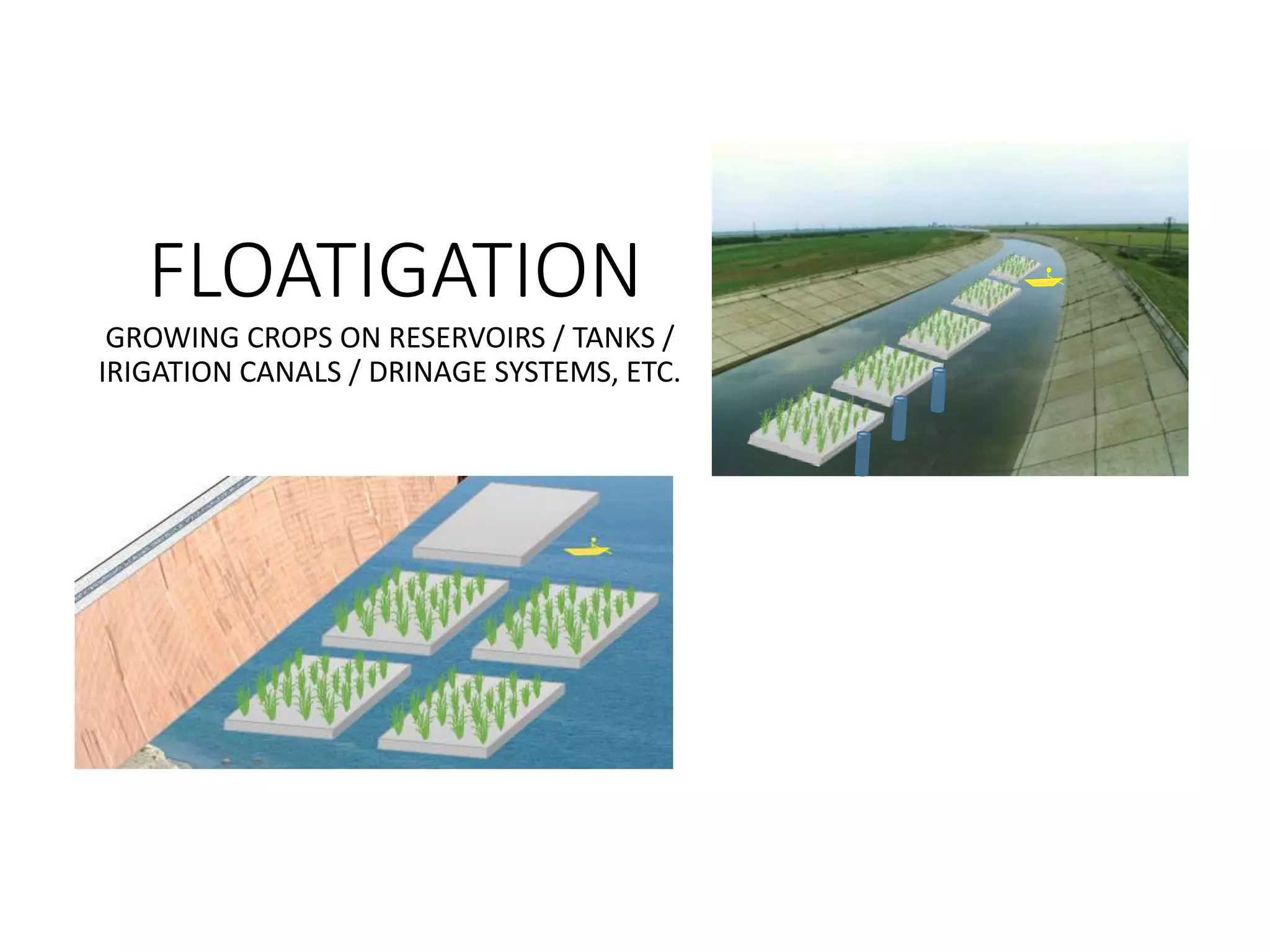
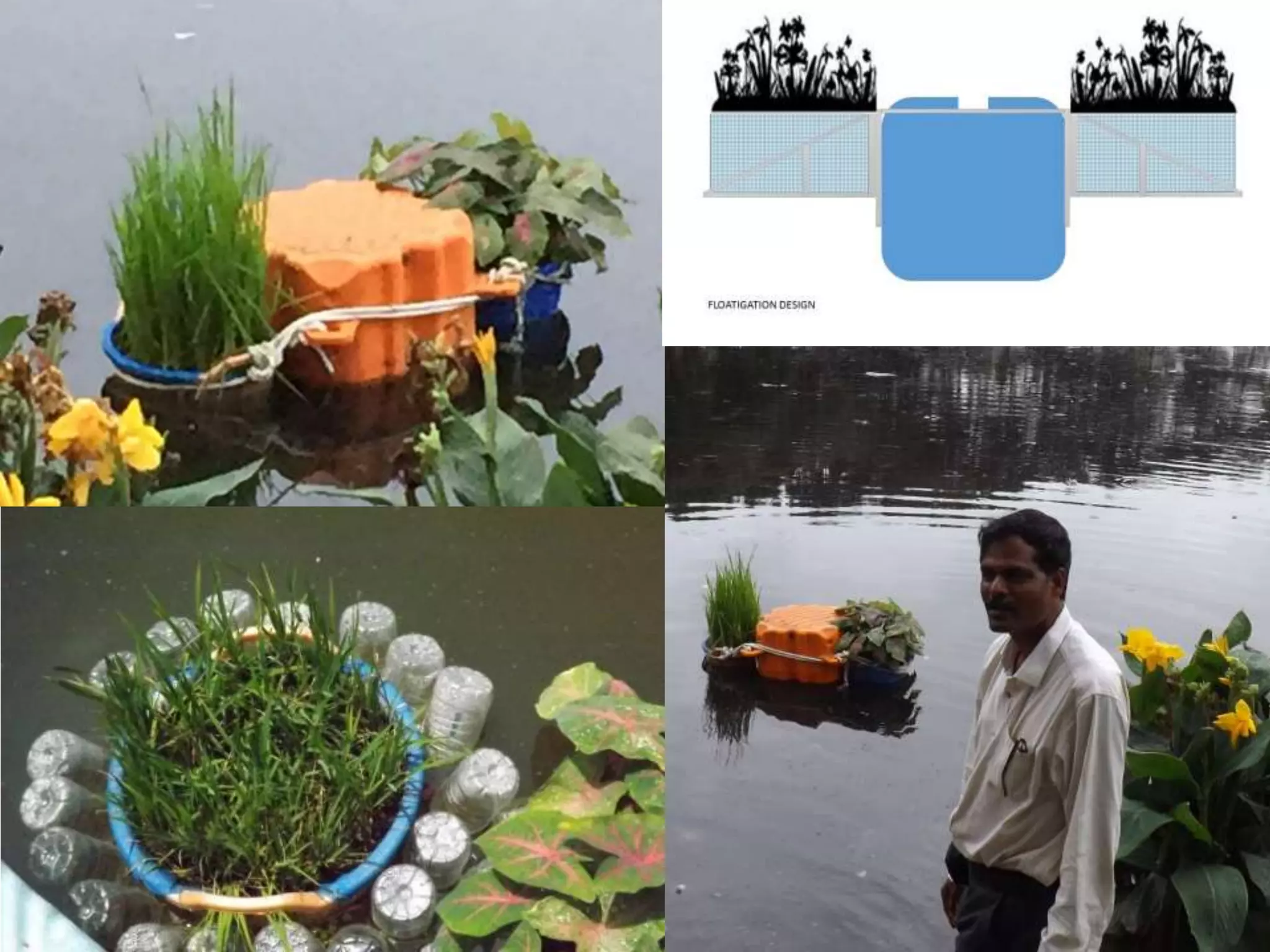
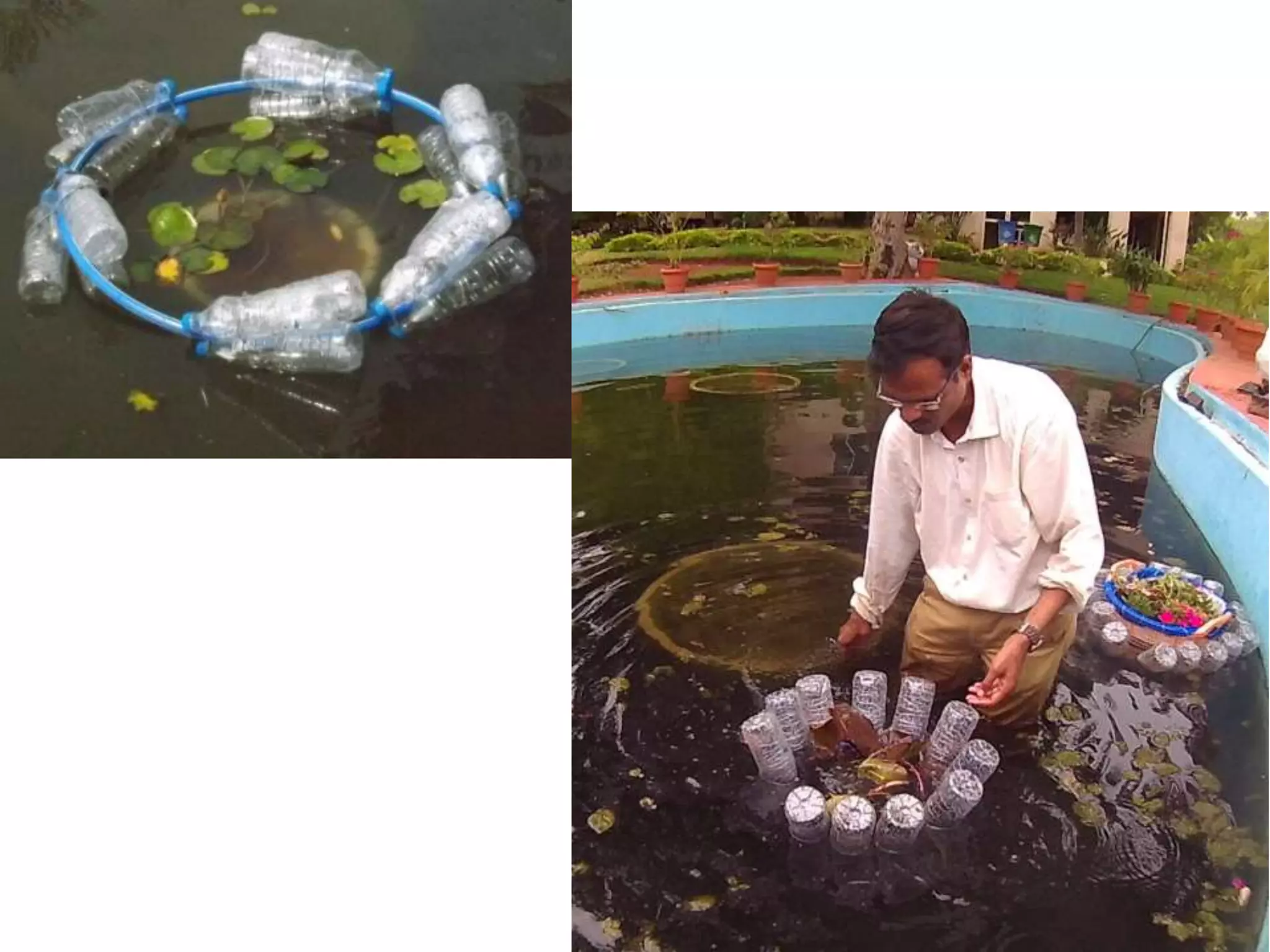
FLOATIGATION
GROWING CROPS ON RESERVOIRS / TANKS /
IRIGATION CANALS / DRINAGE SYSTEMS, ETC.
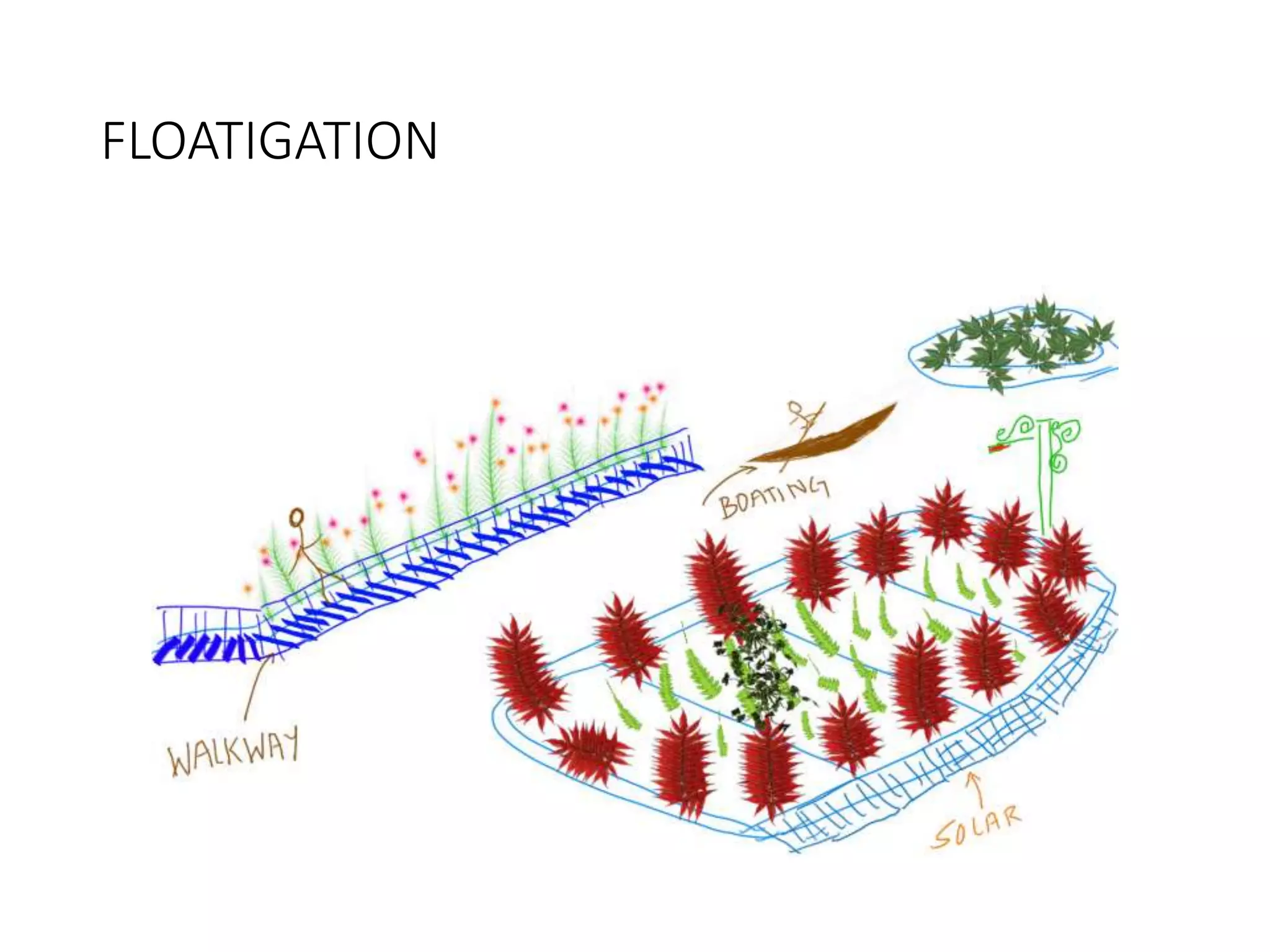
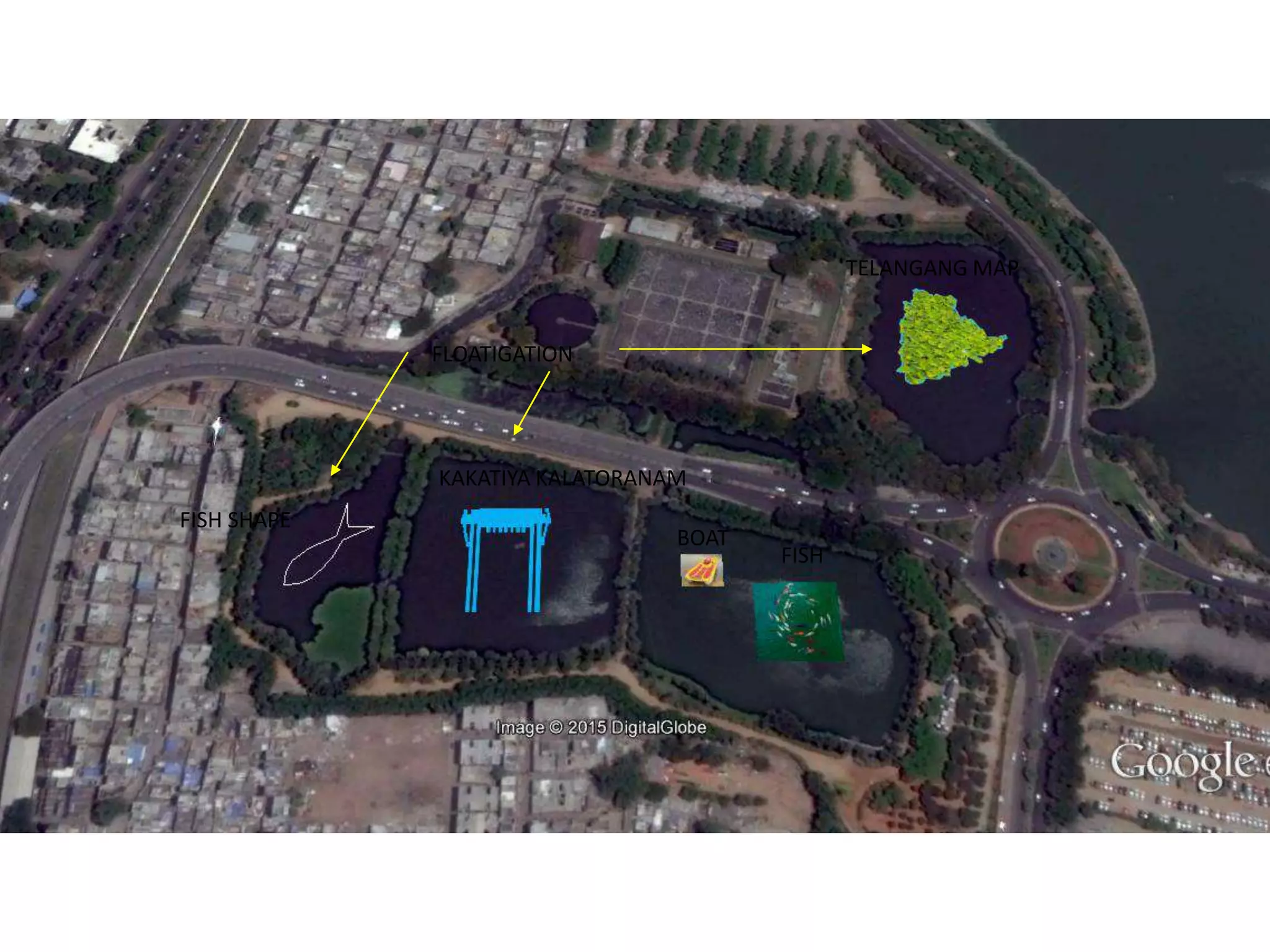
FLOATIGATION
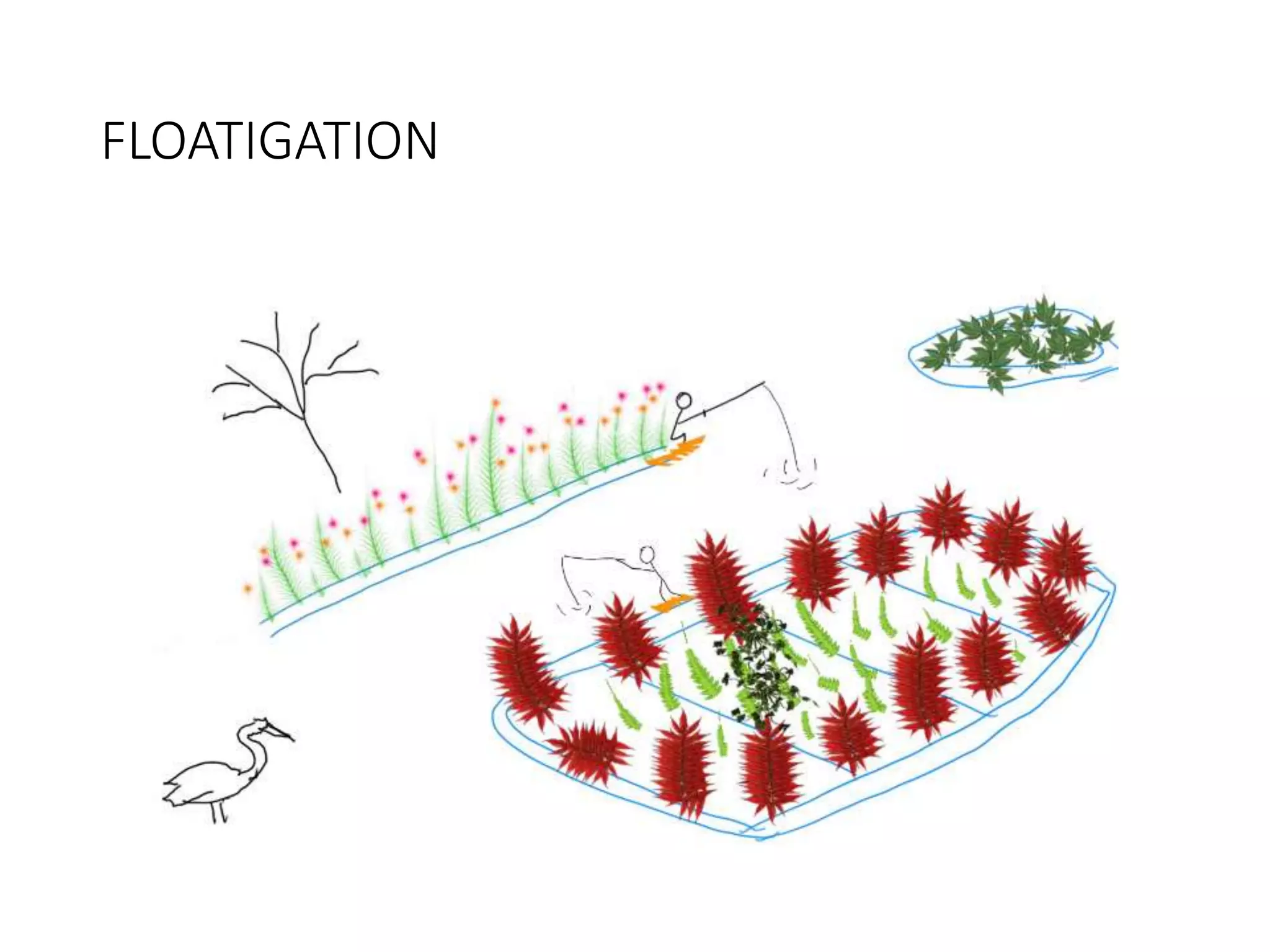
FLOATIGATION
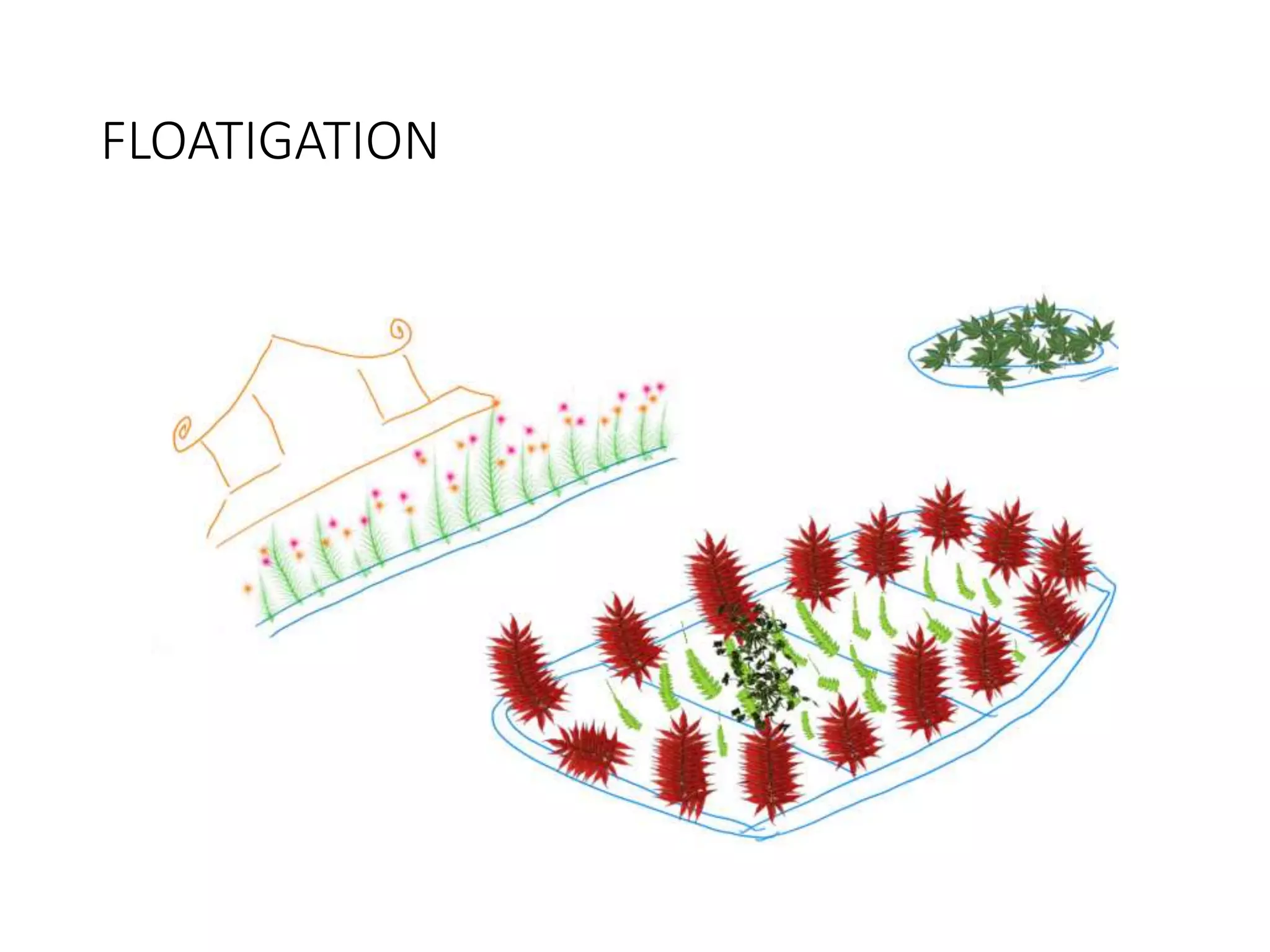
FLOATIGATION
TELANGANG MAP
KAKATIYA KALATORANAM
FISH SHAPE
FISH
BOAT
FLOATIGATION
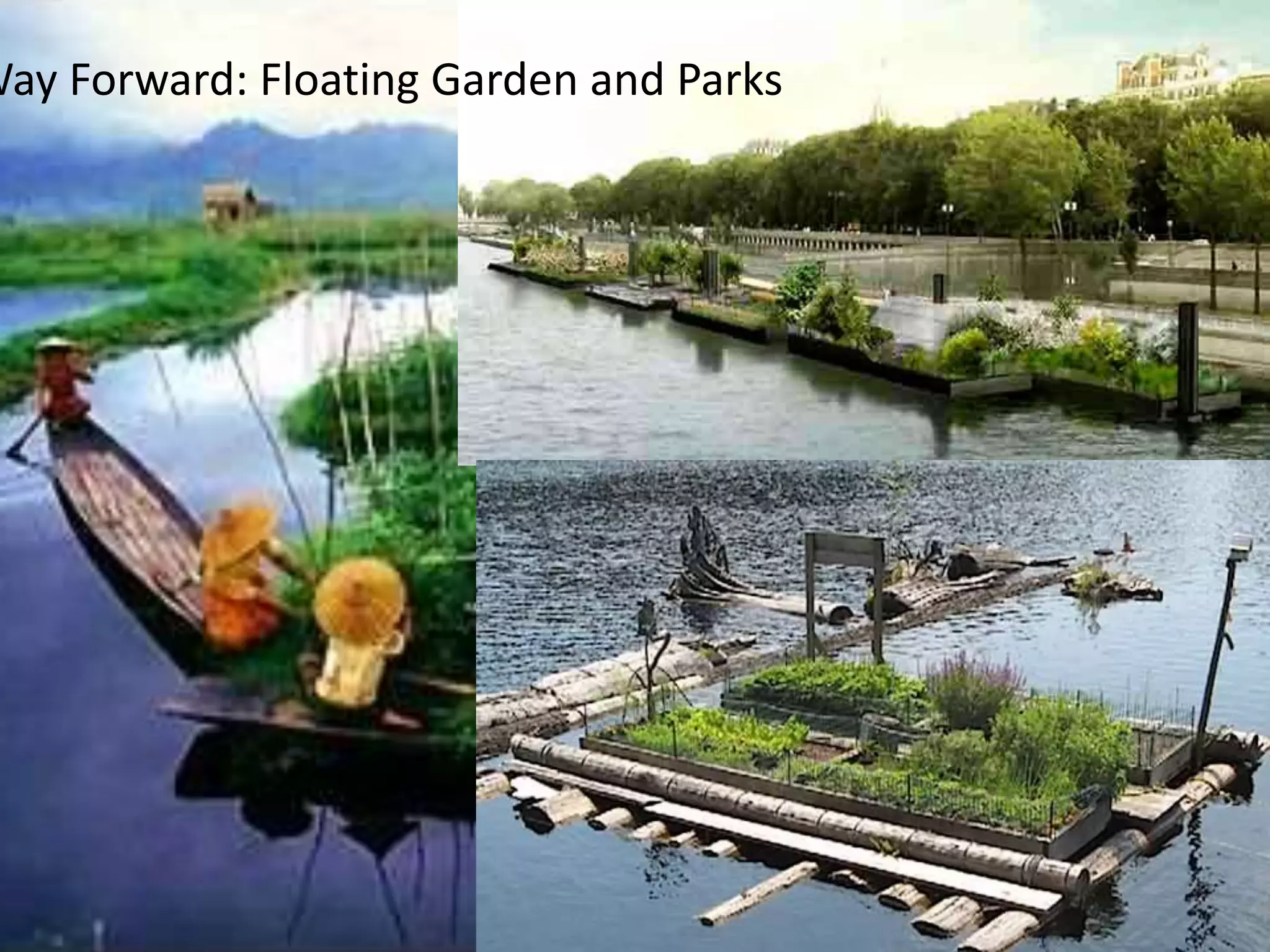
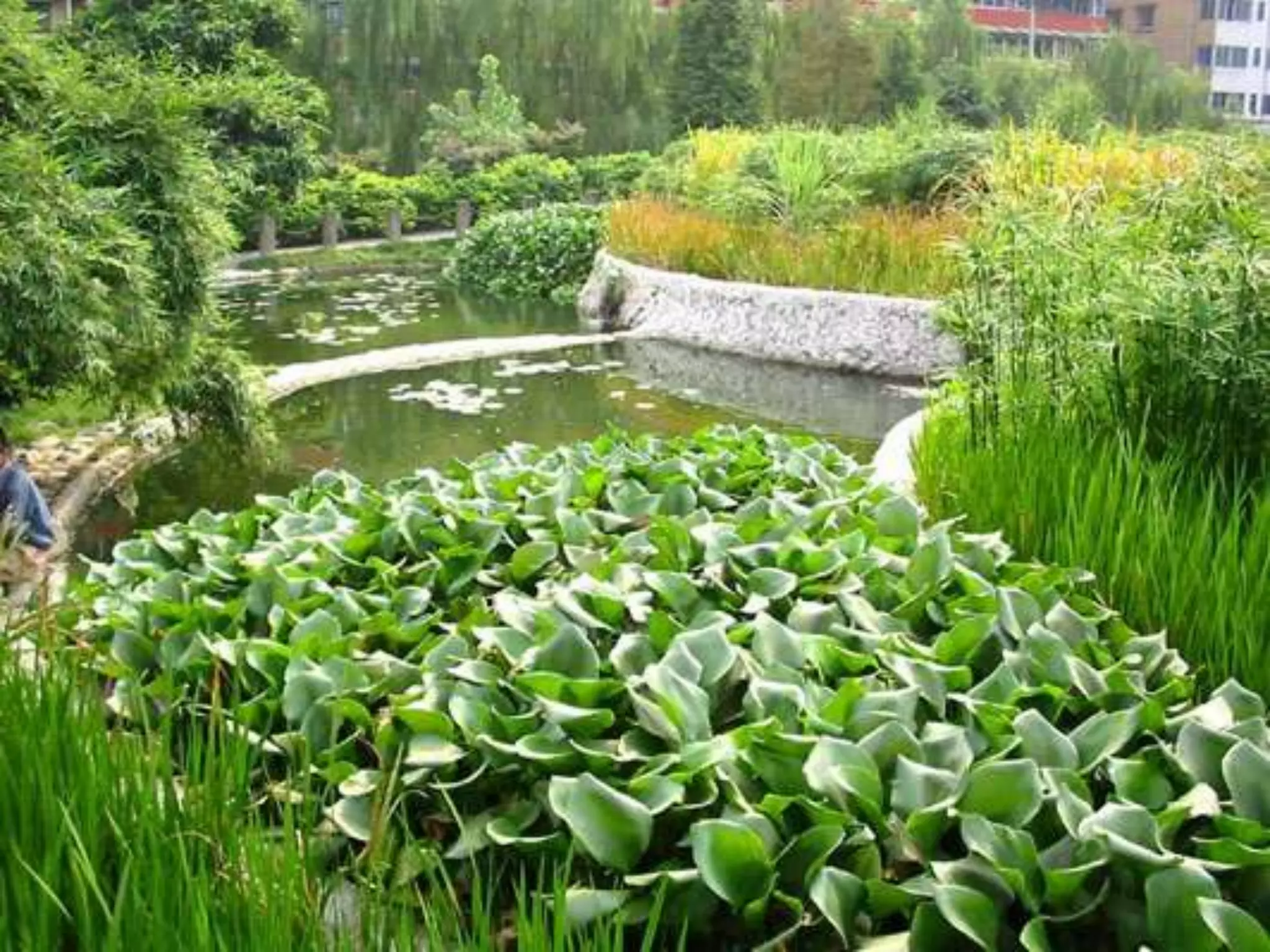
Way Forward: Floating Garden and Parks
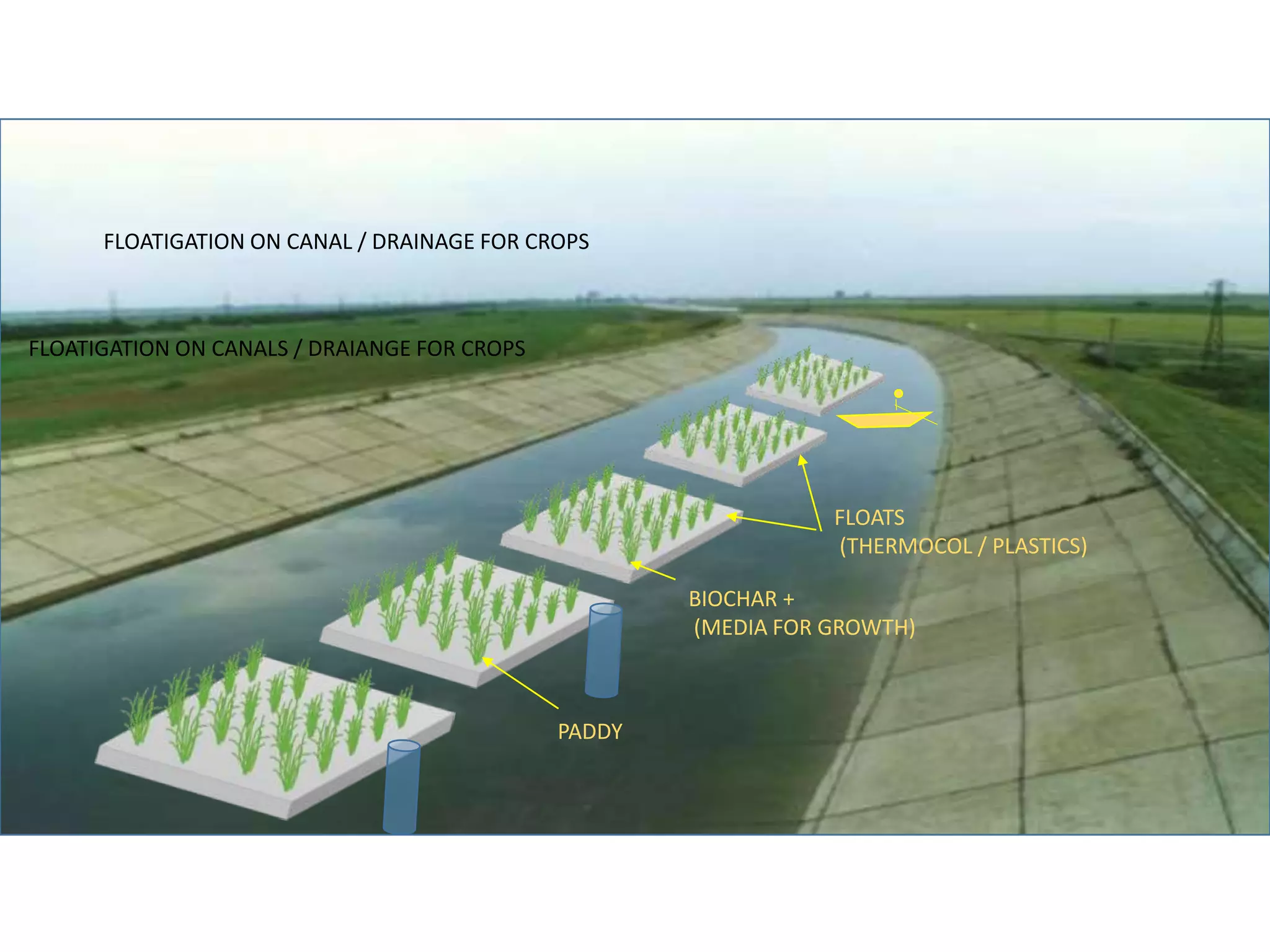
FLOATS
(THERMOCOL / PLASTICS)
BIOCHAR +
(MEDIA FOR GROWTH)
FLOATIGATION ON CANAL / DRAINAGE FOR CROPS
PADDY
FLOATIGATION ON CANALS / DRAIANGE FOR CROPS
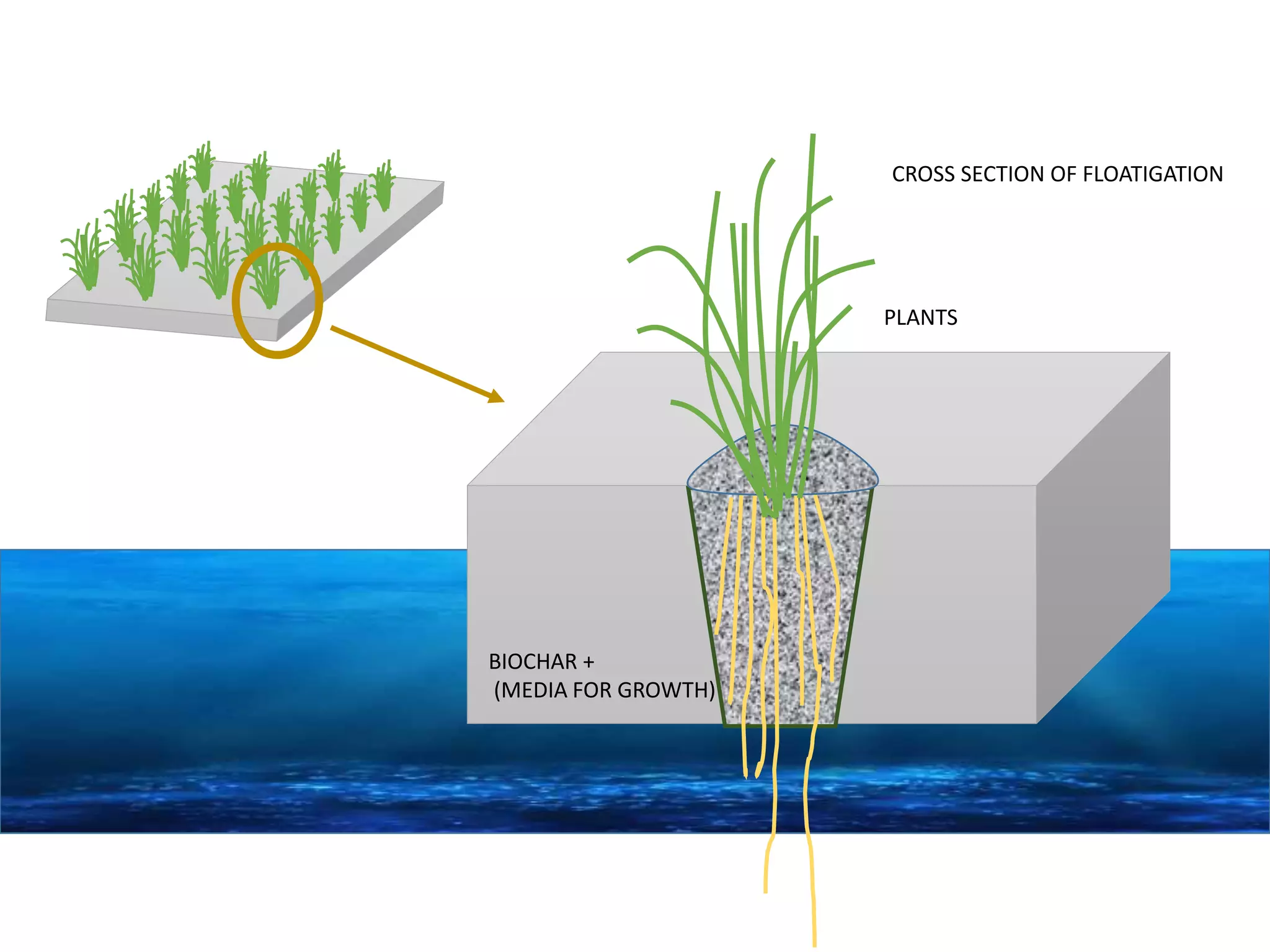
CROSS SECTION OF FLOATIGATION
BIOCHAR +
(MEDIA FOR GROWTH)
PLANTS
© DR. N. SAI BHASKAR REDDY
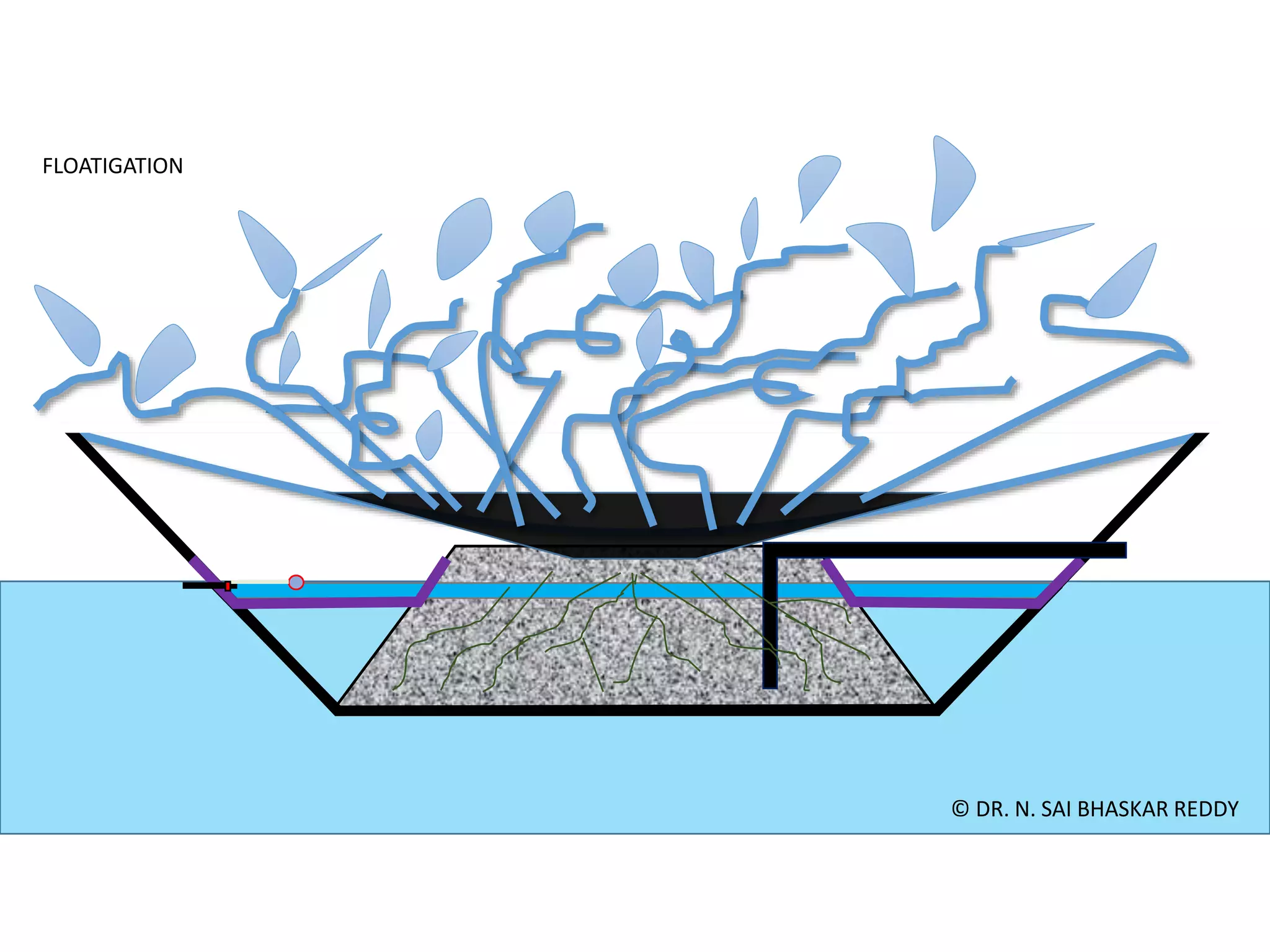
FLOATIGATION
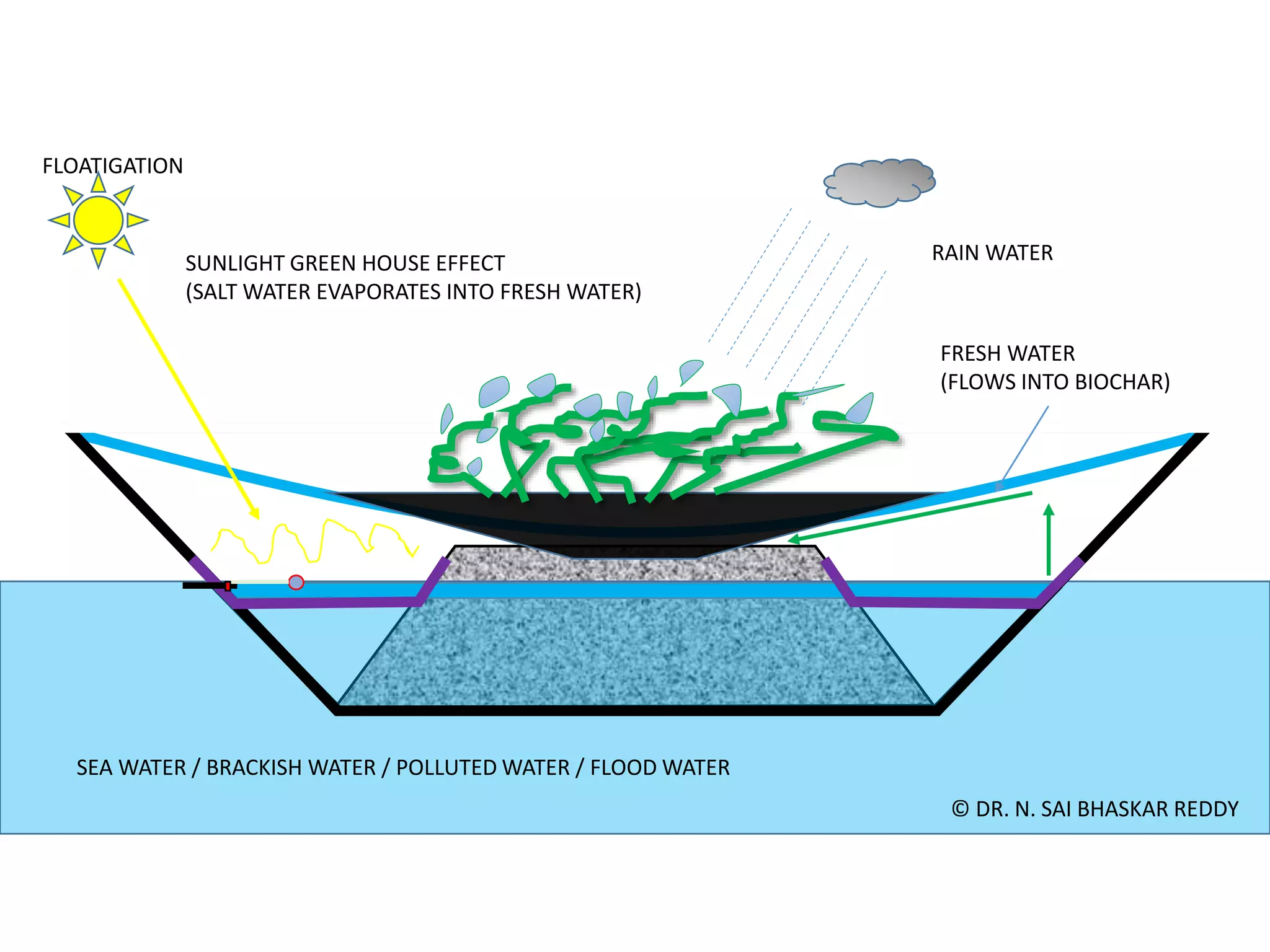
SUNLIGHT GREEN HOUSE EFFECT
(SALT WATER EVAPORATES INTO FRESH WATER)
SEA WATER / BRACKISH WATER / POLLUTED WATER / FLOOD WATER
FRESH WATER
(FLOWS INTO BIOCHAR)
RAIN WATER
© DR. N. SAI BHASKAR REDDY
FLOATIGATION
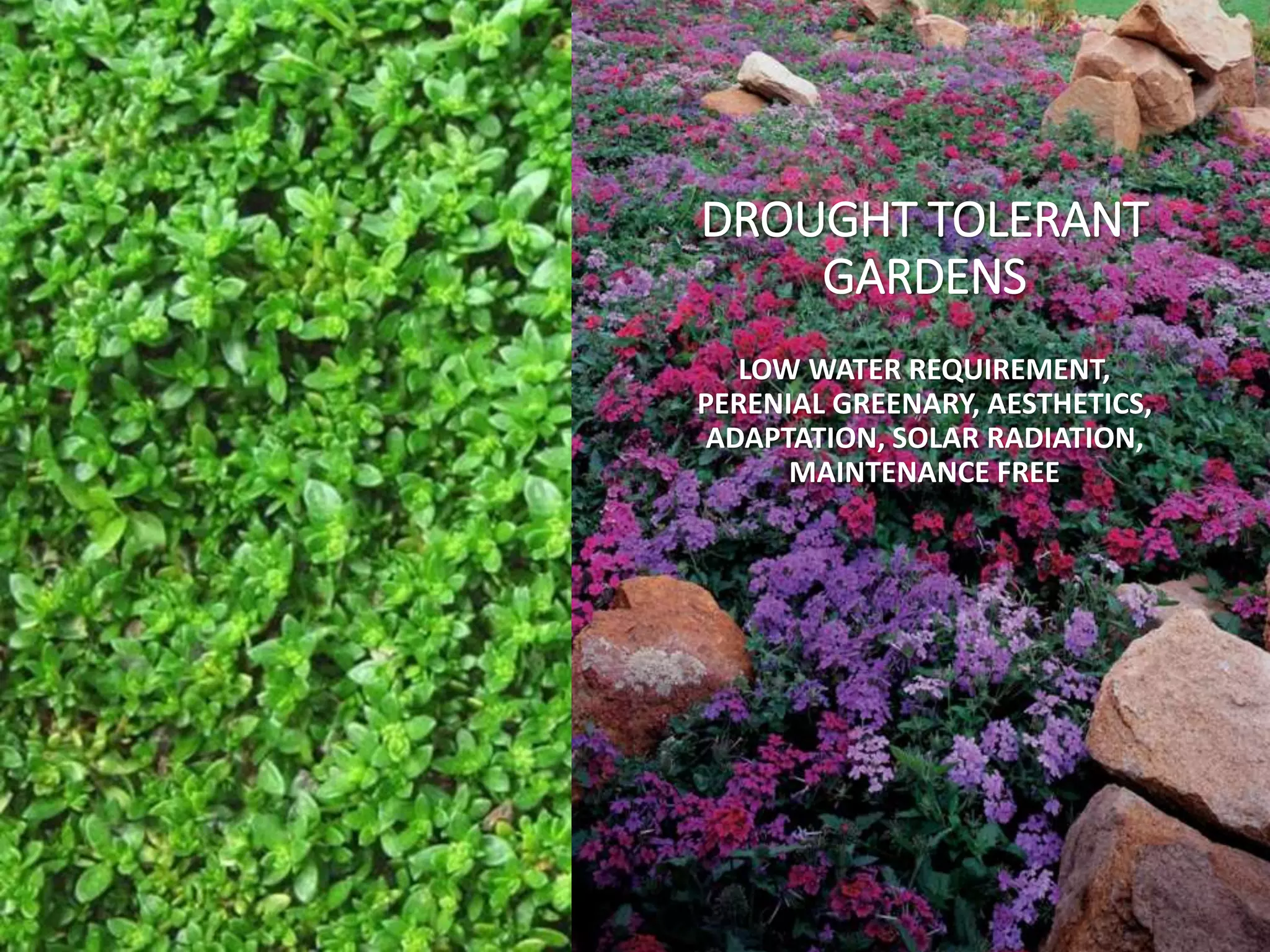
DROUGHT TOLERANT
GARDENS
LOW WATER REQUIREMENT,
PERENIAL GREENARY, AESTHETICS,
ADAPTATION, SOLAR RADIATION,
MAINTENANCE FREE
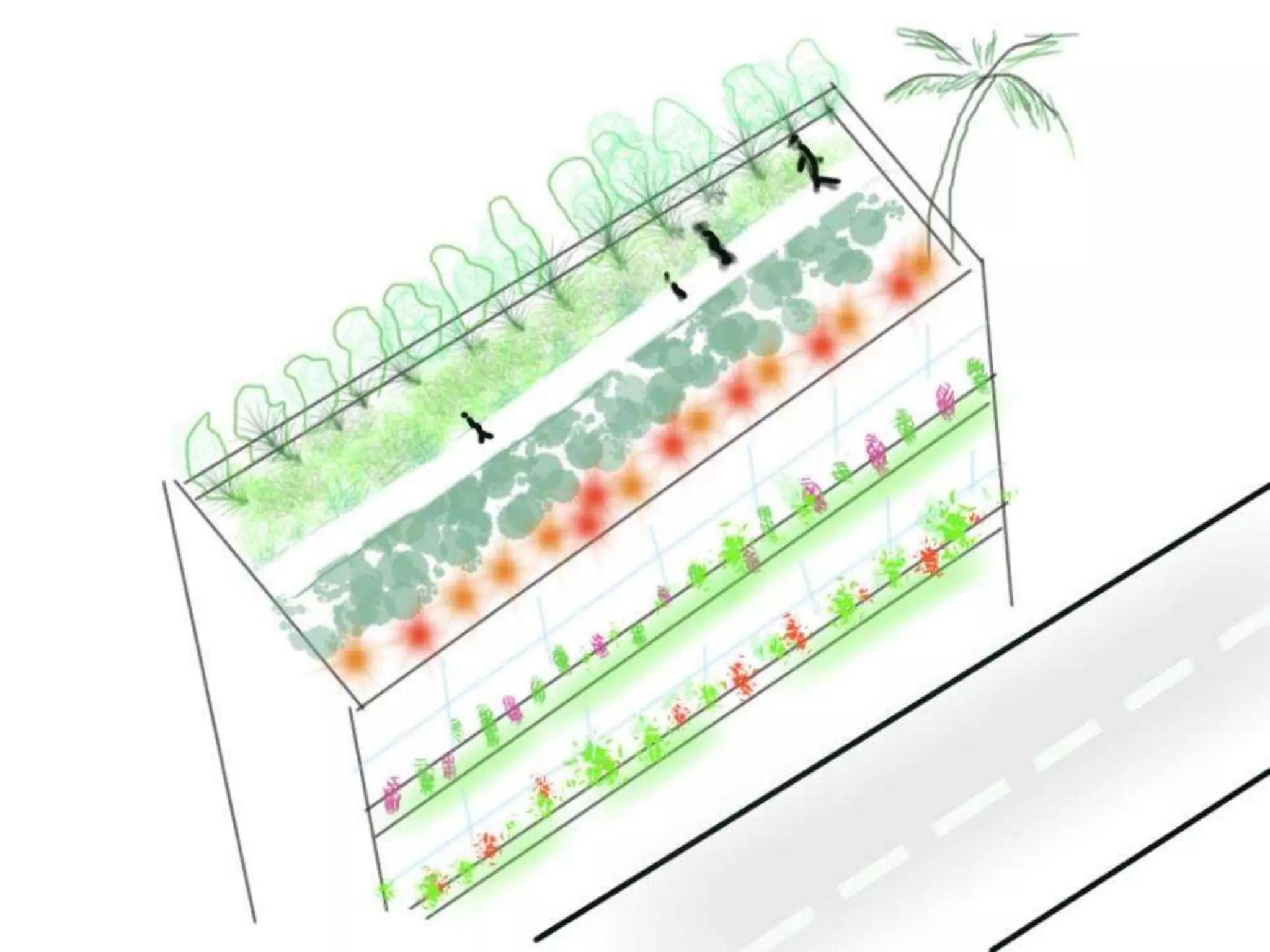
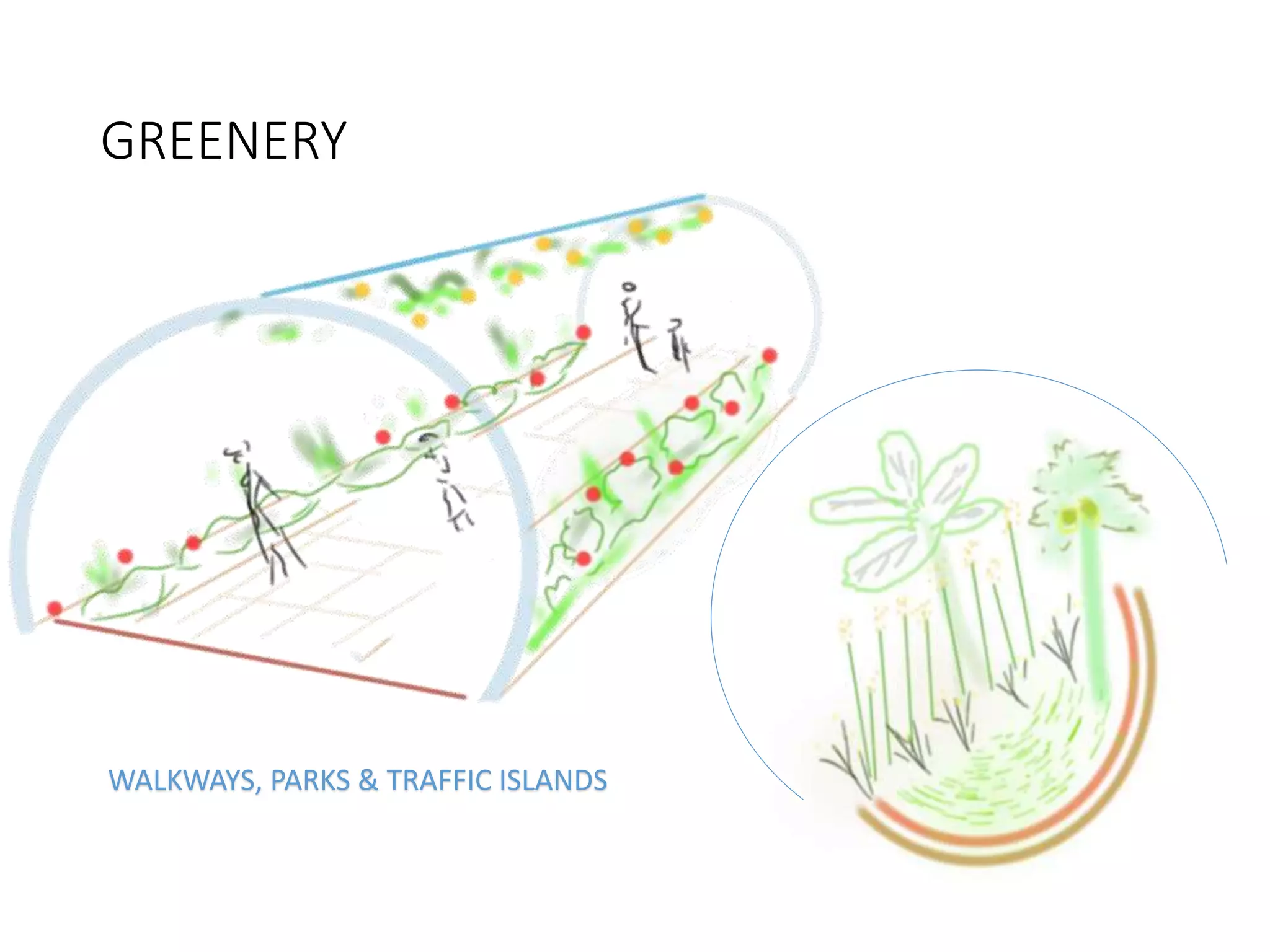
GREENERY
WALKWAYS, PARKS & TRAFFIC ISLANDS
Ref: http//

Biochar and soil environment

Editor's Notes

  • #5 Biochar 10% to 30%
  • #6 Biochar has been in use in parts of India for centuries. Biochar is added along with FYM or compost every year. As the retention time of biochar in soil is very high, the impact is cumulative. In many villages in India, agriculture is at least a few hundred years old. The existing biochar in the soil found in the majority of the fields is a cumulative contribution of the farmers – sometimes intentionally and other times by chance. Biochar is found in all types of soils. As this practice has become traditional, it is sustainable, and can be applied irrespective of climate and soil conditions. Biochar or biochar compost can be applied to the soil in different ways.
  • #13 These impacts frequently lead to reductions in yields. Land conservation and rehabilitation are essential parts of sustainable agricultural development. While severely degraded soil is found in most regions of the world, the negative economic impact of degraded soil may be most severe in the countries most dependent on agriculture for their incomes.
  • #20 Ref: Biochar Systems for Smallholders in Developing Countries, LEVERAGING CURRENT KNOWLEDGE AND EXPLORING FUTURE POTENTIAL FOR CLIMATE-SMART AGRICULTURE, Sebastian M. Scholz, Thomas Sembres, Kelli Roberts, Thea Whitman, Kelpie Wilson, and Johannes Lehman, A WORLD BANK STUDY, 2014
  • #24 Biomass from agriculture, forestry, livestock rearing, food production and processing.. Woody biomass— softwoods, hardwoods, or a combination Agricultural residues including bagasse from sugar cane, corn stover, rice husks, cereal straw, and coconut shells, etc..
  • #55 Pine needless biochar from gassifiers, gasifiers
  • #82 Drought tolerant plants are not limited to cacti and succulents. There are thousands of species of beautiful flowers, shrubs, vines and ground covers that are “un” thirsty and could save more than 50% of the water used in a more traditional landscape. Drought tolerant gardening also involves sensible management like installation of drip irrigation systems, timers, water sensors, and above all, MULCH! Mulching and composting beds will improve soil quality, reduce evaporation and encourage better water absorption. Native plants, those plants which naturally grow in our climate, need only about half as much water as most exotic species. They also provide habitat for our native birds and butterflies.