1
Carbon Management and
Sequestration Center
Soil Organic Carbon Sequestration:
Importance and State of Science
Dr. Rattan Lal
Carbon Management and Sequestration Center
The Ohio State University
Columbus, Ohio
2
Carbon Management and
Sequestration Center
CONSTITUENTS OF SOIL CARBON POOL
Soil Carbon Pool
Organic Inorganic
Pedogenic Lithogenic
Carbonates Bicarbonates
Live
- Fauna
- MBC
Undecomposed
(Detritus)
Decomposed
Protected Unprotected
DOC POC MOC
3
Carbon Management and
Sequestration Center
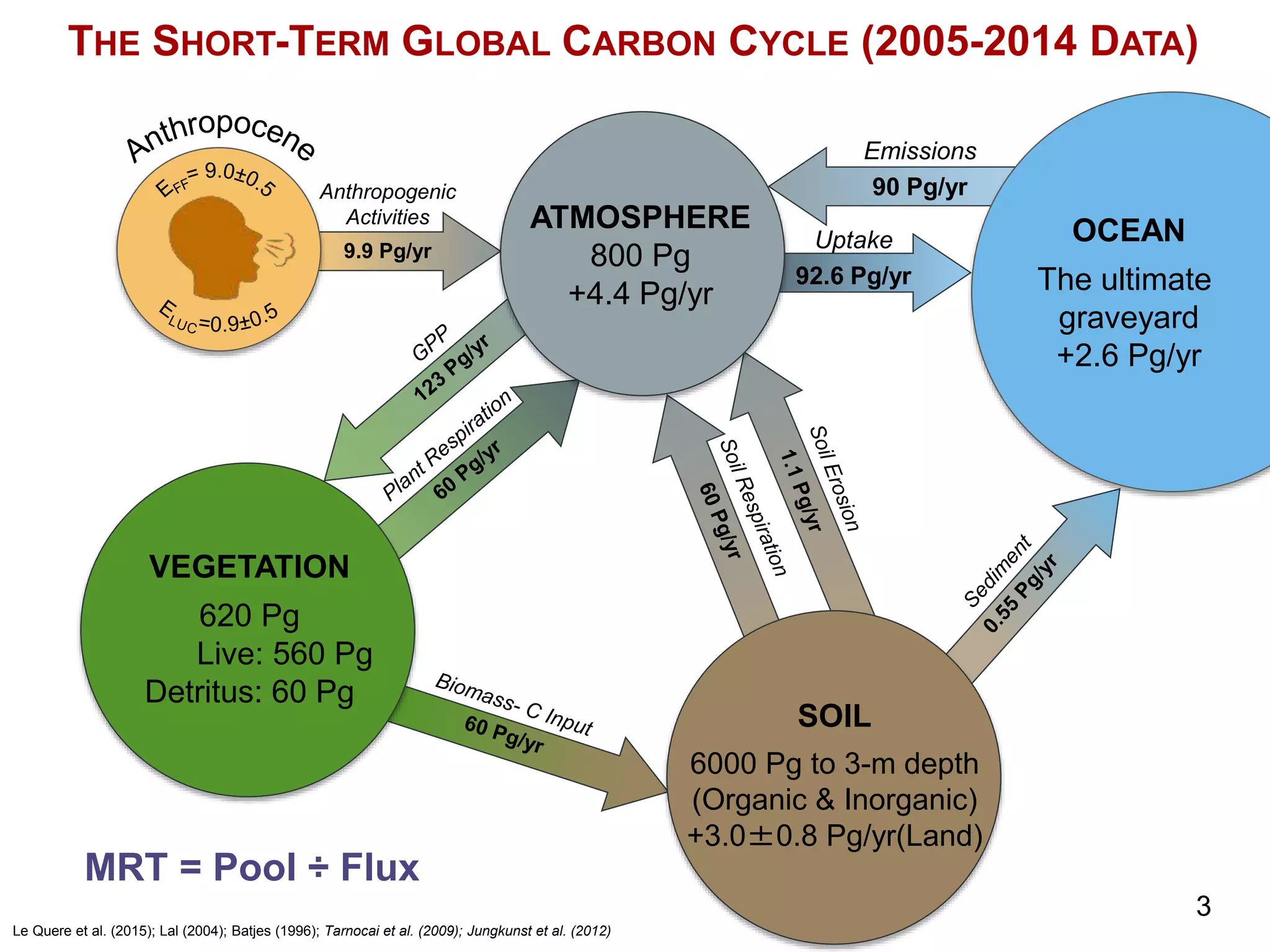
THE SHORT-TERM GLOBAL CARBON CYCLE (2005-2014 DATA)
Anthropogenic
Activities
9.9 Pg/yr
Emissions
90 Pg/yr
Uptake
92.6 Pg/yr
ATMOSPHERE
800 Pg
+4.4 Pg/yr
OCEAN
The ultimate
graveyard
+2.6 Pg/yr
SOIL
6000 Pg to 3-m depth
(Organic & Inorganic)
+3.0±0.8 Pg/yr(Land)
VEGETATION
620 Pg
Live: 560 Pg
Detritus: 60 Pg
Le Quere et al. (2015); Lal (2004); Batjes (1996); Tarnocai et al. (2009); Jungkunst et al. (2012)
MRT = Pool ÷ Flux
4
Carbon Management and
Sequestration Center
AGGREGATION (PHYSICAL PROTECTION) ENHANCES THE
MRT
Shaking and erosion lead to release of C and its oxidation by microbial processes
Clay particles Domains Micro-aggregates Aggregates Peds
5
Carbon Management and
Sequestration Center
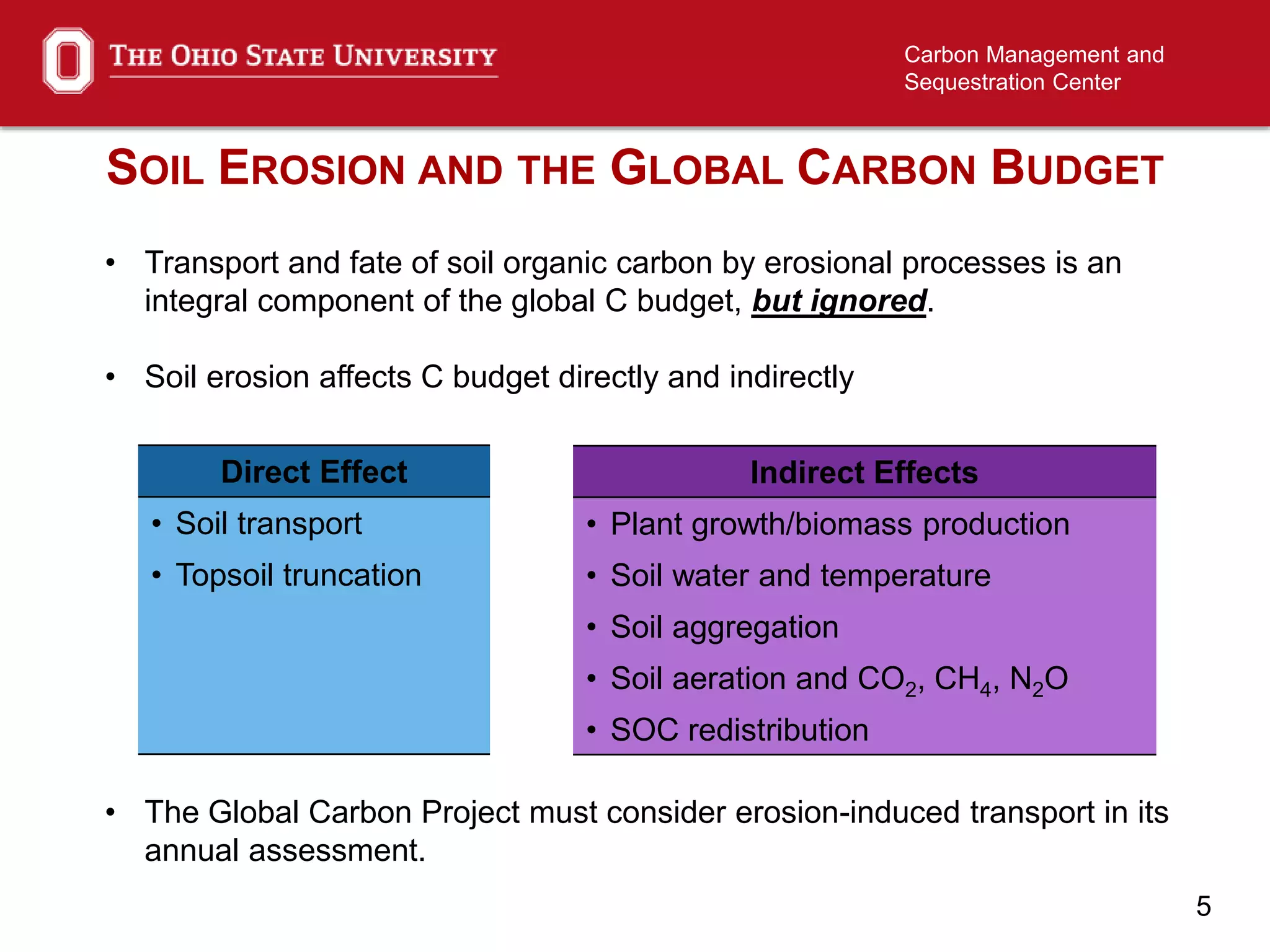
SOIL EROSION AND THE GLOBAL CARBON BUDGET
• Transport and fate of soil organic carbon by erosional processes is an
integral component of the global C budget, but ignored.
• Soil erosion affects C budget directly and indirectly
Direct Effect
• Soil transport
• Topsoil truncation
Indirect Effects
• Plant growth/biomass production
• Soil water and temperature
• Soil aggregation
• Soil aeration and CO2, CH4, N2O
• SOC redistribution
• The Global Carbon Project must consider erosion-induced transport in its
annual assessment.
6
Carbon Management and
Sequestration Center
CO2,N2O
CO2,CH4,N2O
GaseousEmissions
Stream
Top Soil
TRANSPORT, REDISTRIBUTION AND DEPOSITION OF SOIL ORGANIC CARBON ON AN
ERODED LANDSCAPE (LAL, 2016)
Delivery ratio is about 10%.
It decreases with increase in distance from the source.
7
Carbon Management and
Sequestration Center
CUMULATIVE CO2 EMISSIONS AND SINKS BETWEEN 1750-2015
Le Quéré et al. (2016)
Source/Sink 1750-2015 (PgC)
Sources Fossil fuel and industry 410±20
Land use change 190±65
Total emissions 600±70
Sinks Atmosphere 260±5
Ocean 175±20
Residual terrestrial 165±70
With sources and sinks of landuse being uncertain, the global carbon
budget remains a work-in-progress.
8
Carbon Management and
Sequestration Center
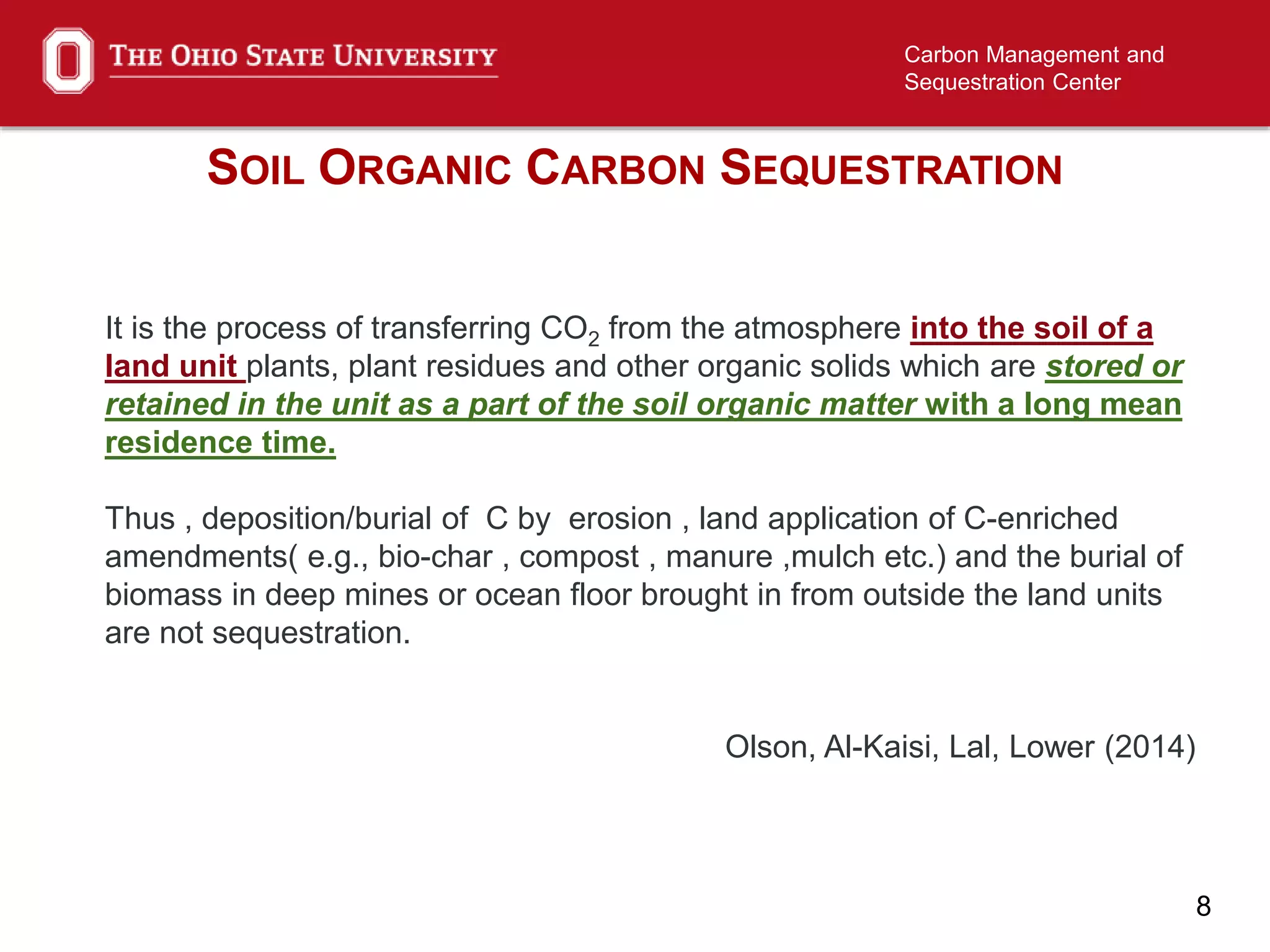
SOIL ORGANIC CARBON SEQUESTRATION
It is the process of transferring CO2 from the atmosphere into the soil of a
land unit plants, plant residues and other organic solids which are stored or
retained in the unit as a part of the soil organic matter with a long mean
residence time.
Thus , deposition/burial of C by erosion , land application of C-enriched
amendments( e.g., bio-char , compost , manure ,mulch etc.) and the burial of
biomass in deep mines or ocean floor brought in from outside the land units
are not sequestration.
Olson, Al-Kaisi, Lal, Lower (2014)
9
Carbon Management and
Sequestration Center
Disease-
Suppressive soil
High Soil
Biodiversity
Mulch Cover crop
MANAGING SOIL HEALTH AND SOM
Mycorrhizae
Integrated Nutrient
Management
Rhizobium
Molecular-based signals
Integrated livestock-
tree systems
N, P, K, Zn, H2O
No-till
10
Carbon Management and
Sequestration Center
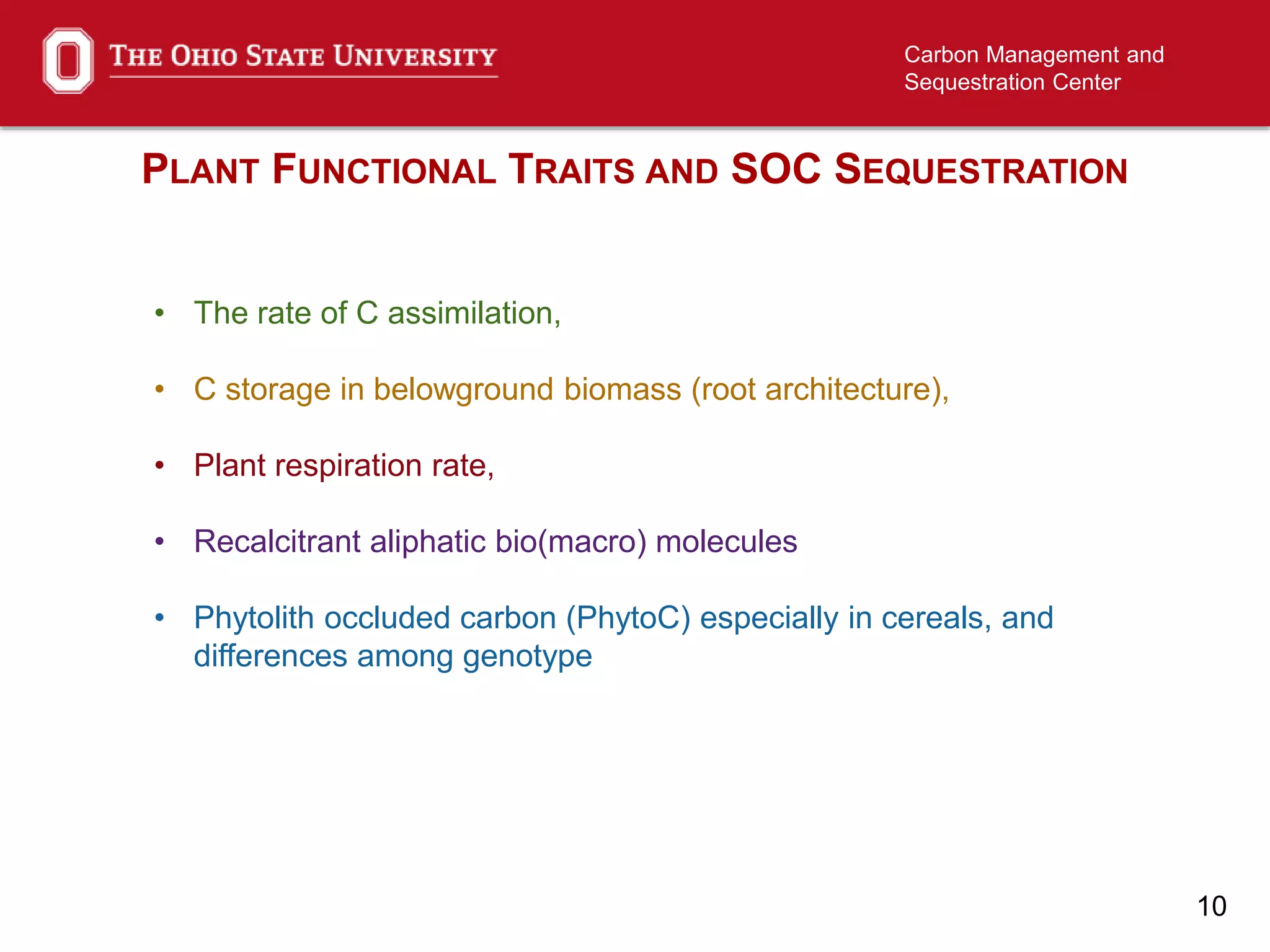
PLANT FUNCTIONAL TRAITS AND SOC SEQUESTRATION
• The rate of C assimilation,
• C storage in belowground biomass (root architecture),
• Plant respiration rate,
• Recalcitrant aliphatic bio(macro) molecules
• Phytolith occluded carbon (PhytoC) especially in cereals, and
differences among genotype
11
Carbon Management and
Sequestration Center
THE PRIMING EFFECTS
It refers to the enhanced or retarded soil organic matter
composition due to amendment of fresh biomass-C or mineral N.
Large amounts of C, N, and other nutrients can be released or
immobilized over a short-time by microbial activities.
• Interactions between different qualities of biomass,
• Interaction between living and dead organic matter,
• Mechanisms and the magnitude of effects depend on a
• Effects of macro-organisms on micro-flora
• Impact of INM
12
Carbon Management and
Sequestration Center
SOIL FUNCTIONAL ATTRIBUTES FOR SOC SEQUESTRATION
• Clay + fine silt content
• Clay minerals
• Soil depth
• Water retention and internal drainage
• Nutrient reserves (N,P,S micronutrients)
• Slope aspect
• Slope shape
13
Carbon Management and
Sequestration Center
MECHANISMS OF LONGER MRT OF ROOT VS. SHOOT-DERIVED SOC
• Chemical recalcitrance (cutin, suberins)
• Deep placement
• Interaction with mycorrhizae and root hairs
• Interaction with polyvalent cations
• Physico-chemical protection
14
Carbon Management and
Sequestration Center
TOWARDS INCREASING CARBON STORAGE IN SOIL
1. Increasing the input of biomass-C and of Ca2+ and Mg2+
1. Decreasing losses by decomposition, erosion, leaching.
1. Enhancing stabilization of SOC by physical, chemical, biological
and ecological protection measures.
1. Enhancing the deep transport of C into the sub-soil.
1. Improving linkages between processes governing SOC and SIC
interactions of mutual enhancement.
15
Carbon Management and
Sequestration Center
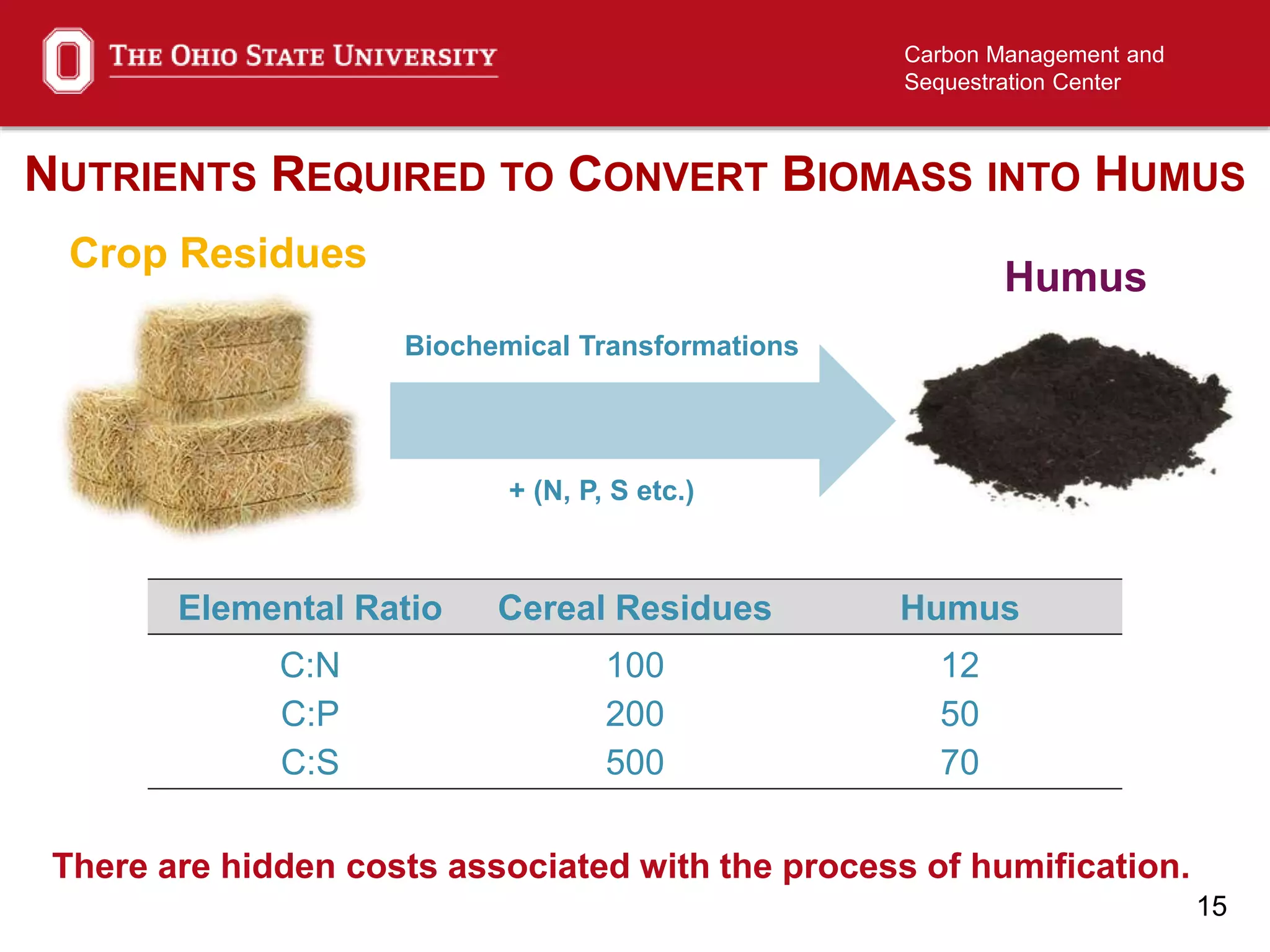
Elemental Ratio Cereal Residues Humus
C:N 100 12
C:P 200 50
C:S 500 70
Crop Residues
Humus
Biochemical Transformations
+ (N, P, S etc.)
NUTRIENTS REQUIRED TO CONVERT BIOMASS INTO HUMUS
There are hidden costs associated with the process of humification.
16
Carbon Management and
Sequestration Center
Sustainableuseofsoil&waterresources
AND THE
ECOSYSTEM
SERVICES GENERATED
COUPLED CYCLING
OF H2O, C, N, P
Lal (2010)
17
Carbon Management and
Sequestration Center
CONSEQUENCES OF THE COUPLED BIOGEOCHEMICAL CYCLING
Because of the coupled cycles of C, N, H2O, P, S, etc.,
management-induced changes in one can affect cycling of
others often with adverse environmental impacts or trade-offs:
• Gaseous emission of CH4, N2O
• Leaching of NO3, N2 or NH3
• Changes in soil inorganic C and N
18
Carbon Management and
Sequestration Center
MECHANISMS OF STABILIZATION OF SOC
Mechanism Process Reference
Physical • Access to microbial processes Dungait et al. (2012)
• Stable microaggregates Vitro et al. (2008, 2010)
• Deep placement in sub-soil Lorenz and Lal (2005)
Chemical • Absorption on clay particles Theng et al. (2012, 2014)
• Formation of organo-mineral complexes Plaza et al. (2013), Chenu and
Plante (2006), Rumpel and Kögel-
Knaber (2011)
Biochemical • Supra-molecular structure Piccolo (2001)
• Formation and selective preservation of
molecules
Schnitzer and Monreal (2011)
• Recalcitrant substances Lorenz et al. (2007)
• Clay hutches Lündsdorf et al. (2000)
Ecological • Ecosystem property Schmidt et al. (2011)
19
Carbon Management and
Sequestration Center
TEMPERATURE DEPENDENCE OF SOM DECOMPOSITION AND
FEEDBACK TO CLIMATE CHANGE
(Kinetic Theory, Arrhenius, 1889)
1. Decomposition rate increase with increase in temperature when substrate
availability and enzyme activity do not constrain the reaction rate
(Davidson and Janssens, 2006).
1. Increase in decomposition rate with the warming temperature is more in
colder than that in warmer climates (Del Grosso et al., 2005; Kirschbaum,
1995).
2. The decomposition reactions with high activation energies (i.e., slow rate)
will experience greater temperature sensitivity than those with low
activation energy (i.e., fast rate).
20
Carbon Management and
Sequestration Center
THE DEBATE ABOUT TEMPERATURE-SENSITIVITY OF SOM
Assumption: Increased response in the rate of decomposition of recalcitrant
substrate with increase in temperature will result in large loss of SOC stock.
Argument: Such a rate increase may not be important because the
decomposition rate of recalcitrant materials, while being kinetically sensitive to
temperature, may be so slow that little SOM would decompose regardless of
the temperature (Conant et al., 2011).
Debate: Thus feedbacks to atmospheric CO2 concentrations from soil carbon
are uncertain (Zhou et al., 2009; Janssen and Vicca, 2010), the decomposition
rate (turnover) also depends on the accessibility (Dungait et al., 2012), the
physiology of soil microfauna (Lützow et al., 2009), and on the fact that the
persistence of SOM is an ecosystem property (Schmidt, 2011).
21
Carbon Management and
Sequestration Center
SOM AS AN ECOSYSTEM PROPERTY
• Molecular structure alone does not control SOM stability.
• Environmental and biological controls predominate (Schmidt et al., 2011).
• The MRT of the fire-derived SOM (biochar), widely believed to be
recalcitrant, also depends on physical protection and interaction with soil
minerals (Brodowski et al., 2006), and the soil fertility trade-offs must also
be considered.
• Thus, management (soil, plant, animals, water, nutrients, tillage,
phytoengineering, cover crops, residues) can play an important role in SOM
persistence and in moderating feedback to climate change (Lal, 2004).
22
Carbon Management and
Sequestration Center
THE CASE OF PERMAFROST
• Cryosols contain 1672 PgC (Tarnocai et al., 2009; Jungkunst et al., 2013)
• With stabilization due to low temperature, thawing may accentuate
mineralization (Nowinski et al., 2010) even of older SOM.
• However, formation of pedogenic carbonates (Strigel et al., 2005;
Kawahigashi et al., 2006) and enhanced aggregation in active layer
(Schmidt et al., 2001) may stabilize SOM.
23
Carbon Management and
Sequestration Center
SOIL CARBON STOCKS
• SOC stock: prehistoric, 1750, 1800,
1900, 1950, 2000
• Gaseous emissions
• SIC stocks (3-m)
• SOC stock vs. yield
24
Carbon Management and
Sequestration Center
OTHER RESEARCHABLE PRIORITIES
• Initiating long-term field experiments to assess
stabilization/destabilization processes and MRT,
• Evaluating global C budget with due consideration to the fate of
erosional processes, soil/water management,
• Mapping SOC stocks to 3-m depth, gaseous fluxes, productivity
effects and critical limits.
• Assessment of SIC and SOC stocks at landscape level.
• Developing new technologies for measurement of stocks (INS,
Mid-infrared reflectance spectroscopy-MIRS).
25
Carbon Management and
Sequestration Center
CARBON PIE
Total C Pie = (560ppm-400ppm)  2Gt/1 ppm = 320 Gt
26
Carbon Management and
Sequestration Center
2 – Food & Nutritional
Security
SOIL AS A
COMPONENT OF
THE NEXUS

Soil Organic Carbon Sequestration: Importance and State of Science

  • 1.
    1 Carbon Management and SequestrationCenter Soil Organic Carbon Sequestration: Importance and State of Science Dr. Rattan Lal Carbon Management and Sequestration Center The Ohio State University Columbus, Ohio
  • 2.
    2 Carbon Management and SequestrationCenter CONSTITUENTS OF SOIL CARBON POOL Soil Carbon Pool Organic Inorganic Pedogenic Lithogenic Carbonates Bicarbonates Live - Fauna - MBC Undecomposed (Detritus) Decomposed Protected Unprotected DOC POC MOC
  • 3.
    3 Carbon Management and SequestrationCenter THE SHORT-TERM GLOBAL CARBON CYCLE (2005-2014 DATA) Anthropogenic Activities 9.9 Pg/yr Emissions 90 Pg/yr Uptake 92.6 Pg/yr ATMOSPHERE 800 Pg +4.4 Pg/yr OCEAN The ultimate graveyard +2.6 Pg/yr SOIL 6000 Pg to 3-m depth (Organic & Inorganic) +3.0±0.8 Pg/yr(Land) VEGETATION 620 Pg Live: 560 Pg Detritus: 60 Pg Le Quere et al. (2015); Lal (2004); Batjes (1996); Tarnocai et al. (2009); Jungkunst et al. (2012) MRT = Pool ÷ Flux
  • 4.
    4 Carbon Management and SequestrationCenter AGGREGATION (PHYSICAL PROTECTION) ENHANCES THE MRT Shaking and erosion lead to release of C and its oxidation by microbial processes Clay particles Domains Micro-aggregates Aggregates Peds Clay particles Domains Micro-aggregates Aggregates Peds
  • 5.
    5 Carbon Management and SequestrationCenter SOIL EROSION AND THE GLOBAL CARBON BUDGET • Transport and fate of soil organic carbon by erosional processes is an integral component of the global C budget, but ignored. • Soil erosion affects C budget directly and indirectly Direct Effect • Soil transport • Topsoil truncation Indirect Effects • Plant growth/biomass production • Soil water and temperature • Soil aggregation • Soil aeration and CO2, CH4, N2O • SOC redistribution • The Global Carbon Project must consider erosion-induced transport in its annual assessment.
  • 6.
    6 Carbon Management and SequestrationCenter CO2,N2O CO2,CH4,N2O GaseousEmissions Stream Top Soil TRANSPORT, REDISTRIBUTION AND DEPOSITION OF SOIL ORGANIC CARBON ON AN ERODED LANDSCAPE (LAL, 2016) Delivery ratio is about 10%. It decreases with increase in distance from the source.
  • 7.
    7 Carbon Management and SequestrationCenter CUMULATIVE CO2 EMISSIONS AND SINKS BETWEEN 1750-2015 Le Quéré et al. (2016) Source/Sink 1750-2015 (PgC) Sources Fossil fuel and industry 410±20 Land use change 190±65 Total emissions 600±70 Sinks Atmosphere 260±5 Ocean 175±20 Residual terrestrial 165±70 With sources and sinks of landuse being uncertain, the global carbon budget remains a work-in-progress.
  • 8.
    8 Carbon Management and SequestrationCenter SOIL ORGANIC CARBON SEQUESTRATION It is the process of transferring CO2 from the atmosphere into the soil of a land unit plants, plant residues and other organic solids which are stored or retained in the unit as a part of the soil organic matter with a long mean residence time. Thus , deposition/burial of C by erosion , land application of C-enriched amendments( e.g., bio-char , compost , manure ,mulch etc.) and the burial of biomass in deep mines or ocean floor brought in from outside the land units are not sequestration. Olson, Al-Kaisi, Lal, Lower (2014)
  • 9.
    9 Carbon Management and SequestrationCenter Disease- Suppressive soil High Soil Biodiversity Mulch Cover crop MANAGING SOIL HEALTH AND SOM Mycorrhizae Integrated Nutrient Management Rhizobium Molecular-based signals Integrated livestock- tree systems N, P, K, Zn, H2O No-till
  • 10.
    10 Carbon Management and SequestrationCenter PLANT FUNCTIONAL TRAITS AND SOC SEQUESTRATION • The rate of C assimilation, • C storage in belowground biomass (root architecture), • Plant respiration rate, • Recalcitrant aliphatic bio(macro) molecules • Phytolith occluded carbon (PhytoC) especially in cereals, and differences among genotype
  • 11.
    11 Carbon Management and SequestrationCenter THE PRIMING EFFECTS It refers to the enhanced or retarded soil organic matter composition due to amendment of fresh biomass-C or mineral N. Large amounts of C, N, and other nutrients can be released or immobilized over a short-time by microbial activities. • Interactions between different qualities of biomass, • Interaction between living and dead organic matter, • Mechanisms and the magnitude of effects depend on a • Effects of macro-organisms on micro-flora • Impact of INM
  • 12.
    12 Carbon Management and SequestrationCenter SOIL FUNCTIONAL ATTRIBUTES FOR SOC SEQUESTRATION • Clay + fine silt content • Clay minerals • Soil depth • Water retention and internal drainage • Nutrient reserves (N,P,S micronutrients) • Slope aspect • Slope shape
  • 13.
    13 Carbon Management and SequestrationCenter MECHANISMS OF LONGER MRT OF ROOT VS. SHOOT-DERIVED SOC • Chemical recalcitrance (cutin, suberins) • Deep placement • Interaction with mycorrhizae and root hairs • Interaction with polyvalent cations • Physico-chemical protection
  • 14.
    14 Carbon Management and SequestrationCenter TOWARDS INCREASING CARBON STORAGE IN SOIL 1. Increasing the input of biomass-C and of Ca2+ and Mg2+ 1. Decreasing losses by decomposition, erosion, leaching. 1. Enhancing stabilization of SOC by physical, chemical, biological and ecological protection measures. 1. Enhancing the deep transport of C into the sub-soil. 1. Improving linkages between processes governing SOC and SIC interactions of mutual enhancement.
  • 15.
    15 Carbon Management and SequestrationCenter Elemental Ratio Cereal Residues Humus C:N 100 12 C:P 200 50 C:S 500 70 Crop Residues Humus Biochemical Transformations + (N, P, S etc.) NUTRIENTS REQUIRED TO CONVERT BIOMASS INTO HUMUS There are hidden costs associated with the process of humification.
  • 16.
    16 Carbon Management and SequestrationCenter Sustainableuseofsoil&waterresources AND THE ECOSYSTEM SERVICES GENERATED COUPLED CYCLING OF H2O, C, N, P Lal (2010)
  • 17.
    17 Carbon Management and SequestrationCenter CONSEQUENCES OF THE COUPLED BIOGEOCHEMICAL CYCLING Because of the coupled cycles of C, N, H2O, P, S, etc., management-induced changes in one can affect cycling of others often with adverse environmental impacts or trade-offs: • Gaseous emission of CH4, N2O • Leaching of NO3, N2 or NH3 • Changes in soil inorganic C and N
  • 18.
    18 Carbon Management and SequestrationCenter MECHANISMS OF STABILIZATION OF SOC Mechanism Process Reference Physical • Access to microbial processes Dungait et al. (2012) • Stable microaggregates Vitro et al. (2008, 2010) • Deep placement in sub-soil Lorenz and Lal (2005) Chemical • Absorption on clay particles Theng et al. (2012, 2014) • Formation of organo-mineral complexes Plaza et al. (2013), Chenu and Plante (2006), Rumpel and Kögel- Knaber (2011) Biochemical • Supra-molecular structure Piccolo (2001) • Formation and selective preservation of molecules Schnitzer and Monreal (2011) • Recalcitrant substances Lorenz et al. (2007) • Clay hutches Lündsdorf et al. (2000) Ecological • Ecosystem property Schmidt et al. (2011)
  • 19.
    19 Carbon Management and SequestrationCenter TEMPERATURE DEPENDENCE OF SOM DECOMPOSITION AND FEEDBACK TO CLIMATE CHANGE (Kinetic Theory, Arrhenius, 1889) 1. Decomposition rate increase with increase in temperature when substrate availability and enzyme activity do not constrain the reaction rate (Davidson and Janssens, 2006). 1. Increase in decomposition rate with the warming temperature is more in colder than that in warmer climates (Del Grosso et al., 2005; Kirschbaum, 1995). 2. The decomposition reactions with high activation energies (i.e., slow rate) will experience greater temperature sensitivity than those with low activation energy (i.e., fast rate).
  • 20.
    20 Carbon Management and SequestrationCenter THE DEBATE ABOUT TEMPERATURE-SENSITIVITY OF SOM Assumption: Increased response in the rate of decomposition of recalcitrant substrate with increase in temperature will result in large loss of SOC stock. Argument: Such a rate increase may not be important because the decomposition rate of recalcitrant materials, while being kinetically sensitive to temperature, may be so slow that little SOM would decompose regardless of the temperature (Conant et al., 2011). Debate: Thus feedbacks to atmospheric CO2 concentrations from soil carbon are uncertain (Zhou et al., 2009; Janssen and Vicca, 2010), the decomposition rate (turnover) also depends on the accessibility (Dungait et al., 2012), the physiology of soil microfauna (Lützow et al., 2009), and on the fact that the persistence of SOM is an ecosystem property (Schmidt, 2011).
  • 21.
    21 Carbon Management and SequestrationCenter SOM AS AN ECOSYSTEM PROPERTY • Molecular structure alone does not control SOM stability. • Environmental and biological controls predominate (Schmidt et al., 2011). • The MRT of the fire-derived SOM (biochar), widely believed to be recalcitrant, also depends on physical protection and interaction with soil minerals (Brodowski et al., 2006), and the soil fertility trade-offs must also be considered. • Thus, management (soil, plant, animals, water, nutrients, tillage, phytoengineering, cover crops, residues) can play an important role in SOM persistence and in moderating feedback to climate change (Lal, 2004).
  • 22.
    22 Carbon Management and SequestrationCenter THE CASE OF PERMAFROST • Cryosols contain 1672 PgC (Tarnocai et al., 2009; Jungkunst et al., 2013) • With stabilization due to low temperature, thawing may accentuate mineralization (Nowinski et al., 2010) even of older SOM. • However, formation of pedogenic carbonates (Strigel et al., 2005; Kawahigashi et al., 2006) and enhanced aggregation in active layer (Schmidt et al., 2001) may stabilize SOM.
  • 23.
    23 Carbon Management and SequestrationCenter SOIL CARBON STOCKS • SOC stock: prehistoric, 1750, 1800, 1900, 1950, 2000 • Gaseous emissions • SIC stocks (3-m) • SOC stock vs. yield
  • 24.
    24 Carbon Management and SequestrationCenter OTHER RESEARCHABLE PRIORITIES • Initiating long-term field experiments to assess stabilization/destabilization processes and MRT, • Evaluating global C budget with due consideration to the fate of erosional processes, soil/water management, • Mapping SOC stocks to 3-m depth, gaseous fluxes, productivity effects and critical limits. • Assessment of SIC and SOC stocks at landscape level. • Developing new technologies for measurement of stocks (INS, Mid-infrared reflectance spectroscopy-MIRS).
  • 25.
    25 Carbon Management and SequestrationCenter CARBON PIE Total C Pie = (560ppm-400ppm)  2Gt/1 ppm = 320 Gt
  • 26.
    26 Carbon Management and SequestrationCenter 2 – Food & Nutritional Security SOIL AS A COMPONENT OF THE NEXUS