For Farming, Environment and Development
Natural Eco Living Group
http://naturalecoliving.com
Dr. N. SAI BHASKAR REDDY
Director, The Earth Center
http://saibhaskar.com
saibhaskarnakka@gmail.com | 4th October 2020
Biochar is another name for
charcoal used for purposes other
than combustion.
Like all charcoal, biochar is
created by the pyrolysis of
biomass.
There are various types
of biochars, based on
feedstock's and
production technologies.
• Agriculture productivity increases
• Low input agricultureNatural
• Local jobs and equity
• Local enterprisesSocial
• Least skills required
• BiocharcultureHuman
• Local technologies
• Low energyPhysical
• Low carbon economy
• Low costFinancial
• Carbon sequestration and energy security
• Mitigation and adaptation to climate changeEnvironment
http://dx.doi.org/10.1596/978-0-8213-9525-7
CULTUR
AL
SPIRITU
AL
BELIEFS
RITUALS
FESTIVA
LS
ALTARS
CREMATIO
N
SOURCE
S
(BIOMAS
S)
GOOD
STOVES
•TLUDs
•Other
stoves
CROP
RESIDU
E
POULTR
Y
LITTER
WASTE
MANAG
EMENT
•Sludge
PRACTICES
FOOD PRESE
RVING
FOOD
CLEANIN
G
MEDICI
NE
MATTRES
S
TOOTH
POWD
ER
AIR
QUALITY
•CO2 /
CH4
WATE
R
TREAT
MENT
AQUA
RIUM /
TERRA
RIUMS
BIOCH
AR
BRICK
S
BIOCH
AR
URINA
LS
SOAK
PITS
FILTE
RING
MEDIA
INSEC
T
REPEL
LENT
SOIL
AMENDMEN
T
INCREAS
ED
PRODUC
TION
SOIL
TEMPER
ATURE
REGULA
TED
MOISTU
RE
RETENTI
ON
WATER
CONSER
VATION
NITROG
EN /
PHOSPH
OROUS
RETENTI
ON
NURSER
IESPESTICI
DES
ADBSOR
BTION
SOIL
MICROB
ES
DENSITY
INCREAS
E
BIOCHA
R
COMPOS
T
EARTHW
ORMS
INCREAS
E
TERMIT
ES /
ANTS
REPULSI
ON
CARBON
SEQUES
TRATIO
N
ANIMALS
POULTRY
- CH4
REDUCTI
ON
LIVESTO
CK -
URINE
AND
DUNG
FYM /
COMPOST
BIOMAS
S
BIOCHA
R
ENERGY
SOIL
BIOCHAR
BIOCHAR
COMPOST
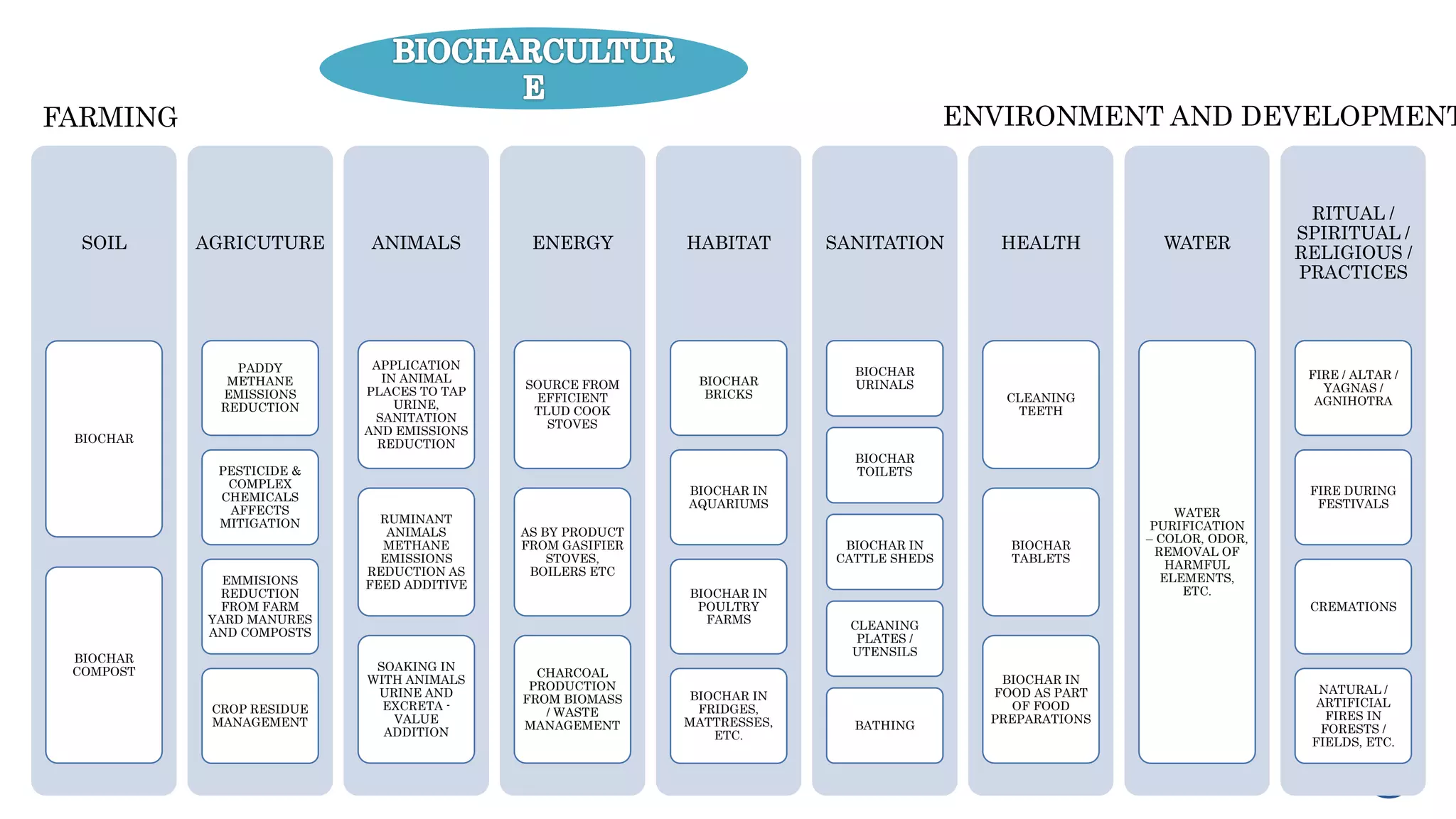
AGRICUTURE
PADDY
METHANE
EMISSIONS
REDUCTION
PESTICIDE &
COMPLEX
CHEMICALS
AFFECTS
MITIGATION
EMMISIONS
REDUCTION
FROM FARM
YARD MANURES
AND COMPOSTS
CROP RESIDUE
MANAGEMENT
ANIMALS
APPLICATION
IN ANIMAL
PLACES TO TAP
URINE,
SANITATION
AND EMISSIONS
REDUCTION
RUMINANT
ANIMALS
METHANE
EMISSIONS
REDUCTION AS
FEED ADDITIVE
SOAKING IN
WITH ANIMALS
URINE AND
EXCRETA -
VALUE
ADDITION
ENERGY
SOURCE FROM
EFFICIENT
TLUD COOK
STOVES
AS BY PRODUCT
FROM GASIFIER
STOVES,
BOILERS ETC
CHARCOAL
PRODUCTION
FROM BIOMASS
/ WASTE
MANAGEMENT
HABITAT
BIOCHAR
BRICKS
BIOCHAR IN
AQUARIUMS
BIOCHAR IN
POULTRY
FARMS
BIOCHAR IN
FRIDGES,
MATTRESSES,
ETC.
SANITATION
BIOCHAR
URINALS
BIOCHAR
TOILETS
BIOCHAR IN
CATTLE SHEDS
CLEANING
PLATES /
UTENSILS
BATHING
HEALTH
CLEANING
TEETH
BIOCHAR
TABLETS
BIOCHAR IN
FOOD AS PART
OF FOOD
PREPARATIONS
WATER
WATER
PURIFICATION
– COLOR, ODOR,
REMOVAL OF
HARMFUL
ELEMENTS,
ETC.
RITUAL /
SPIRITUAL /
RELIGIOUS /
PRACTICES
FIRE / ALTAR /
YAGNAS /
AGNIHOTRA
FIRE DURING
FESTIVALS
CREMATIONS
NATURAL /
ARTIFICIAL
FIRES IN
FORESTS /
FIELDS, ETC.
FARMING ENVIRONMENT AND DEVELOPMENT
Biochar as
Growth
promoter
Soil
conditioner
Soil
amendment
Traditional
use of biochar
Biocharculture is a holistic approach that has been
historically tested, traditionally practiced, is culturally
integral, economically viable, socially responsible,
environmentally sustainable, and agreeable as a policy.
The uses of biochar—as part of biocharculture—include
its application in the areas of soil management,
livestock, biomass energy, water purification, green
habitats, sanitation, food, health, etc.
Securing the crop
from drought and
climate variabiiity
Reclaim the
degraded soils
water conservation
Lessen the impact
of hazardous
pesticides and
complex chemicals
reducing emissions
and increasing the
carbon
sequestration
Conversion of
biomass into
biochar
Increase in crop
yield
increases in C, N,
pH, and available P
to the plants
Impacts of biochar
last more than 1000
years.
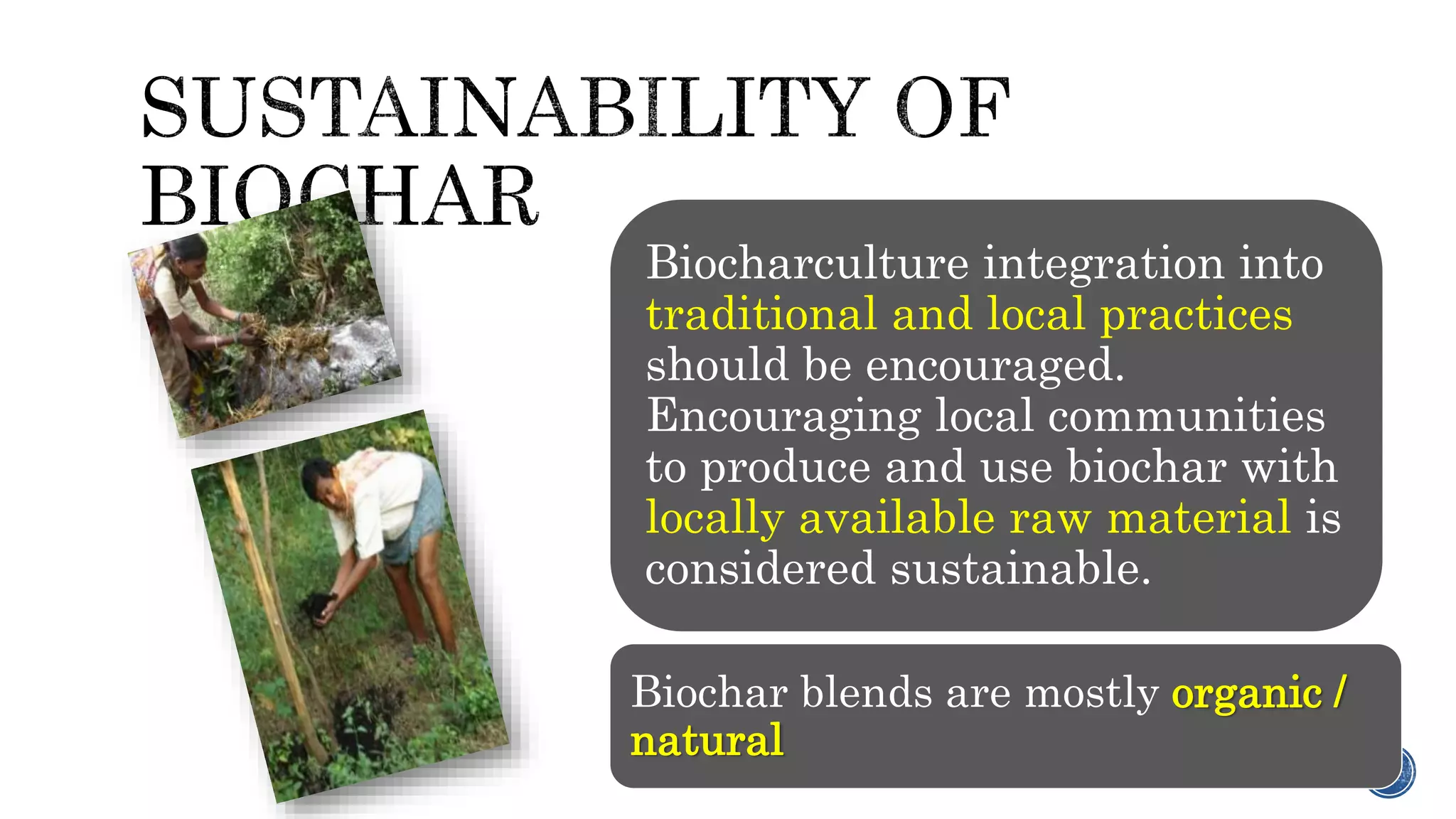
Biocharculture integration into
traditional and local practices
should be encouraged.
Encouraging local communities
to produce and use biochar with
locally available raw material is
considered sustainable.
Biochar blends are mostly organic /
natural
CHARCOAL
PLUS
AMENDME
NTS TO
SOIL
BIOCHAR
FRAMEWORK
Other Environmental Applications
Climate change
- variability -
extremes
Soil fertility Water
management
Impact of
hazardous
pesticides and
nitrogen
fertilizers
Burning of crop
residue
Alkalinity of
soils
http://www.fao.org/docrep/003/w2612e/w2612emap12-e.pdf
Damage has occurred on 15 percent of the world’s total land area (13 percent
light and moderate, 2 percent severe and very severe), mainly resulting from
erosion, nutrient decline, salinization and physical compaction.
http://www.eoearth.org/edit/article/51cbeda07896bb431f692df8/
http://dx.doi.org/10.1596/978-0-8213-9525-7
Biomass from agriculture,
forestry, livestock rearing,
food production and
processing..
Woody biomass—
softwoods, hardwoods, or a
combination
Agricultural residues
including bagasse from
sugar cane, corn stover, rice
husks, cereal straw, and
coconut shells, etc..
http://dx.doi.org/10.1596/978-0-8213-9525-7
CROP RESIDUE (800 million tons of biomass burnt)
COTTON STALKS (22.3 million tons generated)
PROSOPIS JULIFLORA
RICE HUSK
OTHER BIOMASS
(in India)
Plants
Stoves
Biochar
Soil Fertility
Carbon Sequestration
Emission reduction
Water conservation
Energy
Emissions reduction
Biomass conservation
Biochar as byproduct
Carbon as biochar
Water and fertilizers conservation
Carbon sequestration
Note: Presenter has designed low cost highly efficient 50 good stoves that produce biochar as a byproduct. http://goodstove.com
Also see the book Understanding Stoves http://metameta.nl/wp-content/uploads/2012/10/Understanding-Stoves-okt-10-
webversion.pdf
Wood vinegar is being used to increase rates of seed
germination, reduce fungal diseases
and to improve both plant health and crop quality.
Users of this product were frequently fruit
and nut farmers.
WAGES FROM PRODUCTION
INCOME FROM SALE
A B C
CHIMNEY
PRIMARY AIR
SECONDARY AIR
GEO metal retort
Magh biochar retort 2
Magh biochar retort 1
~350–750°C
 Wood vinegar is being used to increase rates
of seed germination, reduce fungal diseases
and to improve both plant health and crop
quality. Users of this product were
frequently fruit and nut farmers.
 Spraying wood vinegar on soil generally
tends to raise the density of useful microbes
such as bacilli and actinomyces.
 Note: It is important that wood vinegar not
be used in too concentrated a form. In this
sense, wood vinegar is like vitamins for
humans: repeated use of concentrated doses
is not more effective, and may even be more
harmful, than using the prescribed amount.
BIOMAS
S
https://biochar-international.org/stoves/Understanding Stoves by Dr. Sai Bhaskar Reddy Nakka
http://dx.doi.org/10.1596/978-0-8213-9525-7
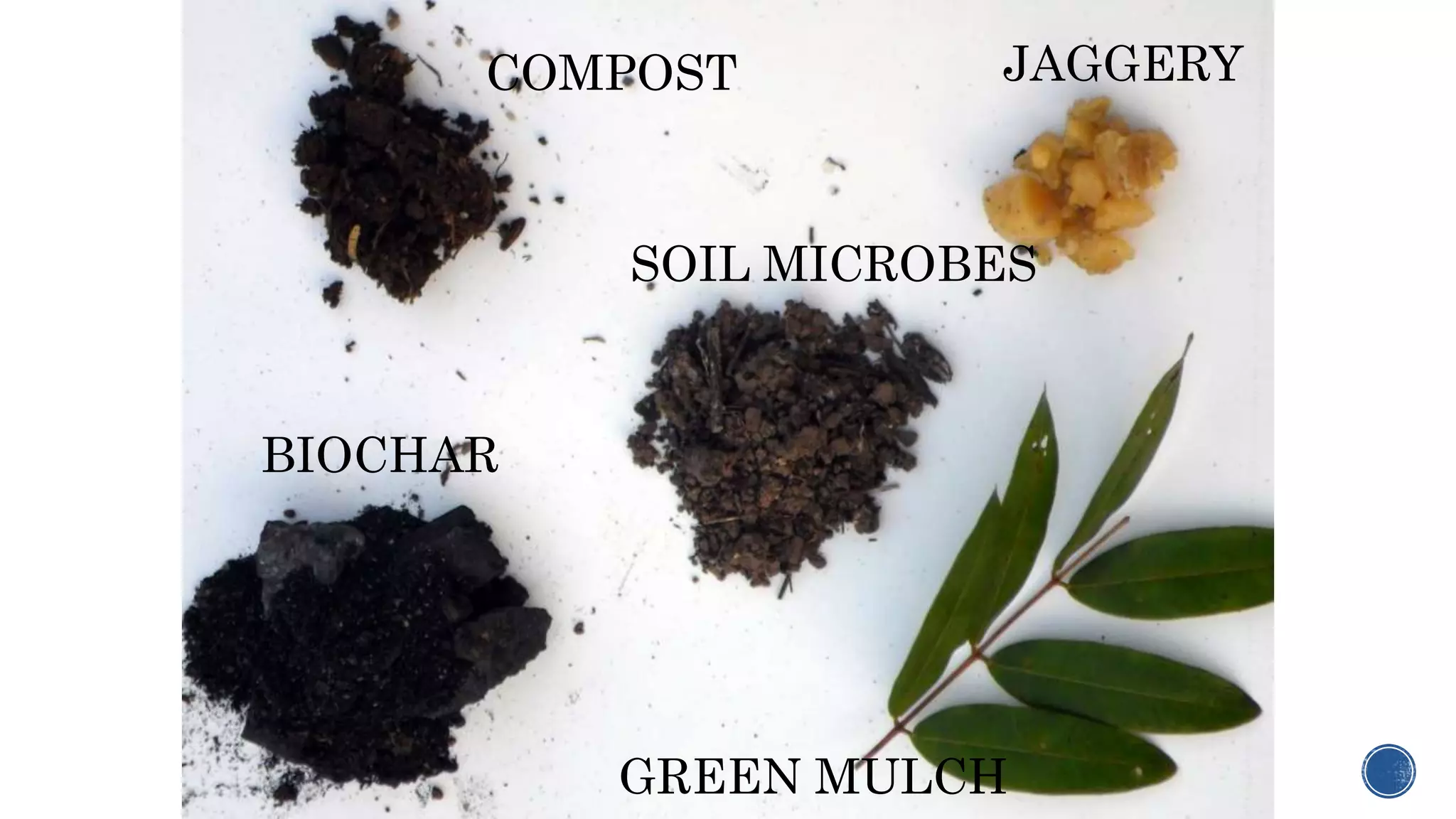
JAGGERYCOMPOST
BIOCHAR
SOIL MICROBES
GREEN MULCH
Biochar compost Application
• Point - eg. Horticulture
• Spread - eg. Paddy
Biochar compost preparation
• Biochar + compost + green mulch + soil microbes + Jaggery + (pottery shards / fish
bones / brick pieces / urine / etc.)
• Addition of biochar to Farm Yard Manure pits in small quantities every day from
traditional stoves – i.e., Cattle dung, cattle urine, straw, biochar, ash, pottery shards,
pottery tile pieces, etc.
Biochar only application
• Point - Biochar mulching - eg. Horticulture
• Spread - Biochar broadcasting - eg. paddy
Biochar Prepartion methods - Many.
5-50 t/ha (0.5-5 kg/m2)
Cation exchange capacity - 50% increase (Glaser et al., 2002)
Fertilizer use efficiency - 10-30 % increase (Gaunt and Cowie, 2009)
Liming agent - 1 point pH increase (Lehman and Rondon, 2006)
Soil moisture retention - Up to 18 % increase (Tryon, 1948)
Crop productivity - 20-120% increase (Lehman and Rondon, 2006)
Methane emission - 100% decrease (Rondon et al, 2005)
Nitrous oxide emissions - 50 % decrease (Yanai et al., 2007)
Bulk density - Soil dependent (Laird, 2008)
Mycorrhizal fungi - 40 % increase (Warnock et al., 2007)
Biological nitrogen fixation - 50-72% increase (Lehman and Rondon, 2006)
(NICRA Bulletin 1/2013)
The difference is high in less fertile and degraded soils.
Biochar is good for all types of soils, because the fertility of soils defined in time and
space varies, based on human and natural conditions.
1 kg to 3 kgs of biochar application for every 1 square meter field area is the emerging
good application result for as tested in field trials.
The compost and other nutrients should be added to the field, as done regularly to any
field as per the crop.
Initially the Nitrogen should be added more (1.5 to 2 times) than what is applied regularly,
Green mulch / composts / farmyard manures etc., are most preferable.
http://dx.doi.org/10.1596/978-0-8213-9525-7
CROP YIELD
INCREASE
SOIL
IMPROVEMENT
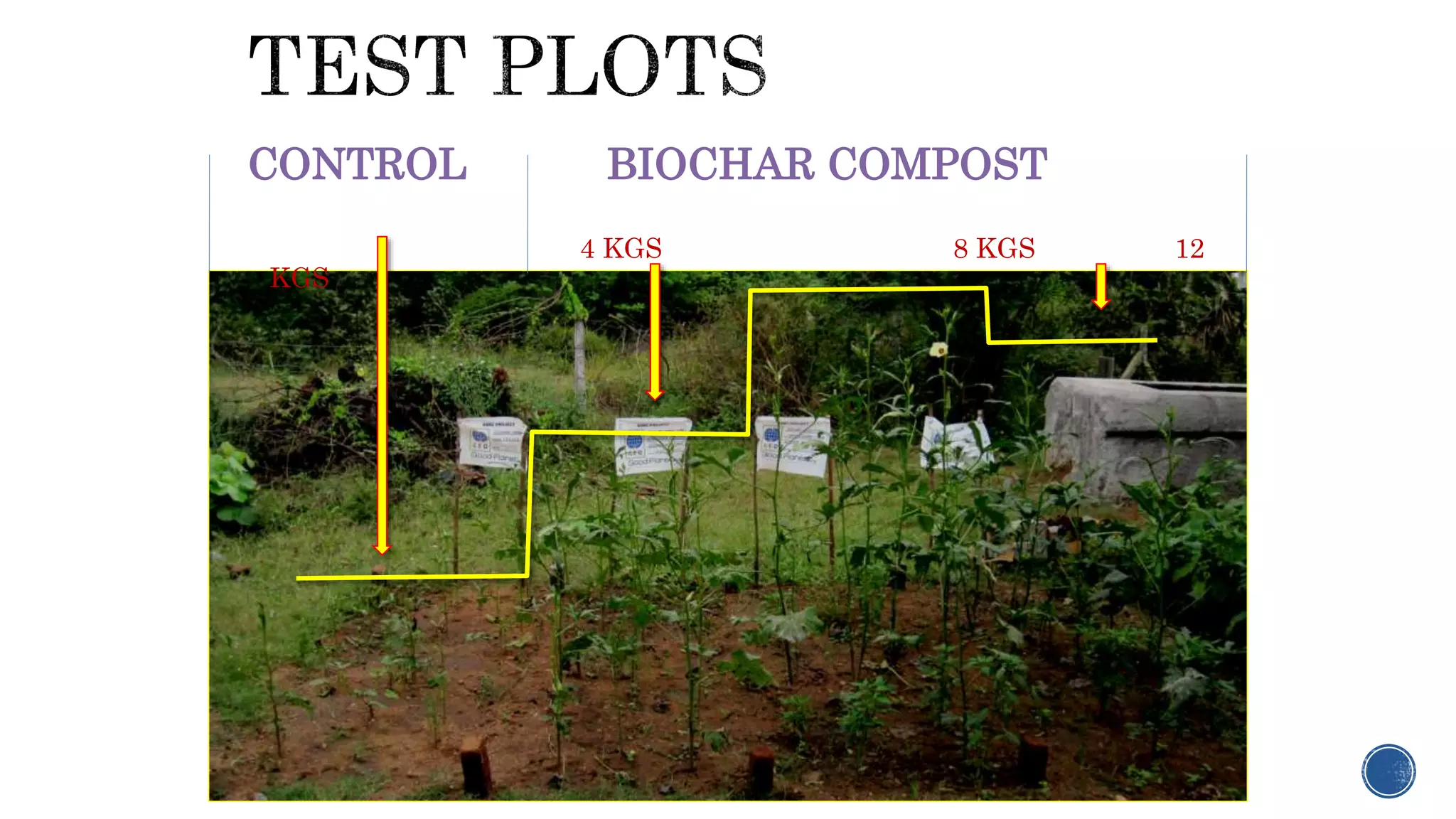
CONTROL
4 KGS BIOCHAR COMPOST
8 KGS BIOCHAR COMPOST
CONTROL BIOCHAR COMPOST
4 KGS 8 KGS 12
KGS
1.5 FEET 6 FEET
CONTROL BIOCHAR
Water
Water is given through the drip
irrigation system to the
subsurface biochar capsule.
Water is absorbed by biochar
and slowly released into the root
zone soil. The water loss is very
less. The roots of perennial
plants over a period encompass
the biochar capsule and absorb
the water without much loss. As
biochar has greater affinity to
water, the water losses due to
percolation into the aquifer is
less. Biochar is not
biodegradable for longer periods
(up to 1000 years or more) of
time, therefore the investment is
only once.
Designed by Dr. N. Sai Bhaskar Reddy, Hyderabad, India. saibhaskarnakka@gmail.com
GEO BIOCHAR
CAPSULE
- FOR
SUBSURFACE
EFFICIENT
IRRIGATION
BIOCHAR
URBAN
GARDENS
Less weight and insulation to
the rooftops
Economic savings through
access to self grown food
Utilization of urban organic
waste for biochar compost.
Aesthetics and green spaces on
rooftops
Unblended biochar and biochar products
blended with other materials are being
sold in many countries at a wide range of
retail prices ranging from $0.08 to $13.48
per kilogram. The average price reported
was $2.48 per kilogram.
http://www.biochar-
DAM / BUND
FLOATS
(THERMO
BIOCHAR +
(MEDIA FOR GROWT
P
Waterproof liquid sprayBiochar
A circular pit is prepared
around the plant without
damaging the roots. Part
of the soil in the pit would
be covered with
polyethylene or
biodegradable wax
sprayed / covered with any
water proof and durable
material and then biochar
compost would be applied.
W
A
T
E
R
WATER &
NUTRIENTS
Small Pouches of biochar
compost would be attached
to the roots of a plant.
These can be made of any
material, preferably a
durable material which can
expand. Water (including
fertilizers) is taken by the
plant by drip irrigation
system
BIOCHAR
LEACHETS
COMPOST
BIN WITH
HOLES
COMPOST BIN
= FOOD WASTE (1 PART) +
SAW DUST / DRY LEAVES
(2 PARTS) + BIOCHAR
POWDER (1 PART)
COMPOST
COVER
COMPOST REMOVAL OPENING FOR LARGE SIZE BIN
HAND WASH
Biochar
Indoor Plants
Water
LEDs for light
Perforated pipe
Sand
Biochar
Gravel
In the present market less
than 25% biochar
businesses and production
technologies are from
developing countries
Low price of biochar in the
developing countries might
trigger exports
Subsidies a hindrance
Lack of awareness
Gardening
Agriculture (Large Farms)
Household
Others
https://www.smashwords.com/books/view/649995 https://www.smashwords.com/books/view/921589 https://www.smashwords.com/books/view/953940 https://www.smashwords.com/books/view/878122 https://www.smashwords.com/books/view/643892
https://web.archive.org/web/20171227063253/http://www.biocharindia.com/Home
https://archive.org/details/InterviewSaibhaskarBiocharEg
https://archive.org/details/BiocharInterviewOfDrNSaiBhaskarReddyByLauramunoz23October2013
Usage of biochar for farming, environment and development

Usage of biochar for farming, environment and development

  • 1.
    For Farming, Environmentand Development Natural Eco Living Group http://naturalecoliving.com Dr. N. SAI BHASKAR REDDY Director, The Earth Center http://saibhaskar.com saibhaskarnakka@gmail.com | 4th October 2020
  • 2.
    Biochar is anothername for charcoal used for purposes other than combustion. Like all charcoal, biochar is created by the pyrolysis of biomass.
  • 3.
    There are varioustypes of biochars, based on feedstock's and production technologies.
  • 5.
    • Agriculture productivityincreases • Low input agricultureNatural • Local jobs and equity • Local enterprisesSocial • Least skills required • BiocharcultureHuman • Local technologies • Low energyPhysical • Low carbon economy • Low costFinancial • Carbon sequestration and energy security • Mitigation and adaptation to climate changeEnvironment
  • 6.
  • 7.
    CULTUR AL SPIRITU AL BELIEFS RITUALS FESTIVA LS ALTARS CREMATIO N SOURCE S (BIOMAS S) GOOD STOVES •TLUDs •Other stoves CROP RESIDU E POULTR Y LITTER WASTE MANAG EMENT •Sludge PRACTICES FOOD PRESE RVING FOOD CLEANIN G MEDICI NE MATTRES S TOOTH POWD ER AIR QUALITY •CO2 / CH4 WATE R TREAT MENT AQUA RIUM/ TERRA RIUMS BIOCH AR BRICK S BIOCH AR URINA LS SOAK PITS FILTE RING MEDIA INSEC T REPEL LENT SOIL AMENDMEN T INCREAS ED PRODUC TION SOIL TEMPER ATURE REGULA TED MOISTU RE RETENTI ON WATER CONSER VATION NITROG EN / PHOSPH OROUS RETENTI ON NURSER IESPESTICI DES ADBSOR BTION SOIL MICROB ES DENSITY INCREAS E BIOCHA R COMPOS T EARTHW ORMS INCREAS E TERMIT ES / ANTS REPULSI ON CARBON SEQUES TRATIO N ANIMALS POULTRY - CH4 REDUCTI ON LIVESTO CK - URINE AND DUNG FYM / COMPOST BIOMAS S BIOCHA R ENERGY
  • 8.
    SOIL BIOCHAR BIOCHAR COMPOST AGRICUTURE PADDY METHANE EMISSIONS REDUCTION PESTICIDE & COMPLEX CHEMICALS AFFECTS MITIGATION EMMISIONS REDUCTION FROM FARM YARDMANURES AND COMPOSTS CROP RESIDUE MANAGEMENT ANIMALS APPLICATION IN ANIMAL PLACES TO TAP URINE, SANITATION AND EMISSIONS REDUCTION RUMINANT ANIMALS METHANE EMISSIONS REDUCTION AS FEED ADDITIVE SOAKING IN WITH ANIMALS URINE AND EXCRETA - VALUE ADDITION ENERGY SOURCE FROM EFFICIENT TLUD COOK STOVES AS BY PRODUCT FROM GASIFIER STOVES, BOILERS ETC CHARCOAL PRODUCTION FROM BIOMASS / WASTE MANAGEMENT HABITAT BIOCHAR BRICKS BIOCHAR IN AQUARIUMS BIOCHAR IN POULTRY FARMS BIOCHAR IN FRIDGES, MATTRESSES, ETC. SANITATION BIOCHAR URINALS BIOCHAR TOILETS BIOCHAR IN CATTLE SHEDS CLEANING PLATES / UTENSILS BATHING HEALTH CLEANING TEETH BIOCHAR TABLETS BIOCHAR IN FOOD AS PART OF FOOD PREPARATIONS WATER WATER PURIFICATION – COLOR, ODOR, REMOVAL OF HARMFUL ELEMENTS, ETC. RITUAL / SPIRITUAL / RELIGIOUS / PRACTICES FIRE / ALTAR / YAGNAS / AGNIHOTRA FIRE DURING FESTIVALS CREMATIONS NATURAL / ARTIFICIAL FIRES IN FORESTS / FIELDS, ETC. FARMING ENVIRONMENT AND DEVELOPMENT
  • 9.
  • 10.
  • 11.
    Biocharculture is aholistic approach that has been historically tested, traditionally practiced, is culturally integral, economically viable, socially responsible, environmentally sustainable, and agreeable as a policy. The uses of biochar—as part of biocharculture—include its application in the areas of soil management, livestock, biomass energy, water purification, green habitats, sanitation, food, health, etc.
  • 12.
    Securing the crop fromdrought and climate variabiiity Reclaim the degraded soils water conservation Lessen the impact of hazardous pesticides and complex chemicals reducing emissions and increasing the carbon sequestration Conversion of biomass into biochar Increase in crop yield increases in C, N, pH, and available P to the plants Impacts of biochar last more than 1000 years.
  • 14.
    Biocharculture integration into traditionaland local practices should be encouraged. Encouraging local communities to produce and use biochar with locally available raw material is considered sustainable. Biochar blends are mostly organic / natural
  • 15.
  • 16.
    Climate change - variability- extremes Soil fertility Water management Impact of hazardous pesticides and nitrogen fertilizers Burning of crop residue Alkalinity of soils
  • 18.
    http://www.fao.org/docrep/003/w2612e/w2612emap12-e.pdf Damage has occurredon 15 percent of the world’s total land area (13 percent light and moderate, 2 percent severe and very severe), mainly resulting from erosion, nutrient decline, salinization and physical compaction.
  • 19.
  • 20.
  • 21.
    Biomass from agriculture, forestry,livestock rearing, food production and processing.. Woody biomass— softwoods, hardwoods, or a combination Agricultural residues including bagasse from sugar cane, corn stover, rice husks, cereal straw, and coconut shells, etc.. http://dx.doi.org/10.1596/978-0-8213-9525-7
  • 22.
    CROP RESIDUE (800million tons of biomass burnt) COTTON STALKS (22.3 million tons generated) PROSOPIS JULIFLORA RICE HUSK OTHER BIOMASS (in India)
  • 23.
    Plants Stoves Biochar Soil Fertility Carbon Sequestration Emissionreduction Water conservation Energy Emissions reduction Biomass conservation Biochar as byproduct Carbon as biochar Water and fertilizers conservation Carbon sequestration Note: Presenter has designed low cost highly efficient 50 good stoves that produce biochar as a byproduct. http://goodstove.com Also see the book Understanding Stoves http://metameta.nl/wp-content/uploads/2012/10/Understanding-Stoves-okt-10- webversion.pdf
  • 24.
    Wood vinegar isbeing used to increase rates of seed germination, reduce fungal diseases and to improve both plant health and crop quality. Users of this product were frequently fruit and nut farmers.
  • 25.
  • 26.
    A B C CHIMNEY PRIMARYAIR SECONDARY AIR GEO metal retort Magh biochar retort 2 Magh biochar retort 1 ~350–750°C
  • 27.
     Wood vinegaris being used to increase rates of seed germination, reduce fungal diseases and to improve both plant health and crop quality. Users of this product were frequently fruit and nut farmers.  Spraying wood vinegar on soil generally tends to raise the density of useful microbes such as bacilli and actinomyces.  Note: It is important that wood vinegar not be used in too concentrated a form. In this sense, wood vinegar is like vitamins for humans: repeated use of concentrated doses is not more effective, and may even be more harmful, than using the prescribed amount.
  • 29.
  • 30.
  • 31.
  • 32.
  • 33.
    Biochar compost Application •Point - eg. Horticulture • Spread - eg. Paddy Biochar compost preparation • Biochar + compost + green mulch + soil microbes + Jaggery + (pottery shards / fish bones / brick pieces / urine / etc.) • Addition of biochar to Farm Yard Manure pits in small quantities every day from traditional stoves – i.e., Cattle dung, cattle urine, straw, biochar, ash, pottery shards, pottery tile pieces, etc. Biochar only application • Point - Biochar mulching - eg. Horticulture • Spread - Biochar broadcasting - eg. paddy Biochar Prepartion methods - Many. 5-50 t/ha (0.5-5 kg/m2)
  • 36.
    Cation exchange capacity- 50% increase (Glaser et al., 2002) Fertilizer use efficiency - 10-30 % increase (Gaunt and Cowie, 2009) Liming agent - 1 point pH increase (Lehman and Rondon, 2006) Soil moisture retention - Up to 18 % increase (Tryon, 1948) Crop productivity - 20-120% increase (Lehman and Rondon, 2006) Methane emission - 100% decrease (Rondon et al, 2005) Nitrous oxide emissions - 50 % decrease (Yanai et al., 2007) Bulk density - Soil dependent (Laird, 2008) Mycorrhizal fungi - 40 % increase (Warnock et al., 2007) Biological nitrogen fixation - 50-72% increase (Lehman and Rondon, 2006) (NICRA Bulletin 1/2013)
  • 37.
    The difference ishigh in less fertile and degraded soils. Biochar is good for all types of soils, because the fertility of soils defined in time and space varies, based on human and natural conditions. 1 kg to 3 kgs of biochar application for every 1 square meter field area is the emerging good application result for as tested in field trials. The compost and other nutrients should be added to the field, as done regularly to any field as per the crop. Initially the Nitrogen should be added more (1.5 to 2 times) than what is applied regularly, Green mulch / composts / farmyard manures etc., are most preferable.
  • 38.
  • 40.
  • 41.
    CONTROL 4 KGS BIOCHARCOMPOST 8 KGS BIOCHAR COMPOST
  • 43.
    CONTROL BIOCHAR COMPOST 4KGS 8 KGS 12 KGS
  • 44.
    1.5 FEET 6FEET CONTROL BIOCHAR
  • 46.
    Water Water is giventhrough the drip irrigation system to the subsurface biochar capsule. Water is absorbed by biochar and slowly released into the root zone soil. The water loss is very less. The roots of perennial plants over a period encompass the biochar capsule and absorb the water without much loss. As biochar has greater affinity to water, the water losses due to percolation into the aquifer is less. Biochar is not biodegradable for longer periods (up to 1000 years or more) of time, therefore the investment is only once. Designed by Dr. N. Sai Bhaskar Reddy, Hyderabad, India. saibhaskarnakka@gmail.com GEO BIOCHAR CAPSULE - FOR SUBSURFACE EFFICIENT IRRIGATION
  • 47.
  • 48.
    Less weight andinsulation to the rooftops Economic savings through access to self grown food Utilization of urban organic waste for biochar compost. Aesthetics and green spaces on rooftops
  • 49.
    Unblended biochar andbiochar products blended with other materials are being sold in many countries at a wide range of retail prices ranging from $0.08 to $13.48 per kilogram. The average price reported was $2.48 per kilogram. http://www.biochar-
  • 52.
  • 54.
    Waterproof liquid sprayBiochar Acircular pit is prepared around the plant without damaging the roots. Part of the soil in the pit would be covered with polyethylene or biodegradable wax sprayed / covered with any water proof and durable material and then biochar compost would be applied.
  • 55.
    W A T E R WATER & NUTRIENTS Small Pouchesof biochar compost would be attached to the roots of a plant. These can be made of any material, preferably a durable material which can expand. Water (including fertilizers) is taken by the plant by drip irrigation system
  • 59.
    BIOCHAR LEACHETS COMPOST BIN WITH HOLES COMPOST BIN =FOOD WASTE (1 PART) + SAW DUST / DRY LEAVES (2 PARTS) + BIOCHAR POWDER (1 PART) COMPOST COVER COMPOST REMOVAL OPENING FOR LARGE SIZE BIN HAND WASH
  • 61.
  • 64.
  • 65.
    In the presentmarket less than 25% biochar businesses and production technologies are from developing countries
  • 66.
    Low price ofbiochar in the developing countries might trigger exports Subsidies a hindrance Lack of awareness Gardening Agriculture (Large Farms) Household Others
  • 67.
    https://www.smashwords.com/books/view/649995 https://www.smashwords.com/books/view/921589 https://www.smashwords.com/books/view/953940https://www.smashwords.com/books/view/878122 https://www.smashwords.com/books/view/643892 https://web.archive.org/web/20171227063253/http://www.biocharindia.com/Home https://archive.org/details/InterviewSaibhaskarBiocharEg https://archive.org/details/BiocharInterviewOfDrNSaiBhaskarReddyByLauramunoz23October2013

Editor's Notes

  • #10 Biochar 10% to 30%
  • #14 https://ars.els-cdn.com/content/image/1-s2.0-S0960852417314360-fx1_lrg.jpg
  • #19 These impacts frequently lead to reductions in yields. Land conservation and rehabilitation are essential parts of sustainable agricultural development. While severely degraded soil is found in most regions of the world, the negative economic impact of degraded soil may be most severe in the countries most dependent on agriculture for their incomes.
  • #28 http://www.warrencc.org.au/wp-content/uploads/2015/12/CharcoalVinegar-with-pictures.pdf
  • #30 During the torrefaction process, the water contained in the biomass as well as superfluous volatiles are released, and the biopolymers ( cellulose, hemicellulose and lignin) partly decompose, giving off various types of volatiles.
  • #40 A Report on the Value of Biochar and Wood Vinegar: Practical Experience of Users in Australia and New Zealand Version 1.0 – June 2019
  • #50 Pine needless biochar from gassifiers, gasifiers
  • #52 The use of biochar as animal feed is an important emerging market in Australia. Those who feed biochar to cattle do so on a daily basis for the purpose of improved cattle health, improved cattle weight gain, methane emissions reduction and reduced feed cost.