The challenge
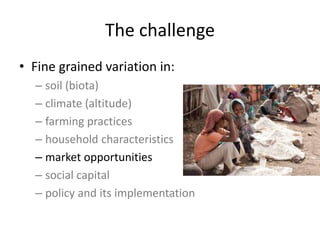
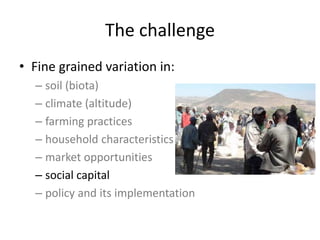
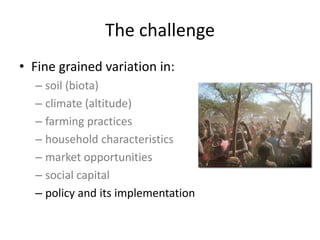
• Fine grained variation in:
– soil (biota)
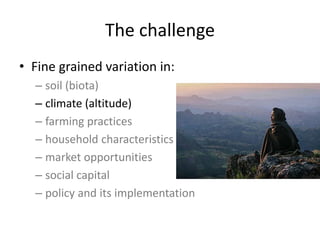
– climate (altitude)
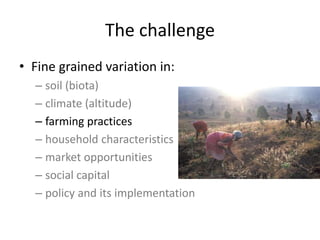
– farming practices
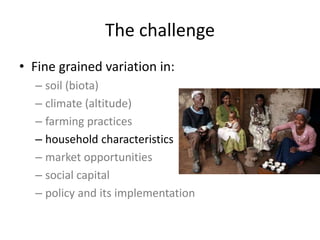
– household characteristics
– market opportunities
– social capital
– policy and its implementation
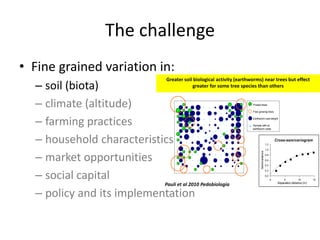
Pruned trees
Free growing trees
Earthworm cast weight
Sample with no
earthworm casts
0.0
0.2
0.4
0.6
0.8
1.0
1.2
0 5 10 15
Separation distance (m)
Semivariance
Cross-semivariogram
Greater soil biological activity (earthworms) near trees but effect
greater for some tree species than others
Pauli et al 2010 Pedobiologia
The challenge
• Fine grained variation in:
– soil (biota)
– climate (altitude)
– farming practices
– household characteristics
– market opportunities
– social capital
– policy and its implementation
The challenge
• Fine grained variation in:
– soil (biota)
– climate (altitude)
– farming practices
– household characteristics
– market opportunities
– social capital
– policy and its implementation
The challenge
• Fine grained variation in:
– soil (biota)
– climate (altitude)
– farming practices
– household characteristics
– market opportunities
– social capital
– policy and its implementation
The challenge
• Fine grained variation in:
– soil (biota)
– climate (altitude)
– farming practices
– household characteristics
– market opportunities
– social capital
– policy and its implementation
The challenge
• Fine grained variation in:
– soil (biota)
– climate (altitude)
– farming practices
– household characteristics
– market opportunities
– social capital
– policy and its implementation
The challenge
• Fine grained variation in:
– soil (biota)
– climate (altitude)
– farming practices
– household characteristics
– market opportunities
– social capital
– policy and its implementation
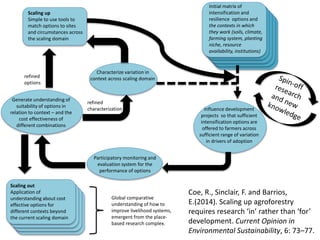
Characterize variation in
context across scaling domain
Influence development
projects so that sufficient
intensification options are
offered to farmers across
sufficient range of variation
in drivers of adoption
Initial matrix of
intensification and
resilience options and
the contexts in which
they work (soils, climate,
farming system, planting
niche, resource
availability, institutions)
Participatory monitoring and
evaluation system for the
performance of options
Scaling up
Simple to use tools to
match options to sites
and circumstances across
the scaling domain
Generate understanding of
suitability of options in
relation to context – and the
cost effectiveness of
different combinations
refined
characterization
refined
options
Scaling out
Application of
understanding about cost
effective options for
different contexts beyond
the current scaling domain
Global comparative
understanding of how to
improve livelihood systems,
emergent from the place-
based research complex.
Coe, R., Sinclair, F. and Barrios,
E.(2014). Scaling up agroforestry
requires research ‘in’ rather than ‘for’
development. Current Opinion in
Environmental Sustainability, 6: 73–77.
Local effects - trees increase crop yields from
meta analysis of >90 trials across sub Saharan Africa
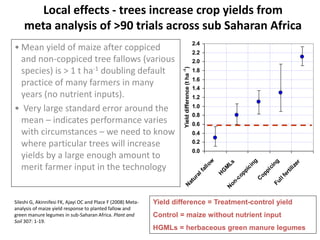
• Mean yield of maize after coppiced
and non-coppiced tree fallows (various
species) is > 1 t ha-1 doubling default
practice of many farmers in many
years (no nutrient inputs).
• Very large standard error around the
mean – indicates performance varies
with circumstances – we need to know
where particular trees will increase
yields by a large enough amount to
merit farmer input in the technology
0.0
0.2
0.4
0.6
0.8
1.0
1.2
1.4
1.6
1.8
2.0
2.2
2.4
N
aturalfallow
H
G
M
Ls
N
on-coppicing
C
oppicingFullfertilizer
Yielddifference(tha-1
)
Yield difference = Treatment-control yield
Control = maize without nutrient input
HGMLs = herbaceous green manure legumes
Sileshi G, Akinnifesi FK, Ajayi OC and Place F (2008) Meta-
analysis of maize yield response to planted fallow and
green manure legumes in sub-Saharan Africa. Plant and
Soil 307: 1-19.
0.0
0.1
0.2
0.3
0.4
0.5
0.6
0.7
0.8
0.9
1.0
-1.0 0.0 1.0 2.0 3.0 4.0 5.0
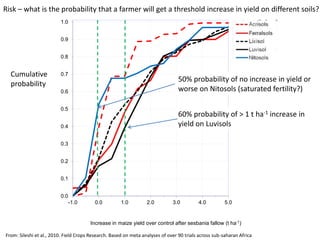
Increase in maize yield over control after sesbania fallow (t ha-1)
Cumulative
probability
From: Sileshi et al., 2010. Field Crops Research. Based on meta analyses of over 90 trials across sub-saharan Africa
50% probability of no increase in yield or
worse on Nitosols (saturated fertility?)
Risk – what is the probability that a farmer will get a threshold increase in yield on different soils?
60% probability of > 1 t ha-1 increase in
yield on Luvisols
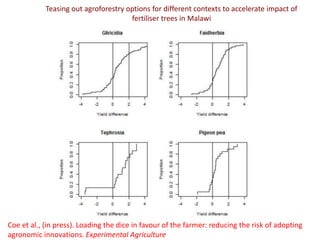
Coe et al., (in press). Loading the dice in favour of the farmer: reducing the risk of adopting
agronomic innovations. Experimental Agriculture
Teasing out agroforestry options for different contexts to accelerate impact of
fertiliser trees in Malawi
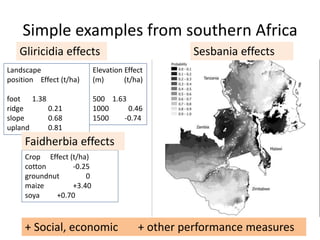
Simple examples from southern Africa
Landscape
position Effect (t/ha)
foot 1.38
ridge 0.21
slope 0.68
upland 0.81
Elevation Effect
(m) (t/ha)
500 1.63
1000 0.46
1500 -0.74
Crop Effect (t/ha)
cotton -0.25
groundnut 0
maize +3.40
soya +0.70
Gliricidia effects
Faidherbia effects
Sesbania effects
+ Social, economic + other performance measures
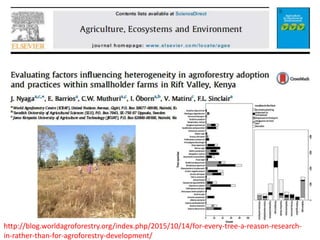
http://blog.worldagroforestry.org/index.php/2015/10/14/for-every-tree-a-reason-research-
in-rather-than-for-agroforestry-development/
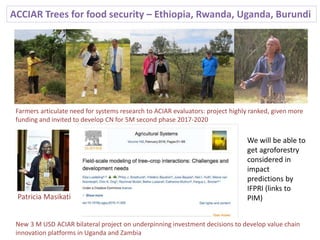
ACCIAR Trees for food security – Ethiopia, Rwanda, Uganda, Burundi
Farmers articulate need for systems research to ACIAR evaluators: project highly ranked, given more
funding and invited to develop CN for 5M second phase 2017-2020
New 3 M USD ACIAR bilateral project on underpinning investment decisions to develop value chain
innovation platforms in Uganda and Zambia
Patricia Masikati
We will be able to
get agroforestry
considered in
impact
predictions by
IFPRI (links to
PIM)
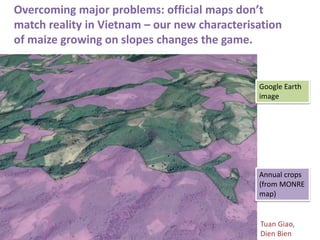
Overcoming major problems: official maps don’t
match reality in Vietnam – our new characterisation
of maize growing on slopes changes the game.
Annual crops
(from MONRE
map)
Google Earth
image
Tuan Giao,
Dien Bien
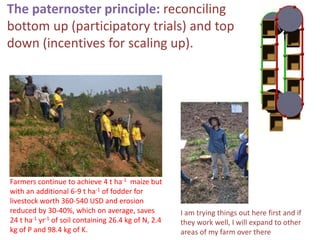
I am trying things out here first and if
they work well, I will expand to other
areas of my farm over there
The paternoster principle: reconciling
bottom up (participatory trials) and top
down (incentives for scaling up).
Farmers continue to achieve 4 t ha-1 maize but
with an additional 6-9 t ha-1 of fodder for
livestock worth 360-540 USD and erosion
reduced by 30-40%, which on average, saves
24 t ha-1 yr-1 of soil containing 26.4 kg of N, 2.4
kg of P and 98.4 kg of K.
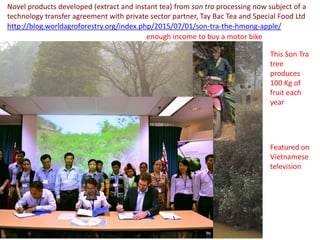
This Son Tra
tree
produces
100 Kg of
fruit each
year
enough income to buy a motor bike
Novel products developed (extract and instant tea) from son tra processing now subject of a
technology transfer agreement with private sector partner, Tay Bac Tea and Special Food Ltd
http://blog.worldagroforestry.org/index.php/2015/07/01/son-tra-the-hmong-apple/
Featured on
Vietnamese
television
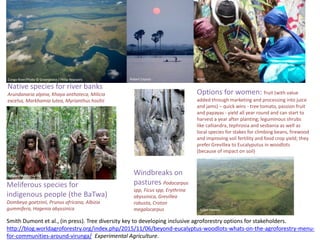
Options for women: fruit (with value
added through marketing and processing into juice
and jams) – quick wins - tree tomato, passion fruit
and papayas - yield all year round and can start to
harvest a year after planting; leguminous shrubs
like calliandra, tephrosia and sesbania as well as
local species for stakes for climbing beans, firewood
and improving soil fertility and food crop yield; they
prefer Grevillea to Eucalyputus in woodlots
(because of impact on soil)
Meliferous species for
indigenous people (the BaTwa)
Dombeya goetzinii, Prunus africana, Albizia
gummifera, Hagenia abyssinica
Native species for river banks
Arundanaria alpina, Khaya anthoteca, Milicia
excelsa, Markhamia lutea, Myrianthus hosltii
Julien Harneis
Windbreaks on
pastures Podocarpus
spp, Ficus spp, Erythrina
abyssinica, Grevillea
robusta, Croton
megalocarpus
Congo River/Photo © Greenpeace / Philip Reynaers Robert Caputo
Rebecca Blackwell / AP
WWF
Smith Dumont et al., (in press). Tree diversity key to developing inclusive agroforestry options for stakeholders.
http://blog.worldagroforestry.org/index.php/2015/11/06/beyond-eucalyptus-woodlots-whats-on-the-agroforestry-menu-
for-communities-around-virunga/ Experimental Agriculture.
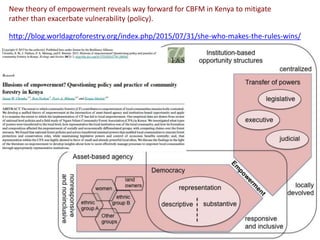
http://blog.worldagroforestry.org/index.php/2015/07/31/she-who-makes-the-rules-wins/
New theory of empowerment reveals way forward for CBFM in Kenya to mitigate
rather than exacerbate vulnerability (policy).
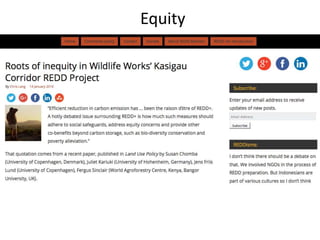
Equity
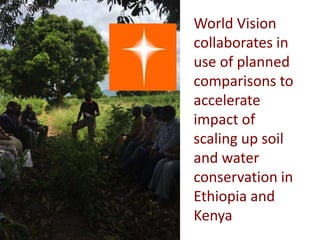
World Vision
collaborates in
use of planned
comparisons to
accelerate
impact of
scaling up soil
and water
conservation in
Ethiopia and
Kenya
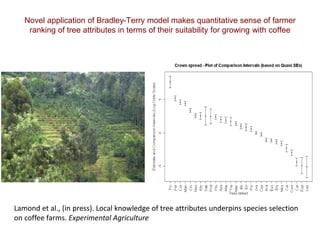
Novel application of Bradley-Terry model makes quantitative sense of farmer
ranking of tree attributes in terms of their suitability for growing with coffee
Lamond et al., (in press). Local knowledge of tree attributes underpins species selection
on coffee farms. Experimental Agriculture
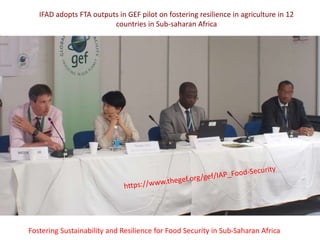
IFAD adopts FTA outputs in GEF pilot on fostering resilience in agriculture in 12
countries in Sub-saharan Africa
Fostering Sustainability and Resilience for Food Security in Sub-Saharan Africa
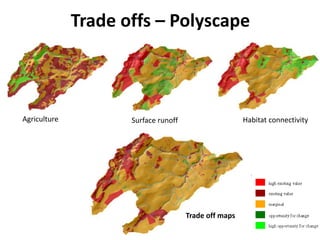
Agriculture Surface runoff Habitat connectivity
Trade off maps
Trade offs – Polyscape
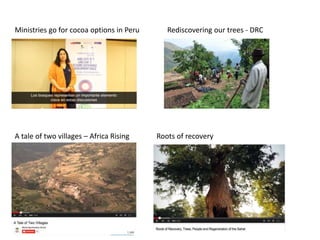
Roots of recoveryA tale of two villages – Africa Rising
Ministries go for cocoa options in Peru Rediscovering our trees - DRC

Fergus Sinclair ICRAF Systems Science

  • 1.
    The challenge • Finegrained variation in: – soil (biota) – climate (altitude) – farming practices – household characteristics – market opportunities – social capital – policy and its implementation Pruned trees Free growing trees Earthworm cast weight Sample with no earthworm casts 0.0 0.2 0.4 0.6 0.8 1.0 1.2 0 5 10 15 Separation distance (m) Semivariance Cross-semivariogram Greater soil biological activity (earthworms) near trees but effect greater for some tree species than others Pauli et al 2010 Pedobiologia
  • 2.
    The challenge • Finegrained variation in: – soil (biota) – climate (altitude) – farming practices – household characteristics – market opportunities – social capital – policy and its implementation
  • 3.
    The challenge • Finegrained variation in: – soil (biota) – climate (altitude) – farming practices – household characteristics – market opportunities – social capital – policy and its implementation
  • 4.
    The challenge • Finegrained variation in: – soil (biota) – climate (altitude) – farming practices – household characteristics – market opportunities – social capital – policy and its implementation
  • 5.
    The challenge • Finegrained variation in: – soil (biota) – climate (altitude) – farming practices – household characteristics – market opportunities – social capital – policy and its implementation
  • 6.
    The challenge • Finegrained variation in: – soil (biota) – climate (altitude) – farming practices – household characteristics – market opportunities – social capital – policy and its implementation
  • 7.
    The challenge • Finegrained variation in: – soil (biota) – climate (altitude) – farming practices – household characteristics – market opportunities – social capital – policy and its implementation
  • 8.
    Characterize variation in contextacross scaling domain Influence development projects so that sufficient intensification options are offered to farmers across sufficient range of variation in drivers of adoption Initial matrix of intensification and resilience options and the contexts in which they work (soils, climate, farming system, planting niche, resource availability, institutions) Participatory monitoring and evaluation system for the performance of options Scaling up Simple to use tools to match options to sites and circumstances across the scaling domain Generate understanding of suitability of options in relation to context – and the cost effectiveness of different combinations refined characterization refined options Scaling out Application of understanding about cost effective options for different contexts beyond the current scaling domain Global comparative understanding of how to improve livelihood systems, emergent from the place- based research complex. Coe, R., Sinclair, F. and Barrios, E.(2014). Scaling up agroforestry requires research ‘in’ rather than ‘for’ development. Current Opinion in Environmental Sustainability, 6: 73–77.
  • 9.
    Local effects -trees increase crop yields from meta analysis of >90 trials across sub Saharan Africa • Mean yield of maize after coppiced and non-coppiced tree fallows (various species) is > 1 t ha-1 doubling default practice of many farmers in many years (no nutrient inputs). • Very large standard error around the mean – indicates performance varies with circumstances – we need to know where particular trees will increase yields by a large enough amount to merit farmer input in the technology 0.0 0.2 0.4 0.6 0.8 1.0 1.2 1.4 1.6 1.8 2.0 2.2 2.4 N aturalfallow H G M Ls N on-coppicing C oppicingFullfertilizer Yielddifference(tha-1 ) Yield difference = Treatment-control yield Control = maize without nutrient input HGMLs = herbaceous green manure legumes Sileshi G, Akinnifesi FK, Ajayi OC and Place F (2008) Meta- analysis of maize yield response to planted fallow and green manure legumes in sub-Saharan Africa. Plant and Soil 307: 1-19.
  • 10.
    0.0 0.1 0.2 0.3 0.4 0.5 0.6 0.7 0.8 0.9 1.0 -1.0 0.0 1.02.0 3.0 4.0 5.0 Increase in maize yield over control after sesbania fallow (t ha-1) Cumulative probability From: Sileshi et al., 2010. Field Crops Research. Based on meta analyses of over 90 trials across sub-saharan Africa 50% probability of no increase in yield or worse on Nitosols (saturated fertility?) Risk – what is the probability that a farmer will get a threshold increase in yield on different soils? 60% probability of > 1 t ha-1 increase in yield on Luvisols
  • 11.
    Coe et al.,(in press). Loading the dice in favour of the farmer: reducing the risk of adopting agronomic innovations. Experimental Agriculture Teasing out agroforestry options for different contexts to accelerate impact of fertiliser trees in Malawi
  • 12.
    Simple examples fromsouthern Africa Landscape position Effect (t/ha) foot 1.38 ridge 0.21 slope 0.68 upland 0.81 Elevation Effect (m) (t/ha) 500 1.63 1000 0.46 1500 -0.74 Crop Effect (t/ha) cotton -0.25 groundnut 0 maize +3.40 soya +0.70 Gliricidia effects Faidherbia effects Sesbania effects + Social, economic + other performance measures
  • 13.
  • 14.
    ACCIAR Trees forfood security – Ethiopia, Rwanda, Uganda, Burundi Farmers articulate need for systems research to ACIAR evaluators: project highly ranked, given more funding and invited to develop CN for 5M second phase 2017-2020 New 3 M USD ACIAR bilateral project on underpinning investment decisions to develop value chain innovation platforms in Uganda and Zambia Patricia Masikati We will be able to get agroforestry considered in impact predictions by IFPRI (links to PIM)
  • 15.
    Overcoming major problems:official maps don’t match reality in Vietnam – our new characterisation of maize growing on slopes changes the game. Annual crops (from MONRE map) Google Earth image Tuan Giao, Dien Bien
  • 16.
    I am tryingthings out here first and if they work well, I will expand to other areas of my farm over there The paternoster principle: reconciling bottom up (participatory trials) and top down (incentives for scaling up). Farmers continue to achieve 4 t ha-1 maize but with an additional 6-9 t ha-1 of fodder for livestock worth 360-540 USD and erosion reduced by 30-40%, which on average, saves 24 t ha-1 yr-1 of soil containing 26.4 kg of N, 2.4 kg of P and 98.4 kg of K.
  • 17.
    This Son Tra tree produces 100Kg of fruit each year enough income to buy a motor bike Novel products developed (extract and instant tea) from son tra processing now subject of a technology transfer agreement with private sector partner, Tay Bac Tea and Special Food Ltd http://blog.worldagroforestry.org/index.php/2015/07/01/son-tra-the-hmong-apple/ Featured on Vietnamese television
  • 18.
    Options for women:fruit (with value added through marketing and processing into juice and jams) – quick wins - tree tomato, passion fruit and papayas - yield all year round and can start to harvest a year after planting; leguminous shrubs like calliandra, tephrosia and sesbania as well as local species for stakes for climbing beans, firewood and improving soil fertility and food crop yield; they prefer Grevillea to Eucalyputus in woodlots (because of impact on soil) Meliferous species for indigenous people (the BaTwa) Dombeya goetzinii, Prunus africana, Albizia gummifera, Hagenia abyssinica Native species for river banks Arundanaria alpina, Khaya anthoteca, Milicia excelsa, Markhamia lutea, Myrianthus hosltii Julien Harneis Windbreaks on pastures Podocarpus spp, Ficus spp, Erythrina abyssinica, Grevillea robusta, Croton megalocarpus Congo River/Photo © Greenpeace / Philip Reynaers Robert Caputo Rebecca Blackwell / AP WWF Smith Dumont et al., (in press). Tree diversity key to developing inclusive agroforestry options for stakeholders. http://blog.worldagroforestry.org/index.php/2015/11/06/beyond-eucalyptus-woodlots-whats-on-the-agroforestry-menu- for-communities-around-virunga/ Experimental Agriculture.
  • 19.
    http://blog.worldagroforestry.org/index.php/2015/07/31/she-who-makes-the-rules-wins/ New theory ofempowerment reveals way forward for CBFM in Kenya to mitigate rather than exacerbate vulnerability (policy).
  • 20.
  • 21.
    World Vision collaborates in useof planned comparisons to accelerate impact of scaling up soil and water conservation in Ethiopia and Kenya
  • 22.
    Novel application ofBradley-Terry model makes quantitative sense of farmer ranking of tree attributes in terms of their suitability for growing with coffee Lamond et al., (in press). Local knowledge of tree attributes underpins species selection on coffee farms. Experimental Agriculture
  • 23.
    IFAD adopts FTAoutputs in GEF pilot on fostering resilience in agriculture in 12 countries in Sub-saharan Africa Fostering Sustainability and Resilience for Food Security in Sub-Saharan Africa
  • 24.
    Agriculture Surface runoffHabitat connectivity Trade off maps Trade offs – Polyscape
  • 25.
    Roots of recoveryAtale of two villages – Africa Rising Ministries go for cocoa options in Peru Rediscovering our trees - DRC