Inner organization of the cell
Structure
Barriers
Maintenance of the inner structure of the cell
Function
Transport
Signal transmission
Unity of structure and function
Membrane structure
Membrane transport
Cell compartmentalization and protein sorting
Vesicle transport
Signal transmission
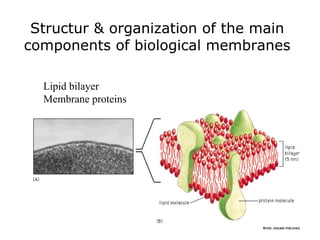
Structur & organization of the main
components of biological membranes
Lipid bilayer
Membrane proteins
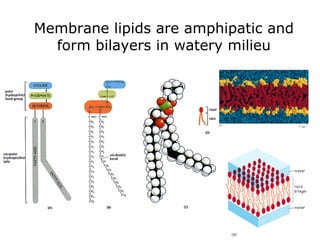
Membrane lipids are amphipatic and
form bilayers in watery milieu
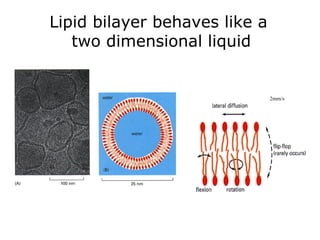
Lipid bilayer behaves like a
two dimensional liquid
2mm/s
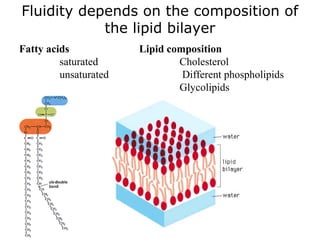
Fluidity depends on the composition of
the lipid bilayer
Fatty acids
saturated
unsaturated
Lipid composition
Cholesterol
Different phospholipids
Glycolipids
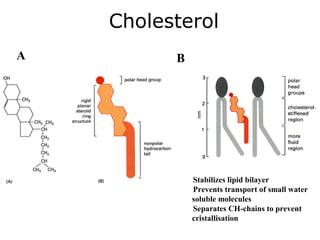
Cholesterol
A B
Stabilizes lipid bilayer
Prevents transport of small water
soluble molecules
Separates CH-chains to prevent
cristallisation
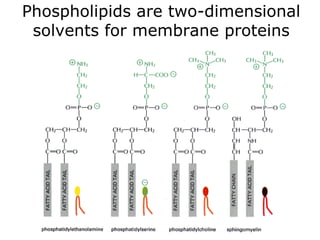
Phospholipids are two-dimensional
solvents for membrane proteins
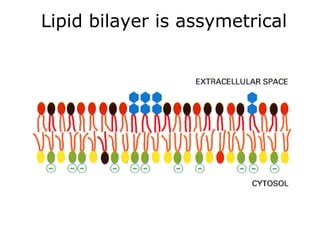
Lipid bilayer is assymetrical
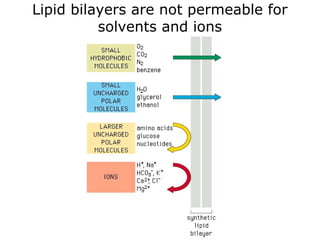
Lipid bilayers are not permeable for
solvents and ions
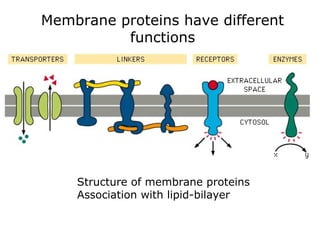
Membrane proteins have different
functions
Structure of membrane proteins
Association with lipid-bilayer
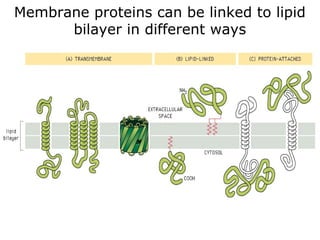
Membrane proteins can be linked to lipid
bilayer in different ways
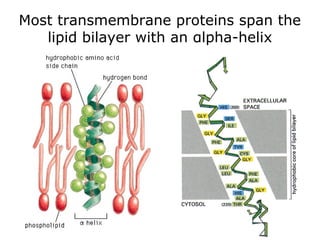
Most transmembrane proteins span the
lipid bilayer with an αlpha-helix
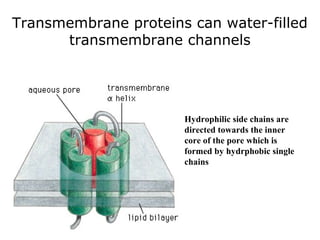
Transmembrane proteins can water-filled
transmembrane channels
Hydrophilic side chains are
directed towards the inner
core of the pore which is
formed by hydrphobic single
chains
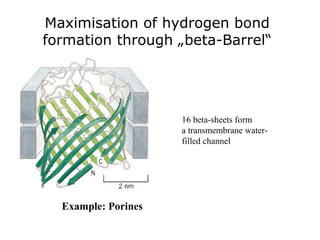
Maximisation of hydrogen bond
formation through „beta-Barrel“
Example: Porines
16 beta-sheets form
a transmembrane water-
filled channel
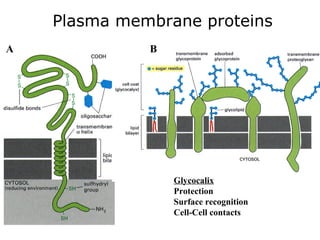
Plasma membrane proteins
A B
Glycocalix
Protection
Surface recognition
Cell-Cell contacts
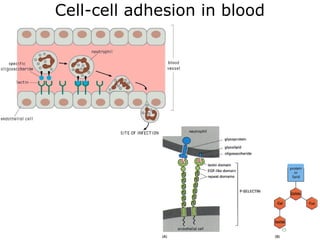
Cell-cell adhesion in blood
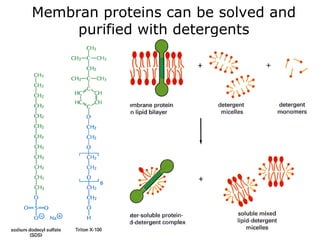
Membran proteins can be solved and
purified with detergents
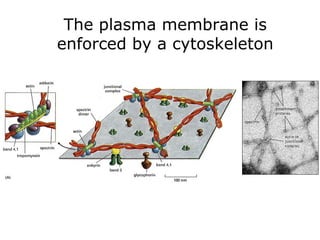
The plasma membrane is
enforced by a cytoskeleton
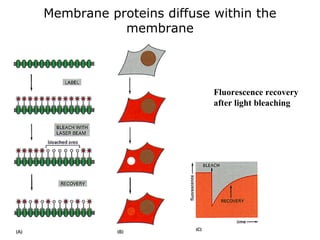
Membrane proteins diffuse within the
membrane
Fluorescence recovery
after light bleaching
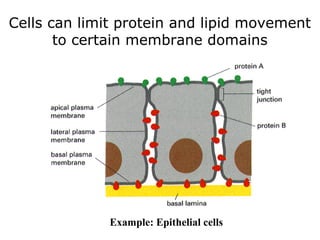
Cells can limit protein and lipid movement
to certain membrane domains
Example: Epithelial cells

Bio211 lecture 9 (membrane structure)(1)