Biology and Human Concerns
                              09/30/09 – Notes

Proteins
       -Polypeptides
       -Amino acid monomers
       (Diagram bottom of page 42 – amino group vs. carboxyl group)

      Amino Acids
         -Linked by dehydration synthesis
         -Link formed by carbon and nitrogen – peptide bond
         -polypeptide = protein = bond forms polypeptide chain
         -Order of polypeptides determines what type of amino acid is formed,
         fold into 3-Dimensional shape to do different jobs.
         -Cells build proteins, programmed by genes

      Protein Structure
         -Primary structure: beginning of all of the shaping of the protein
                               sequence of amino acids forms correct proteins
         -Secondary structure: (diagram page 45). Alpha helix forms weak
                                   hydrogen bonds that hold spiral shapes
                                   together.
                                   -Denaturation occurs when body temperature
                                   gets too high, because proteins begin unfolding
         -Tertiary structure: Stronger bonding helps protein hold shape.
                              (Living cell in living thing = surrounded by water).
                              -Loops and folds give protein shape
                              -Hyrophobic ends cluster in the middle, hydrophilic
                               ends face the outside around water
         -Quaternary Structure: tertiary structures “glued” together in the cell by
                                   collagen. 2 or more polypeptide subunits. 4
                                   connected form a haemoglobin molecule.


      Protein function
         - Structural proteins: attach things together (cells to cells, parts of the
      body to other parts of the body.
         -Transport proteins: control what gets into cell and what doesn’t.
         regulate movement within cell.
         -Receptor proteins.
         -Defensive proteins: antibodies: bind to invaders (pathogens) and
         mark them for destruction.
         -Enzymes: changes the rate of another chemical reaction
         -Sensory proteins: (“living things respond to change in environment”!).
         -Gene regulatory proteins: bind to DNA and control whether genes will
         be read. Proteins do things to other proteins to give them function
Nucleic Acids
       -Nucleic acids are long chains of monomers.
       -Made of three parts: sugar, nitrogen base (shape made of carbon and
nitrogen) and a phosphate group. (ex. Deoxyribonucleic acid, ribonucleic acid)

RNA – Ribose = sugar. bases. Adenine, guanine, cytosine, uracil
DNA – Deoxyribose = sugar. bases. Adenine, guanine, cytosine and thymine

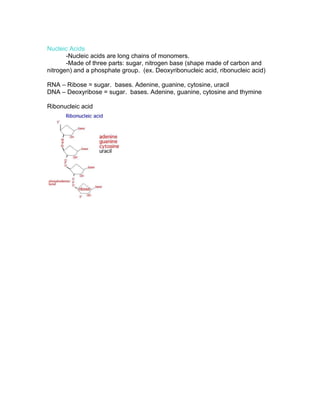
Ribonucleic acid

09 30 09 Notes

  • 1.
    Biology and HumanConcerns 09/30/09 – Notes Proteins -Polypeptides -Amino acid monomers (Diagram bottom of page 42 – amino group vs. carboxyl group) Amino Acids -Linked by dehydration synthesis -Link formed by carbon and nitrogen – peptide bond -polypeptide = protein = bond forms polypeptide chain -Order of polypeptides determines what type of amino acid is formed, fold into 3-Dimensional shape to do different jobs. -Cells build proteins, programmed by genes Protein Structure -Primary structure: beginning of all of the shaping of the protein sequence of amino acids forms correct proteins -Secondary structure: (diagram page 45). Alpha helix forms weak hydrogen bonds that hold spiral shapes together. -Denaturation occurs when body temperature gets too high, because proteins begin unfolding -Tertiary structure: Stronger bonding helps protein hold shape. (Living cell in living thing = surrounded by water). -Loops and folds give protein shape -Hyrophobic ends cluster in the middle, hydrophilic ends face the outside around water -Quaternary Structure: tertiary structures “glued” together in the cell by collagen. 2 or more polypeptide subunits. 4 connected form a haemoglobin molecule. Protein function - Structural proteins: attach things together (cells to cells, parts of the body to other parts of the body. -Transport proteins: control what gets into cell and what doesn’t. regulate movement within cell. -Receptor proteins. -Defensive proteins: antibodies: bind to invaders (pathogens) and mark them for destruction. -Enzymes: changes the rate of another chemical reaction -Sensory proteins: (“living things respond to change in environment”!). -Gene regulatory proteins: bind to DNA and control whether genes will be read. Proteins do things to other proteins to give them function
  • 2.
    Nucleic Acids -Nucleic acids are long chains of monomers. -Made of three parts: sugar, nitrogen base (shape made of carbon and nitrogen) and a phosphate group. (ex. Deoxyribonucleic acid, ribonucleic acid) RNA – Ribose = sugar. bases. Adenine, guanine, cytosine, uracil DNA – Deoxyribose = sugar. bases. Adenine, guanine, cytosine and thymine Ribonucleic acid