By vijay gupta
Protein structures
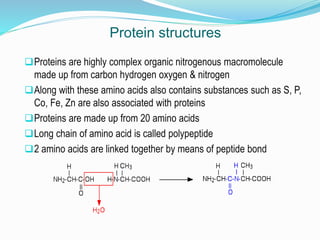
Proteins are highly complex organic nitrogenous macromolecule
made up from carbon hydrogen oxygen & nitrogen
Along with these amino acids also contains substances such as S, P,
Co, Fe, Zn are also associated with proteins
Proteins are made up from 20 amino acids
Long chain of amino acid is called polypeptide
2 amino acids are linked together by means of peptide bond
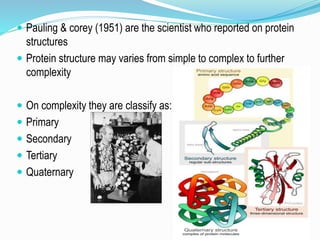
 Pauling & corey (1951) are the scientist who reported on protein
structures
 Protein structure may varies from simple to complex to further
complexity
 On complexity they are classify as:
 Primary
 Secondary
 Tertiary
 Quaternary
Primary structure
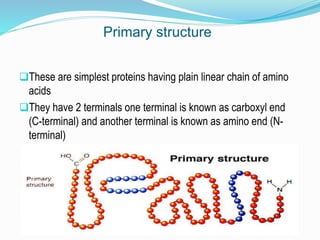
These are simplest proteins having plain linear chain of amino
acids
They have 2 terminals one terminal is known as carboxyl end
(C-terminal) and another terminal is known as amino end (N-
terminal)
Secondary structure
Folding of the linear poly peptide chain in to a specific coil
represents the secondary structure
The bonds can occur in same peptide chain &either between
different polypeptide chain
On complexity there are two different types of secondary
structures
Alpha helices
 Beta pleated sheets
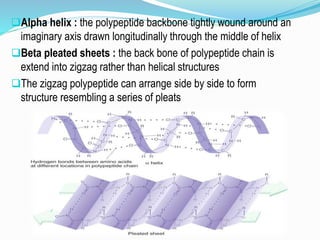
Alpha helix : the polypeptide backbone tightly wound around an
imaginary axis drawn longitudinally through the middle of helix
Beta pleated sheets : the back bone of polypeptide chain is
extend into zigzag rather than helical structures
The zigzag polypeptide can arrange side by side to form
structure resembling a series of pleats
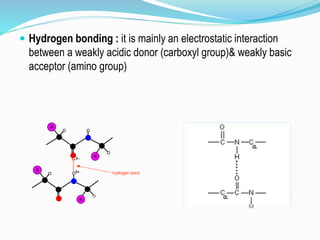
 Hydrogen bonding : it is mainly an electrostatic interaction
between a weakly acidic donor (carboxyl group)& weakly basic
acceptor (amino group)
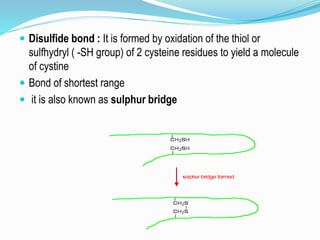
 Disulfide bond : It is formed by oxidation of the thiol or
sulfhydryl ( -SH group) of 2 cysteine residues to yield a molecule
of cystine
 Bond of shortest range
 it is also known as sulphur bridge
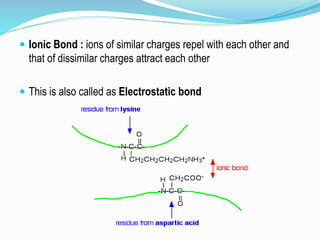
 Ionic Bond : ions of similar charges repel with each other and
that of dissimilar charges attract each other
 This is also called as Electrostatic bond
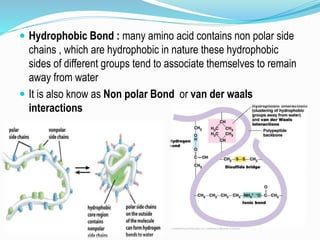
 Hydrophobic Bond : many amino acid contains non polar side
chains , which are hydrophobic in nature these hydrophobic
sides of different groups tend to associate themselves to remain
away from water
 It is also know as Non polar Bond or van der waals
interactions
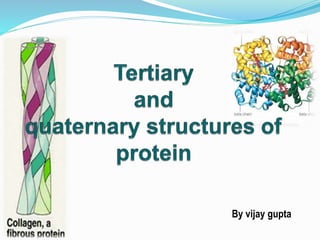
Tertiary structure
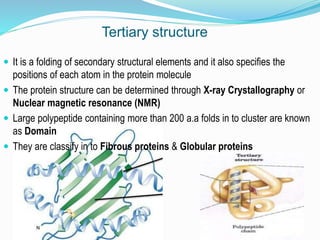
 It is a folding of secondary structural elements and it also specifies the
positions of each atom in the protein molecule
 The protein structure can be determined through X-ray Crystallography or
Nuclear magnetic resonance (NMR)
 Large polypeptide containing more than 200 a.a folds in to cluster are known
as Domain
 They are classify in to Fibrous proteins & Globular proteins
Fibrous proteins
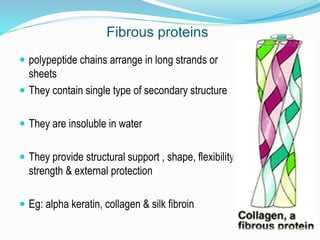
 polypeptide chains arrange in long strands or
sheets
 They contain single type of secondary structure
 They are insoluble in water
 They provide structural support , shape, flexibility,
strength & external protection
 Eg: alpha keratin, collagen & silk fibroin
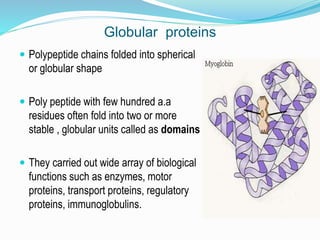
Globular proteins
 Polypeptide chains folded into spherical
or globular shape
 Poly peptide with few hundred a.a
residues often fold into two or more
stable , globular units called as domains
 They carried out wide array of biological
functions such as enzymes, motor
proteins, transport proteins, regulatory
proteins, immunoglobulins.
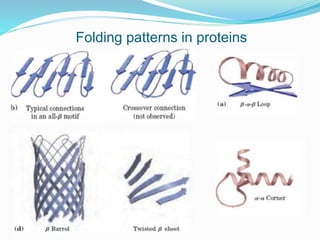
Folding patterns in proteins
Quaternary structures
 The quaternary structure involves the Non-Covalent association of
one or more peptide chains
 There are two types of quaternary structures
 Multimer : it is composed of non identical subunits
 They are also called as oligomer
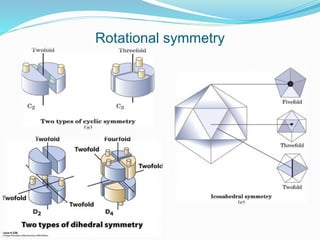
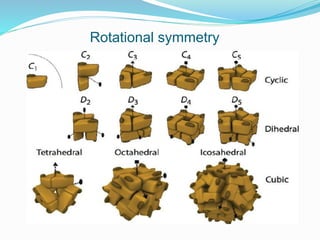
 Oligomers may have either
rotational or helical symmetry
 Protomer : it is composed of
same structural subunits
 Eg: hemoglobin, nucleosomes
and microtubules.
Rotational symmetry
Rotational symmetry
Refrences
 Lehninger principles of biochemistry by David L. Nelson &
Michael M.Cox
 Plant physiology by S.Mukherji & A K Ghosh
Thanking you

Protein structures by anivjeh

  • 1.
  • 2.
    Protein structures Proteins arehighly complex organic nitrogenous macromolecule made up from carbon hydrogen oxygen & nitrogen Along with these amino acids also contains substances such as S, P, Co, Fe, Zn are also associated with proteins Proteins are made up from 20 amino acids Long chain of amino acid is called polypeptide 2 amino acids are linked together by means of peptide bond
  • 3.
     Pauling &corey (1951) are the scientist who reported on protein structures  Protein structure may varies from simple to complex to further complexity  On complexity they are classify as:  Primary  Secondary  Tertiary  Quaternary
  • 4.
    Primary structure These aresimplest proteins having plain linear chain of amino acids They have 2 terminals one terminal is known as carboxyl end (C-terminal) and another terminal is known as amino end (N- terminal)
  • 5.
    Secondary structure Folding ofthe linear poly peptide chain in to a specific coil represents the secondary structure The bonds can occur in same peptide chain &either between different polypeptide chain On complexity there are two different types of secondary structures Alpha helices  Beta pleated sheets
  • 6.
    Alpha helix :the polypeptide backbone tightly wound around an imaginary axis drawn longitudinally through the middle of helix Beta pleated sheets : the back bone of polypeptide chain is extend into zigzag rather than helical structures The zigzag polypeptide can arrange side by side to form structure resembling a series of pleats
  • 7.
     Hydrogen bonding: it is mainly an electrostatic interaction between a weakly acidic donor (carboxyl group)& weakly basic acceptor (amino group)
  • 8.
     Disulfide bond: It is formed by oxidation of the thiol or sulfhydryl ( -SH group) of 2 cysteine residues to yield a molecule of cystine  Bond of shortest range  it is also known as sulphur bridge
  • 9.
     Ionic Bond: ions of similar charges repel with each other and that of dissimilar charges attract each other  This is also called as Electrostatic bond
  • 10.
     Hydrophobic Bond: many amino acid contains non polar side chains , which are hydrophobic in nature these hydrophobic sides of different groups tend to associate themselves to remain away from water  It is also know as Non polar Bond or van der waals interactions
  • 11.
    Tertiary structure  Itis a folding of secondary structural elements and it also specifies the positions of each atom in the protein molecule  The protein structure can be determined through X-ray Crystallography or Nuclear magnetic resonance (NMR)  Large polypeptide containing more than 200 a.a folds in to cluster are known as Domain  They are classify in to Fibrous proteins & Globular proteins
  • 12.
    Fibrous proteins  polypeptidechains arrange in long strands or sheets  They contain single type of secondary structure  They are insoluble in water  They provide structural support , shape, flexibility, strength & external protection  Eg: alpha keratin, collagen & silk fibroin
  • 13.
    Globular proteins  Polypeptidechains folded into spherical or globular shape  Poly peptide with few hundred a.a residues often fold into two or more stable , globular units called as domains  They carried out wide array of biological functions such as enzymes, motor proteins, transport proteins, regulatory proteins, immunoglobulins.
  • 14.
  • 15.
    Quaternary structures  Thequaternary structure involves the Non-Covalent association of one or more peptide chains  There are two types of quaternary structures  Multimer : it is composed of non identical subunits  They are also called as oligomer  Oligomers may have either rotational or helical symmetry  Protomer : it is composed of same structural subunits  Eg: hemoglobin, nucleosomes and microtubules.
  • 16.
  • 17.
  • 18.
    Refrences  Lehninger principlesof biochemistry by David L. Nelson & Michael M.Cox  Plant physiology by S.Mukherji & A K Ghosh
  • 19.