RAMKRISHNA MAHATO GOVERNMENT
ENGINEERING COLLEGE
 NAME – SITU PAUL
 ROLL – 35000720068
 DEPT. – MECHANICAL ENGINEERING
 SEMESTER – 8th
 SUBJEC- WASTE OF ENERGY
 SUBJECT CODE – OE-ME802F
BIO GAS
What is biogas?
It mainly comprises of hydro-carbon which is combustible and can
produce heat and energy when burnt. Bio-gas is produced through a
bio-chemical process in which certain types of bacteria convert the
biological wastes into useful bio-gas. Since the useful gas originates
from biological process, it has been termed as bio-gas. Methane gas
is the main constituent of biogas.
Properties of Biogas
 It is lighter Than (20%) air. Density is about 1.2 gm/litre.
 Ignition Temperature between 650 to 750 C.
 Calorific value is 18.7 to 26 MJ.
 Even at very low temperature the biogas readily mixes with air. So It does
not need to provide rich mixture at starting time.
 It has very good antiknock properties.
 It is a safe fuel.
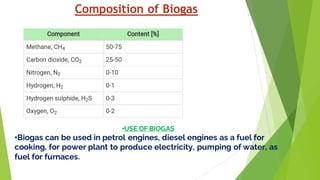
Composition of Biogas
•USE OF BIOGAS
•Biogas can be used in petrol engines, diesel engines as a fuel for
cooking, for power plant to produce electricity, pumping of water, as
fuel for furnaces.
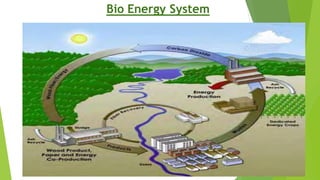
Bio Energy System
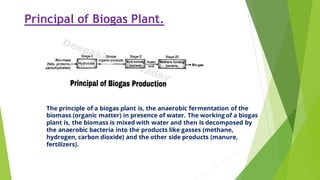
Principal of Biogas Plant.
The principle of a biogas plant is, the anaerobic fermentation of the
biomass (organic matter) in presence of water. The working of a biogas
plant is, the biomass is mixed with water and then is decomposed by
the anaerobic bacteria into the products like gasses (methane,
hydrogen, carbon dioxide) and the other side products (manure,
fertilizers).
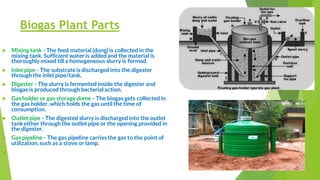
Biogas Plant Parts
 Mixing tank - The feed material (dung) is collected in the
mixing tank. Sufficient water is added and the material is
thoroughly mixed till a homogeneous slurry is formed.
 Inlet pipe - The substrate is discharged into the digester
through the inlet pipe/tank.
 Digester - The slurry is fermented inside the digester and
biogas is produced through bacterial action.
 Gas holder or gas storage dome - The biogas gets collected in
the gas holder, which holds the gas until the time of
consumption.
 Outlet pipe - The digested slurry is discharged into the outlet
tank either through the outlet pipe or the opening provided in
the digester.
 Gas pipeline - The gas pipeline carries the gas to the point of
utilization, such as a stove or lamp.

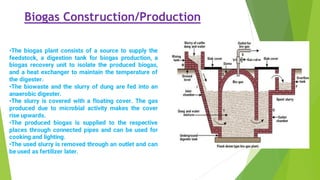
Biogas Construction/Production
•The biogas plant consists of a source to supply the
feedstock, a digestion tank for biogas production, a
biogas recovery unit to isolate the produced biogas,
and a heat exchanger to maintain the temperature of
the digester.
•The biowaste and the slurry of dung are fed into an
anaerobic digester.
•The slurry is covered with a floating cover. The gas
produced due to microbial activity makes the cover
rise upwards.
•The produced biogas is supplied to the respective
places through connected pipes and can be used for
cooking and lighting.
•The used slurry is removed through an outlet and can
be used as fertilizer later.
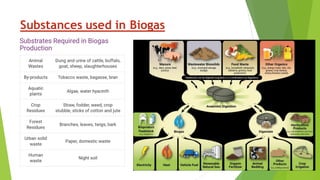
Substances used in Biogas
Advantages of Biogas
 Biogas is a safe, cheap, renewable source of energy.
 Biogas can be burnt in stoves to provide heat.
 It is used for domestic and street lighting, and cooking.
 It is eco-friendly and does not cause any pollution.
 It is also used for driving engines.
 It is easy to generate, transport and store.
 It improves the sanitation of the surroundings.
 The residue left after the production of biogas can be used as manure.
 The use of biogas is environment-friendly. It implies the conversion of animal and
plant waste into useful energy, thereby, reducing the production of methane. This
is because of the biogas combustion which results in a net decrease in the
emission of greenhouse gases
Use of Biogas
 It is commonly used in rural areas as cooking gas.
 It can be used for the production of electricity.
 It can be used in instruments used for water heating, space (room) heating etc.
 It can replace compressed natural gas for use in vehicles.
 It can displace carbon dioxide in on-site CHP plants.
 It is being used in transport. For example, ‘Amanda Biogas Train’ runs on biogas in
Sweden.Production of biogas produced a very useful dry solid byproduct which is
used as manure.
 It is used in many states for street lighting purposes. It can be used in hydrogen
fuel cells as well.

Bio gas

  • 1.
    RAMKRISHNA MAHATO GOVERNMENT ENGINEERINGCOLLEGE  NAME – SITU PAUL  ROLL – 35000720068  DEPT. – MECHANICAL ENGINEERING  SEMESTER – 8th  SUBJEC- WASTE OF ENERGY  SUBJECT CODE – OE-ME802F
  • 2.
    BIO GAS What isbiogas? It mainly comprises of hydro-carbon which is combustible and can produce heat and energy when burnt. Bio-gas is produced through a bio-chemical process in which certain types of bacteria convert the biological wastes into useful bio-gas. Since the useful gas originates from biological process, it has been termed as bio-gas. Methane gas is the main constituent of biogas.
  • 3.
    Properties of Biogas It is lighter Than (20%) air. Density is about 1.2 gm/litre.  Ignition Temperature between 650 to 750 C.  Calorific value is 18.7 to 26 MJ.  Even at very low temperature the biogas readily mixes with air. So It does not need to provide rich mixture at starting time.  It has very good antiknock properties.  It is a safe fuel.
  • 4.
    Composition of Biogas •USEOF BIOGAS •Biogas can be used in petrol engines, diesel engines as a fuel for cooking, for power plant to produce electricity, pumping of water, as fuel for furnaces.
  • 5.
  • 6.
    Principal of BiogasPlant. The principle of a biogas plant is, the anaerobic fermentation of the biomass (organic matter) in presence of water. The working of a biogas plant is, the biomass is mixed with water and then is decomposed by the anaerobic bacteria into the products like gasses (methane, hydrogen, carbon dioxide) and the other side products (manure, fertilizers).
  • 7.
    Biogas Plant Parts Mixing tank - The feed material (dung) is collected in the mixing tank. Sufficient water is added and the material is thoroughly mixed till a homogeneous slurry is formed.  Inlet pipe - The substrate is discharged into the digester through the inlet pipe/tank.  Digester - The slurry is fermented inside the digester and biogas is produced through bacterial action.  Gas holder or gas storage dome - The biogas gets collected in the gas holder, which holds the gas until the time of consumption.  Outlet pipe - The digested slurry is discharged into the outlet tank either through the outlet pipe or the opening provided in the digester.  Gas pipeline - The gas pipeline carries the gas to the point of utilization, such as a stove or lamp. 
  • 8.
    Biogas Construction/Production •The biogasplant consists of a source to supply the feedstock, a digestion tank for biogas production, a biogas recovery unit to isolate the produced biogas, and a heat exchanger to maintain the temperature of the digester. •The biowaste and the slurry of dung are fed into an anaerobic digester. •The slurry is covered with a floating cover. The gas produced due to microbial activity makes the cover rise upwards. •The produced biogas is supplied to the respective places through connected pipes and can be used for cooking and lighting. •The used slurry is removed through an outlet and can be used as fertilizer later.
  • 9.
  • 10.
    Advantages of Biogas Biogas is a safe, cheap, renewable source of energy.  Biogas can be burnt in stoves to provide heat.  It is used for domestic and street lighting, and cooking.  It is eco-friendly and does not cause any pollution.  It is also used for driving engines.  It is easy to generate, transport and store.  It improves the sanitation of the surroundings.  The residue left after the production of biogas can be used as manure.  The use of biogas is environment-friendly. It implies the conversion of animal and plant waste into useful energy, thereby, reducing the production of methane. This is because of the biogas combustion which results in a net decrease in the emission of greenhouse gases
  • 11.
    Use of Biogas It is commonly used in rural areas as cooking gas.  It can be used for the production of electricity.  It can be used in instruments used for water heating, space (room) heating etc.  It can replace compressed natural gas for use in vehicles.  It can displace carbon dioxide in on-site CHP plants.  It is being used in transport. For example, ‘Amanda Biogas Train’ runs on biogas in Sweden.Production of biogas produced a very useful dry solid byproduct which is used as manure.  It is used in many states for street lighting purposes. It can be used in hydrogen fuel cells as well.