VIVEKANANDHA
ARTS AND SCIENCE COLLEGE FOR WOMEN
Veerachipalayam-637 303,Sankagiri,Salem Dt, Tamilnadu,India.
Affiliated to Periyar University Salem ; recognised under section 2(f)&12(b) of the UGC act,1956
DEPARTMENT OF MICROBIOLOGY
SUBJECT: ENVIRONMENTAL MICROBIOLOGY
TITLE : BIOGAS TECHNOLOGY
SUBJECT INCHARGE :
Mrs. Mythili Ravichandran
Head Of the Department (HOD)
Department of Microbiology
VIAAS , Sankagiri .
SUBMITTED BY :
NANDHINI
VENGADACHALAM
III B.sc Microbiology
Department of Microbiology
VIAAS , Sankagiri .
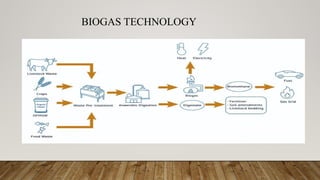
BIOGAS TECHNOLOGY
CONTENT
• Introduction
• Production of biogas
• Properties of biogas
• Anaerobic environment
• Applications of biogas plants
• Uses of biogas
• Limitations
• Recent Development of biogas
• Conclusion
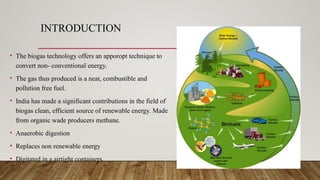
INTRODUCTION
• The biogas technology offers an apporopt technique to
convert non- conventional energy.
• The gas thus produced is a neat, combustible and
pollution free fuel.
• India has made a significant contributions in the field of
biogas clean, efficient source of renewable energy. Made
from organic wade producers methane.
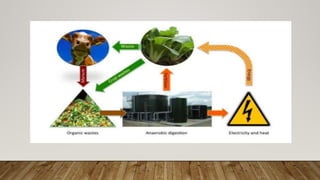
• Anaerobic digestion
• Replaces non renewable energy
• Digitated in a airtight containers.
PRODUCTION OF BIOGAS – THE BIOGAS PLANTS
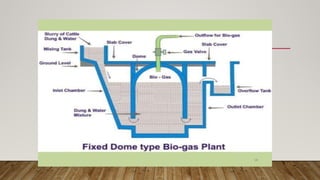
• There are two types of biogas plants in usage for the production of biogas. There are,
1. The fixed – dome type of biogas plant
2. The floating gas holder type of biogas plant
• The fixed – dome type of biogas plant :
• The various forms of biomass are mixed with an equal quantity of water in the mixing tank. This forms the slurry.
• During there two months anaerobic bacteria present in the slurry decompose of fermenter the biomass in the
presence of water.
• As more and more biogas starts collecting the pressure exerted by the biogas forces the spent slurry into the outlet
chamber.
• From the outlet chamber the spent slurry overflows into the overflow tank.
• The gas value connected to a system of pipelines is opened when a supply of biogas is
required.
• ADVANTAGES:
• Requires only locally and easily available materials for construction.
• Inexpensive
• Easy to construct
THE FLOATING GAS HOLDER TYPE OF BIOGAS
PLANT
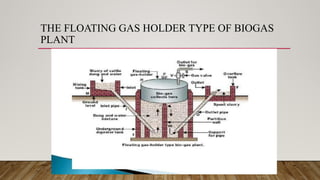
• The floating gas holder type of biogas plant has the following chambers /sections:
• Mixing tank :
• Present above the ground level
• Digester tank :
• Deep underground well like structure
• It is divided into two chambers by a partition wall in between.
• It has two long cement pipes:
• Inlet pipe opening into the inlet chamber for introduction of slurry.
• Outlet pipe opening into the overflow tank for removal of spent slurry.
• Gas holder:
• An inverted steel drum resting above the digester. The drum can move up and down float
over the digester.. The gas holder has an outlet at the top which could be connected to gas
stoves.
• Overflow tank- present above the ground level.
• ADVANTAGES:
• High calorific value clean fuel no residue produced ,no smoke produced, non polluting,
economical, can be supplied through pipe lines.
• Burns readily – has a convenient ignition temperature.
• DISADVANTAGES:
• Expensive
• Steel drum may rust
• Requires regular maintenance.
PROPERTIES OF BIOGAS
• The decay organic matter: particularly human, animal and plant wastes, in the absence of air
produces an inflammable gas which consists mainly of methane (CH4) and carbon dioxide (CO2).
• Methane which is a principal constiruent of biogas is a colouless, odourless and tasteless gas.
• Biogas unlike LPG cannot be converted to liquid state under normal temperature. A temperature of -
162 °C is needed to liquefy methane at atmospheric pressure.
• pH or hydrogen ion concentration microorganisms will be very active and biodigestion will be very
efficient in the pH range of 6.5 to 7.5 .
• Pressure gas production will be better at low pressure.
ANAEROBIC ENVIRONMENT
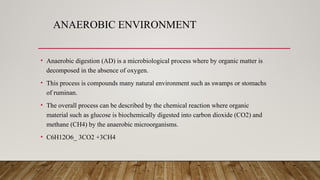
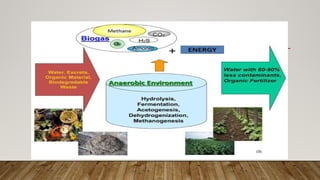
• Anaerobic digestion (AD) is a microbiological process where by organic matter is
decomposed in the absence of oxygen.
• This process is compounds many natural environment such as swamps or stomachs
of ruminan.
• The overall process can be described by the chemical reaction where organic
material such as glucose is biochemically digested into carbon dioxide (CO2) and
methane (CH4) by the anaerobic microorganisms.
• C6H12O6_ 3CO2 +3CH4
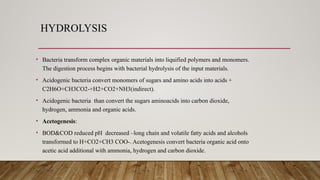
HYDROLYSIS
• Bacteria transform complex organic materials into liquified polymers and monomers.
The digestion process begins with bacterial hydrolysis of the input materials.
• Acidogenic bacteria convert monomers of sugars and amino acids into acids +
C2H6O+CH3CO2-+H2+CO2+NH3(indirect).
• Acidogenic bacteria than convert the sugars aminoacids into carbon dioxide,
hydrogen, ammonia and organic acids.
• Acetogenesis:
• BOD&COD reduced pH decreased –long chain and volatile fatty acids and alcohols
transformed to H+CO2+CH3 COO-. Acetogenesis convert bacteria organic acid onto
acetic acid additional with ammonia, hydrogen and carbon dioxide.
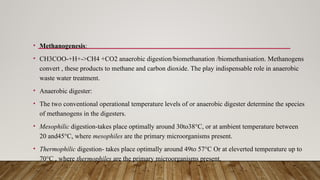
• Methanogenesis:
• CH3COO-+H+->CH4 +CO2 anaerobic digestion/biomethanation /biomethanisation. Methanogens
convert , these products to methane and carbon dioxide. The play indispensable role in anaerobic
waste water treatment.
• Anaerobic digester:
• The two conventional operational temperature levels of or anaerobic digester determine the species
of methanogens in the digesters.
• Mesophilic digestion-takes place optimally around 30to38°C, or at ambient temperature between
20 and45°C, where mesophiles are the primary microorganisms present.
• Thermophilic digestion- takes place optimally around 49to 57°C Or at eleverted temperature up to
70°C , where thermophiles are the primary microorganisms present.
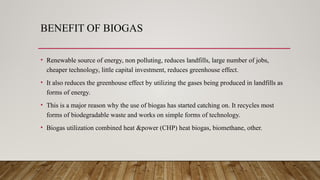
BENEFIT OF BIOGAS
• Renewable source of energy, non polluting, reduces landfills, large number of jobs,
cheaper technology, little capital investment, reduces greenhouse effect.
• It also reduces the greenhouse effect by utilizing the gases being produced in landfills as
forms of energy.
• This is a major reason why the use of biogas has started catching on. It recycles most
forms of biodegradable waste and works on simple forms of technology.
• Biogas utilization combined heat &power (CHP) heat biogas, biomethane, other.
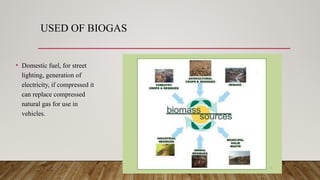
USED OF BIOGAS
• Domestic fuel, for street
lighting, generation of
electricity, if compressed it
can replace compressed
natural gas for use in
vehicles.
APPLICATION OF BIOGAS
• Cooking fuel, fuel for lighting, fuel for motive power to replace dierel
oil, enriched organic manure of agriculture and aquaculture, manure for
mushroom growing, manure for seed coating, use light to trap in sects
at the farm, to treat human excreta and for pollution control.
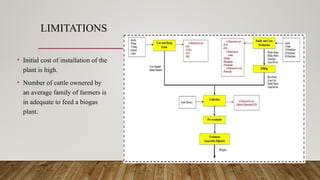
LIMITATIONS
• Initial cost of installation of the
plant is high.
• Number of cattle ownered by
an average family of farmers is
in adequate to feed a biogas
plant.
RECENT DEVELOPMENT OF BIOGAS
• With the many benefits of biogas, it is starting to become a popular source of energy and
is starting to be used in the United States more.
• On 5 October 2010,biogas was injected into the UK gas gried for the first time. As of
September 2013,there are about 130 non-sewage biogas plants in the UK.
• Germany is Europe biggest biogas producer and the market leader in biogas technology.
• To create awareness and associated the people interested in biogas, the Indian biogas
association was formed. India ministry of new and renewable energy effers some subsidy
per model constructed.
CONCLUSION
• Biogas is a clean source of energy. Biogas plants have been in operation for a
long period of time, especially in rural areas around the globe.
• The research organization should focus on newer efficient low cost design.
• The government can play important role by introducing different legal frame
works, education schemes and the availability of technology and simultaneously
creating more awareness and providing more subsidies.
Environment microbiology - biogas technology

Environment microbiology - biogas technology

  • 2.
    VIVEKANANDHA ARTS AND SCIENCECOLLEGE FOR WOMEN Veerachipalayam-637 303,Sankagiri,Salem Dt, Tamilnadu,India. Affiliated to Periyar University Salem ; recognised under section 2(f)&12(b) of the UGC act,1956 DEPARTMENT OF MICROBIOLOGY SUBJECT: ENVIRONMENTAL MICROBIOLOGY TITLE : BIOGAS TECHNOLOGY SUBJECT INCHARGE : Mrs. Mythili Ravichandran Head Of the Department (HOD) Department of Microbiology VIAAS , Sankagiri . SUBMITTED BY : NANDHINI VENGADACHALAM III B.sc Microbiology Department of Microbiology VIAAS , Sankagiri .
  • 3.
  • 4.
    CONTENT • Introduction • Productionof biogas • Properties of biogas • Anaerobic environment • Applications of biogas plants • Uses of biogas • Limitations • Recent Development of biogas • Conclusion
  • 5.
    INTRODUCTION • The biogastechnology offers an apporopt technique to convert non- conventional energy. • The gas thus produced is a neat, combustible and pollution free fuel. • India has made a significant contributions in the field of biogas clean, efficient source of renewable energy. Made from organic wade producers methane. • Anaerobic digestion • Replaces non renewable energy • Digitated in a airtight containers.
  • 6.
    PRODUCTION OF BIOGAS– THE BIOGAS PLANTS • There are two types of biogas plants in usage for the production of biogas. There are, 1. The fixed – dome type of biogas plant 2. The floating gas holder type of biogas plant • The fixed – dome type of biogas plant : • The various forms of biomass are mixed with an equal quantity of water in the mixing tank. This forms the slurry. • During there two months anaerobic bacteria present in the slurry decompose of fermenter the biomass in the presence of water. • As more and more biogas starts collecting the pressure exerted by the biogas forces the spent slurry into the outlet chamber.
  • 8.
    • From theoutlet chamber the spent slurry overflows into the overflow tank. • The gas value connected to a system of pipelines is opened when a supply of biogas is required. • ADVANTAGES: • Requires only locally and easily available materials for construction. • Inexpensive • Easy to construct
  • 9.
    THE FLOATING GASHOLDER TYPE OF BIOGAS PLANT
  • 10.
    • The floatinggas holder type of biogas plant has the following chambers /sections: • Mixing tank : • Present above the ground level • Digester tank : • Deep underground well like structure • It is divided into two chambers by a partition wall in between. • It has two long cement pipes: • Inlet pipe opening into the inlet chamber for introduction of slurry. • Outlet pipe opening into the overflow tank for removal of spent slurry.
  • 11.
    • Gas holder: •An inverted steel drum resting above the digester. The drum can move up and down float over the digester.. The gas holder has an outlet at the top which could be connected to gas stoves. • Overflow tank- present above the ground level. • ADVANTAGES: • High calorific value clean fuel no residue produced ,no smoke produced, non polluting, economical, can be supplied through pipe lines.
  • 12.
    • Burns readily– has a convenient ignition temperature. • DISADVANTAGES: • Expensive • Steel drum may rust • Requires regular maintenance.
  • 13.
    PROPERTIES OF BIOGAS •The decay organic matter: particularly human, animal and plant wastes, in the absence of air produces an inflammable gas which consists mainly of methane (CH4) and carbon dioxide (CO2). • Methane which is a principal constiruent of biogas is a colouless, odourless and tasteless gas. • Biogas unlike LPG cannot be converted to liquid state under normal temperature. A temperature of - 162 °C is needed to liquefy methane at atmospheric pressure. • pH or hydrogen ion concentration microorganisms will be very active and biodigestion will be very efficient in the pH range of 6.5 to 7.5 . • Pressure gas production will be better at low pressure.
  • 15.
    ANAEROBIC ENVIRONMENT • Anaerobicdigestion (AD) is a microbiological process where by organic matter is decomposed in the absence of oxygen. • This process is compounds many natural environment such as swamps or stomachs of ruminan. • The overall process can be described by the chemical reaction where organic material such as glucose is biochemically digested into carbon dioxide (CO2) and methane (CH4) by the anaerobic microorganisms. • C6H12O6_ 3CO2 +3CH4
  • 17.
    HYDROLYSIS • Bacteria transformcomplex organic materials into liquified polymers and monomers. The digestion process begins with bacterial hydrolysis of the input materials. • Acidogenic bacteria convert monomers of sugars and amino acids into acids + C2H6O+CH3CO2-+H2+CO2+NH3(indirect). • Acidogenic bacteria than convert the sugars aminoacids into carbon dioxide, hydrogen, ammonia and organic acids. • Acetogenesis: • BOD&COD reduced pH decreased –long chain and volatile fatty acids and alcohols transformed to H+CO2+CH3 COO-. Acetogenesis convert bacteria organic acid onto acetic acid additional with ammonia, hydrogen and carbon dioxide.
  • 18.
    • Methanogenesis: • CH3COO-+H+->CH4+CO2 anaerobic digestion/biomethanation /biomethanisation. Methanogens convert , these products to methane and carbon dioxide. The play indispensable role in anaerobic waste water treatment. • Anaerobic digester: • The two conventional operational temperature levels of or anaerobic digester determine the species of methanogens in the digesters. • Mesophilic digestion-takes place optimally around 30to38°C, or at ambient temperature between 20 and45°C, where mesophiles are the primary microorganisms present. • Thermophilic digestion- takes place optimally around 49to 57°C Or at eleverted temperature up to 70°C , where thermophiles are the primary microorganisms present.
  • 19.
    BENEFIT OF BIOGAS •Renewable source of energy, non polluting, reduces landfills, large number of jobs, cheaper technology, little capital investment, reduces greenhouse effect. • It also reduces the greenhouse effect by utilizing the gases being produced in landfills as forms of energy. • This is a major reason why the use of biogas has started catching on. It recycles most forms of biodegradable waste and works on simple forms of technology. • Biogas utilization combined heat &power (CHP) heat biogas, biomethane, other.
  • 20.
    USED OF BIOGAS •Domestic fuel, for street lighting, generation of electricity, if compressed it can replace compressed natural gas for use in vehicles.
  • 21.
    APPLICATION OF BIOGAS •Cooking fuel, fuel for lighting, fuel for motive power to replace dierel oil, enriched organic manure of agriculture and aquaculture, manure for mushroom growing, manure for seed coating, use light to trap in sects at the farm, to treat human excreta and for pollution control.
  • 22.
    LIMITATIONS • Initial costof installation of the plant is high. • Number of cattle ownered by an average family of farmers is in adequate to feed a biogas plant.
  • 23.
    RECENT DEVELOPMENT OFBIOGAS • With the many benefits of biogas, it is starting to become a popular source of energy and is starting to be used in the United States more. • On 5 October 2010,biogas was injected into the UK gas gried for the first time. As of September 2013,there are about 130 non-sewage biogas plants in the UK. • Germany is Europe biggest biogas producer and the market leader in biogas technology. • To create awareness and associated the people interested in biogas, the Indian biogas association was formed. India ministry of new and renewable energy effers some subsidy per model constructed.
  • 24.
    CONCLUSION • Biogas isa clean source of energy. Biogas plants have been in operation for a long period of time, especially in rural areas around the globe. • The research organization should focus on newer efficient low cost design. • The government can play important role by introducing different legal frame works, education schemes and the availability of technology and simultaneously creating more awareness and providing more subsidies.