MILLER/SPOOLMAN
    LIVING IN THE ENVIRONMENT          17TH


                  Chapter 17
                  Environmental Hazards and
                  Human Health
Core Case Study: Are Baby Bottles and Food Cans
     Safe To Use? The BPA Controversy (1)
 • Some synthetic chemicals act as hormone mimics
   and disrupt the human endocrine system

 • Excess estrogen effects on males
    •   Feminization
    •   Smaller penis
    •   Lower sperm counts
    •   Presence of both male and female sex organs
Core Case Study: Are Baby Bottles and Food Cans
     Safe To Use? The BPA Controversy (2)
 • BPA (bisphenol A)
    • Estrogen mimic
    • In polycarbonates and other hardened plastics
       • Baby bottles and sipping cups
       • Reusable water bottles
       • Sports drink and juice bottles
       • Microwave dishes
       • Food storage containers
       • Liners of most food and soft drink cans
Core Case Study: Are Baby Bottles and Food Cans
     Safe To Use? The BPA Controversy (3)
 • BPA leaches into foods and drinks
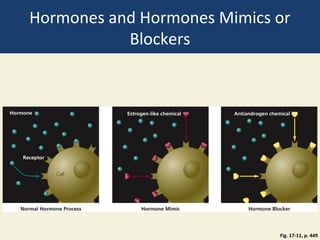
    • Even when containers not heated

 • 93% of Americans older than 6 have BPA levels
   above the threshold level set by the EPA
    • Higher in children and adolescents

 • Risks for infants, children, adults
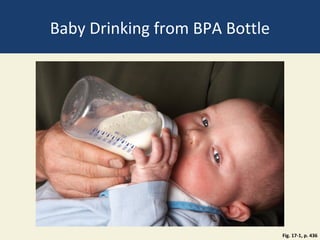
Baby Drinking from BPA Bottle


                                Fig. 17-1, p. 436
Risks Are Usually Expressed as Probabilities
  • Risk
    • Probability of suffering harm from a hazard
    • Probability vs. possibility


  • Risk Assessment

  • Risk Management
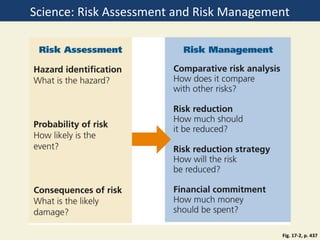
Science: Risk Assessment and Risk Management


                                          Fig. 17-2, p. 437
We Face Many Types of Hazards
1. Biological:
  •   Pathogen: an organism that causes disease in other
      organisms


2. Chemical

3. Physical

4. Cultural

5. Lifestyle choices
Some Diseases Can Spread from One
       Person to Another (1)
• Infectious disease
   • Pathogen invades the body and multiplies

• Transmissible disease
   • Contagious or communicable disease
   • Infectious disease transmitted between people
   • Flu, tuberculosis, measles
Some Diseases Can Spread from One
       Person to Another (2)
• Nontransmissible disease
   • Not caused by living organisms
   • Heart disease, most cancers, diabetes

• Since 1950, death from infectious diseases have
  declined due to
   •   Better health care
   •   Better sanitation
   •   Antibiotics
   •   Vaccines
Infectious Diseases Are Still Major
             Health Threats
• Infectious diseases spread through
   •   Air
   •   Water
   •   Food
   •   Body fluids

• Epidemics and pandemics

• Resistance of bacteria and insects to drugs and
  pesticides
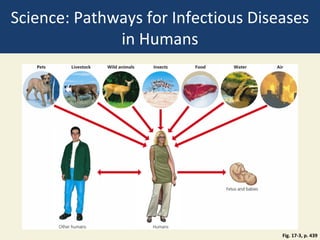
Science: Pathways for Infectious Diseases
              in Humans


                                     Fig. 17-3, p. 439
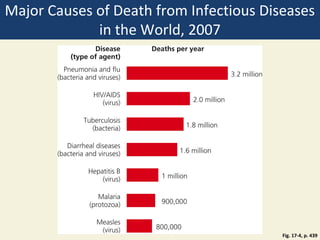
Major Causes of Death from Infectious Diseases
             in the World, 2007


                                         Fig. 17-4, p. 439
Science Focus: Genetic Resistance to
      Antibiotics Is Increasing (1)
• Bacteria: rapid reproduction, easily spread

• Overuse of antibiotics

• Overuse of pesticides
Viral Diseases and Parasites Kill Large
        Numbers of People (1)
• Influenza or flu virus
   • #1 Killer


• HIV
   • #2 Killer

• Hepatitis B virus (HBV)
   • #3 Killer

• Emergent diseases: West Nile virus
Viral Diseases and Parasites Kill Large
        Numbers of People (2)
• Viruses that move form animals to humans
   • West Nile virus
   • Swine flu (H1N1)
   • Bird flu


• Reduce chances of infection:
   1. Wash your hands
   2. Avoid touching your face
   3. Avoid sick people
Case Study: Malaria — The Spread of a
         Deadly Parasite (1)
• Malaria
  • Caused by Plasmodium sp. carried by Anopheles
    mosquitoes
  • Tropical and subtropical regions
  • Malarial cycle
Case Study: Malaria — The Spread of a
         Deadly Parasite (2)
• Malaria on the rise since 1970
   •   Drug resistant Plasmodium
   •   Insecticide resistant mosquitoes
   •   Clearing of tropical forests
   •   AIDS patients particularly vulnerable
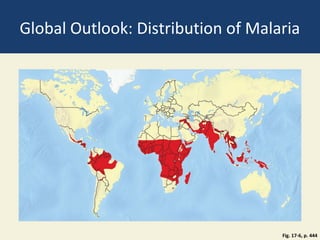
Global Outlook: Distribution of Malaria


                                    Fig. 17-6, p. 444
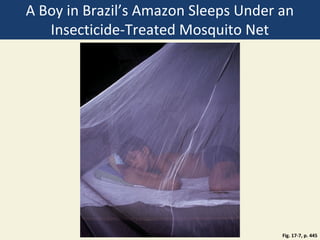
A Boy in Brazil’s Amazon Sleeps Under an
   Insecticide-Treated Mosquito Net


                                      Fig. 17-7, p. 445
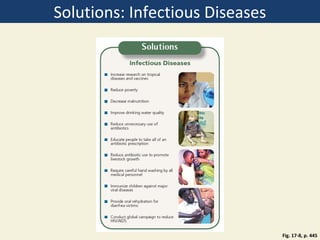
Solutions: Infectious Diseases


                                 Fig. 17-8, p. 445
Some Chemicals Can Cause Cancers,
    Mutations, and Birth Defects
• Toxic chemicals
  • Carcinogens
     • Chemicals, types of radiation, or certain viruses the
       cause or promote cancer
  • Mutagens
     • Chemicals or radiation that cause mutations or
       increase their frequency
  • Teratogens
     • Chemicals that cause harm or birth defects to a fetus or
       embryo
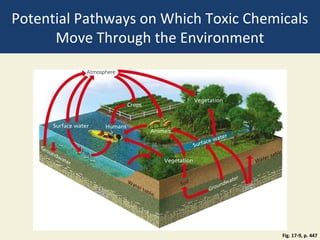
Potential Pathways on Which Toxic Chemicals
      Move Through the Environment


                                       Fig. 17-9, p. 447
Some Chemicals May Affect Our Immune
        and Nervous Systems
• Some natural and synthetic chemicals in the
  environment can weaken and harm
   • Immune system
   • Nervous system
      • Neurotoxins: PCBs, arsenic, lead, some pesticides
   • Endocrine system
Science Focus: Mercury’s Toxic
                 Effects (1)
• Hg: teratogen and potent neurotoxin
   •   Once airborne, persistent and not degradable
   •   1/3 from natural sources
   •   2/3 from human activities
   •   Enters the food chain: biomagnification

• How are humans exposed?
   1. Inhalation: vaporized Hg or particulates
   2. Eating fish with high levels of methylmercury
   3. Eating high-fructose corn syrup
Science Focus: Mercury’s Toxic
               Effects (2)
• Effects of Hg on humans
   • Damage nervous system, kidneys, lungs
   • Harm fetuses and cause birth defects


• Who is most at risk?
   • Pregnant women
   • 75% of exposure comes from eating fish
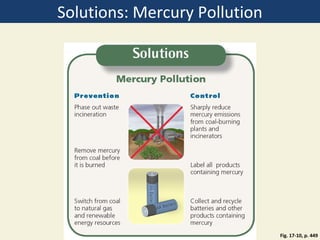
Solutions: Mercury Pollution


                               Fig. 17-10, p. 449
Some Chemicals Affect the Human
          Endocrine System
• Glands that release hormones that regulate bodily
  systems and control sexual reproduction, growth,
  development, learning, behavior

• Hormonally active agents have similar shapes and
  bind to hormone receptors
   •   Gender benders
   •   Thyroid disruptors
   •   BPA?
   •   Phthalates in plastics-increase plastic flexibility
Hormones and Hormones Mimics or
           Blockers


                             Fig. 17-11, p. 449
Many Factors Determine the Harmful
   Health Effects of a Chemical (1)
• Toxicology

• Toxicity dependent on
  •   Dose
  •   Age
  •   Genetic makeup
  •   Solubility
  •   Persistence
  •   Biomagnification
Many Factors Determine the Harmful
  Health Effects of a Chemical (2)
• Response
  • Acute effect: immediate or rapid
  • Chronic effect: permanent or long-lasting
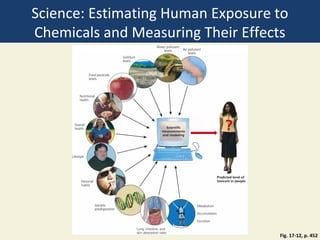
Science: Estimating Human Exposure to
Chemicals and Measuring Their Effects


                                   Fig. 17-12, p. 452
Case Study: Protecting Children from Toxic
                Chemicals

 • Infants and children more susceptible
    • Eat, drink water, and breathe more per unit of body
      weight than adults
    • Put their fingers in their mouths
    • Less well-developed immune systems and body
      detoxification processes

 • Fetal exposure may increase risk of autism, asthma,
   learning disorders
Scientists Use Live Lab Animals and Nonanimal
           Tests to Estimate Toxicity (1)
• Mice and rats
   • Systems are similar to
     humans
   • Small, and reproduce rapidly
   • Is extrapolation to humans
     valid?

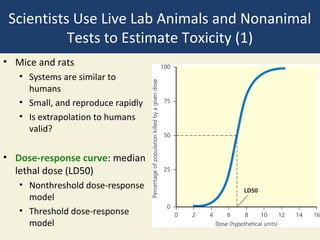
• Dose-response curve: median
  lethal dose (LD50)
   • Nonthreshold dose-response
     model
   • Threshold dose-response
     model
Scientists Use Live Lab Animals and Nonanimal
          Tests to Estimate Toxicity (2)
 • More humane methods using animals

 • Replace animals with other models
    • Computer simulations
    • Tissue culture and individual animal cells
    • Chicken egg membranes


 • What are the effects of mixtures of potentially toxic
   chemicals?
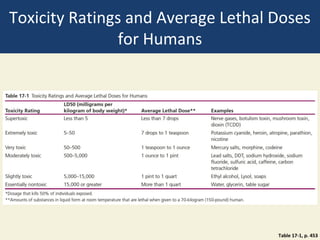
Toxicity Ratings and Average Lethal Doses
                for Humans


                                    Table 17-1, p. 453
Are Trace Levels of Toxic Chemicals
               Harmful?
• Insufficient data for most chemicals

• We are all exposed to toxic chemicals

• Are the dangers increasing or are the tests just more
  sensitive?
Why Do We Know So Little about the
   Harmful Effects of Chemicals?
• Severe limitations estimating toxicity levels and risks

• Only 2% of 100,000 chemicals have been adequately
  tested

• 99.5% of chemicals used in the United States are not
  supervised by government
Pollution Prevention and the Precautionary
                 Principle
  • Those introducing a new chemical or new
    technology would have to follow new
    strategies
    • A new product is considered harmful until it can
      be proved to be safe
    • Existing chemicals and technologies that appear to
      cause significant harm must be removed
The Greatest Health Risks Come from
Poverty, Gender, and Lifestyle Choices
• Risk analysis
   • Risk assessment
   • Risk management
   • Risk communication

• Greatest health risks
   • Poverty
   • Gender
   • Lifestyle choices
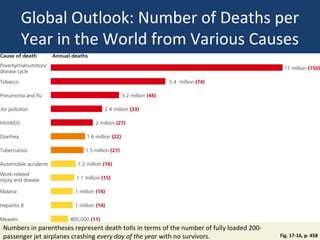
Global Outlook: Number of Deaths per
      Year in the World from Various Causes


Numbers in parentheses represent death tolls in terms of the number of fully loaded 200-
passenger jet airplanes crashing every day of the year with no survivors.                  Fig. 17-16, p. 458
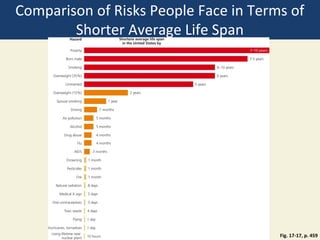
Comparison of Risks People Face in Terms of
        Shorter Average Life Span


                                       Fig. 17-17, p. 459
Most People Do a Poor Job of Evaluating
                Risks
1. Fear

2. Degree of control

3. Whether a risk is catastrophic or chronic

4. Optimism bias

5. Want instant gratification without thinking of future
   harm
Several Principles Can Help Us to Evaluate
             and Reduce Risk
 1. Compare risks

 2. Determine how much you are willing to accept

 3. Determine the actual risk involved

 4. Concentrate on evaluating and carefully making
    important lifestyle choices
Three Big Ideas
1. We face significant hazards from infectious diseases,
   malaria, and tuberculosis, and from exposure to chemicals
   that can cause cancers and birth defects, and disrupt the
   human immune, nervous, and endocrine systems.
2. Because of the difficulty in evaluating the harm caused by
   exposure to chemicals, many health scientists call for
   much greater emphasis on pollution prevention.
3. Becoming informed, thinking critically about risks, and
   making careful choices can reduce the major risks we
   face.

Bio 105 Chapter 17

  • 1.
    MILLER/SPOOLMAN LIVING IN THE ENVIRONMENT 17TH Chapter 17 Environmental Hazards and Human Health
  • 2.
    Core Case Study:Are Baby Bottles and Food Cans Safe To Use? The BPA Controversy (1) • Some synthetic chemicals act as hormone mimics and disrupt the human endocrine system • Excess estrogen effects on males • Feminization • Smaller penis • Lower sperm counts • Presence of both male and female sex organs
  • 3.
    Core Case Study:Are Baby Bottles and Food Cans Safe To Use? The BPA Controversy (2) • BPA (bisphenol A) • Estrogen mimic • In polycarbonates and other hardened plastics • Baby bottles and sipping cups • Reusable water bottles • Sports drink and juice bottles • Microwave dishes • Food storage containers • Liners of most food and soft drink cans
  • 4.
    Core Case Study:Are Baby Bottles and Food Cans Safe To Use? The BPA Controversy (3) • BPA leaches into foods and drinks • Even when containers not heated • 93% of Americans older than 6 have BPA levels above the threshold level set by the EPA • Higher in children and adolescents • Risks for infants, children, adults
  • 5.
    Baby Drinking fromBPA Bottle Fig. 17-1, p. 436
  • 6.
    Risks Are UsuallyExpressed as Probabilities • Risk • Probability of suffering harm from a hazard • Probability vs. possibility • Risk Assessment • Risk Management
  • 7.
    Science: Risk Assessmentand Risk Management Fig. 17-2, p. 437
  • 8.
    We Face ManyTypes of Hazards 1. Biological: • Pathogen: an organism that causes disease in other organisms 2. Chemical 3. Physical 4. Cultural 5. Lifestyle choices
  • 9.
    Some Diseases CanSpread from One Person to Another (1) • Infectious disease • Pathogen invades the body and multiplies • Transmissible disease • Contagious or communicable disease • Infectious disease transmitted between people • Flu, tuberculosis, measles
  • 10.
    Some Diseases CanSpread from One Person to Another (2) • Nontransmissible disease • Not caused by living organisms • Heart disease, most cancers, diabetes • Since 1950, death from infectious diseases have declined due to • Better health care • Better sanitation • Antibiotics • Vaccines
  • 11.
    Infectious Diseases AreStill Major Health Threats • Infectious diseases spread through • Air • Water • Food • Body fluids • Epidemics and pandemics • Resistance of bacteria and insects to drugs and pesticides
  • 12.
    Science: Pathways forInfectious Diseases in Humans Fig. 17-3, p. 439
  • 13.
    Major Causes ofDeath from Infectious Diseases in the World, 2007 Fig. 17-4, p. 439
  • 14.
    Science Focus: GeneticResistance to Antibiotics Is Increasing (1) • Bacteria: rapid reproduction, easily spread • Overuse of antibiotics • Overuse of pesticides
  • 15.
    Viral Diseases andParasites Kill Large Numbers of People (1) • Influenza or flu virus • #1 Killer • HIV • #2 Killer • Hepatitis B virus (HBV) • #3 Killer • Emergent diseases: West Nile virus
  • 16.
    Viral Diseases andParasites Kill Large Numbers of People (2) • Viruses that move form animals to humans • West Nile virus • Swine flu (H1N1) • Bird flu • Reduce chances of infection: 1. Wash your hands 2. Avoid touching your face 3. Avoid sick people
  • 17.
    Case Study: Malaria— The Spread of a Deadly Parasite (1) • Malaria • Caused by Plasmodium sp. carried by Anopheles mosquitoes • Tropical and subtropical regions • Malarial cycle
  • 18.
    Case Study: Malaria— The Spread of a Deadly Parasite (2) • Malaria on the rise since 1970 • Drug resistant Plasmodium • Insecticide resistant mosquitoes • Clearing of tropical forests • AIDS patients particularly vulnerable
  • 19.
    Global Outlook: Distributionof Malaria Fig. 17-6, p. 444
  • 20.
    A Boy inBrazil’s Amazon Sleeps Under an Insecticide-Treated Mosquito Net Fig. 17-7, p. 445
  • 21.
  • 22.
    Some Chemicals CanCause Cancers, Mutations, and Birth Defects • Toxic chemicals • Carcinogens • Chemicals, types of radiation, or certain viruses the cause or promote cancer • Mutagens • Chemicals or radiation that cause mutations or increase their frequency • Teratogens • Chemicals that cause harm or birth defects to a fetus or embryo
  • 23.
    Potential Pathways onWhich Toxic Chemicals Move Through the Environment Fig. 17-9, p. 447
  • 24.
    Some Chemicals MayAffect Our Immune and Nervous Systems • Some natural and synthetic chemicals in the environment can weaken and harm • Immune system • Nervous system • Neurotoxins: PCBs, arsenic, lead, some pesticides • Endocrine system
  • 25.
    Science Focus: Mercury’sToxic Effects (1) • Hg: teratogen and potent neurotoxin • Once airborne, persistent and not degradable • 1/3 from natural sources • 2/3 from human activities • Enters the food chain: biomagnification • How are humans exposed? 1. Inhalation: vaporized Hg or particulates 2. Eating fish with high levels of methylmercury 3. Eating high-fructose corn syrup
  • 26.
    Science Focus: Mercury’sToxic Effects (2) • Effects of Hg on humans • Damage nervous system, kidneys, lungs • Harm fetuses and cause birth defects • Who is most at risk? • Pregnant women • 75% of exposure comes from eating fish
  • 27.
  • 28.
    Some Chemicals Affectthe Human Endocrine System • Glands that release hormones that regulate bodily systems and control sexual reproduction, growth, development, learning, behavior • Hormonally active agents have similar shapes and bind to hormone receptors • Gender benders • Thyroid disruptors • BPA? • Phthalates in plastics-increase plastic flexibility
  • 29.
    Hormones and HormonesMimics or Blockers Fig. 17-11, p. 449
  • 30.
    Many Factors Determinethe Harmful Health Effects of a Chemical (1) • Toxicology • Toxicity dependent on • Dose • Age • Genetic makeup • Solubility • Persistence • Biomagnification
  • 31.
    Many Factors Determinethe Harmful Health Effects of a Chemical (2) • Response • Acute effect: immediate or rapid • Chronic effect: permanent or long-lasting
  • 32.
    Science: Estimating HumanExposure to Chemicals and Measuring Their Effects Fig. 17-12, p. 452
  • 33.
    Case Study: ProtectingChildren from Toxic Chemicals • Infants and children more susceptible • Eat, drink water, and breathe more per unit of body weight than adults • Put their fingers in their mouths • Less well-developed immune systems and body detoxification processes • Fetal exposure may increase risk of autism, asthma, learning disorders
  • 34.
    Scientists Use LiveLab Animals and Nonanimal Tests to Estimate Toxicity (1) • Mice and rats • Systems are similar to humans • Small, and reproduce rapidly • Is extrapolation to humans valid? • Dose-response curve: median lethal dose (LD50) • Nonthreshold dose-response model • Threshold dose-response model
  • 35.
    Scientists Use LiveLab Animals and Nonanimal Tests to Estimate Toxicity (2) • More humane methods using animals • Replace animals with other models • Computer simulations • Tissue culture and individual animal cells • Chicken egg membranes • What are the effects of mixtures of potentially toxic chemicals?
  • 36.
    Toxicity Ratings andAverage Lethal Doses for Humans Table 17-1, p. 453
  • 37.
    Are Trace Levelsof Toxic Chemicals Harmful? • Insufficient data for most chemicals • We are all exposed to toxic chemicals • Are the dangers increasing or are the tests just more sensitive?
  • 38.
    Why Do WeKnow So Little about the Harmful Effects of Chemicals? • Severe limitations estimating toxicity levels and risks • Only 2% of 100,000 chemicals have been adequately tested • 99.5% of chemicals used in the United States are not supervised by government
  • 39.
    Pollution Prevention andthe Precautionary Principle • Those introducing a new chemical or new technology would have to follow new strategies • A new product is considered harmful until it can be proved to be safe • Existing chemicals and technologies that appear to cause significant harm must be removed
  • 40.
    The Greatest HealthRisks Come from Poverty, Gender, and Lifestyle Choices • Risk analysis • Risk assessment • Risk management • Risk communication • Greatest health risks • Poverty • Gender • Lifestyle choices
  • 41.
    Global Outlook: Numberof Deaths per Year in the World from Various Causes Numbers in parentheses represent death tolls in terms of the number of fully loaded 200- passenger jet airplanes crashing every day of the year with no survivors. Fig. 17-16, p. 458
  • 42.
    Comparison of RisksPeople Face in Terms of Shorter Average Life Span Fig. 17-17, p. 459
  • 43.
    Most People Doa Poor Job of Evaluating Risks 1. Fear 2. Degree of control 3. Whether a risk is catastrophic or chronic 4. Optimism bias 5. Want instant gratification without thinking of future harm
  • 44.
    Several Principles CanHelp Us to Evaluate and Reduce Risk 1. Compare risks 2. Determine how much you are willing to accept 3. Determine the actual risk involved 4. Concentrate on evaluating and carefully making important lifestyle choices
  • 45.
    Three Big Ideas 1.We face significant hazards from infectious diseases, malaria, and tuberculosis, and from exposure to chemicals that can cause cancers and birth defects, and disrupt the human immune, nervous, and endocrine systems. 2. Because of the difficulty in evaluating the harm caused by exposure to chemicals, many health scientists call for much greater emphasis on pollution prevention. 3. Becoming informed, thinking critically about risks, and making careful choices can reduce the major risks we face.

Editor's Notes

  • #6 Figure 17.1: There is concern that bisphenol A (BPA), an estrogen mimic, can leach out of polycarbonate baby bottles, especially when they are warmed, microwaved, or used to hold acidic juices. In 2008, Canada became the first country to classify BPA as a toxic substance and announced that it would ban its use in baby bottles. Some manufacturers are no longer using polycarbonate plastic in baby bottles, in sipping cups, or in the plastic lining of baby formula cans. But almost all food and soft drink cans are lined with a plastic resin that some researchers believe can release BPA into the contents of the cans.
  • #8 Figure 17.2: S cience. Risk assessment and risk management are used to estimate the seriousness of various risks and how to reduce such risks. Question: What is an example of how you have applied this process in your daily living?
  • #13 Figure 17.3: S cience. There are a number of pathways on which infectious disease organisms can enter the human body. Question: Can you think of other pathways not shown here?
  • #14 Figure 17.4: Global outlook: The World Health Organization estimates that each year, the world’s seven deadliest infectious diseases kill 11.3 million people—most of them poor people in less-developed countries ( Concept 17-2 ). This averages about 31,000 mostly preventable deaths every day—roughly the same as wiping out everyone in the U.S. states of Massachusetts and Alabama or all the people in Delhi, India, each year. Question: How many people, on average, die prematurely from these diseases every hour? (Data from the World Health Organization, 2007 )
  • #20 Figure 17.6: Global outlook: About 40% of the world’s population lives in areas in which malaria is prevalent. Malaria kills at least 1 million people a year or about 2 people every minute. More than 80% of these victims live in sub-Saharan Africa and most of them are children younger than age 5. According to the WHO, every 45 seconds, a child in Africa dies of malaria. (Data from the World Health Organization and U.S. Centers for Disease Control and Prevention )
  • #21 Figure 17.7: This boy, who lives in Brazil’s Amazon Basin, is sleeping under an insecticide-treated mosquito net to reduce his risk of being bitten by malaria-carrying mosquitoes. Such nets cost about $5 each and can be donated through groups such as www.Malaria N oMore.or g .
  • #22 Figure 17.8: There are a number of ways to prevent or reduce the incidence of infectious diseases, especially in less-developed countries. Question: Which three of these approaches do you think are the most important?
  • #24 Figure 17.9: PCBs and other persistent toxic chemicals can move through the living and nonliving environment on a number of pathways.
  • #28 Figure 17.10: There are a number of ways to prevent or control inputs of mercury into the environment from human sources—mostly coal-burning power plants and incinerators. Question: Which four of these solutions do you think are the most important?
  • #30 Figure 17.11: Hormones are molecules that act as messengers in the endocrine system to regulate various bodily processes, including reproduction, growth, and development. Each type of hormone has a unique molecular shape that allows it to attach to specially shaped receptors on the surface of, or inside, cells and to transmit its chemical message (left). Molecules of certain pesticides and other synthetic chemicals have shapes similar to those of natural hormones, allowing them to attach to the hormone molecules and disrupt the endocrine system in people and various other animals. These molecules are called hormonally active agents (HAAs). Because of the difficulty in determining the harmful effects of long-term exposure to low levels of HAAs, there is uncertainty about their effects on human health.
  • #33 Figure 17.12: S cience. Estimating human exposure to chemicals and measuring the effects of that exposure are very difficult because of the many and often poorly understood variables involved. Question: Which of these factors, if any, might make you more vulnerable to the harmful effects of chemicals?
  • #42 Figure 17.16: Global outlook: Scientists have estimated the number of deaths per year in the world from various causes. Numbers in parentheses represent death tolls in terms of the number of fully loaded 200-passenger jet airplanes crashing every day of the year with no survivors. Because of the lack of media coverage of the largest annual causes of death and its sensational coverage of other causes of death, most people are misinformed and guided by irrational fears about the comparative levels of risk. Question: Which three of these items are most likely to shorten your life span? (Data from World Health Organization, 2007)
  • #43 Figure 17.17: Global outlook: This figure compares key risks that people can face, expressed in terms of an estimated shorter average life span ( Concept 17-5 ). Excepting poverty and gender, the greatest risks people face come mostly from the lifestyle choices they make. These are merely generalized relative estimates. Individual responses to these risks differ because of factors such as genetic variation, family medical history, emotional makeup, stress, and social ties and support. Question: Which three of these factors are most likely to shorten your life span? (Data from Bernard L. Cohen)