Biophysics
Jessalyn C. Verzosa
BIOMOLECULE
S
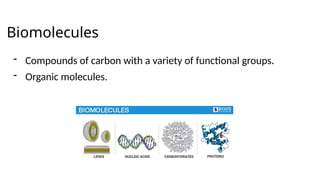
Biomolecules
- Compounds of carbon with a variety of functional groups.
- Organic molecules.
Biomolecules
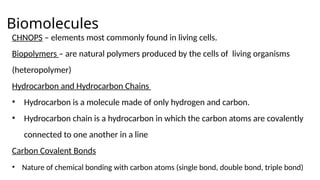
CHNOPS – elements most commonly found in living cells.
Biopolymers – are natural polymers produced by the cells of living organisms
(heteropolymer)
Hydrocarbon and Hydrocarbon Chains
• Hydrocarbon is a molecule made of only hydrogen and carbon.
• Hydrocarbon chain is a hydrocarbon in which the carbon atoms are covalently
connected to one another in a line
Carbon Covalent Bonds
• Nature of chemical bonding with carbon atoms (single bond, double bond, triple bond)
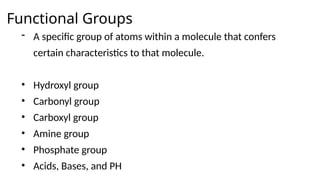
Functional Groups
- A specific group of atoms within a molecule that confers
certain characteristics to that molecule.
• Hydroxyl group
• Carbonyl group
• Carboxyl group
• Amine group
• Phosphate group
• Acids, Bases, and PH
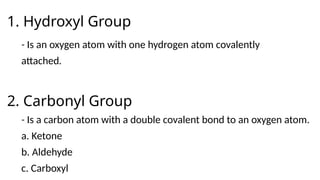
1. Hydroxyl Group
- Is an oxygen atom with one hydrogen atom covalently
attached.
2. Carbonyl Group
- Is a carbon atom with a double covalent bond to an oxygen atom.
a. Ketone
b. Aldehyde
c. Carboxyl
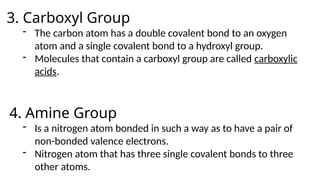
3. Carboxyl Group
- The carbon atom has a double covalent bond to an oxygen
atom and a single covalent bond to a hydroxyl group.
- Molecules that contain a carboxyl group are called carboxylic
acids.
4. Amine Group
- Is a nitrogen atom bonded in such a way as to have a pair of
non-bonded valence electrons.
- Nitrogen atom that has three single covalent bonds to three
other atoms.
5. Phosphate Group
- Is a phosphorous atom with four oxygen atoms attached.
6. Acids, Bases, and pH
• Acids – are molecules or functional groups that increase the
concentration of protons in solution.
• Bases – are molecules or functional groups that decrease the
concentration of protons.
• pH – concentration of protons in units of pH.
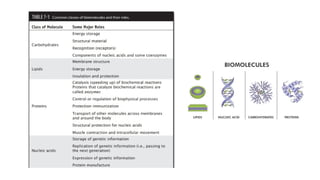
Class of Biomolecules
1. Carbohydrates
- Are molecules made of carbon, hydrogen, and oxygen.
- Most abundant biomolecules on Earth.
- Are used for energy storage (food).
- Serve as structural material (cellulose).
- Components of nucleic acids and of some coenzymes.
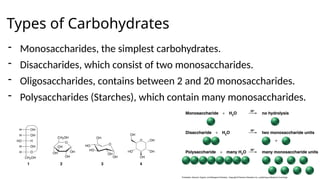
Types of Carbohydrates
- Monosaccharides, the simplest carbohydrates.
- Disaccharides, which consist of two monosaccharides.
- Oligosaccharides, contains between 2 and 20 monosaccharides.
- Polysaccharides (Starches), which contain many monosaccharides.
Derivatives of Carbohydrates
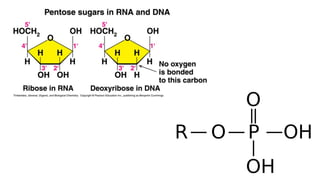
• Deoxycarbohydrate – a carbohydrate molecule that has one
less oxygen atom than normally found in carbohydrates.
 Deoxyribose – a major component of the residues making up
DNA
• Sugar alcohols – used as low-calorie sweeteners
• Sugar acids – produced by oxidation of glucose
Class of Biomolecules
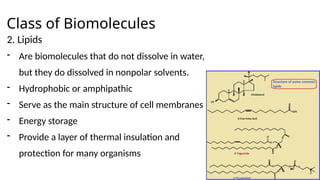
2. Lipids
- Are biomolecules that do not dissolve in water,
but they do dissolved in nonpolar solvents.
- Hydrophobic or amphipathic
- Serve as the main structure of cell membranes
- Energy storage
- Provide a layer of thermal insulation and
protection for many organisms
Types of Lipids
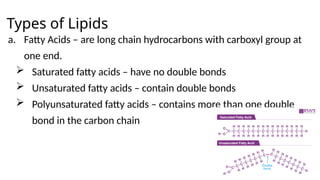
a. Fatty Acids – are long chain hydrocarbons with carboxyl group at
one end.
 Saturated fatty acids – have no double bonds
 Unsaturated fatty acids – contain double bonds
 Polyunsaturated fatty acids – contains more than one double
bond in the carbon chain
Types of Lipids
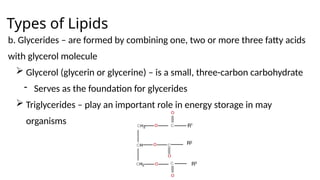
b. Glycerides – are formed by combining one, two or more three fatty acids
with glycerol molecule
 Glycerol (glycerin or glycerine) – is a small, three-carbon carbohydrate
- Serves as the foundation for glycerides
 Triglycerides – play an important role in energy storage in may
organisms
Types of Lipids
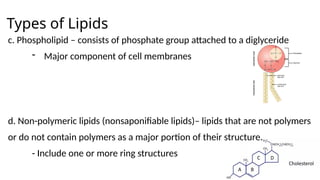
c. Phospholipid – consists of phosphate group attached to a diglyceride
- Major component of cell membranes
d. Non-polymeric lipids (nonsaponifiable lipids)– lipids that are not polymers
or do not contain polymers as a major portion of their structure.
- Include one or more ring structures
Class of Biomolecules
3. Proteins
- A polymer of amino acids
- Defined as compounds of high molar mass consisting largely or entirely of
chains of amino acids
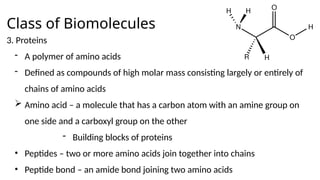
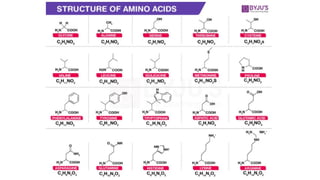
 Amino acid – a molecule that has a carbon atom with an amine group on
one side and a carboxyl group on the other
- Building blocks of proteins
• Peptides – two or more amino acids join together into chains
• Peptide bond – an amide bond joining two amino acids
Protein Structure and Function
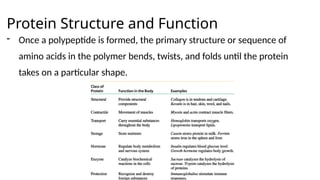
- Once a polypeptide is formed, the primary structure or sequence of
amino acids in the polymer bends, twists, and folds until the protein
takes on a particular shape.
Class of Biomolecules
4. Nucleic Acid
- Are biomolecules named for being an acidic substance originally
discovered in the nucleus of cells.
- Storage and expression of genetic information, transport of amino acids
during protein synthesis and acting as catalysts.
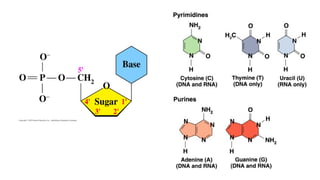
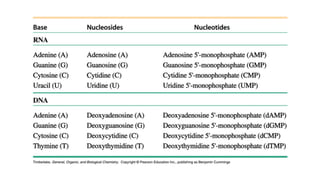
- Are polymers of nucleotides – are molecules that contain nitrogenous
base, sugar, and phosphate group.
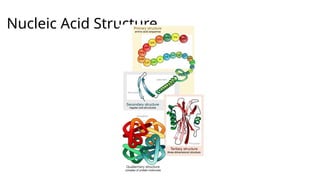
Nucleic Acid Structure
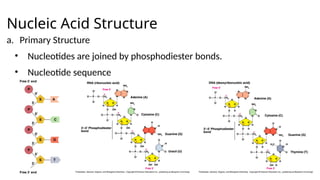
a. Primary Structure
• Nucleotides are joined by phosphodiester bonds.
• Nucleotide sequence
Nucleic Acid Structure
a. Secondary Structure
• Nucleic acids tend toward a helical shape, due to aromatic stacking
interactions among nitrogenous bases.
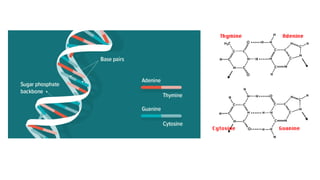
• Base pairing – refers to the stacking interactions of nitrogenous bases
in nucleic acid.
• Double helix – consists of two strands of nucleotides that form a
double helix structure like a spiral stair case.
• DNA contains complementary base pairs.
Nucleic Acid Structure
Nucleic Acid Function
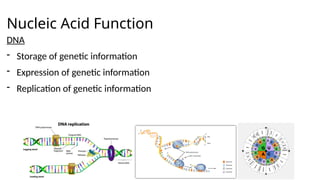
DNA
- Storage of genetic information
- Expression of genetic information
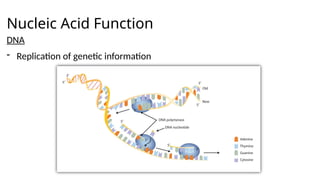
- Replication of genetic information
Nucleic Acid Function
DNA
- Storage of genetic information
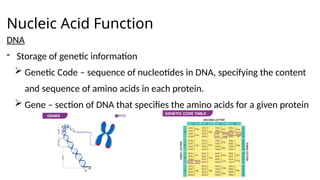
 Genetic Code – sequence of nucleotides in DNA, specifying the content
and sequence of amino acids in each protein.
 Gene – section of DNA that specifies the amino acids for a given protein
Nucleic Acid Function
DNA
- Expression of genetic information
 Reading the instructions stored in DNA’s nucleotide sequence and starting the
process of building a protein.
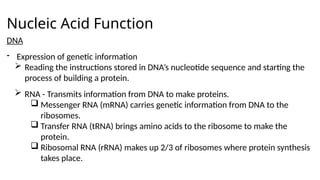
 RNA - Transmits information from DNA to make proteins.
 Messenger RNA (mRNA) carries genetic information from DNA to the
ribosomes.
 Transfer RNA (tRNA) brings amino acids to the ribosome to make the
protein.
 Ribosomal RNA (rRNA) makes up 2/3 of ribosomes where protein synthesis
takes place.
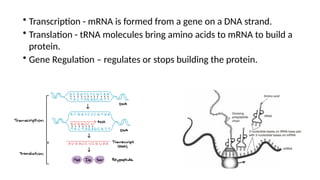
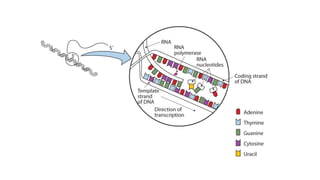
• Transcription - mRNA is formed from a gene on a DNA strand.
• Translation - tRNA molecules bring amino acids to mRNA to build a
protein.
• Gene Regulation – regulates or stops building the protein.
Nucleic Acid Function
DNA
- Replication of genetic information
Nucleotides as Energy
Currency
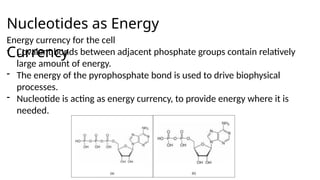
Energy currency for the cell
- Covalent bonds between adjacent phosphate groups contain relatively
large amount of energy.
- The energy of the pyrophosphate bond is used to drive biophysical
processes.
- Nucleotide is acting as energy currency, to provide energy where it is
needed.

Biological Physics Chapter 5 _AY 2024-30

  • 1.
  • 2.
  • 3.
    Biomolecules - Compounds ofcarbon with a variety of functional groups. - Organic molecules.
  • 5.
    Biomolecules CHNOPS – elementsmost commonly found in living cells. Biopolymers – are natural polymers produced by the cells of living organisms (heteropolymer) Hydrocarbon and Hydrocarbon Chains • Hydrocarbon is a molecule made of only hydrogen and carbon. • Hydrocarbon chain is a hydrocarbon in which the carbon atoms are covalently connected to one another in a line Carbon Covalent Bonds • Nature of chemical bonding with carbon atoms (single bond, double bond, triple bond)
  • 6.
    Functional Groups - Aspecific group of atoms within a molecule that confers certain characteristics to that molecule. • Hydroxyl group • Carbonyl group • Carboxyl group • Amine group • Phosphate group • Acids, Bases, and PH
  • 7.
    1. Hydroxyl Group -Is an oxygen atom with one hydrogen atom covalently attached. 2. Carbonyl Group - Is a carbon atom with a double covalent bond to an oxygen atom. a. Ketone b. Aldehyde c. Carboxyl
  • 8.
    3. Carboxyl Group -The carbon atom has a double covalent bond to an oxygen atom and a single covalent bond to a hydroxyl group. - Molecules that contain a carboxyl group are called carboxylic acids. 4. Amine Group - Is a nitrogen atom bonded in such a way as to have a pair of non-bonded valence electrons. - Nitrogen atom that has three single covalent bonds to three other atoms.
  • 9.
    5. Phosphate Group -Is a phosphorous atom with four oxygen atoms attached. 6. Acids, Bases, and pH • Acids – are molecules or functional groups that increase the concentration of protons in solution. • Bases – are molecules or functional groups that decrease the concentration of protons. • pH – concentration of protons in units of pH.
  • 10.
    Class of Biomolecules 1.Carbohydrates - Are molecules made of carbon, hydrogen, and oxygen. - Most abundant biomolecules on Earth. - Are used for energy storage (food). - Serve as structural material (cellulose). - Components of nucleic acids and of some coenzymes.
  • 11.
    Types of Carbohydrates -Monosaccharides, the simplest carbohydrates. - Disaccharides, which consist of two monosaccharides. - Oligosaccharides, contains between 2 and 20 monosaccharides. - Polysaccharides (Starches), which contain many monosaccharides.
  • 12.
    Derivatives of Carbohydrates •Deoxycarbohydrate – a carbohydrate molecule that has one less oxygen atom than normally found in carbohydrates.  Deoxyribose – a major component of the residues making up DNA • Sugar alcohols – used as low-calorie sweeteners • Sugar acids – produced by oxidation of glucose
  • 13.
    Class of Biomolecules 2.Lipids - Are biomolecules that do not dissolve in water, but they do dissolved in nonpolar solvents. - Hydrophobic or amphipathic - Serve as the main structure of cell membranes - Energy storage - Provide a layer of thermal insulation and protection for many organisms
  • 14.
    Types of Lipids a.Fatty Acids – are long chain hydrocarbons with carboxyl group at one end.  Saturated fatty acids – have no double bonds  Unsaturated fatty acids – contain double bonds  Polyunsaturated fatty acids – contains more than one double bond in the carbon chain
  • 15.
    Types of Lipids b.Glycerides – are formed by combining one, two or more three fatty acids with glycerol molecule  Glycerol (glycerin or glycerine) – is a small, three-carbon carbohydrate - Serves as the foundation for glycerides  Triglycerides – play an important role in energy storage in may organisms
  • 16.
    Types of Lipids c.Phospholipid – consists of phosphate group attached to a diglyceride - Major component of cell membranes d. Non-polymeric lipids (nonsaponifiable lipids)– lipids that are not polymers or do not contain polymers as a major portion of their structure. - Include one or more ring structures
  • 17.
    Class of Biomolecules 3.Proteins - A polymer of amino acids - Defined as compounds of high molar mass consisting largely or entirely of chains of amino acids  Amino acid – a molecule that has a carbon atom with an amine group on one side and a carboxyl group on the other - Building blocks of proteins • Peptides – two or more amino acids join together into chains • Peptide bond – an amide bond joining two amino acids
  • 19.
    Protein Structure andFunction - Once a polypeptide is formed, the primary structure or sequence of amino acids in the polymer bends, twists, and folds until the protein takes on a particular shape.
  • 20.
    Class of Biomolecules 4.Nucleic Acid - Are biomolecules named for being an acidic substance originally discovered in the nucleus of cells. - Storage and expression of genetic information, transport of amino acids during protein synthesis and acting as catalysts. - Are polymers of nucleotides – are molecules that contain nitrogenous base, sugar, and phosphate group.
  • 24.
    Nucleic Acid Structure a.Primary Structure • Nucleotides are joined by phosphodiester bonds. • Nucleotide sequence
  • 25.
    Nucleic Acid Structure a.Secondary Structure • Nucleic acids tend toward a helical shape, due to aromatic stacking interactions among nitrogenous bases. • Base pairing – refers to the stacking interactions of nitrogenous bases in nucleic acid. • Double helix – consists of two strands of nucleotides that form a double helix structure like a spiral stair case. • DNA contains complementary base pairs.
  • 27.
  • 28.
    Nucleic Acid Function DNA -Storage of genetic information - Expression of genetic information - Replication of genetic information
  • 29.
    Nucleic Acid Function DNA -Storage of genetic information  Genetic Code – sequence of nucleotides in DNA, specifying the content and sequence of amino acids in each protein.  Gene – section of DNA that specifies the amino acids for a given protein
  • 30.
    Nucleic Acid Function DNA -Expression of genetic information  Reading the instructions stored in DNA’s nucleotide sequence and starting the process of building a protein.  RNA - Transmits information from DNA to make proteins.  Messenger RNA (mRNA) carries genetic information from DNA to the ribosomes.  Transfer RNA (tRNA) brings amino acids to the ribosome to make the protein.  Ribosomal RNA (rRNA) makes up 2/3 of ribosomes where protein synthesis takes place.
  • 31.
    • Transcription -mRNA is formed from a gene on a DNA strand. • Translation - tRNA molecules bring amino acids to mRNA to build a protein. • Gene Regulation – regulates or stops building the protein.
  • 33.
    Nucleic Acid Function DNA -Replication of genetic information
  • 34.
    Nucleotides as Energy Currency Energycurrency for the cell - Covalent bonds between adjacent phosphate groups contain relatively large amount of energy. - The energy of the pyrophosphate bond is used to drive biophysical processes. - Nucleotide is acting as energy currency, to provide energy where it is needed.