BIOMOLECULES
SRIRAMAKRISHNAN.E
I M.Sc. Biotechnology
Department of Biotechnology and Microbiology
National College (Autonomous), Trichy, Tamil Nadu, India
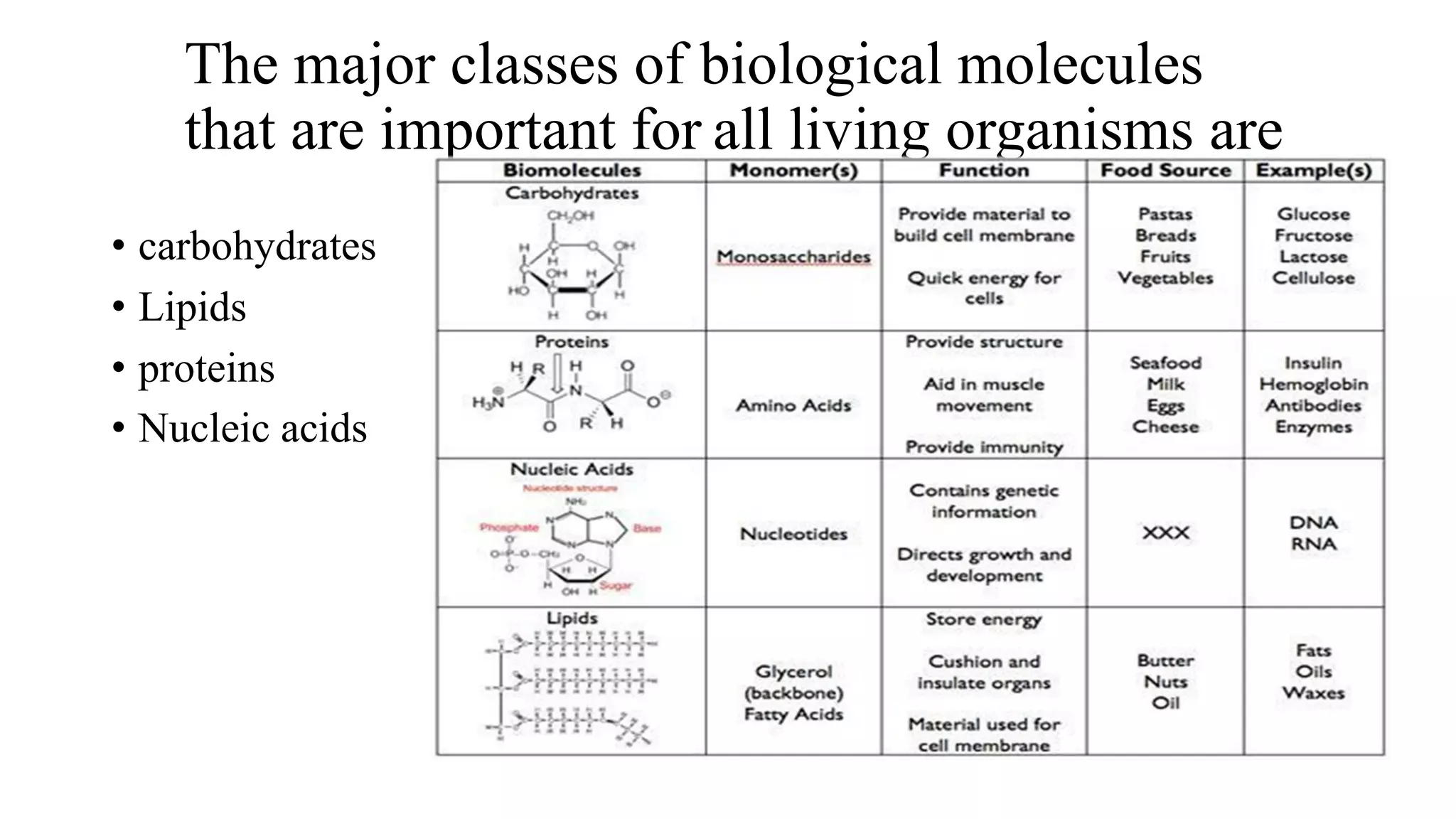
The major classes of biological molecules
that are important for all living organisms are
• carbohydrates
• Lipids
• proteins
• Nucleic acids
CARBOHYDRATES
• Carbohydrates - compounds that are made of C, H, and O
• Examples: all sugars, starches, cellulose and chitin are Carbohydrates
used for energy storage and structures.
• Carbohydrates have a caloric value of 4.1 kilocalories/gram.
• The simplest class of carbohydrates are monosaccharides - simple sugars- All have
3 to 6 carbons
• 6 carbon sugars
Simple sugars
exist in different
forms and can be
drawn in different
ways
• The six carbon sugars all
have the same chemical
formula: C6H12O6
• They differ in the
placement of functional
groups C=O and -OH
• Isomers have the same
chemical formula .
• Stereoisomers differ in the
arrangement of a functional
group at a single carbon
• Monosaccharides are the
building blocks of more
complex carbohydrates
• For example. Sucrose and
lactose are a combination
of two monosaccharides
• Disaccharides
are formed by
GLYCOSIDIC
linkage by the
removal of
water molecule
• Polysaccharides are polymers of
monosaccharides.
• Polymers are long chain
molecules with repeating
subunits
• Starches are polymers of glucose
• Each glucose molecule is an
energy rich molecule
• Amylose is an unbranched chain
and is produced by plants.
Amylopectin is branched and
also produced by plants.
• Glycogen is highly branched and
produced by animals
• Starch is a polymer of α- glucose
and it is readily soluble
• Cellulose is a β-glucose and
indigestible
• Cellulose is a structural
polysaccharide and used for
construction of cell wall synthesis
by plants.
• Another important
polysaccharide is chitin which is
made up of β-glucose molecule
that have nitrogen containing
functional group.
• chitin is used for the
construction of cell wall in fungi.
LIPIDS
• Lipids - a chemically diverse class of organic molecules that are
grouped together because they are all largely nonpolar.
• Because they are nonpolar in nature they are soluble in organic
solvents like chloroform, benzene, acetone, paint thinner, etc.
and insoluble in water
• The major classes of lipids are fatty acids, neutral fats,
phospholipids, steroids
• Lipids have many functions including energy storage, cell
membrane structure, vitamins and hormones
Saturated fatty acid
Unsaturated fatty acid
• Fatty acids are long-chain
carbon molecules with many
carbon- hydrogen bonds and a
carboxyl group (COOH) on one
end.
• The carboxyl group can ionize,
releasing an H+
• Saturated fatty acids have no
C=C bonds - all carbons in the
chain are bonded to as many
hydrogens as possible
• Unsaturated fatty acids have
some C=C bonds in the chain -
the carbon chain is not
completely saturated with
hydrogens.
• Phospholipids - structural lipids - an integral part of cell
membranes - inside and enclosing cells.
• Structurally similar to triglycerides - one fatty acid is replaced by a
choline group.
• The choline group has both N and P in its structure
• The choline group is charged (polar) and will hydrogen bond with
water. It is called hydrophilic .
• The rest of the molecule is nonpolar and insoluble in water. It will not
hydrogen bond with water. It is hydrophobic.
• The choline end of the
molecule is called the
“head.”
• The fatty acid chains are
called the “tails.”
• Phospholipids have
hydrophilic heads and
hydrophobic tails
• In water, phospholipids
spontaneously form
micelles or bilayers
• Steroids or Sterols
- have a more complex
structure than other lipids
and a greater diversity of
functions
• Cholesterol is an important
part of cell membranes
• Vitamin D is necessary for
some biochemical reactions
to occur properly
Vitamin D
PROTEINS • Proteins – the most functionally diverse class
of biological molecules - Protein diversity is
the basis of the diversity of life.
• Everything that organisms are composed of -
all parts - are made of, or by proteins
• Proteins serve as enzymes, for defense,
transport, support, motion, regulation, and
storage
• There are 20 different amino acids used in
proteins. All have a similar structure.
• All have a central carbon, an amino group
(NH2) and a carboxyl group (COOH).
• Proteins are polymers of amino
acids joined through peptide
bonds.
• The carboxyl group (COOH) of
one amino acid links with the
amino group (NH2) of another to
produce the sequence CONH and
release water forms a peptide
bond (H2O)
• The diversity of protein function results from diversity ofprotein structure which
is the result of variation in the sequence of amino acids
• Functional proteins can vary in length from about 50 aminoacids to several
thousand amino acids
• The variety of amino acid sequences that are possible for proteins is practically
infinite.
• The diversity of amino acid sequence results in diversity of protein structure
Protein structure can be classified at several different levels: primary, secondary,
tertiary, and quaternary.
• Primary structure - the
amino acid sequence by the
polypeptide bonds
• Met - Gly - His - Trp - Lys - ...
• Secondary structure - the
regular coiling and bending of
the polypeptide that results
from hydrogen bonding of
amino and carboxyl groups in
different amino acids.
• This forms have 2
characteristic structures - the
a helix and the b-pleated sheet
• R groups of different amino acids
can interact in a variety of ways
to produce more complex
structure
• Hydrogen bonds are weak
interactions between polar R
groups
• Some R groups form covalent
bonds or ionic bonds
• Nonpolar R groups can have a
weak attractive interaction
• Because nonpolar R groups are
hydrophobic they are found in the
interior of proteins
• Tertiary structure - the bending
and folding of the polypeptide in
3-D space due to the interactions
of the R groups distant amino
acids
• Interactions include: bonding,
ionic bonding, covalent bonds,
hydrophobic interactions,
hydrophilic interactions
• Quaternary structure - the
interaction of different
polypeptides
• Quaternary structure is the result
of the same interactionsas above.
• Not all proteins have quaternary
structure
• Protein structural diversity is responsible for the functional diversity of proteins.
• Protein shape causes protein function
• Small changes in shape can influence function
• Proteins are sensitive to environmental changes.
• Change in pH, temperature, ion concentration can all
cause a change in the shape of the protein and influence its functional properties
• High temperatures result in weakening of H-bonds.
• Proteins tend to denatures (unfold) at high temperature.
• Low temperatures strengthen H-bonds.
• Proteins become rigid at low temperature.
NUCLEIC ACID
• Nucleic acids - nucleic acids are the repositories and carriers of information.
• All the information needed to make living things work is contained in nucleic
acids
• Nucleic acids also transmit the information needed to make living things work
• Nucleic acids are the basis of protein diversity andbiological diversity.
• The information contained in the DNA makes organisms what they are.
• DNA and RNA are both
polymers of nucleotides
• Nucleotides all have a central
5-carbon sugar, a nitrogenous
base, and a phosphate group.
• The sugar differs between
DNA and RNA.
• RNA uses ribose. DNA uses
deoxyribose.
• The two sugars differ in the
position of 2nd carbon
• The nitrogenous bases
found in DNA are
Adenine, Thymine,
Guanine and Cytosine.
(A,T,G,C)
• The nitrogenous bases
found in RNA are
Adenine, Uracil,
Guanine, and Cytosine.
(A,U,G,C)
• The linkage between nucleotides
is called a phosphodiester bond.
• The sugars are oriented from their
5th carbon to their 3rd carbon.
• The entire polymer has a 5’ to 3’
orientation
• The bases extend from the side of
the polymer
• Both DNA and RNA are
synthesized by adding new
nucleotides to the 3’ end of the
chain.
• RNA is a single stranded polymer
of nucleotides
• DNA is a double stranded
molecule. The two strands coiled
around each other, to form double
helical structure.
• The two strands of DNA run in
opposite directions. They are
compliment to each other.
• Adenine always binds with
Thymine
• Guanine always binds with
Cytosine
• This base pair binding was
explained in Chargaff’s rule.
THANK YOU

BIOMOLECULES.pdf

  • 1.
    BIOMOLECULES SRIRAMAKRISHNAN.E I M.Sc. Biotechnology Departmentof Biotechnology and Microbiology National College (Autonomous), Trichy, Tamil Nadu, India
  • 2.
    The major classesof biological molecules that are important for all living organisms are • carbohydrates • Lipids • proteins • Nucleic acids
  • 3.
    CARBOHYDRATES • Carbohydrates -compounds that are made of C, H, and O • Examples: all sugars, starches, cellulose and chitin are Carbohydrates used for energy storage and structures. • Carbohydrates have a caloric value of 4.1 kilocalories/gram.
  • 4.
    • The simplestclass of carbohydrates are monosaccharides - simple sugars- All have 3 to 6 carbons
  • 5.
  • 6.
    Simple sugars exist indifferent forms and can be drawn in different ways
  • 7.
    • The sixcarbon sugars all have the same chemical formula: C6H12O6 • They differ in the placement of functional groups C=O and -OH • Isomers have the same chemical formula . • Stereoisomers differ in the arrangement of a functional group at a single carbon
  • 8.
    • Monosaccharides arethe building blocks of more complex carbohydrates • For example. Sucrose and lactose are a combination of two monosaccharides
  • 9.
    • Disaccharides are formedby GLYCOSIDIC linkage by the removal of water molecule
  • 10.
    • Polysaccharides arepolymers of monosaccharides. • Polymers are long chain molecules with repeating subunits • Starches are polymers of glucose • Each glucose molecule is an energy rich molecule • Amylose is an unbranched chain and is produced by plants. Amylopectin is branched and also produced by plants. • Glycogen is highly branched and produced by animals
  • 11.
    • Starch isa polymer of α- glucose and it is readily soluble • Cellulose is a β-glucose and indigestible • Cellulose is a structural polysaccharide and used for construction of cell wall synthesis by plants. • Another important polysaccharide is chitin which is made up of β-glucose molecule that have nitrogen containing functional group. • chitin is used for the construction of cell wall in fungi.
  • 12.
    LIPIDS • Lipids -a chemically diverse class of organic molecules that are grouped together because they are all largely nonpolar. • Because they are nonpolar in nature they are soluble in organic solvents like chloroform, benzene, acetone, paint thinner, etc. and insoluble in water • The major classes of lipids are fatty acids, neutral fats, phospholipids, steroids • Lipids have many functions including energy storage, cell membrane structure, vitamins and hormones
  • 13.
    Saturated fatty acid Unsaturatedfatty acid • Fatty acids are long-chain carbon molecules with many carbon- hydrogen bonds and a carboxyl group (COOH) on one end. • The carboxyl group can ionize, releasing an H+ • Saturated fatty acids have no C=C bonds - all carbons in the chain are bonded to as many hydrogens as possible • Unsaturated fatty acids have some C=C bonds in the chain - the carbon chain is not completely saturated with hydrogens.
  • 14.
    • Phospholipids -structural lipids - an integral part of cell membranes - inside and enclosing cells. • Structurally similar to triglycerides - one fatty acid is replaced by a choline group. • The choline group has both N and P in its structure • The choline group is charged (polar) and will hydrogen bond with water. It is called hydrophilic . • The rest of the molecule is nonpolar and insoluble in water. It will not hydrogen bond with water. It is hydrophobic.
  • 15.
    • The cholineend of the molecule is called the “head.” • The fatty acid chains are called the “tails.” • Phospholipids have hydrophilic heads and hydrophobic tails • In water, phospholipids spontaneously form micelles or bilayers
  • 17.
    • Steroids orSterols - have a more complex structure than other lipids and a greater diversity of functions • Cholesterol is an important part of cell membranes • Vitamin D is necessary for some biochemical reactions to occur properly Vitamin D
  • 18.
    PROTEINS • Proteins– the most functionally diverse class of biological molecules - Protein diversity is the basis of the diversity of life. • Everything that organisms are composed of - all parts - are made of, or by proteins • Proteins serve as enzymes, for defense, transport, support, motion, regulation, and storage • There are 20 different amino acids used in proteins. All have a similar structure. • All have a central carbon, an amino group (NH2) and a carboxyl group (COOH).
  • 19.
    • Proteins arepolymers of amino acids joined through peptide bonds. • The carboxyl group (COOH) of one amino acid links with the amino group (NH2) of another to produce the sequence CONH and release water forms a peptide bond (H2O)
  • 21.
    • The diversityof protein function results from diversity ofprotein structure which is the result of variation in the sequence of amino acids • Functional proteins can vary in length from about 50 aminoacids to several thousand amino acids • The variety of amino acid sequences that are possible for proteins is practically infinite. • The diversity of amino acid sequence results in diversity of protein structure Protein structure can be classified at several different levels: primary, secondary, tertiary, and quaternary.
  • 22.
    • Primary structure- the amino acid sequence by the polypeptide bonds • Met - Gly - His - Trp - Lys - ... • Secondary structure - the regular coiling and bending of the polypeptide that results from hydrogen bonding of amino and carboxyl groups in different amino acids. • This forms have 2 characteristic structures - the a helix and the b-pleated sheet
  • 23.
    • R groupsof different amino acids can interact in a variety of ways to produce more complex structure • Hydrogen bonds are weak interactions between polar R groups • Some R groups form covalent bonds or ionic bonds • Nonpolar R groups can have a weak attractive interaction • Because nonpolar R groups are hydrophobic they are found in the interior of proteins
  • 24.
    • Tertiary structure- the bending and folding of the polypeptide in 3-D space due to the interactions of the R groups distant amino acids • Interactions include: bonding, ionic bonding, covalent bonds, hydrophobic interactions, hydrophilic interactions • Quaternary structure - the interaction of different polypeptides • Quaternary structure is the result of the same interactionsas above. • Not all proteins have quaternary structure
  • 25.
    • Protein structuraldiversity is responsible for the functional diversity of proteins. • Protein shape causes protein function • Small changes in shape can influence function • Proteins are sensitive to environmental changes. • Change in pH, temperature, ion concentration can all cause a change in the shape of the protein and influence its functional properties • High temperatures result in weakening of H-bonds. • Proteins tend to denatures (unfold) at high temperature. • Low temperatures strengthen H-bonds. • Proteins become rigid at low temperature.
  • 26.
    NUCLEIC ACID • Nucleicacids - nucleic acids are the repositories and carriers of information. • All the information needed to make living things work is contained in nucleic acids • Nucleic acids also transmit the information needed to make living things work • Nucleic acids are the basis of protein diversity andbiological diversity. • The information contained in the DNA makes organisms what they are.
  • 27.
    • DNA andRNA are both polymers of nucleotides • Nucleotides all have a central 5-carbon sugar, a nitrogenous base, and a phosphate group. • The sugar differs between DNA and RNA. • RNA uses ribose. DNA uses deoxyribose. • The two sugars differ in the position of 2nd carbon
  • 28.
    • The nitrogenousbases found in DNA are Adenine, Thymine, Guanine and Cytosine. (A,T,G,C) • The nitrogenous bases found in RNA are Adenine, Uracil, Guanine, and Cytosine. (A,U,G,C)
  • 29.
    • The linkagebetween nucleotides is called a phosphodiester bond. • The sugars are oriented from their 5th carbon to their 3rd carbon. • The entire polymer has a 5’ to 3’ orientation • The bases extend from the side of the polymer • Both DNA and RNA are synthesized by adding new nucleotides to the 3’ end of the chain.
  • 30.
    • RNA isa single stranded polymer of nucleotides • DNA is a double stranded molecule. The two strands coiled around each other, to form double helical structure. • The two strands of DNA run in opposite directions. They are compliment to each other. • Adenine always binds with Thymine • Guanine always binds with Cytosine • This base pair binding was explained in Chargaff’s rule.
  • 33.