Binary
Arithmetic
NAME: JANHAVI KORDE
CLASS: SY BSC.BT
ROLL NO: 10
Introduction to Binary Numbers
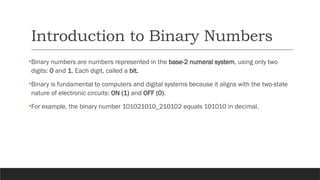
•Binary numbers are numbers represented in the base-2 numeral system, using only two
digits: 0 and 1. Each digit, called a bit.
•Binary is fundamental to computers and digital systems because it aligns with the two-state
nature of electronic circuits: ON (1) and OFF (0).
•For example, the binary number 101021010_210102​equals 101010 in decimal.
Binary Arithmetic
•Binary arithmetic is the process of
performing mathematical operations like
addition, subtraction, multiplication, and
division using binary numbers (0 and 1).
•It forms the foundation of digital
computing and is essential for data
processing and hardware design in
modern computers.
Types of Binary Arithmetic
Operations
• Addition: Binary addition is the addition of two binary numbers using rules somewhat
similar to those of decimal addition but restricted to two digits: 0 and 1. Every bit is added
from the least significant bit up and carries are propagated to the next higher bit when the
sum is greater than 1.
•Subtraction: Binary subtraction is subtracting one binary number from another. It makes
use of borrowing when necessary. Borrowing happens when subtracting 1 from 0 where the
1 is borrowed from the next higher bit.
•Multiplication: Binary multiplication is the
process of multiplying two binary numbers based
on the rules of bitwise multiplication. Here, each
bit of one binary number is multiplied by each bit
of the other, followed by adding the shifted
results, just like long multiplication in decimals.
•Division: Binary division is the process of dividing
a binary dividend by a binary divisor, following the
same principles as decimal long division. The
quotient and remainder are determined based on
repeated subtraction of the divisor from the
dividend.
Real-World Applications:
•Addition: Basic computations, such as
adding numbers or values in registers.
•Subtraction: Used for computing
differences and error correction.
•Multiplication: Frequently used in
algorithms like signal processing or image
rendering.
•Division: Essential for calculating
quotients, fractional values, and scaling
data.
1’s and 2’s complement of binary
numbers
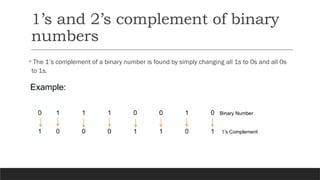
• The 1’s complement of a binary number is found by simply changing all 1s to 0s and all 0s
to 1s.
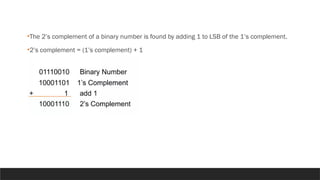
•The 2’s complement of a binary number is found by adding 1 to LSB of the 1’s complement.
•2’s complement = (1’s complement) + 1

References
•https://www.geeksforgeeks.org
•https://ryanstutorials.net
•https://www.w3resource.com
THANKYOU!

Binary Arithmetic that is used in Computer Programming.pptx

  • 1.
  • 2.
    Introduction to BinaryNumbers •Binary numbers are numbers represented in the base-2 numeral system, using only two digits: 0 and 1. Each digit, called a bit. •Binary is fundamental to computers and digital systems because it aligns with the two-state nature of electronic circuits: ON (1) and OFF (0). •For example, the binary number 101021010_210102​equals 101010 in decimal.
  • 3.
    Binary Arithmetic •Binary arithmeticis the process of performing mathematical operations like addition, subtraction, multiplication, and division using binary numbers (0 and 1). •It forms the foundation of digital computing and is essential for data processing and hardware design in modern computers.
  • 4.
    Types of BinaryArithmetic Operations • Addition: Binary addition is the addition of two binary numbers using rules somewhat similar to those of decimal addition but restricted to two digits: 0 and 1. Every bit is added from the least significant bit up and carries are propagated to the next higher bit when the sum is greater than 1. •Subtraction: Binary subtraction is subtracting one binary number from another. It makes use of borrowing when necessary. Borrowing happens when subtracting 1 from 0 where the 1 is borrowed from the next higher bit.
  • 5.
    •Multiplication: Binary multiplicationis the process of multiplying two binary numbers based on the rules of bitwise multiplication. Here, each bit of one binary number is multiplied by each bit of the other, followed by adding the shifted results, just like long multiplication in decimals. •Division: Binary division is the process of dividing a binary dividend by a binary divisor, following the same principles as decimal long division. The quotient and remainder are determined based on repeated subtraction of the divisor from the dividend.
  • 6.
    Real-World Applications: •Addition: Basiccomputations, such as adding numbers or values in registers. •Subtraction: Used for computing differences and error correction. •Multiplication: Frequently used in algorithms like signal processing or image rendering. •Division: Essential for calculating quotients, fractional values, and scaling data.
  • 7.
    1’s and 2’scomplement of binary numbers • The 1’s complement of a binary number is found by simply changing all 1s to 0s and all 0s to 1s.
  • 8.
    •The 2’s complementof a binary number is found by adding 1 to LSB of the 1’s complement. •2’s complement = (1’s complement) + 1
  • 9.
  • 10.