Introduction to Computer Science
Presentation By: Shehrevar Davierwala
Visit: http://www.authorstream.com/shehrevard
http://www.slideshare.net/shehrevard
http://sites.google.com/sites/techwizardin
Common Number Systems
Introduction to Computer Science
Number Systems
Introduction to Computer Science
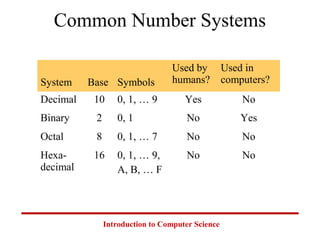
Common Number Systems
System Base Symbols
Used by
humans?
Used in
computers?
Decimal 10 0, 1, … 9 Yes No
Binary 2 0, 1 No Yes
Octal 8 0, 1, … 7 No No
Hexa-
decimal
16 0, 1, … 9,
A, B, … F
No No
Introduction to Computer Science
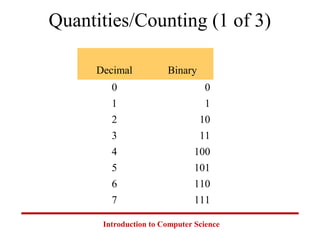
Quantities/Counting (1 of 3)
Decimal Binary
0 0
1 1
2 10
3 11
4 100
5 101
6 110
7 111
Introduction to Computer Science
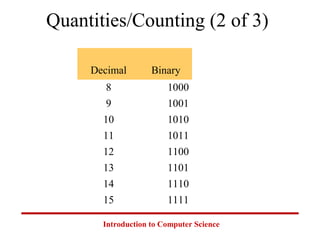
Quantities/Counting (2 of 3)
Decimal Binary
8 1000
9 1001
10 1010
11 1011
12 1100
13 1101
14 1110
15 1111
Introduction to Computer Science
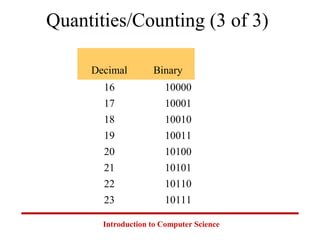
Quantities/Counting (3 of 3)
Decimal Binary
16 10000
17 10001
18 10010
19 10011
20 10100
21 10101
22 10110
23 10111
Introduction to Computer Science
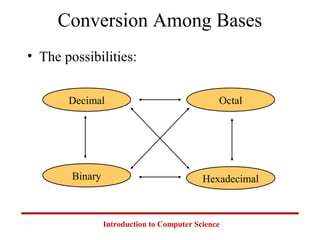
Conversion Among Bases
• The possibilities:
Hexadecimal
Decimal Octal
Binary
Introduction to Computer Science
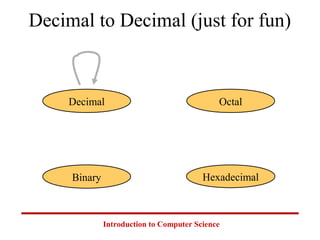
Decimal to Decimal (just for fun)
Hexadecimal
Decimal Octal
Binary
Introduction to Computer Science
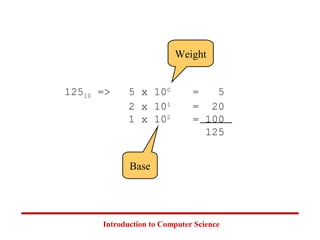
12510 => 5 x 100
= 5
2 x 101
= 20
1 x 102
= 100
125
Base
Weight
Introduction to Computer Science
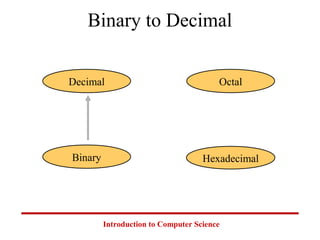
Binary to Decimal
Hexadecimal
Decimal Octal
Binary
Introduction to Computer Science
Binary to Decimal
• Technique
– Multiply each bit by 2n
, where n is the “weight”
of the bit
– The weight is the position of the bit, starting
from 0 on the right
– Add the results
Introduction to Computer Science
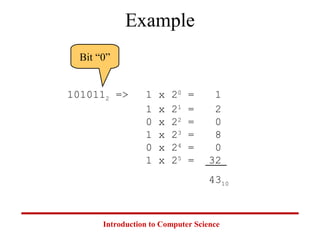
Example
1010112 => 1 x 20
= 1
1 x 21
= 2
0 x 22
= 0
1 x 23
= 8
0 x 24
= 0
1 x 25
= 32
4310
Bit “0”
Introduction to Computer Science
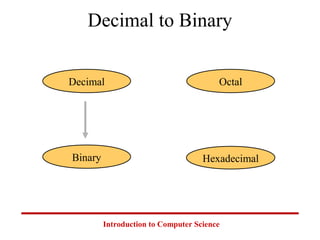
Decimal to Binary
Hexadecimal
Decimal Octal
Binary
Introduction to Computer Science
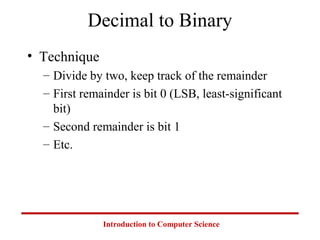
Decimal to Binary
• Technique
– Divide by two, keep track of the remainder
– First remainder is bit 0 (LSB, least-significant
bit)
– Second remainder is bit 1
– Etc.
Introduction to Computer Science
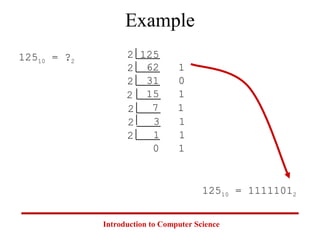
Example
12510 = ?2
2 125
62 12
31 02
15 12
7 12
3 12
1 12
0 1
12510 = 11111012
Introduction to Computer Science
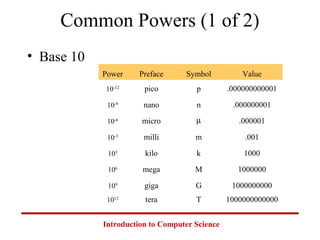
Common Powers (1 of 2)
• Base 10
Power Preface Symbol
10-12
pico p
10-9
nano n
10-6 micro µ
10-3 milli m
103 kilo k
106
mega M
109
giga G
1012
tera T
Value
.000000000001
.000000001
.000001
.001
1000
1000000
1000000000
1000000000000
Introduction to Computer Science
Common Powers (2 of 2)
• Base 2
Power Preface Symbol
210 kilo k
220
mega M
230
Giga G
Value
1024
1048576
1073741824
• What is the value of “k”, “M”, and “G”?
• In computing, particularly w.r.t. memory,
the base-2 interpretation generally applies
Introduction to Computer Science
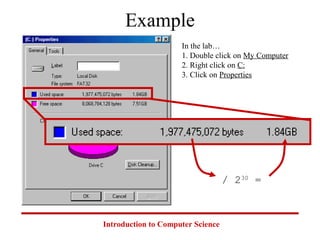
Example
/ 230
=
In the lab…
1. Double click on My Computer
2. Right click on C:
3. Click on Properties
Introduction to Computer Science
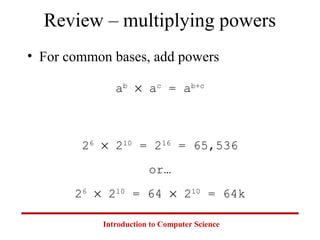
Review – multiplying powers
• For common bases, add powers
26
× 210
= 216
= 65,536
or…
26
× 210
= 64 × 210
= 64k
ab
× ac
= ab+c
Introduction to Computer Science
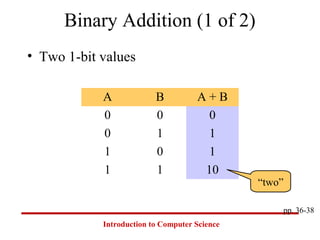
Binary Addition (1 of 2)
• Two 1-bit values
pp. 36-38
A B A + B
0 0 0
0 1 1
1 0 1
1 1 10
“two”
Introduction to Computer Science
Binary Addition (2 of 2)
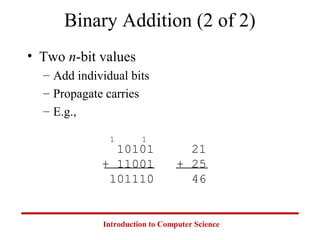
• Two n-bit values
– Add individual bits
– Propagate carries
– E.g.,
10101 21
+ 11001 + 25
101110 46
11
Introduction to Computer Science
Multiplication (2 of 3)
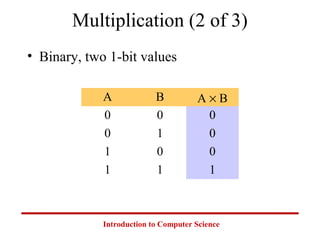
• Binary, two 1-bit values
A B A × B
0 0 0
0 1 0
1 0 0
1 1 1
Introduction to Computer Science
Multiplication (3 of 3)
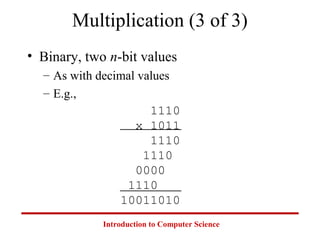
• Binary, two n-bit values
– As with decimal values
– E.g.,
1110
x 1011
1110
1110
0000
1110
10011010
Introduction to Computer Science
Fractions
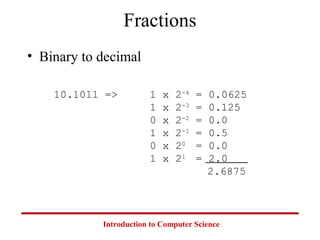
• Binary to decimal
10.1011 => 1 x 2-4
= 0.0625
1 x 2-3
= 0.125
0 x 2-2
= 0.0
1 x 2-1
= 0.5
0 x 20
= 0.0
1 x 21
= 2.0
2.6875
Introduction to Computer Science
Fractions
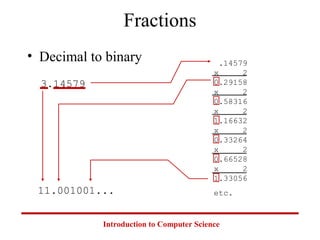
• Decimal to binary
3.14579
.14579
x 2
0.29158
x 2
0.58316
x 2
1.16632
x 2
0.33264
x 2
0.66528
x 2
1.33056
etc.11.001001...

Binary numbersystem

  • 1.
    Introduction to ComputerScience Presentation By: Shehrevar Davierwala Visit: http://www.authorstream.com/shehrevard http://www.slideshare.net/shehrevard http://sites.google.com/sites/techwizardin Common Number Systems
  • 2.
    Introduction to ComputerScience Number Systems
  • 3.
    Introduction to ComputerScience Common Number Systems System Base Symbols Used by humans? Used in computers? Decimal 10 0, 1, … 9 Yes No Binary 2 0, 1 No Yes Octal 8 0, 1, … 7 No No Hexa- decimal 16 0, 1, … 9, A, B, … F No No
  • 4.
    Introduction to ComputerScience Quantities/Counting (1 of 3) Decimal Binary 0 0 1 1 2 10 3 11 4 100 5 101 6 110 7 111
  • 5.
    Introduction to ComputerScience Quantities/Counting (2 of 3) Decimal Binary 8 1000 9 1001 10 1010 11 1011 12 1100 13 1101 14 1110 15 1111
  • 6.
    Introduction to ComputerScience Quantities/Counting (3 of 3) Decimal Binary 16 10000 17 10001 18 10010 19 10011 20 10100 21 10101 22 10110 23 10111
  • 7.
    Introduction to ComputerScience Conversion Among Bases • The possibilities: Hexadecimal Decimal Octal Binary
  • 8.
    Introduction to ComputerScience Decimal to Decimal (just for fun) Hexadecimal Decimal Octal Binary
  • 9.
    Introduction to ComputerScience 12510 => 5 x 100 = 5 2 x 101 = 20 1 x 102 = 100 125 Base Weight
  • 10.
    Introduction to ComputerScience Binary to Decimal Hexadecimal Decimal Octal Binary
  • 11.
    Introduction to ComputerScience Binary to Decimal • Technique – Multiply each bit by 2n , where n is the “weight” of the bit – The weight is the position of the bit, starting from 0 on the right – Add the results
  • 12.
    Introduction to ComputerScience Example 1010112 => 1 x 20 = 1 1 x 21 = 2 0 x 22 = 0 1 x 23 = 8 0 x 24 = 0 1 x 25 = 32 4310 Bit “0”
  • 13.
    Introduction to ComputerScience Decimal to Binary Hexadecimal Decimal Octal Binary
  • 14.
    Introduction to ComputerScience Decimal to Binary • Technique – Divide by two, keep track of the remainder – First remainder is bit 0 (LSB, least-significant bit) – Second remainder is bit 1 – Etc.
  • 15.
    Introduction to ComputerScience Example 12510 = ?2 2 125 62 12 31 02 15 12 7 12 3 12 1 12 0 1 12510 = 11111012
  • 16.
    Introduction to ComputerScience Common Powers (1 of 2) • Base 10 Power Preface Symbol 10-12 pico p 10-9 nano n 10-6 micro µ 10-3 milli m 103 kilo k 106 mega M 109 giga G 1012 tera T Value .000000000001 .000000001 .000001 .001 1000 1000000 1000000000 1000000000000
  • 17.
    Introduction to ComputerScience Common Powers (2 of 2) • Base 2 Power Preface Symbol 210 kilo k 220 mega M 230 Giga G Value 1024 1048576 1073741824 • What is the value of “k”, “M”, and “G”? • In computing, particularly w.r.t. memory, the base-2 interpretation generally applies
  • 18.
    Introduction to ComputerScience Example / 230 = In the lab… 1. Double click on My Computer 2. Right click on C: 3. Click on Properties
  • 19.
    Introduction to ComputerScience Review – multiplying powers • For common bases, add powers 26 × 210 = 216 = 65,536 or… 26 × 210 = 64 × 210 = 64k ab × ac = ab+c
  • 20.
    Introduction to ComputerScience Binary Addition (1 of 2) • Two 1-bit values pp. 36-38 A B A + B 0 0 0 0 1 1 1 0 1 1 1 10 “two”
  • 21.
    Introduction to ComputerScience Binary Addition (2 of 2) • Two n-bit values – Add individual bits – Propagate carries – E.g., 10101 21 + 11001 + 25 101110 46 11
  • 22.
    Introduction to ComputerScience Multiplication (2 of 3) • Binary, two 1-bit values A B A × B 0 0 0 0 1 0 1 0 0 1 1 1
  • 23.
    Introduction to ComputerScience Multiplication (3 of 3) • Binary, two n-bit values – As with decimal values – E.g., 1110 x 1011 1110 1110 0000 1110 10011010
  • 24.
    Introduction to ComputerScience Fractions • Binary to decimal 10.1011 => 1 x 2-4 = 0.0625 1 x 2-3 = 0.125 0 x 2-2 = 0.0 1 x 2-1 = 0.5 0 x 20 = 0.0 1 x 21 = 2.0 2.6875
  • 25.
    Introduction to ComputerScience Fractions • Decimal to binary 3.14579 .14579 x 2 0.29158 x 2 0.58316 x 2 1.16632 x 2 0.33264 x 2 0.66528 x 2 1.33056 etc.11.001001...