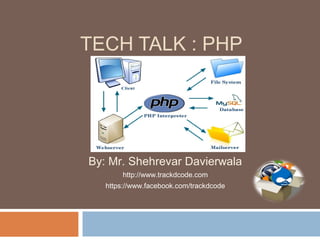
TECH TALK : PHP
By: Mr. Shehrevar Davierwala
http://www.trackdcode.com
https://www.facebook.com/trackdcode
Goal of the projectGoal of the project
• Designing a website generator
• Intuitive interface for
• Website creation
• Website administration
Abstract
Goal of the projectGoal of the project
A classy lab website is always composed by the
following types of elements:
• HTML basic page
• Lists of people – As list of supervisors, list of professors…
• Lists of projects proposal
• Lists of finished projects
• Lists of links
• Certain pages contain several different elements
So m e facts
Goal of the projectGoal of the project
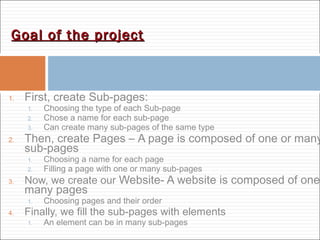
1. First, create Sub-pages:
1. Choosing the type of each Sub-page
2. Chose a name for each sub-page
3. Can create many sub-pages of the same type
2. Then, create Pages – A page is composed of one or many
sub-pages
1. Choosing a name for each page
2. Filling a page with one or many sub-pages
3. Now, we create our Website- A website is composed of one
many pages
1. Choosing pages and their order
4. Finally, we fill the sub-pages with elements
1. An element can be in many sub-pages
Goal of the projectGoal of the project
Used TechnologiesUsed Technologies
07/01/16
1. PHP recursive acronym for "PHP:Hypertext
Preprocessor“
2. Widely-used Open Source scripting language
3. Especially suited for Web development
4. Used for producing dynamic web pages
5. Can be embedded into HTML.
Used TechnologiesUsed Technologies
PHP
Personal Home Page (PHP)
1. PHP includes a large number of free and open
source libraries
2. Real Object Oriented Programming Language
3. Commonly install on Apache Server allow to interact
with Database like Mysql
4. PHP is mainly focused on server-side scripting
Used TechnologiesUsed Technologies
PHP
Hypertext Preprocessor
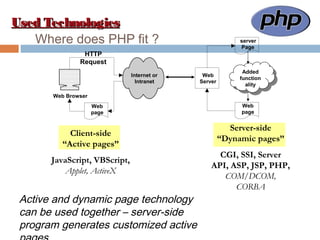
Where does PHP fit ?
Web Browser
Internet or
Intranet
page
Web
HTTP
Request
Page
Web
page
Web
Server
server
Added
function
ality
Added
function
ality
Client-side
“Active pages”
JavaScript, VBScript,
Applet, ActiveX
Server-side
“Dynamic pages”
CGI, SSI, Server
API, ASP, JSP, PHP,
COM/DCOM,
CORBA
Active and dynamic page technology
can be used together – server-side
program generates customized active
Used TechnologiesUsed Technologies
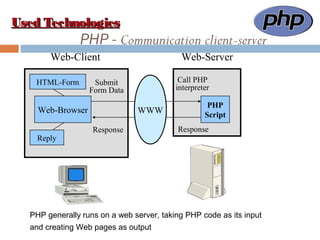
Web-Client Web-Server
PHP
Script
HTML-Form Submit
Form Data
Call PHP
interpreter
Response Response
Web-Browser WWW
Reply
PHP - Communication client-server
Used TechnologiesUsed Technologies
PHP generally runs on a web server, taking PHP code as its input
and creating Web pages as output
A content management system is software that keeps track of every piece of
content on your Website, much like your local public library keeps track of
books and stores them.
Content can be simple text, photos, music, video, documents, or just about
anything you can think of.
A major advantage of using a CMS is that it requires almost no technical skill
or knowledge to manage.
Since the CMS manages all your content, you don't have to.
What's a content management system(CMS)?
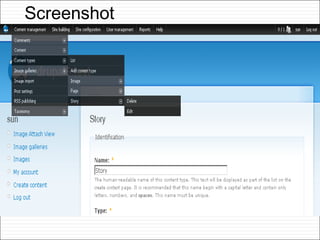
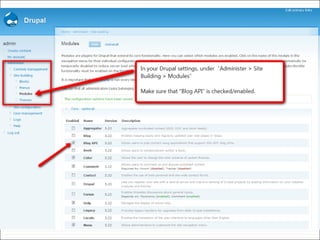
Drupal is a robust and flexible open source content management
system that is easy to use and very extensible.
Renowned for its reliability and suitability for a wide range of sectors,
Drupal has been adopted by leading organisations all over the world
including The White House, The Economist and Royal Mail.
Drupal Development
Screenshot
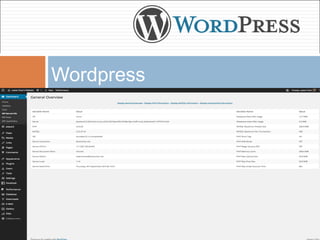
Wordpress
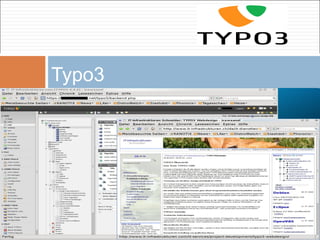
Typo3
Used TechnologiesUsed Technologies
MySQL
1. MySQL is a multithreaded, multi-user SQL database
management system.
2. Popular for web applications.
3. Closely tied to PHP.
4. Allow all sort of queries.
5. PhpMyAdmin: friendly user interface to manage database
develop on PHP.
Used TechnologiesUsed Technologies
CCS
1. Cascading Style Sheets (CSS): style sheet language used to
describe the presentation of a html document.
2. Define colors, fonts, layout, and other aspects of document
3. Why CSS?
• more flexibility
• control the specification of presentational characteristics
• reduce complexity and repetition in the structural
content.
Used TechnologiesUsed Technologies
Javascript
1. JavaScript is a scripting language most often used for client-
side.
2. JS functions are embedded in HTML pages and interact with
the Document Object Model (DOM) of the page
3. Respond to user actions quickly, making an application feel
more responsive
4. Detect user actions which HTML alone cannot
Used TechnologiesUsed Technologies
Security
1. Administration is protected by username and password
2. Encryption using a MD5 provider that itself implements an
algorithm based on a cryptographic hash function.
3. Used of Session and cookies
Database DesignDatabase Design
07/01/16
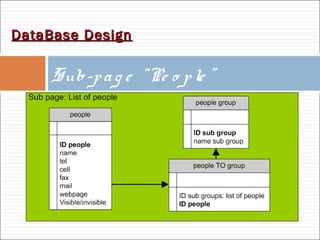
Sub-pag e “Pe o ple ”
DataBase DesignDataBase Design
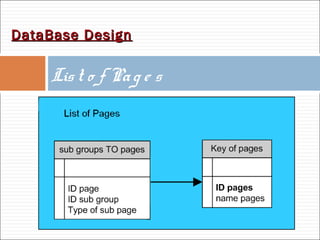
List o f Pag e s
DataBase DesignDataBase Design
PHP vs. JSP
 PHP is faster in execution time
 A recent survey in ZDnet's e We e k online publication
found that PHP is as much as 3. 5 times faster than
JSP
 Faster in development time – flatter learning curve
 PHP supports any 32-bit or better platform, whereas
JSP supports only platforms that have a Java virtual
machine available
PHP vs. ASP
 PHP is faster
 Superior Memory Management
 Closer to C Style of Programming
 Cross Platform Migration Strategy
 Dynamic generation of UI is more flexible
TThe End…he End…
07/01/16
Thanks…..

Tech talk php_cms

  • 1.
    TECH TALK :PHP By: Mr. Shehrevar Davierwala http://www.trackdcode.com https://www.facebook.com/trackdcode
  • 2.
    Goal of theprojectGoal of the project
  • 3.
    • Designing awebsite generator • Intuitive interface for • Website creation • Website administration Abstract Goal of the projectGoal of the project
  • 4.
    A classy labwebsite is always composed by the following types of elements: • HTML basic page • Lists of people – As list of supervisors, list of professors… • Lists of projects proposal • Lists of finished projects • Lists of links • Certain pages contain several different elements So m e facts Goal of the projectGoal of the project
  • 5.
    1. First, createSub-pages: 1. Choosing the type of each Sub-page 2. Chose a name for each sub-page 3. Can create many sub-pages of the same type 2. Then, create Pages – A page is composed of one or many sub-pages 1. Choosing a name for each page 2. Filling a page with one or many sub-pages 3. Now, we create our Website- A website is composed of one many pages 1. Choosing pages and their order 4. Finally, we fill the sub-pages with elements 1. An element can be in many sub-pages Goal of the projectGoal of the project
  • 6.
  • 7.
    1. PHP recursiveacronym for "PHP:Hypertext Preprocessor“ 2. Widely-used Open Source scripting language 3. Especially suited for Web development 4. Used for producing dynamic web pages 5. Can be embedded into HTML. Used TechnologiesUsed Technologies PHP Personal Home Page (PHP)
  • 8.
    1. PHP includesa large number of free and open source libraries 2. Real Object Oriented Programming Language 3. Commonly install on Apache Server allow to interact with Database like Mysql 4. PHP is mainly focused on server-side scripting Used TechnologiesUsed Technologies PHP Hypertext Preprocessor
  • 9.
    Where does PHPfit ? Web Browser Internet or Intranet page Web HTTP Request Page Web page Web Server server Added function ality Added function ality Client-side “Active pages” JavaScript, VBScript, Applet, ActiveX Server-side “Dynamic pages” CGI, SSI, Server API, ASP, JSP, PHP, COM/DCOM, CORBA Active and dynamic page technology can be used together – server-side program generates customized active Used TechnologiesUsed Technologies
  • 10.
    Web-Client Web-Server PHP Script HTML-Form Submit FormData Call PHP interpreter Response Response Web-Browser WWW Reply PHP - Communication client-server Used TechnologiesUsed Technologies PHP generally runs on a web server, taking PHP code as its input and creating Web pages as output
  • 11.
    A content managementsystem is software that keeps track of every piece of content on your Website, much like your local public library keeps track of books and stores them. Content can be simple text, photos, music, video, documents, or just about anything you can think of. A major advantage of using a CMS is that it requires almost no technical skill or knowledge to manage. Since the CMS manages all your content, you don't have to. What's a content management system(CMS)?
  • 12.
    Drupal is arobust and flexible open source content management system that is easy to use and very extensible. Renowned for its reliability and suitability for a wide range of sectors, Drupal has been adopted by leading organisations all over the world including The White House, The Economist and Royal Mail. Drupal Development
  • 13.
  • 15.
  • 16.
  • 17.
    Used TechnologiesUsed Technologies MySQL 1.MySQL is a multithreaded, multi-user SQL database management system. 2. Popular for web applications. 3. Closely tied to PHP. 4. Allow all sort of queries. 5. PhpMyAdmin: friendly user interface to manage database develop on PHP.
  • 18.
    Used TechnologiesUsed Technologies CCS 1.Cascading Style Sheets (CSS): style sheet language used to describe the presentation of a html document. 2. Define colors, fonts, layout, and other aspects of document 3. Why CSS? • more flexibility • control the specification of presentational characteristics • reduce complexity and repetition in the structural content.
  • 19.
    Used TechnologiesUsed Technologies Javascript 1.JavaScript is a scripting language most often used for client- side. 2. JS functions are embedded in HTML pages and interact with the Document Object Model (DOM) of the page 3. Respond to user actions quickly, making an application feel more responsive 4. Detect user actions which HTML alone cannot
  • 20.
    Used TechnologiesUsed Technologies Security 1.Administration is protected by username and password 2. Encryption using a MD5 provider that itself implements an algorithm based on a cryptographic hash function. 3. Used of Session and cookies
  • 21.
  • 22.
    Sub-pag e “Peo ple ” DataBase DesignDataBase Design
  • 23.
    List o fPag e s DataBase DesignDataBase Design
  • 25.
    PHP vs. JSP PHP is faster in execution time  A recent survey in ZDnet's e We e k online publication found that PHP is as much as 3. 5 times faster than JSP  Faster in development time – flatter learning curve  PHP supports any 32-bit or better platform, whereas JSP supports only platforms that have a Java virtual machine available
  • 26.
    PHP vs. ASP PHP is faster  Superior Memory Management  Closer to C Style of Programming  Cross Platform Migration Strategy  Dynamic generation of UI is more flexible
  • 27.

Editor's Notes

  • #26 Because JSP is based on Java, a strongly typed language, we had to declare the types of variables we used and manually convert between types when necessary. This makes JSP the hardest of the scripting languages we tested for nonprogrammers to learn... PHP is very easy to learn because the core language of PHP is quite small, and the constructs are similar to Javascript. As a bonus, many basic HTTP concepts are built into the language.