BIM Dimensions
3D | 4D | 5D | 6D | 7D
Definition & Benefits
DIFFERENT DIMENSIONS,
DIFFERENT USES
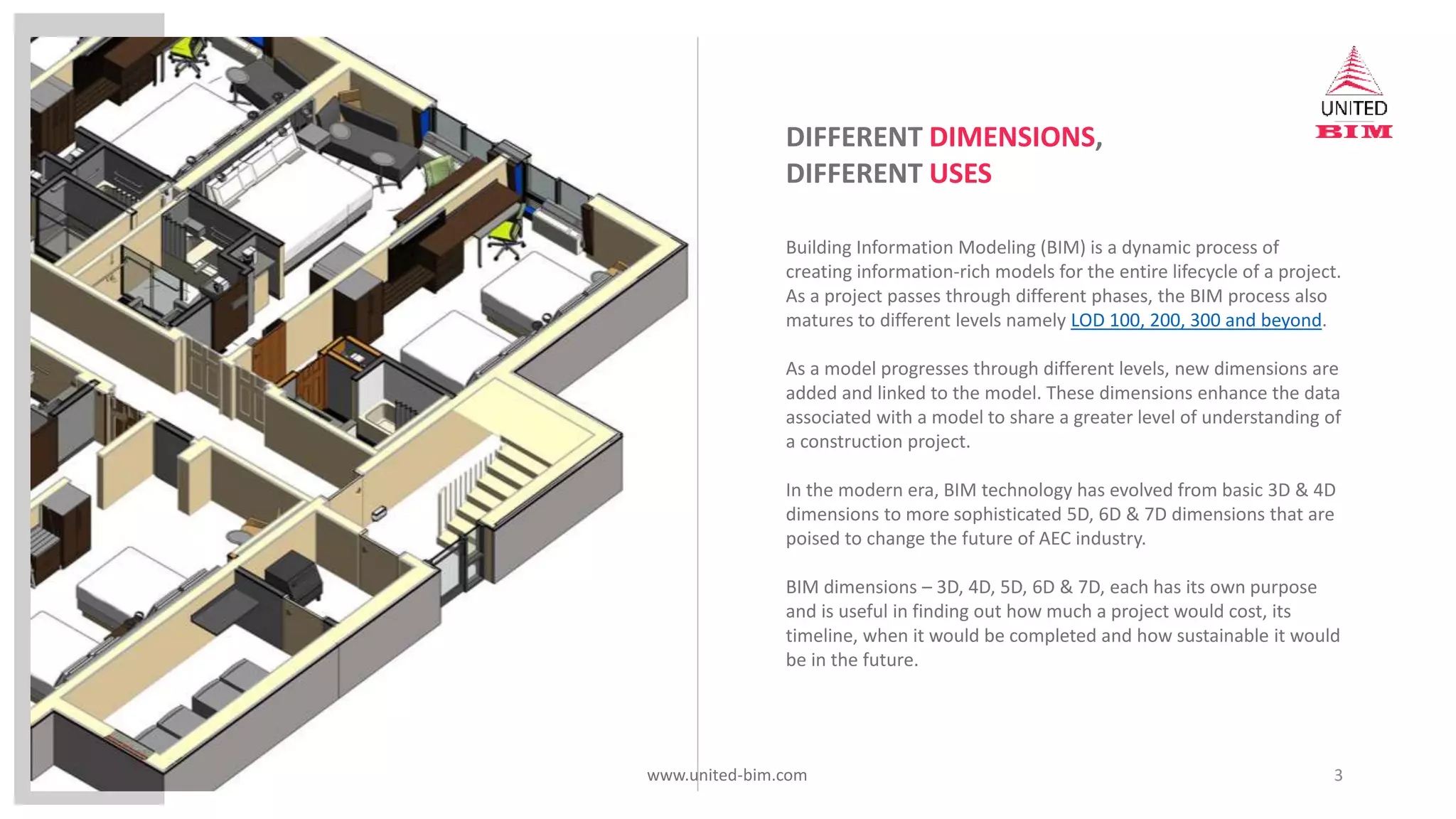
Building Information Modeling (BIM) is a dynamic process of
creating information-rich models for the entire lifecycle of a project.
As a project passes through different phases, the BIM process also
matures to different levels namely LOD 100, 200, 300 and beyond.
As a model progresses through different levels, new dimensions are
added and linked to the model. These dimensions enhance the data
associated with a model to share a greater level of understanding of
a construction project.
In the modern era, BIM technology has evolved from basic 3D & 4D
dimensions to more sophisticated 5D, 6D & 7D dimensions that are
poised to change the future of AEC industry.
BIM dimensions – 3D, 4D, 5D, 6D & 7D, each has its own purpose
and is useful in finding out how much a project would cost, its
timeline, when it would be completed and how sustainable it would
be in the future.
www.united-bim.com 3
Benefits of 3D BIM
• Enhanced 3D visualization of the entire
project
• Streamlined communication and
sharing of design expectations
• Easy collaboration between multiple
teams irrespective of their area of
expertise
• Reduced instances of rework and
revisions due to complete
transparency from the beginning
BIM 3rd Dimension
All About Geometry
3D
3D as we are all commonly aware, represents the three geographical dimensions (x, y, z) of a
building structure. The geographical capabilities help stakeholders to visualize a building’s
structure in 3 dimensions even before the project is started. When it comes to 3D BIM, it
involves the creation of a 3D model and sharing the same information using a common data
environment (CDE).
3D BIM enables all the stakeholders to collaborate effectively for modeling and solving
typical structural problems. Also, as everything is stored at a central location i.e. the BIM
model, it becomes easier to resolve issues at a future stage.
www.united-bim.com4
Benefits of 4D BIM
• Improved site planning and scheduling
optimization
• Seamless coordination among
architects, contractors and on-site
teams
• Better preparedness in terms of next
steps during every construction stage
• Enhanced information sharing related
to timeline expectations helping to
avoid costly delays
• Enhanced safety and efficiency due to
documentation of entire plan with
specific timelines
BIM 4th Dimension
Duration, Timeline & Scheduling
4D
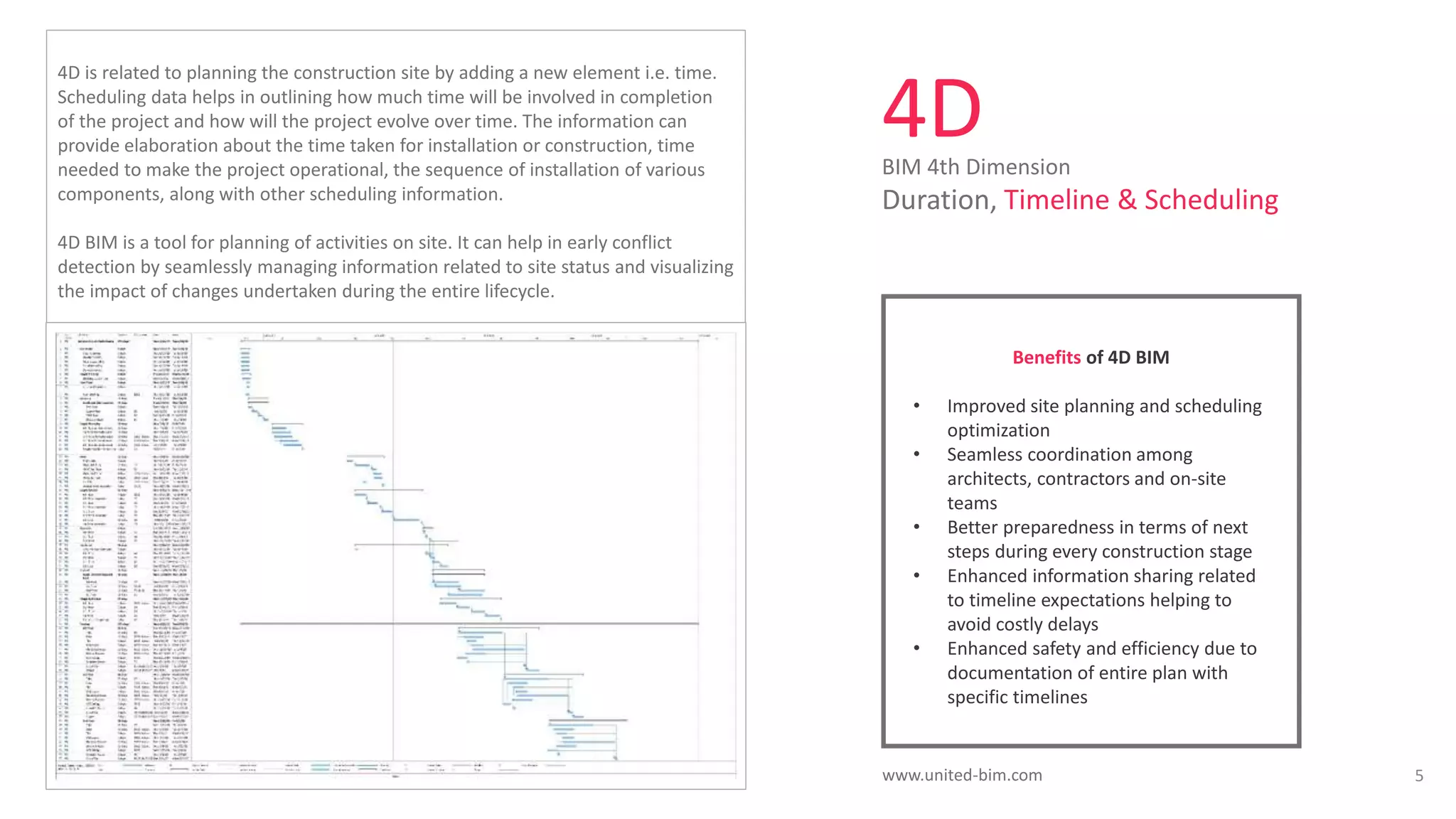
4D is related to planning the construction site by adding a new element i.e. time.
Scheduling data helps in outlining how much time will be involved in completion
of the project and how will the project evolve over time. The information can
provide elaboration about the time taken for installation or construction, time
needed to make the project operational, the sequence of installation of various
components, along with other scheduling information.
4D BIM is a tool for planning of activities on site. It can help in early conflict
detection by seamlessly managing information related to site status and visualizing
the impact of changes undertaken during the entire lifecycle.
www.united-bim.com 5
Benefits of 5D BIM
• Real-time cost visualization in 3D with
notification on changes in costs
• Automatic count for
components/system/equipment
associated with a project
• Simplified cost analysis and budgetary
analysis with predicted and actual
spends over the course of time
• Minimization of budgetary offshoot
due to regular cost reporting and
budgeting
BIM 5th Dimension
Cost Estimation, Analysis
And Budgetary Tracking
5D
5D BIM is useful in cases where budget analysis and cost estimation are required from the
beginning of any project. It goes without saying that cost is one of the most important
elements associated with a project. 5D BIM enables project promoters and owners to analyze
the costs that will be incurred over time in relation to the project activities.
5D BIM can help in accurately predicting the budgetary requirements along with the changes
in scope, material, manpower or equipment requirements. With 5D BIM, one can easily
extract the costs associated with a scenario and can also factor in for changes along the way.
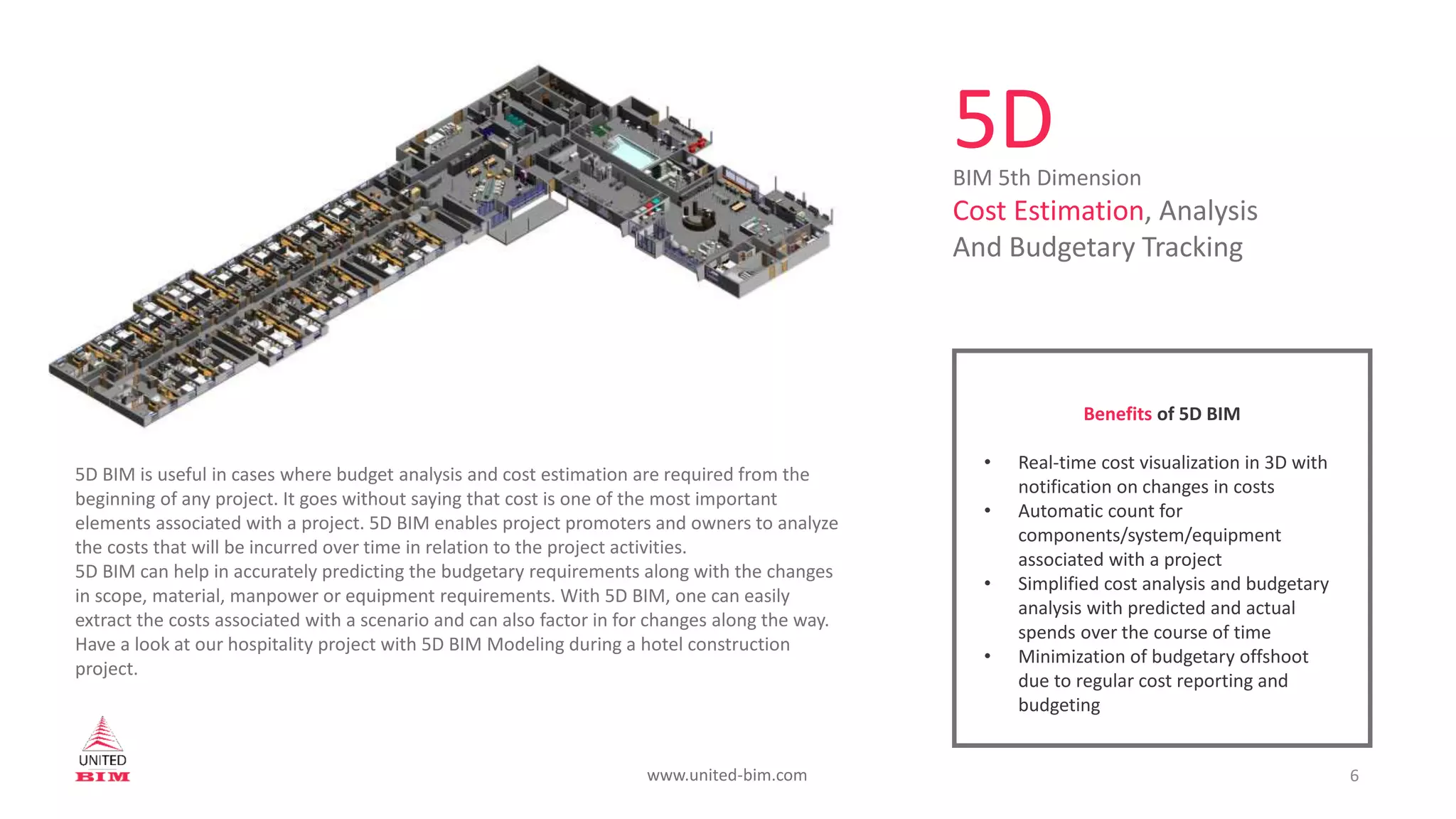
Have a look at our hospitality project with 5D BIM Modeling during a hotel construction
project.
www.united-bim.com 6
Benefits of 6D BIM
• Reduced energy consumption in the
long run
• Faster and more accurate decision
making related to component
installation during the design process
• Detailed analysis and impact of a
decision on economic and operational
aspects over the entire lifecycle
• Better operational management of the
building or structure after handover
BIM 6th Dimension
Making A Structure Self-
Sustainable & Energy Efficient
6D
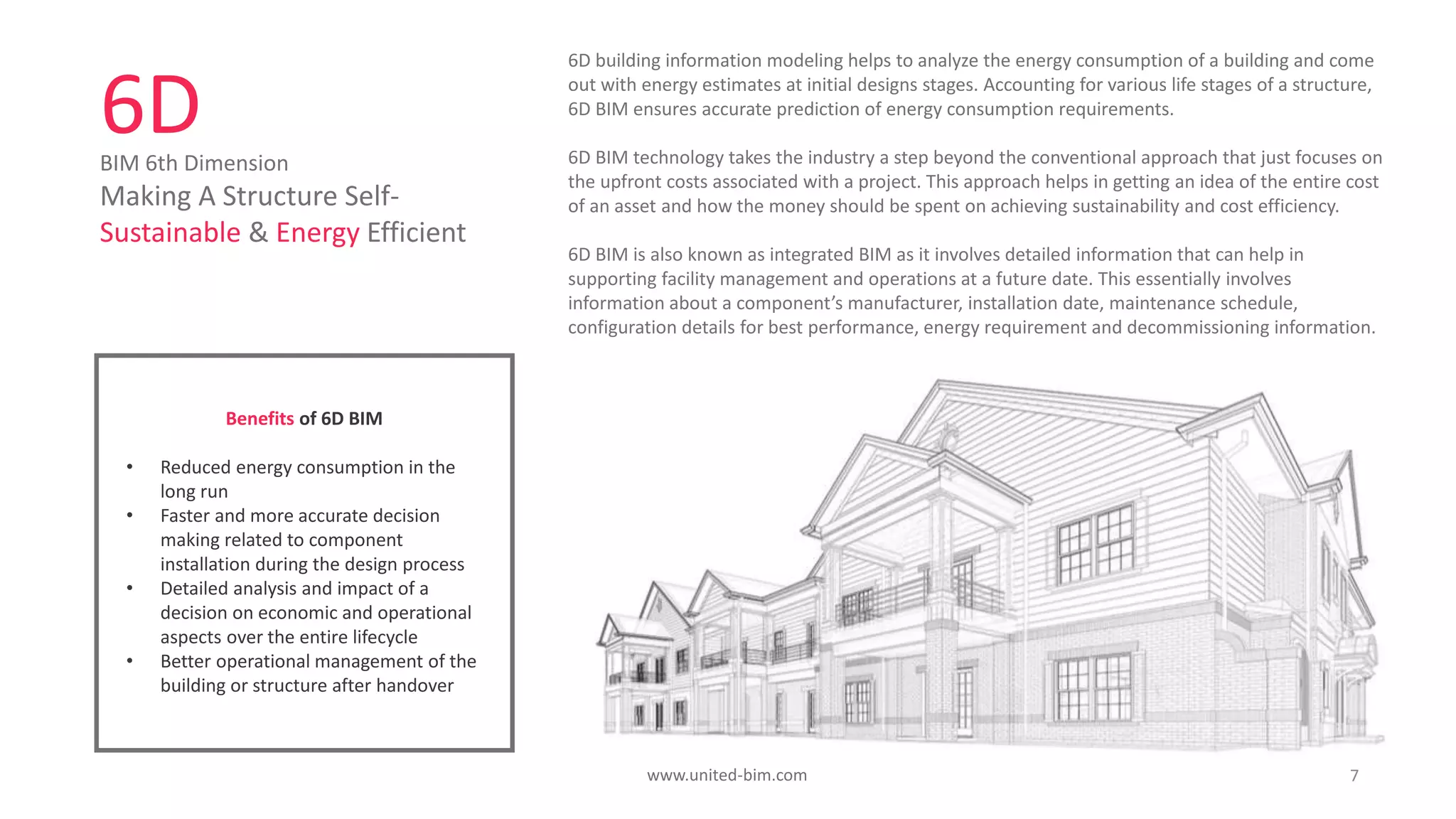
6D building information modeling helps to analyze the energy consumption of a building and come
out with energy estimates at initial designs stages. Accounting for various life stages of a structure,
6D BIM ensures accurate prediction of energy consumption requirements.
6D BIM technology takes the industry a step beyond the conventional approach that just focuses on
the upfront costs associated with a project. This approach helps in getting an idea of the entire cost
of an asset and how the money should be spent on achieving sustainability and cost efficiency.
6D BIM is also known as integrated BIM as it involves detailed information that can help in
supporting facility management and operations at a future date. This essentially involves
information about a component’s manufacturer, installation date, maintenance schedule,
configuration details for best performance, energy requirement and decommissioning information.
www.united-bim.com 7
Benefits of 7D BIM
• Optimized asset and facility
management from design stage to
demolition
• Simplified and easy replacement of
parts and repairs anytime during the
entire life of a building
• Streamlined maintenance process for
contractors and subcontractors
BIM 7th Dimension
Holistic Facility Management
Information for Entire Lifecycle
7D
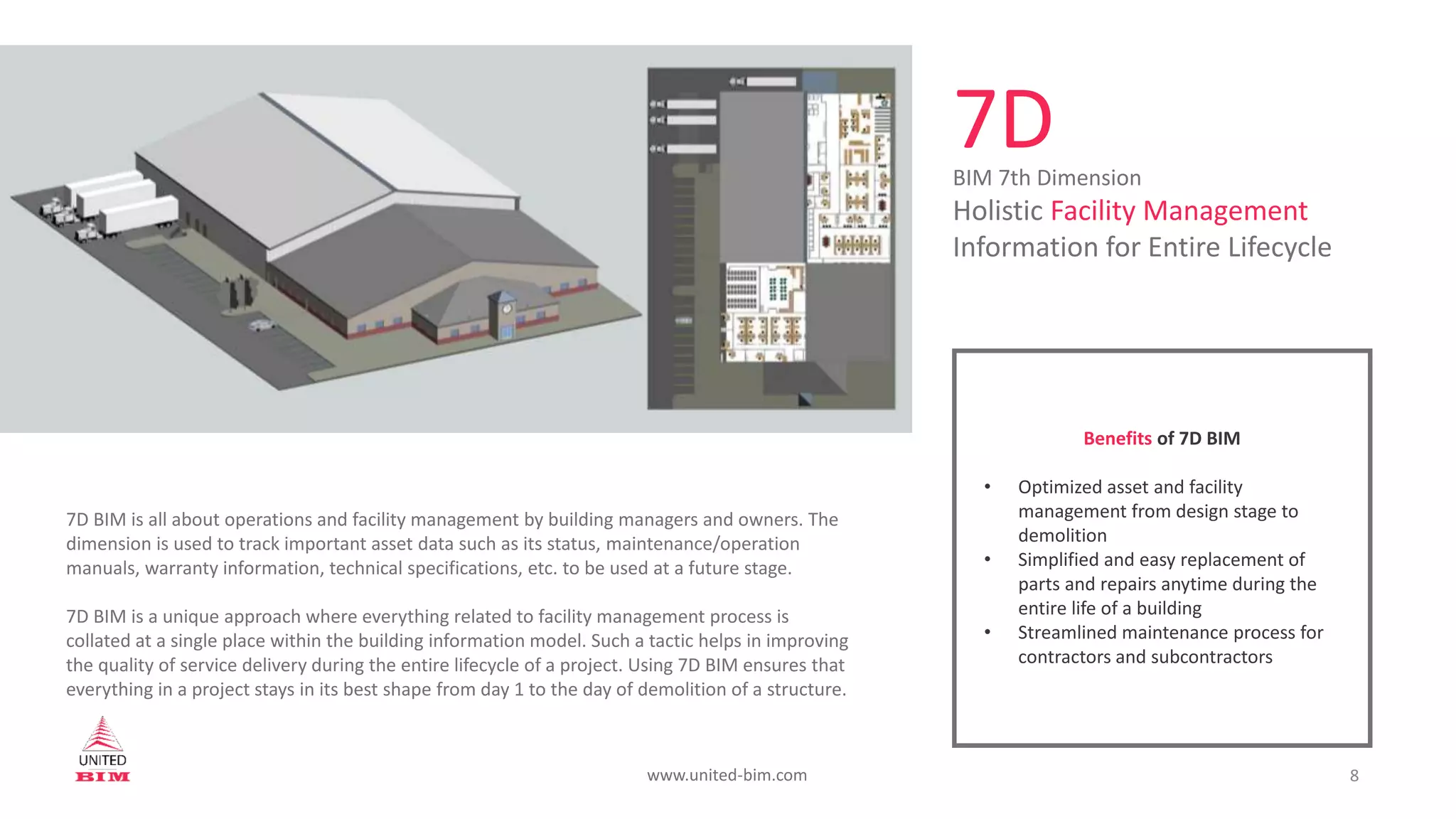
7D BIM is all about operations and facility management by building managers and owners. The
dimension is used to track important asset data such as its status, maintenance/operation
manuals, warranty information, technical specifications, etc. to be used at a future stage.
7D BIM is a unique approach where everything related to facility management process is
collated at a single place within the building information model. Such a tactic helps in improving
the quality of service delivery during the entire lifecycle of a project. Using 7D BIM ensures that
everything in a project stays in its best shape from day 1 to the day of demolition of a structure.
www.united-bim.com 8
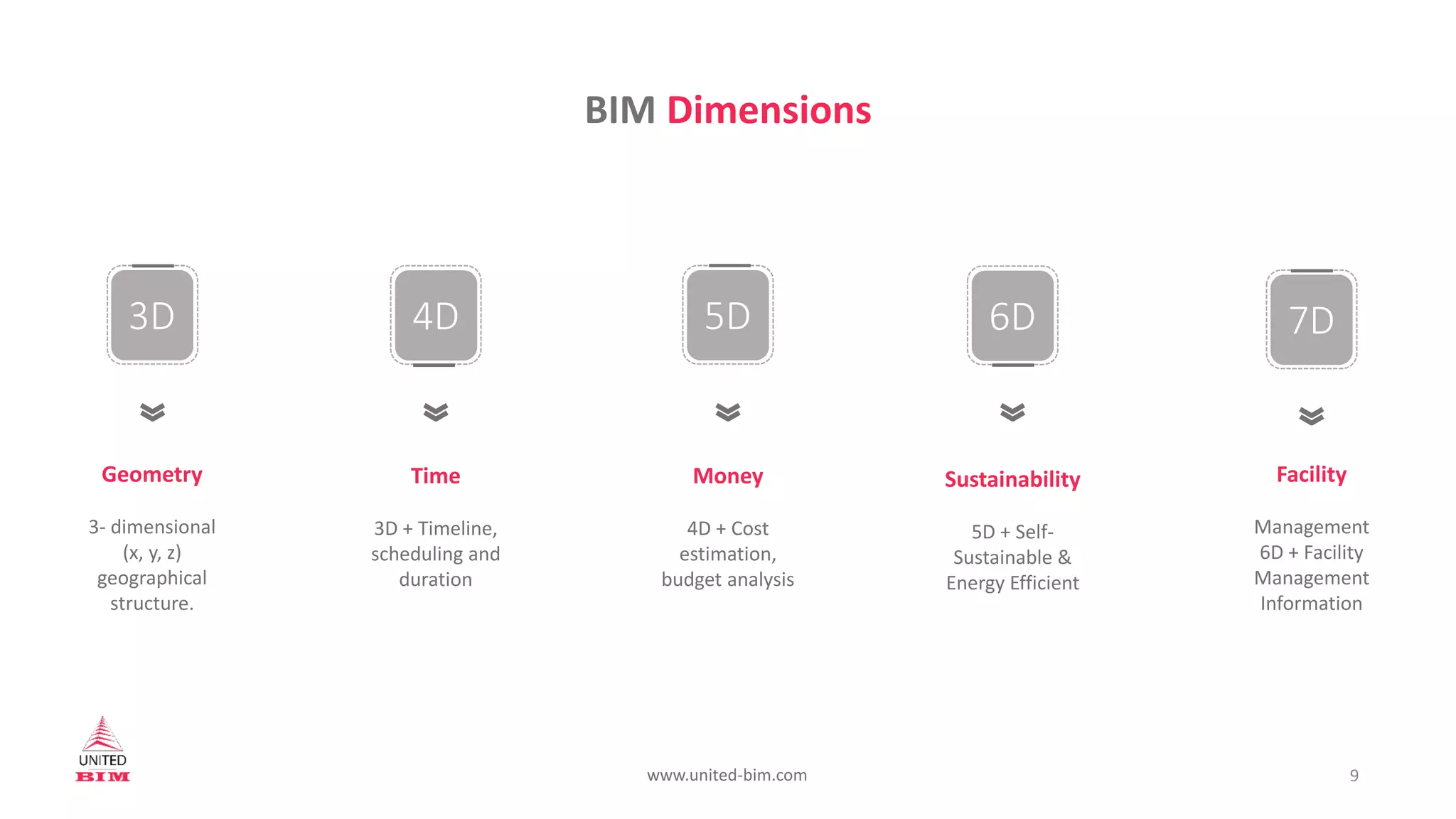
Geometry
3- dimensional
(x, y, z)
geographical
structure.
3D
Money
4D + Cost
estimation,
budget analysis
5D 6D
Time
3D + Timeline,
scheduling and
duration
4D
Sustainability
5D + Self-
Sustainable &
Energy Efficient
7D
Facility
Management
6D + Facility
Management
Information
BIM Dimensions
www.united-bim.com 9
Guidelines for Outsourcing BIM
Key Takeaways for AEC Professionals
FEATURED BLOGS
What is COBie?
How it is streamlining data collaboration
between AEC professionals
What is Clash Detection in BIM?
Process, Benefits and Future Scope in Modern
Day AEC industry
www.united-bim.com 10
Review your design drawings to perfection with this easy to use
drawing checklist, made for Architects and Engineers.
REVIEW CHECKLIST
FOR PERFECT DESIGN DRAWINGS
www.united-bim.com 11
www.united-bim.com info@united-bim.com
+1 (954) 537-9137

BIM Dimensions Explained- 3D, 4D, 5D, 6D and 7D- Definition and Benefits

  • 1.
    BIM Dimensions 3D |4D | 5D | 6D | 7D Definition & Benefits
  • 2.
    DIFFERENT DIMENSIONS, DIFFERENT USES BuildingInformation Modeling (BIM) is a dynamic process of creating information-rich models for the entire lifecycle of a project. As a project passes through different phases, the BIM process also matures to different levels namely LOD 100, 200, 300 and beyond. As a model progresses through different levels, new dimensions are added and linked to the model. These dimensions enhance the data associated with a model to share a greater level of understanding of a construction project. In the modern era, BIM technology has evolved from basic 3D & 4D dimensions to more sophisticated 5D, 6D & 7D dimensions that are poised to change the future of AEC industry. BIM dimensions – 3D, 4D, 5D, 6D & 7D, each has its own purpose and is useful in finding out how much a project would cost, its timeline, when it would be completed and how sustainable it would be in the future. www.united-bim.com 3
  • 3.
    Benefits of 3DBIM • Enhanced 3D visualization of the entire project • Streamlined communication and sharing of design expectations • Easy collaboration between multiple teams irrespective of their area of expertise • Reduced instances of rework and revisions due to complete transparency from the beginning BIM 3rd Dimension All About Geometry 3D 3D as we are all commonly aware, represents the three geographical dimensions (x, y, z) of a building structure. The geographical capabilities help stakeholders to visualize a building’s structure in 3 dimensions even before the project is started. When it comes to 3D BIM, it involves the creation of a 3D model and sharing the same information using a common data environment (CDE). 3D BIM enables all the stakeholders to collaborate effectively for modeling and solving typical structural problems. Also, as everything is stored at a central location i.e. the BIM model, it becomes easier to resolve issues at a future stage. www.united-bim.com4
  • 4.
    Benefits of 4DBIM • Improved site planning and scheduling optimization • Seamless coordination among architects, contractors and on-site teams • Better preparedness in terms of next steps during every construction stage • Enhanced information sharing related to timeline expectations helping to avoid costly delays • Enhanced safety and efficiency due to documentation of entire plan with specific timelines BIM 4th Dimension Duration, Timeline & Scheduling 4D 4D is related to planning the construction site by adding a new element i.e. time. Scheduling data helps in outlining how much time will be involved in completion of the project and how will the project evolve over time. The information can provide elaboration about the time taken for installation or construction, time needed to make the project operational, the sequence of installation of various components, along with other scheduling information. 4D BIM is a tool for planning of activities on site. It can help in early conflict detection by seamlessly managing information related to site status and visualizing the impact of changes undertaken during the entire lifecycle. www.united-bim.com 5
  • 5.
    Benefits of 5DBIM • Real-time cost visualization in 3D with notification on changes in costs • Automatic count for components/system/equipment associated with a project • Simplified cost analysis and budgetary analysis with predicted and actual spends over the course of time • Minimization of budgetary offshoot due to regular cost reporting and budgeting BIM 5th Dimension Cost Estimation, Analysis And Budgetary Tracking 5D 5D BIM is useful in cases where budget analysis and cost estimation are required from the beginning of any project. It goes without saying that cost is one of the most important elements associated with a project. 5D BIM enables project promoters and owners to analyze the costs that will be incurred over time in relation to the project activities. 5D BIM can help in accurately predicting the budgetary requirements along with the changes in scope, material, manpower or equipment requirements. With 5D BIM, one can easily extract the costs associated with a scenario and can also factor in for changes along the way. Have a look at our hospitality project with 5D BIM Modeling during a hotel construction project. www.united-bim.com 6
  • 6.
    Benefits of 6DBIM • Reduced energy consumption in the long run • Faster and more accurate decision making related to component installation during the design process • Detailed analysis and impact of a decision on economic and operational aspects over the entire lifecycle • Better operational management of the building or structure after handover BIM 6th Dimension Making A Structure Self- Sustainable & Energy Efficient 6D 6D building information modeling helps to analyze the energy consumption of a building and come out with energy estimates at initial designs stages. Accounting for various life stages of a structure, 6D BIM ensures accurate prediction of energy consumption requirements. 6D BIM technology takes the industry a step beyond the conventional approach that just focuses on the upfront costs associated with a project. This approach helps in getting an idea of the entire cost of an asset and how the money should be spent on achieving sustainability and cost efficiency. 6D BIM is also known as integrated BIM as it involves detailed information that can help in supporting facility management and operations at a future date. This essentially involves information about a component’s manufacturer, installation date, maintenance schedule, configuration details for best performance, energy requirement and decommissioning information. www.united-bim.com 7
  • 7.
    Benefits of 7DBIM • Optimized asset and facility management from design stage to demolition • Simplified and easy replacement of parts and repairs anytime during the entire life of a building • Streamlined maintenance process for contractors and subcontractors BIM 7th Dimension Holistic Facility Management Information for Entire Lifecycle 7D 7D BIM is all about operations and facility management by building managers and owners. The dimension is used to track important asset data such as its status, maintenance/operation manuals, warranty information, technical specifications, etc. to be used at a future stage. 7D BIM is a unique approach where everything related to facility management process is collated at a single place within the building information model. Such a tactic helps in improving the quality of service delivery during the entire lifecycle of a project. Using 7D BIM ensures that everything in a project stays in its best shape from day 1 to the day of demolition of a structure. www.united-bim.com 8
  • 8.
    Geometry 3- dimensional (x, y,z) geographical structure. 3D Money 4D + Cost estimation, budget analysis 5D 6D Time 3D + Timeline, scheduling and duration 4D Sustainability 5D + Self- Sustainable & Energy Efficient 7D Facility Management 6D + Facility Management Information BIM Dimensions www.united-bim.com 9
  • 9.
    Guidelines for OutsourcingBIM Key Takeaways for AEC Professionals FEATURED BLOGS What is COBie? How it is streamlining data collaboration between AEC professionals What is Clash Detection in BIM? Process, Benefits and Future Scope in Modern Day AEC industry www.united-bim.com 10
  • 10.
    Review your designdrawings to perfection with this easy to use drawing checklist, made for Architects and Engineers. REVIEW CHECKLIST FOR PERFECT DESIGN DRAWINGS www.united-bim.com 11
  • 11.