Seminar on:
B I M
(Building Information Modeling)
Presented by: Mate Rushikesh
Class : TY
Branch : Civil
Guided by : Prof. A. S. Mehetre
GES’S Sir. Dr. M. S. Gosavi Polytechnic
Department of Civil Engineering
Content
• Introduction
• Evolution of Building Designing Process
• Evolution of BIM
• About BIM
• CAD & BIM
• The efficiency difference between CAD & BIM
• Software's of BIM
• Advantages
• Disadvantages
• Conclusion
• Reference
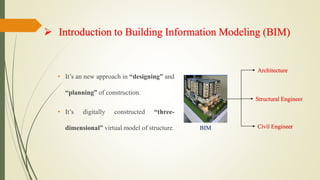
 Introduction to Building Information Modeling (BIM)
• It’s an new approach in “designing” and
“planning” of construction.
• It’s digitally constructed “three-
dimensional” virtual model of structure. BIM
Architecture
Structural Engineer
Civil Engineer
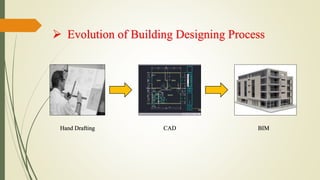
 Evolution of Building Designing Process
Hand Drafting CAD BIM
 Evolution of BIM:
• The concept of BIM has existed since the 1980s.
• The term 'building model‘ was first used in papers in the mid-1980.
• The term 'Building Information Model' first appeared in 1992 on paper.
• In 2002, Autodesk released a white paper (report) on "Building Information Modeling”.
• ARCHICAD became regarded by as the first implementation of BIM.
 BIM:
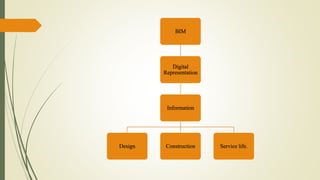
• Building Information Modeling (BIM) is a digital representation of 3D as well as physical
and functional characteristics of a structure or building.
• Building information modeling extends beyond than 2D and 3D drawings.
• It’s an 7D representation of structure or building.
• This 7D represents:-
• Width, Height and Depth.
• Time and Cost.
• Building environmental and sustainability aspects.
• Through-life time facility management of building
BIM
Digital
Representation
Information
Design Construction Service life.
 CAD & BIM:
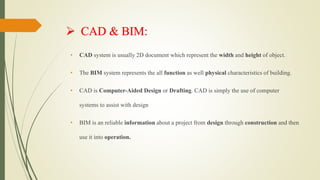
• CAD system is usually 2D document which represent the width and height of object.
• The BIM system represents the all function as well physical characteristics of building.
• CAD is Computer-Aided Design or Drafting. CAD is simply the use of computer
systems to assist with design
• BIM is an reliable information about a project from design through construction and then
use it into operation.
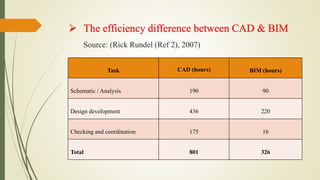
 The efficiency difference between CAD & BIM
Source: (Rick Rundel (Ref 2), 2007)
Task CAD (hours) BIM (hours)
Schematic / Analysis 190 90
Design development 436 220
Checking and coordination 175 16
Total 801 326
 Software's of BIM:
 Revit
Autodesk Revit is building information modeling software for Architects, Structural
Engineers, Designers and Contractors. The original software was developed by Revit
Technology Corporation in 2000, and acquired by Autodesk in 2002
 Autodesk BIM 360
BIM 360™ Field is a cloud-based collaboration product for field management and
reporting. It developed by Autodesk. This provides new ways of managing field processes in
construction industries.
 Archicad
ARCHICAD is an architectural BIM & CAD software developed by the Hungarian
company Graphisoft. It’s launch in 1987, with "Virtual Building" concept. ARCHICAD
became regarded by some as the first implementation of BIM.
 BIMX
BIMx is a set of desktop and mobile software tools to present or open the BIM files. It
open BIM files created with ArchiCAD softwere.
 Present Scenario of BIM :
 Shanghai Tower in China.
 Nagpur Metro Rail Corporation.
Advantages of BIM
• Collaborative Work
• Simulation
• Parametric Modelling
• Presentation
Lack of BIM specialists
Incompatibility with associates
Cost of software
 Disadvantages of BIM:
 Conclusion:
From above seminar we can conclude that,
• The BIM is a new and promising approach in construction industry.
• The BIM potentials when used in the field it provide better communication and
information about construction industry.
• BIM allowing for efficient work processes and better decisions making.
• The use of BIM in construction save time and provide good quality of construction.
Reference:
1) “Scope of Building Information Modeling (BIM) in India” by J. Vinoth Kumar and Mahua
Mukherjee.
2) Rick Rundell, AIA. The Five Fallies of BIM, Part 1. cadalyst. [Online],
http://aec.cadalyst.com/aec/Column:+1-2-3+Revit/The-Five-Fallaciesof-BIM-Part-1-1-2-
3Revit-Tutor/ArticleStandard/Article/detail/470107, (November 1, 2007).
3) BIM methodology, a new approach - case study of structural elements creation by Lino
Maiaa,b*, Pedro Mêdab, João G. Freitasa.
T H A N K
Y O U.

Bim

  • 1.
    Seminar on: B IM (Building Information Modeling)
  • 2.
    Presented by: MateRushikesh Class : TY Branch : Civil Guided by : Prof. A. S. Mehetre GES’S Sir. Dr. M. S. Gosavi Polytechnic Department of Civil Engineering
  • 3.
    Content • Introduction • Evolutionof Building Designing Process • Evolution of BIM • About BIM • CAD & BIM • The efficiency difference between CAD & BIM • Software's of BIM • Advantages • Disadvantages • Conclusion • Reference
  • 4.
     Introduction toBuilding Information Modeling (BIM) • It’s an new approach in “designing” and “planning” of construction. • It’s digitally constructed “three- dimensional” virtual model of structure. BIM Architecture Structural Engineer Civil Engineer
  • 5.
     Evolution ofBuilding Designing Process Hand Drafting CAD BIM
  • 6.
     Evolution ofBIM: • The concept of BIM has existed since the 1980s. • The term 'building model‘ was first used in papers in the mid-1980. • The term 'Building Information Model' first appeared in 1992 on paper. • In 2002, Autodesk released a white paper (report) on "Building Information Modeling”. • ARCHICAD became regarded by as the first implementation of BIM.
  • 7.
     BIM: • BuildingInformation Modeling (BIM) is a digital representation of 3D as well as physical and functional characteristics of a structure or building. • Building information modeling extends beyond than 2D and 3D drawings. • It’s an 7D representation of structure or building. • This 7D represents:- • Width, Height and Depth. • Time and Cost. • Building environmental and sustainability aspects. • Through-life time facility management of building
  • 8.
  • 9.
     CAD &BIM: • CAD system is usually 2D document which represent the width and height of object. • The BIM system represents the all function as well physical characteristics of building. • CAD is Computer-Aided Design or Drafting. CAD is simply the use of computer systems to assist with design • BIM is an reliable information about a project from design through construction and then use it into operation.
  • 10.
     The efficiencydifference between CAD & BIM Source: (Rick Rundel (Ref 2), 2007) Task CAD (hours) BIM (hours) Schematic / Analysis 190 90 Design development 436 220 Checking and coordination 175 16 Total 801 326
  • 11.
     Software's ofBIM:  Revit Autodesk Revit is building information modeling software for Architects, Structural Engineers, Designers and Contractors. The original software was developed by Revit Technology Corporation in 2000, and acquired by Autodesk in 2002
  • 12.
     Autodesk BIM360 BIM 360™ Field is a cloud-based collaboration product for field management and reporting. It developed by Autodesk. This provides new ways of managing field processes in construction industries.
  • 13.
     Archicad ARCHICAD isan architectural BIM & CAD software developed by the Hungarian company Graphisoft. It’s launch in 1987, with "Virtual Building" concept. ARCHICAD became regarded by some as the first implementation of BIM.
  • 14.
     BIMX BIMx isa set of desktop and mobile software tools to present or open the BIM files. It open BIM files created with ArchiCAD softwere.
  • 15.
     Present Scenarioof BIM :  Shanghai Tower in China.
  • 16.
     Nagpur MetroRail Corporation.
  • 17.
    Advantages of BIM •Collaborative Work • Simulation • Parametric Modelling • Presentation
  • 18.
    Lack of BIMspecialists Incompatibility with associates Cost of software  Disadvantages of BIM:
  • 19.
     Conclusion: From aboveseminar we can conclude that, • The BIM is a new and promising approach in construction industry. • The BIM potentials when used in the field it provide better communication and information about construction industry. • BIM allowing for efficient work processes and better decisions making. • The use of BIM in construction save time and provide good quality of construction.
  • 20.
    Reference: 1) “Scope ofBuilding Information Modeling (BIM) in India” by J. Vinoth Kumar and Mahua Mukherjee. 2) Rick Rundell, AIA. The Five Fallies of BIM, Part 1. cadalyst. [Online], http://aec.cadalyst.com/aec/Column:+1-2-3+Revit/The-Five-Fallaciesof-BIM-Part-1-1-2- 3Revit-Tutor/ArticleStandard/Article/detail/470107, (November 1, 2007). 3) BIM methodology, a new approach - case study of structural elements creation by Lino Maiaa,b*, Pedro Mêdab, João G. Freitasa.
  • 21.
    T H AN K Y O U.