




Levels of BIM Maturity
Level 0, Level 1, Level 2, Level 3
INTRODUCTION
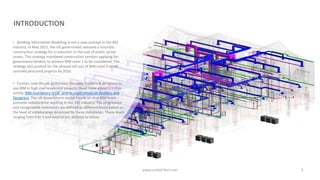
• Building Information Modeling is not a new concept in the AEC
industry. In May 2011, the UK government released a futuristic
construction strategy for a reduction in the cost of public sector
assets. This strategy mandated construction vendors applying for
government tenders to achieve BIM Level 2 to be considered. The
strategy also pushed for the phased roll-out of BIM Level 3 on all
centrally-procured projects by 2016.
• Further, now the UK authorities mandate builders & designers to
use BIM in high-rise residential projects. Read more about it in this
article, BIM mandatory in UK and its implications on Builders and
Designers. The UK Government realized early on that BIM levels
promote collaborative working in the AEC industry. The progressive
and recognizable milestones are defined as different levels based on
the level of collaboration promised by these milestones. These levels
ranging from 0 to 3 and beyond are defined as below:
www.united-bim.com 3
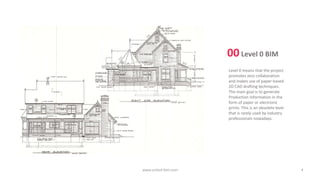
Level 0 means that the project
promotes zero collaboration
and makes use of paper-based
2D CAD drafting techniques.
The main goal is to generate
Production Information in the
form of paper or electronic
prints. This is an obsolete level
that is rarely used by industry
professionals nowadays.
00Level 0 BIM
www.united-bim.com 4
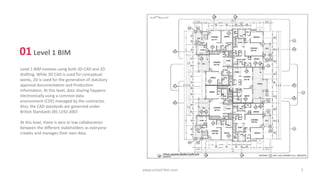
Level 1 BIM involves using both 3D CAD and 2D
drafting. While 3D CAD is used for conceptual
works, 2D is used for the generation of statutory
approval documentation and Production
Information. At this level, data sharing happens
electronically using a common data
environment (CDE) managed by the contractor.
Also, the CAD standards are governed under
British Standards (BS 1192:2007
At this level, there is zero or low collaboration
between the different stakeholders as everyone
creates and manages their own data.
01Level 1 BIM
www.united-bim.com 5
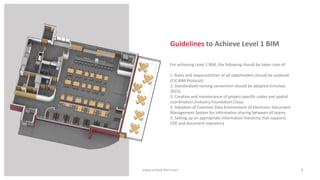
For achieving Level 1 BIM, the following should be taken care of:
1. Roles and responsibilities of all stakeholders should be outlined
(CIC BIM Protocol)
2. Standardized naming convention should be adopted (Uniclass
2015)
3. Creation and maintenance of project-specific codes and spatial
coordination (Industry Foundation Class)
4. Adoption of Common Data Environment of Electronic Document
Management System for information sharing between all teams.
5. Setting up an appropriate information hierarchy that supports
CDE and document repository
Guidelines to Achieve Level 1 BIM
www.united-bim.com 6
Level 2 BIM is prescribed by the UK Government for
public sector projects. This level promotes
collaborative working by giving each of the
stakeholders its own 3D CAD model. Collaborative
working is the distinguishing aspect of this level and
Level 2 requires streamlined information exchange
related to a project and seamless coordination
between all the systems and the stakeholders.
All the parties work on their local 3D CAD
models and information is exchanged through
a common file format. Such a system allows
organizations to combine external data with
their own model to create a federated BIM
Model. Explore more about BIM Exectution
plan (BEP/BXP)
02Level 2 BIM
www.united-bim.com 7
For achieving level 2, it is essential for an organization to:
1. Achieve all the guidelines outlined in Level 1
2. Install CAD software that supports common file formats such
as IFC or COBie
Guidelines to Achieve Level 2 BIM
www.united-bim.com 8
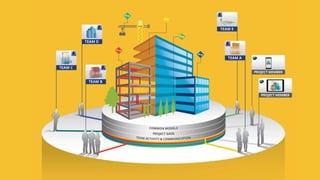
Often termed as ‘Open BIM’ the scope of Level 3
hasn’t been completely defined though it promises
deeper collaboration between all stakeholders
through a shared model stored in a central repository.
Level 3 concept enables all the participants to work
on the same model simultaneously which eliminates
the chance of conflicting information.
Level 3 proposes the use of an integrated solution
built around open standards like IFC where a single
server stores all the project data. Though this level is
slowly picking up pace, many firms in the UK are still
thinking of transitioning from Level 2 to Level 3.
03Level 3 BIM
The scope and vision of BIM Level 3 are defined by
the UK Government in Level 3 Strategic Plan. Proper
implementation and adoption of Level 3 require:
1. Development of a fresh ‘Open Data’ standard that
facilitates the sharing of project data around the
globe
2. Creation of new contractual frameworks for BIM-
based projects for promoting collaboration and
ensuring consistency
3. Training clients in the public sector to use BIM
techniques
Guidelines
to Achieve Level 3 BIM
www.united-bim.com 9
The United Kingdom’s Digital Built Britain Strategy talks
highly of using Level 3 BIM for the future. Though there is a
strong push by the government, the industry is slow to adapt
Level 3 BIM which is in the preliminary stages. The strategy
defines four phases for successful adoption of Level 3 BIM
which includes:
• Level 3A: Improving the existing Level 2 model
• Level 3B: Allowing new technologies and systems
• Level 3C: Enabling development of fresh business models
• Level 3D: Capitalizing the global authority in BIM sphere
Similar to the recent mandates in favor of BIM by the UK
government, fresh measures will pave the perfect adoption
path towards greater levels. Also, the private sector is looking
to propagate the collaborative work theory which will
eventually impact the public AEC industry too. The transition
will be similar to the transition from paper-based models to
CAD during the 1990s.
BIM Levels & Existing
Industry Ecosystem
www.united-bim.com 11
Guidelines for Outsourcing BIM
Key Takeaways for AEC Professionals
FEATURED BLOGS
What is COBie?
How it is streamlining data collaboration between
AEC professionals
What is Clash Detection in BIM?
Process, Benefits and Future Scope in Modern Day
AEC industry
www.united-bim.com 12
Review your design drawings to perfection with this easy to use
drawing checklist, made for Architects and Engineers.
REVIEW CHECKLIST
FOR PERFECT DESIGN DRAWINGS
www.united-bim.com 13
www.united-bim.com info@united-bim.com
+1 (954) 537-9137

BIM Maturity Levels Explained Level 0, Level 1, Level 2, Level 3

  • 1.
    Levels of BIMMaturity Level 0, Level 1, Level 2, Level 3
  • 2.
    INTRODUCTION • Building InformationModeling is not a new concept in the AEC industry. In May 2011, the UK government released a futuristic construction strategy for a reduction in the cost of public sector assets. This strategy mandated construction vendors applying for government tenders to achieve BIM Level 2 to be considered. The strategy also pushed for the phased roll-out of BIM Level 3 on all centrally-procured projects by 2016. • Further, now the UK authorities mandate builders & designers to use BIM in high-rise residential projects. Read more about it in this article, BIM mandatory in UK and its implications on Builders and Designers. The UK Government realized early on that BIM levels promote collaborative working in the AEC industry. The progressive and recognizable milestones are defined as different levels based on the level of collaboration promised by these milestones. These levels ranging from 0 to 3 and beyond are defined as below: www.united-bim.com 3
  • 3.
    Level 0 meansthat the project promotes zero collaboration and makes use of paper-based 2D CAD drafting techniques. The main goal is to generate Production Information in the form of paper or electronic prints. This is an obsolete level that is rarely used by industry professionals nowadays. 00Level 0 BIM www.united-bim.com 4
  • 4.
    Level 1 BIMinvolves using both 3D CAD and 2D drafting. While 3D CAD is used for conceptual works, 2D is used for the generation of statutory approval documentation and Production Information. At this level, data sharing happens electronically using a common data environment (CDE) managed by the contractor. Also, the CAD standards are governed under British Standards (BS 1192:2007 At this level, there is zero or low collaboration between the different stakeholders as everyone creates and manages their own data. 01Level 1 BIM www.united-bim.com 5
  • 5.
    For achieving Level1 BIM, the following should be taken care of: 1. Roles and responsibilities of all stakeholders should be outlined (CIC BIM Protocol) 2. Standardized naming convention should be adopted (Uniclass 2015) 3. Creation and maintenance of project-specific codes and spatial coordination (Industry Foundation Class) 4. Adoption of Common Data Environment of Electronic Document Management System for information sharing between all teams. 5. Setting up an appropriate information hierarchy that supports CDE and document repository Guidelines to Achieve Level 1 BIM www.united-bim.com 6
  • 6.
    Level 2 BIMis prescribed by the UK Government for public sector projects. This level promotes collaborative working by giving each of the stakeholders its own 3D CAD model. Collaborative working is the distinguishing aspect of this level and Level 2 requires streamlined information exchange related to a project and seamless coordination between all the systems and the stakeholders. All the parties work on their local 3D CAD models and information is exchanged through a common file format. Such a system allows organizations to combine external data with their own model to create a federated BIM Model. Explore more about BIM Exectution plan (BEP/BXP) 02Level 2 BIM www.united-bim.com 7
  • 7.
    For achieving level2, it is essential for an organization to: 1. Achieve all the guidelines outlined in Level 1 2. Install CAD software that supports common file formats such as IFC or COBie Guidelines to Achieve Level 2 BIM www.united-bim.com 8
  • 8.
    Often termed as‘Open BIM’ the scope of Level 3 hasn’t been completely defined though it promises deeper collaboration between all stakeholders through a shared model stored in a central repository. Level 3 concept enables all the participants to work on the same model simultaneously which eliminates the chance of conflicting information. Level 3 proposes the use of an integrated solution built around open standards like IFC where a single server stores all the project data. Though this level is slowly picking up pace, many firms in the UK are still thinking of transitioning from Level 2 to Level 3. 03Level 3 BIM The scope and vision of BIM Level 3 are defined by the UK Government in Level 3 Strategic Plan. Proper implementation and adoption of Level 3 require: 1. Development of a fresh ‘Open Data’ standard that facilitates the sharing of project data around the globe 2. Creation of new contractual frameworks for BIM- based projects for promoting collaboration and ensuring consistency 3. Training clients in the public sector to use BIM techniques Guidelines to Achieve Level 3 BIM www.united-bim.com 9
  • 10.
    The United Kingdom’sDigital Built Britain Strategy talks highly of using Level 3 BIM for the future. Though there is a strong push by the government, the industry is slow to adapt Level 3 BIM which is in the preliminary stages. The strategy defines four phases for successful adoption of Level 3 BIM which includes: • Level 3A: Improving the existing Level 2 model • Level 3B: Allowing new technologies and systems • Level 3C: Enabling development of fresh business models • Level 3D: Capitalizing the global authority in BIM sphere Similar to the recent mandates in favor of BIM by the UK government, fresh measures will pave the perfect adoption path towards greater levels. Also, the private sector is looking to propagate the collaborative work theory which will eventually impact the public AEC industry too. The transition will be similar to the transition from paper-based models to CAD during the 1990s. BIM Levels & Existing Industry Ecosystem www.united-bim.com 11
  • 11.
    Guidelines for OutsourcingBIM Key Takeaways for AEC Professionals FEATURED BLOGS What is COBie? How it is streamlining data collaboration between AEC professionals What is Clash Detection in BIM? Process, Benefits and Future Scope in Modern Day AEC industry www.united-bim.com 12
  • 12.
    Review your designdrawings to perfection with this easy to use drawing checklist, made for Architects and Engineers. REVIEW CHECKLIST FOR PERFECT DESIGN DRAWINGS www.united-bim.com 13
  • 13.