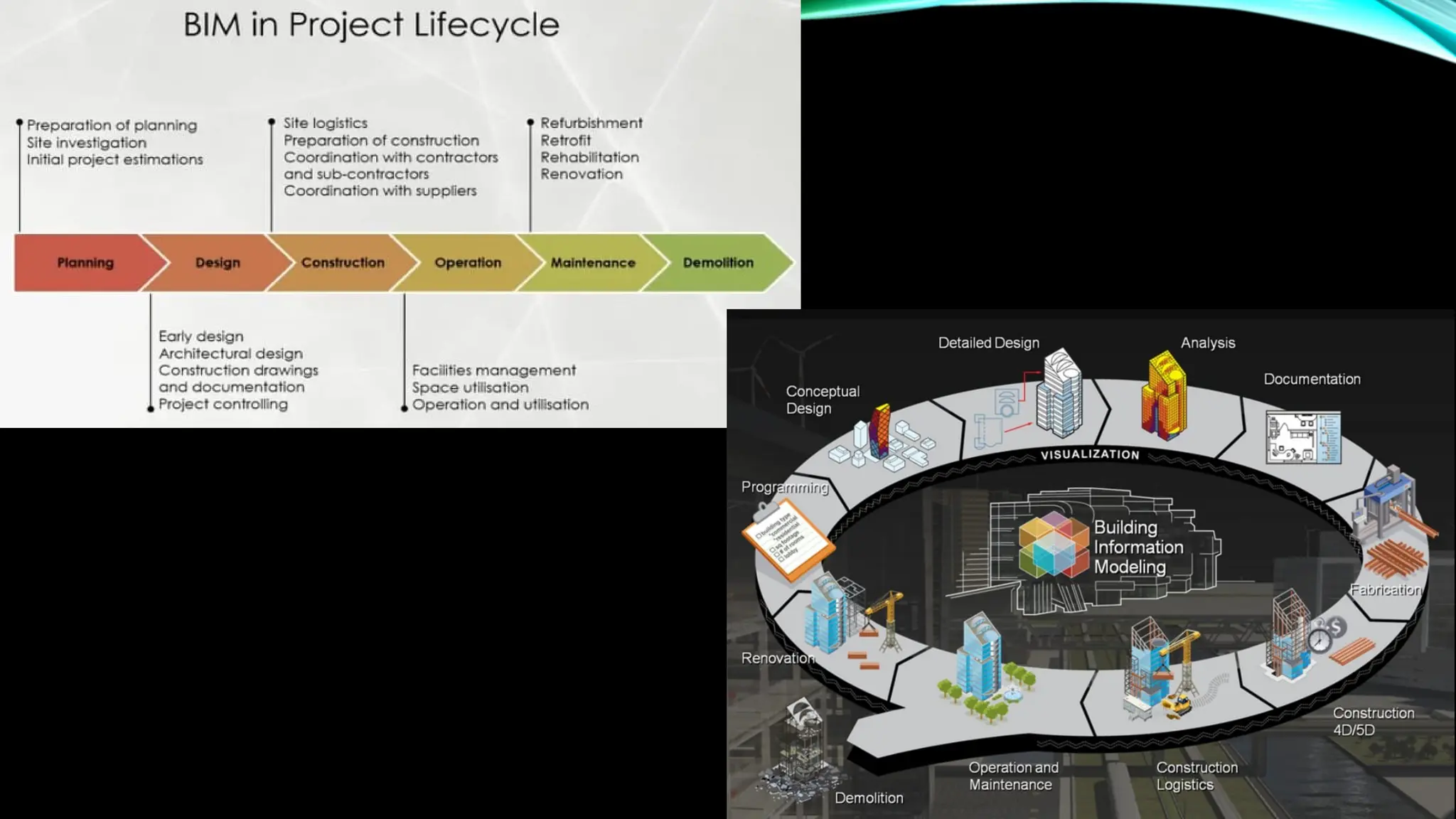
What Is BIM ?
 BIM ( Building Information & Modelling )is a process of
information sharing in construction starting from
initiative ,planning ,execution ,monitoring and completion.
 BIM enables design, construction and engineering teams
to work together using digital technologies.
 BIM provides insight into how real-life elements will impact
a building once it is constructed.
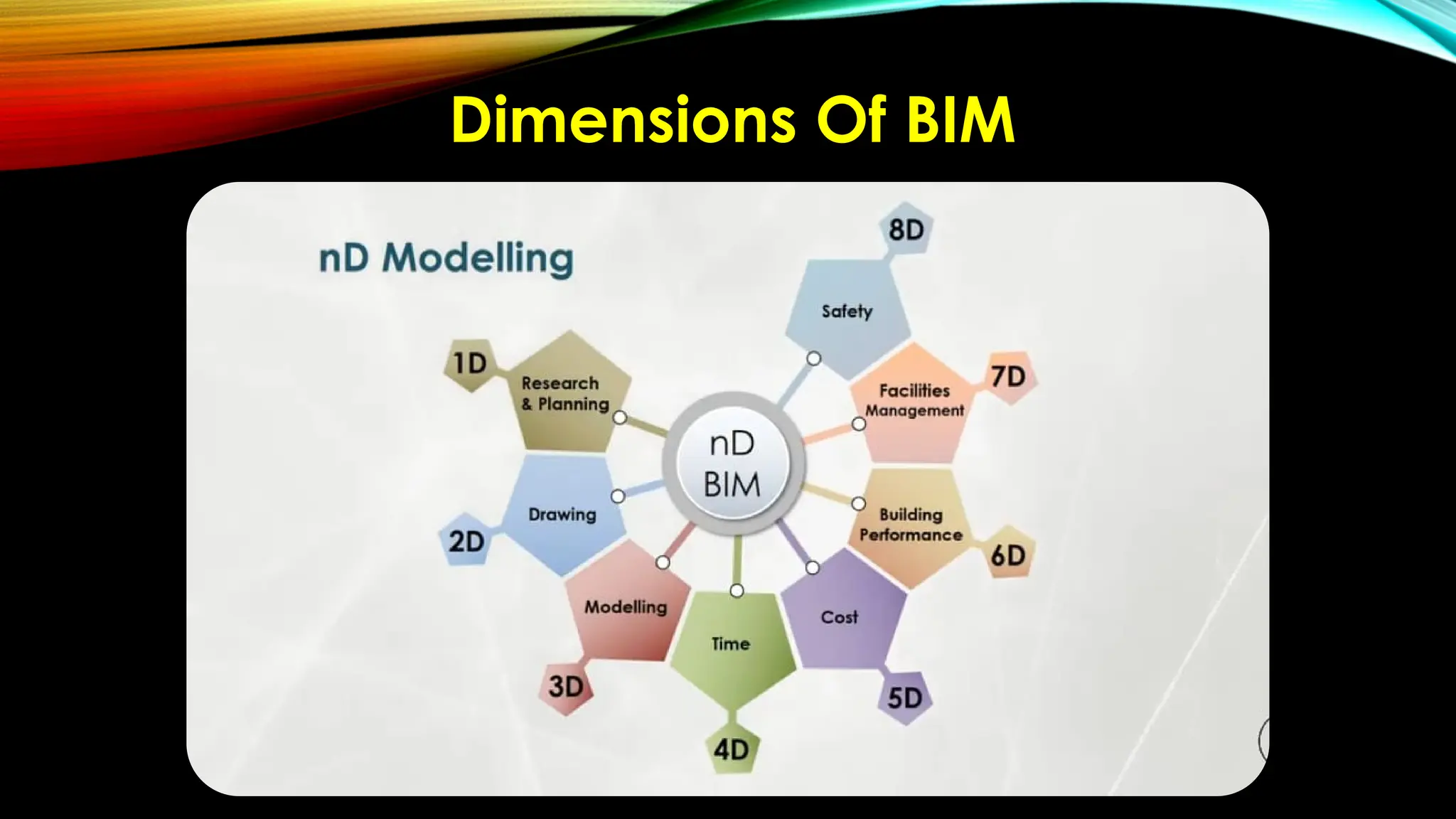
Dimensions Of BIM
1D BIM- Documentation
1D BIM
• It involves documentation of all requirements associated with
the construction project lifecycle.
• It also involves Preliminary surveys and
• BIM platform helps for managing Changes to configuration and
documents for the project.
• In 2D modeling, a geometric model of the proposed structure or
object is created within a two-dimensional plane.
• 2D BIM involves fundamental planning activities to be performed
faster and in a similar format (i.e. Plan, Section and Elevation)
2D BIM- Drawings
3D BIM- Modelling
• 3D modelling is the one of the BIM dimensions that allows professionals to view
the project digital model in three dimensions.
• more detailed and accurate visualization of the entire project.
• It helps to check for possible collision
• 3D + Time Management
• 4D BIM adds an extra dimension to a project describing task duration and
timing in order to drive a 3D representation of how the building evolves in
relation to the various construction phases.
4D BIM- Time Scheduling
5D BIM- Estimation & Costing
• 3D + Time Management + Estimating & Costing
• 5D BIM modelling consists of measurements extraction from a project to define
the material/s quantity necessary for cost estimation and analysis.
• 6D BIM is associated with energy efficiency and sustainable development of
new or existing buildings.
The concept of sustainability can be examined from three different points of view:
a) environmental, in terms of the ability to reproduce and maintain natural
resources.
b) financial, in terms of the ability to generate income and employment.
c) social, as a generator of human well-being.
6D BIM- Sustainability
7D BIM- Maintenance
• 7D BIM is the operational management and maintenance of the building and
its components throughout its life cycle.
• 7D BIM extracts and keeps track of all data related to components,
specifications, maintenance and installation manuals, warranties, etc.
• 8D BIM is the dimension that adds safety information to the geometric model,
allowing to predict risks during the construction process and identifying
activities to be implemented to improve safety at work and prevent accidents.
8D BIM- Safety & Security
9D BIM- Lean Construction
• 9D BIM involves the resource management techniques to improve the
allocation and use of materials, labor, equipment and tools during the facility
lifespan.(Reuse of Raw Material).
• 10D BIM identifies and eliminates obstacles to productivity throughout the
design, construction and delivery of facility.
• Use of drones and manufacturing machines.
10D BIM- Industrialized Construction
THANK YOU

College BIM presentation, What is BIM and Dimensions of BIM

  • 2.
    What Is BIM?  BIM ( Building Information & Modelling )is a process of information sharing in construction starting from initiative ,planning ,execution ,monitoring and completion.  BIM enables design, construction and engineering teams to work together using digital technologies.  BIM provides insight into how real-life elements will impact a building once it is constructed.
  • 3.
  • 4.
    1D BIM- Documentation 1DBIM • It involves documentation of all requirements associated with the construction project lifecycle. • It also involves Preliminary surveys and • BIM platform helps for managing Changes to configuration and documents for the project. • In 2D modeling, a geometric model of the proposed structure or object is created within a two-dimensional plane. • 2D BIM involves fundamental planning activities to be performed faster and in a similar format (i.e. Plan, Section and Elevation) 2D BIM- Drawings
  • 5.
    3D BIM- Modelling •3D modelling is the one of the BIM dimensions that allows professionals to view the project digital model in three dimensions. • more detailed and accurate visualization of the entire project. • It helps to check for possible collision • 3D + Time Management • 4D BIM adds an extra dimension to a project describing task duration and timing in order to drive a 3D representation of how the building evolves in relation to the various construction phases. 4D BIM- Time Scheduling
  • 6.
    5D BIM- Estimation& Costing • 3D + Time Management + Estimating & Costing • 5D BIM modelling consists of measurements extraction from a project to define the material/s quantity necessary for cost estimation and analysis. • 6D BIM is associated with energy efficiency and sustainable development of new or existing buildings. The concept of sustainability can be examined from three different points of view: a) environmental, in terms of the ability to reproduce and maintain natural resources. b) financial, in terms of the ability to generate income and employment. c) social, as a generator of human well-being. 6D BIM- Sustainability
  • 7.
    7D BIM- Maintenance •7D BIM is the operational management and maintenance of the building and its components throughout its life cycle. • 7D BIM extracts and keeps track of all data related to components, specifications, maintenance and installation manuals, warranties, etc. • 8D BIM is the dimension that adds safety information to the geometric model, allowing to predict risks during the construction process and identifying activities to be implemented to improve safety at work and prevent accidents. 8D BIM- Safety & Security
  • 9.
    9D BIM- LeanConstruction • 9D BIM involves the resource management techniques to improve the allocation and use of materials, labor, equipment and tools during the facility lifespan.(Reuse of Raw Material). • 10D BIM identifies and eliminates obstacles to productivity throughout the design, construction and delivery of facility. • Use of drones and manufacturing machines. 10D BIM- Industrialized Construction
  • 11.