BIM TECHNOLOGY
WHAT IS BIM !!!
 BIM (Building Information Modeling) is an intelligent 3D
model-based process that gives architecture, engineering,
and construction (AEC) professionals the insight and tools to
more efficiently plan, design, construct, and manage
buildings and infrastructure.
 Building information modeling (BIM) gets people and
information working together effectively and efficiently
through defined processes and technology.
BIM HISTORY
 BIM was brought to wide industry attention in the UK
Government Construction Strategy published in 2011.
 Since then the BIM Task Group has been developing
standards and requirements to enable BIM adoption.
 Take up of BIM is slowly but surely increasing although
there is still more BIM related development work in the
pipeline.
BIM BENEFITS
 BIM Reduces Rework.
The highest rated business benefit among experts. Four
in five experts say it brings high to very high value,
compared to 23% of beginners.
 BIM Improves Productivity.
Ranked by architects as the top way to improve their
return on investment in the technology.
BIM BENEFITS
 BIM Reduces Conflicts and Changes During Construction.
Are among the top rated ways engineers say BIM adds value
to their project.
 Clash Detection and Avoiding Rework.
Owners claim that BIM usage saves time and money.
BIM BENEFITS
 Provides a way to change traditional architectural phases
and data sharing.
 The modeling process integrates actual construction pieces
and parts
 BIM can be used as a tool to estimate and complete
construction cost forecasting
 Used to monitor actual building performance data
BIM BENEFITS
 The software can be used to collect data on warranty,
aging, defects, and installation time
 Determine whether a temporary construction set up is
needed
 Can be used to sequencing planning or determining
how the phases of a project should be scheduled.
 Detect or avoid construction and design issues early in
the game preventing change orders and unforeseen
conditions
 Reporting, scheduling, submittals can be part of the BIM
process and communication will be greatly enhanced
Collaborative Working (CDE)
Shared files
Inter-Discipline Access to WIP
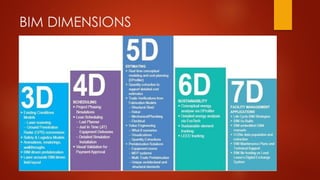
BIM DIMENSIONS
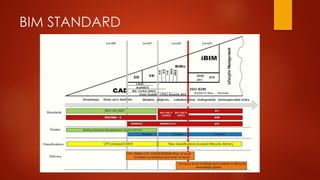
BIM STANDARD
BIM STANDARD
LEVEL OF DEVLPOMENT (LOD)
BIM TOOLS (SOFTWARE)
AUTODESK REVIT
AUTODESK REVIT
 Autodesk Revit software is built for Building Information
Modeling (BIM}, helping professionals design, build, and
maintain higher-quality, more energy-efficient buildings.
Using the information-rich models created with Autodesk
Revit software, architects, engineers, and construction
firms can collaborate to make more-informed decisions
earlier in the design process to deliver projects more
efficiently
AUTODESK REVIT
 Any design changes made in Revit models are
automatically updated throughout the model, keeping
designs and documentation coordinated and more
reliable. Autodesk Revit includes features for
architectural design, mechanical, electrical, and
plumbing, structural engineering, and construction and is
available as part of Autodesk Architecture, Engineering
and Construction Collection, providing a comprehensive
solution for the entire building project team.
AUTODESK REVIT
AUTODESK REVIT
AUTODESK REVIT
AUTODESK REVIT

Bim

  • 1.
  • 4.
    WHAT IS BIM!!!  BIM (Building Information Modeling) is an intelligent 3D model-based process that gives architecture, engineering, and construction (AEC) professionals the insight and tools to more efficiently plan, design, construct, and manage buildings and infrastructure.  Building information modeling (BIM) gets people and information working together effectively and efficiently through defined processes and technology.
  • 5.
    BIM HISTORY  BIMwas brought to wide industry attention in the UK Government Construction Strategy published in 2011.  Since then the BIM Task Group has been developing standards and requirements to enable BIM adoption.  Take up of BIM is slowly but surely increasing although there is still more BIM related development work in the pipeline.
  • 6.
    BIM BENEFITS  BIMReduces Rework. The highest rated business benefit among experts. Four in five experts say it brings high to very high value, compared to 23% of beginners.  BIM Improves Productivity. Ranked by architects as the top way to improve their return on investment in the technology.
  • 7.
    BIM BENEFITS  BIMReduces Conflicts and Changes During Construction. Are among the top rated ways engineers say BIM adds value to their project.  Clash Detection and Avoiding Rework. Owners claim that BIM usage saves time and money.
  • 8.
    BIM BENEFITS  Providesa way to change traditional architectural phases and data sharing.  The modeling process integrates actual construction pieces and parts  BIM can be used as a tool to estimate and complete construction cost forecasting  Used to monitor actual building performance data
  • 9.
    BIM BENEFITS  Thesoftware can be used to collect data on warranty, aging, defects, and installation time  Determine whether a temporary construction set up is needed  Can be used to sequencing planning or determining how the phases of a project should be scheduled.  Detect or avoid construction and design issues early in the game preventing change orders and unforeseen conditions  Reporting, scheduling, submittals can be part of the BIM process and communication will be greatly enhanced
  • 10.
  • 11.
  • 12.
  • 15.
  • 16.
  • 17.
  • 18.
  • 19.
  • 20.
  • 21.
  • 22.
  • 23.
    AUTODESK REVIT  AutodeskRevit software is built for Building Information Modeling (BIM}, helping professionals design, build, and maintain higher-quality, more energy-efficient buildings. Using the information-rich models created with Autodesk Revit software, architects, engineers, and construction firms can collaborate to make more-informed decisions earlier in the design process to deliver projects more efficiently
  • 24.
    AUTODESK REVIT  Anydesign changes made in Revit models are automatically updated throughout the model, keeping designs and documentation coordinated and more reliable. Autodesk Revit includes features for architectural design, mechanical, electrical, and plumbing, structural engineering, and construction and is available as part of Autodesk Architecture, Engineering and Construction Collection, providing a comprehensive solution for the entire building project team.
  • 25.
  • 26.
  • 27.
  • 28.