Listening exercise 2:
• 1. What language and when did it started being taught to
Joanna?
• 2. What is the father’s opinion about having raised his child
bilingual?
• 3. What is the father’s parent’s nationality? Why did they end
up in Melbourne?
• 4. When were German and English spoken by the family?
• 5. When did English become the father’s dominant language?
• 6. When is each of the languages spoken among the family?
• 7. What is one of the anecdotes that the father tells to illustrate
that Joanna feels proud of being bilingual?
• 8. What is the movie mentioned at the end of the podcast?
What is it about?
Exercise 3:
• Growing up with English plus
• 1. What called your attention from the part of the video
watched?
• 2. Describe the type of bilingualism that can be evidenced in
most of the kids of the video.
Bilingual memory
storage: Compound-
Coordinate and
Derivates
How do speakers of one or more
languages might store their lg in
memory?
• What is a homograph?
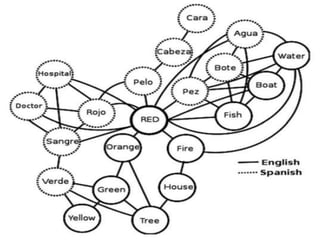
• If a Spanish-English bilingual reads the homograph red, it would activate:
1. Its English-related meanings (orange, green, fire),
2. Its Spanish direct translation (rojo) and associations (rojo-doctor, hospital), and
3. Its additional meanings in Spanish related to red-pelo (net-hair), red-pez (net-
fish), red-internet, associations (pelo-cabeza, pez-agua), and direct translations
(pez-fish, agua-water).
• How is all this information organized in bilingual memory?
• Current bilingual models. postulate separate but interconnected systems
Bilingual storage structures by
Weinreich (1953):
Levels of representation
and types of memory
organization
• At the levels of representation: information is organized in terms of
meaning (i.e., the conceptual or signified level, represented by squares in
Fig. 2), or word-form (i.e., the lexical or signifier level, represented by
circles in Fig. 2) representation.
For a compound
bilingual
• information at the meaning or conceptual level is fused or shared and
information at the lexical or word level is independent.
• For a Spanish-English compound bilingual, whose first language (L1) is
Spanish and second language (L2) is English, two different lexical items or
verbal labels represent the concept of libro and book, but the underlying
meaning would be the same across the two languages.
For a coordinate
bilingual (pure
bilingalism)
• Their bilingual configuration suggests that the definitions of
libro and book, for example, represent meanings that may be
unique to each language.
• Thus, the meaning of the Spanish word libro and its
translation (book) are different, and both meanings are
associated with information that is language-specific.
For a subordinate
bilingual
• A subordinate system (Fig. 2c) on the other hand, views the
bilingual as containing one meaning-based representational
system, in which the to-be-learned language or L2 is simply a
translation of the L1 word.
• They link or associate every L2 word with the L1translation
equivalent and access to the meaning-based representational
system must necessarily go through the L1
Bilingual memory representation is
dynamic:
Subordinate bilingualism
A subordinate
bilingual memory
structure through
practice may develop
into a compound
bilingual structure.
Compound bilingualism
Bilingual concepts may
have instances of
compound, (e.g.,
concrete words:
Father vs. Padre, and
cognates or words
similar in form and
meaning across
languages: Hospital in
English vs. Hospital in
Spanish)
Coordinate bilingualism
Or coordinate
representations (e.g.,
abstract: Love vs.
Amor, and interlingual
homographs: Red as in
color in English vs. Red
as in net in Spanish
Acquisition (learning) contexts
and language organization
• Look at the information on this section of the article for 5
minutes.
• After the 5 minutes, get into groups and discuss the
information in there.
• After the group discussion, share info with the whole group.
Interviewing a bilingual
• Let’s listen to the interview of the bilingual students and
identify the type of bilingualism.

Bilingual memory storage

  • 1.
    Listening exercise 2: •1. What language and when did it started being taught to Joanna? • 2. What is the father’s opinion about having raised his child bilingual? • 3. What is the father’s parent’s nationality? Why did they end up in Melbourne? • 4. When were German and English spoken by the family? • 5. When did English become the father’s dominant language? • 6. When is each of the languages spoken among the family? • 7. What is one of the anecdotes that the father tells to illustrate that Joanna feels proud of being bilingual? • 8. What is the movie mentioned at the end of the podcast? What is it about?
  • 2.
    Exercise 3: • Growingup with English plus • 1. What called your attention from the part of the video watched? • 2. Describe the type of bilingualism that can be evidenced in most of the kids of the video.
  • 3.
  • 4.
    How do speakersof one or more languages might store their lg in memory? • What is a homograph? • If a Spanish-English bilingual reads the homograph red, it would activate: 1. Its English-related meanings (orange, green, fire), 2. Its Spanish direct translation (rojo) and associations (rojo-doctor, hospital), and 3. Its additional meanings in Spanish related to red-pelo (net-hair), red-pez (net- fish), red-internet, associations (pelo-cabeza, pez-agua), and direct translations (pez-fish, agua-water). • How is all this information organized in bilingual memory? • Current bilingual models. postulate separate but interconnected systems
  • 6.
    Bilingual storage structuresby Weinreich (1953): Levels of representation and types of memory organization • At the levels of representation: information is organized in terms of meaning (i.e., the conceptual or signified level, represented by squares in Fig. 2), or word-form (i.e., the lexical or signifier level, represented by circles in Fig. 2) representation. For a compound bilingual • information at the meaning or conceptual level is fused or shared and information at the lexical or word level is independent. • For a Spanish-English compound bilingual, whose first language (L1) is Spanish and second language (L2) is English, two different lexical items or verbal labels represent the concept of libro and book, but the underlying meaning would be the same across the two languages.
  • 7.
    For a coordinate bilingual(pure bilingalism) • Their bilingual configuration suggests that the definitions of libro and book, for example, represent meanings that may be unique to each language. • Thus, the meaning of the Spanish word libro and its translation (book) are different, and both meanings are associated with information that is language-specific. For a subordinate bilingual • A subordinate system (Fig. 2c) on the other hand, views the bilingual as containing one meaning-based representational system, in which the to-be-learned language or L2 is simply a translation of the L1 word. • They link or associate every L2 word with the L1translation equivalent and access to the meaning-based representational system must necessarily go through the L1
  • 8.
    Bilingual memory representationis dynamic: Subordinate bilingualism A subordinate bilingual memory structure through practice may develop into a compound bilingual structure. Compound bilingualism Bilingual concepts may have instances of compound, (e.g., concrete words: Father vs. Padre, and cognates or words similar in form and meaning across languages: Hospital in English vs. Hospital in Spanish) Coordinate bilingualism Or coordinate representations (e.g., abstract: Love vs. Amor, and interlingual homographs: Red as in color in English vs. Red as in net in Spanish
  • 9.
    Acquisition (learning) contexts andlanguage organization • Look at the information on this section of the article for 5 minutes. • After the 5 minutes, get into groups and discuss the information in there. • After the group discussion, share info with the whole group.
  • 10.
    Interviewing a bilingual •Let’s listen to the interview of the bilingual students and identify the type of bilingualism.