Deisy Velasquez David ValenciaDAVIDVALENCIA.
done. presented.
BICS
(Basic Interpersonal Communication Skills)
CALP
(Cognitive Academic Language Proficiency)
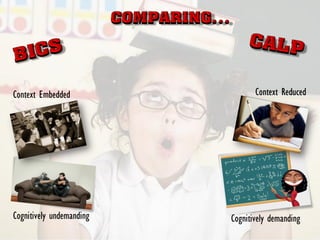
Context Reduced
Cognitively undemanding Cognitively demanding
Context Embedded
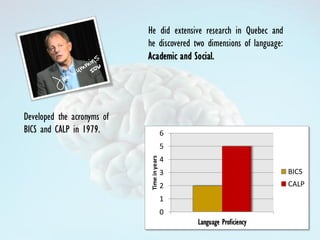
0
1
2
3
4
5
6
Language Proficiency
Timeinyears
BICS
CALP
Developed the acronyms of
BICS and CALP in 1979.
He did extensive research in Quebec and
he discovered two dimensions of language:
Academic and Social.
A learner’s language ability can easily be over-estimated by
looking at the BICS and not realizing the complexity and
difficulty that second language students have in acquiring CALP
in the second language.
"In school environments, ESL students need to be able to use spoken and
written English both to acquire academic content and to demonstrate their
learning". The TESOL ESL Standards (1997).
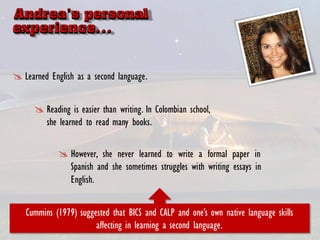
 However, she never learned to write a formal paper in
Spanish and she sometimes struggles with writing essays in
English.
Cummins (1979) suggested that BICS and CALP and one’s own native language skills
affecting in learning a second language.
 Learned English as a second language.
 Reading is easier than writing. In Colombian school,
she learned to read many books.
 Daniel learned Spanish as a
foreign language while in
an English-speaking country.
Cummins (1979) argued that
teachers should learn the difference
between BICS and CALP so that
they can assess their students’
proficiency in two distinct areas.
 Daniel was fluent in English
BICS and CALP before
attempting to learn Spanish.
 While in Spain, reading
and writing were much
easier than speaking and
listening.
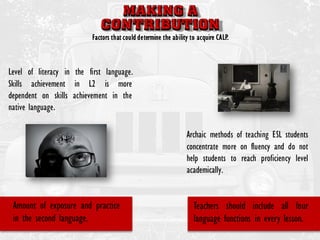
Factors that could determine the ability to acquire CALP.
Level of literacy in the first language.
Skills achievement in L2 is more
dependent on skills achievement in the
native language.
Archaic methods of teaching ESL students
concentrate more on fluency and do not
help students to reach proficiency level
academically.
Teachers should include all four
language functions in every lesson.
Amount of exposure and practice
in the second language.
 http://www2.education.ualberta.ca/staff/olenka.Bilash/best%20of%20bilash/bics%20calp.html
 http://www.everythingesl.net/inservices/bics_calp.php
 http://pinterest.com/daniel27/pins/?filter=likes
 http://esl.fis.edu/teachers/support/cummin.htm
thank you.
DEISY DAVIDVELASQUEZ. VALENCIA.
done. presented.

Bics calp

  • 1.
    Deisy Velasquez DavidValenciaDAVIDVALENCIA. done. presented.
  • 2.
    BICS (Basic Interpersonal CommunicationSkills) CALP (Cognitive Academic Language Proficiency)
  • 3.
    Context Reduced Cognitively undemandingCognitively demanding Context Embedded
  • 4.
    0 1 2 3 4 5 6 Language Proficiency Timeinyears BICS CALP Developed theacronyms of BICS and CALP in 1979. He did extensive research in Quebec and he discovered two dimensions of language: Academic and Social.
  • 5.
    A learner’s languageability can easily be over-estimated by looking at the BICS and not realizing the complexity and difficulty that second language students have in acquiring CALP in the second language. "In school environments, ESL students need to be able to use spoken and written English both to acquire academic content and to demonstrate their learning". The TESOL ESL Standards (1997).
  • 6.
     However, shenever learned to write a formal paper in Spanish and she sometimes struggles with writing essays in English. Cummins (1979) suggested that BICS and CALP and one’s own native language skills affecting in learning a second language.  Learned English as a second language.  Reading is easier than writing. In Colombian school, she learned to read many books.
  • 7.
     Daniel learnedSpanish as a foreign language while in an English-speaking country. Cummins (1979) argued that teachers should learn the difference between BICS and CALP so that they can assess their students’ proficiency in two distinct areas.  Daniel was fluent in English BICS and CALP before attempting to learn Spanish.  While in Spain, reading and writing were much easier than speaking and listening.
  • 8.
    Factors that coulddetermine the ability to acquire CALP. Level of literacy in the first language. Skills achievement in L2 is more dependent on skills achievement in the native language. Archaic methods of teaching ESL students concentrate more on fluency and do not help students to reach proficiency level academically. Teachers should include all four language functions in every lesson. Amount of exposure and practice in the second language.
  • 9.
  • 10.
    thank you. DEISY DAVIDVELASQUEZ.VALENCIA. done. presented.