An Overview of Syllabuses in English Language TeachingWilliam Hall ESL 501
What is the definition of Syllabus?In Wilkins’(1981) words, syllabuses are “specifications of the content of language teaching which have been submitted to some degree of structuring or ordering with the aim of making teaching and learning a more effective process.”“a plan or what is to be achieved through our teaching and our student’s learning.”(Breen, 1984)
Syllabus definition part 2function of a syllabus is “to specify what is to be taught and in what order.” (Prabhu, 1984)“a summary of the content to which learners will be exposed.”(Yalden, 1987)
Syllabus definition part 3“social constructions, produced interdependently in classrooms by teachers and learners…They are concerned with the specification and planning of what is to be learned, frequently set down in some written form as prescriptions for action by teachers and learners.” (Candlin, 1984)
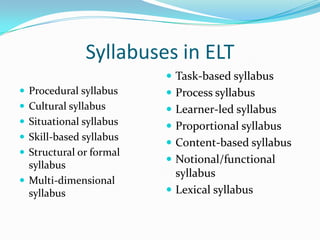
Syllabuses in ELTProcedural syllabusCultural syllabusSituational syllabusSkill-based syllabusStructural or formal syllabusMulti-dimensional syllabusTask-based syllabusProcess syllabusLearner-led syllabusProportional syllabusContent-based syllabusNotional/functional syllabusLexical syllabus
Procedural SyllabusStructure can be best learned when attention is concentrated on meaningFocus is on the learnerTasks and activities are designed but not the linguistic contentLearner focuses on trying to solve the meaning behind the text
Cultural SyllabusBased on learner’s own countryRequiring teacher to have knowledge of student’s cultureGoals to develop interest, curiosity and empathy for culturesEmphasis on socio-cultural implications of language usage
Situational SyllabusBased on real life situations, such as going to the dentist, seeing a movie, meeting a new studentContent of language is based on such situations.Learners find meaning from relevant context.
Skill-Based SyllabusSkills are taught that are needed for language competencySpecific skills such as pronunciation, grammar and discourse are improved through activities such as: listening to language to find the main idea, writing well-formed paragraphs, and giving lectures.
Structural (Formal) SyllabusOrganized along grammatical lines.Focus on outcomes or the productLearner expected to master each structural step while increasing grammarUses structured, sequenced practice drills
Multi-Dimensional Syllabus	Flexible syllabus incorporating elements of other models.  Example: a syllabus that includes important functions, reviewing important situations, and teaching specific skillsA combination of other models.
Task Based SyllabusUsing specific task to achieve a purposeLanguage is developed through interaction and practice.  Task must be relevant to the real world
Process SyllabusProgram is designed as the school year takes placeDecision to follow a pre-designed content syllabus, or develop an on-going syllabus using alternative assessment, activities and tasksDevelops a strong relationship between subject matter, learning, and the contributions of a classroom.
Learner-Led SyllabusLearners engaged in the implementation and design as much as practically possibleThe hope is that the learner is more motivated due to their awareness of the course and their involvement.Questions on practicality of program as syllabus is guided by learner
Proportional SyllabusFocus is on flexibility and spiral technique of language sequencing leading to the recycling of language.Goal is to develop an overall competenceThemes are chosen by the learnerShift from form to interaction.States syllabus has to indicate what will be taught, rather than what will be learned
Content-Based SyllabusGoal is to teach specific information and content using the language that learners are learning.Subject matter is primary, and language learning happens concurrently.For example, in  a chemistry class, linguistic adjustments are made to make the chemistry more understandable.
Notional/Functional SyllabusFocus is on the communicative purpose and the conceptual meaning of language.Calls for needs analysis to establish objectivesFunctions such as inviting, requesting, agreeing, apologizing are taught.Notions such as age, color, size, comparison, time, etc.
Lexical SyllabusFirmly based on real language.Use of the commonest words and phrases and their meaningsLearning the patterns of languageLanguage is carefully selected for the learner to analyze by themselves.
Why syllabus would you chose, and why?

Sylabuss powerpoitn

  • 1.
    An Overview ofSyllabuses in English Language TeachingWilliam Hall ESL 501
  • 2.
    What is thedefinition of Syllabus?In Wilkins’(1981) words, syllabuses are “specifications of the content of language teaching which have been submitted to some degree of structuring or ordering with the aim of making teaching and learning a more effective process.”“a plan or what is to be achieved through our teaching and our student’s learning.”(Breen, 1984)
  • 3.
    Syllabus definition part2function of a syllabus is “to specify what is to be taught and in what order.” (Prabhu, 1984)“a summary of the content to which learners will be exposed.”(Yalden, 1987)
  • 4.
    Syllabus definition part3“social constructions, produced interdependently in classrooms by teachers and learners…They are concerned with the specification and planning of what is to be learned, frequently set down in some written form as prescriptions for action by teachers and learners.” (Candlin, 1984)
  • 5.
    Syllabuses in ELTProceduralsyllabusCultural syllabusSituational syllabusSkill-based syllabusStructural or formal syllabusMulti-dimensional syllabusTask-based syllabusProcess syllabusLearner-led syllabusProportional syllabusContent-based syllabusNotional/functional syllabusLexical syllabus
  • 6.
    Procedural SyllabusStructure canbe best learned when attention is concentrated on meaningFocus is on the learnerTasks and activities are designed but not the linguistic contentLearner focuses on trying to solve the meaning behind the text
  • 7.
    Cultural SyllabusBased onlearner’s own countryRequiring teacher to have knowledge of student’s cultureGoals to develop interest, curiosity and empathy for culturesEmphasis on socio-cultural implications of language usage
  • 8.
    Situational SyllabusBased onreal life situations, such as going to the dentist, seeing a movie, meeting a new studentContent of language is based on such situations.Learners find meaning from relevant context.
  • 9.
    Skill-Based SyllabusSkills aretaught that are needed for language competencySpecific skills such as pronunciation, grammar and discourse are improved through activities such as: listening to language to find the main idea, writing well-formed paragraphs, and giving lectures.
  • 10.
    Structural (Formal) SyllabusOrganizedalong grammatical lines.Focus on outcomes or the productLearner expected to master each structural step while increasing grammarUses structured, sequenced practice drills
  • 11.
    Multi-Dimensional Syllabus Flexible syllabusincorporating elements of other models. Example: a syllabus that includes important functions, reviewing important situations, and teaching specific skillsA combination of other models.
  • 12.
    Task Based SyllabusUsingspecific task to achieve a purposeLanguage is developed through interaction and practice. Task must be relevant to the real world
  • 13.
    Process SyllabusProgram isdesigned as the school year takes placeDecision to follow a pre-designed content syllabus, or develop an on-going syllabus using alternative assessment, activities and tasksDevelops a strong relationship between subject matter, learning, and the contributions of a classroom.
  • 14.
    Learner-Led SyllabusLearners engagedin the implementation and design as much as practically possibleThe hope is that the learner is more motivated due to their awareness of the course and their involvement.Questions on practicality of program as syllabus is guided by learner
  • 15.
    Proportional SyllabusFocus ison flexibility and spiral technique of language sequencing leading to the recycling of language.Goal is to develop an overall competenceThemes are chosen by the learnerShift from form to interaction.States syllabus has to indicate what will be taught, rather than what will be learned
  • 16.
    Content-Based SyllabusGoal isto teach specific information and content using the language that learners are learning.Subject matter is primary, and language learning happens concurrently.For example, in a chemistry class, linguistic adjustments are made to make the chemistry more understandable.
  • 17.
    Notional/Functional SyllabusFocus ison the communicative purpose and the conceptual meaning of language.Calls for needs analysis to establish objectivesFunctions such as inviting, requesting, agreeing, apologizing are taught.Notions such as age, color, size, comparison, time, etc.
  • 18.
    Lexical SyllabusFirmly basedon real language.Use of the commonest words and phrases and their meaningsLearning the patterns of languageLanguage is carefully selected for the learner to analyze by themselves.
  • 19.
    Why syllabus wouldyou chose, and why?