CHROMATOGRAPHIC
TECHNIQUES
PRESENTED BY
BHAVANA SHIVANKAR
M.Sc.- II SEM
DEPARTMENT OF CRIMINOLOGY AND FORENSIC SCIENCE
CHROMATOGRAPHY
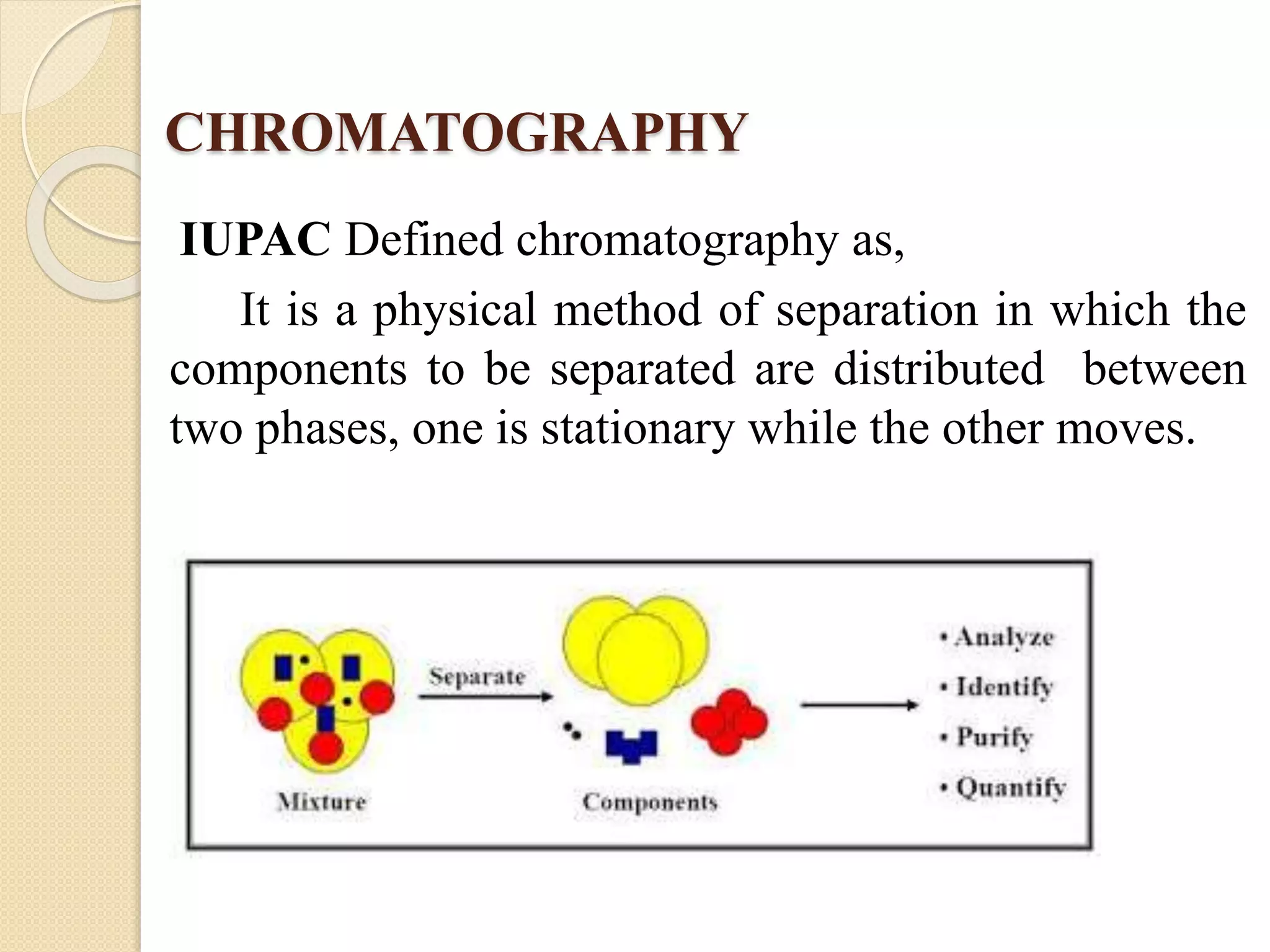
IUPAC Defined chromatography as,
It is a physical method of separation in which the
components to be separated are distributed between
two phases, one is stationary while the other moves.
 Chromatography was invented by Mikhail Tswett,
a botanist in 1906. He had successfully separated
chlorophyll, xanthophylls and other colored
substances by percolating vegetable extract through
a column of calcium carbonate.
 Paper chromatography was first introduced by
German scientist Christian Freidrich Schonbein.
 A.J.P. Martin, was awarded the Nobel prize for his
work in developing liquid-liquid and paper
chromatography in 1941 and recognized for the
development of gas chromatography.
HISTORICAL BACKGROUND
Conti…
 In 1952, A.P.J.Martin and Richard Laurence
Millington Synge was awarded Nobel Prize for
invention of partition chromatography.
PRINCIPLE
Chromatography is based on the principle of
selective distribution of the components of a mixture
between stationary (stagnant) and mobile
phase(moving). Stationary phase can a solid or a
liquid while the mobile phase can be a liquid or gas.
CLASSIFICATION OF
CHROMATOGRAPHIC METHODS
 Based upon the physical means by which
stationary and mobile phases are brought into
contact;
1. Planar chromatography
2. Column chromatography
CLASSIFICATION OF
CHROMATOGRAPHIC METHODS
 Based upon mobile and stationary phase and
kind of equilibrium established between two
phases.
1. Gas chromatography
2. Liquid chromatography
 Based upon the mechanism of separation
1. Adsorption
2. Partition
PLANAR CHROMATOGRAPHY
 In planar chromatography, the stationary phase is
supported on a flat plate or in the interstices of
paper; here the mobile phase moves through the
stationary phase by capillary action or under the
influence of gravity.
 In this the position of migrated spots on
chromatograms are indicated by retention or
retardation factor (Rf).
Rf= distance travelled by solute from baseline
distance travelled by solvent from baseline
PLANAR CHROMATOGRAPHY
Paper
chromatography
Thin layer
chromatography
HPTLC(HIGH PERFORMANCE THIN
LAYER CHROMATOGRAPHY)
The advanced form of TLC is HPTLC. It is a
validated method for qualitative and quantitative
analysis. Instrument works on sophisticated
software which ensure the highest degree of
usefulness, reliability and reproducibility.
HPTLC
INSTRUMENTATION
Fig. (A) application of sample, (B) Chromatographic development
chamber, (C)Detection & Visualization.
COLUMN CHROMATOGRAPHY
In column chromatography, the stationary phase
is held in a narrow tube through which the mobile
phase is forced under pressure.
COLUMN CHROMATOGRAPHY
In this method, the mixture to be separated is
dissolved in suitable solvent and allowed to pass
through tube containing adsorbent. The components
which has greater adsorbing power is adsorbed in
upper pert of the column. The next component is
adsorbed in lower portion of column which has lesser
absorbing power than the first component.
HPLC
 HPLC was referred as High Pressure Liquid
Chromatography but nowadays the term is referred
as High Performance Liquid Chromatography.
 Types of HPLC :
Based on modes of chromatography
1. Normal phase mode
2. Reverse phase mode
Based on principle of separation
1. Adsorption chromatography
2. Ion exchange chromatography
3. Partition chromatography
4. Size exclusion
Conti…
Based on elution technique
1. Isocratic separation
2. Gradient separation
Based on type of analysis
1. Qualitative analysis
2. Quantitative analysis
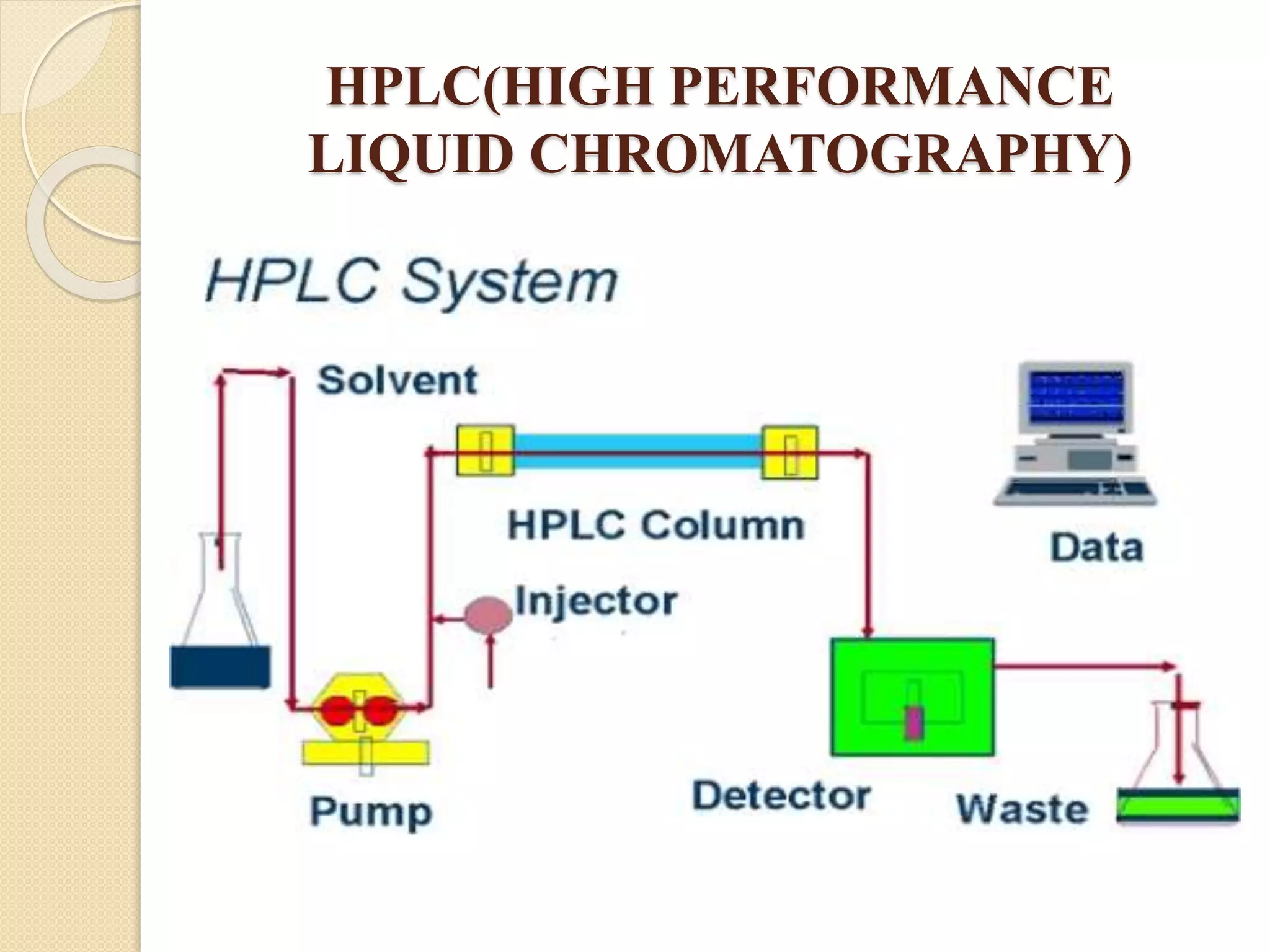
HPLC(HIGH PERFORMANCE
LIQUID CHROMATOGRAPHY)
HPLC (HIGH PERFORMANCE
LIQUID CHROMATOGRAPHY)
 A solvent reservoir
 A high pressure pump
 Sample injection port
 A column
 A detector and recording unit
SOLVENT RESERVOIR
Mobile phase contents are contained in a glass
reservoir. The mobile phase , or solvent, in HPTLC is
usually a mixture of polar and non- polar liquid
components whose respective concentrations are
varied depending on the composition of the sample.
 Isocratic separation
 Gradient separation
PUMP
A pump aspirates the mobile phase from the
solvent reservoir and forces it through the system’s
column and detector. Depending on the particle size
of stationary phase, the flow rate and the composition
of the mobile phase, operating pressures are
generated.
SAMPLE INJECTOR
The injection can be single or an automated
injection. An injector for an HPLC system should
provide injection of the liquid sample within the range
of 0.1-100 ml of volume with high reproducibility and
under high pressure.
COLUMN
Columns are usually made up of polished
stainless steel, are between 50 and 300 mm long and
have an internal diameter between 2- 5 mm. Ideally
the temperature of column and mobile phase should
be constant during an analysis.
Column packing
◦ Microporous
◦ Pellicular
◦ Bonded Phase
DETECTOR
The HPLC detectors are located at the end of the
column, detect the analytes as they elute from the
chromatographic column. Commonly used detectors
are UV – spectroscope, fluorescence, electrochemical
and mass spectrometric detectors.
DATA COLLECTION DEVICES
Signals from detector may be collected on chart
recorders or electronic integrators that vary in
complexity and in their ability to process, store and
reprocess chromatographic data. The computer
integrates the response of the detector to each
component and placed it into a chromatograph that is
easy to read and interpret.
Applications of HPLC
Pharmaceutical applications
 Pharmaceutical quality control
 Tablet dissolution study of pharmaceutical dosages form.
Environmental applications
 Detection of phenolic compounds in drinking water.
 Bio monitoring of pollutants.
Food and flavor
 Measurement of quality of soft drinks and water.
 Sugar analysis in fruit juices.
 Analysis of adulterants in food materials.
 Preservative analysis.
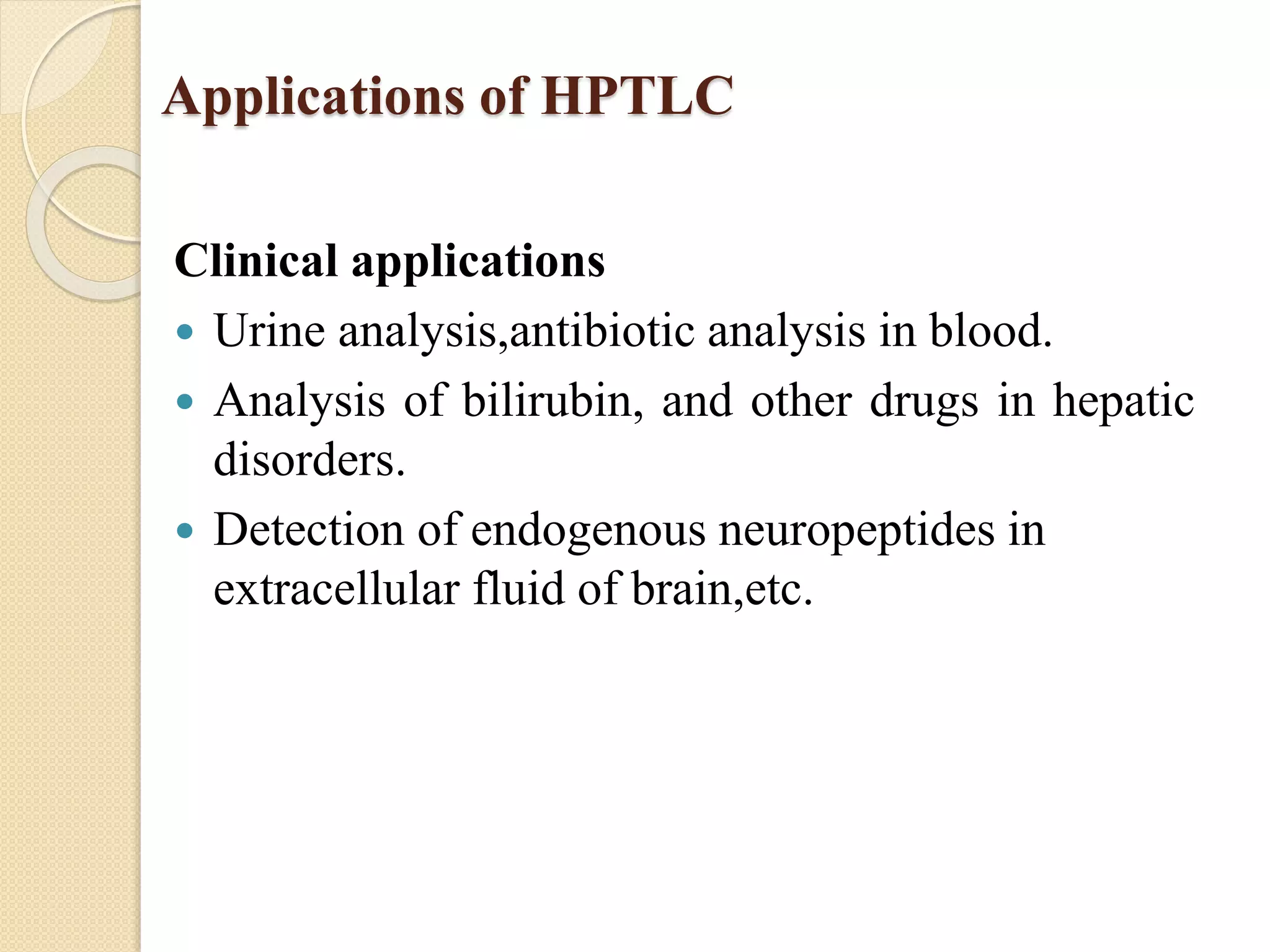
Applications of HPTLC
Clinical applications
 Urine analysis,antibiotic analysis in blood.
 Analysis of bilirubin, and other drugs in hepatic
disorders.
 Detection of endogenous neuropeptides in
extracellular fluid of brain,etc.
 Identification and quantification of drugs in
biological samples.
 Identification of steroids in blood.
 Analysis of dyes.
 Determination of cocaine and other drugs of
abuse in blood, urine etc.
FORENSIC APPLICATION
Bhavana Shivankar

Bhavana Shivankar

  • 1.
    CHROMATOGRAPHIC TECHNIQUES PRESENTED BY BHAVANA SHIVANKAR M.Sc.-II SEM DEPARTMENT OF CRIMINOLOGY AND FORENSIC SCIENCE
  • 2.
    CHROMATOGRAPHY IUPAC Defined chromatographyas, It is a physical method of separation in which the components to be separated are distributed between two phases, one is stationary while the other moves.
  • 3.
     Chromatography wasinvented by Mikhail Tswett, a botanist in 1906. He had successfully separated chlorophyll, xanthophylls and other colored substances by percolating vegetable extract through a column of calcium carbonate.  Paper chromatography was first introduced by German scientist Christian Freidrich Schonbein.  A.J.P. Martin, was awarded the Nobel prize for his work in developing liquid-liquid and paper chromatography in 1941 and recognized for the development of gas chromatography. HISTORICAL BACKGROUND
  • 4.
    Conti…  In 1952,A.P.J.Martin and Richard Laurence Millington Synge was awarded Nobel Prize for invention of partition chromatography.
  • 5.
    PRINCIPLE Chromatography is basedon the principle of selective distribution of the components of a mixture between stationary (stagnant) and mobile phase(moving). Stationary phase can a solid or a liquid while the mobile phase can be a liquid or gas.
  • 6.
    CLASSIFICATION OF CHROMATOGRAPHIC METHODS Based upon the physical means by which stationary and mobile phases are brought into contact; 1. Planar chromatography 2. Column chromatography
  • 7.
    CLASSIFICATION OF CHROMATOGRAPHIC METHODS Based upon mobile and stationary phase and kind of equilibrium established between two phases. 1. Gas chromatography 2. Liquid chromatography  Based upon the mechanism of separation 1. Adsorption 2. Partition
  • 8.
    PLANAR CHROMATOGRAPHY  Inplanar chromatography, the stationary phase is supported on a flat plate or in the interstices of paper; here the mobile phase moves through the stationary phase by capillary action or under the influence of gravity.  In this the position of migrated spots on chromatograms are indicated by retention or retardation factor (Rf). Rf= distance travelled by solute from baseline distance travelled by solvent from baseline
  • 9.
  • 10.
    HPTLC(HIGH PERFORMANCE THIN LAYERCHROMATOGRAPHY) The advanced form of TLC is HPTLC. It is a validated method for qualitative and quantitative analysis. Instrument works on sophisticated software which ensure the highest degree of usefulness, reliability and reproducibility.
  • 12.
  • 13.
    INSTRUMENTATION Fig. (A) applicationof sample, (B) Chromatographic development chamber, (C)Detection & Visualization.
  • 14.
    COLUMN CHROMATOGRAPHY In columnchromatography, the stationary phase is held in a narrow tube through which the mobile phase is forced under pressure.
  • 15.
    COLUMN CHROMATOGRAPHY In thismethod, the mixture to be separated is dissolved in suitable solvent and allowed to pass through tube containing adsorbent. The components which has greater adsorbing power is adsorbed in upper pert of the column. The next component is adsorbed in lower portion of column which has lesser absorbing power than the first component.
  • 16.
    HPLC  HPLC wasreferred as High Pressure Liquid Chromatography but nowadays the term is referred as High Performance Liquid Chromatography.  Types of HPLC : Based on modes of chromatography 1. Normal phase mode 2. Reverse phase mode Based on principle of separation 1. Adsorption chromatography 2. Ion exchange chromatography 3. Partition chromatography 4. Size exclusion
  • 17.
    Conti… Based on elutiontechnique 1. Isocratic separation 2. Gradient separation Based on type of analysis 1. Qualitative analysis 2. Quantitative analysis
  • 18.
  • 19.
    HPLC (HIGH PERFORMANCE LIQUIDCHROMATOGRAPHY)  A solvent reservoir  A high pressure pump  Sample injection port  A column  A detector and recording unit
  • 20.
    SOLVENT RESERVOIR Mobile phasecontents are contained in a glass reservoir. The mobile phase , or solvent, in HPTLC is usually a mixture of polar and non- polar liquid components whose respective concentrations are varied depending on the composition of the sample.  Isocratic separation  Gradient separation
  • 21.
    PUMP A pump aspiratesthe mobile phase from the solvent reservoir and forces it through the system’s column and detector. Depending on the particle size of stationary phase, the flow rate and the composition of the mobile phase, operating pressures are generated.
  • 22.
    SAMPLE INJECTOR The injectioncan be single or an automated injection. An injector for an HPLC system should provide injection of the liquid sample within the range of 0.1-100 ml of volume with high reproducibility and under high pressure.
  • 23.
    COLUMN Columns are usuallymade up of polished stainless steel, are between 50 and 300 mm long and have an internal diameter between 2- 5 mm. Ideally the temperature of column and mobile phase should be constant during an analysis. Column packing ◦ Microporous ◦ Pellicular ◦ Bonded Phase
  • 24.
    DETECTOR The HPLC detectorsare located at the end of the column, detect the analytes as they elute from the chromatographic column. Commonly used detectors are UV – spectroscope, fluorescence, electrochemical and mass spectrometric detectors.
  • 25.
    DATA COLLECTION DEVICES Signalsfrom detector may be collected on chart recorders or electronic integrators that vary in complexity and in their ability to process, store and reprocess chromatographic data. The computer integrates the response of the detector to each component and placed it into a chromatograph that is easy to read and interpret.
  • 26.
    Applications of HPLC Pharmaceuticalapplications  Pharmaceutical quality control  Tablet dissolution study of pharmaceutical dosages form. Environmental applications  Detection of phenolic compounds in drinking water.  Bio monitoring of pollutants. Food and flavor  Measurement of quality of soft drinks and water.  Sugar analysis in fruit juices.  Analysis of adulterants in food materials.  Preservative analysis.
  • 27.
    Applications of HPTLC Clinicalapplications  Urine analysis,antibiotic analysis in blood.  Analysis of bilirubin, and other drugs in hepatic disorders.  Detection of endogenous neuropeptides in extracellular fluid of brain,etc.
  • 28.
     Identification andquantification of drugs in biological samples.  Identification of steroids in blood.  Analysis of dyes.  Determination of cocaine and other drugs of abuse in blood, urine etc. FORENSIC APPLICATION