CYBER CRIME
&
IT’S TYPES
Presented By;
Bhupeshkumar Nanhe
Assist. Professor,
Dept. of Forensic Science
SoS, JECRC University, Jaipur (RJ), India
INTRODUCTION TO COMPUTER FORENSIC
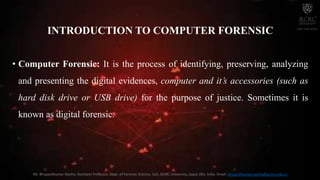
• Computer Forensic: It is the process of identifying, preserving, analyzing
and presenting the digital evidences, computer and it’s accessories (such as
hard disk drive or USB drive) for the purpose of justice. Sometimes it is
known as digital forensic.
Mr. Bhupeshkumar Nanhe, Assistant Professor, Dept. of Forensic Science, SoS, JECRC University, Jaipur (RJ), India. Email: bhupeshkumar.nanhe@jecrcu.edu.in
INTRODUCTION TO COMPUTER CRIME
AND CYBER CRIME
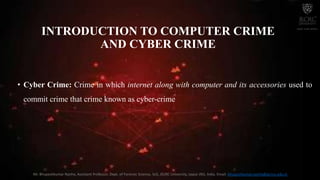
• Cyber Crime: Crime in which internet along with computer and its accessories used to
commit crime that crime known as cyber-crime
Mr. Bhupeshkumar Nanhe, Assistant Professor, Dept. of Forensic Science, SoS, JECRC University, Jaipur (RJ), India. Email: bhupeshkumar.nanhe@jecrcu.edu.in
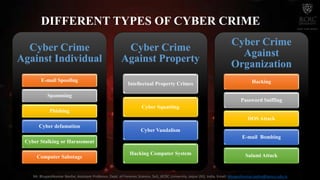
DIFFERENT TYPES OF CYBER CRIME
Cyber Crime
Against Individual
E-mail Spoofing
Spamming
Phishing
Cyber defamation
Cyber Stalking or Harassment
Computer Sabotage
Cyber Crime
Against Property
Intellectual Property Crimes
Cyber Squatting
Cyber Vandalism
Hacking Computer System
Cyber Crime
Against
Organization
Hacking
Password Sniffing
DOS Attack
E-mail Bombing
Salami Attack
Mr. Bhupeshkumar Nanhe, Assistant Professor, Dept. of Forensic Science, SoS, JECRC University, Jaipur (RJ), India. Email: bhupeshkumar.nanhe@jecrcu.edu.in
CYBER CRIME AGAINST INDIVIDUAL1
• E-Mail Spoofing: This means a spoofed email is one that appears to originate from one
source but actually has been sent from another source. This can also be termed as E-Mail
forging or identity spoofing.
• Phishing: It is a type of social engineering attack often used to steal user data, including
login credentials (user ID and passwords) and credit card numbers. It occurs when an
attacker, pretend to be as a trusted entity, dupes a victim into opening an email, instant
message, or text message.
Mr. Bhupeshkumar Nanhe, Assistant Professor, Dept. of Forensic Science, SoS, JECRC University, Jaipur (RJ), India. Email: bhupeshkumar.nanhe@jecrcu.edu.in
• Spamming: Spam is the abuse of electronic messaging system to send
bulk messages indiscriminately
• Cyber defamation: It involves any person with intent to lower down
the dignity/image of the person by hacking his mail account and
sending some mails with using vulgar language to unknown persons
mail account.
CYBER CRIME AGAINST INDIVIDUAL2
Mr. Bhupeshkumar Nanhe, Assistant Professor, Dept. of Forensic Science, SoS, JECRC University, Jaipur (RJ), India. Email: bhupeshkumar.nanhe@jecrcu.edu.in
• Cyber stalking and harassment: The use of Internet to repeatedly harass
another person, group, or organization. This harassment could be sexual
in nature, or it could have other motivations including anger.
• Computer sabotage: the use of the internet to halt the normal
functioning of a computer system through the introduction of worms or
viruses is referred to as computer sabotage.
CYBER CRIME AGAINST INDIVIDUAL3
Mr. Bhupeshkumar Nanhe, Assistant Professor, Dept. of Forensic Science, SoS, JECRC University, Jaipur (RJ), India. Email: bhupeshkumar.nanhe@jecrcu.edu.in
CYBER CRIME AGAINST PROPERTY 1
• Intellectual Property Crimes: Any unlawful act by which the owner is
deprived completely or partially of his rights is a crime. The most common
type of crimes are software piracy, violation of copyright, trademark , theft of
computer source code, etc.
• Cyber Squatting: It involves two persons claiming for the same Domain Name
either by claiming that they had registered the name first.
Mr. Bhupeshkumar Nanhe, Assistant Professor, Dept. of Forensic Science, SoS, JECRC University, Jaipur (RJ), India. Email: bhupeshkumar.nanhe@jecrcu.edu.in
• Cyber Vandalism: Vandalism means damaging property of another.
Thus cyber vandalism means destroying or damaging the data or
information stored in computer when a network service is stopped or
disrupted.
• Hacking Computer System: Hacking in simple terms means illegal
intrusion into a computer system and/or network.
• Hacking attacks include Famous social networking sites such as
Facebook, Twitter, blogging platform by unauthorized access/control
over the computer. Due to the hacking activity there will be loss of
data as well as computer system.
CYBER CRIME AGAINST PROPERTY2
Mr. Bhupeshkumar Nanhe, Assistant Professor, Dept. of Forensic Science, SoS, JECRC University, Jaipur (RJ), India. Email: bhupeshkumar.nanhe@jecrcu.edu.in
CYBER CRIME AGAINST ORGANIZATION1
• Password sniffing: Password sniffers are programs that monitor
and record the name and password of network users as they login,
at site.
• E-mail bombing/mail bomb: refers to sending a large no of emails
to the victim to crash victim’s E-mail account or server crash.
Mr. Bhupeshkumar Nanhe, Assistant Professor, Dept. of Forensic Science, SoS, JECRC University, Jaipur (RJ), India. Email: bhupeshkumar.nanhe@jecrcu.edu.in
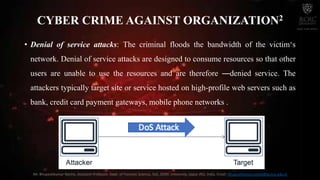
• Denial of service attacks: The criminal floods the bandwidth of the victim‘s
network. Denial of service attacks are designed to consume resources so that other
users are unable to use the resources and are therefore ―denied service. The
attackers typically target site or service hosted on high-profile web servers such as
bank, credit card payment gateways, mobile phone networks .
CYBER CRIME AGAINST ORGANIZATION2
Mr. Bhupeshkumar Nanhe, Assistant Professor, Dept. of Forensic Science, SoS, JECRC University, Jaipur (RJ), India. Email: bhupeshkumar.nanhe@jecrcu.edu.in
• Salami attack: these attacks used for committing financial crimes. The key
here is to make the alteration so insignificant that in a single case it would go
completely unnoticed e.g. a bank employee inserts a program into bank‘s
servers that deducts a small amount from the account of every customer.
CYBER CRIME AGAINST ORGANIZATION3
Mr. Bhupeshkumar Nanhe, Assistant Professor, Dept. of Forensic Science, SoS, JECRC University, Jaipur (RJ), India. Email: bhupeshkumar.nanhe@jecrcu.edu.in
SYMPTOMS OF CYBER ATTACK
• Files, applications, or services cannot be accessed by user.
• Accounts have been locked or the passwords have been changed without your knowledge.
• Files or software have been deleted or installed, or the contents have been changed without
your involvement.
• Suspicious pop-ups load when you access the internet, or unknown files or programmes
appear.
• Slower than normal internet speeds due to a spike in network traffic (or computers “hang”
or crash).
• Files have been automatically encrypted, blocking your access to them.
• Emails sent automatically without the user’s knowledge.
• No control over functions of the computer.
Mr. Bhupeshkumar Nanhe, Assistant Professor, Dept. of Forensic Science, SoS, JECRC University, Jaipur (RJ), India. Email: bhupeshkumar.nanhe@jecrcu.edu.in
PREVENTION
• Use strong passwords
• Secure your computer
• Block spyware attacks
• Install the latest operating system updates
• Protect your data
• Secure your wireless network
• Avoid being scammed
Mr. Bhupeshkumar Nanhe, Assistant Professor, Dept. of Forensic Science, SoS, JECRC University, Jaipur (RJ), India. Email: bhupeshkumar.nanhe@jecrcu.edu.in
LEGALACTS AGAINST CYBER CRIME
• The India Information Technology Act of 2000.
• CLOUD Act (Clarifying Lawful Overseas Use of Data)
• Govt. Initiatives
Mr. Bhupeshkumar Nanhe, Assistant Professor, Dept. of Forensic Science, SoS, JECRC University, Jaipur (RJ), India. Email: bhupeshkumar.nanhe@jecrcu.edu.in
Thank You
Mr. Bhupeshkumar Nanhe, Assistant Professor, Dept. of Forensic Science, SoS, JECRC University, Jaipur (RJ), India. Email: bhupeshkumar.nanhe@jecrcu.edu.in

L5 Cyber Crime.pptx

  • 1.
    CYBER CRIME & IT’S TYPES PresentedBy; Bhupeshkumar Nanhe Assist. Professor, Dept. of Forensic Science SoS, JECRC University, Jaipur (RJ), India
  • 2.
    INTRODUCTION TO COMPUTERFORENSIC • Computer Forensic: It is the process of identifying, preserving, analyzing and presenting the digital evidences, computer and it’s accessories (such as hard disk drive or USB drive) for the purpose of justice. Sometimes it is known as digital forensic. Mr. Bhupeshkumar Nanhe, Assistant Professor, Dept. of Forensic Science, SoS, JECRC University, Jaipur (RJ), India. Email: bhupeshkumar.nanhe@jecrcu.edu.in
  • 3.
    INTRODUCTION TO COMPUTERCRIME AND CYBER CRIME • Cyber Crime: Crime in which internet along with computer and its accessories used to commit crime that crime known as cyber-crime Mr. Bhupeshkumar Nanhe, Assistant Professor, Dept. of Forensic Science, SoS, JECRC University, Jaipur (RJ), India. Email: bhupeshkumar.nanhe@jecrcu.edu.in
  • 4.
    DIFFERENT TYPES OFCYBER CRIME Cyber Crime Against Individual E-mail Spoofing Spamming Phishing Cyber defamation Cyber Stalking or Harassment Computer Sabotage Cyber Crime Against Property Intellectual Property Crimes Cyber Squatting Cyber Vandalism Hacking Computer System Cyber Crime Against Organization Hacking Password Sniffing DOS Attack E-mail Bombing Salami Attack Mr. Bhupeshkumar Nanhe, Assistant Professor, Dept. of Forensic Science, SoS, JECRC University, Jaipur (RJ), India. Email: bhupeshkumar.nanhe@jecrcu.edu.in
  • 5.
    CYBER CRIME AGAINSTINDIVIDUAL1 • E-Mail Spoofing: This means a spoofed email is one that appears to originate from one source but actually has been sent from another source. This can also be termed as E-Mail forging or identity spoofing. • Phishing: It is a type of social engineering attack often used to steal user data, including login credentials (user ID and passwords) and credit card numbers. It occurs when an attacker, pretend to be as a trusted entity, dupes a victim into opening an email, instant message, or text message. Mr. Bhupeshkumar Nanhe, Assistant Professor, Dept. of Forensic Science, SoS, JECRC University, Jaipur (RJ), India. Email: bhupeshkumar.nanhe@jecrcu.edu.in
  • 6.
    • Spamming: Spamis the abuse of electronic messaging system to send bulk messages indiscriminately • Cyber defamation: It involves any person with intent to lower down the dignity/image of the person by hacking his mail account and sending some mails with using vulgar language to unknown persons mail account. CYBER CRIME AGAINST INDIVIDUAL2 Mr. Bhupeshkumar Nanhe, Assistant Professor, Dept. of Forensic Science, SoS, JECRC University, Jaipur (RJ), India. Email: bhupeshkumar.nanhe@jecrcu.edu.in
  • 7.
    • Cyber stalkingand harassment: The use of Internet to repeatedly harass another person, group, or organization. This harassment could be sexual in nature, or it could have other motivations including anger. • Computer sabotage: the use of the internet to halt the normal functioning of a computer system through the introduction of worms or viruses is referred to as computer sabotage. CYBER CRIME AGAINST INDIVIDUAL3 Mr. Bhupeshkumar Nanhe, Assistant Professor, Dept. of Forensic Science, SoS, JECRC University, Jaipur (RJ), India. Email: bhupeshkumar.nanhe@jecrcu.edu.in
  • 8.
    CYBER CRIME AGAINSTPROPERTY 1 • Intellectual Property Crimes: Any unlawful act by which the owner is deprived completely or partially of his rights is a crime. The most common type of crimes are software piracy, violation of copyright, trademark , theft of computer source code, etc. • Cyber Squatting: It involves two persons claiming for the same Domain Name either by claiming that they had registered the name first. Mr. Bhupeshkumar Nanhe, Assistant Professor, Dept. of Forensic Science, SoS, JECRC University, Jaipur (RJ), India. Email: bhupeshkumar.nanhe@jecrcu.edu.in
  • 9.
    • Cyber Vandalism:Vandalism means damaging property of another. Thus cyber vandalism means destroying or damaging the data or information stored in computer when a network service is stopped or disrupted. • Hacking Computer System: Hacking in simple terms means illegal intrusion into a computer system and/or network. • Hacking attacks include Famous social networking sites such as Facebook, Twitter, blogging platform by unauthorized access/control over the computer. Due to the hacking activity there will be loss of data as well as computer system. CYBER CRIME AGAINST PROPERTY2 Mr. Bhupeshkumar Nanhe, Assistant Professor, Dept. of Forensic Science, SoS, JECRC University, Jaipur (RJ), India. Email: bhupeshkumar.nanhe@jecrcu.edu.in
  • 10.
    CYBER CRIME AGAINSTORGANIZATION1 • Password sniffing: Password sniffers are programs that monitor and record the name and password of network users as they login, at site. • E-mail bombing/mail bomb: refers to sending a large no of emails to the victim to crash victim’s E-mail account or server crash. Mr. Bhupeshkumar Nanhe, Assistant Professor, Dept. of Forensic Science, SoS, JECRC University, Jaipur (RJ), India. Email: bhupeshkumar.nanhe@jecrcu.edu.in
  • 11.
    • Denial ofservice attacks: The criminal floods the bandwidth of the victim‘s network. Denial of service attacks are designed to consume resources so that other users are unable to use the resources and are therefore ―denied service. The attackers typically target site or service hosted on high-profile web servers such as bank, credit card payment gateways, mobile phone networks . CYBER CRIME AGAINST ORGANIZATION2 Mr. Bhupeshkumar Nanhe, Assistant Professor, Dept. of Forensic Science, SoS, JECRC University, Jaipur (RJ), India. Email: bhupeshkumar.nanhe@jecrcu.edu.in
  • 12.
    • Salami attack:these attacks used for committing financial crimes. The key here is to make the alteration so insignificant that in a single case it would go completely unnoticed e.g. a bank employee inserts a program into bank‘s servers that deducts a small amount from the account of every customer. CYBER CRIME AGAINST ORGANIZATION3 Mr. Bhupeshkumar Nanhe, Assistant Professor, Dept. of Forensic Science, SoS, JECRC University, Jaipur (RJ), India. Email: bhupeshkumar.nanhe@jecrcu.edu.in
  • 13.
    SYMPTOMS OF CYBERATTACK • Files, applications, or services cannot be accessed by user. • Accounts have been locked or the passwords have been changed without your knowledge. • Files or software have been deleted or installed, or the contents have been changed without your involvement. • Suspicious pop-ups load when you access the internet, or unknown files or programmes appear. • Slower than normal internet speeds due to a spike in network traffic (or computers “hang” or crash). • Files have been automatically encrypted, blocking your access to them. • Emails sent automatically without the user’s knowledge. • No control over functions of the computer. Mr. Bhupeshkumar Nanhe, Assistant Professor, Dept. of Forensic Science, SoS, JECRC University, Jaipur (RJ), India. Email: bhupeshkumar.nanhe@jecrcu.edu.in
  • 14.
    PREVENTION • Use strongpasswords • Secure your computer • Block spyware attacks • Install the latest operating system updates • Protect your data • Secure your wireless network • Avoid being scammed Mr. Bhupeshkumar Nanhe, Assistant Professor, Dept. of Forensic Science, SoS, JECRC University, Jaipur (RJ), India. Email: bhupeshkumar.nanhe@jecrcu.edu.in
  • 15.
    LEGALACTS AGAINST CYBERCRIME • The India Information Technology Act of 2000. • CLOUD Act (Clarifying Lawful Overseas Use of Data) • Govt. Initiatives Mr. Bhupeshkumar Nanhe, Assistant Professor, Dept. of Forensic Science, SoS, JECRC University, Jaipur (RJ), India. Email: bhupeshkumar.nanhe@jecrcu.edu.in
  • 16.
    Thank You Mr. BhupeshkumarNanhe, Assistant Professor, Dept. of Forensic Science, SoS, JECRC University, Jaipur (RJ), India. Email: bhupeshkumar.nanhe@jecrcu.edu.in