A SEMINOR ON SELF COMPACTING
CONCRETE
Prepared by
P.Bharath Kumar
INTRODUCTION:
Mixing concrete srructures without vibration,have been
done in the past.
for examples placement of concrete under water is done by
the use of tremie with out vibration
mass concrete and shaft concrete can be successfully placed
without vibration.
But the above examples of concrete are generally of lower
strength and difficult to obtain consistent quality
Modern application of self-compacting concrete (SCC) is
focused on high performance - better and more reliable quality
Recognizing the lack of uniformity and complete
compaction of concrete by vibration
 researchers at the University of Tokyo, Japan, started out in
late 1980's to develop SCC
By the early 1990's, Japan has developed and used SCC that
does not require vibration to achieve full compaction.
By the year 2000,the scc has become popular in japan.
Advantages of scc
Low noise-level in the plants and construction sites.
Eliminated problems associated with vibration.
Less labor involved.
Faster construction.
Improved quality and durability.
Higher strength. Faster construction.
APPLICATIONS OF SELF COMPACTING
CONCRETE
Since the development of the prototype of self-compacting
concrete in 1988
the use of self-compacting concrete in actual structures has
gradually increased.
The main reasons for the employment of self-compacting
concrete can be summarized as follows:
 To shorten construction period
To assure compaction in the structure: especially in
confined zones where vibrating compaction is difficult
 To eliminate noise due to vibration: effective especially at
concrete products plants
Test Methods for Fresh SCC
The Slump Flow Test
This is a test method for evaluating the flow ability of SCC,
where the slump flow of SCC with coarse aggregates having
the maximum size of less than 40 mm is measured.
The basic equipment is the same as for the conventional slump
test. However, the concrete placed into the mold is not rodded.
When the slump cone has been lifted and the sample has
collapsed, the diameter of the spread is measured rather than
the vertical distance of the collapse.
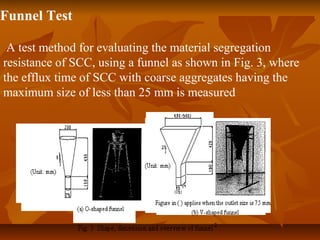
Funnel Test
A test method for evaluating the material segregation
resistance of SCC, using a funnel as shown in Fig. 3, where
the efflux time of SCC with coarse aggregates having the
maximum size of less than 25 mm is measured
T50 Test
A test method for evaluating the material segregation
resistance of SCC, where the 500-mm flow reach time is
measured in the slump flow test above, that is, the time for the
flow to reach 500 mm is measured in the slump flow test. SCC
should give T50 = 2 - 5 seconds.
U-Type and Box-Type Tests
These are methods for testing flow ability of SCC through an
obstacle with coarse aggregates having the maximum size of
less than 25 mm (Fig. 4 and Photo 1). Time and height to be
filled in the chamber B and amount of aggregate passed
through the obstacle are measured for self-compact ability.
Fig. 4 Shape of Filling Unit and Flow Obstacle 2
Photo 1 Box Type Filling Unit and Flow Obstacle
Properties of Hardened SCC
1 Structural Properties
The basic ingredients used in SCC mixes are practically the
same as those used in the conventional HPC vibrated concrete,
except they are mixed in different proportions and the addition
of special admixtures to meet the project specifications for
SCC
The hardened properties are expected to be similar to those
obtainable with HPC concrete. Laboratory and field tests have
demonstrated that the SCC hardened properties are indeed
similar to those of HPC. Table 3 shows some of the structural
properties of SCC.
Table 3 Structural Properties of SCC2
Items SCC
Water-binder ratio (%) 25 to 40
Air content (%) 4.5-6.0
Compressive strength (age: 28 days) (MPa) 40 to 80
Compressive strength (age: 91 days) (MPa) 55 to 100
Splitting tensile strength (age:28 days)
(MPa)
2.4 to 4.8
Elastic modulus (GPa) 30 to 36
Shrinkage strain (x 10-6
) 600 to 800
Compressive Strength
SCC compressive strengths are comparable to those of
conventional vibrated concrete made with similar mix
proportions and water/cement ratio. There is no
difficulty in producing SCC with compressive
strengths up to 60MPa.
Tensile Strength
Tensile strengths are based on the indirect splitting
test on cylinders. For SCC, the tensile strengths and
the ratios of tensile and compressive strengths are in
the same order of magnitude as the conventional
vibrated concrete.
Bond Strength
Pull-out tests have been performed to determine the strength
of the bond between concrete and reinforcement of different
diameters. In general, the SCC bond strengths expressed in
terms of the compressive strengths are higher than those of
conventional concrete.
Modulus of Elasticity
SCC and conventional concrete bear a similar relationship
between modulus of elasticity and compressive strength
expressed in the form E/(fc)0.5, where E = modulus of
elasticity, fc = compressive strength. This is similar to the one
recommended by ACI for conventional normal weight
concrete.
THANK YOU

civil engineer

  • 1.
    A SEMINOR ONSELF COMPACTING CONCRETE Prepared by P.Bharath Kumar
  • 2.
    INTRODUCTION: Mixing concrete srructureswithout vibration,have been done in the past. for examples placement of concrete under water is done by the use of tremie with out vibration mass concrete and shaft concrete can be successfully placed without vibration. But the above examples of concrete are generally of lower strength and difficult to obtain consistent quality Modern application of self-compacting concrete (SCC) is focused on high performance - better and more reliable quality
  • 3.
    Recognizing the lackof uniformity and complete compaction of concrete by vibration  researchers at the University of Tokyo, Japan, started out in late 1980's to develop SCC By the early 1990's, Japan has developed and used SCC that does not require vibration to achieve full compaction. By the year 2000,the scc has become popular in japan.
  • 4.
    Advantages of scc Lownoise-level in the plants and construction sites. Eliminated problems associated with vibration. Less labor involved. Faster construction. Improved quality and durability. Higher strength. Faster construction.
  • 5.
    APPLICATIONS OF SELFCOMPACTING CONCRETE Since the development of the prototype of self-compacting concrete in 1988 the use of self-compacting concrete in actual structures has gradually increased. The main reasons for the employment of self-compacting concrete can be summarized as follows:
  • 6.
     To shortenconstruction period To assure compaction in the structure: especially in confined zones where vibrating compaction is difficult  To eliminate noise due to vibration: effective especially at concrete products plants
  • 7.
    Test Methods forFresh SCC The Slump Flow Test This is a test method for evaluating the flow ability of SCC, where the slump flow of SCC with coarse aggregates having the maximum size of less than 40 mm is measured. The basic equipment is the same as for the conventional slump test. However, the concrete placed into the mold is not rodded. When the slump cone has been lifted and the sample has collapsed, the diameter of the spread is measured rather than the vertical distance of the collapse.
  • 9.
    Funnel Test A testmethod for evaluating the material segregation resistance of SCC, using a funnel as shown in Fig. 3, where the efflux time of SCC with coarse aggregates having the maximum size of less than 25 mm is measured
  • 10.
    T50 Test A testmethod for evaluating the material segregation resistance of SCC, where the 500-mm flow reach time is measured in the slump flow test above, that is, the time for the flow to reach 500 mm is measured in the slump flow test. SCC should give T50 = 2 - 5 seconds. U-Type and Box-Type Tests These are methods for testing flow ability of SCC through an obstacle with coarse aggregates having the maximum size of less than 25 mm (Fig. 4 and Photo 1). Time and height to be filled in the chamber B and amount of aggregate passed through the obstacle are measured for self-compact ability.
  • 11.
    Fig. 4 Shapeof Filling Unit and Flow Obstacle 2 Photo 1 Box Type Filling Unit and Flow Obstacle
  • 12.
    Properties of HardenedSCC 1 Structural Properties The basic ingredients used in SCC mixes are practically the same as those used in the conventional HPC vibrated concrete, except they are mixed in different proportions and the addition of special admixtures to meet the project specifications for SCC The hardened properties are expected to be similar to those obtainable with HPC concrete. Laboratory and field tests have demonstrated that the SCC hardened properties are indeed similar to those of HPC. Table 3 shows some of the structural properties of SCC.
  • 13.
    Table 3 StructuralProperties of SCC2 Items SCC Water-binder ratio (%) 25 to 40 Air content (%) 4.5-6.0 Compressive strength (age: 28 days) (MPa) 40 to 80 Compressive strength (age: 91 days) (MPa) 55 to 100 Splitting tensile strength (age:28 days) (MPa) 2.4 to 4.8 Elastic modulus (GPa) 30 to 36 Shrinkage strain (x 10-6 ) 600 to 800
  • 14.
    Compressive Strength SCC compressivestrengths are comparable to those of conventional vibrated concrete made with similar mix proportions and water/cement ratio. There is no difficulty in producing SCC with compressive strengths up to 60MPa. Tensile Strength Tensile strengths are based on the indirect splitting test on cylinders. For SCC, the tensile strengths and the ratios of tensile and compressive strengths are in the same order of magnitude as the conventional vibrated concrete.
  • 15.
    Bond Strength Pull-out testshave been performed to determine the strength of the bond between concrete and reinforcement of different diameters. In general, the SCC bond strengths expressed in terms of the compressive strengths are higher than those of conventional concrete. Modulus of Elasticity SCC and conventional concrete bear a similar relationship between modulus of elasticity and compressive strength expressed in the form E/(fc)0.5, where E = modulus of elasticity, fc = compressive strength. This is similar to the one recommended by ACI for conventional normal weight concrete.
  • 16.