M.E-CONSTRUCTION ENGINEERING
& MANAGEMENT
BIRLA
VISHVAKARMA
MAHAVIDHYALAYA
PREPAIRED BY:
PRANAV CHOVATIYA(1st year)
(15CMT012)
M.E-CONSTRUCTION ENGINEERING
& MANAGEMENT
B.V.M. ENGINEERING COLLEGE
VALLABH VIDHYANAGAR
UNDER GUIDANCE OF:
Dr. JAYESHKUMAR R.PITRODA
ASSISTANT PROFESSOR
CIVIL ENGINEERING DEPARTMENT
B.V.M. ENGINEERING COLLEGE
VALLABH VIDHYANAGAR
REVIEW PRESENTATION OF PAPER (RP)
ADVANCED CONSTRUCTION TECHNIQUES
GEOPOLYMER CONCRETE AN ECO-FRIENDLY
CONSTRUCTION MATERIAL
AUTHOR & JOURNAL
 Krishnan, S.Karthikeyan, S.Nathiya, K. Suganya
 (Assistant Professors, Department of Civil Engineering,
Knowledge Institute of Technology, Salem)
 International Journal of Research in Engineering and
Technology
 eISSN: 2319-1163 , pISSN: 2321-7308
2
WHAT IS POLYMER CONCRETE ?
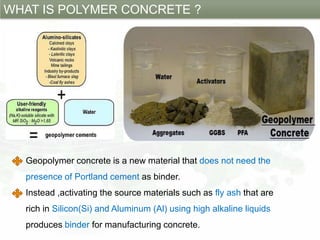
Geopolymer concrete is a new material that does not need the
presence of Portland cement as binder.
Instead ,activating the source materials such as fly ash that are
rich in Silicon(Si) and Aluminum (Al) using high alkaline liquids
produces binder for manufacturing concrete.
WHY WE USE ?
 The major problem that the world is facing today is the environmental
pollution.
 In the construction industry mainly the production of ordinary Portland
cement (OPC) will cause the emission of pollutants which results in
environmental pollution.
 The emission of carbon dioxide during the production of ordinary
Portland cement is tremendous because the production of one ton of
Portland cement emits approximately one ton of CO2 into the
atmosphere.
 In terms of global warming, the geopolymer concrete significantly reduce
the CO2 emission to the atmosphere caused by the cement industries
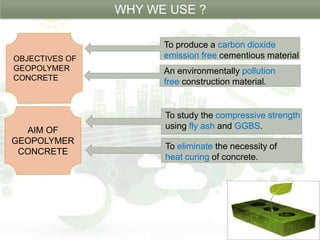
OBJECTIVES OF
GEOPOLYMER
CONCRETE
To produce a carbon dioxide
emission free cementious material
An environmentally pollution
free construction material.
WHY WE USE ?
AIM OF
GEOPOLYMER
CONCRETE
To study the compressive strength
using fly ash and GGBS.
.
To eliminate the necessity of
heat curing of concrete.
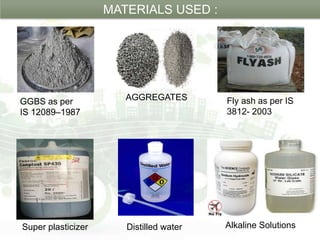
MATERIALS USED :
Fly ash as per IS
3812- 2003
GGBS as per
IS 12089–1987
Super plasticizer Alkaline SolutionsDistilled water
AGGREGATES
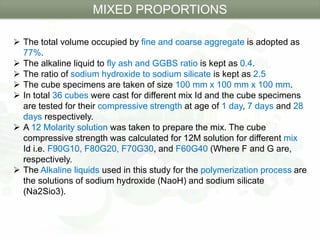
 The total volume occupied by fine and coarse aggregate is adopted as
77%.
 The alkaline liquid to fly ash and GGBS ratio is kept as 0.4.
 The ratio of sodium hydroxide to sodium silicate is kept as 2.5
 The cube specimens are taken of size 100 mm x 100 mm x 100 mm.
 In total 36 cubes were cast for different mix Id and the cube specimens
are tested for their compressive strength at age of 1 day, 7 days and 28
days respectively.
 A 12 Molarity solution was taken to prepare the mix. The cube
compressive strength was calculated for 12M solution for different mix
Id i.e. F90G10, F80G20, F70G30, and F60G40 (Where F and G are,
respectively.
 The Alkaline liquids used in this study for the polymerization process are
the solutions of sodium hydroxide (NaoH) and sodium silicate
(Na2Sio3).
MIXED PROPORTIONS
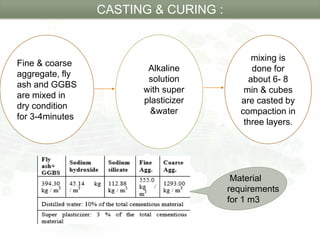
CASTING & CURING :
Fine & coarse
aggregate, fly
ash and GGBS
are mixed in
dry condition
for 3-4minutes
Alkaline
solution
with super
plasticizer
&water
mixing is
done for
about 6- 8
min & cubes
are casted by
compaction in
three layers.
Material
requirements
for 1 m3
TEST RESULTS
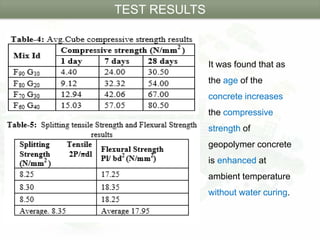
It was found that as
the age of the
concrete increases
the compressive
strength of
geopolymer concrete
is enhanced at
ambient temperature
without water curing.
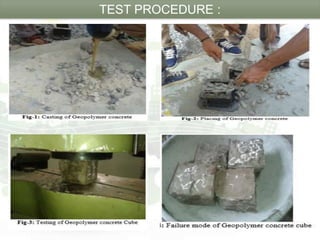
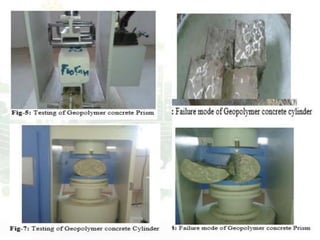
TEST PROCEDURE :
Based on the results obtained in the experimental investigation, the following
conclusions are drawn.
 The geopolymer concrete gained strength within 24 hours at ambient
temperature without water curing.
 The necessity of heat curing of concrete was eliminated by incorporating
GGBS and fly ash in a concrete mix.
 The strength of geopolymer concrete was increased with increase in
percentage of GGBS in a mix.
 It was observed that the mix Id F60 G40 gave maximum compressive
strength of 80.50N/mm2.
CONCLUSION
geopolymer

geopolymer

  • 1.
    M.E-CONSTRUCTION ENGINEERING & MANAGEMENT BIRLA VISHVAKARMA MAHAVIDHYALAYA PREPAIREDBY: PRANAV CHOVATIYA(1st year) (15CMT012) M.E-CONSTRUCTION ENGINEERING & MANAGEMENT B.V.M. ENGINEERING COLLEGE VALLABH VIDHYANAGAR UNDER GUIDANCE OF: Dr. JAYESHKUMAR R.PITRODA ASSISTANT PROFESSOR CIVIL ENGINEERING DEPARTMENT B.V.M. ENGINEERING COLLEGE VALLABH VIDHYANAGAR REVIEW PRESENTATION OF PAPER (RP) ADVANCED CONSTRUCTION TECHNIQUES GEOPOLYMER CONCRETE AN ECO-FRIENDLY CONSTRUCTION MATERIAL
  • 2.
    AUTHOR & JOURNAL Krishnan, S.Karthikeyan, S.Nathiya, K. Suganya  (Assistant Professors, Department of Civil Engineering, Knowledge Institute of Technology, Salem)  International Journal of Research in Engineering and Technology  eISSN: 2319-1163 , pISSN: 2321-7308 2
  • 3.
    WHAT IS POLYMERCONCRETE ? Geopolymer concrete is a new material that does not need the presence of Portland cement as binder. Instead ,activating the source materials such as fly ash that are rich in Silicon(Si) and Aluminum (Al) using high alkaline liquids produces binder for manufacturing concrete.
  • 4.
    WHY WE USE?  The major problem that the world is facing today is the environmental pollution.  In the construction industry mainly the production of ordinary Portland cement (OPC) will cause the emission of pollutants which results in environmental pollution.  The emission of carbon dioxide during the production of ordinary Portland cement is tremendous because the production of one ton of Portland cement emits approximately one ton of CO2 into the atmosphere.  In terms of global warming, the geopolymer concrete significantly reduce the CO2 emission to the atmosphere caused by the cement industries
  • 5.
    OBJECTIVES OF GEOPOLYMER CONCRETE To producea carbon dioxide emission free cementious material An environmentally pollution free construction material. WHY WE USE ? AIM OF GEOPOLYMER CONCRETE To study the compressive strength using fly ash and GGBS. . To eliminate the necessity of heat curing of concrete.
  • 6.
    MATERIALS USED : Flyash as per IS 3812- 2003 GGBS as per IS 12089–1987 Super plasticizer Alkaline SolutionsDistilled water AGGREGATES
  • 7.
     The totalvolume occupied by fine and coarse aggregate is adopted as 77%.  The alkaline liquid to fly ash and GGBS ratio is kept as 0.4.  The ratio of sodium hydroxide to sodium silicate is kept as 2.5  The cube specimens are taken of size 100 mm x 100 mm x 100 mm.  In total 36 cubes were cast for different mix Id and the cube specimens are tested for their compressive strength at age of 1 day, 7 days and 28 days respectively.  A 12 Molarity solution was taken to prepare the mix. The cube compressive strength was calculated for 12M solution for different mix Id i.e. F90G10, F80G20, F70G30, and F60G40 (Where F and G are, respectively.  The Alkaline liquids used in this study for the polymerization process are the solutions of sodium hydroxide (NaoH) and sodium silicate (Na2Sio3). MIXED PROPORTIONS
  • 8.
    CASTING & CURING: Fine & coarse aggregate, fly ash and GGBS are mixed in dry condition for 3-4minutes Alkaline solution with super plasticizer &water mixing is done for about 6- 8 min & cubes are casted by compaction in three layers. Material requirements for 1 m3
  • 9.
    TEST RESULTS It wasfound that as the age of the concrete increases the compressive strength of geopolymer concrete is enhanced at ambient temperature without water curing.
  • 10.
  • 12.
    Based on theresults obtained in the experimental investigation, the following conclusions are drawn.  The geopolymer concrete gained strength within 24 hours at ambient temperature without water curing.  The necessity of heat curing of concrete was eliminated by incorporating GGBS and fly ash in a concrete mix.  The strength of geopolymer concrete was increased with increase in percentage of GGBS in a mix.  It was observed that the mix Id F60 G40 gave maximum compressive strength of 80.50N/mm2. CONCLUSION