Koya University
Faculty of Engineering
Civil Department - 2ndStage
Concrete Technology
Test no: 6
Slump Test of Fresh Concrete
Student Name: Muhammad Saleem Asaad
Group: B
Expr Date:14-2-2016
Submission Date: -2-2016
Introduction
Slump test is the most commonly used method of measuring
consistency of concrete, which can be employed either in laboratory or
at site of work. It is not a suitable method for very wet or very dry
concrete. It does not measure all factors contributing to workability,
nor is always representative of the applicability of the concrete.
However, it is used conveniently as a control test and gives an
indication of the uniformity of concrete from batch to batch. The
deformation shows the characteristics of concrete with respect to
tendency for segregation
Apparatus
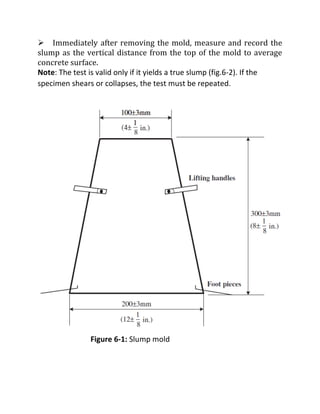
1. Slump mold of galvanized iron or steel (figure 6-1).
2. Scoop.
3. Sampling try.
4. Shovel
5. Tamping rod (16mm dia. and 600mm long).
6. Steel ruler or tape.
Procedure
Calculate the volume of the frustum by taking average of end
areas multiplied by the height, to estimate the amount of fresh
concrete required for the test.
The total weight of concrete required for the test is calculated
by multiplying volume of the mold by unit weight of concrete (2300
– 2400 kg/m3).
Prepare a sample of concrete mixture having (1:2:4) mixing
proportion or directly take a sample of fresh concrete from the
delivered concrete mixer if you are in the field.
After calculating weight of the ingredients, take water/cement
ratio of (0.6) to make the concrete mixture.
Mix the dry ingredients thoroughly until a uniform mixture is
obtained, then pour the calculated amount of water into the mixture
and make a homogenous mixture of fresh concrete.
Lubricate the inner surface of the slump mold.
Put the slump mold on the try (wide end facing down). While
firmly holding the mold, fill one third of the mold with fresh
concrete and tamp it with 25 strokes of the tamping rod (the strokes
must be distributed uniformly over the cross-section of the layer
and penetrate the layer to its full depth).
Fill the second and third layer of the mold by the same manner.
After the top layer have been tamped, strike off the concrete
level with the top of the mold with a sawing motion of the tamping
rod.
With the mold still held down, clean the excess concrete around
the mold.
Remove the mold by raising it vertically slowly and carefully in
5 to 10 seconds in one move. The entire operation from the start of
filling to the removal of the mold shall be carried out without
interruption within 2.5 minutes.
Immediately after removing the mold, measure and record the
slump as the vertical distance from the top of the mold to average
concrete surface.
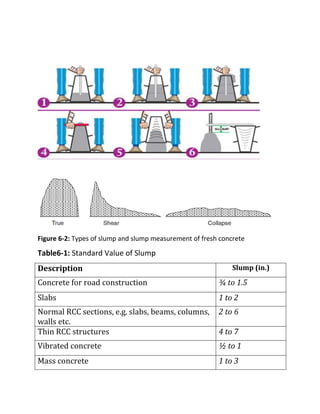
Note: The test is valid only if it yields a true slump (fig.6-2). If the
specimen shears or collapses, the test must be repeated.
Figure 6-1: Slump mold
Figure 6-2: Types of slump and slump measurement of fresh concrete
Table6-1: Standard Value of Slump
Description Slump (in.)
Concrete for road construction ¾ to 1.5
Slabs 1 to 2
Normal RCC sections, e.g. slabs, beams, columns,
walls etc.
2 to 6
Thin RCC structures 4 to 7
Vibrated concrete ½ to 1
Mass concrete 1 to 3
Discussion
Slump test is most commonly used to determine
consistency of concrete because this test is useful to
design or determine mix propagation of a sample. Our
result in the test is dry when we use a small amount of
water in a specific amount of sand cement and gravel it
get 41mm slump, but when we use the small amount of
superglayser for the same proportion of the sample the
slump is measured 250mm.then measure 210mm when
we increase water of a sample. This test is important for
known slump or the sample and by this we can know
workability of the concrete. During test may be have
same errors for example if our balance is not true and
read error or when we mix the sample by mixer not mix
good or not hint by tamping rod. In conclusion this test is
very useful for engineering works because by this test we
know slump or workability of the sample and we know
that sample 2 and sample 3 is more use in engineering
works.

Slump

  • 1.
    Koya University Faculty ofEngineering Civil Department - 2ndStage Concrete Technology Test no: 6 Slump Test of Fresh Concrete Student Name: Muhammad Saleem Asaad Group: B Expr Date:14-2-2016 Submission Date: -2-2016
  • 2.
    Introduction Slump test isthe most commonly used method of measuring consistency of concrete, which can be employed either in laboratory or at site of work. It is not a suitable method for very wet or very dry concrete. It does not measure all factors contributing to workability, nor is always representative of the applicability of the concrete. However, it is used conveniently as a control test and gives an indication of the uniformity of concrete from batch to batch. The deformation shows the characteristics of concrete with respect to tendency for segregation
  • 3.
    Apparatus 1. Slump moldof galvanized iron or steel (figure 6-1). 2. Scoop. 3. Sampling try. 4. Shovel 5. Tamping rod (16mm dia. and 600mm long). 6. Steel ruler or tape.
  • 4.
    Procedure Calculate the volumeof the frustum by taking average of end areas multiplied by the height, to estimate the amount of fresh concrete required for the test. The total weight of concrete required for the test is calculated by multiplying volume of the mold by unit weight of concrete (2300 – 2400 kg/m3). Prepare a sample of concrete mixture having (1:2:4) mixing proportion or directly take a sample of fresh concrete from the delivered concrete mixer if you are in the field. After calculating weight of the ingredients, take water/cement ratio of (0.6) to make the concrete mixture. Mix the dry ingredients thoroughly until a uniform mixture is obtained, then pour the calculated amount of water into the mixture and make a homogenous mixture of fresh concrete. Lubricate the inner surface of the slump mold. Put the slump mold on the try (wide end facing down). While firmly holding the mold, fill one third of the mold with fresh concrete and tamp it with 25 strokes of the tamping rod (the strokes must be distributed uniformly over the cross-section of the layer and penetrate the layer to its full depth). Fill the second and third layer of the mold by the same manner. After the top layer have been tamped, strike off the concrete level with the top of the mold with a sawing motion of the tamping rod. With the mold still held down, clean the excess concrete around the mold. Remove the mold by raising it vertically slowly and carefully in 5 to 10 seconds in one move. The entire operation from the start of filling to the removal of the mold shall be carried out without interruption within 2.5 minutes.
  • 5.
    Immediately after removingthe mold, measure and record the slump as the vertical distance from the top of the mold to average concrete surface. Note: The test is valid only if it yields a true slump (fig.6-2). If the specimen shears or collapses, the test must be repeated. Figure 6-1: Slump mold
  • 6.
    Figure 6-2: Typesof slump and slump measurement of fresh concrete Table6-1: Standard Value of Slump Description Slump (in.) Concrete for road construction ¾ to 1.5 Slabs 1 to 2 Normal RCC sections, e.g. slabs, beams, columns, walls etc. 2 to 6 Thin RCC structures 4 to 7 Vibrated concrete ½ to 1 Mass concrete 1 to 3
  • 7.
    Discussion Slump test ismost commonly used to determine consistency of concrete because this test is useful to design or determine mix propagation of a sample. Our result in the test is dry when we use a small amount of water in a specific amount of sand cement and gravel it get 41mm slump, but when we use the small amount of superglayser for the same proportion of the sample the slump is measured 250mm.then measure 210mm when we increase water of a sample. This test is important for known slump or the sample and by this we can know workability of the concrete. During test may be have same errors for example if our balance is not true and read error or when we mix the sample by mixer not mix good or not hint by tamping rod. In conclusion this test is very useful for engineering works because by this test we know slump or workability of the sample and we know that sample 2 and sample 3 is more use in engineering works.