Hardened Concrete Properties
Testing of concrete
 The basic method of verifying that concrete
complies with the specifications is to test its
strength using cubes or cylinders made from
samples of fresh concrete.
 concrete assumed as a brittle materialconcrete assumed as a brittle material
Compressive StrengthCompressive Strength
Cylinder : ASTM C470Cylinder : ASTM C470
 Cubes : British standard 150x150x150 mmCubes : British standard 150x150x150 mm33
 Other sizes:Other sizes:
Cylinder: 100Cylinder: 100 ×× 200 or 150200 or 150×× 300 mm300 mm
Cubes:Cubes: 100100 ×× 100100 ×× 100 mm100 mm33
oror
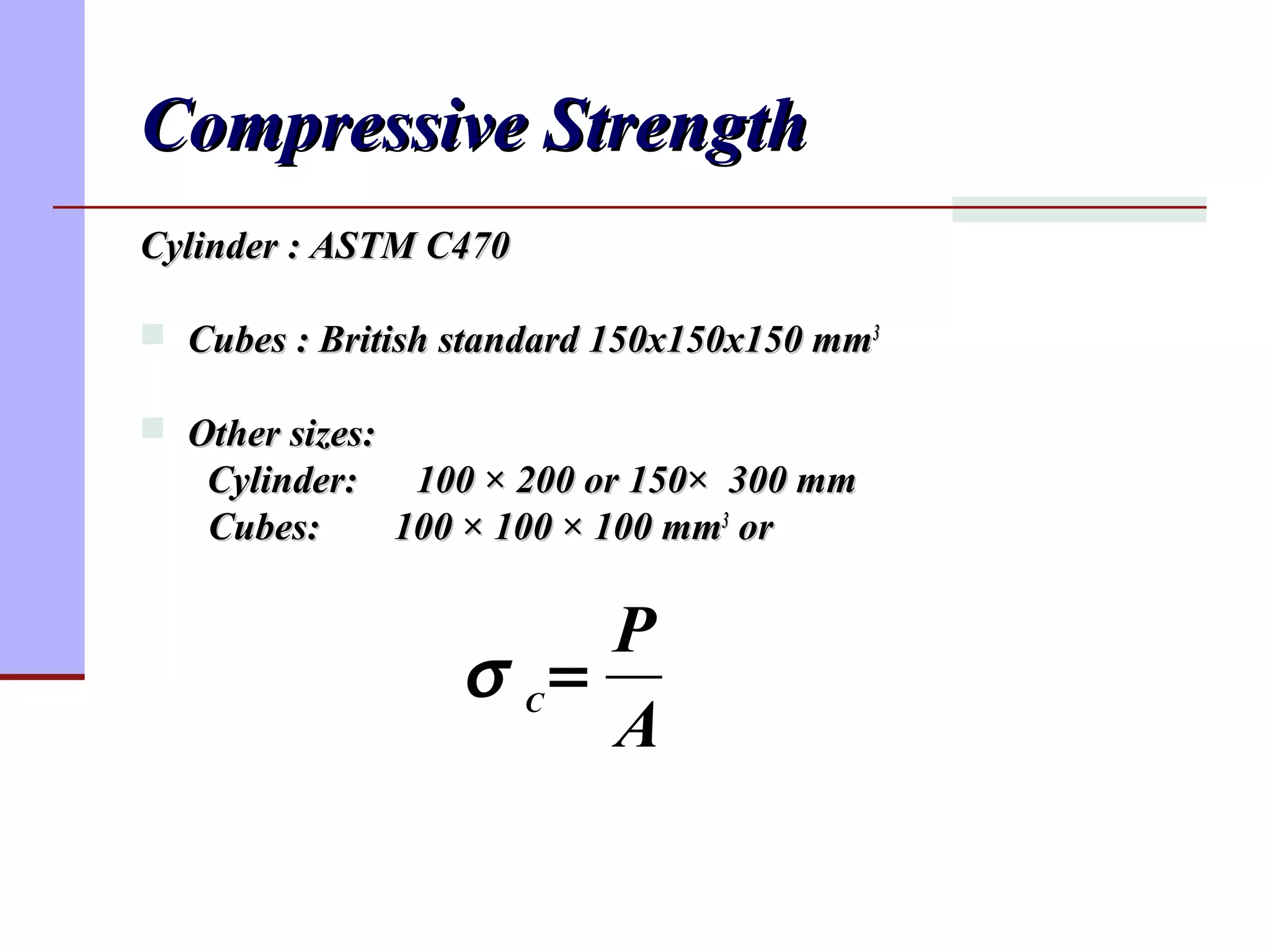
A
P
C
=σ
•For 150 mm cubes fill in 3 layers compact
each layer 35 times.
•For 100 mm cubes fill in 3 layers compact
each layer 25 times.
•No need for capping.
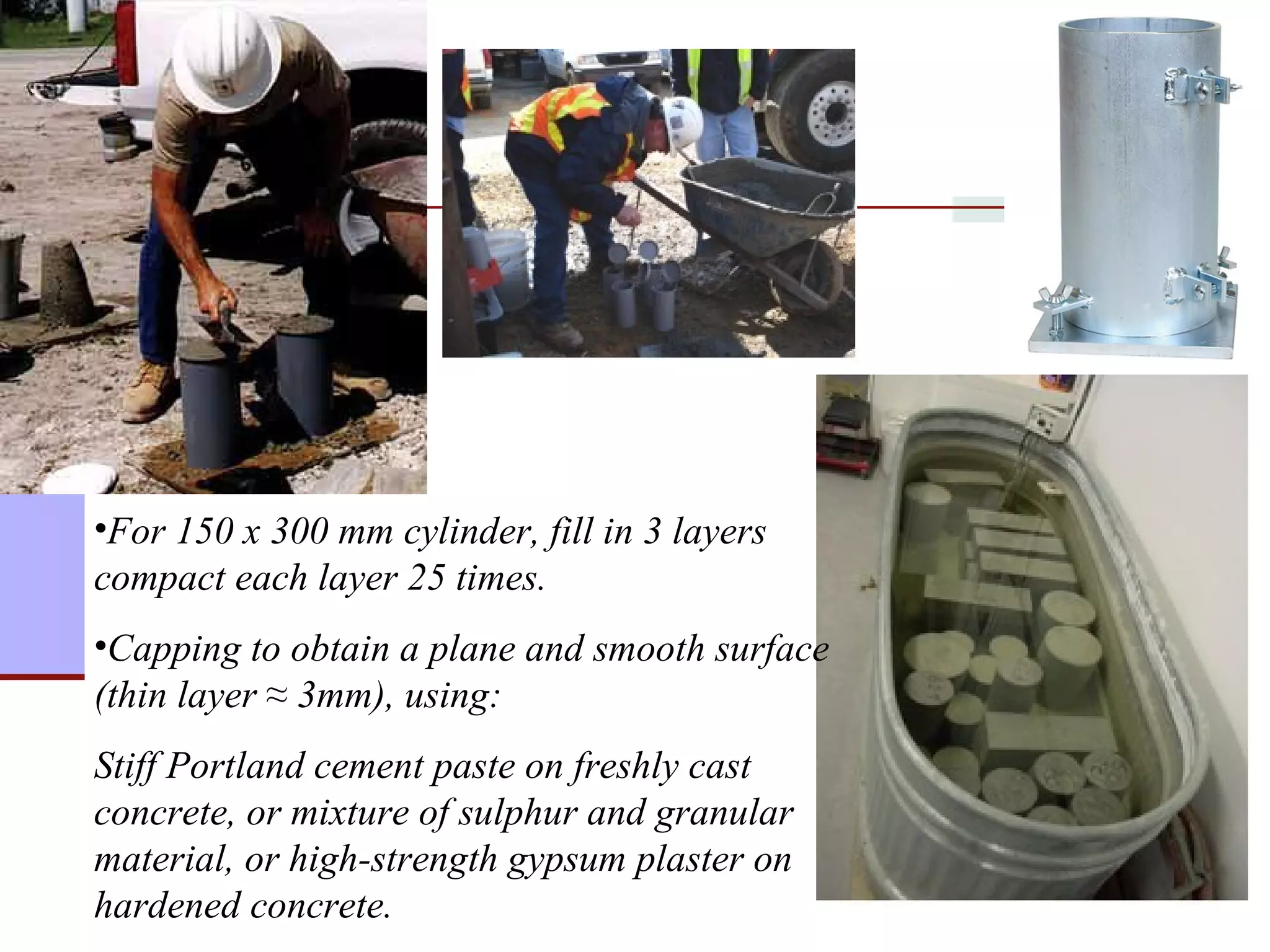
•For 150 x 300 mm cylinder, fill in 3 layers
compact each layer 25 times.
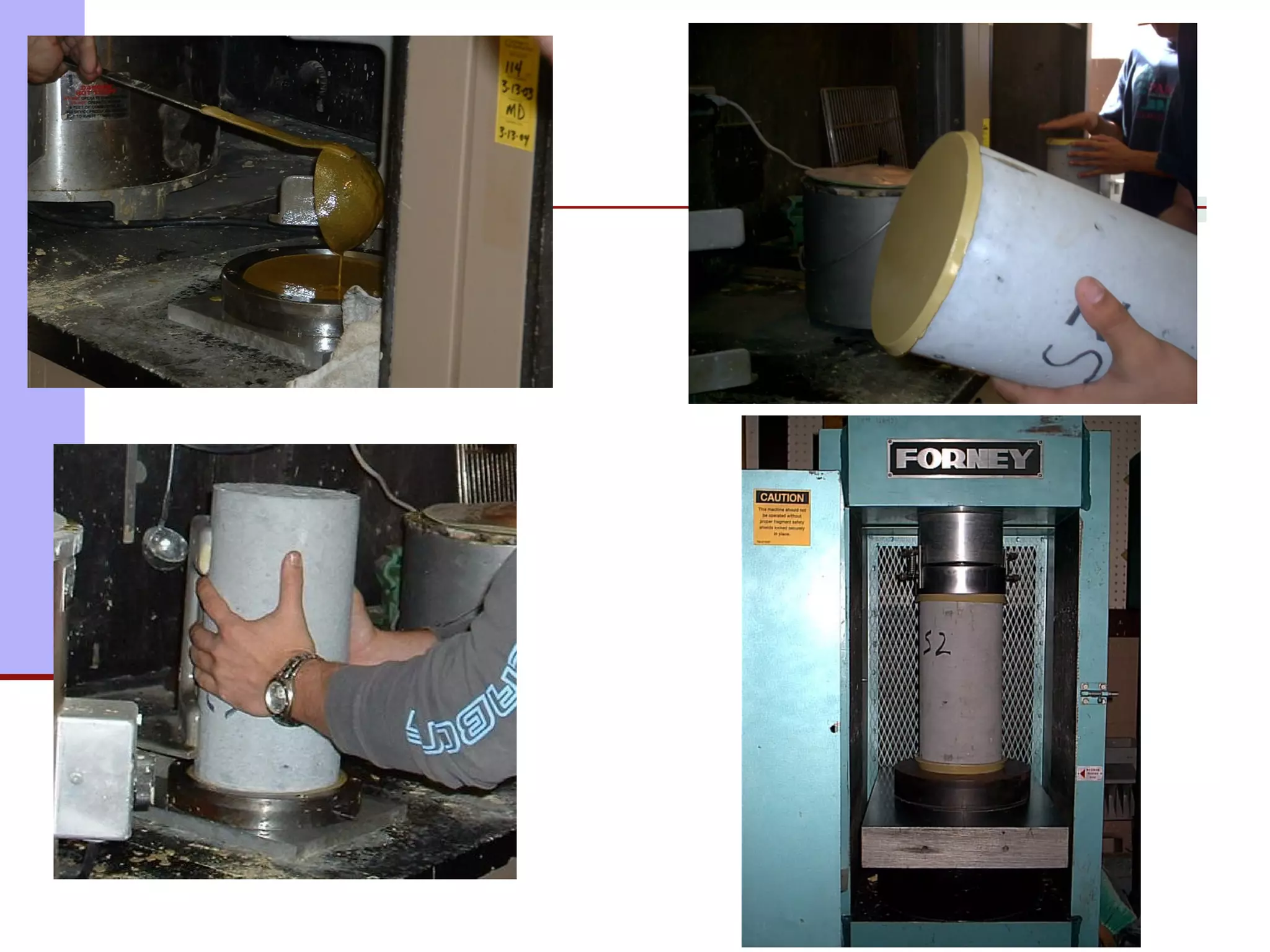
•Capping to obtain a plane and smooth surface
(thin layer ≈ 3mm), using:
Stiff Portland cement paste on freshly cast
concrete, or mixture of sulphur and granular
material, or high-strength gypsum plaster on
hardened concrete.
Factors Affecting Measured Compressive StrengthFactors Affecting Measured Compressive Strength
1. Stress Distribution in Specimens.1. Stress Distribution in Specimens.
2. Effect of L/d ratio.2. Effect of L/d ratio.
3. Specimen Geometry.3. Specimen Geometry.
4. Rate of Loading.4. Rate of Loading.
5. Moisture Content.5. Moisture Content.
6. Temperature at Testing.6. Temperature at Testing.
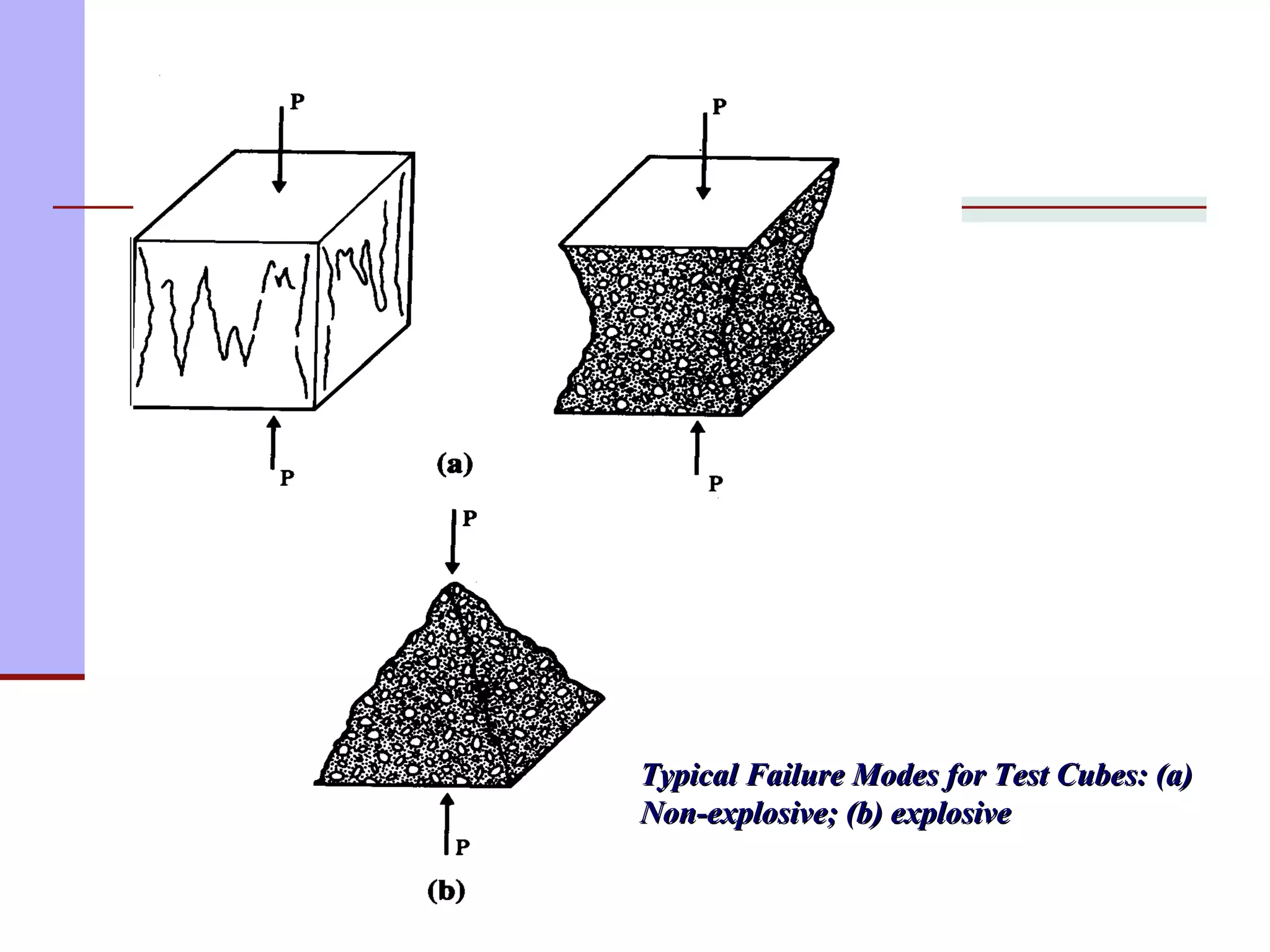
Typical Failure Modes for Test Cubes: (a)Typical Failure Modes for Test Cubes: (a)
Non-explosive; (b) explosiveNon-explosive; (b) explosive
Typical Failure Modes for Test Standard Cylinders:Typical Failure Modes for Test Standard Cylinders:
a) Splitting;a) Splitting; (b) Shear;(b) Shear; (c) Splitting and(c) Splitting and
shearshear
(cone).(cone).
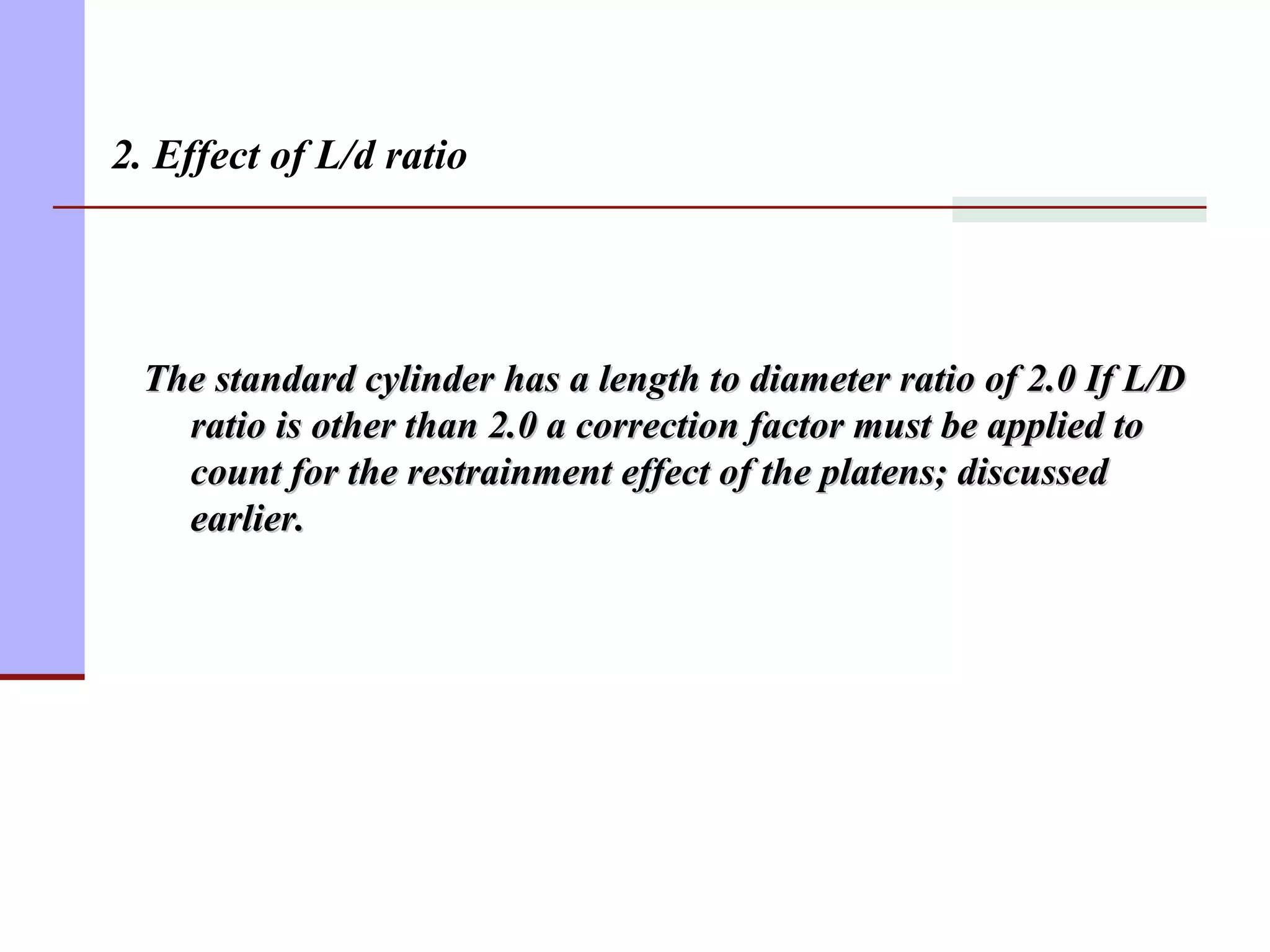
2. Effect of L/d ratio
The standard cylinder has a length to diameter ratio of 2.0 If L/DThe standard cylinder has a length to diameter ratio of 2.0 If L/D
ratio is other than 2.0 a correction factor must be applied toratio is other than 2.0 a correction factor must be applied to
count for the restrainment effect of the platens; discussedcount for the restrainment effect of the platens; discussed
earlier.earlier.
Reference Cylinder : L/D =2Reference Cylinder : L/D =2
Strength (L/D) = C.F x Strength (L/D=2)Strength (L/D) = C.F x Strength (L/D=2)
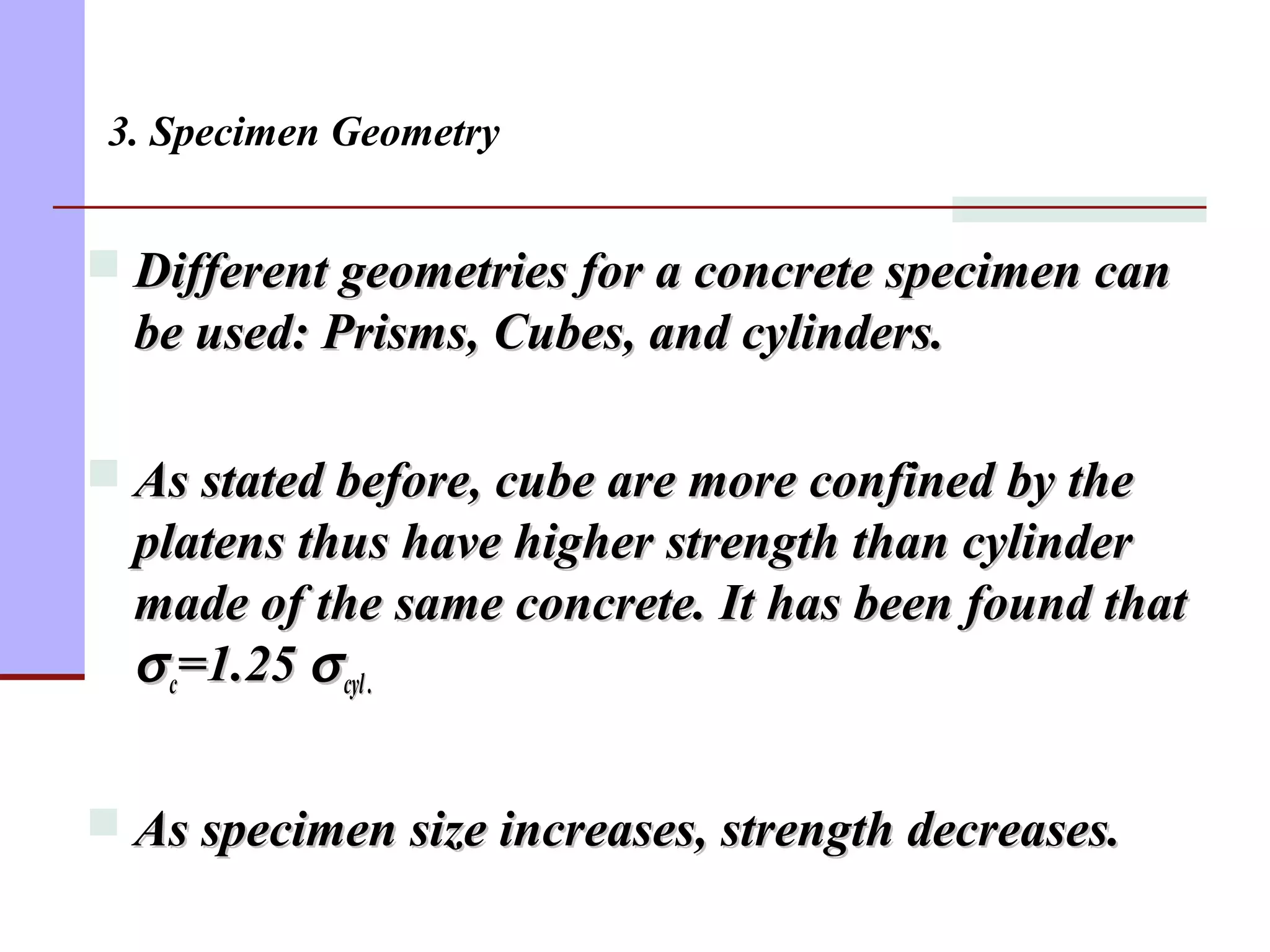
3. Specimen Geometry
 Different geometries for a concrete specimen canDifferent geometries for a concrete specimen can
be used: Prisms, Cubes, and cylinders.be used: Prisms, Cubes, and cylinders.
 As stated before, cube are more confined by theAs stated before, cube are more confined by the
platens thus have higher strength than cylinderplatens thus have higher strength than cylinder
made of the same concrete. It has been found thatmade of the same concrete. It has been found that
σσcc=1.25=1.25 σσcyl.cyl.
 As specimen size increases, strength decreases.As specimen size increases, strength decreases.
 4. Rate of Loading
 Higher rate of ladingHigher rate of lading →→ higher strength.higher strength.
5. Moisture Content
 Standards require testing of concrete in SSD conditions (ASTMStandards require testing of concrete in SSD conditions (ASTM
C39).C39).
 6. Temperature at Testing
Higher TemperatureHigher Temperature →→ lower strengthlower strength
1. Direct Tensile: No standard Test1. Direct Tensile: No standard Test
2. Indirect Tensile:2. Indirect Tensile:
A. Splitting Tension Test.A. Splitting Tension Test.
The tensile strength of concrete is approximately equal toThe tensile strength of concrete is approximately equal to
10% of its compressive strength.10% of its compressive strength.
Tensile strength:Tensile strength:
LD
P2
sp
π
σ =
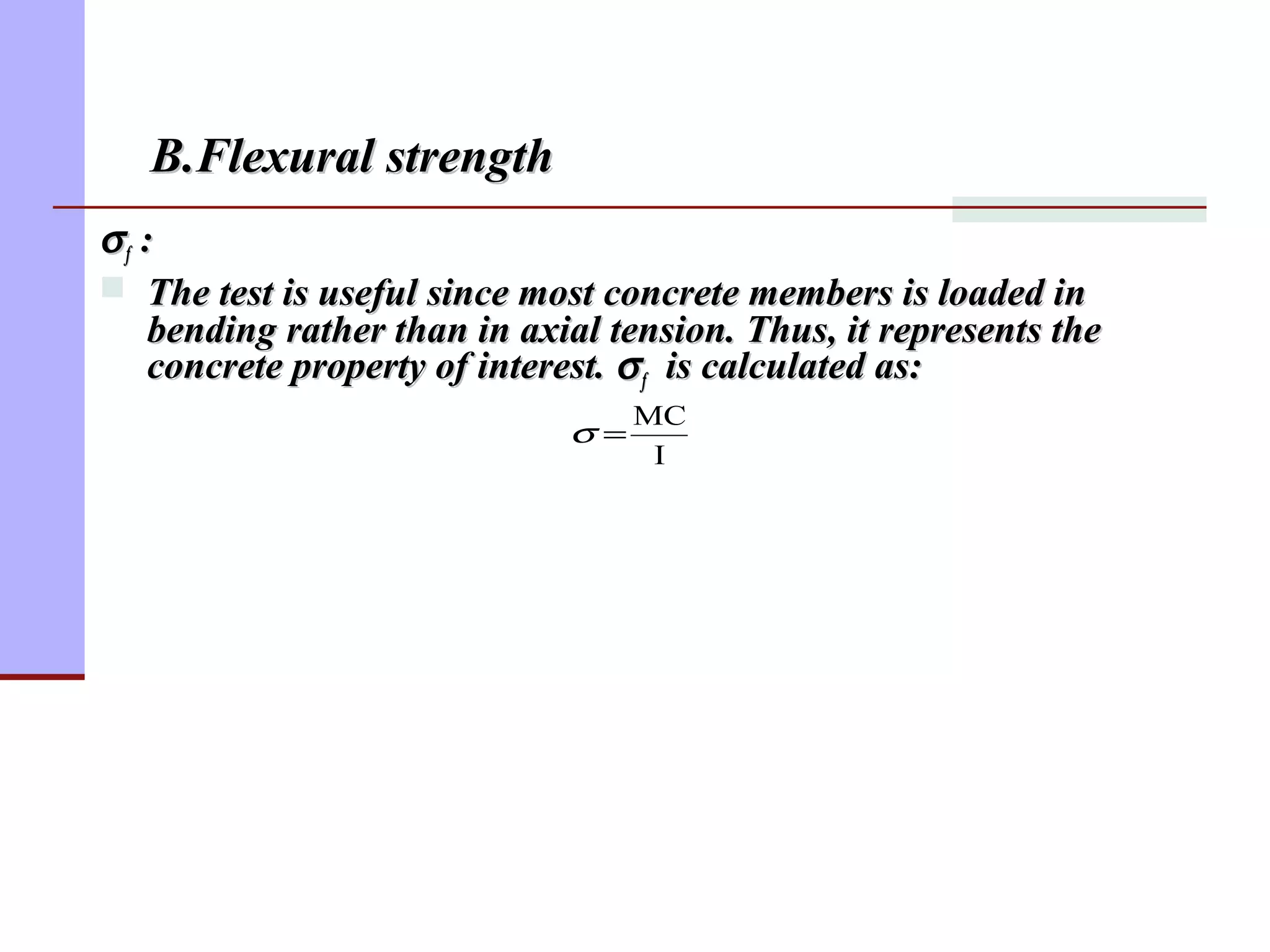
σσff ::
 The test is useful since most concrete members is loaded inThe test is useful since most concrete members is loaded in
bending rather than in axial tension. Thus, it represents thebending rather than in axial tension. Thus, it represents the
concrete property of interest.concrete property of interest. σσff is calculated as:is calculated as:
I
MC
=σ
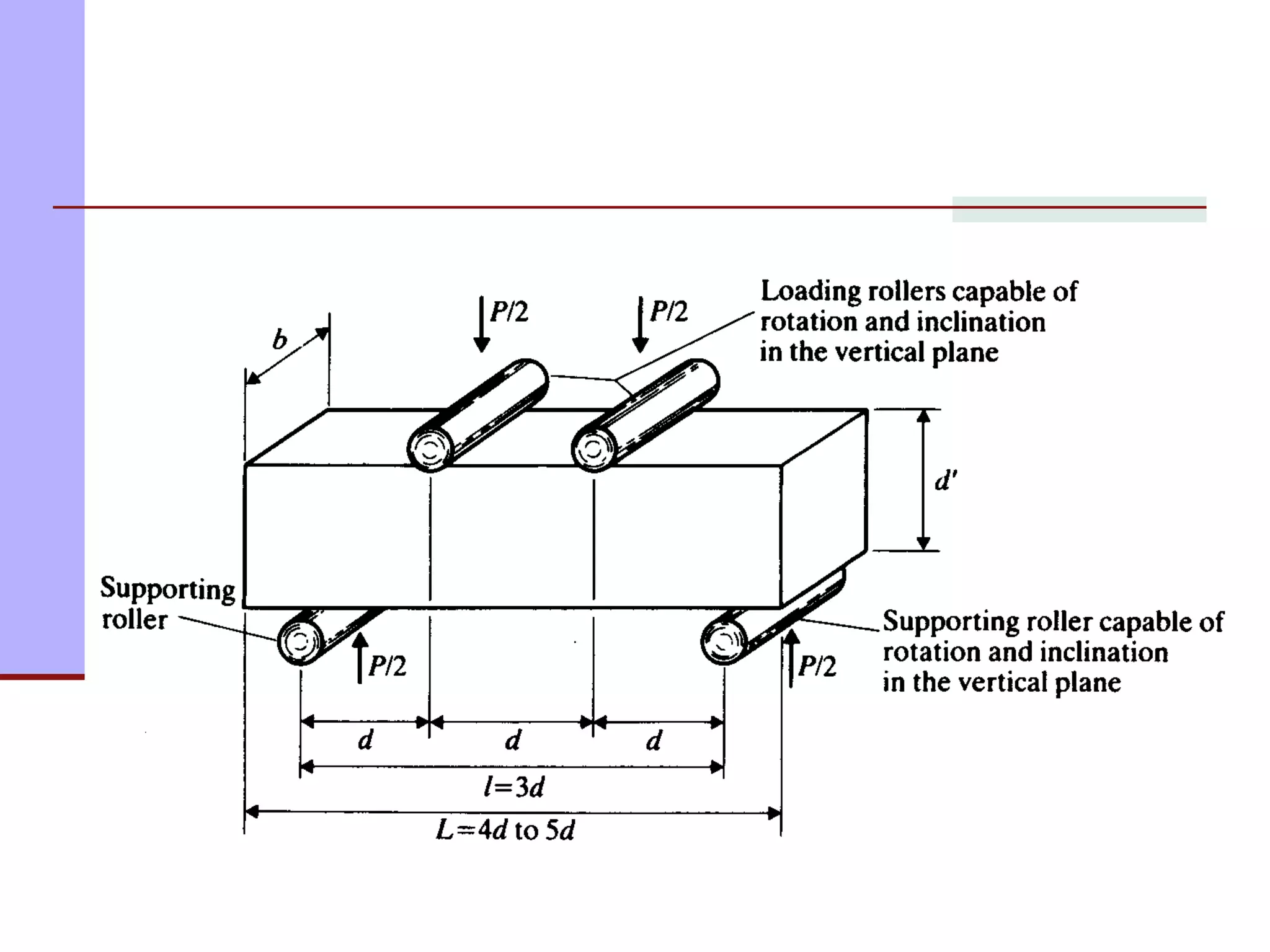
B.Flexural strengthB.Flexural strength
 This test is mostly used for quality control of highways and airportThis test is mostly used for quality control of highways and airport
runways. It gives more useful information than do compressionrunways. It gives more useful information than do compression
tests.tests.
 Flexural strength:Flexural strength:
Affected by:Affected by:
- Specimen Size- Specimen Size ↑↑ →→ strengthstrength ↓↓
- Temperature: Same as in compression.- Temperature: Same as in compression.
The tensile strength of concrete is approximately equal to 10% ofThe tensile strength of concrete is approximately equal to 10% of
its compressive strength.its compressive strength.
Strength of concrete
 Strength = ability to resist stress without failure.
 Concrete strength made of:
1. Strength of paste or mortar.
2. Strength of CA-paste (mortar) interface.
3. Strength of CA.
Cracks at the bond between the
aggregate, rebar, and paste
(see arrows).
Factors Affecting Strength of ConcreteFactors Affecting Strength of Concrete
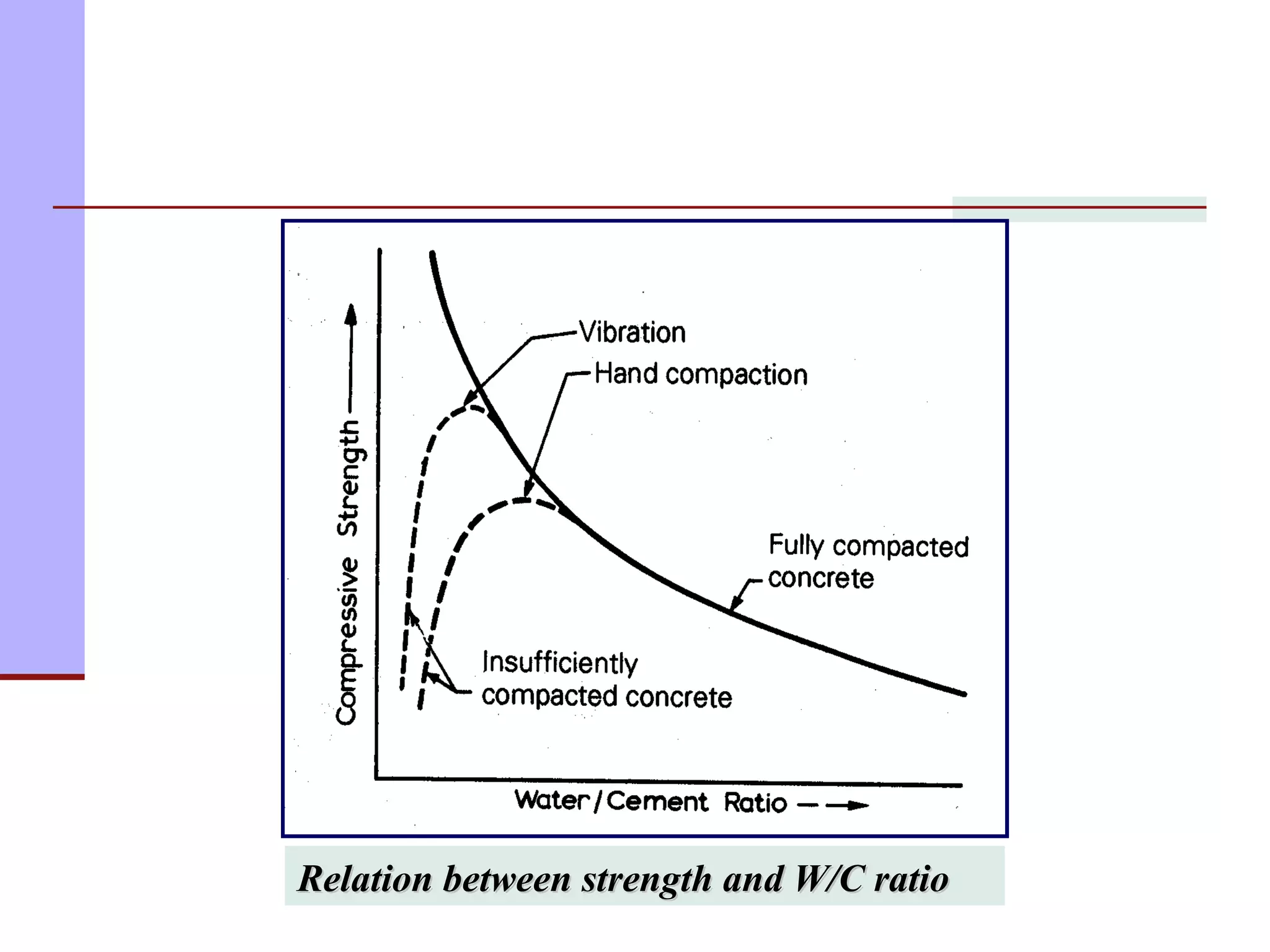
1. Water/Cement Ratio1. Water/Cement Ratio
Since the W/C ratio controls the porosity of concrete, it controlsSince the W/C ratio controls the porosity of concrete, it controls
the strength as well.the strength as well.
W/CW/C ↑↑ →→ strengthstrength ↓↓
2. Degree of Compaction2. Degree of Compaction
Strength = f (full compaction)Strength = f (full compaction)
Relation between strength and W/C ratioRelation between strength and W/C ratio
3. Curing Time:3. Curing Time:
 In practice, it is common to obtain 7-day as well as 28-dayIn practice, it is common to obtain 7-day as well as 28-day
compressive strength.compressive strength.
4. Cement:4. Cement:
 The effect of Portland cement on concrete strength dependsThe effect of Portland cement on concrete strength depends
on the chemical composition and fineness of the cement.on the chemical composition and fineness of the cement.
5. Aggregates:5. Aggregates:
aggregates Shape and Textureaggregates Shape and Texture
Texture depends on whether aggregate is natural (gravel )orTexture depends on whether aggregate is natural (gravel )or
crushed.crushed.
 DmaxDmax ↑↑ →→ Reducing the specific surface areaReducing the specific surface area →→ Less BondLess Bond →→
StrengthStrength ↓↓
 II. DmaxII. Dmax ↑↑ →→ More restraint on volume changes in the pasteMore restraint on volume changes in the paste
Inducing additional stresses in pasteInducing additional stresses in paste →→ StrengthStrength ↓↓
 III. DmaxIII. Dmax ↑↑ →→ Water contentWater content ↓↓ →→ StrengthStrength ↑↑
 C. Aggregate StrengthC. Aggregate Strength
B. maximum Aggregate Size (Dmax)
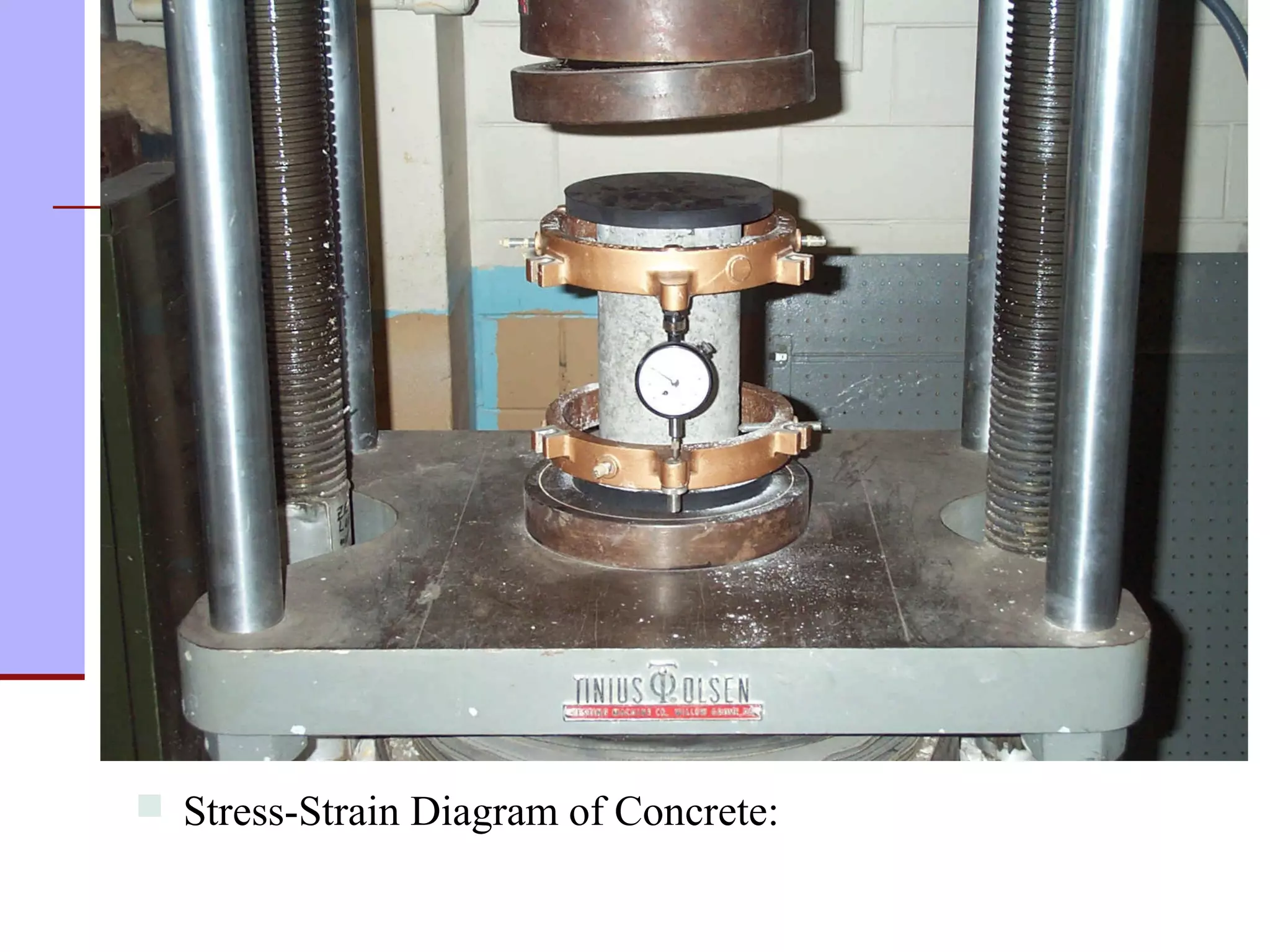
 Stress-Strain Diagram of Concrete:

Hardened concrete 1

  • 1.
  • 2.
     The basicmethod of verifying that concrete complies with the specifications is to test its strength using cubes or cylinders made from samples of fresh concrete.  concrete assumed as a brittle materialconcrete assumed as a brittle material
  • 3.
    Compressive StrengthCompressive Strength Cylinder: ASTM C470Cylinder : ASTM C470  Cubes : British standard 150x150x150 mmCubes : British standard 150x150x150 mm33  Other sizes:Other sizes: Cylinder: 100Cylinder: 100 ×× 200 or 150200 or 150×× 300 mm300 mm Cubes:Cubes: 100100 ×× 100100 ×× 100 mm100 mm33 oror A P C =σ
  • 4.
    •For 150 mmcubes fill in 3 layers compact each layer 35 times. •For 100 mm cubes fill in 3 layers compact each layer 25 times. •No need for capping.
  • 5.
    •For 150 x300 mm cylinder, fill in 3 layers compact each layer 25 times. •Capping to obtain a plane and smooth surface (thin layer ≈ 3mm), using: Stiff Portland cement paste on freshly cast concrete, or mixture of sulphur and granular material, or high-strength gypsum plaster on hardened concrete.
  • 7.
    Factors Affecting MeasuredCompressive StrengthFactors Affecting Measured Compressive Strength 1. Stress Distribution in Specimens.1. Stress Distribution in Specimens. 2. Effect of L/d ratio.2. Effect of L/d ratio. 3. Specimen Geometry.3. Specimen Geometry. 4. Rate of Loading.4. Rate of Loading. 5. Moisture Content.5. Moisture Content. 6. Temperature at Testing.6. Temperature at Testing.
  • 8.
    Typical Failure Modesfor Test Cubes: (a)Typical Failure Modes for Test Cubes: (a) Non-explosive; (b) explosiveNon-explosive; (b) explosive
  • 9.
    Typical Failure Modesfor Test Standard Cylinders:Typical Failure Modes for Test Standard Cylinders: a) Splitting;a) Splitting; (b) Shear;(b) Shear; (c) Splitting and(c) Splitting and shearshear (cone).(cone).
  • 10.
    2. Effect ofL/d ratio The standard cylinder has a length to diameter ratio of 2.0 If L/DThe standard cylinder has a length to diameter ratio of 2.0 If L/D ratio is other than 2.0 a correction factor must be applied toratio is other than 2.0 a correction factor must be applied to count for the restrainment effect of the platens; discussedcount for the restrainment effect of the platens; discussed earlier.earlier.
  • 11.
    Reference Cylinder :L/D =2Reference Cylinder : L/D =2 Strength (L/D) = C.F x Strength (L/D=2)Strength (L/D) = C.F x Strength (L/D=2)
  • 12.
    3. Specimen Geometry Different geometries for a concrete specimen canDifferent geometries for a concrete specimen can be used: Prisms, Cubes, and cylinders.be used: Prisms, Cubes, and cylinders.  As stated before, cube are more confined by theAs stated before, cube are more confined by the platens thus have higher strength than cylinderplatens thus have higher strength than cylinder made of the same concrete. It has been found thatmade of the same concrete. It has been found that σσcc=1.25=1.25 σσcyl.cyl.  As specimen size increases, strength decreases.As specimen size increases, strength decreases.
  • 13.
     4. Rateof Loading  Higher rate of ladingHigher rate of lading →→ higher strength.higher strength. 5. Moisture Content  Standards require testing of concrete in SSD conditions (ASTMStandards require testing of concrete in SSD conditions (ASTM C39).C39).  6. Temperature at Testing Higher TemperatureHigher Temperature →→ lower strengthlower strength
  • 14.
    1. Direct Tensile:No standard Test1. Direct Tensile: No standard Test 2. Indirect Tensile:2. Indirect Tensile: A. Splitting Tension Test.A. Splitting Tension Test. The tensile strength of concrete is approximately equal toThe tensile strength of concrete is approximately equal to 10% of its compressive strength.10% of its compressive strength. Tensile strength:Tensile strength:
  • 15.
  • 16.
    σσff ::  Thetest is useful since most concrete members is loaded inThe test is useful since most concrete members is loaded in bending rather than in axial tension. Thus, it represents thebending rather than in axial tension. Thus, it represents the concrete property of interest.concrete property of interest. σσff is calculated as:is calculated as: I MC =σ B.Flexural strengthB.Flexural strength
  • 19.
     This testis mostly used for quality control of highways and airportThis test is mostly used for quality control of highways and airport runways. It gives more useful information than do compressionrunways. It gives more useful information than do compression tests.tests.  Flexural strength:Flexural strength: Affected by:Affected by: - Specimen Size- Specimen Size ↑↑ →→ strengthstrength ↓↓ - Temperature: Same as in compression.- Temperature: Same as in compression. The tensile strength of concrete is approximately equal to 10% ofThe tensile strength of concrete is approximately equal to 10% of its compressive strength.its compressive strength.
  • 20.
    Strength of concrete Strength = ability to resist stress without failure.  Concrete strength made of: 1. Strength of paste or mortar. 2. Strength of CA-paste (mortar) interface. 3. Strength of CA. Cracks at the bond between the aggregate, rebar, and paste (see arrows).
  • 21.
    Factors Affecting Strengthof ConcreteFactors Affecting Strength of Concrete 1. Water/Cement Ratio1. Water/Cement Ratio Since the W/C ratio controls the porosity of concrete, it controlsSince the W/C ratio controls the porosity of concrete, it controls the strength as well.the strength as well. W/CW/C ↑↑ →→ strengthstrength ↓↓ 2. Degree of Compaction2. Degree of Compaction Strength = f (full compaction)Strength = f (full compaction)
  • 22.
    Relation between strengthand W/C ratioRelation between strength and W/C ratio
  • 23.
    3. Curing Time:3.Curing Time:  In practice, it is common to obtain 7-day as well as 28-dayIn practice, it is common to obtain 7-day as well as 28-day compressive strength.compressive strength. 4. Cement:4. Cement:  The effect of Portland cement on concrete strength dependsThe effect of Portland cement on concrete strength depends on the chemical composition and fineness of the cement.on the chemical composition and fineness of the cement. 5. Aggregates:5. Aggregates: aggregates Shape and Textureaggregates Shape and Texture Texture depends on whether aggregate is natural (gravel )orTexture depends on whether aggregate is natural (gravel )or crushed.crushed.
  • 24.
     DmaxDmax ↑↑→→ Reducing the specific surface areaReducing the specific surface area →→ Less BondLess Bond →→ StrengthStrength ↓↓  II. DmaxII. Dmax ↑↑ →→ More restraint on volume changes in the pasteMore restraint on volume changes in the paste Inducing additional stresses in pasteInducing additional stresses in paste →→ StrengthStrength ↓↓  III. DmaxIII. Dmax ↑↑ →→ Water contentWater content ↓↓ →→ StrengthStrength ↑↑  C. Aggregate StrengthC. Aggregate Strength B. maximum Aggregate Size (Dmax)
  • 25.