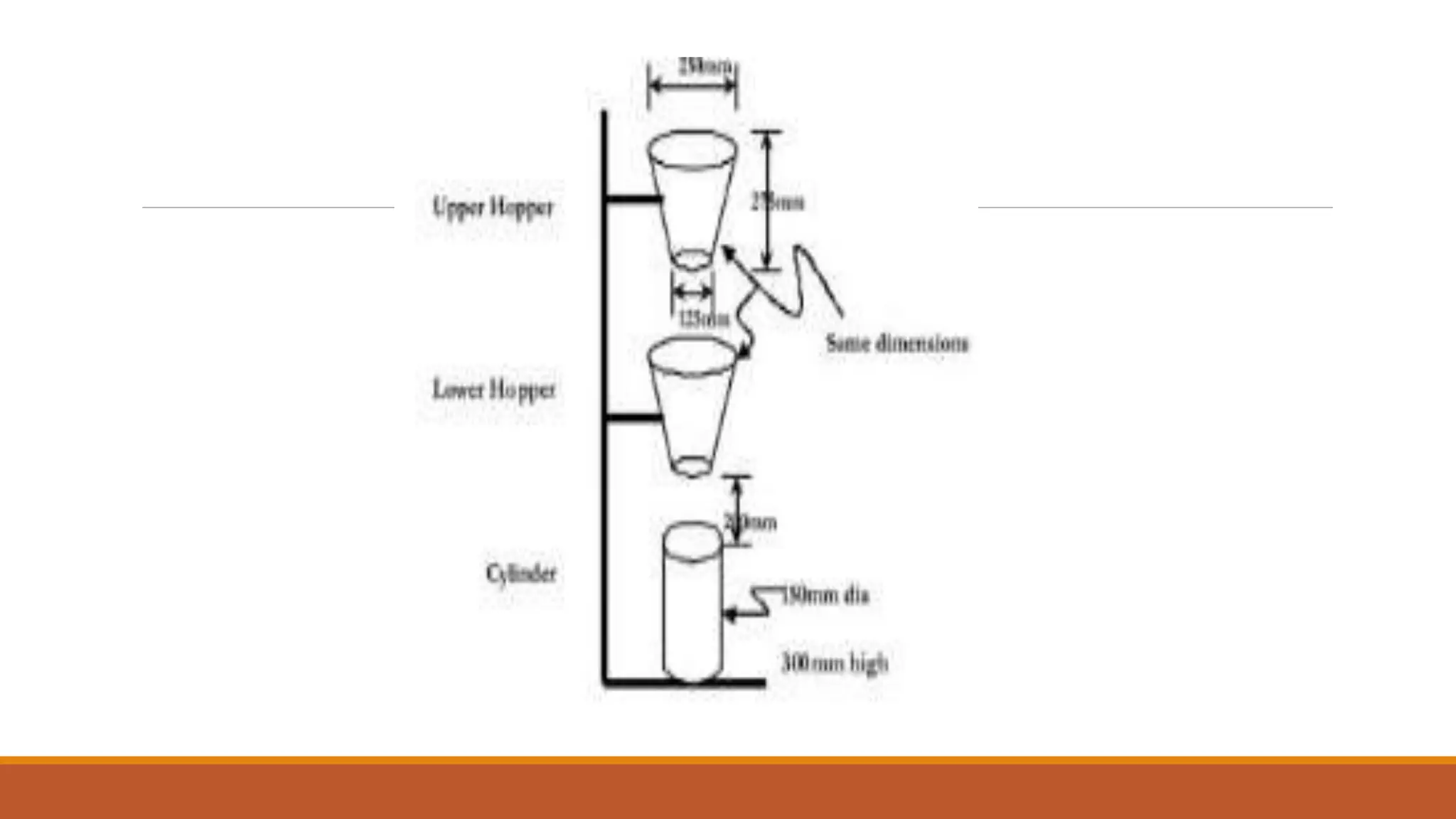
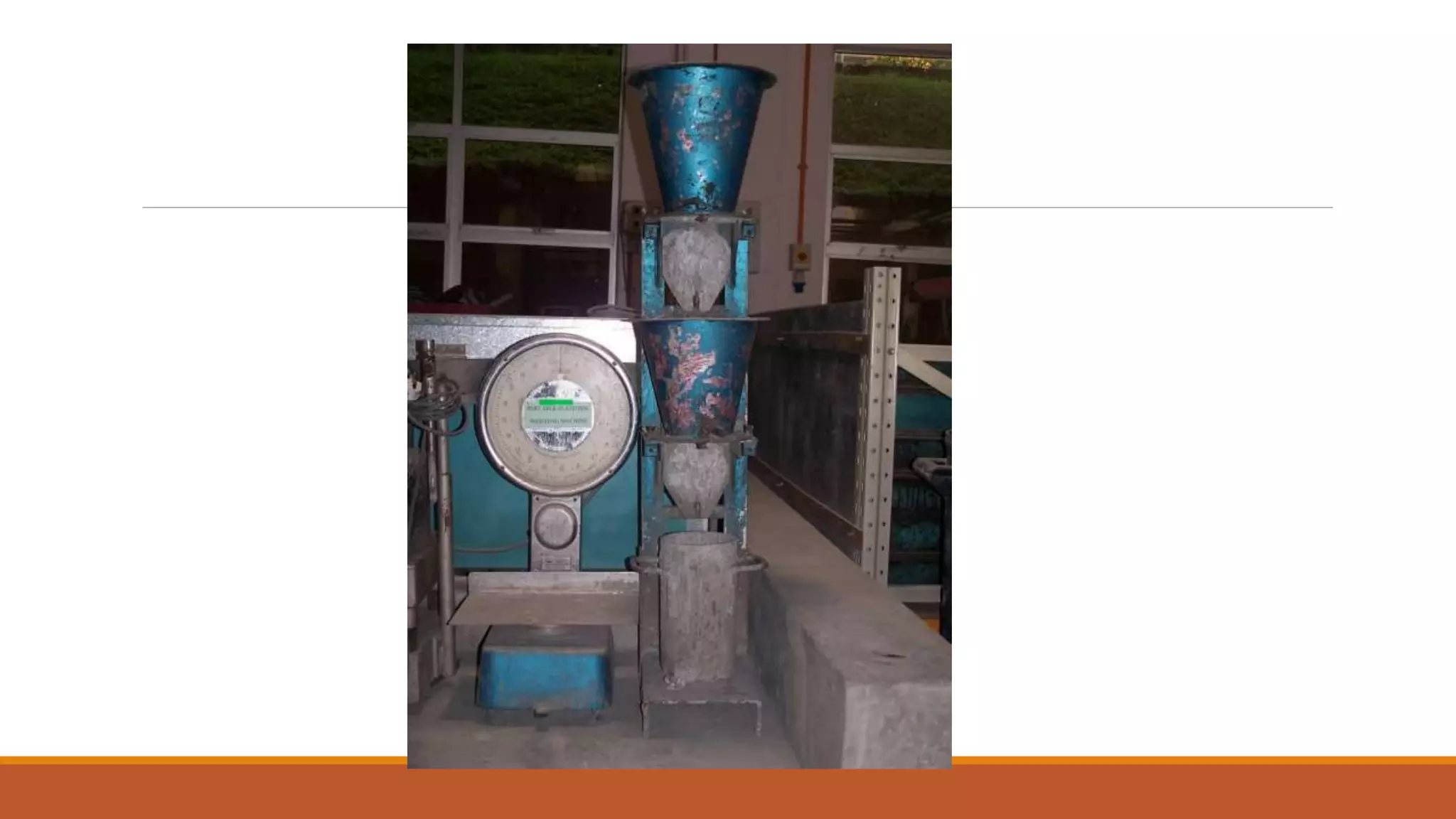
This document describes procedures for conducting a compacting factor test of concrete. It involves the following steps:
1. Greasing the compacting factor apparatus and weighing the empty cylinder.
2. Mixing concrete with a specific water-cement ratio and filling the upper hopper.
3. Allowing the concrete to fall into the cylinder to achieve partial compaction.
4. Filling and vibrating the cylinder in layers to achieve full compaction and weighing.
5. Calculating the compaction factor using the weights.
Apparatus Required:
(a)Compacting Factor apparatus
(b) Trowels
(c) Graduated cylinder
(d) Balance
(e) Tamping rod and iron buckets
6.
Procedure:
Step 1:-Apply Grease on inner surface of the apparatus
Step 2:- Measure the mass as w1 kg by weighing the cylinder
accurately and fix the cylinder on the base in such a way that the
central points of hoppers and cylinder lie on one vertical line and
cover the cylinder with a plate.
7.
Procedure:
Step 3:-For each 5 kg of aggregate mixes are to be prepared with
water-cement ratio by weight with 2.5 kg sand and 1.25 kg of
cement and then add required amount of water thoroughly until and
unless concrete appears to be homogeneous.
Step 4:- fill the freshly mixed concrete in upper hopper part. Two
minutes then release the trap door so that the concrete may fall into
the lower hopper such that it bring the concrete into standard
compaction.
8.
Procedure:
Step 5:-Fall the concrete to into the cylinder causes the concrete in
standard Compaction immediately after the concrete has come to
rest and open the trap door of lower hopper and then remove the
excess concrete above the top of the cylinder.
9.
Procedure:
Step 6:-Clean the cylinder from all sides properly. Weight the
partially compacted concrete thus filled in the cylinder and say it W2
kg. After this refill the cylinder with the same sample of concrete in
approximately 50 mm layers, by vibrating each layer heavily so as to
expel all the air and obtain full compaction of the Concrete.
10.
Procedure:
Step 7:-Struck off level the concrete and weigh and cylinder filled
with fully compacted concrete. Let the mass be W3 kg.
Step 8:- Calculate compaction factor by using the formula:-
11.
CALCULATION
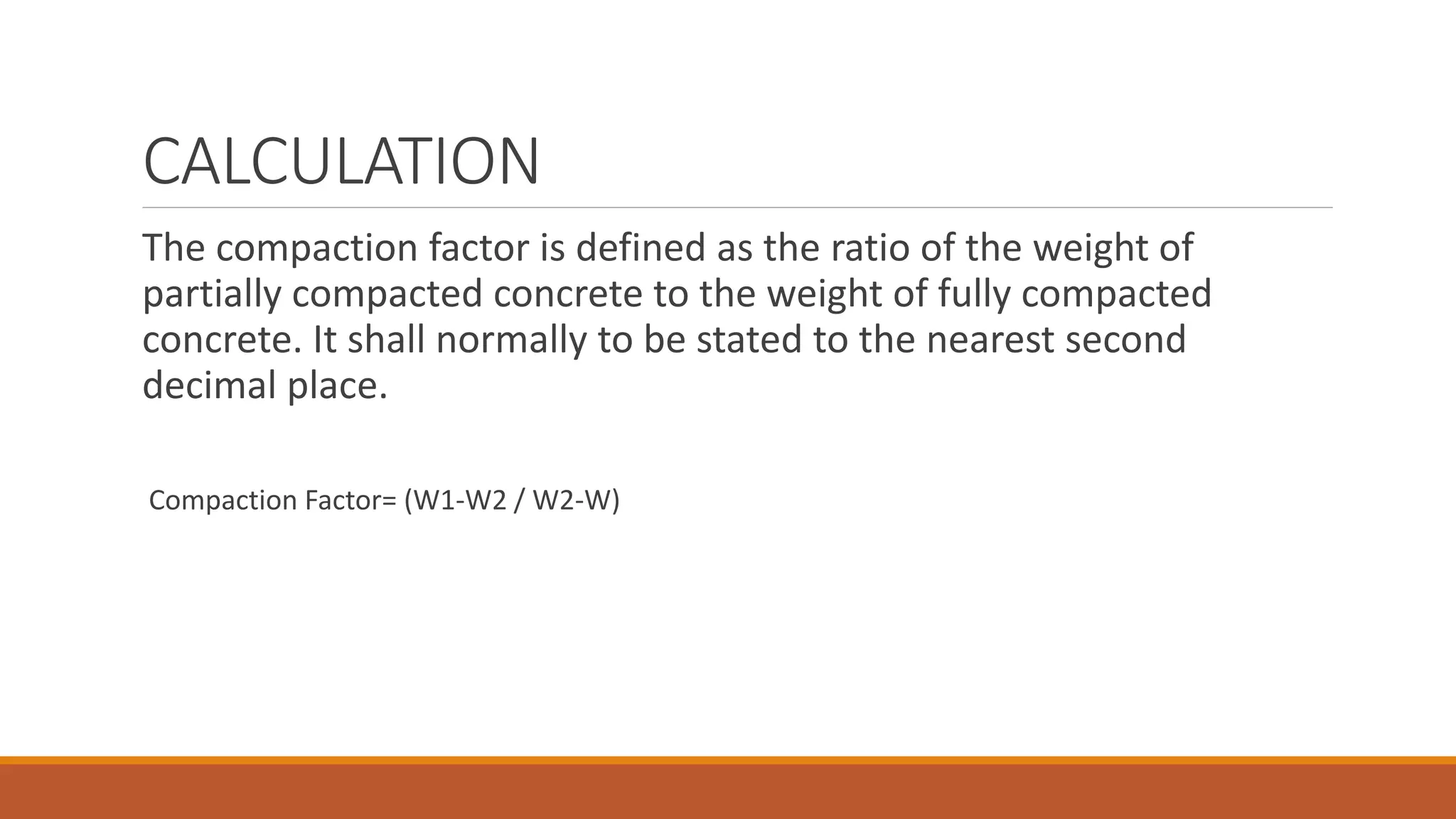
The compactionfactor is defined as the ratio of the weight of
partially compacted concrete to the weight of fully compacted
concrete. It shall normally to be stated to the nearest second
decimal place.
Compaction Factor= (W1-W2 / W2-W)
12.
Precaution
1. Accurateamount of water, cement and sand are to be taken to avoid collapsing of sample.
2. Maintain the consistency throughout the experiment to avoid the failure.
3. Convenient time for releasing the concrete from the upper hopper has been found to be two
minutes after the completion of mixing
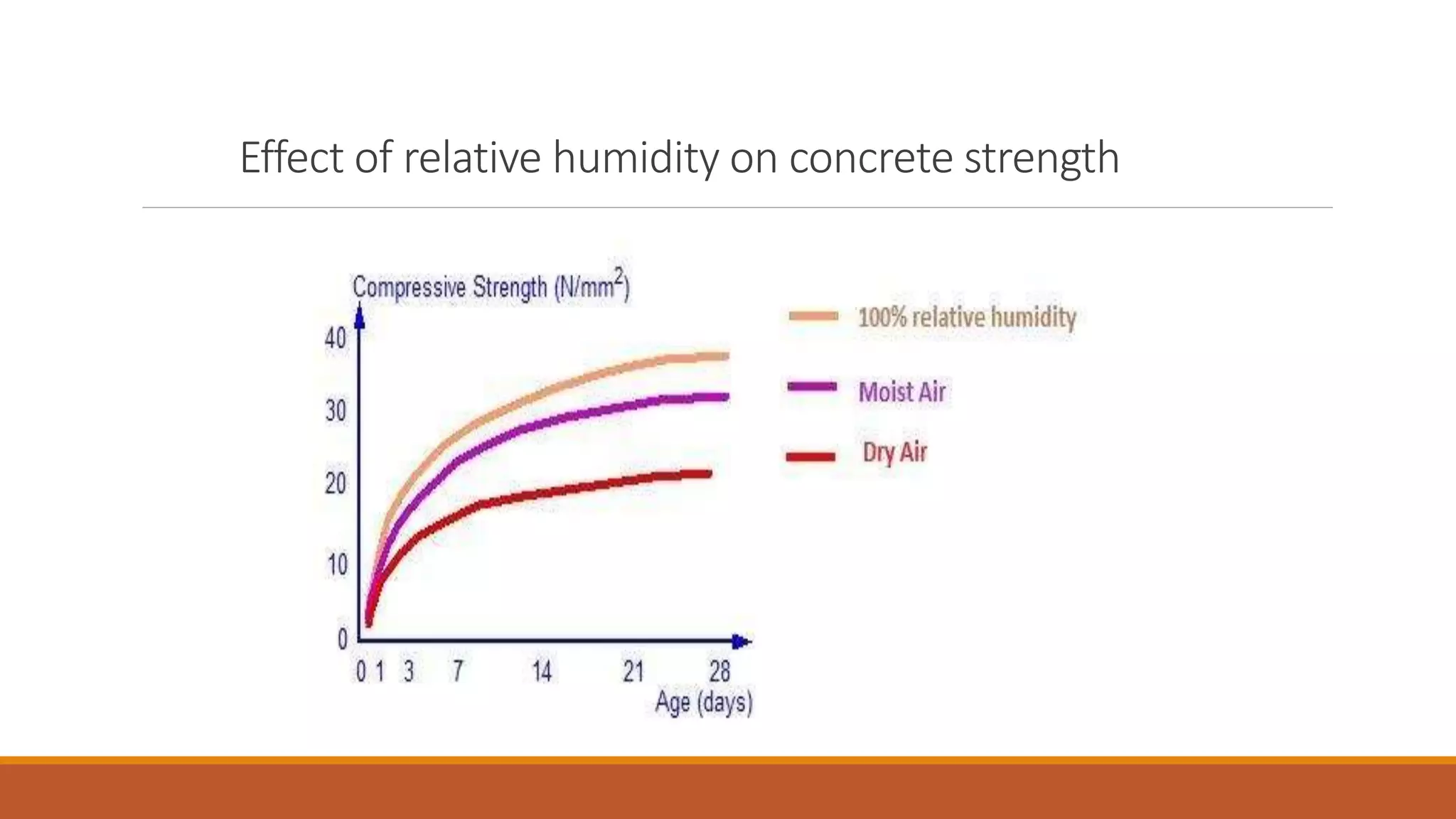
Relative humidity
•Ifthe concrete is allowed to dry out, the hydration reaction will stop.
•The hydration reaction cannot proceed without moisture.
•Relative humidity is important because the more moisture that’s already in the air, the lower
the rate at which water will evaporate and the less moisture that the air can hold.
•Relative humidity is a measure of the current amount of water vapor in the air relative to the
total amount of water vapor that can exist in the air at its current temperature, and is expressed
as a percentage.
•A relative humidity of 100% means the air cannot contain any more water vapor at that
temperature, whereas a relative humidity of 50% means that the air only has only half as much
water vapor as it can hold at the current temperature.
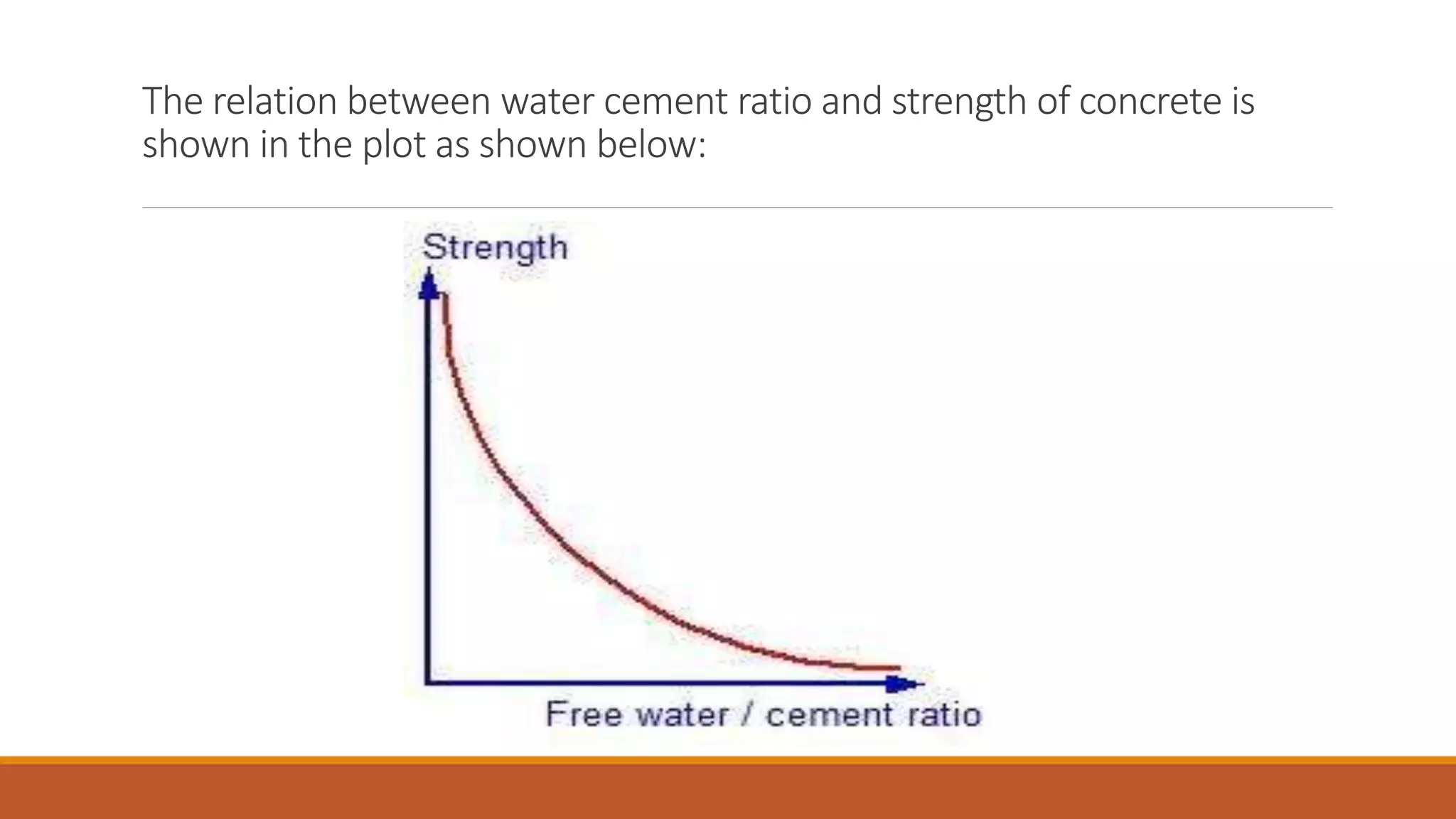
Water / CementRatio:
• The higher the water/cement ratio, the greater the initial spacing between the
cement grains and the greater the volume of residual voids not filled by
hydration products.
•There is one thing missing on the graph. For a given cement content, the
workability of the concrete is reduced if the water/cement ratio is reduced. A
lower water cement ratio means less water, or more cement and lower
workability.
•However if the workability becomes too low the concrete becomes difficult to
compact and the strength reduces.
17.
The relation betweenwater cement ratio and strength of concrete is
shown in the plot as shown below:
18.
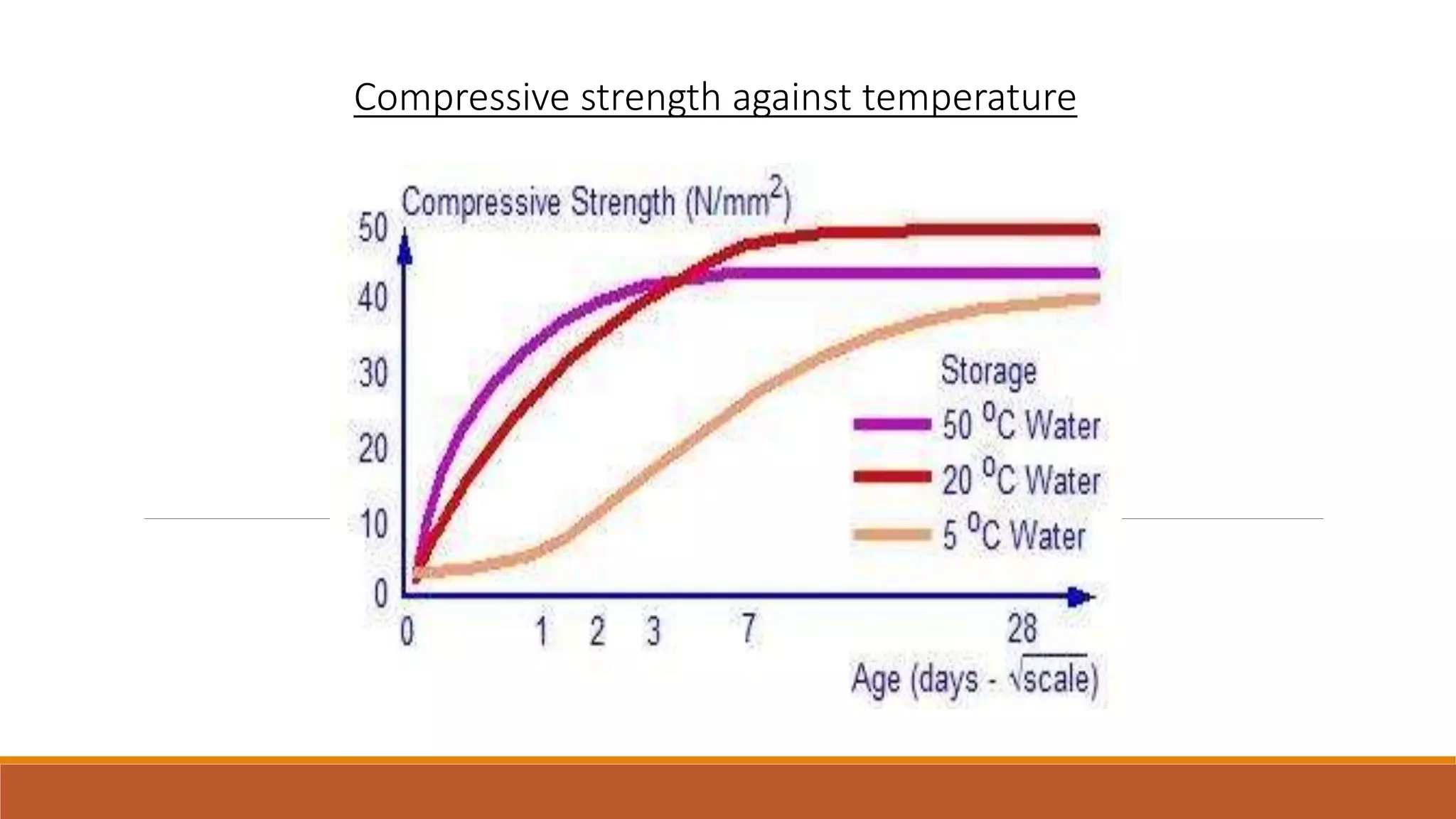
Temperature
• Therate of hydration reaction is temperature dependent.
• Temperature increases, the reaction also increases.
• The concrete kept at higher temperature will gain strength more quickly than a similar concrete
kept at a lower temperature.
• The final strength of the concrete kept at the higher temperature will be lower.