Organic Architecture
Name: Ritu S Gosavi
Subject: Contemporary Architecture Seminar
Year: Third year B.Arch.
College: N.M.V.P.College of Architecture Nasik.
Table of content
CHAPTER 3: CURRENT STATUS
3.1 Architects practicing
3.2 Structures
CHAPTER 4: ORGANIC APART FROM
ARCHITECTURE
4.1 Furniture
4.2 Production
CHATPER 5: AWARDS AND COMPETITION
CHAPTER 6: CONCLUSION
CHAPTER 1: INTRODUCTION
1.1 Background history
1.2 Characteristics of organic architecture
1.3 Origin of organic architecture
1.4 Rules and regulation regarding organic architecture
1.5 Role of material in the organic architecture
1.6 Characteristics features
1.7 Advantages
CHAPTER 2: POST ORGANIC ARCHITECUTRE
2.1 Introduction
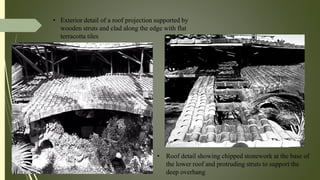
2.2 Case studies
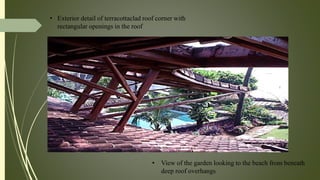
2.3 Architects practicing during this time
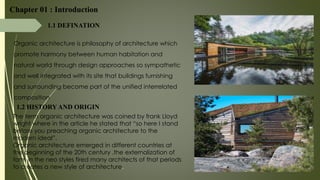
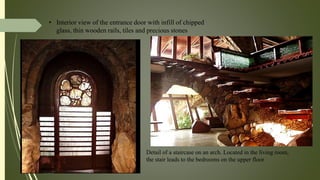
Organic architecture is philosophy of architecture which
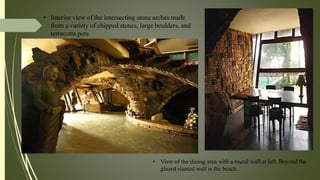
promote harmony between human habitation and
natural world through design approaches so sympathetic
and well integrated with its site that buildings furnishing
and surrounding become part of the unified interrelated
composition
1.1 DEFINATION
1.2 HISTORYAND ORIGIN
The term organic architecture was coined by frank Lloyd
wright where in the article he stated that “so here I stand
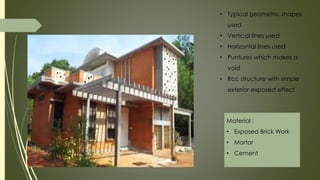
before you preaching organic architecture to the
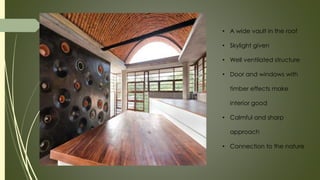
modern ideal”.
Organic architecture emerged in different countries at
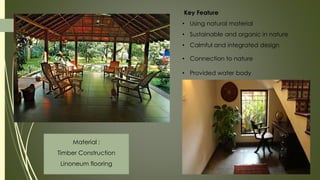
the beginning of the 20th century .the externalization of
form in the neo styles fired many architects of that periods
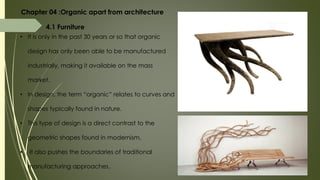
to creates a new style of architecture.
Chapter 01 : Introduction
1.3 OBJECTIVES
• Organic architecture not only addresses environment concern but also
expresses individuality.
• Each building is related to variables likes MAN ,SITE, TIME.
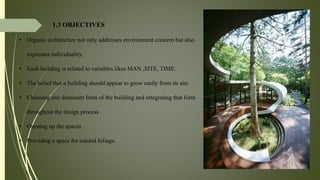
• The belief that a building should appear to grow easily from its site.
• Choosing one dominant form of the building and integrating that form
throughout the design process .
• Opening up the spaces .
• Providing a space for natural foliage.
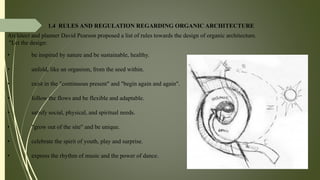
1.4 RULES AND REGULATION REGARDING ORGANIC ARCHITECTURE
Architect and planner David Pearson proposed a list of rules towards the design of organic architecture.
"Let the design:
• be inspired by nature and be sustainable, healthy.
• unfold, like an organism, from the seed within.
• exist in the "continuous present" and "begin again and again".
• follow the flows and be flexible and adaptable.
• satisfy social, physical, and spiritual needs.
• "grow out of the site" and be unique.
• celebrate the spirit of youth, play and surprise.
• express the rhythm of music and the power of dance.
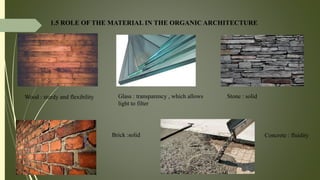
1.5 ROLE OF THE MATERIAL IN THE ORGANIC ARCHITECTURE
Concrete : fluidity
Wood : sturdy and flexibility Glass : transparency , which allows
light to filter
Stone : solid
Brick :solid
1.5.1 Wood :
1.5.1.1
Definition : Wood is a porous and fibrous structural tissue
found in the stems and roots of trees and other woody plants. It
is an organic material, a natural composite of cellulose fibers
that are strong in tension and embedded in a matrix of lignin
that resists compression
1.5.1.2 Characteristics
1. hardness
2. strength
3. toughness
4. stiffness
1.5.2 Glass :
1.5.2.1
Definition :a hard, brittle substance, typically transparent or
translucent, made by fusing sand with soda and lime and
cooling rapidly. It is used to make windows
1.5.2.2 Characteristics
1. Transparency
2. heat resistance
1.5.3 : Concrete
1.5.3.1
Definition :a building material made from a mixture of broken
stone or gravel, sand, cement, and water, which can be spread
or poured into molds and forms a stone-like mass on hardening
1.5.3.2 Characteristics
1. Strength and Durability. Used in the majority of buildings,
bridges, tunnels and dams for its strength.
2. Versatility.
3. Low Maintenance.
4. Affordability.
5. Fire-resistance.
6. Thermal mass.
1.5.4 : Stone Masonry
1.5.4.1 Definition :Hard solid non-metallic mineral matter of
which rock is made, especially as a building material. "the
houses are built of stone"
1.5.4.2 Characteristics
1. Dense
2. Durability and strength.
3. Other examples of dense stones include basalt, dolomite,
and slate.
4.Porosity is the amount of open space between mineral grains
in a stone (and generally dictates permeability)
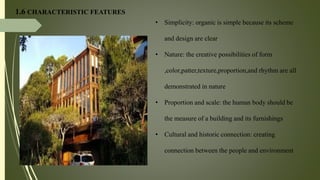
1.6 CHARACTERISTIC FEATURES
• Simplicity: organic is simple because its scheme
and design are clear
• Nature: the creative possibilities of form
,color,patter,texture,proportion,and rhythm are all
demonstrated in nature
• Proportion and scale: the human body should be
the measure of a building and its furnishings
• Cultural and historic connection: creating
connection between the people and environment
1.7 ADVANTAGES
• Introducing nature through trees and open spaces doesn't only look nice but also gives you wellness benefits.
• There is growing lack of interaction between man and nature which has created a void thus organic architecture
with free flowing and curvilinear organic forms fills this void enhancing the city aesthetically with with spirit of
marvel.
• It creats a ecofriendly buildings which provide improved indoor air quality optial cofort proper ventilaton and
health .
• It eliminates possible causes of SBS (sick building syndrome).
• Organic buildings are more economic as they increases there assets value and profits by giving higher employee
satisfaction.
CHAPTER 02 :POST ORGANIC ARCHITECTURE
2.1 INTRODUCTION
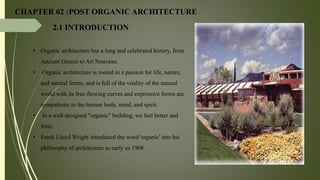
• Organic architecture has a long and celebrated history, from
Ancient Greece to Art Nouveau.
• Organic architecture is rooted in a passion for life, nature,
and natural forms, and is full of the vitality of the natural
world with its free-flowing curves and expressive forms are
sympathetic to the human body, mind, and spirit.
• In a well-designed "organic" building, we feel better and
freer.
• Frank Lloyd Wright introduced the word 'organic' into his
philosophy of architecture as early as 1908.
2.2 : CASE STUDY
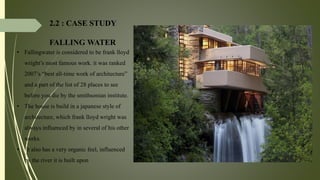
FALLING WATER
• Fallingwater is considered to be frank lloyd
wright’s most famous work. it was ranked
2007’s “best all-time work of architecture”
and a part of the list of 28 places to see
before you die by the smithsonian institute.
• The house is build in a japanese style of
architecture, which frank lloyd wright was
always influenced by in several of his other
works.
• It also has a very organic feel, influenced
by the river it is built upon
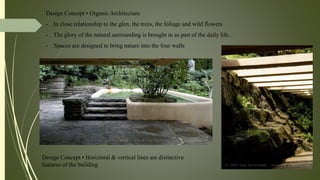
Design Concept • Organic Architecture
- In close relationship to the glen, the trees, the foliage and wild flowers
- The glory of the natural surrounding is brought in as part of the daily life…
- Spaces are designed to bring nature into the four walls
Design Concept • Horizintal & vertical lines are distinctive
features of the building
-
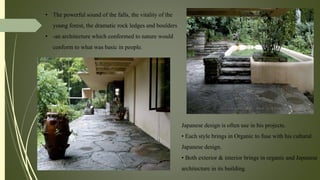
Japanese design is often use in his projects.
• Each style brings in Organic to fuse with his cultural
Japanese design.
• Both exterior & interior brings in organic and Japanese
architecture in its building.
• The powerful sound of the falls, the vitality of the
young forest, the dramatic rock ledges and boulders
• -an architecture which conformed to nature would
conform to what was basic in people.
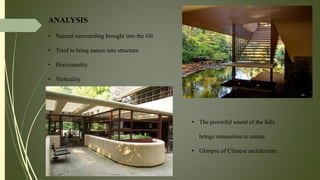
ANALYSIS
• Natural surrounding brought into the life
• Tried to bring nature into structure
• Horizontality
• Verticality
• The powerful sound of the falls
brings connection to nature.
• Glimpse of Chinese architecture.
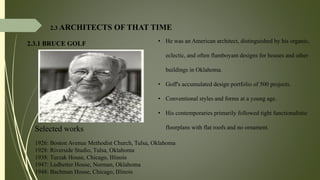
2.3.1 BRUCE GOLF
2.3 ARCHITECTS OF THAT TIME
• He was an American architect, distinguished by his organic,
eclectic, and often flamboyant designs for houses and other
buildings in Oklahoma.
• Goff's accumulated design portfolio of 500 projects.
• Conventional styles and forms at a young age.
• His contemporaries primarily followed tight functionalistic
floorplans with flat roofs and no ornament.Selected works
1926: Boston Avenue Methodist Church, Tulsa, Oklahoma
1928: Riverside Studio, Tulsa, Oklahoma
1938: Turzak House, Chicago, Illinois
1947: Ledbetter House, Norman, Oklahoma
1948: Bachman House, Chicago, Illinois
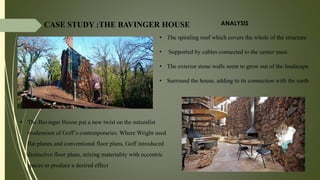
• The Bavinger House put a new twist on the naturalist
modernism of Goff’s contemporaries. Where Wright used
flat planes and conventional floor plans, Goff introduced
distinctive floor plans, mixing materiality with eccentric
spaces to produce a desired effect
• The spiraling roof which covers the whole of the structure
• Supported by cables connected to the center mast.
• The exterior stone walls seem to grow out of the landscape
• Surround the house, adding to its connection with the earth
CASE STUDY :THE BAVINGER HOUSE ANALYSIS
• This is an unfortunate pattern.
• earth-bound natural and symbolic architecture.
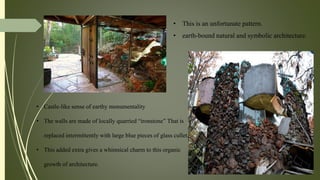
• Castle-like sense of earthy monumentality
• The walls are made of locally quarried “ironstone” That is
replaced intermittently with large blue pieces of glass cullet.
• This added extra gives a whimsical charm to this organic
growth of architecture.
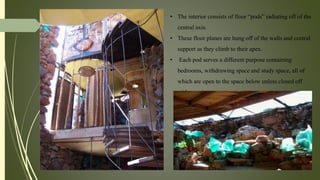
• The interior consists of floor “pods” radiating off of the
central axis.
• These floor planes are hung off of the walls and central
support as they climb to their apex.
• Each pod serves a different purpose containing
bedrooms, withdrawing space and study space, all of
which are open to the space below unless closed off
with curtains.
2.3.2 BRUNO ZEVI
• He was an Italian architect, historian, professor, curator,
author, and editor. Zevi was a vocal critic of "classicizing"
modern architecture and postmodernism
• In 1944, he founded the influential Association for Organic
Architecture (APAO)
• Zevi's major contribution to architectural theory was what he
called "organic architecture,“
• organic architecture grounded in asymmetry, rupture,
dissonance and fragmentation.Selected Works :
• Giulio Einaudi editore, Torino 1945
• Horizon Press, New York 1957
• Etas Kompass, Milano 1970;
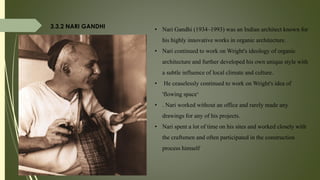
3.3.2 NARI GANDHI • Nari Gandhi (1934–1993) was an Indian architect known for
his highly innovative works in organic architecture.
• Nari continued to work on Wright's ideology of organic
architecture and further developed his own unique style with
a subtle influence of local climate and culture.
• He ceaselessly continued to work on Wright's idea of
'flowing space‘
• . Nari worked without an office and rarely made any
drawings for any of his projects.
• Nari spent a lot of time on his sites and worked closely with
the craftsmen and often participated in the construction
process himself
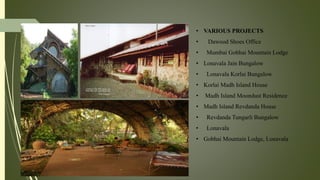
• VARIOUS PROJECTS
• Dawood Shoes Office
• Mumbai Gobhai Mountain Lodge
• Lonavala Jain Bungalow
• Lonavala Korlai Bungalow
• Korlai Madh Island House
• Madh Island Moondust Residence
• Madh Island Revdanda House
• Revdanda Tungarli Bungalow
• Lonavala
• Gobhai Mountain Lodge, Lonavala
CASE STUDY
MOON DUST RESIDENCE MUDH ISLAND
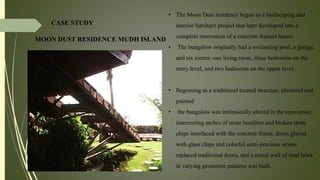
• The Moon Dust residence began as a landscaping and
interior furniture project that later developed into a
complete renovation of a concrete-framed house.
• The bungalow originally had a swimming pool, a garage,
and six rooms: one living room, three bedrooms on the
entry level, and two bedrooms on the upper level.
• Beginning as a traditional treated structure, plastered and
painted
• the bungalow was intrinsically altered in the renovation:
intersecting arches of stone boulders and broken stone
chips interfaced with the concrete frame, doors glazed
with glass chips and colorful semi-precious stones
replaced traditional doors, and a mural wall of mud brick
in varying geometric patterns was built.
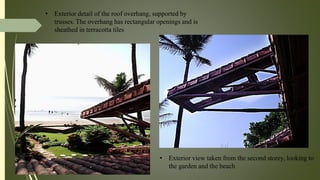
• Exterior detail of the roof overhang, supported by
trusses. The overhang has rectangular openings and is
sheathed in terracotta tiles
• Exterior view taken from the second storey, looking to
the garden and the beach
• Exterior detail of a roof projection supported by
wooden struts and clad along the edge with flat
terracotta tiles
• Roof detail showing chipped stonework at the base of
the lower roof and protruding struts to support the
deep overhang
• Exterior detail of terracottaclad roof corner with
rectangular openings in the roof
• View of the garden looking to the beach from beneath
deep roof overhangs
• Interior view of the entrance door with infill of chipped
glass, thin wooden rails, tiles and precious stones
• Detail of a staircase on an arch. Located in the living room,
the stair leads to the bedrooms on the upper floor
• Interior view of the intersecting stone arches made
from a variety of chipped stones, large boulders, and
terracotta pots
• View of the dining area with a mural wall at left. Beyond the
glazed slanted wall is the beach
CHAPTER 03 : CURRENT STATUS
3.1 ARCHITECTS PRACTISING
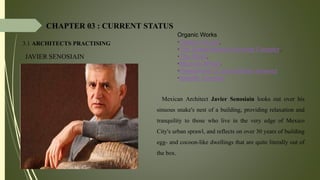
JAVIER SENOSIAIN
Organic Works
•Organic House,
•The SnakePeanuts Housing Complex,.
•The Shark,
•Mexican Whale.
•FloweGrave of Jose Alfredo Jimenez
•Satelite Complex
• - Mexican Architect Javier Senosiain looks out over his
sinuous snake's nest of a building, providing relaxation and
tranquility to those who live in the very edge of Mexico
City's urban sprawl, and reflects on over 30 years of building
egg- and cocoon-like dwellings that are quite literally out of
the box.
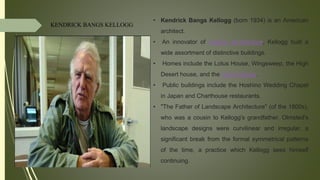
KENDRICK BANGS KELLOGG
• Kendrick Bangs Kellogg (born 1934) is an American
architect.
• An innovator of organic architecture, Kellogg built a
wide assortment of distinctive buildings.
• Homes include the Lotus House, Wingsweep, the High
Desert house, and the Onion House.
• Public buildings include the Hoshino Wedding Chapel
in Japan and Charthouse restaurants.
• "The Father of Landscape Architecture" (of the 1800s),
who was a cousin to Kellogg's grandfather. Olmsted's
landscape designs were curvilinear and irregular, a
significant break from the formal symmetrical patterns
of the time, a practice which Kellogg sees himself
continuing.
3.2 STRUCTURES
3.2.1 Katchi Kothi by Kamath Design Studio
Architect: Kamath Design Studio
Location: Haryana
• The Mud House at Anangpur Village, Surajkund,
Haryana, is located on land that was once a
quarry, mining quartzite and Badarpur stone dust.
• The ecology of the area had been devastated by
the mining and the original scrub forest had been
chopped and ravaged for fire wood.
• The Mud House is an attempt to heal the wounds
inflicted on the earth and establish a niche in the
ecosystem that is expressive of emerging
ecological values.
• He used natural material
• Simple form
• The design process has actively been guided
towards the evolution of an ecological
architectural vocabulary informed by indigenous
building practices.
• The creating of space, form and visual
characteristics is based on the rearrangement of
natural materials found on the site and its
surroundings, with a minimum, judicious use of
non-renewable
• Calmful interior
• Cozy feeling
• Connection to nature
,
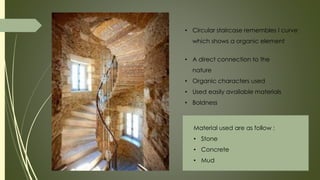
• Circular staircase remembles I curve
which shows a organic element
• A direct connection to the
nature
• Organic characters used
• Used easily available materials
• Boldness
Material used are as follow :
• Stone
• Concrete
• Mud
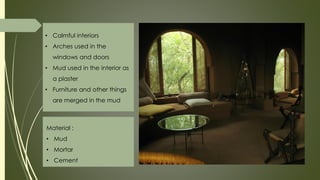
Material :
• Mud
• Mortar
• Cement
• Calmful interiors
• Arches used in the
windows and doors
• Mud used in the interior as
a plaster
• Furniture and other things
are merged in the mud
3.2.2 DuStudio – Dharmesh Jadeja
Architect: Dharmesh Jadeja
Location: India
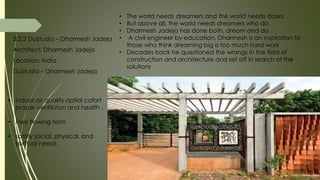
DuStudio – Dharmesh Jadeja
• The world needs dreamers and the world needs doers.
• But above all, the world needs dreamers who do.
• Dharmesh Jadeja has done both, dream and do.
• A civil engineer by education, Dharmesh is an inspiration to
those who think dreaming big is too much hard work
• Decades back he questioned the wrongs in the field of
construction and architecture and set off in search of the
solutions.
• indoor air quality optial cofort
proper ventilaton and health .
• Free flowing form
• satisfy social, physical, and
spiritual needs
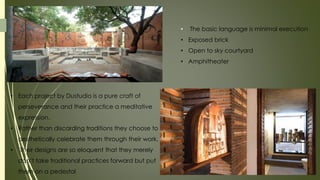
• Each project by Dustudio is a pure craft of
perseverance and their practice a meditative
expression.
• Rather than discarding traditions they choose to
aesthetically celebrate them through their work.
• Their designs are so eloquent that they merely
don’t take traditional practices forward but put
them on a pedestal
• The basic language is minimal execution
• Exposed brick
• Open to sky courtyard
• Amphitheater
• Typical geometric shapes
used
• Vertical lines used
• Horizontal lines used
• Puntures which makes a
void
• Rcc structure with simple
exterior exposed effect
Material :
• Exposed Brick Work
• Mortar
• Cement
• A wide vault in the roof
• Skylight given
• Well ventilated structure
• Door and windows with
timber effects make
interior good
• Calmful and sharp
approach
• Connection to the nature
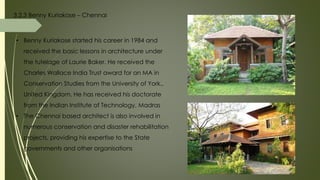
3.2.3 Benny Kuriakose – Chennai
• Benny Kuriakose started his career in 1984 and
received the basic lessons in architecture under
the tutelage of Laurie Baker. He received the
Charles Wallace India Trust award for an MA in
Conservation Studies from the University of York.,
United Kingdom. He has received his doctorate
from the Indian Institute of Technology, Madras
• The Chennai based architect is also involved in
numerous conservation and disaster rehabilitation
projects, providing his expertise to the State
governments and other organisations
Key Feature
• Using natural material
• Sustainable and organic in nature
• Calmful and integrated design
• Connection to nature
• Provided water body
Material :
Timber Construction
Linoneum flooring
Chapter 04 :Organic apart from architecture
4.1 Furniture
• It is only in the past 30 years or so that organic
design has only been able to be manufactured
industrially, making it available on the mass
market.
• In design, the term “organic” relates to curves and
shapes typically found in nature.
• This type of design is a direct contrast to the
geometric shapes found in modernism.
• It also pushes the boundaries of traditional
manufacturing approaches.
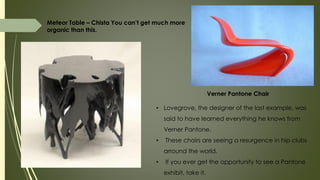
Meteor Table – Chista You can’t get much more
organic than this.
Verner Pantone Chair
• Lovegrove, the designer of the last example, was
said to have learned everything he knows from
Verner Pantone.
• These chairs are seeing a resurgence in hip clubs
arround the world.
• If you ever get the opportunity to see a Pantone
exhibit, take it.
4.2 Production
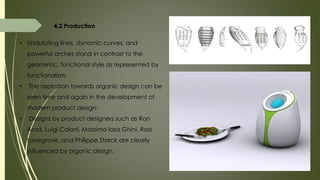
• Undulating lines, dynamic curves, and
powerful arches stand in contrast to the
geometric, functional style as represented by
functionalism.
• The aspiration towards organic design can be
seen time and again in the development of
modern product design:
• Designs by product designers such as Ron
Arad, Luigi Colani, Massimo Iosa Ghini, Ross
Lovegrove, and Philippe Starck are clearly
influenced by organic design.
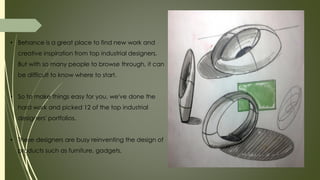
• Behance is a great place to find new work and
creative inspiration from top industrial designers.
But with so many people to browse through, it can
be difficult to know where to start.
• So to make things easy for you, we've done the
hard work and picked 12 of the top industrial
designers' portfolios.
• These designers are busy reinventing the design of
products such as furniture, gadgets,
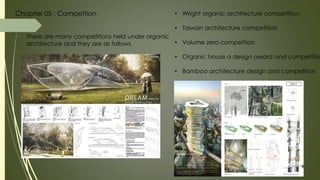
Chapter 05 : Compettion
There are many competitions held under organic
architecture and they are as follows
• Wright organic architecture competition
• Taiwan architecture competition
• Volume zero compettion
• Organic house a design award and competition
• Bamboo architecture design and competiton
Conclusion :
• Organic architecture was introduced by F l Wright.
• As the time passes new form new techniques were introduced by new
architects followed by the footprint of f l wright
• In india Nari Gandhi was the only Architect who practiced organic architecture
• So in india there are some architects who followed the same footprint same
ideas in there own way
• The architects are as follows:
• Ar. Kamath
• Ar. Dharmesh Jadeja
• Ar . Benny Kuriakose.
• In the design field different branches also follow this style as in furniture design
and in product design
• There are some firms who organized competition regarding organic
architecture in order to maintain style
Refrences :
• http://www.industrial-design-germany.com/design/organic-
design.html
• http://www.kamathdesign.org/projects
• https://www.archdaily.com/171574/ad-classics-bavinger-house-
bruce-goff
• https://www.google.co.in/search?rlz=1C1CHBD_e
nIN
• http://www.posts.architecturelive.in/benny-
kuriakose/
• https://en.wikipedia.org/wiki/Kendrick_Bangs_Kell
ogg

ORGANIC ARCHITECTURE (CURRENT SENERIO)

  • 1.
    Organic Architecture Name: RituS Gosavi Subject: Contemporary Architecture Seminar Year: Third year B.Arch. College: N.M.V.P.College of Architecture Nasik.
  • 2.
    Table of content CHAPTER3: CURRENT STATUS 3.1 Architects practicing 3.2 Structures CHAPTER 4: ORGANIC APART FROM ARCHITECTURE 4.1 Furniture 4.2 Production CHATPER 5: AWARDS AND COMPETITION CHAPTER 6: CONCLUSION CHAPTER 1: INTRODUCTION 1.1 Background history 1.2 Characteristics of organic architecture 1.3 Origin of organic architecture 1.4 Rules and regulation regarding organic architecture 1.5 Role of material in the organic architecture 1.6 Characteristics features 1.7 Advantages CHAPTER 2: POST ORGANIC ARCHITECUTRE 2.1 Introduction 2.2 Case studies 2.3 Architects practicing during this time
  • 3.
    Organic architecture isphilosophy of architecture which promote harmony between human habitation and natural world through design approaches so sympathetic and well integrated with its site that buildings furnishing and surrounding become part of the unified interrelated composition 1.1 DEFINATION 1.2 HISTORYAND ORIGIN The term organic architecture was coined by frank Lloyd wright where in the article he stated that “so here I stand before you preaching organic architecture to the modern ideal”. Organic architecture emerged in different countries at the beginning of the 20th century .the externalization of form in the neo styles fired many architects of that periods to creates a new style of architecture. Chapter 01 : Introduction
  • 4.
    1.3 OBJECTIVES • Organicarchitecture not only addresses environment concern but also expresses individuality. • Each building is related to variables likes MAN ,SITE, TIME. • The belief that a building should appear to grow easily from its site. • Choosing one dominant form of the building and integrating that form throughout the design process . • Opening up the spaces . • Providing a space for natural foliage.
  • 5.
    1.4 RULES ANDREGULATION REGARDING ORGANIC ARCHITECTURE Architect and planner David Pearson proposed a list of rules towards the design of organic architecture. "Let the design: • be inspired by nature and be sustainable, healthy. • unfold, like an organism, from the seed within. • exist in the "continuous present" and "begin again and again". • follow the flows and be flexible and adaptable. • satisfy social, physical, and spiritual needs. • "grow out of the site" and be unique. • celebrate the spirit of youth, play and surprise. • express the rhythm of music and the power of dance.
  • 6.
    1.5 ROLE OFTHE MATERIAL IN THE ORGANIC ARCHITECTURE Concrete : fluidity Wood : sturdy and flexibility Glass : transparency , which allows light to filter Stone : solid Brick :solid
  • 7.
    1.5.1 Wood : 1.5.1.1 Definition: Wood is a porous and fibrous structural tissue found in the stems and roots of trees and other woody plants. It is an organic material, a natural composite of cellulose fibers that are strong in tension and embedded in a matrix of lignin that resists compression 1.5.1.2 Characteristics 1. hardness 2. strength 3. toughness 4. stiffness 1.5.2 Glass : 1.5.2.1 Definition :a hard, brittle substance, typically transparent or translucent, made by fusing sand with soda and lime and cooling rapidly. It is used to make windows 1.5.2.2 Characteristics 1. Transparency 2. heat resistance
  • 8.
    1.5.3 : Concrete 1.5.3.1 Definition:a building material made from a mixture of broken stone or gravel, sand, cement, and water, which can be spread or poured into molds and forms a stone-like mass on hardening 1.5.3.2 Characteristics 1. Strength and Durability. Used in the majority of buildings, bridges, tunnels and dams for its strength. 2. Versatility. 3. Low Maintenance. 4. Affordability. 5. Fire-resistance. 6. Thermal mass. 1.5.4 : Stone Masonry 1.5.4.1 Definition :Hard solid non-metallic mineral matter of which rock is made, especially as a building material. "the houses are built of stone" 1.5.4.2 Characteristics 1. Dense 2. Durability and strength. 3. Other examples of dense stones include basalt, dolomite, and slate. 4.Porosity is the amount of open space between mineral grains in a stone (and generally dictates permeability)
  • 9.
    1.6 CHARACTERISTIC FEATURES •Simplicity: organic is simple because its scheme and design are clear • Nature: the creative possibilities of form ,color,patter,texture,proportion,and rhythm are all demonstrated in nature • Proportion and scale: the human body should be the measure of a building and its furnishings • Cultural and historic connection: creating connection between the people and environment
  • 10.
    1.7 ADVANTAGES • Introducingnature through trees and open spaces doesn't only look nice but also gives you wellness benefits. • There is growing lack of interaction between man and nature which has created a void thus organic architecture with free flowing and curvilinear organic forms fills this void enhancing the city aesthetically with with spirit of marvel. • It creats a ecofriendly buildings which provide improved indoor air quality optial cofort proper ventilaton and health . • It eliminates possible causes of SBS (sick building syndrome). • Organic buildings are more economic as they increases there assets value and profits by giving higher employee satisfaction.
  • 11.
    CHAPTER 02 :POSTORGANIC ARCHITECTURE 2.1 INTRODUCTION • Organic architecture has a long and celebrated history, from Ancient Greece to Art Nouveau. • Organic architecture is rooted in a passion for life, nature, and natural forms, and is full of the vitality of the natural world with its free-flowing curves and expressive forms are sympathetic to the human body, mind, and spirit. • In a well-designed "organic" building, we feel better and freer. • Frank Lloyd Wright introduced the word 'organic' into his philosophy of architecture as early as 1908.
  • 12.
    2.2 : CASESTUDY FALLING WATER • Fallingwater is considered to be frank lloyd wright’s most famous work. it was ranked 2007’s “best all-time work of architecture” and a part of the list of 28 places to see before you die by the smithsonian institute. • The house is build in a japanese style of architecture, which frank lloyd wright was always influenced by in several of his other works. • It also has a very organic feel, influenced by the river it is built upon
  • 13.
    Design Concept •Organic Architecture - In close relationship to the glen, the trees, the foliage and wild flowers - The glory of the natural surrounding is brought in as part of the daily life… - Spaces are designed to bring nature into the four walls Design Concept • Horizintal & vertical lines are distinctive features of the building -
  • 14.
    Japanese design isoften use in his projects. • Each style brings in Organic to fuse with his cultural Japanese design. • Both exterior & interior brings in organic and Japanese architecture in its building. • The powerful sound of the falls, the vitality of the young forest, the dramatic rock ledges and boulders • -an architecture which conformed to nature would conform to what was basic in people.
  • 15.
    ANALYSIS • Natural surroundingbrought into the life • Tried to bring nature into structure • Horizontality • Verticality • The powerful sound of the falls brings connection to nature. • Glimpse of Chinese architecture.
  • 16.
    2.3.1 BRUCE GOLF 2.3ARCHITECTS OF THAT TIME • He was an American architect, distinguished by his organic, eclectic, and often flamboyant designs for houses and other buildings in Oklahoma. • Goff's accumulated design portfolio of 500 projects. • Conventional styles and forms at a young age. • His contemporaries primarily followed tight functionalistic floorplans with flat roofs and no ornament.Selected works 1926: Boston Avenue Methodist Church, Tulsa, Oklahoma 1928: Riverside Studio, Tulsa, Oklahoma 1938: Turzak House, Chicago, Illinois 1947: Ledbetter House, Norman, Oklahoma 1948: Bachman House, Chicago, Illinois
  • 17.
    • The BavingerHouse put a new twist on the naturalist modernism of Goff’s contemporaries. Where Wright used flat planes and conventional floor plans, Goff introduced distinctive floor plans, mixing materiality with eccentric spaces to produce a desired effect • The spiraling roof which covers the whole of the structure • Supported by cables connected to the center mast. • The exterior stone walls seem to grow out of the landscape • Surround the house, adding to its connection with the earth CASE STUDY :THE BAVINGER HOUSE ANALYSIS
  • 18.
    • This isan unfortunate pattern. • earth-bound natural and symbolic architecture. • Castle-like sense of earthy monumentality • The walls are made of locally quarried “ironstone” That is replaced intermittently with large blue pieces of glass cullet. • This added extra gives a whimsical charm to this organic growth of architecture.
  • 19.
    • The interiorconsists of floor “pods” radiating off of the central axis. • These floor planes are hung off of the walls and central support as they climb to their apex. • Each pod serves a different purpose containing bedrooms, withdrawing space and study space, all of which are open to the space below unless closed off with curtains.
  • 20.
    2.3.2 BRUNO ZEVI •He was an Italian architect, historian, professor, curator, author, and editor. Zevi was a vocal critic of "classicizing" modern architecture and postmodernism • In 1944, he founded the influential Association for Organic Architecture (APAO) • Zevi's major contribution to architectural theory was what he called "organic architecture,“ • organic architecture grounded in asymmetry, rupture, dissonance and fragmentation.Selected Works : • Giulio Einaudi editore, Torino 1945 • Horizon Press, New York 1957 • Etas Kompass, Milano 1970;
  • 21.
    3.3.2 NARI GANDHI• Nari Gandhi (1934–1993) was an Indian architect known for his highly innovative works in organic architecture. • Nari continued to work on Wright's ideology of organic architecture and further developed his own unique style with a subtle influence of local climate and culture. • He ceaselessly continued to work on Wright's idea of 'flowing space‘ • . Nari worked without an office and rarely made any drawings for any of his projects. • Nari spent a lot of time on his sites and worked closely with the craftsmen and often participated in the construction process himself
  • 22.
    • VARIOUS PROJECTS •Dawood Shoes Office • Mumbai Gobhai Mountain Lodge • Lonavala Jain Bungalow • Lonavala Korlai Bungalow • Korlai Madh Island House • Madh Island Moondust Residence • Madh Island Revdanda House • Revdanda Tungarli Bungalow • Lonavala • Gobhai Mountain Lodge, Lonavala
  • 23.
    CASE STUDY MOON DUSTRESIDENCE MUDH ISLAND • The Moon Dust residence began as a landscaping and interior furniture project that later developed into a complete renovation of a concrete-framed house. • The bungalow originally had a swimming pool, a garage, and six rooms: one living room, three bedrooms on the entry level, and two bedrooms on the upper level. • Beginning as a traditional treated structure, plastered and painted • the bungalow was intrinsically altered in the renovation: intersecting arches of stone boulders and broken stone chips interfaced with the concrete frame, doors glazed with glass chips and colorful semi-precious stones replaced traditional doors, and a mural wall of mud brick in varying geometric patterns was built.
  • 24.
    • Exterior detailof the roof overhang, supported by trusses. The overhang has rectangular openings and is sheathed in terracotta tiles • Exterior view taken from the second storey, looking to the garden and the beach
  • 25.
    • Exterior detailof a roof projection supported by wooden struts and clad along the edge with flat terracotta tiles • Roof detail showing chipped stonework at the base of the lower roof and protruding struts to support the deep overhang
  • 26.
    • Exterior detailof terracottaclad roof corner with rectangular openings in the roof • View of the garden looking to the beach from beneath deep roof overhangs
  • 27.
    • Interior viewof the entrance door with infill of chipped glass, thin wooden rails, tiles and precious stones • Detail of a staircase on an arch. Located in the living room, the stair leads to the bedrooms on the upper floor
  • 28.
    • Interior viewof the intersecting stone arches made from a variety of chipped stones, large boulders, and terracotta pots • View of the dining area with a mural wall at left. Beyond the glazed slanted wall is the beach
  • 29.
    CHAPTER 03 :CURRENT STATUS 3.1 ARCHITECTS PRACTISING JAVIER SENOSIAIN Organic Works •Organic House, •The SnakePeanuts Housing Complex,. •The Shark, •Mexican Whale. •FloweGrave of Jose Alfredo Jimenez •Satelite Complex • - Mexican Architect Javier Senosiain looks out over his sinuous snake's nest of a building, providing relaxation and tranquility to those who live in the very edge of Mexico City's urban sprawl, and reflects on over 30 years of building egg- and cocoon-like dwellings that are quite literally out of the box.
  • 30.
    KENDRICK BANGS KELLOGG •Kendrick Bangs Kellogg (born 1934) is an American architect. • An innovator of organic architecture, Kellogg built a wide assortment of distinctive buildings. • Homes include the Lotus House, Wingsweep, the High Desert house, and the Onion House. • Public buildings include the Hoshino Wedding Chapel in Japan and Charthouse restaurants. • "The Father of Landscape Architecture" (of the 1800s), who was a cousin to Kellogg's grandfather. Olmsted's landscape designs were curvilinear and irregular, a significant break from the formal symmetrical patterns of the time, a practice which Kellogg sees himself continuing.
  • 31.
    3.2 STRUCTURES 3.2.1 KatchiKothi by Kamath Design Studio Architect: Kamath Design Studio Location: Haryana • The Mud House at Anangpur Village, Surajkund, Haryana, is located on land that was once a quarry, mining quartzite and Badarpur stone dust. • The ecology of the area had been devastated by the mining and the original scrub forest had been chopped and ravaged for fire wood. • The Mud House is an attempt to heal the wounds inflicted on the earth and establish a niche in the ecosystem that is expressive of emerging ecological values. • He used natural material • Simple form
  • 32.
    • The designprocess has actively been guided towards the evolution of an ecological architectural vocabulary informed by indigenous building practices. • The creating of space, form and visual characteristics is based on the rearrangement of natural materials found on the site and its surroundings, with a minimum, judicious use of non-renewable • Calmful interior • Cozy feeling • Connection to nature ,
  • 33.
    • Circular staircaseremembles I curve which shows a organic element • A direct connection to the nature • Organic characters used • Used easily available materials • Boldness Material used are as follow : • Stone • Concrete • Mud
  • 34.
    Material : • Mud •Mortar • Cement • Calmful interiors • Arches used in the windows and doors • Mud used in the interior as a plaster • Furniture and other things are merged in the mud
  • 35.
    3.2.2 DuStudio –Dharmesh Jadeja Architect: Dharmesh Jadeja Location: India DuStudio – Dharmesh Jadeja • The world needs dreamers and the world needs doers. • But above all, the world needs dreamers who do. • Dharmesh Jadeja has done both, dream and do. • A civil engineer by education, Dharmesh is an inspiration to those who think dreaming big is too much hard work • Decades back he questioned the wrongs in the field of construction and architecture and set off in search of the solutions. • indoor air quality optial cofort proper ventilaton and health . • Free flowing form • satisfy social, physical, and spiritual needs
  • 36.
    • Each projectby Dustudio is a pure craft of perseverance and their practice a meditative expression. • Rather than discarding traditions they choose to aesthetically celebrate them through their work. • Their designs are so eloquent that they merely don’t take traditional practices forward but put them on a pedestal • The basic language is minimal execution • Exposed brick • Open to sky courtyard • Amphitheater
  • 37.
    • Typical geometricshapes used • Vertical lines used • Horizontal lines used • Puntures which makes a void • Rcc structure with simple exterior exposed effect Material : • Exposed Brick Work • Mortar • Cement
  • 38.
    • A widevault in the roof • Skylight given • Well ventilated structure • Door and windows with timber effects make interior good • Calmful and sharp approach • Connection to the nature
  • 39.
    3.2.3 Benny Kuriakose– Chennai • Benny Kuriakose started his career in 1984 and received the basic lessons in architecture under the tutelage of Laurie Baker. He received the Charles Wallace India Trust award for an MA in Conservation Studies from the University of York., United Kingdom. He has received his doctorate from the Indian Institute of Technology, Madras • The Chennai based architect is also involved in numerous conservation and disaster rehabilitation projects, providing his expertise to the State governments and other organisations
  • 40.
    Key Feature • Usingnatural material • Sustainable and organic in nature • Calmful and integrated design • Connection to nature • Provided water body Material : Timber Construction Linoneum flooring
  • 41.
    Chapter 04 :Organicapart from architecture 4.1 Furniture • It is only in the past 30 years or so that organic design has only been able to be manufactured industrially, making it available on the mass market. • In design, the term “organic” relates to curves and shapes typically found in nature. • This type of design is a direct contrast to the geometric shapes found in modernism. • It also pushes the boundaries of traditional manufacturing approaches.
  • 42.
    Meteor Table –Chista You can’t get much more organic than this. Verner Pantone Chair • Lovegrove, the designer of the last example, was said to have learned everything he knows from Verner Pantone. • These chairs are seeing a resurgence in hip clubs arround the world. • If you ever get the opportunity to see a Pantone exhibit, take it.
  • 43.
    4.2 Production • Undulatinglines, dynamic curves, and powerful arches stand in contrast to the geometric, functional style as represented by functionalism. • The aspiration towards organic design can be seen time and again in the development of modern product design: • Designs by product designers such as Ron Arad, Luigi Colani, Massimo Iosa Ghini, Ross Lovegrove, and Philippe Starck are clearly influenced by organic design.
  • 44.
    • Behance isa great place to find new work and creative inspiration from top industrial designers. But with so many people to browse through, it can be difficult to know where to start. • So to make things easy for you, we've done the hard work and picked 12 of the top industrial designers' portfolios. • These designers are busy reinventing the design of products such as furniture, gadgets,
  • 45.
    Chapter 05 :Compettion There are many competitions held under organic architecture and they are as follows • Wright organic architecture competition • Taiwan architecture competition • Volume zero compettion • Organic house a design award and competition • Bamboo architecture design and competiton
  • 46.
    Conclusion : • Organicarchitecture was introduced by F l Wright. • As the time passes new form new techniques were introduced by new architects followed by the footprint of f l wright • In india Nari Gandhi was the only Architect who practiced organic architecture • So in india there are some architects who followed the same footprint same ideas in there own way • The architects are as follows: • Ar. Kamath • Ar. Dharmesh Jadeja • Ar . Benny Kuriakose. • In the design field different branches also follow this style as in furniture design and in product design • There are some firms who organized competition regarding organic architecture in order to maintain style
  • 47.
    Refrences : • http://www.industrial-design-germany.com/design/organic- design.html •http://www.kamathdesign.org/projects • https://www.archdaily.com/171574/ad-classics-bavinger-house- bruce-goff • https://www.google.co.in/search?rlz=1C1CHBD_e nIN • http://www.posts.architecturelive.in/benny- kuriakose/ • https://en.wikipedia.org/wiki/Kendrick_Bangs_Kell ogg