Dr f Dejahang (BSc CEng, BSc (Hons) Construction Mgmt, MSc, MCIOB, PhD)
006006
BENCHMARKINGBENCHMARKING
*(KPI’s)*(KPI’s)
http://www.cpi-team.com
BENCHMARKING-KPI’SBENCHMARKING-KPI’S
A KPI Masterclass provides
training on the principles of
performance measurement.
The benefits of using the UK-EU-
USA Construction Industry KPIs.
Each KPI Masterclass includes
examples of how leading
organizations have used KPIs.
BENCHMARKING-KPI’SBENCHMARKING-KPI’S
Identify non productive items in the use of
best practices and project management
performance.
Identify reasons for lack of productivity
(root causes).
Go to KPIs success factor and high
productivity Power Point for further
information & Benchmarking P1 Power
Point.
BENCHMARKING-KPI’SBENCHMARKING-KPI’S
Develop an action plan (select best
practices to reduce shortfall);
Integrate best practices into the
project delivery process;
Adopt benchmarking as part of a
continuous improvement program;
Develop a process model;
 Monitor progress.
BENCHMARKING-KPI’SBENCHMARKING-KPI’S
The National Research Council
(NRC) completed a planned 3-
year review and assessment
-U.S. Department of Energy
Publication of Progress in
Improving Project Management at
the Department of Energy: 2003
Assessment (NRC, 2004).
BENCHMARKING-KPI’SBENCHMARKING-KPI’S
In that final assessment report,
the Committee for Oversight and
Assessment of U.S. Department
of Energy Project Management
made following suggestions:
The committee suggests 30
possible performance measures
in four sets:
BENCHMARKING-KPI’SBENCHMARKING-KPI’S
Program- and department-level
input/process measures.
Assess the total resources provided for all
projects within a programme or
department.
Assess the degree to which programme-
and department-wide goals for projects
and their management are met.
BENCHMARKING-KPI’SBENCHMARKING-KPI’S
From CT must be deducted:
any additional work;
Alterations;
Based on calendar days.
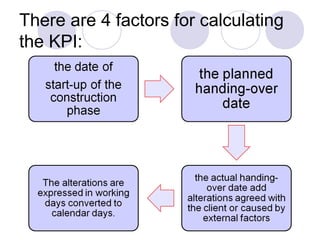
The following three factors are used for
calculating the KPI:
the date of start-up of the
construction phase;
BENCHMARKING-KPI’SBENCHMARKING-KPI’S
the actual handing-over the
project to the client (day);
the alterations that have been
agreed with the client;
or have been caused by external
factors or by the client;
In both cases, the alterations are
expressed in calendar days.
BENCHMARKING-KPI’SBENCHMARKING-KPI’S
If the work takes longer
than anticipated;
the KPI will be greater
than 100%;
KPI will be less than
100% if the work is
completed faster than
anticipated.
There are 4 factors for calculating
the KPI:
BENCHMARKING-KPIsBENCHMARKING-KPIs
Actual construction time includes:
Remedy work (defects) in relation to planned
construction time;
this KPI expresses the relationship between the
actual construction time (including defects
liability period), if any;
and the expected construction time;
 For this case KPI for “Actual construction time
in relation to expected construction time”, the
expected construction time includes alterations
expressed in calendar days.
BENCHMARKING-KPI’SBENCHMARKING-KPI’S
The KPI is calculated as a percentage,
where 100% corresponds to the actual
construction time being identical to the
expected construction time;
If the realised construction time is longer
than expected;
Therefore, the KPI will be greater than
100%.
The KPI will be less than 100% if the work
is completed ahead of the anticipated
time.
BENCHMARKING-KPI’SBENCHMARKING-KPI’S
Remedial work to defects during the first
year after handing over
The KPI includes only the defects
remedied in the first year following
handing over, based on man-hour
consumption.
Some clients set the defect liability for
less time such as 6 month.
Other extra works or additional services
after the first year .
BENCHMARKING-KPI’SBENCHMARKING-KPI’S
If it has been agreed that these additional
services may be carried out after handing
over they are not included in the KPI.
The man hours used to remedy defects in
connection with the one-year inspection
are included as an estimated figure.
The KPI is expressed in man hours
worked and measured against the
contract sum.
BENCHMARKING-KPI’SBENCHMARKING-KPI’S
Accident frequency-CDM
 This is accomplished by the calculating of two
rates:
1. Incidence rate;
2. Accident frequency rate.
Incidence Rate
 Give the number of accidents for 1000
employees and is used to take into account
variations in the size of the workforce:
Incidence Rate = Number of Accidents X 1000
Numbers Employed
BENCHMARKING-KPI’SBENCHMARKING-KPI’S
Accident frequency-CDM
The revised detailed guidance notes which
accompany CDM 2007 entitled 'managing health
and safety in construction.
Listed by the Health and Safety Commission
((the Approved Code of Practice (ACoP)) was
approved in February 2007.
CDM 2007 and ACoP came into force at the
beginning of April 2007.
BENCHMARKING-KPI’SBENCHMARKING-KPI’S
Contribution ratio
Benchmarking System comprises
selected types of costs incurred by a
contracting company.
Earnings- KPIs are calculated on the
basis of a proportion of the total costs
incurred by a contracting company on
a contract.
BENCHMARKING-KPI’SBENCHMARKING-KPI’S
The contribution ratio (basic package),
It is calculated on the basis of the
contractor’s turnover on the contract.
It corresponds to the sum of the payments
he has received from the client.
To the above figure should be added
payments such as:
extra works
additional services
BENCHMARKING-KPI’SBENCHMARKING-KPI’S
Exclude from above:
income from interest
income from sale of scrap materials
salary cost
small assets
other direct and indirect production costs
and overhead costs.
Some of these costs are included in the
benchmarking system’s optional
packages.
BENCHMARKING-KPI’SBENCHMARKING-KPI’S
Labour productivity
Labour productivity is defined as the value
added on the project.
It is measured against the total number of
man hours worked by contractors and
subcontractors contractors.
This productivity indicator will
subsequently constitute the project’s
labour productivity.
BENCHMARKING-KPI’SBENCHMARKING-KPI’S
The value added on the project are
considered as:
the value added to the raw materials,
building materials and components
used from the time they are
purchased to the time they are ”sold”
in the form of the finished
construction project.
BENCHMARKING-KPI’SBENCHMARKING-KPI’S
The presentation of the
productivity indicators is
carried out at different levels
such as:
sector
company
project and contract level.
Benchmarking kpi's

Benchmarking kpi's