BENCH MARKINGBENCH MARKING
Professor, Entrepreneur & Lawyer.
Puttu Guru Prasad,
M.Com. M.B.A., L.L.B., M.Phil. PGDFTM.
AP.SET., ICFAI TMF., (PhD) at JNTUK.
Senior Faculty for Management Science,
S&H Department, VVIT, Nambur, NSS P.O
My Blog: puttuguru.blogspot.in
93 94 96 98 98, 807 444 95 39,
New Toyota FortunerToyota Fortuner Takes On FordFord
EndeavourEndeavour: Bestseller vs. Benchmark?
What is Benchmarking?What is Benchmarking?
Benchmarking is a process of
measuring the performance of a
company’s products, services, or
processes against those of
another business considered to
be the best in the industry, aka
“best in class.”
What is Benchmarking?What is Benchmarking?
The point of benchmarking is to identify
internal opportunities for improvement. By
studying companies with superior
performance, breaking down what makes
such superior performance possible, and
then comparing those processes to how your
business operates, you can implement
changes that will yield significant
improvements.
BENCHMARKING: WHAT IS
IT?
It can be defined as a process for
improving performance by constantly
identifying, understanding and adapting
best practices and process followed inside
and outside the company and
implementing the results.
The main emphasis of benchmarking is
not on “best performance” but on
improving a given business operation or a
process by exploiting “best practices”
 “Benchmarking is an
ongoing outreach activity;
the goal of the outreach is
identification of the best
operating practices that,
when implemented,
produce superior
performance”
- Bogan and English ,
Benchmarking for best
practices.
BENCHMARKING: WHAT IS
IT?
Benchmark refers to a measure of
best practice performance.
Benchmarking is the systematic
search for best practices, innovative
ideas and highly effective operating
procedures.
It measures performance against
that of the “ best-in-the-class”
organization.
BENCHMARKING: WHAT IS IT?
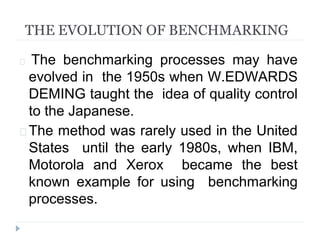
THE EVOLUTION OF BENCHMARKING
 The benchmarking processes may have
evolved in the 1950s when W.EDWARDS
DEMING taught the idea of quality control
to the Japanese.
The method was rarely used in the United
States until the early 1980s, when IBM,
Motorola and Xerox became the best
known example for using benchmarking
processes.
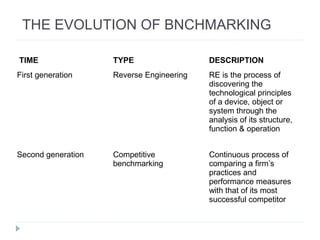
THE EVOLUTION OF BNCHMARKING
TIME TYPE DESCRIPTION
First generation Reverse Engineering RE is the process of
discovering the
technological principles
of a device, object or
system through the
analysis of its structure,
function & operation
Second generation Competitive
benchmarking
Continuous process of
comparing a firm’s
practices and
performance measures
with that of its most
successful competitor
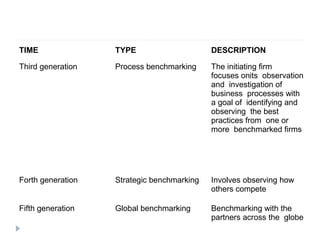
TIME TYPE DESCRIPTION
Third generation Process benchmarking The initiating firm
focuses onits observation
and investigation of
business processes with
a goal of identifying and
observing the best
practices from one or
more benchmarked firms
Forth generation Strategic benchmarking Involves observing how
others compete
Fifth generation Global benchmarking Benchmarking with the
partners across the globe
ADVANTAGES OF BENCHMARKING
 Identify current position and
determining priorities for improving
environment performance
Allowing comparisons
Encouraging regular monitoring of
progress & a process for continuous
improvement
Increasing competitiveness of
organization
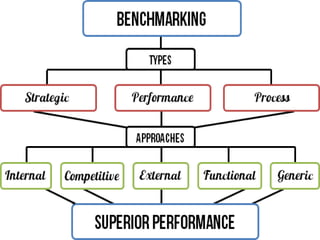
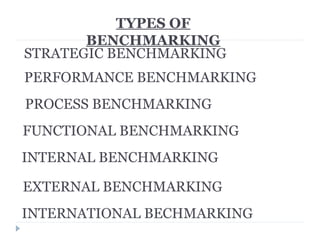
TYPES OF
BENCHMARKING
STRATEGIC BENCHMARKING
PERFORMANCE BENCHMARKING
PROCESS BENCHMARKING
FUNCTIONAL BENCHMARKING
INTERNAL BENCHMARKING
EXTERNAL BENCHMARKING
INTERNATIONAL BECHMARKING
STRATEGIC BENCHMARKING
 It is used where businesses need to
improve overall performance by
examining the long term strategies and
general approaches that have enabled
high performers to succeed.
It involves considering high level aspects
such as core competencies.
This type of benchmarking is suitable
when the company has to realign
business strategies that have become
inappropriate.
PERFORMANCE BENCHMARKING
 Also know as COMPETITIVE BENCHMARKING
 It is used when organizations consider
their positions in relation to performance
characteristics of key products and
services.
Benchmarking partners are usually drawn
from the same sector.
This type of benchmarking is suitable for
assessing relative levels of performance in
key areas or activities in comparison with
others in the same sector to find ways of
closing gaps in performance.
PROCESS BENCHMARKING
 It is used by the organization when the
focus is on improving specific critical
processes and operations
Benchmarking partners are sought from
best practice organization and are drawn
from the same sector.
 This type of benchmarking is suitable for
achieving improvements in key
processes to obtain quick and short term
benefits.
FUNCTIONAL BENCHMARKING
 Also known as GENERIC BENCHMARKING
 It can lead the organization to innovation &
dramatic improvements.
 It is used when organizations look to benchmark
with partners drawn from different business
sectors or areas of activity.
 This type of benchmarking is suitable for
improving activities or services for which
counterparts do not exist.
INTERNAL BENCHMARKING
 It involves seeking partners from within the
same organization & from business units
located in different regions.
 The main advantages are access to sensitive
data & information, availability of standardized.
 This type of benchmarking is suitable when
several business units within the same
organization exemplify good practice and
management and want to spread this expertise
quickly throughout the organization.
EXTERNAL BENCHMARKING
 It involves analyzing outside
organizations that are known to be the
best in the class.
It provides opportunities of learning from
those who are at the “learning edge”.
This type of benchmarking is suitable
where examples of good practices can
be found in other organization and there
is a lack of good practices within internal
business units.
INTERNATIONAL BECHMARKING
 This is used when the best practitioners are
located in other countries. This is due to
globalization and advances in information
technology.
 There is a need for careful analysis &
interpretation due to national differences.
 This type of benchmarking is suitable where the
aim is to achieve world class status or simply
because
there are insufficient “national” businesses
against which to benchmark.
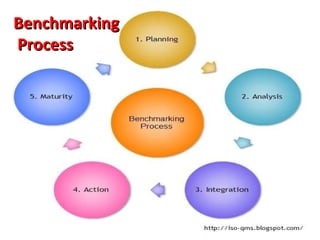
BenchmarkingBenchmarking
ProcessProcess
Benchmarking ProcessBenchmarking Process
LIMITATION TO BENCHMARKING
 Benchmarking is a tough process that
needs a lot of commitment to succeed.
It is a time consuming and expensive.
More often than not benchmarking
processes end with the “they are different
from us” syndrome or competitive
sensitivity that prevents the free flow of
necessary information.
COMMON PITFALLS IN BENCHMARKING
 Lack of management commitment and involvement
 Not applied to critical areas first
 Inadequate resources
 No involvement of the line organization.
 Scope not well defined.
 To many performance measures.
 Critical success factors & performance drivers not understood
or identified.
 Potential partners ignored
 Poorly designed questionnaires.
 Inappropriate data collection method.
 Too much & inconsistent data.
 Analysis paralysis; excess precision.
 Management resistance to change.
 No repeat benchmarking.
6. benchmarking pgp1

6. benchmarking pgp1

  • 1.
    BENCH MARKINGBENCH MARKING Professor,Entrepreneur & Lawyer. Puttu Guru Prasad, M.Com. M.B.A., L.L.B., M.Phil. PGDFTM. AP.SET., ICFAI TMF., (PhD) at JNTUK. Senior Faculty for Management Science, S&H Department, VVIT, Nambur, NSS P.O My Blog: puttuguru.blogspot.in 93 94 96 98 98, 807 444 95 39,
  • 2.
    New Toyota FortunerToyotaFortuner Takes On FordFord EndeavourEndeavour: Bestseller vs. Benchmark?
  • 4.
    What is Benchmarking?Whatis Benchmarking? Benchmarking is a process of measuring the performance of a company’s products, services, or processes against those of another business considered to be the best in the industry, aka “best in class.”
  • 5.
    What is Benchmarking?Whatis Benchmarking? The point of benchmarking is to identify internal opportunities for improvement. By studying companies with superior performance, breaking down what makes such superior performance possible, and then comparing those processes to how your business operates, you can implement changes that will yield significant improvements.
  • 7.
    BENCHMARKING: WHAT IS IT? Itcan be defined as a process for improving performance by constantly identifying, understanding and adapting best practices and process followed inside and outside the company and implementing the results. The main emphasis of benchmarking is not on “best performance” but on improving a given business operation or a process by exploiting “best practices”
  • 8.
     “Benchmarking isan ongoing outreach activity; the goal of the outreach is identification of the best operating practices that, when implemented, produce superior performance” - Bogan and English , Benchmarking for best practices. BENCHMARKING: WHAT IS IT?
  • 9.
    Benchmark refers toa measure of best practice performance. Benchmarking is the systematic search for best practices, innovative ideas and highly effective operating procedures. It measures performance against that of the “ best-in-the-class” organization. BENCHMARKING: WHAT IS IT?
  • 10.
    THE EVOLUTION OFBENCHMARKING  The benchmarking processes may have evolved in the 1950s when W.EDWARDS DEMING taught the idea of quality control to the Japanese. The method was rarely used in the United States until the early 1980s, when IBM, Motorola and Xerox became the best known example for using benchmarking processes.
  • 11.
    THE EVOLUTION OFBNCHMARKING TIME TYPE DESCRIPTION First generation Reverse Engineering RE is the process of discovering the technological principles of a device, object or system through the analysis of its structure, function & operation Second generation Competitive benchmarking Continuous process of comparing a firm’s practices and performance measures with that of its most successful competitor
  • 12.
    TIME TYPE DESCRIPTION Thirdgeneration Process benchmarking The initiating firm focuses onits observation and investigation of business processes with a goal of identifying and observing the best practices from one or more benchmarked firms Forth generation Strategic benchmarking Involves observing how others compete Fifth generation Global benchmarking Benchmarking with the partners across the globe
  • 13.
    ADVANTAGES OF BENCHMARKING Identify current position and determining priorities for improving environment performance Allowing comparisons Encouraging regular monitoring of progress & a process for continuous improvement Increasing competitiveness of organization
  • 14.
    TYPES OF BENCHMARKING STRATEGIC BENCHMARKING PERFORMANCEBENCHMARKING PROCESS BENCHMARKING FUNCTIONAL BENCHMARKING INTERNAL BENCHMARKING EXTERNAL BENCHMARKING INTERNATIONAL BECHMARKING
  • 15.
    STRATEGIC BENCHMARKING  Itis used where businesses need to improve overall performance by examining the long term strategies and general approaches that have enabled high performers to succeed. It involves considering high level aspects such as core competencies. This type of benchmarking is suitable when the company has to realign business strategies that have become inappropriate.
  • 16.
    PERFORMANCE BENCHMARKING  Alsoknow as COMPETITIVE BENCHMARKING  It is used when organizations consider their positions in relation to performance characteristics of key products and services. Benchmarking partners are usually drawn from the same sector. This type of benchmarking is suitable for assessing relative levels of performance in key areas or activities in comparison with others in the same sector to find ways of closing gaps in performance.
  • 17.
    PROCESS BENCHMARKING  Itis used by the organization when the focus is on improving specific critical processes and operations Benchmarking partners are sought from best practice organization and are drawn from the same sector.  This type of benchmarking is suitable for achieving improvements in key processes to obtain quick and short term benefits.
  • 18.
    FUNCTIONAL BENCHMARKING  Alsoknown as GENERIC BENCHMARKING  It can lead the organization to innovation & dramatic improvements.  It is used when organizations look to benchmark with partners drawn from different business sectors or areas of activity.  This type of benchmarking is suitable for improving activities or services for which counterparts do not exist.
  • 19.
    INTERNAL BENCHMARKING  Itinvolves seeking partners from within the same organization & from business units located in different regions.  The main advantages are access to sensitive data & information, availability of standardized.  This type of benchmarking is suitable when several business units within the same organization exemplify good practice and management and want to spread this expertise quickly throughout the organization.
  • 20.
    EXTERNAL BENCHMARKING  Itinvolves analyzing outside organizations that are known to be the best in the class. It provides opportunities of learning from those who are at the “learning edge”. This type of benchmarking is suitable where examples of good practices can be found in other organization and there is a lack of good practices within internal business units.
  • 21.
    INTERNATIONAL BECHMARKING  Thisis used when the best practitioners are located in other countries. This is due to globalization and advances in information technology.  There is a need for careful analysis & interpretation due to national differences.  This type of benchmarking is suitable where the aim is to achieve world class status or simply because there are insufficient “national” businesses against which to benchmark.
  • 22.
  • 23.
  • 24.
    LIMITATION TO BENCHMARKING Benchmarking is a tough process that needs a lot of commitment to succeed. It is a time consuming and expensive. More often than not benchmarking processes end with the “they are different from us” syndrome or competitive sensitivity that prevents the free flow of necessary information.
  • 25.
    COMMON PITFALLS INBENCHMARKING  Lack of management commitment and involvement  Not applied to critical areas first  Inadequate resources  No involvement of the line organization.  Scope not well defined.  To many performance measures.  Critical success factors & performance drivers not understood or identified.  Potential partners ignored  Poorly designed questionnaires.  Inappropriate data collection method.  Too much & inconsistent data.  Analysis paralysis; excess precision.  Management resistance to change.  No repeat benchmarking.