
CITOOLKIT
Benchmarking
The Impact of Benchmarking on Performance and Continuous Improvement
citoolkit.com
Benchmarking Definitions
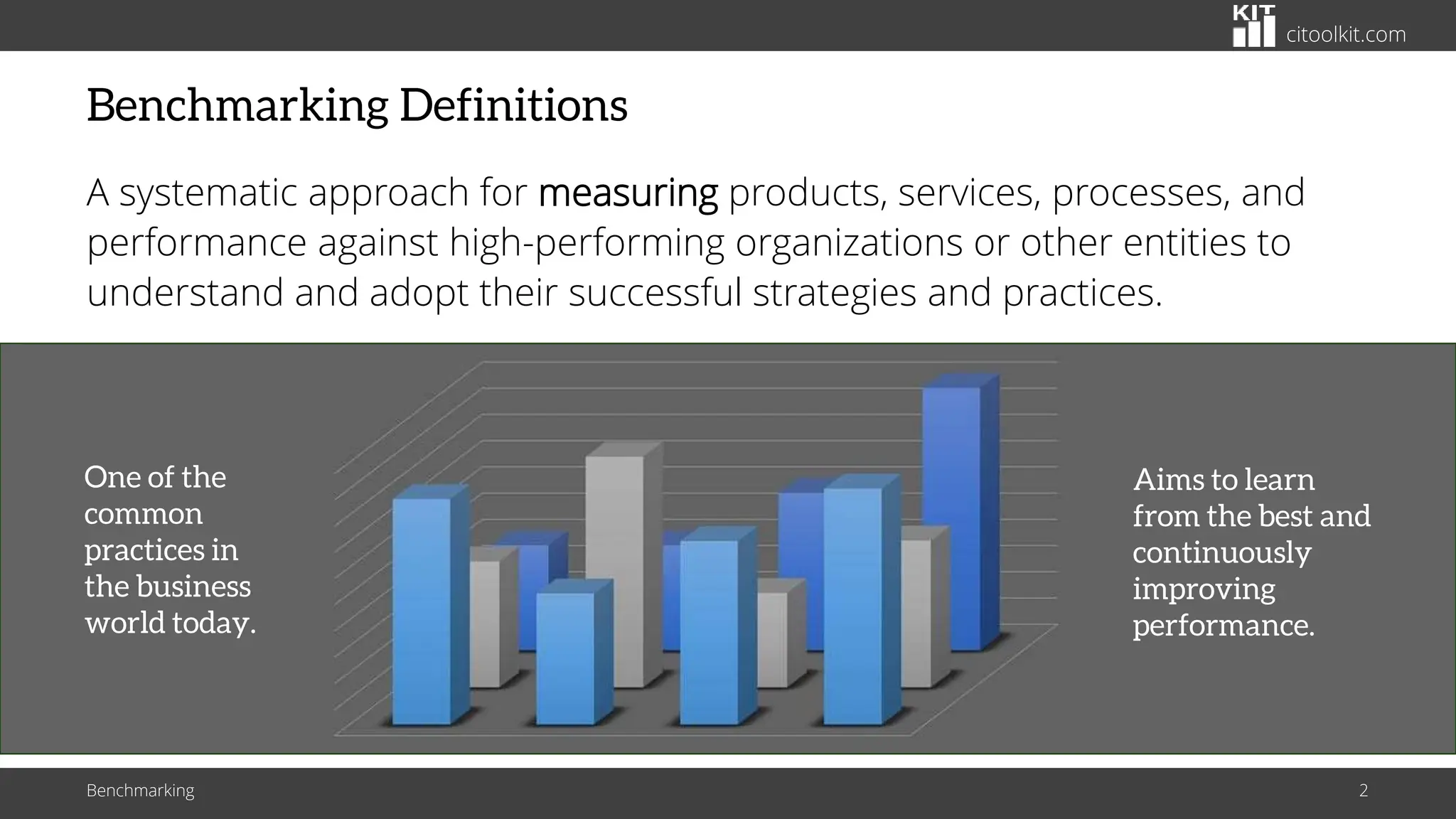
A systematic approach for measuring products, services, processes, and
performance against high-performing organizations or other entities to
understand and adopt their successful strategies and practices.
Benchmarking 2
One of the
common
practices in
the business
world today.
Aims to learn
from the best and
continuously
improving
performance.
citoolkit.com
Benchmarking and Continuous Improvement
Benchmarking 3
Should be viewed as one of
the primary tools for achieving
continuous improvement
Should be integrated into
quality and operational
excellence activities
citoolkit.com
Benchmark
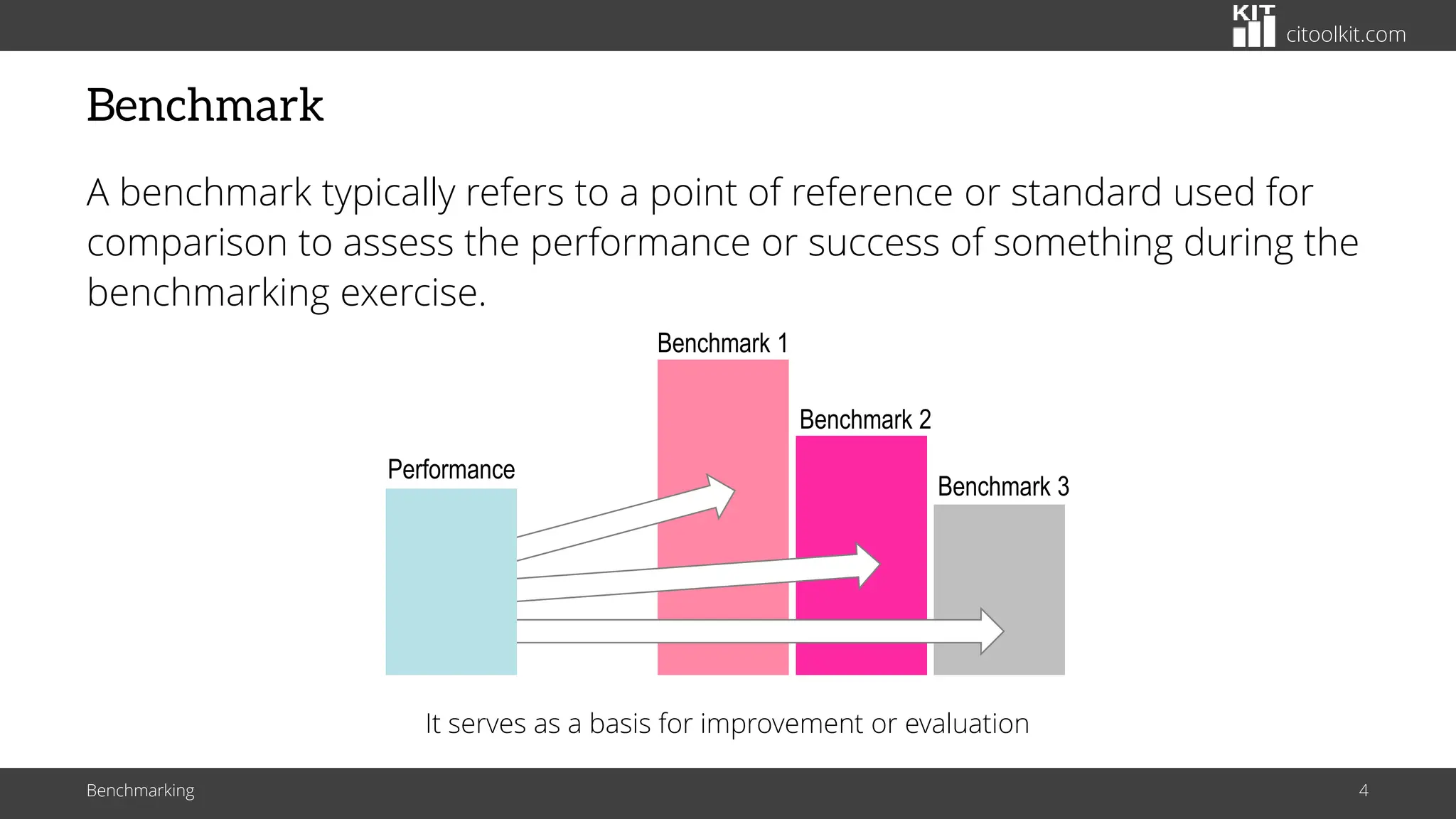
A benchmark typically refers to a point of reference or standard used for
comparison to assess the performance or success of something during the
benchmarking exercise.
Benchmark 1
Benchmark 2
Benchmark 3
Performance
It serves as a basis for improvement or evaluation
Benchmarking 4
citoolkit.com
Uses and Benefits
Benchmarking 5
Companies can use such information
to develop improvement plans and
adopt specific best practices.
A valuable resource for various
purposes, including designing,
redesigning, and improving processes.
Mainly used to better understand
how outstanding companies operate.
Helps in establishing quantitative
improvement goals.
citoolkit.com
What to Benchmark?
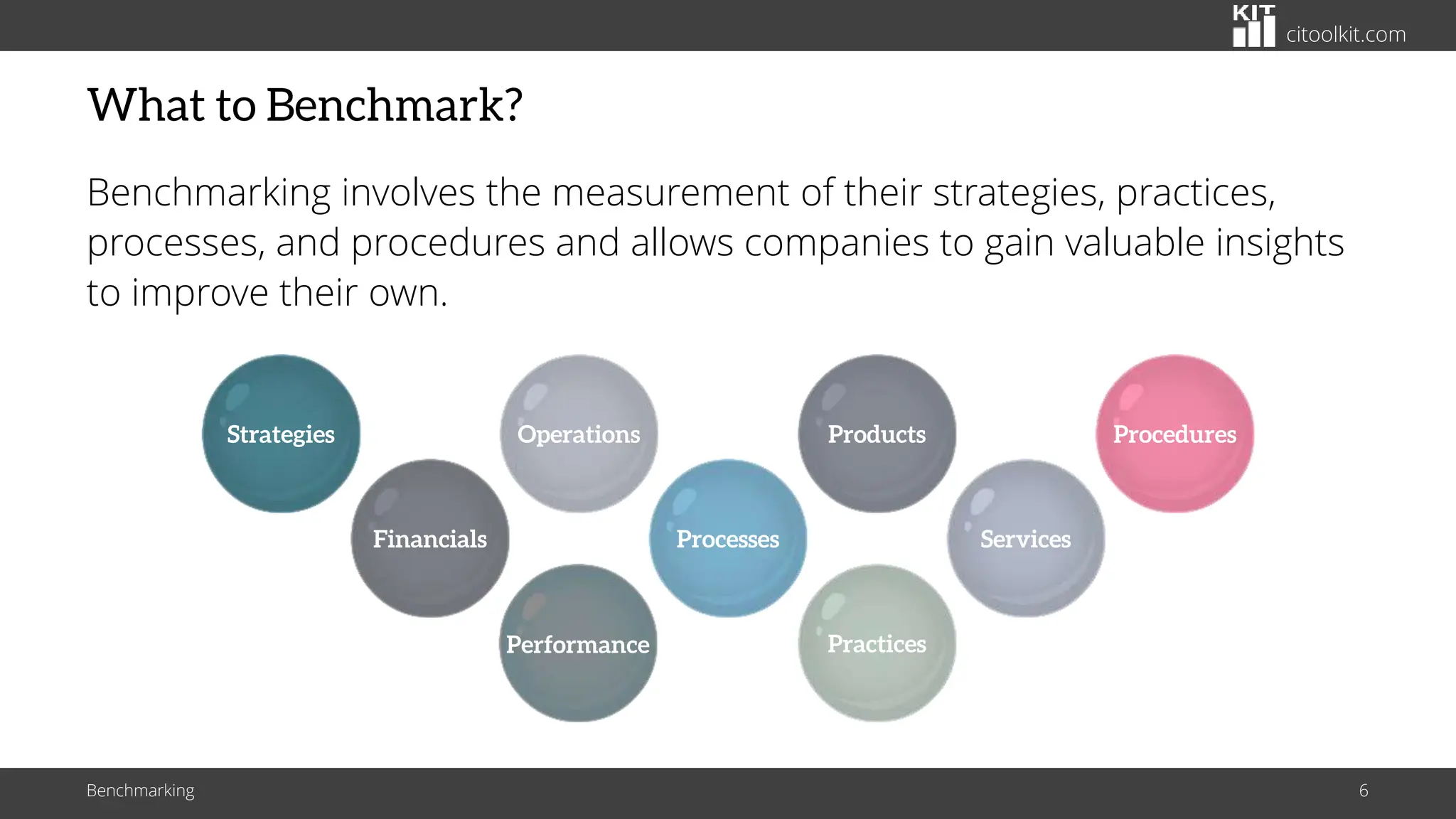
Benchmarking involves the measurement of their strategies, practices,
processes, and procedures and allows companies to gain valuable insights
to improve their own.
Benchmarking 6
Financials Processes Services
Strategies Operations Products Procedures
Performance Practices
citoolkit.com
Benchmarking Types
Benchmarking 7
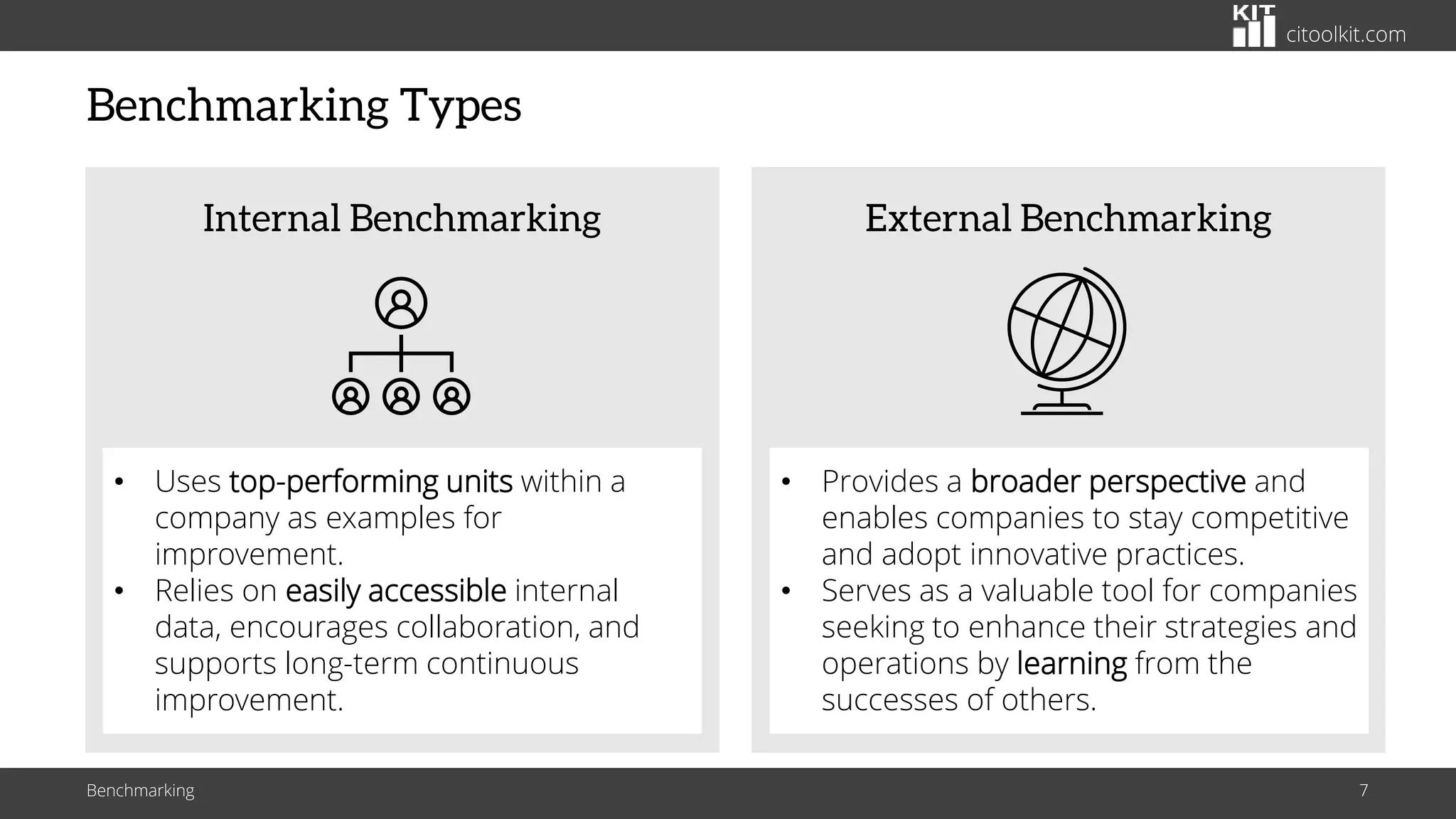
• Uses top-performing units within a
company as examples for
improvement.
• Relies on easily accessible internal
data, encourages collaboration, and
supports long-term continuous
improvement.
Internal Benchmarking
• Provides a broader perspective and
enables companies to stay competitive
and adopt innovative practices.
• Serves as a valuable tool for companies
seeking to enhance their strategies and
operations by learning from the
successes of others.
External Benchmarking
citoolkit.com
Internal Benchmarking Example
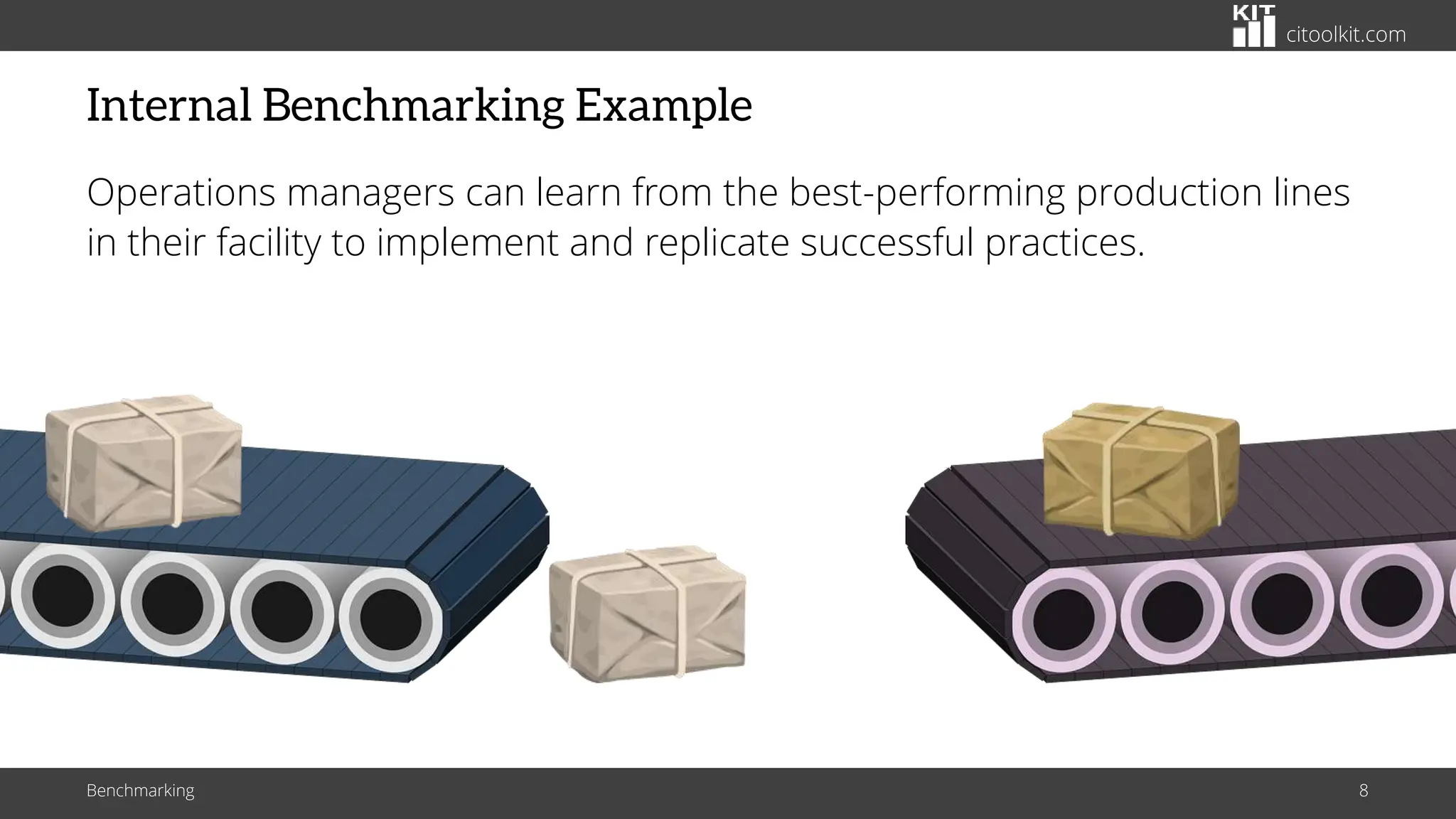
Operations managers can learn from the best-performing production lines
in their facility to implement and replicate successful practices.
Benchmarking 8
citoolkit.com
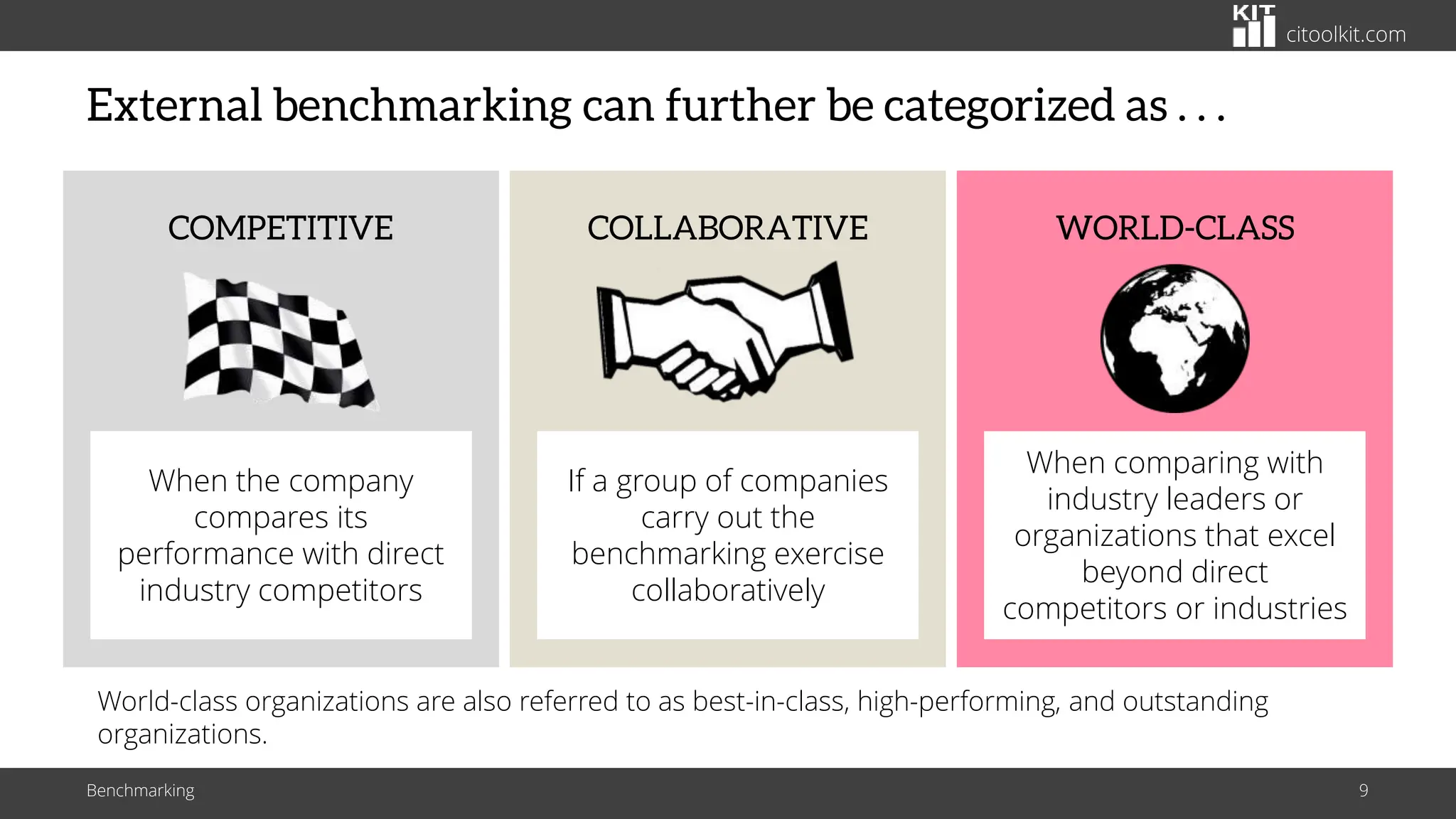
External benchmarking can further be categorized as . . .
Benchmarking 9
When the company
compares its
performance with direct
industry competitors
COMPETITIVE
If a group of companies
carry out the
benchmarking exercise
collaboratively
COLLABORATIVE
When comparing with
industry leaders or
organizations that excel
beyond direct
competitors or industries
WORLD-CLASS
World-class organizations are also referred to as best-in-class, high-performing, and outstanding
organizations.
citoolkit.com
Competitive Benchmarking
Companies usually assess their own progress over time, which is helpful for
understanding internal improvements. However, it doesn't reveal how
competitors are doing.
There is a possibility that the company may
fall behind or be outpaced in the market.
Keep a close eye on the successes and
performance of rival companies to remain
competitive.
Benchmarking 10
citoolkit.com
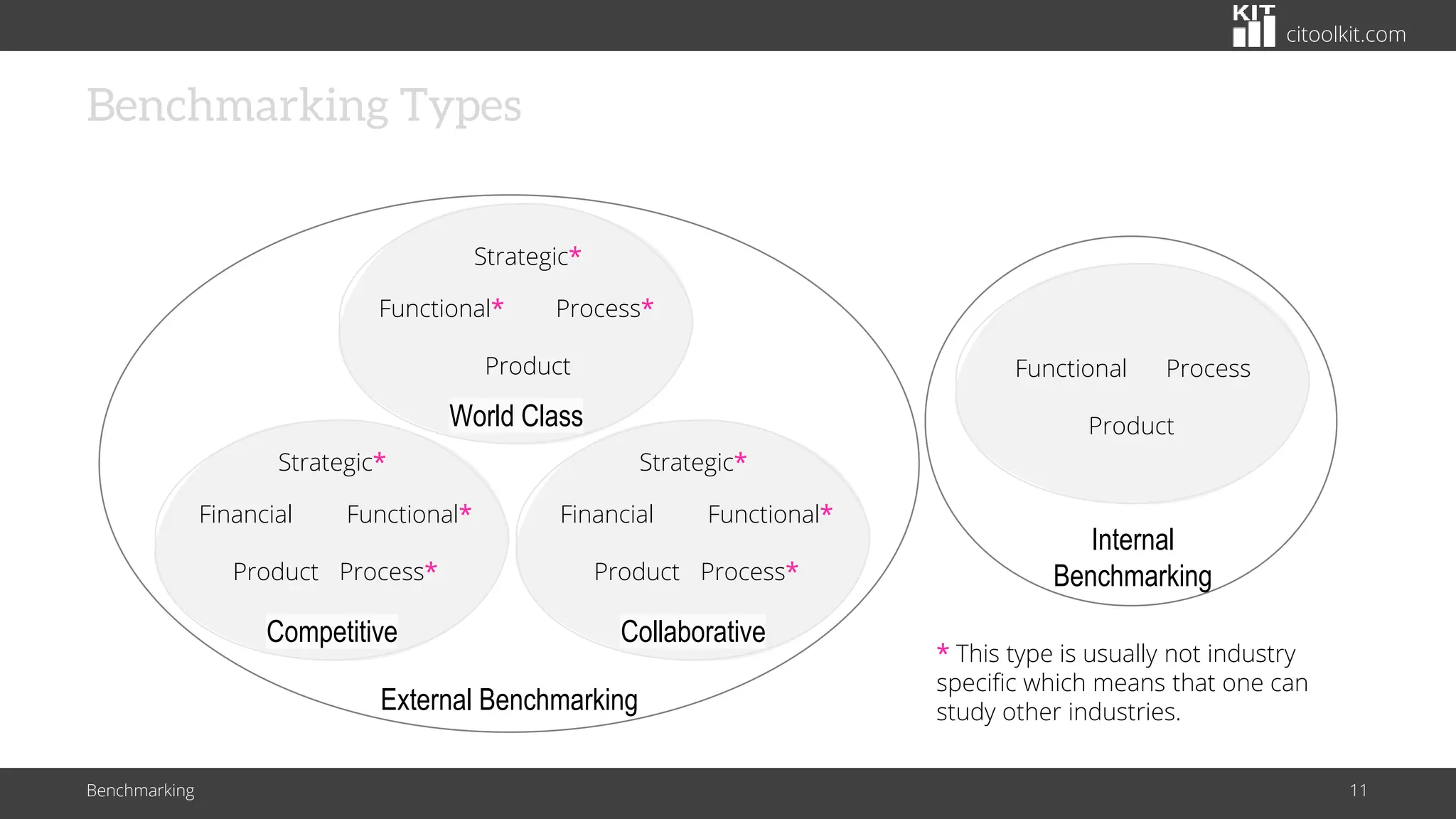
Benchmarking Types
Benchmarking 11
External Benchmarking
Competitive
Strategic*
Functional*
Financial
Process*
Product
Collaborative
Strategic*
Functional*
Financial
Process*
Product
World Class
Strategic*
Process*
Functional*
Product
Internal
Benchmarking
Process
Functional
Product
* This type is usually not industry
specific which means that one can
study other industries.
citoolkit.com
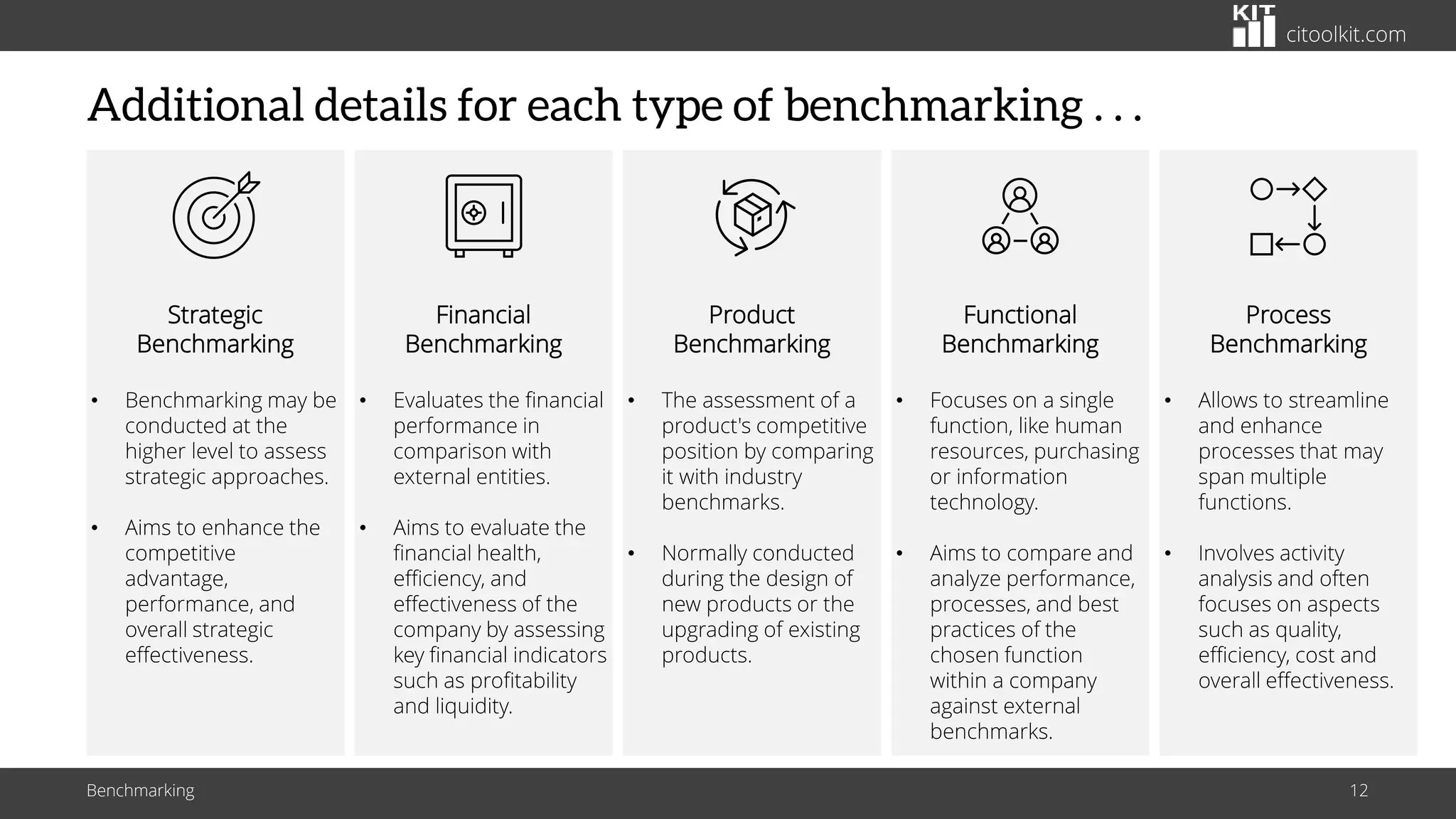
Additional details for each type of benchmarking . . .
Benchmarking 12
Strategic
Benchmarking
• Benchmarking may be
conducted at the
higher level to assess
strategic approaches.
• Aims to enhance the
competitive
advantage,
performance, and
overall strategic
effectiveness.
Financial
Benchmarking
• Evaluates the financial
performance in
comparison with
external entities.
• Aims to evaluate the
financial health,
efficiency, and
effectiveness of the
company by assessing
key financial indicators
such as profitability
and liquidity.
Product
Benchmarking
• The assessment of a
product's competitive
position by comparing
it with industry
benchmarks.
• Normally conducted
during the design of
new products or the
upgrading of existing
products.
Functional
Benchmarking
• Focuses on a single
function, like human
resources, purchasing
or information
technology.
• Aims to compare and
analyze performance,
processes, and best
practices of the
chosen function
within a company
against external
benchmarks.
Process
Benchmarking
• Allows to streamline
and enhance
processes that may
span multiple
functions.
• Involves activity
analysis and often
focuses on aspects
such as quality,
efficiency, cost and
overall effectiveness.
citoolkit.com
Performance Benchmarking
Benchmarking 13
Strategic
Benchmarking
• Benchmarking may be
conducted at the
higher level to assess
strategic approaches.
• Aims to enhance the
competitive
advantage,
performance, and
overall strategic
effectiveness.
Financial
Benchmarking
• Evaluates the financial
performance in
comparison with
external entities.
• Aims to evaluate the
financial health,
efficiency, and
effectiveness of the
company by assessing
key financial indicators
such as profitability
and liquidity.
Product
Benchmarking
• The assessment of a
product's competitive
position by comparing
it with industry
benchmarks.
• Normally conducted
during the design of
new products or the
upgrading of existing
products.
Functional
Benchmarking
• Focuses on a single
function, like human
resources, purchasing
or information
technology.
• Aims to compare and
analyze the
performance,
processes, and best
practices of the
chosen function
within a company
against external
benchmarks.
Process
Benchmarking
• Allows to streamline
and enhance
processes that may
span multiple
functions.
• Involves activity
analysis and often
focuses on aspects
such as quality,
efficiency, cost and
overall effectiveness.
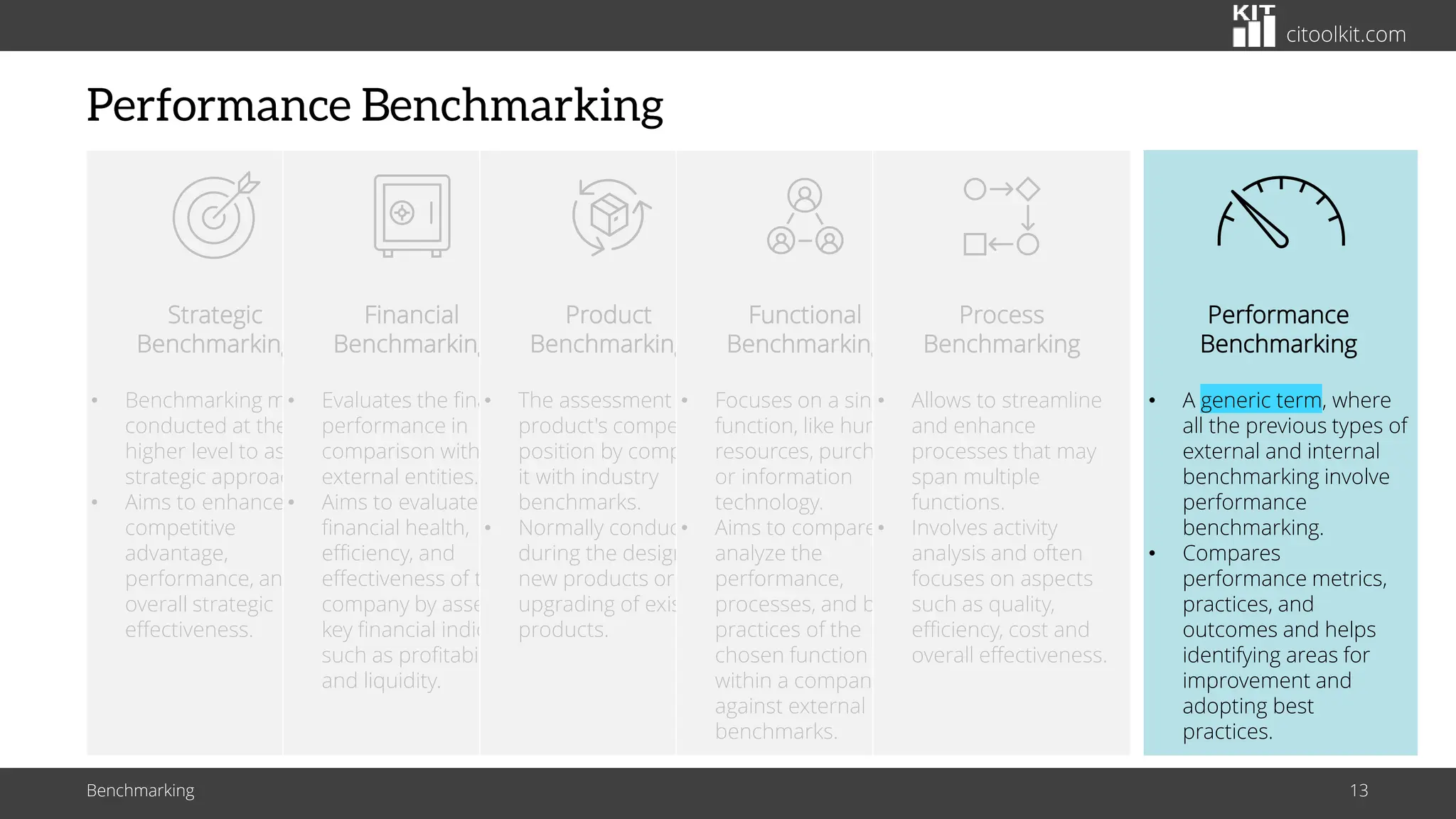
Performance
Benchmarking
• A generic term, where
all the previous types of
external and internal
benchmarking involve
performance
benchmarking.
• Compares
performance metrics,
practices, and
outcomes and helps
identifying areas for
improvement and
adopting best
practices.
citoolkit.com
Beyond Industry Boundaries
Some types of benchmarking are not limited to a particular industry, which means
that one can consider other industries when conducting a benchmarking study.
Benchmarking 14
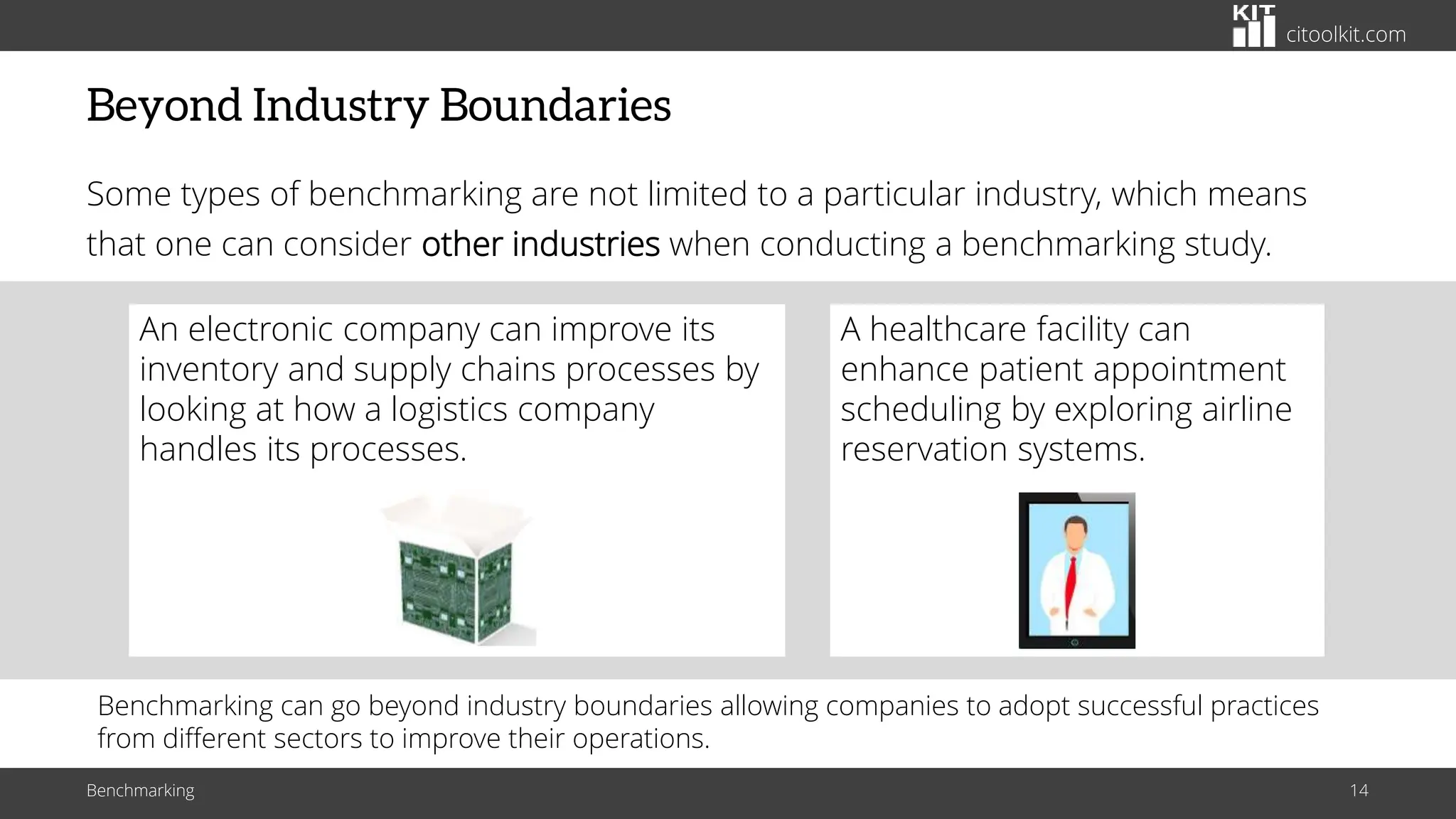
Benchmarking can go beyond industry boundaries allowing companies to adopt successful practices
from different sectors to improve their operations.
An electronic company can improve its
inventory and supply chains processes by
looking at how a logistics company
handles its processes.
A healthcare facility can
enhance patient appointment
scheduling by exploring airline
reservation systems.
citoolkit.com
Benchmarking Can be Implemented at the national level
In recent years, Chinese businesses have actively adopted benchmarking to
learn from global best practices and improve their own operations.
This allows them to identify successful strategies, adopt cutting-edge
technologies, and optimize their business models.
Benchmarking 15
citoolkit.com
Data and Data Collection
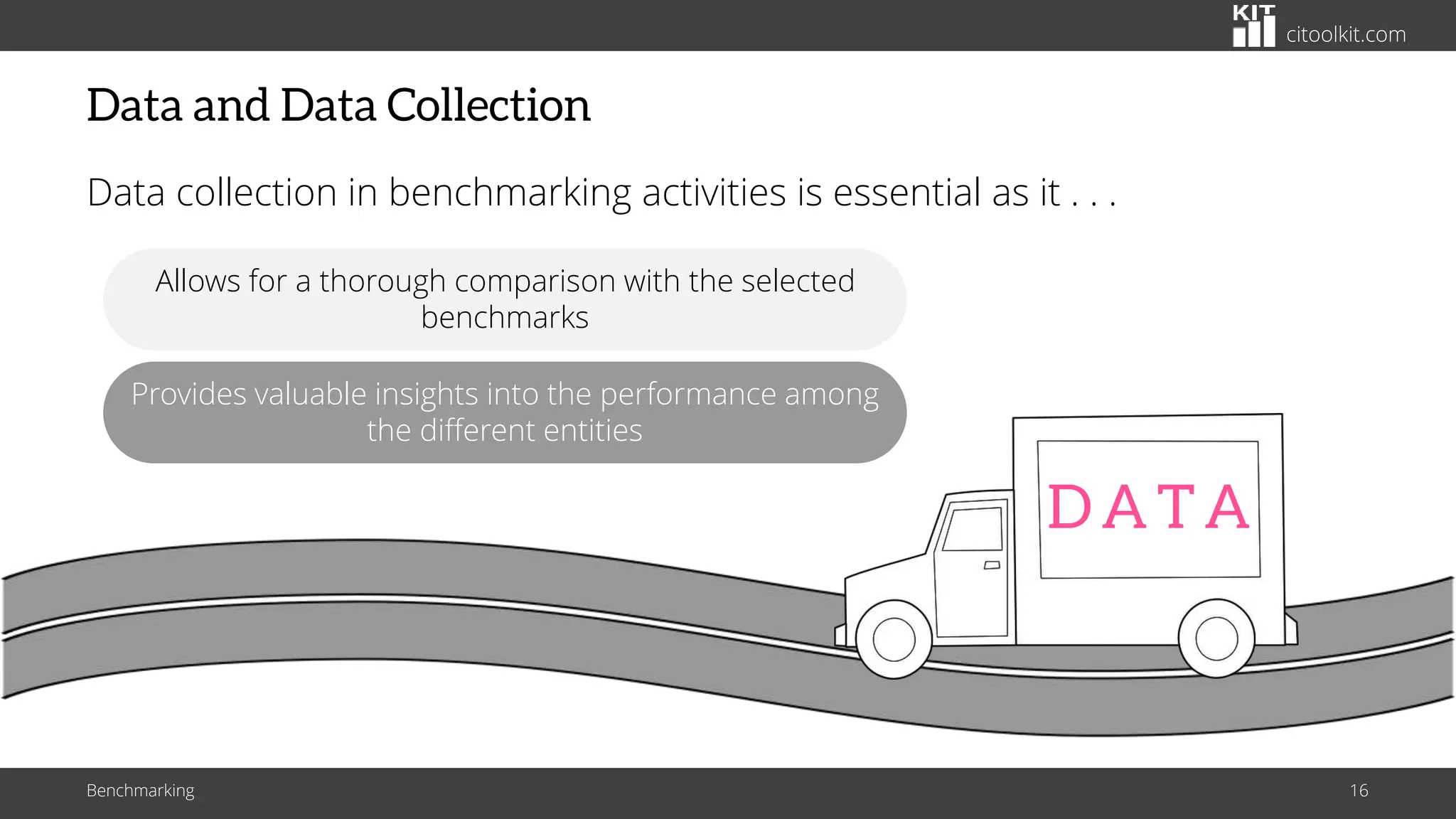
Data collection in benchmarking activities is essential as it . . .
Benchmarking 16
DATA
Allows for a thorough comparison with the selected
benchmarks
Provides valuable insights into the performance among
the different entities
citoolkit.com
Data Collection Challenges
Collecting data can sometimes be challenging due to various reasons . . .
Benchmarking 17
Difficulties in accessing relevant information
Complexities in data sources
Limitations in the availability of accurate and
comprehensive data
Data privacy concerns
citoolkit.com
Professional
Researchers
Consulting
Firms
Internal
Teams
Benchmarking
Agencies
The
Internet
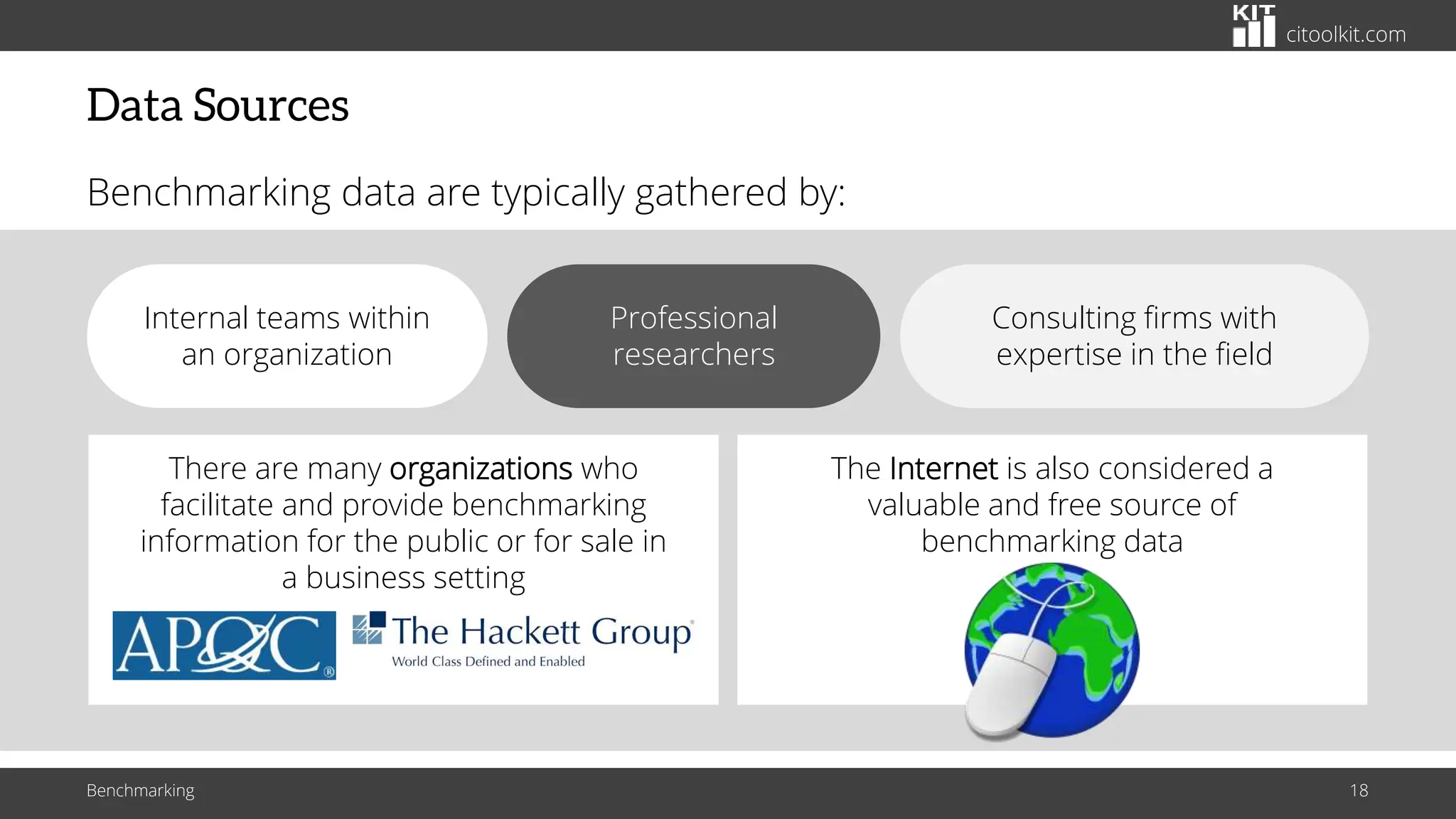
There are many organizations who
facilitate and provide benchmarking
information for the public or for sale in
a business setting
The Internet is also considered a
valuable and free source of
benchmarking data
Data Sources
Benchmarking data are typically gathered by:
Benchmarking 18
Internal teams within
an organization
Professional
researchers
Consulting firms with
expertise in the field
citoolkit.com
Performance Metrics
Identifying performance metrics before starting the benchmarking activity
is important to ensure a focused, relevant, and measurable approach.
Benchmarking 19
Typical performance metrics often considered include . . .
Defect level
Cycle time
Service response time
Return on investment
Cost per unit
Customer satisfaction
citoolkit.com
How to Conduct a Benchmarking Exercise
While there is no universally adopted benchmarking approach, the
following four stages can assist in conducting a benchmarking exercise.
Planning
Data
Collecting
Analyzing Acting
Note: Benchmarking can be performed as a one-time effort, but it is ideally conducted on a continuous
basis. In such ongoing process, companies should continually strive to enhance their performance and
practices, especially in the face of growing competition.
Benchmarking 20
citoolkit.com
How to Conduct a Benchmarking Exercise
Benchmarking 21
Form a dedicated benchmarking team
• Determine the specific function, product, or process to be benchmarked.
• Identify relevant performance metrics for the benchmarking analysis.
• Identify data sources, partners, or companies for comparison.
Planning
Data Collecting
Analyzing
Acting
citoolkit.com
How to Conduct a Benchmarking Exercise
Benchmarking 22
Utilize appropriate methods to collect benchmarking data
• Collect data from data sources.
Planning
Data Collecting
Analyzing
Acting
citoolkit.com
How to Conduct a Benchmarking Exercise
Benchmarking 23
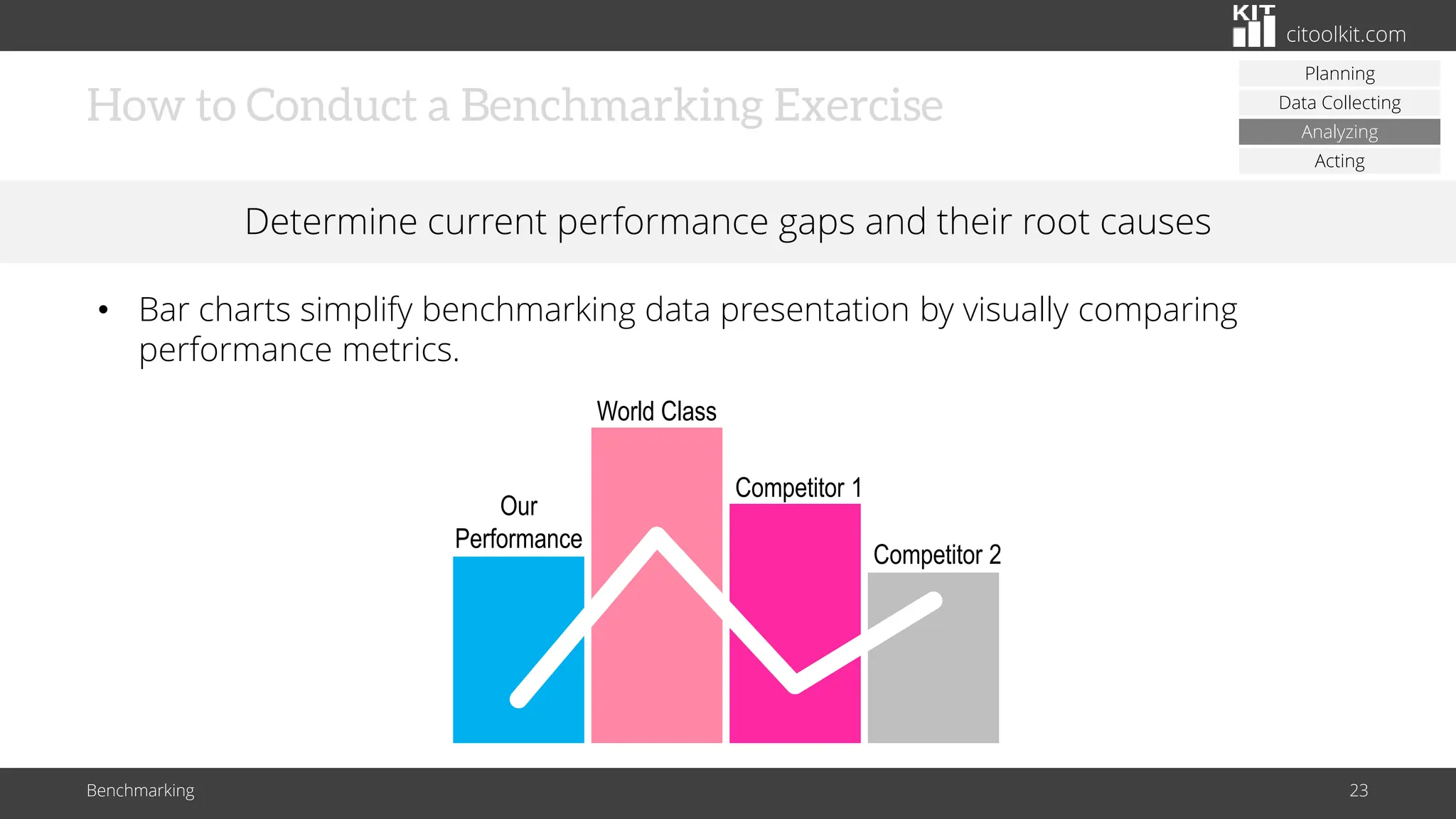
Determine current performance gaps and their root causes
Planning
Data Collecting
Analyzing
Acting
Our
Performance
World Class
Competitor 1
Competitor 2
• Bar charts simplify benchmarking data presentation by visually comparing
performance metrics.
citoolkit.com
How to Conduct a Benchmarking Exercise
Benchmarking 24
Set goals and develop plans based on the analysis findings.
• Put plans into action to fill the performance gaps.
• Monitor progress continuously.
Planning
Data Collecting
Analyzing
Acting
citoolkit.com
Benchmarking Identification Template
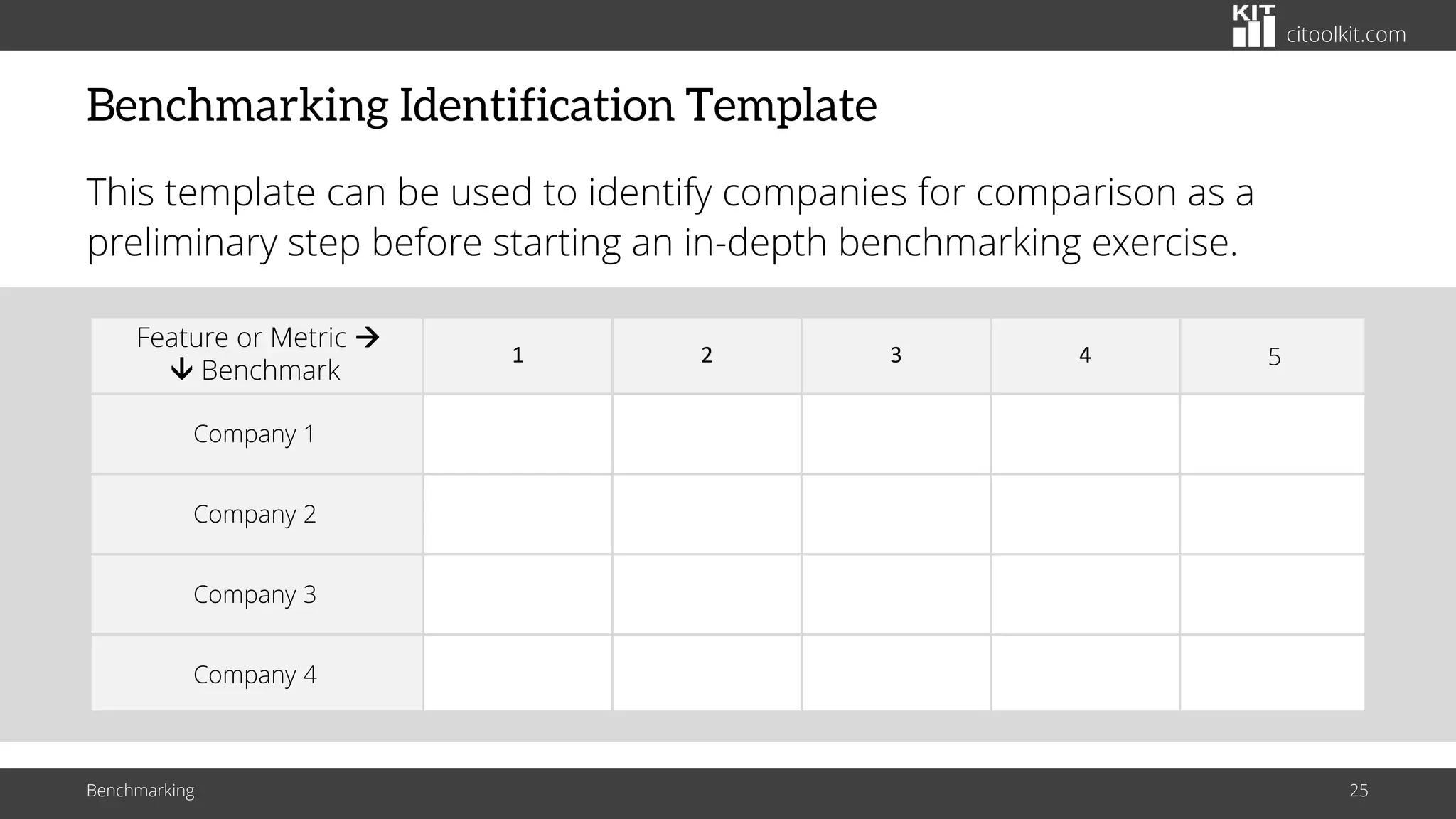
This template can be used to identify companies for comparison as a
preliminary step before starting an in-depth benchmarking exercise.
Benchmarking 25
Feature or Metric →
 Benchmark
1 2 3 4 5
Company 1
Company 2
Company 3
Company 4
citoolkit.com
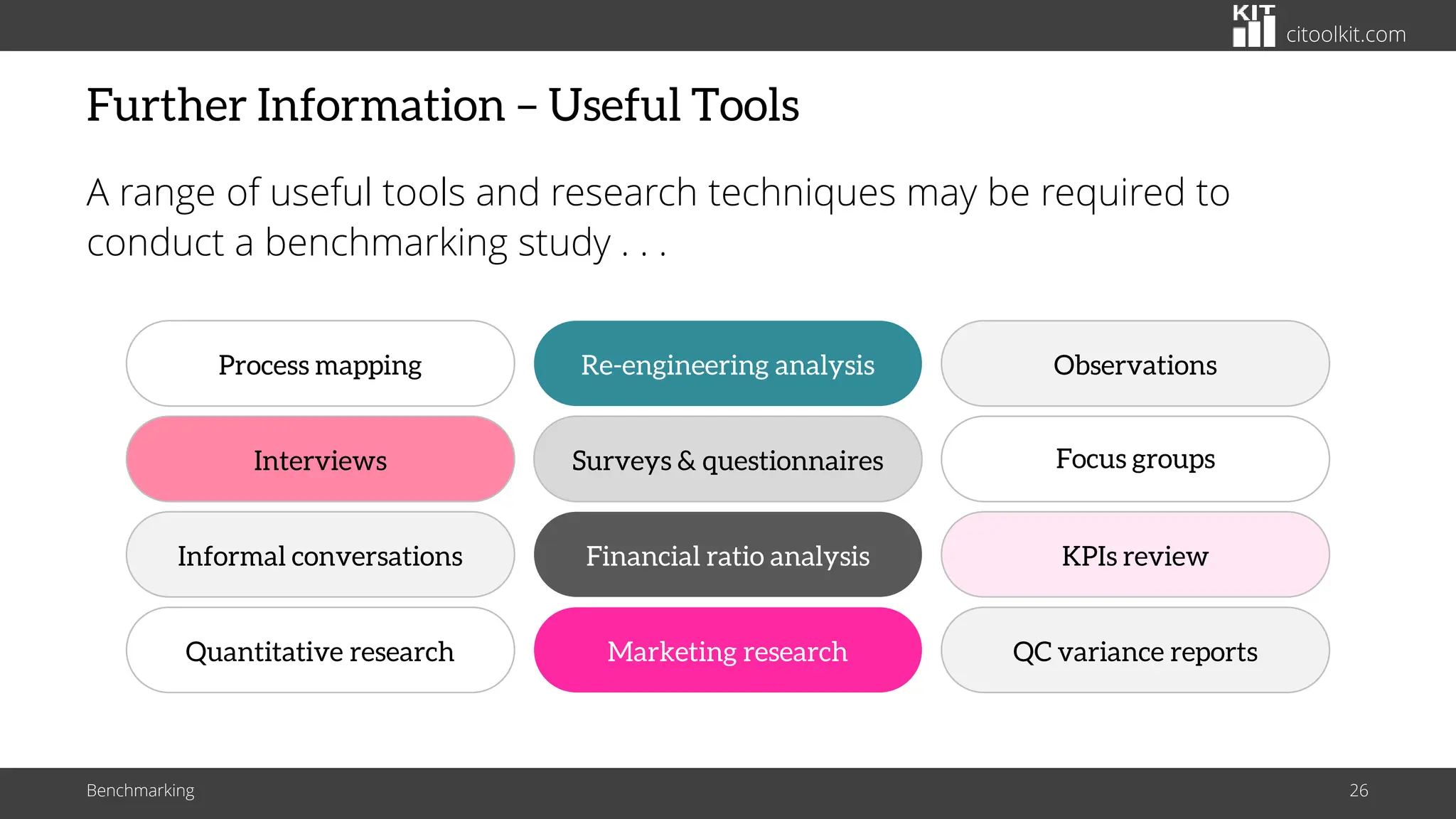
Further Information – Useful Tools
A range of useful tools and research techniques may be required to
conduct a benchmarking study . . .
Benchmarking 26
Informal conversations KPIs review
Financial ratio analysis
Interviews Focus groups
Surveys & questionnaires
Process mapping Observations
Re-engineering analysis
Quantitative research QC variance reports
Marketing research
citoolkit.com
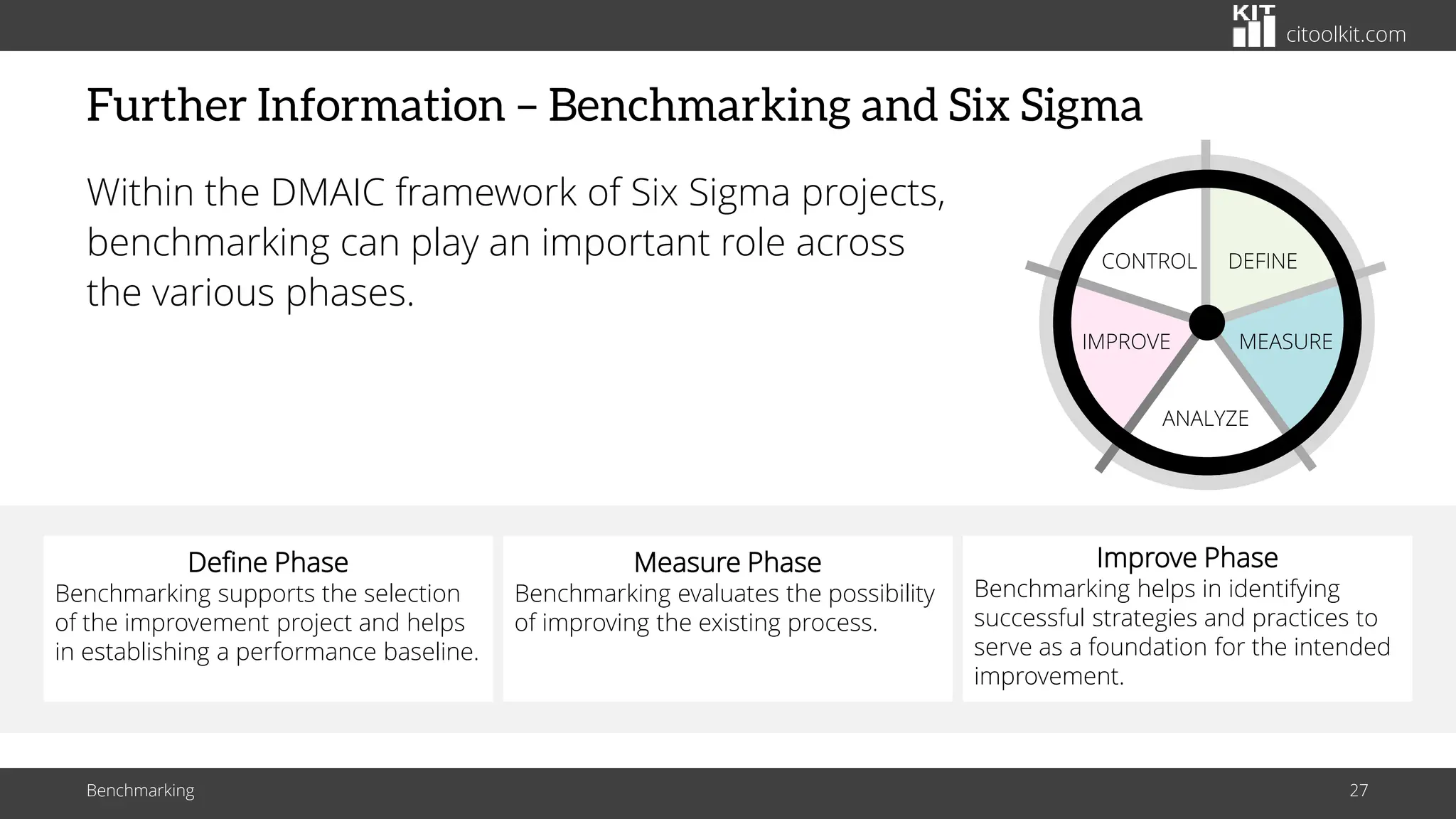
Further Information – Benchmarking and Six Sigma
Within the DMAIC framework of Six Sigma projects,
benchmarking can play an important role across
the various phases.
Benchmarking 27
Define Phase
Benchmarking supports the selection
of the improvement project and helps
in establishing a performance baseline.
Measure Phase
Benchmarking evaluates the possibility
of improving the existing process.
Improve Phase
Benchmarking helps in identifying
successful strategies and practices to
serve as a foundation for the intended
improvement.
DEFINE
MEASURE
ANALYZE
IMPROVE
CONTROL
citoolkit.com
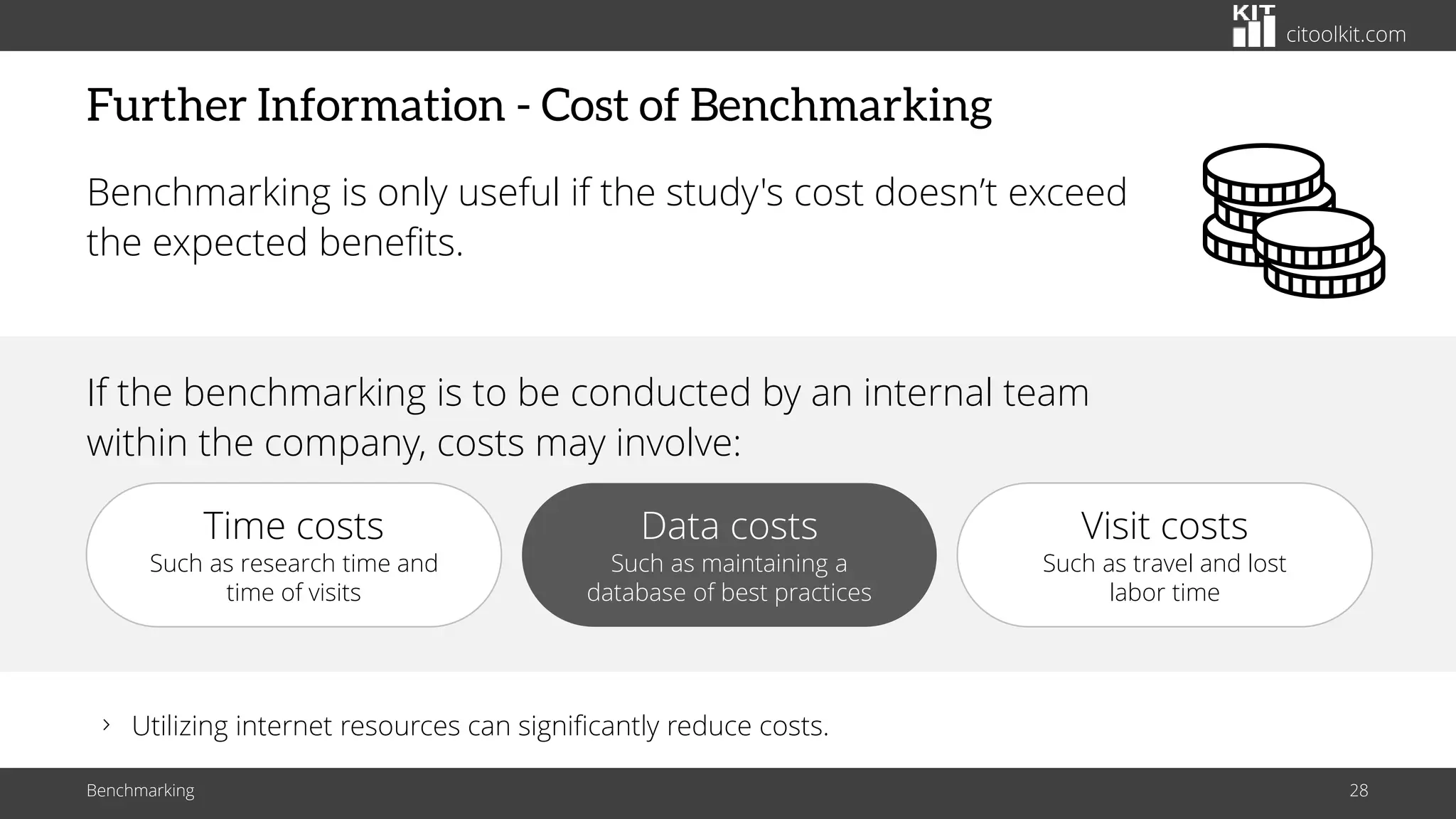
Further Information - Cost of Benchmarking
Benchmarking is only useful if the study's cost doesn’t exceed
the expected benefits.
If the benchmarking is to be conducted by an internal team
within the company, costs may involve:
Benchmarking 28
Time costs
Such as research time and
time of visits
Data costs
Such as maintaining a
database of best practices
Visit costs
Such as travel and lost
labor time
Utilizing internet resources can significantly reduce costs.
citoolkit.com
Further Information - Limitations of Benchmarking
1. The benchmarking process is time-consuming and costly.
2. Selecting the target company to be benchmarked may be challenging.
3. Successful benchmarking requires significant commitment.
4. Variations in metric definitions may vary among companies.
5. Companies may be reluctant to share information due to
fear of revealing competitive advantages.
6. Some projects may face obstacles due to the 'they are
different from us' syndrome
7. Benchmarking is viewed as a study or research without
providing ready-made solutions.
Benchmarking 29
CITOOLKIT
© Copyright Citoolkit.com. All Rights Reserved.
CITOOLKIT
Made with by
The Continuous Improvement Toolkit
www.citoolkit.com

Benchmarking

  • 1.
    CITOOLKIT Benchmarking The Impact ofBenchmarking on Performance and Continuous Improvement
  • 2.
    citoolkit.com Benchmarking Definitions A systematicapproach for measuring products, services, processes, and performance against high-performing organizations or other entities to understand and adopt their successful strategies and practices. Benchmarking 2 One of the common practices in the business world today. Aims to learn from the best and continuously improving performance.
  • 3.
    citoolkit.com Benchmarking and ContinuousImprovement Benchmarking 3 Should be viewed as one of the primary tools for achieving continuous improvement Should be integrated into quality and operational excellence activities
  • 4.
    citoolkit.com Benchmark A benchmark typicallyrefers to a point of reference or standard used for comparison to assess the performance or success of something during the benchmarking exercise. Benchmark 1 Benchmark 2 Benchmark 3 Performance It serves as a basis for improvement or evaluation Benchmarking 4
  • 5.
    citoolkit.com Uses and Benefits Benchmarking5 Companies can use such information to develop improvement plans and adopt specific best practices. A valuable resource for various purposes, including designing, redesigning, and improving processes. Mainly used to better understand how outstanding companies operate. Helps in establishing quantitative improvement goals.
  • 6.
    citoolkit.com What to Benchmark? Benchmarkinginvolves the measurement of their strategies, practices, processes, and procedures and allows companies to gain valuable insights to improve their own. Benchmarking 6 Financials Processes Services Strategies Operations Products Procedures Performance Practices
  • 7.
    citoolkit.com Benchmarking Types Benchmarking 7 •Uses top-performing units within a company as examples for improvement. • Relies on easily accessible internal data, encourages collaboration, and supports long-term continuous improvement. Internal Benchmarking • Provides a broader perspective and enables companies to stay competitive and adopt innovative practices. • Serves as a valuable tool for companies seeking to enhance their strategies and operations by learning from the successes of others. External Benchmarking
  • 8.
    citoolkit.com Internal Benchmarking Example Operationsmanagers can learn from the best-performing production lines in their facility to implement and replicate successful practices. Benchmarking 8
  • 9.
    citoolkit.com External benchmarking canfurther be categorized as . . . Benchmarking 9 When the company compares its performance with direct industry competitors COMPETITIVE If a group of companies carry out the benchmarking exercise collaboratively COLLABORATIVE When comparing with industry leaders or organizations that excel beyond direct competitors or industries WORLD-CLASS World-class organizations are also referred to as best-in-class, high-performing, and outstanding organizations.
  • 10.
    citoolkit.com Competitive Benchmarking Companies usuallyassess their own progress over time, which is helpful for understanding internal improvements. However, it doesn't reveal how competitors are doing. There is a possibility that the company may fall behind or be outpaced in the market. Keep a close eye on the successes and performance of rival companies to remain competitive. Benchmarking 10
  • 11.
    citoolkit.com Benchmarking Types Benchmarking 11 ExternalBenchmarking Competitive Strategic* Functional* Financial Process* Product Collaborative Strategic* Functional* Financial Process* Product World Class Strategic* Process* Functional* Product Internal Benchmarking Process Functional Product * This type is usually not industry specific which means that one can study other industries.
  • 12.
    citoolkit.com Additional details foreach type of benchmarking . . . Benchmarking 12 Strategic Benchmarking • Benchmarking may be conducted at the higher level to assess strategic approaches. • Aims to enhance the competitive advantage, performance, and overall strategic effectiveness. Financial Benchmarking • Evaluates the financial performance in comparison with external entities. • Aims to evaluate the financial health, efficiency, and effectiveness of the company by assessing key financial indicators such as profitability and liquidity. Product Benchmarking • The assessment of a product's competitive position by comparing it with industry benchmarks. • Normally conducted during the design of new products or the upgrading of existing products. Functional Benchmarking • Focuses on a single function, like human resources, purchasing or information technology. • Aims to compare and analyze performance, processes, and best practices of the chosen function within a company against external benchmarks. Process Benchmarking • Allows to streamline and enhance processes that may span multiple functions. • Involves activity analysis and often focuses on aspects such as quality, efficiency, cost and overall effectiveness.
  • 13.
    citoolkit.com Performance Benchmarking Benchmarking 13 Strategic Benchmarking •Benchmarking may be conducted at the higher level to assess strategic approaches. • Aims to enhance the competitive advantage, performance, and overall strategic effectiveness. Financial Benchmarking • Evaluates the financial performance in comparison with external entities. • Aims to evaluate the financial health, efficiency, and effectiveness of the company by assessing key financial indicators such as profitability and liquidity. Product Benchmarking • The assessment of a product's competitive position by comparing it with industry benchmarks. • Normally conducted during the design of new products or the upgrading of existing products. Functional Benchmarking • Focuses on a single function, like human resources, purchasing or information technology. • Aims to compare and analyze the performance, processes, and best practices of the chosen function within a company against external benchmarks. Process Benchmarking • Allows to streamline and enhance processes that may span multiple functions. • Involves activity analysis and often focuses on aspects such as quality, efficiency, cost and overall effectiveness. Performance Benchmarking • A generic term, where all the previous types of external and internal benchmarking involve performance benchmarking. • Compares performance metrics, practices, and outcomes and helps identifying areas for improvement and adopting best practices.
  • 14.
    citoolkit.com Beyond Industry Boundaries Sometypes of benchmarking are not limited to a particular industry, which means that one can consider other industries when conducting a benchmarking study. Benchmarking 14 Benchmarking can go beyond industry boundaries allowing companies to adopt successful practices from different sectors to improve their operations. An electronic company can improve its inventory and supply chains processes by looking at how a logistics company handles its processes. A healthcare facility can enhance patient appointment scheduling by exploring airline reservation systems.
  • 15.
    citoolkit.com Benchmarking Can beImplemented at the national level In recent years, Chinese businesses have actively adopted benchmarking to learn from global best practices and improve their own operations. This allows them to identify successful strategies, adopt cutting-edge technologies, and optimize their business models. Benchmarking 15
  • 16.
    citoolkit.com Data and DataCollection Data collection in benchmarking activities is essential as it . . . Benchmarking 16 DATA Allows for a thorough comparison with the selected benchmarks Provides valuable insights into the performance among the different entities
  • 17.
    citoolkit.com Data Collection Challenges Collectingdata can sometimes be challenging due to various reasons . . . Benchmarking 17 Difficulties in accessing relevant information Complexities in data sources Limitations in the availability of accurate and comprehensive data Data privacy concerns
  • 18.
    citoolkit.com Professional Researchers Consulting Firms Internal Teams Benchmarking Agencies The Internet There are manyorganizations who facilitate and provide benchmarking information for the public or for sale in a business setting The Internet is also considered a valuable and free source of benchmarking data Data Sources Benchmarking data are typically gathered by: Benchmarking 18 Internal teams within an organization Professional researchers Consulting firms with expertise in the field
  • 19.
    citoolkit.com Performance Metrics Identifying performancemetrics before starting the benchmarking activity is important to ensure a focused, relevant, and measurable approach. Benchmarking 19 Typical performance metrics often considered include . . . Defect level Cycle time Service response time Return on investment Cost per unit Customer satisfaction
  • 20.
    citoolkit.com How to Conducta Benchmarking Exercise While there is no universally adopted benchmarking approach, the following four stages can assist in conducting a benchmarking exercise. Planning Data Collecting Analyzing Acting Note: Benchmarking can be performed as a one-time effort, but it is ideally conducted on a continuous basis. In such ongoing process, companies should continually strive to enhance their performance and practices, especially in the face of growing competition. Benchmarking 20
  • 21.
    citoolkit.com How to Conducta Benchmarking Exercise Benchmarking 21 Form a dedicated benchmarking team • Determine the specific function, product, or process to be benchmarked. • Identify relevant performance metrics for the benchmarking analysis. • Identify data sources, partners, or companies for comparison. Planning Data Collecting Analyzing Acting
  • 22.
    citoolkit.com How to Conducta Benchmarking Exercise Benchmarking 22 Utilize appropriate methods to collect benchmarking data • Collect data from data sources. Planning Data Collecting Analyzing Acting
  • 23.
    citoolkit.com How to Conducta Benchmarking Exercise Benchmarking 23 Determine current performance gaps and their root causes Planning Data Collecting Analyzing Acting Our Performance World Class Competitor 1 Competitor 2 • Bar charts simplify benchmarking data presentation by visually comparing performance metrics.
  • 24.
    citoolkit.com How to Conducta Benchmarking Exercise Benchmarking 24 Set goals and develop plans based on the analysis findings. • Put plans into action to fill the performance gaps. • Monitor progress continuously. Planning Data Collecting Analyzing Acting
  • 25.
    citoolkit.com Benchmarking Identification Template Thistemplate can be used to identify companies for comparison as a preliminary step before starting an in-depth benchmarking exercise. Benchmarking 25 Feature or Metric →  Benchmark 1 2 3 4 5 Company 1 Company 2 Company 3 Company 4
  • 26.
    citoolkit.com Further Information –Useful Tools A range of useful tools and research techniques may be required to conduct a benchmarking study . . . Benchmarking 26 Informal conversations KPIs review Financial ratio analysis Interviews Focus groups Surveys & questionnaires Process mapping Observations Re-engineering analysis Quantitative research QC variance reports Marketing research
  • 27.
    citoolkit.com Further Information –Benchmarking and Six Sigma Within the DMAIC framework of Six Sigma projects, benchmarking can play an important role across the various phases. Benchmarking 27 Define Phase Benchmarking supports the selection of the improvement project and helps in establishing a performance baseline. Measure Phase Benchmarking evaluates the possibility of improving the existing process. Improve Phase Benchmarking helps in identifying successful strategies and practices to serve as a foundation for the intended improvement. DEFINE MEASURE ANALYZE IMPROVE CONTROL
  • 28.
    citoolkit.com Further Information -Cost of Benchmarking Benchmarking is only useful if the study's cost doesn’t exceed the expected benefits. If the benchmarking is to be conducted by an internal team within the company, costs may involve: Benchmarking 28 Time costs Such as research time and time of visits Data costs Such as maintaining a database of best practices Visit costs Such as travel and lost labor time Utilizing internet resources can significantly reduce costs.
  • 29.
    citoolkit.com Further Information -Limitations of Benchmarking 1. The benchmarking process is time-consuming and costly. 2. Selecting the target company to be benchmarked may be challenging. 3. Successful benchmarking requires significant commitment. 4. Variations in metric definitions may vary among companies. 5. Companies may be reluctant to share information due to fear of revealing competitive advantages. 6. Some projects may face obstacles due to the 'they are different from us' syndrome 7. Benchmarking is viewed as a study or research without providing ready-made solutions. Benchmarking 29
  • 30.
    CITOOLKIT © Copyright Citoolkit.com.All Rights Reserved. CITOOLKIT Made with by The Continuous Improvement Toolkit www.citoolkit.com