PRESENTED BY-
ANKIT SUKHWAL
B.E Final year
C.T.A.E. Udaipur
Guided by-
Dr. S. Jindal Sir
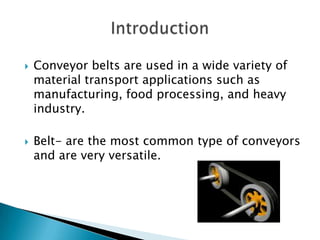
 Conveyor belts are used in a wide variety of
material transport applications such as
manufacturing, food processing, and heavy
industry.
 Belt- are the most common type of conveyors
and are very versatile.
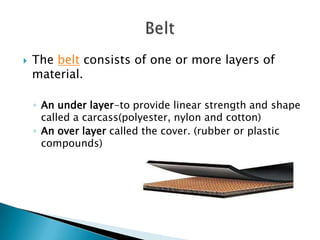
 The belt consists of one or more layers of
material.
◦ An under layer-to provide linear strength and shape
called a carcass(polyester, nylon and cotton)
◦ An over layer called the cover. (rubber or plastic
compounds)
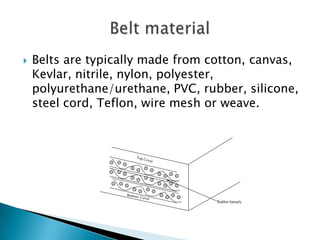
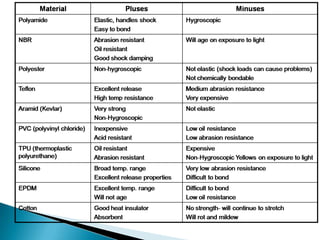
 Belts are typically made from cotton, canvas,
Kevlar, nitrile, nylon, polyester,
polyurethane/urethane, PVC, rubber, silicone,
steel cord, Teflon, wire mesh or weave.
Rubber Interply
Top Cover
Bottom Cover
The actual belt of a system is determined on
what the conveyor is going to be used for.
Items to consider when choosing a belt.
 Size of items being moved
 Weight of items
 shape of items
This will help decide what belt to use so
coefficients of friction can stay low so the
motors wont be over worked.
 Flexibility
 Transverse rigidity
 Low mass per unit length
 High strength
 Simplicity and inexpensive
 Longer life
 Should not stretch under normal working
stresses ,i.e., low relative elongation.
 Wear resistant
 Fire resistant
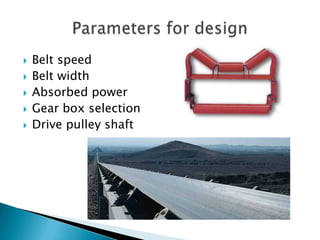
 Belt speed
 Belt width
 Absorbed power
 Gear box selection
 Drive pulley shaft
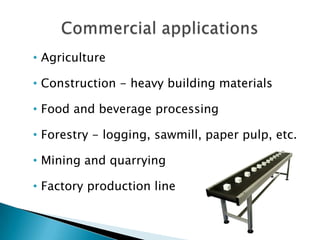
• Agriculture
• Construction - heavy building materials
• Food and beverage processing
• Forestry - logging, sawmill, paper pulp, etc.
• Mining and quarrying
• Factory production line
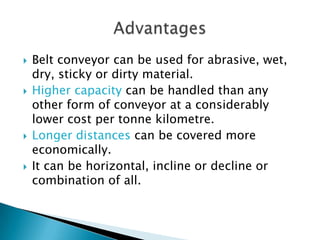
 Belt conveyor can be used for abrasive, wet,
dry, sticky or dirty material.
 Higher capacity can be handled than any
other form of conveyor at a considerably
lower cost per tonne kilometre.
 Longer distances can be covered more
economically.
 It can be horizontal, incline or decline or
combination of all.
 The belt needs higher initial tension.
 Higher elongation of the belt (4% elongation
may take place at the working load).
 Conveying of sticky material is associated
with problems of cleaning and discharge
causing poor productivity.
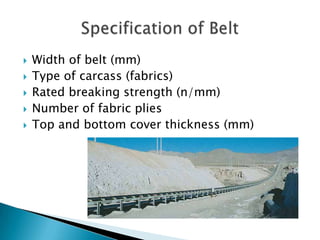
 Width of belt (mm)
 Type of carcass (fabrics)
 Rated breaking strength (n/mm)
 Number of fabric plies
 Top and bottom cover thickness (mm)
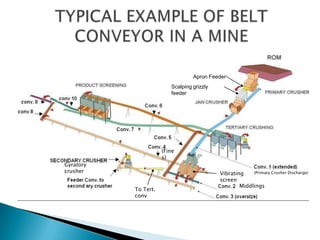
Apron Feeder
Scalping grizzly
feeder
(Primary Crusher Discharge)Vibrating
screen
(Fine
s)
Middlings
Gyratory
crusher
To Tert.
conv
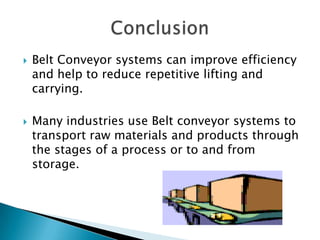
 Belt Conveyor systems can improve efficiency
and help to reduce repetitive lifting and
carrying.
 Many industries use Belt conveyor systems to
transport raw materials and products through
the stages of a process or to and from
storage.
 Conveyor Handbook by Fenner Dunlop (Jun 2009)
 Materials Handling Handbook by David E. Mulcahy ,
McGraw-Hill, 1999
 http://intinno.iitkgp.ernet.in/courses/951/wfiles/1
53173
conveyor belt

conveyor belt

  • 1.
    PRESENTED BY- ANKIT SUKHWAL B.EFinal year C.T.A.E. Udaipur Guided by- Dr. S. Jindal Sir
  • 2.
     Conveyor beltsare used in a wide variety of material transport applications such as manufacturing, food processing, and heavy industry.  Belt- are the most common type of conveyors and are very versatile.
  • 4.
     The beltconsists of one or more layers of material. ◦ An under layer-to provide linear strength and shape called a carcass(polyester, nylon and cotton) ◦ An over layer called the cover. (rubber or plastic compounds)
  • 5.
     Belts aretypically made from cotton, canvas, Kevlar, nitrile, nylon, polyester, polyurethane/urethane, PVC, rubber, silicone, steel cord, Teflon, wire mesh or weave. Rubber Interply Top Cover Bottom Cover
  • 7.
    The actual beltof a system is determined on what the conveyor is going to be used for. Items to consider when choosing a belt.  Size of items being moved  Weight of items  shape of items This will help decide what belt to use so coefficients of friction can stay low so the motors wont be over worked.
  • 8.
     Flexibility  Transverserigidity  Low mass per unit length  High strength  Simplicity and inexpensive  Longer life  Should not stretch under normal working stresses ,i.e., low relative elongation.  Wear resistant  Fire resistant
  • 9.
     Belt speed Belt width  Absorbed power  Gear box selection  Drive pulley shaft
  • 10.
    • Agriculture • Construction- heavy building materials • Food and beverage processing • Forestry - logging, sawmill, paper pulp, etc. • Mining and quarrying • Factory production line
  • 12.
     Belt conveyorcan be used for abrasive, wet, dry, sticky or dirty material.  Higher capacity can be handled than any other form of conveyor at a considerably lower cost per tonne kilometre.  Longer distances can be covered more economically.  It can be horizontal, incline or decline or combination of all.
  • 13.
     The beltneeds higher initial tension.  Higher elongation of the belt (4% elongation may take place at the working load).  Conveying of sticky material is associated with problems of cleaning and discharge causing poor productivity.
  • 14.
     Width ofbelt (mm)  Type of carcass (fabrics)  Rated breaking strength (n/mm)  Number of fabric plies  Top and bottom cover thickness (mm)
  • 15.
    Apron Feeder Scalping grizzly feeder (PrimaryCrusher Discharge)Vibrating screen (Fine s) Middlings Gyratory crusher To Tert. conv
  • 16.
     Belt Conveyorsystems can improve efficiency and help to reduce repetitive lifting and carrying.  Many industries use Belt conveyor systems to transport raw materials and products through the stages of a process or to and from storage.
  • 17.
     Conveyor Handbookby Fenner Dunlop (Jun 2009)  Materials Handling Handbook by David E. Mulcahy , McGraw-Hill, 1999  http://intinno.iitkgp.ernet.in/courses/951/wfiles/1 53173

Editor's Notes

  • #3 Conveyors are used when material must be moved in relatively large quantities between specific locations over a fixed path.
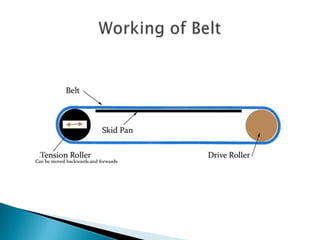
  • #4 Slider bed- skid pan
  • #5 In this photo we can see the under layer and over layer of the belt.
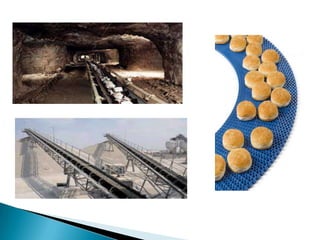
  • #12 Use of Conveyor belt in Mining industry and food industry.
  • #13 Minimum labour is required for the operation and maintenance of belt conveyor system.Many other functions can be performed with the basic conveying like weighing, sorting, picking, sampling, blending, spraying, cooling, drying etc.
  • #16 Mining industry deploys conveyor belt for transport of materials in many ways.