Conveyor Belts
Definition 
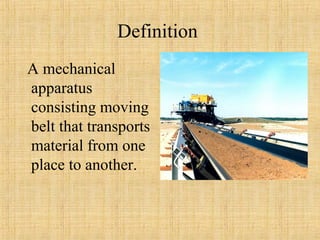
A mechanical 
apparatus 
consisting moving 
belt that transports 
material from one 
place to another.
Types of conveyor belt system 
1) Troughed belt conveyor 
2) Flat belt conveyor 
3) Pipe belt conveyor
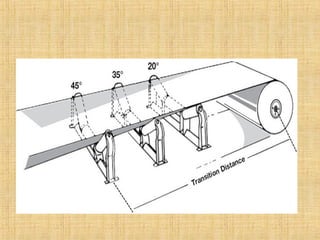
Troughed belt conveyor 
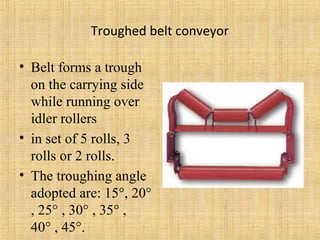
• Belt forms a trough 
on the carrying side 
while running over 
idler rollers 
• in set of 5 rolls, 3 
rolls or 2 rolls. 
• The troughing angle 
adopted are: 15°, 20° 
, 25° , 30° , 35° , 
40° , 45°.
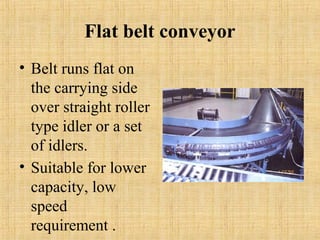
Flat belt conveyor 
• Belt runs flat on 
the carrying side 
over straight roller 
type idler or a set 
of idlers. 
• Suitable for lower 
capacity, low 
speed 
requirement .
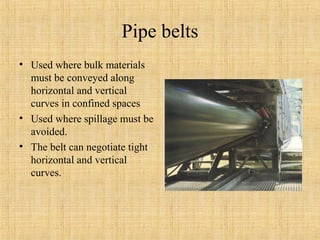
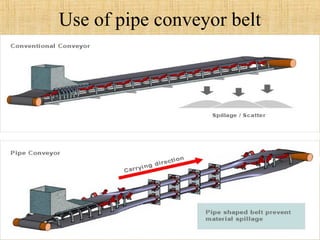
Pipe belts 
• Used where bulk materials 
must be conveyed along 
horizontal and vertical 
curves in confined spaces 
• Used where spillage must be 
avoided. 
• The belt can negotiate tight 
horizontal and vertical 
curves.
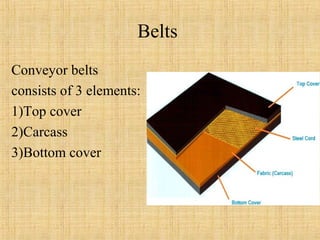
Belts 
Conveyor belts 
consists of 3 elements: 
1)Top cover 
2)Carcass 
3)Bottom cover
Types of conveyor belts 
1)Steel cord belt 
2)Textile belts
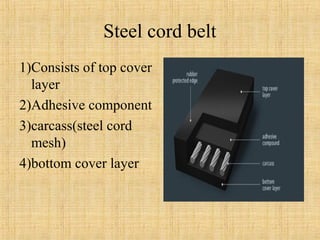
Steel cord belt 
1)Consists of top cover 
layer 
2)Adhesive component 
3)carcass(steel cord 
mesh) 
4)bottom cover layer
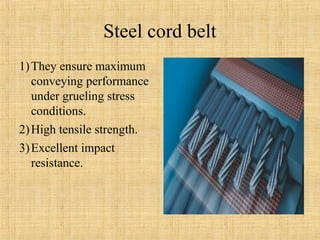
Steel cord belt 
1)They ensure maximum 
conveying performance 
under grueling stress 
conditions. 
2)High tensile strength. 
3)Excellent impact 
resistance.
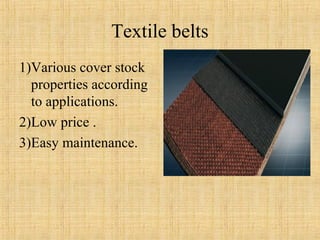
Textile belts 
1)Various cover stock 
properties according 
to applications. 
2)Low price . 
3)Easy maintenance.
Types of textile belts 
1)Temperature resistance belts 
2)Oil & grease resistance belts 
3)Slit protection belts 
4)Dirt repellent cover belts
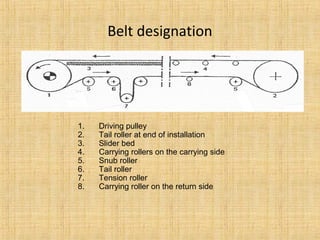
Belt designation 
1. Driving pulley 
2. Tail roller at end of installation 
3. Slider bed 
4. Carrying rollers on the carrying side 
5. Snub roller 
6. Tail roller 
7. Tension roller 
8. Carrying roller on the return side
Belt nomenclature
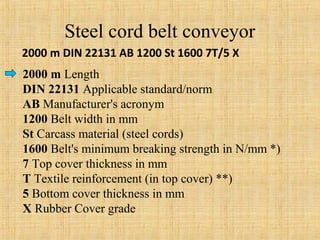
Steel cord belt conveyor 
2000 m DIN 22131 AB 1200 St 1600 7T/5 X 
2000 m Length 
DIN 22131 Applicable standard/norm 
AB Manufacturer's acronym 
1200 Belt width in mm 
St Carcass material (steel cords) 
1600 Belt's minimum breaking strength in N/mm *) 
7 Top cover thickness in mm 
T Textile reinforcement (in top cover) **) 
5 Bottom cover thickness in mm 
X Rubber Cover grade
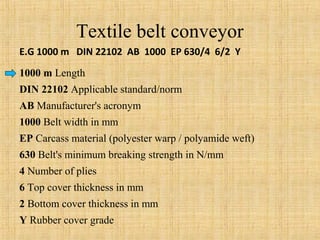
Textile belt conveyor 
E.G 1000 m DIN 22102 AB 1000 EP 630/4 6/2 Y 
1000 m Length 
DIN 22102 Applicable standard/norm 
AB Manufacturer's acronym 
1000 Belt width in mm 
EP Carcass material (polyester warp / polyamide weft) 
630 Belt's minimum breaking strength in N/mm 
4 Number of plies 
6 Top cover thickness in mm 
2 Bottom cover thickness in mm 
Y Rubber cover grade
Failures in belt conveyor system 
• Drive unit failure 
• Pulley failure 
• Idlers and belts failure
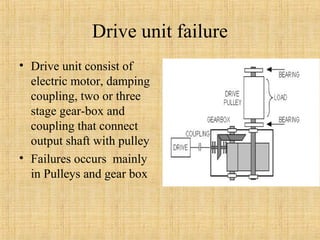
Drive unit failure 
• Drive unit consist of 
electric motor, damping 
coupling, two or three 
stage gear-box and 
coupling that connect 
output shaft with pulley 
• Failures occurs mainly 
in Pulleys and gear box
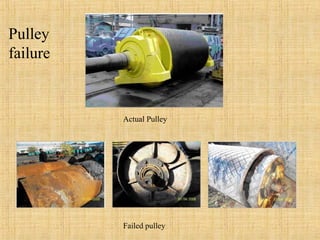
Actual Pulley 
Failed pulley 
Pulley 
failure
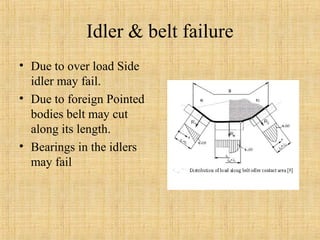
Idler & belt failure 
• Due to over load Side 
idler may fail. 
• Due to foreign Pointed 
bodies belt may cut 
along its length. 
• Bearings in the idlers 
may fail
Belt conveyor troubleshooting
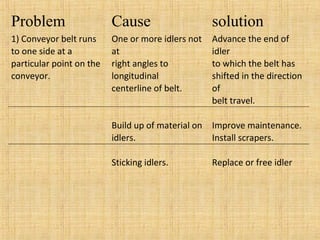
Problem Cause solution 
1) Conveyor belt runs 
to one side at a 
particular point on the 
conveyor. 
One or more idlers not 
at 
right angles to 
longitudinal 
centerline of belt. 
Build up of material on 
idlers. 
Sticking idlers. 
Advance the end of 
idler 
to which the belt has 
shifted in the direction 
of 
belt travel. 
Improve maintenance. 
Install scrapers. 
Replace or free idler
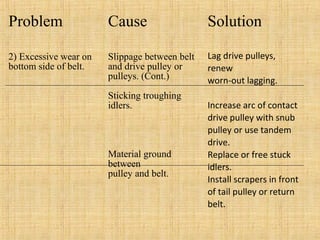
Problem Cause Solution 
2) Excessive wear on 
bottom side of belt. 
Slippage between belt 
and drive pulley or 
pulleys. (Cont.) 
Sticking troughing 
idlers. 
Material ground 
between 
pulley and belt. 
Lag drive pulleys, 
renew 
worn-out lagging. 
Increase arc of contact 
drive pulley with snub 
pulley or use tandem 
drive. 
Replace or free stuck 
idlers. 
Install scrapers in front 
of tail pulley or return 
belt.
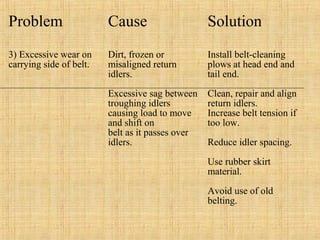
Problem Cause Solution 
3) Excessive wear on 
carrying side of belt. 
Dirt, frozen or 
misaligned return 
idlers. 
Excessive sag between 
troughing idlers 
causing load to move 
and shift on 
belt as it passes over 
idlers. 
Install belt-cleaning 
plows at head end and 
tail end. 
Clean, repair and align 
return idlers. 
Increase belt tension if 
too low. 
Reduce idler spacing. 
Use rubber skirt 
material. 
Avoid use of old 
belting.
Problem Cause Solution 
4) Short breaks in 
carcass 
of belt parallel to edge 
and star breaks in 
carcass. 
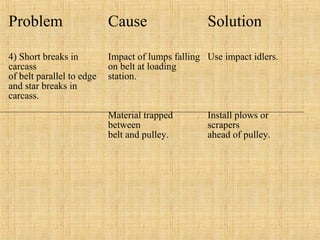
Impact of lumps falling 
on belt at loading 
station. 
Material trapped 
between 
belt and pulley. 
Use impact idlers. 
Install plows or 
scrapers 
ahead of pulley.
Problem Cause Solution 
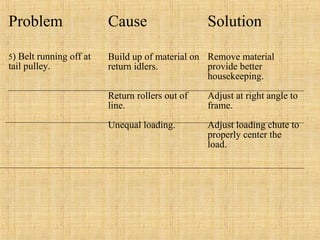
5) Belt running off at 
tail pulley. 
Build up of material on 
return idlers. 
Return rollers out of 
line. 
Unequal loading. 
Remove material 
provide better 
housekeeping. 
Adjust at right angle to 
frame. 
Adjust loading chute to 
properly center the 
load.
Preventive maintenance of belt 
conveyor system
Daily preventive maintenance 
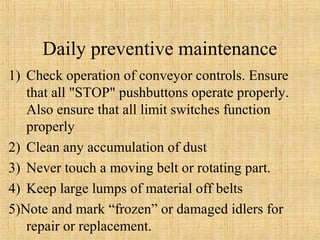
1) Check operation of conveyor controls. Ensure 
that all "STOP" pushbuttons operate properly. 
Also ensure that all limit switches function 
properly 
2) Clean any accumulation of dust 
3) Never touch a moving belt or rotating part. 
4) Keep large lumps of material off belts 
5)Note and mark “frozen” or damaged idlers for 
repair or replacement.
Daily preventive maintenance 
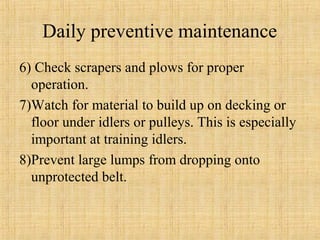
6) Check scrapers and plows for proper 
operation. 
7)Watch for material to build up on decking or 
floor under idlers or pulleys. This is especially 
important at training idlers. 
8)Prevent large lumps from dropping onto 
unprotected belt.
Weekly preventive maintenance 
1)(Conveyor Drive) Check reducer (gearbox) oil 
level, Check reducer for oil leaks, Inspect 
drive coupling , Check oil level in backstop 
and inspect for leaks , Ensure all safety guards 
for drive are in place and in good condition. 
never touch a moving belt or rotating part. 
2)(Safety Switches) Inspect cables for correct 
tension, Ensure flags are free from material 
build up. do not touch loose wires.
Weekly preventive maintenance 
3)Head pulley) Inspect belt cleaners for worn or 
missing blades, Inspect belt cleaners for 
cleanliness of frames and blades , Check belt 
cleaner tension according to manufacturers 
recommendation , Ensure belt is cantered on 
pulley. 
4)(Tail pulley) Ensure belt is centered on pulley, 
check V-plow blade for wear, Check V-plow 
mounting , Check V-plow tension
How to avoid spillage over 
conveyor?
Spillage over the conveyor occurs mainly at 
three different areas: 
1)Loading point containment 
2)Preventing the escape of material from the run 
of conveyor 
3)Managing the discharge of the materials being 
conveyed.
Use of pipe conveyor belt
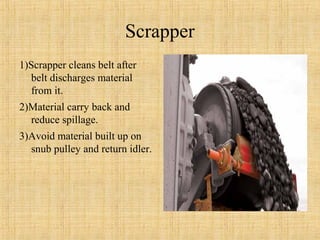
Scrapper 
1)Scrapper cleans belt after 
belt discharges material 
from it. 
2)Material carry back and 
reduce spillage. 
3)Avoid material built up on 
snub pulley and return idler.
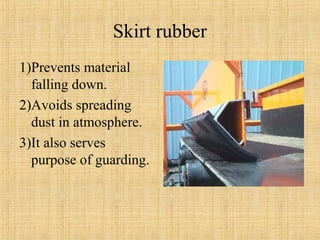
Skirt rubber 
1)Prevents material 
falling down. 
2)Avoids spreading 
dust in atmosphere. 
3)It also serves 
purpose of guarding.
Methods of conveyor belt joining
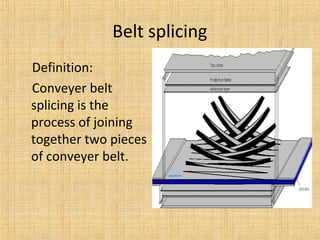
Belt splicing 
Definition: 
Conveyer belt 
splicing is the 
process of joining 
together two pieces 
of conveyer belt.
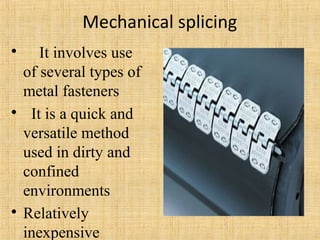
Mechanical splicing 
 It involves use 
of several types of 
metal fasteners 
 It is a quick and 
versatile method 
used in dirty and 
confined 
environments 
 Relatively 
inexpensive
Vulcanization 
1)Vulcanization creates a splice by using 
heat and/or chemicals. 
2)Requires special tools, expertise, and a 
clean, temperature- and moisture-controlled 
environment. 
3)Splice is smoother and typically more 
durable than a mechanical splice
Types of vulcanization 
Hot vulcanization Cold vulcanization 
1)splices by using heat and 
pressure through use of a 
vulcanizing press. 
1)Use of chemicals that bond two 
pieces of belt.
Safety
How to avoid accidents in belt 
conveyor?
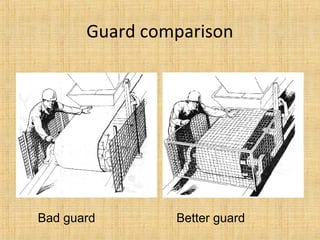
Guarding 
1) Each workplace must be examined at least once in each 
shift for conditions which may adversely affect safety. 
2) Prompt action must be initiated to correct hazardous 
conditions. 
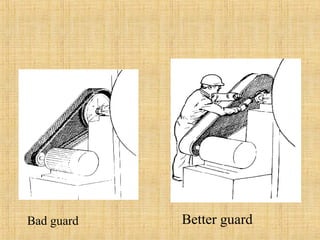
3) Moving machine parts must be guarded to protect persons 
from contacting them. 
4) Guards must be securely in place while machinery is being 
operated . 
5) New employees must be indoctrinated in safety rules and 
safe work procedures
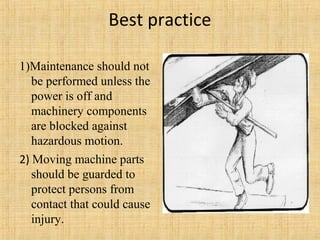
Best practice 
1)Maintenance should not 
be performed unless the 
power is off and 
machinery components 
are blocked against 
hazardous motion. 
2) Moving machine parts 
should be guarded to 
protect persons from 
contact that could cause 
injury.
3)Maintenance should not be performed unless 
the power is off and machinery components are 
blocked against motion. 
4)Visible or audible warnings should be 
provided before conveyor start-up when the 
entire length of the conveyor is not visible from 
the starting switch. 
5)Machine operators should take measures to 
assure all personnel are trained in safe work 
procedures.
Guard comparison 
Bad guard Better guard
Thank you

Conveyor belts new1(final)x

  • 1.
  • 2.
    Definition A mechanical apparatus consisting moving belt that transports material from one place to another.
  • 3.
    Types of conveyorbelt system 1) Troughed belt conveyor 2) Flat belt conveyor 3) Pipe belt conveyor
  • 4.
    Troughed belt conveyor • Belt forms a trough on the carrying side while running over idler rollers • in set of 5 rolls, 3 rolls or 2 rolls. • The troughing angle adopted are: 15°, 20° , 25° , 30° , 35° , 40° , 45°.
  • 6.
    Flat belt conveyor • Belt runs flat on the carrying side over straight roller type idler or a set of idlers. • Suitable for lower capacity, low speed requirement .
  • 7.
    Pipe belts •Used where bulk materials must be conveyed along horizontal and vertical curves in confined spaces • Used where spillage must be avoided. • The belt can negotiate tight horizontal and vertical curves.
  • 8.
    Belts Conveyor belts consists of 3 elements: 1)Top cover 2)Carcass 3)Bottom cover
  • 9.
    Types of conveyorbelts 1)Steel cord belt 2)Textile belts
  • 10.
    Steel cord belt 1)Consists of top cover layer 2)Adhesive component 3)carcass(steel cord mesh) 4)bottom cover layer
  • 11.
    Steel cord belt 1)They ensure maximum conveying performance under grueling stress conditions. 2)High tensile strength. 3)Excellent impact resistance.
  • 12.
    Textile belts 1)Variouscover stock properties according to applications. 2)Low price . 3)Easy maintenance.
  • 13.
    Types of textilebelts 1)Temperature resistance belts 2)Oil & grease resistance belts 3)Slit protection belts 4)Dirt repellent cover belts
  • 14.
    Belt designation 1.Driving pulley 2. Tail roller at end of installation 3. Slider bed 4. Carrying rollers on the carrying side 5. Snub roller 6. Tail roller 7. Tension roller 8. Carrying roller on the return side
  • 15.
  • 16.
    Steel cord beltconveyor 2000 m DIN 22131 AB 1200 St 1600 7T/5 X 2000 m Length DIN 22131 Applicable standard/norm AB Manufacturer's acronym 1200 Belt width in mm St Carcass material (steel cords) 1600 Belt's minimum breaking strength in N/mm *) 7 Top cover thickness in mm T Textile reinforcement (in top cover) **) 5 Bottom cover thickness in mm X Rubber Cover grade
  • 17.
    Textile belt conveyor E.G 1000 m DIN 22102 AB 1000 EP 630/4 6/2 Y 1000 m Length DIN 22102 Applicable standard/norm AB Manufacturer's acronym 1000 Belt width in mm EP Carcass material (polyester warp / polyamide weft) 630 Belt's minimum breaking strength in N/mm 4 Number of plies 6 Top cover thickness in mm 2 Bottom cover thickness in mm Y Rubber cover grade
  • 18.
    Failures in beltconveyor system • Drive unit failure • Pulley failure • Idlers and belts failure
  • 19.
    Drive unit failure • Drive unit consist of electric motor, damping coupling, two or three stage gear-box and coupling that connect output shaft with pulley • Failures occurs mainly in Pulleys and gear box
  • 20.
    Actual Pulley Failedpulley Pulley failure
  • 21.
    Idler & beltfailure • Due to over load Side idler may fail. • Due to foreign Pointed bodies belt may cut along its length. • Bearings in the idlers may fail
  • 22.
  • 23.
    Problem Cause solution 1) Conveyor belt runs to one side at a particular point on the conveyor. One or more idlers not at right angles to longitudinal centerline of belt. Build up of material on idlers. Sticking idlers. Advance the end of idler to which the belt has shifted in the direction of belt travel. Improve maintenance. Install scrapers. Replace or free idler
  • 24.
    Problem Cause Solution 2) Excessive wear on bottom side of belt. Slippage between belt and drive pulley or pulleys. (Cont.) Sticking troughing idlers. Material ground between pulley and belt. Lag drive pulleys, renew worn-out lagging. Increase arc of contact drive pulley with snub pulley or use tandem drive. Replace or free stuck idlers. Install scrapers in front of tail pulley or return belt.
  • 25.
    Problem Cause Solution 3) Excessive wear on carrying side of belt. Dirt, frozen or misaligned return idlers. Excessive sag between troughing idlers causing load to move and shift on belt as it passes over idlers. Install belt-cleaning plows at head end and tail end. Clean, repair and align return idlers. Increase belt tension if too low. Reduce idler spacing. Use rubber skirt material. Avoid use of old belting.
  • 26.
    Problem Cause Solution 4) Short breaks in carcass of belt parallel to edge and star breaks in carcass. Impact of lumps falling on belt at loading station. Material trapped between belt and pulley. Use impact idlers. Install plows or scrapers ahead of pulley.
  • 27.
    Problem Cause Solution 5) Belt running off at tail pulley. Build up of material on return idlers. Return rollers out of line. Unequal loading. Remove material provide better housekeeping. Adjust at right angle to frame. Adjust loading chute to properly center the load.
  • 28.
    Preventive maintenance ofbelt conveyor system
  • 29.
    Daily preventive maintenance 1) Check operation of conveyor controls. Ensure that all "STOP" pushbuttons operate properly. Also ensure that all limit switches function properly 2) Clean any accumulation of dust 3) Never touch a moving belt or rotating part. 4) Keep large lumps of material off belts 5)Note and mark “frozen” or damaged idlers for repair or replacement.
  • 30.
    Daily preventive maintenance 6) Check scrapers and plows for proper operation. 7)Watch for material to build up on decking or floor under idlers or pulleys. This is especially important at training idlers. 8)Prevent large lumps from dropping onto unprotected belt.
  • 31.
    Weekly preventive maintenance 1)(Conveyor Drive) Check reducer (gearbox) oil level, Check reducer for oil leaks, Inspect drive coupling , Check oil level in backstop and inspect for leaks , Ensure all safety guards for drive are in place and in good condition. never touch a moving belt or rotating part. 2)(Safety Switches) Inspect cables for correct tension, Ensure flags are free from material build up. do not touch loose wires.
  • 32.
    Weekly preventive maintenance 3)Head pulley) Inspect belt cleaners for worn or missing blades, Inspect belt cleaners for cleanliness of frames and blades , Check belt cleaner tension according to manufacturers recommendation , Ensure belt is cantered on pulley. 4)(Tail pulley) Ensure belt is centered on pulley, check V-plow blade for wear, Check V-plow mounting , Check V-plow tension
  • 33.
    How to avoidspillage over conveyor?
  • 34.
    Spillage over theconveyor occurs mainly at three different areas: 1)Loading point containment 2)Preventing the escape of material from the run of conveyor 3)Managing the discharge of the materials being conveyed.
  • 35.
    Use of pipeconveyor belt
  • 36.
    Scrapper 1)Scrapper cleansbelt after belt discharges material from it. 2)Material carry back and reduce spillage. 3)Avoid material built up on snub pulley and return idler.
  • 37.
    Skirt rubber 1)Preventsmaterial falling down. 2)Avoids spreading dust in atmosphere. 3)It also serves purpose of guarding.
  • 38.
    Methods of conveyorbelt joining
  • 39.
    Belt splicing Definition: Conveyer belt splicing is the process of joining together two pieces of conveyer belt.
  • 40.
    Mechanical splicing It involves use of several types of metal fasteners  It is a quick and versatile method used in dirty and confined environments  Relatively inexpensive
  • 41.
    Vulcanization 1)Vulcanization createsa splice by using heat and/or chemicals. 2)Requires special tools, expertise, and a clean, temperature- and moisture-controlled environment. 3)Splice is smoother and typically more durable than a mechanical splice
  • 42.
    Types of vulcanization Hot vulcanization Cold vulcanization 1)splices by using heat and pressure through use of a vulcanizing press. 1)Use of chemicals that bond two pieces of belt.
  • 43.
  • 44.
    How to avoidaccidents in belt conveyor?
  • 45.
    Guarding 1) Eachworkplace must be examined at least once in each shift for conditions which may adversely affect safety. 2) Prompt action must be initiated to correct hazardous conditions. 3) Moving machine parts must be guarded to protect persons from contacting them. 4) Guards must be securely in place while machinery is being operated . 5) New employees must be indoctrinated in safety rules and safe work procedures
  • 46.
    Best practice 1)Maintenanceshould not be performed unless the power is off and machinery components are blocked against hazardous motion. 2) Moving machine parts should be guarded to protect persons from contact that could cause injury.
  • 47.
    3)Maintenance should notbe performed unless the power is off and machinery components are blocked against motion. 4)Visible or audible warnings should be provided before conveyor start-up when the entire length of the conveyor is not visible from the starting switch. 5)Machine operators should take measures to assure all personnel are trained in safe work procedures.
  • 48.
    Guard comparison Badguard Better guard
  • 49.
  • 50.