Educational Psychology 
Define and contrast the three types of 
behavioral learning theories (contiguity, 
classical conditioning, and operant 
conditioning), giving examples of how each 
can be used in the classroom.
Behavioral Learning Theory 
According to the behaviorists, learning can 
be defined as “the relatively permanent 
change in behavior brought about as a 
result of experience or practice.” 
Behaviorists recognize that learning is an 
internal event. However, it is not 
recognized as learning until it is displayed 
by overt behavior.
Behavioral Learning Theory 
• The term "learning theory" is often 
associated with the behavioral view. 
• The focus of the behavioral approach is on 
how the environment impacts overt 
behavior. 
• Remember that biological maturation or 
genetics is an alternative explanation for 
relatively permanent change.
Behavioral Learning Theory 
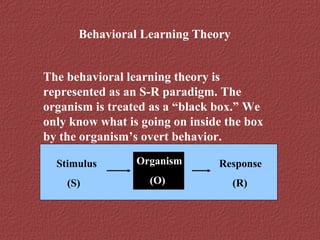
The behavioral learning theory is 
represented as an S-R paradigm. The 
organism is treated as a “black box.” We 
only know what is going on inside the box 
by the organism’s overt behavior. 
Stimulus 
(S) 
Organism 
(O) 
Response 
(R)
Behavioral Learning Theory 
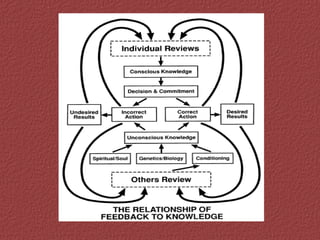
The feedback loop that connects overt 
behavior to stimuli that activate the senses 
has been studied extensively from this 
perspective.
Behavioral Learning Theory 
Notice that the behaviorists are only 
interested in that aspect of feedback that 
connects directly to overt behavior. 
Behaviorists are not interested in the 
conscious decision of the individual to 
disrupt, modify, or go against the 
conditioning process.
Behavioral Learning Theory 
There are three types of behavioral 
learning theories: 
• Contiguity theory 
• Classical or respondent conditioning 
theory 
• Operant or instrumental conditioning 
theory
Contiguity Theory 
Contiguity theory is based on the work of 
E. R. Guthrie. 
It proposes that any stimulus and 
response connected in time and/or space 
will tend to be associated.
Contiguity Theory 
Examples: 
• A baseball player wearing a certain pair 
of socks on the day he hits three home 
runs associates wearing the socks and 
hitting home runs. 
• A student making a good grade on a 
test after trying a new study technique 
makes an association between the 
stimulus of studying and the response of 
getting a good grade.
Contiguity Theory 
Guthrie’s contiguity theory is one 
foundation for the more cognitively-oriented 
learning theory of neural 
networks.
Classical Conditioning Theory 
Classical conditioning was the first type of 
learning to be discovered and studied within 
the behaviorist tradition (hence the name 
classical). 
The major theorist in the development of 
classical conditioning is Ivan Pavlov, a 
Russian scientist trained in biology and 
medicine (as was his German contemporary, 
Sigmund Freud).
Classical Conditioning Theory 
Pavlov was studying the digestive system of dogs 
and became intrigued with his observation that 
dogs deprived of food began to salivate when one of 
his assistants walked into the room. 
He began to investigate this phenomena and 
established the laws of classical conditioning. 
Skinner renamed this type of learning 
"respondent conditioning” since in this type of 
learning, one is responding to an environmental 
antecedent.
Classical Conditioning Theory 
• General model: Stimulus (S) elicits 
>Response (R) 
• Classical conditioning starts with a reflex (R): 
an innate, involuntary behavior. 
• This involuntary behavior is elicited or caused 
by an antecedent environmental event. 
• For example, if air is blown into your eye, 
you blink. You have no voluntary or 
conscious control over whether the blink 
occurs or not.
Classical Conditioning Theory 
The specific model for classical conditioning 
is: 
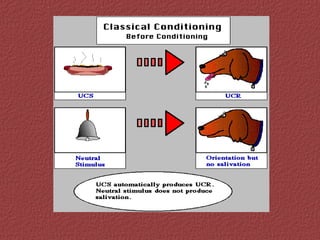
• A stimulus will naturally (without learning) 
elicit or bring about a reflexive response 
• Unconditioned Stimulus (US) elicits > 
Unconditioned Response (UR)
Classical Conditioning Theory 
The specific model for classical conditioning 
is: 
• Neutral Stimulus (NS) --- does not elicit 
the response of interest 
• This stimulus (sometimes called an 
orienting stimulus as it elicits an 
orienting response) is a neutral stimulus 
since it does not elicit the Unconditioned 
(or reflexive) Response.
Classical Conditioning Theory 
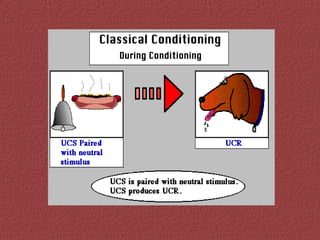
The Neutral/Orientiing Stimulus (NS) is 
repeatedly paired with the 
Unconditioned/Natural Stimulus (US).
Classical Conditioning Theory 
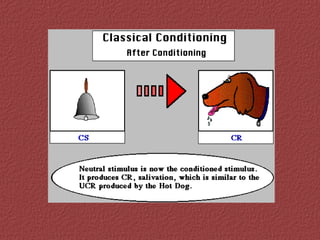
• The Neutral Stimulus (NS) is transformed 
into a Conditioned Stimulus (CS). 
• That is, when the CS is presented by itself, it 
elicits or causes the CR (which is the same 
involuntary response as the UR. 
• The name changes because it is elicited 
by a different stimulus. 
• This is written CS elicits > CR.
Classical Conditioning Theory 
• In the area of classroom learning, classical 
conditioning is seen primarily in the 
conditioning of emotional behavior. 
• Things that make us happy, sad, angry, 
etc. become associated with neutral 
stimuli that gain our attention.
Classical Conditioning Theory 
• For example, the school, classroom, teacher, 
or subject matter are initially neutral stimuli 
that gain attention. 
• Activities at school or in the classroom 
automatically elicit emotional responses 
and these activities are associated with 
the neutral or orienting stimulus 
• After repeated presentations, the 
previously neutral stimulus will elicit the 
emotional response
Classical Conditioning Theory 
Example: 
• Child is harassed at school 
• Child feels bad when harassed 
• Child associates being harassed 
and school 
• Child begins to feel bad when she 
thinks of school
Classical Conditioning Theory 
In order to extinguish the associated of 
feeling bad and thinking of school, the 
connection between school and being 
harassed must be broken.
Operant Conditioning Theory 
• Operant conditioning is the study of the 
impact of consequences on behavior. 
• With operant conditioning we are dealing 
with voluntary behaviors. 
• The details of operant conditioning are 
presented separately.

Behthr

  • 1.
    Educational Psychology Defineand contrast the three types of behavioral learning theories (contiguity, classical conditioning, and operant conditioning), giving examples of how each can be used in the classroom.
  • 2.
    Behavioral Learning Theory According to the behaviorists, learning can be defined as “the relatively permanent change in behavior brought about as a result of experience or practice.” Behaviorists recognize that learning is an internal event. However, it is not recognized as learning until it is displayed by overt behavior.
  • 3.
    Behavioral Learning Theory • The term "learning theory" is often associated with the behavioral view. • The focus of the behavioral approach is on how the environment impacts overt behavior. • Remember that biological maturation or genetics is an alternative explanation for relatively permanent change.
  • 4.
    Behavioral Learning Theory The behavioral learning theory is represented as an S-R paradigm. The organism is treated as a “black box.” We only know what is going on inside the box by the organism’s overt behavior. Stimulus (S) Organism (O) Response (R)
  • 5.
    Behavioral Learning Theory The feedback loop that connects overt behavior to stimuli that activate the senses has been studied extensively from this perspective.
  • 7.
    Behavioral Learning Theory Notice that the behaviorists are only interested in that aspect of feedback that connects directly to overt behavior. Behaviorists are not interested in the conscious decision of the individual to disrupt, modify, or go against the conditioning process.
  • 8.
    Behavioral Learning Theory There are three types of behavioral learning theories: • Contiguity theory • Classical or respondent conditioning theory • Operant or instrumental conditioning theory
  • 9.
    Contiguity Theory Contiguitytheory is based on the work of E. R. Guthrie. It proposes that any stimulus and response connected in time and/or space will tend to be associated.
  • 10.
    Contiguity Theory Examples: • A baseball player wearing a certain pair of socks on the day he hits three home runs associates wearing the socks and hitting home runs. • A student making a good grade on a test after trying a new study technique makes an association between the stimulus of studying and the response of getting a good grade.
  • 11.
    Contiguity Theory Guthrie’scontiguity theory is one foundation for the more cognitively-oriented learning theory of neural networks.
  • 12.
    Classical Conditioning Theory Classical conditioning was the first type of learning to be discovered and studied within the behaviorist tradition (hence the name classical). The major theorist in the development of classical conditioning is Ivan Pavlov, a Russian scientist trained in biology and medicine (as was his German contemporary, Sigmund Freud).
  • 13.
    Classical Conditioning Theory Pavlov was studying the digestive system of dogs and became intrigued with his observation that dogs deprived of food began to salivate when one of his assistants walked into the room. He began to investigate this phenomena and established the laws of classical conditioning. Skinner renamed this type of learning "respondent conditioning” since in this type of learning, one is responding to an environmental antecedent.
  • 14.
    Classical Conditioning Theory • General model: Stimulus (S) elicits >Response (R) • Classical conditioning starts with a reflex (R): an innate, involuntary behavior. • This involuntary behavior is elicited or caused by an antecedent environmental event. • For example, if air is blown into your eye, you blink. You have no voluntary or conscious control over whether the blink occurs or not.
  • 15.
    Classical Conditioning Theory The specific model for classical conditioning is: • A stimulus will naturally (without learning) elicit or bring about a reflexive response • Unconditioned Stimulus (US) elicits > Unconditioned Response (UR)
  • 16.
    Classical Conditioning Theory The specific model for classical conditioning is: • Neutral Stimulus (NS) --- does not elicit the response of interest • This stimulus (sometimes called an orienting stimulus as it elicits an orienting response) is a neutral stimulus since it does not elicit the Unconditioned (or reflexive) Response.
  • 18.
    Classical Conditioning Theory The Neutral/Orientiing Stimulus (NS) is repeatedly paired with the Unconditioned/Natural Stimulus (US).
  • 20.
    Classical Conditioning Theory • The Neutral Stimulus (NS) is transformed into a Conditioned Stimulus (CS). • That is, when the CS is presented by itself, it elicits or causes the CR (which is the same involuntary response as the UR. • The name changes because it is elicited by a different stimulus. • This is written CS elicits > CR.
  • 22.
    Classical Conditioning Theory • In the area of classroom learning, classical conditioning is seen primarily in the conditioning of emotional behavior. • Things that make us happy, sad, angry, etc. become associated with neutral stimuli that gain our attention.
  • 23.
    Classical Conditioning Theory • For example, the school, classroom, teacher, or subject matter are initially neutral stimuli that gain attention. • Activities at school or in the classroom automatically elicit emotional responses and these activities are associated with the neutral or orienting stimulus • After repeated presentations, the previously neutral stimulus will elicit the emotional response
  • 24.
    Classical Conditioning Theory Example: • Child is harassed at school • Child feels bad when harassed • Child associates being harassed and school • Child begins to feel bad when she thinks of school
  • 25.
    Classical Conditioning Theory In order to extinguish the associated of feeling bad and thinking of school, the connection between school and being harassed must be broken.
  • 26.
    Operant Conditioning Theory • Operant conditioning is the study of the impact of consequences on behavior. • With operant conditioning we are dealing with voluntary behaviors. • The details of operant conditioning are presented separately.