Philosophical Foundations of
Education
EDUC 205
Ms. Renalyn H. Tarog
MAE-English
Introduction
Theory is a scientifically
acceptable set of principles
offered to explain a
phenomenon Chunck (2015).
Introduction
Theories provides frameworks to
interpret an environmental
observation and serves as a
bridge between research and
education.
Introduction
Theories and learning are
important element in teacher
development.
Introduction
Most of the practice and
development in a teaching
profession field barrow idea from
learning theories.
Introduction
No matter what the specified
areas linked in studying theories,
the best part of learning the
theories is for making a strong
foundation in education.
Introduction
The following theories in
psychology are the assigned
topic to be thoroughly discuss
based on the research.
Content
Gestalt Theory
Guthrie Theory
Tolman Theory
Gestalt Theory
Gestalt
Gestalt derived from the German
word 'gestalten', has no English
equivalent.
Gestalt
The nearest English translation of
Gestalt is ‘configuration’ or an
‘organized whole’ or the ‘totality
of a situation’.
Prominent Gestalt
Psychologists
Wolfgang Kohler Max Wertheimer
Kurt Koffka Kurt Lewin
“The whole is more
important than its parts.”
Implications of the Gestalt
Principles in Teaching and
Learning Process
Law of Proximity
 Related concepts or lessons
should be taught aligned or
closely to each other.
Law of Similarity
 Similar lessons or contents
should be grouped together to
make learners develop
understanding more efficiently
and effectively.
Law of Closure
 Incomplete information may
make learners want to discover
what’s missing, rather than
concentrating on the given
instruction.
Law of Closure
 Make the lesson complete.
 Present the lesson clearly and
simple.
 Always be ready for students'
clarifications.
Law of Good Continuation
 Lessons should be presented in
such a way that learners will see
these as connected and
continuous.
 DLL: Review of the Previous
Lesson
Law of Pragranz (Good Figure)
 Pragnanz states that when things
are grasped as whole, the minimal
amount of energy is exerted in
thinking.
 Make the lesson holistic, complete
and simple.
Law of Figure/Ground
 For a figure to be perceived, it
must stand out from the
background.
 Emphasis should be done as
important aspect of the lesson.
Law of Figure/Ground
 Teachers should vary the tone
of voice or underline the
important key words of the
lesson.
Implications of Gestalt
Theory to Education
Gestalt Psychology
Gestalt psychology proposes
education to be an integration
of affective and cognitive
domains of learning.
Gestalt Psychology
Gestalt psychology is a
proponent of discovery or insight
learning.
Role of the Teacher
Affective Domain:
 The teacher should set the objectives
that does not only focus on the
cognitive and psychomotor domains of
teaching and learning but also on
the affective domain.
Role of the Teacher
Harmonious Environment:
 The teacher should maintain an
emotionally harmonious and non
threatening atmosphere during the
teaching and learning process to
consequently caters exchange of ideas
and learning.
Role of the Teacher
Hands-On Activities:
 The teacher should make use of
discovery approach in learning.
Example Activities:
 experiments
 laboratory
 inquiry-based strategies (interview)
Role of the Teacher
From Whole to Parts:
 The teacher should present the
subject matter as a whole to
facilitate insight learning.
Role of the Teacher
Importance of Motivation:
 The teacher should arouse the
student’s curiosity, interest and
motivation.
Role of the Teacher
Problem Solving Approach:
 The teacher should encourage the
learners to solve problems by
insight, meaningful learning,
learning by understanding,
reasoning, etc.
Role of the Teacher
Previous Experiences:
 The teacher should check the
previous experiences of the
student and relate them with
the new learning situation.
Role of the Teacher
Goal Orientation:
 The teacher should make sure
that the goals and purposes of
every task are fully presented in
the class.
Guthrie
Theory
Edwin Ray
Guthrie
January 9, 1886—
April 23, 1959
Contiguity Theory
“A combination of stimuli which
has accompanied a movement
will on its recurrence tend to be
followed by that movement”.
Contiguity Theory
Guthrie proposed that all
learning was a consequence of
association between a particular
stimulus and response.
Contiguity Theory
Guthrie argued that stimuli and
responses affect specific sensory-
motor patterns; what is learned
are movements, not behaviors.
One Trial
Learning
One Trial Learning
 Guthrie’s theories went against
those of Watson’s Classical
Conditioning and Skinner’s
Operant Conditioning
One Trial Learning
 Guthrie’s learning theory is
called one-trial learning
 He developed it with Smith at
the University of Washington.
One Trial Learning
 Guthrie and Smith’s theory
states that all learning is done
within a single exposure to a
situation.
Implications of
Principles of
One Trial Learning in
Teaching
Principles of One Trial Learning
1. Learner react to a given
situation the same way so long
as it was still effective.
STIMULATION RESPONSE
ONE PAIRING
Essay
Writing
(Informal
Letter)
Teacher
gives
explanation
on the
format.
Students
take note
of the
format.
LEARNING
COMPLETE
LEARNING
COMPLETE
Explanation:
After this, whenever students come
across with the instruction
“write an informal letter”, students
will automatically construct an
informal letter with correct format.
Principles of One Trial Learning
2. In order for conditioning to
occur, the organism must actively
respond (i.e., do things).
Role of the Teacher
Active Participation:
 Learning must be active.
 Teacher should involve the
learners during discussion.
Role of the Teacher
Importance of Motivation:
• The role of motivation in teacher’s
discussion is to create a state of
arousal and activity which produces
responses (active participation) that
can be conditioned.
Principles of One Trial Learning
3. Since learning involves the
conditioning of specific
movements, instruction must
present every specific task.
Role of the Teacher
Task Orientation:
 The teacher should make sure
that the directions and purposes
of every task are fully presented
in the class.
Principles of One Trial Learning
4. Exposure to many variations in
stimulus patterns is desirable in
order to produce a generalized
response.
Role of the Teacher
Comprehensive Discussion:
 The teacher should discuss the
lesson thoroughly.
Principles of One Trial Learning
5. The last response in a learning
situation should be correct since
it is the one that will be
associated.
Role of the Teacher
Correction:
 The teacher should make sure
that the information that he/she
implies to the learners is true
and correct.
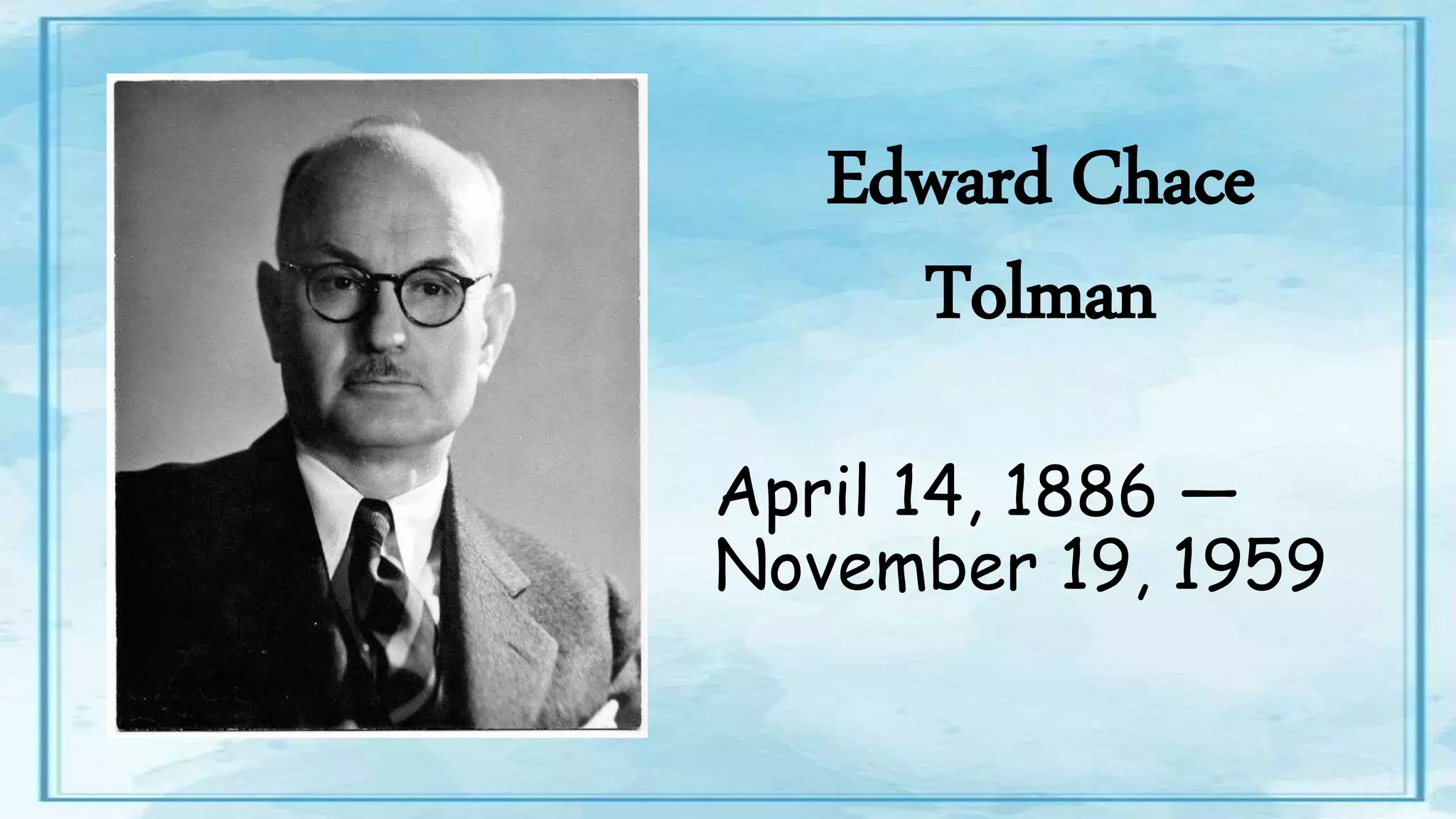
Tolman Theory
Edward Chace
Tolman
April 14, 1886 —
November 19, 1959
Purposive Behaviorism
• Purposive Behaviorism was also
referred as Sign Learning Theory.
• It link between behaviorism
and cognitive theory.
Purposive Behaviorism
• Tolman’s theory was founded
on two psychological views:
 Gestalt Theory
 John Watson (Behaviorist)
Key Concepts:
1. Goal Directedness
2. Cognitive Maps
3. Latent Learning
4. Intervening Variables
Goal Directedness
 Learning is always purposive
and goal-directed.
 Tolman claimed that an
organism acted or responded
for some adaptive purpose.
Goal Directedness
 He also stated that individuals
do more than merely respond to
stimuli; they act on belief,
attitudes, changing conditions,
and they strive toward goals.
Cognitive Maps
 tendency to learn location
Rat’s Maze
--organisms will select the
shortest or easiest path to
achieve goal
Cognitive Maps
Rat’s Maze
--rats formed cognitive maps
that help them perform well on
the maze
Latent Learning
 learning that remains or stays with
individual until needed
 learning that is not outwardly
manifested at once
 can exist even without
reinforcement
Latent Learning
Rat’s Maze
--rats learned the maze by forming
cognitive maps of the maze, but
manifested this knowledge of the
maze only when they needed to
Intervening Variables
 variables that are not readily
seen but serve as
determinations of behavior
Intervening Variables
 Tolman believed that learning
is influenced by expectations,
perceptions, representations,
needs and other internal or
environmental variables.
Intervening Variables
Rat’s Maze
--rat’s hunger is the intervening
variable
Implications of Principles
of
Purposive Behaviorism in
Teaching
Principles of Purposive Behaviorism
1. Reinforcement is not essential
for learning, although it provides
an incentive for performance.
Role of the Teacher
The Importance of Lesson:
 The teacher should present the
value of learning the lesson for
future purposes.
Principles of Purposive Behaviorism
2. Learning is always purposive
and goal-directed.
Role of the Teacher
Goal Orientation:
 The teacher should make sure
that the goals and purposes of
every task are fully presented in
the class.
Principles of Purposive Behaviorism
3. Learning often involves the
use of environmental factors to
achieve a goal.
Role of the Teacher
Classroom Management:
 The teacher should maintain a
non threatening atmosphere
during the teaching and learning
process.
Principles of Purposive Behaviorism
4. Organisms will select the
shortest or easiest path to
achieve a goal.
Role of the Teacher
Holistic Discussion:
 The teacher should discuss the
lesson holistic, complete and
simple.
Reflection
Learning theories are one of the
foundations of education that build
a concreate pillars in teaching and
learning. It helps explain how
learning occurs and factors that
influence learning.
Reflection
Learning theories also afford a
variety of teaching strategies to help
enhance student development and
understanding. There is no single or
perfect learning theory that applies
to every student.
Reflection
Therefore, different learning theories
should be studied, learned, and
utilized to accommodate a variety of
learner, in order to create an
environment that will be beneficial to
both the teacher the learners.
References
Guthrie, E.R. (1930). Conditioning as a principle of
learning. Psychological Review, 37, 412-428.
Guthrie, E.R. (1935). The Psychology of Learning. New York:
Harper.
Guthrie, E.R. (1938). The Psychology of Human
Conflict. New York: Harper.
Guthrie, E.R. & Horton, G.P. (1946). Cats in a Puzzle
Box. New York: Rinehart.
References
Tolman, E.C. (1932). Purposive Behavior in Animals and
Men. New York: Appleton-Century-Crofts.
Tolman, E.C. (1942). Drives Towards War. New York:
Appleton-Century-Crofts.
Tolman, E.C. (1948). Cognitive maps in rats and
men. Psychological Review, 55, 189-208.
https://www.instructionaldesign.org/theories/sign-theory/
http://psychclassics.yorku.ca/Tolman/formula.htm
Gestalt, Guthrie, and Tolman Theory to Education

Gestalt, Guthrie, and Tolman Theory to Education

  • 1.
    Philosophical Foundations of Education EDUC205 Ms. Renalyn H. Tarog MAE-English
  • 2.
    Introduction Theory is ascientifically acceptable set of principles offered to explain a phenomenon Chunck (2015).
  • 3.
    Introduction Theories provides frameworksto interpret an environmental observation and serves as a bridge between research and education.
  • 4.
    Introduction Theories and learningare important element in teacher development.
  • 5.
    Introduction Most of thepractice and development in a teaching profession field barrow idea from learning theories.
  • 6.
    Introduction No matter whatthe specified areas linked in studying theories, the best part of learning the theories is for making a strong foundation in education.
  • 7.
    Introduction The following theoriesin psychology are the assigned topic to be thoroughly discuss based on the research.
  • 8.
  • 9.
  • 10.
    Gestalt Gestalt derived fromthe German word 'gestalten', has no English equivalent.
  • 11.
    Gestalt The nearest Englishtranslation of Gestalt is ‘configuration’ or an ‘organized whole’ or the ‘totality of a situation’.
  • 12.
  • 13.
  • 14.
  • 15.
    “The whole ismore important than its parts.”
  • 16.
    Implications of theGestalt Principles in Teaching and Learning Process
  • 17.
    Law of Proximity Related concepts or lessons should be taught aligned or closely to each other.
  • 18.
    Law of Similarity Similar lessons or contents should be grouped together to make learners develop understanding more efficiently and effectively.
  • 19.
    Law of Closure Incomplete information may make learners want to discover what’s missing, rather than concentrating on the given instruction.
  • 20.
    Law of Closure Make the lesson complete.  Present the lesson clearly and simple.  Always be ready for students' clarifications.
  • 21.
    Law of GoodContinuation  Lessons should be presented in such a way that learners will see these as connected and continuous.  DLL: Review of the Previous Lesson
  • 22.
    Law of Pragranz(Good Figure)  Pragnanz states that when things are grasped as whole, the minimal amount of energy is exerted in thinking.  Make the lesson holistic, complete and simple.
  • 23.
    Law of Figure/Ground For a figure to be perceived, it must stand out from the background.  Emphasis should be done as important aspect of the lesson.
  • 24.
    Law of Figure/Ground Teachers should vary the tone of voice or underline the important key words of the lesson.
  • 25.
  • 26.
    Gestalt Psychology Gestalt psychologyproposes education to be an integration of affective and cognitive domains of learning.
  • 27.
    Gestalt Psychology Gestalt psychologyis a proponent of discovery or insight learning.
  • 28.
    Role of theTeacher Affective Domain:  The teacher should set the objectives that does not only focus on the cognitive and psychomotor domains of teaching and learning but also on the affective domain.
  • 29.
    Role of theTeacher Harmonious Environment:  The teacher should maintain an emotionally harmonious and non threatening atmosphere during the teaching and learning process to consequently caters exchange of ideas and learning.
  • 30.
    Role of theTeacher Hands-On Activities:  The teacher should make use of discovery approach in learning. Example Activities:  experiments  laboratory  inquiry-based strategies (interview)
  • 31.
    Role of theTeacher From Whole to Parts:  The teacher should present the subject matter as a whole to facilitate insight learning.
  • 32.
    Role of theTeacher Importance of Motivation:  The teacher should arouse the student’s curiosity, interest and motivation.
  • 33.
    Role of theTeacher Problem Solving Approach:  The teacher should encourage the learners to solve problems by insight, meaningful learning, learning by understanding, reasoning, etc.
  • 34.
    Role of theTeacher Previous Experiences:  The teacher should check the previous experiences of the student and relate them with the new learning situation.
  • 35.
    Role of theTeacher Goal Orientation:  The teacher should make sure that the goals and purposes of every task are fully presented in the class.
  • 36.
  • 37.
    Edwin Ray Guthrie January 9,1886— April 23, 1959
  • 38.
    Contiguity Theory “A combinationof stimuli which has accompanied a movement will on its recurrence tend to be followed by that movement”.
  • 39.
    Contiguity Theory Guthrie proposedthat all learning was a consequence of association between a particular stimulus and response.
  • 40.
    Contiguity Theory Guthrie arguedthat stimuli and responses affect specific sensory- motor patterns; what is learned are movements, not behaviors.
  • 41.
  • 42.
    One Trial Learning Guthrie’s theories went against those of Watson’s Classical Conditioning and Skinner’s Operant Conditioning
  • 43.
    One Trial Learning Guthrie’s learning theory is called one-trial learning  He developed it with Smith at the University of Washington.
  • 44.
    One Trial Learning Guthrie and Smith’s theory states that all learning is done within a single exposure to a situation.
  • 45.
    Implications of Principles of OneTrial Learning in Teaching
  • 46.
    Principles of OneTrial Learning 1. Learner react to a given situation the same way so long as it was still effective.
  • 47.
    STIMULATION RESPONSE ONE PAIRING Essay Writing (Informal Letter) Teacher gives explanation onthe format. Students take note of the format. LEARNING COMPLETE LEARNING COMPLETE
  • 48.
    Explanation: After this, wheneverstudents come across with the instruction “write an informal letter”, students will automatically construct an informal letter with correct format.
  • 49.
    Principles of OneTrial Learning 2. In order for conditioning to occur, the organism must actively respond (i.e., do things).
  • 50.
    Role of theTeacher Active Participation:  Learning must be active.  Teacher should involve the learners during discussion.
  • 51.
    Role of theTeacher Importance of Motivation: • The role of motivation in teacher’s discussion is to create a state of arousal and activity which produces responses (active participation) that can be conditioned.
  • 52.
    Principles of OneTrial Learning 3. Since learning involves the conditioning of specific movements, instruction must present every specific task.
  • 53.
    Role of theTeacher Task Orientation:  The teacher should make sure that the directions and purposes of every task are fully presented in the class.
  • 54.
    Principles of OneTrial Learning 4. Exposure to many variations in stimulus patterns is desirable in order to produce a generalized response.
  • 55.
    Role of theTeacher Comprehensive Discussion:  The teacher should discuss the lesson thoroughly.
  • 56.
    Principles of OneTrial Learning 5. The last response in a learning situation should be correct since it is the one that will be associated.
  • 57.
    Role of theTeacher Correction:  The teacher should make sure that the information that he/she implies to the learners is true and correct.
  • 58.
  • 59.
    Edward Chace Tolman April 14,1886 — November 19, 1959
  • 60.
    Purposive Behaviorism • PurposiveBehaviorism was also referred as Sign Learning Theory. • It link between behaviorism and cognitive theory.
  • 61.
    Purposive Behaviorism • Tolman’stheory was founded on two psychological views:  Gestalt Theory  John Watson (Behaviorist)
  • 62.
    Key Concepts: 1. GoalDirectedness 2. Cognitive Maps 3. Latent Learning 4. Intervening Variables
  • 63.
    Goal Directedness  Learningis always purposive and goal-directed.  Tolman claimed that an organism acted or responded for some adaptive purpose.
  • 64.
    Goal Directedness  Healso stated that individuals do more than merely respond to stimuli; they act on belief, attitudes, changing conditions, and they strive toward goals.
  • 65.
    Cognitive Maps  tendencyto learn location Rat’s Maze --organisms will select the shortest or easiest path to achieve goal
  • 66.
    Cognitive Maps Rat’s Maze --ratsformed cognitive maps that help them perform well on the maze
  • 67.
    Latent Learning  learningthat remains or stays with individual until needed  learning that is not outwardly manifested at once  can exist even without reinforcement
  • 68.
    Latent Learning Rat’s Maze --ratslearned the maze by forming cognitive maps of the maze, but manifested this knowledge of the maze only when they needed to
  • 69.
    Intervening Variables  variablesthat are not readily seen but serve as determinations of behavior
  • 70.
    Intervening Variables  Tolmanbelieved that learning is influenced by expectations, perceptions, representations, needs and other internal or environmental variables.
  • 71.
    Intervening Variables Rat’s Maze --rat’shunger is the intervening variable
  • 72.
  • 73.
    Principles of PurposiveBehaviorism 1. Reinforcement is not essential for learning, although it provides an incentive for performance.
  • 74.
    Role of theTeacher The Importance of Lesson:  The teacher should present the value of learning the lesson for future purposes.
  • 75.
    Principles of PurposiveBehaviorism 2. Learning is always purposive and goal-directed.
  • 76.
    Role of theTeacher Goal Orientation:  The teacher should make sure that the goals and purposes of every task are fully presented in the class.
  • 77.
    Principles of PurposiveBehaviorism 3. Learning often involves the use of environmental factors to achieve a goal.
  • 78.
    Role of theTeacher Classroom Management:  The teacher should maintain a non threatening atmosphere during the teaching and learning process.
  • 79.
    Principles of PurposiveBehaviorism 4. Organisms will select the shortest or easiest path to achieve a goal.
  • 80.
    Role of theTeacher Holistic Discussion:  The teacher should discuss the lesson holistic, complete and simple.
  • 81.
    Reflection Learning theories areone of the foundations of education that build a concreate pillars in teaching and learning. It helps explain how learning occurs and factors that influence learning.
  • 82.
    Reflection Learning theories alsoafford a variety of teaching strategies to help enhance student development and understanding. There is no single or perfect learning theory that applies to every student.
  • 83.
    Reflection Therefore, different learningtheories should be studied, learned, and utilized to accommodate a variety of learner, in order to create an environment that will be beneficial to both the teacher the learners.
  • 84.
    References Guthrie, E.R. (1930).Conditioning as a principle of learning. Psychological Review, 37, 412-428. Guthrie, E.R. (1935). The Psychology of Learning. New York: Harper. Guthrie, E.R. (1938). The Psychology of Human Conflict. New York: Harper. Guthrie, E.R. & Horton, G.P. (1946). Cats in a Puzzle Box. New York: Rinehart.
  • 85.
    References Tolman, E.C. (1932).Purposive Behavior in Animals and Men. New York: Appleton-Century-Crofts. Tolman, E.C. (1942). Drives Towards War. New York: Appleton-Century-Crofts. Tolman, E.C. (1948). Cognitive maps in rats and men. Psychological Review, 55, 189-208. https://www.instructionaldesign.org/theories/sign-theory/ http://psychclassics.yorku.ca/Tolman/formula.htm

Editor's Notes

  • #16 According to the prominent Gestalt Psychologists:
  • #18 This is the reason why subtraction is taught after addition, multiplication after subtraction then division after multiplication. Imagine teaching addition then jumping directly to polygons.
  • #19 This is the reason why lessons are grouped into units: Unit I is for human body, Unit II is for energy and motion, so on and so forth.
  • #33 The teacher should gain full attention of the whole class before teaching
  • #39 According to Edwin Guthrie: “READ THE QUOTE ABOVE”.
  • #40 According to Edwin Guthrie: “READ THE QUOTE ABOVE”.
  • #56 The teacher should give an example to fully understand the lesson.
  • #75 The students will pay attention in the discussion when they realized that it is essential to achieve their goals.