By: Keairah Hanks
Learning
Theories
Types of Theories: Behaviorism
● Behaviorism measures only observable behaviors. Therefore it
only examines outside behavior that is presented.
● The theory of Behaviorism is the brainchild of John Watson, B.F
Skinner, and Ivan Pavlov himself. The learner -in our case our
students- is a blank slate. Through lived experience, they are able
to acquire new behaviors or adapt their behaviors by virtue of the
provided stimuli and responses.
● There are two core theories that stem from behaviorism
● Classical Conditioning , which is Pavlov's contribution and
Operant Conditioning which is B.F Skinner's Contribution.
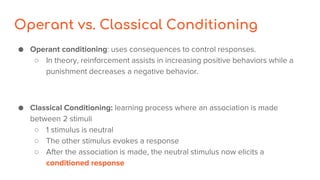
Operant vs. Classical Conditioning
● Operant conditioning: uses consequences to control responses.
○ In theory, reinforcement assists in increasing positive behaviors while a
punishment decreases a negative behavior.
● Classical Conditioning: learning process where an association is made
between 2 stimuli
○ 1 stimulus is neutral
○ The other stimulus evokes a response
○ After the association is made, the neutral stimulus now elicits a
conditioned response
Types of Theories : Constructivism
● Constructivism is the theory that individuals establish
knowledge through their lived experiences and
interactions with the world around them
● In theory through connection, we experience, grow and
obtain knowledge.
● Many of the belief we have have been believed to be
rooted in Constructivism
Types of Theories: Cognitivism
● Similar to rationalist theory of innate knowledge
- knowledge is both intrinsic and can be
retrieved through extrinsic experience
● Emphasis on mental processes such as thinking,
memory, knowing, and problem-solving
● Cognitive theories focus on how information is
received, organized, stored, and retrieved by the
mind
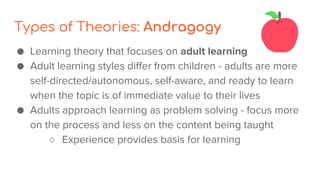
Types of Theories: Andragogy
● Learning theory that focuses on adult learning
● Adult learning styles differ from children - adults are more
self-directed/autonomous, self-aware, and ready to learn
when the topic is of immediate value to their lives
● Adults approach learning as problem solving - focus more
on the process and less on the content being taught
○ Experience provides basis for learning
Theories That Align Most with my Teaching
Philosophy
I believe that these theories would not work
separately. I believe they would function better as a
synthesis of sorts.
I would start with Constructivism. I would
demonstrate what should be learned.
Follow it up with Behaviorism to ensure the content
is being retained.
Cognitivism will help adapt the lesson to cater to
student’s needs.
Theories that will Enhance my Teaching
● Behaviorism is by far the most vital
theory.
● Behaviorism focuses on the student and
their progress in class.
● Through behaviorism I , as an instructor,
can make alterations to my students
lessons and gain a respect a sense of
trust from my student by virtue of my
attentiveness.
How I will Use my Theories in
my Instruction
● Implementing Constructivism is
important to keeping the students
engaged in learning
○ Incorporating interesting
activities and group work
where the students can
collaborate encourages
student agency
○ Encourages critical thinking,
analysis, evaluation, and
creation
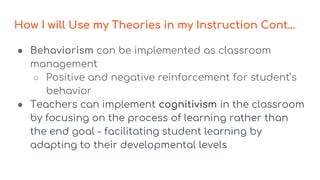
How I will Use my Theories in my Instruction Cont...
● Behaviorism can be implemented as classroom
management
○ Positive and negative reinforcement for student’s
behavior
● Teachers can implement cognitivism in the classroom
by focusing on the process of learning rather than
the end goal - facilitating student learning by
adapting to their developmental levels
References
● Behaviorism in the Classroom. (1970, August 10). Retrieved February 7, 2019, from
http://www.learningscientists.org/blog/2017/8/10-1
● Cognitivism. (n.d.). Retrieved February 7, 2019, from
http://teachinglearningresources.pbworks.com/w/page/31012664/Cognitivism
● Last Updated November 30th, 2. 0. (n.d.). Andragogy (Malcolm Knowles). Retrieved
February 7, 2019, from https://www.instructionaldesign.org/theories/andragogy/
● Types of Behavioral Learning. (n.d.). Retrieved February 7, 2019, from
http://thepeakperformancecenter.com/educational-
learning/learning/theories/types-behavioral-learning/

Learning Theories

  • 1.
  • 2.
    Types of Theories:Behaviorism ● Behaviorism measures only observable behaviors. Therefore it only examines outside behavior that is presented. ● The theory of Behaviorism is the brainchild of John Watson, B.F Skinner, and Ivan Pavlov himself. The learner -in our case our students- is a blank slate. Through lived experience, they are able to acquire new behaviors or adapt their behaviors by virtue of the provided stimuli and responses. ● There are two core theories that stem from behaviorism ● Classical Conditioning , which is Pavlov's contribution and Operant Conditioning which is B.F Skinner's Contribution.
  • 3.
    Operant vs. ClassicalConditioning ● Operant conditioning: uses consequences to control responses. ○ In theory, reinforcement assists in increasing positive behaviors while a punishment decreases a negative behavior. ● Classical Conditioning: learning process where an association is made between 2 stimuli ○ 1 stimulus is neutral ○ The other stimulus evokes a response ○ After the association is made, the neutral stimulus now elicits a conditioned response
  • 4.
    Types of Theories: Constructivism ● Constructivism is the theory that individuals establish knowledge through their lived experiences and interactions with the world around them ● In theory through connection, we experience, grow and obtain knowledge. ● Many of the belief we have have been believed to be rooted in Constructivism
  • 5.
    Types of Theories:Cognitivism ● Similar to rationalist theory of innate knowledge - knowledge is both intrinsic and can be retrieved through extrinsic experience ● Emphasis on mental processes such as thinking, memory, knowing, and problem-solving ● Cognitive theories focus on how information is received, organized, stored, and retrieved by the mind
  • 6.
    Types of Theories:Andragogy ● Learning theory that focuses on adult learning ● Adult learning styles differ from children - adults are more self-directed/autonomous, self-aware, and ready to learn when the topic is of immediate value to their lives ● Adults approach learning as problem solving - focus more on the process and less on the content being taught ○ Experience provides basis for learning
  • 7.
    Theories That AlignMost with my Teaching Philosophy I believe that these theories would not work separately. I believe they would function better as a synthesis of sorts. I would start with Constructivism. I would demonstrate what should be learned. Follow it up with Behaviorism to ensure the content is being retained. Cognitivism will help adapt the lesson to cater to student’s needs.
  • 8.
    Theories that willEnhance my Teaching ● Behaviorism is by far the most vital theory. ● Behaviorism focuses on the student and their progress in class. ● Through behaviorism I , as an instructor, can make alterations to my students lessons and gain a respect a sense of trust from my student by virtue of my attentiveness.
  • 9.
    How I willUse my Theories in my Instruction ● Implementing Constructivism is important to keeping the students engaged in learning ○ Incorporating interesting activities and group work where the students can collaborate encourages student agency ○ Encourages critical thinking, analysis, evaluation, and creation
  • 10.
    How I willUse my Theories in my Instruction Cont... ● Behaviorism can be implemented as classroom management ○ Positive and negative reinforcement for student’s behavior ● Teachers can implement cognitivism in the classroom by focusing on the process of learning rather than the end goal - facilitating student learning by adapting to their developmental levels
  • 11.
    References ● Behaviorism inthe Classroom. (1970, August 10). Retrieved February 7, 2019, from http://www.learningscientists.org/blog/2017/8/10-1 ● Cognitivism. (n.d.). Retrieved February 7, 2019, from http://teachinglearningresources.pbworks.com/w/page/31012664/Cognitivism ● Last Updated November 30th, 2. 0. (n.d.). Andragogy (Malcolm Knowles). Retrieved February 7, 2019, from https://www.instructionaldesign.org/theories/andragogy/ ● Types of Behavioral Learning. (n.d.). Retrieved February 7, 2019, from http://thepeakperformancecenter.com/educational- learning/learning/theories/types-behavioral-learning/

Editor's Notes

  • #9 https://www.youtube.com/watch?v=ADp9P3p85w0