Behaviorism


        By: Bianca Olmo
Behaviorism Menu
 What?
 Who?
 How?
 My ESE
  Classroom
 Works Cited
Behaviorism
                What It Is?
 Human psychology can only be studied through the examination of
  behavioral events.
 Learning is a change in behavior.

    Change induced by:

       o Punishment (positive and negative)
          • Decreases the likelihood the behavior will occur again
          • Adding or taking away a stimulus

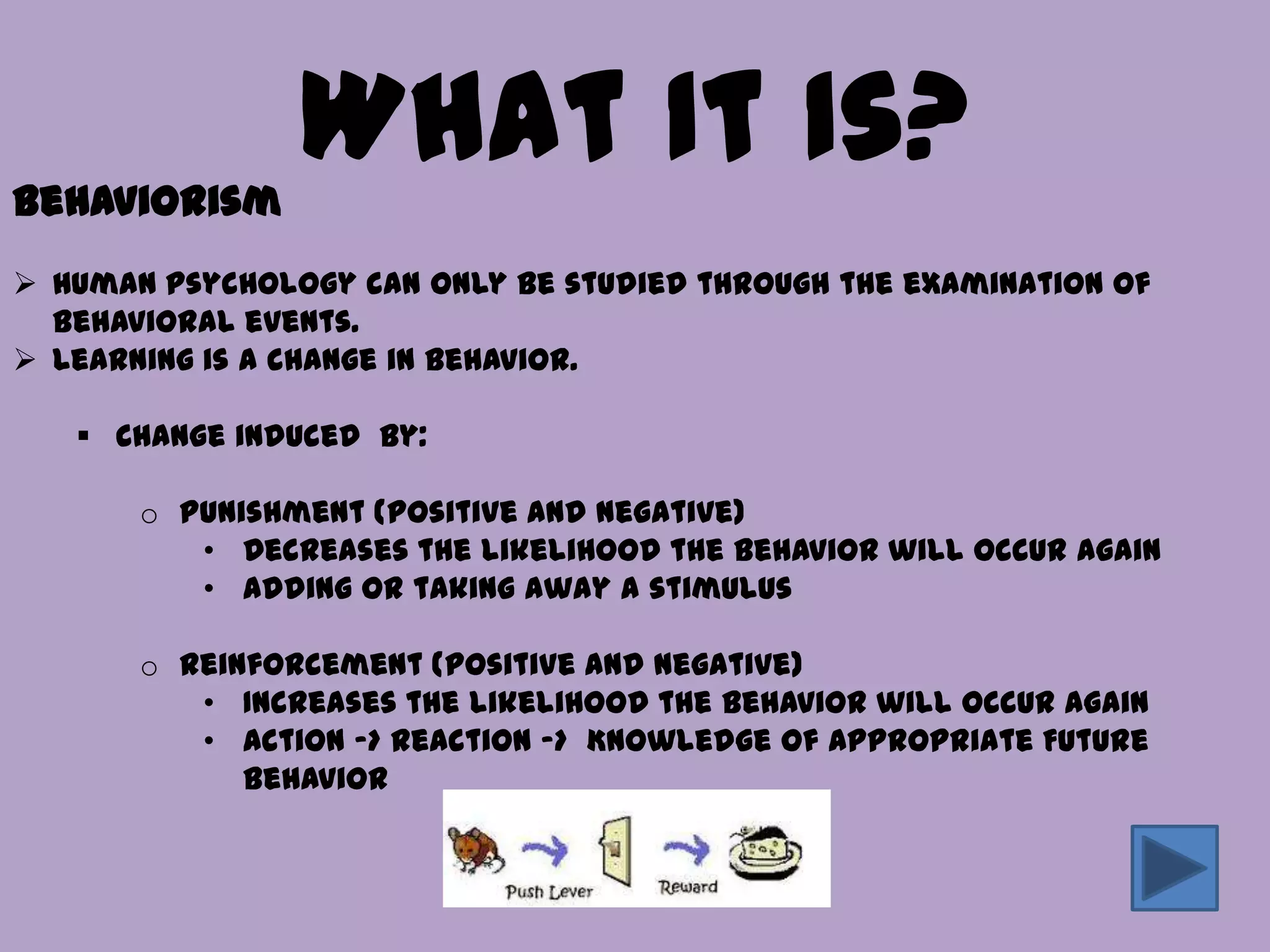
       o Reinforcement (positive and Negative)
          • Increases the likelihood the behavior will occur again
          • Action -> Reaction -> Knowledge of Appropriate Future
             Behavior
Three Types of Behaviorism
1. Methodological Behaviorism
     Psychology is the science of
      behavior, not the mind.
     Mental states aren’t useful
      for empirical study.
2. Psychological Behaviorism
     Sources for behavior are
       external, not internal.
     Behavior can be explained
       without mental events.
3. Analytical and Logical
   Behaviorism
     Mental concepts should be
       translated into behavioral
       concepts.
     Idea of mental state is the
       idea of behavioral
       disposition.
Who Are The Key
     Figures?


 B.F. Skinner (1904-   Ivan Pavlov (1849-
        1990)                 1936)
Operant Conditioning        Classical
                          Conditioning
B.F. Skinner
Operant Conditioning

          Attempts to modify
           behavior through
           reinforcements.
          Association between a
           particular behavior and
           a consequence.
          Example
            • Parents rewarding a
               child with candy or a
               prize when they get
               good grades.
Ivan Pavlov
      Classical Conditioning
 Automatic type of learning.
 A stimulus evokes a
  response originally evoked
  by a different stimulus.
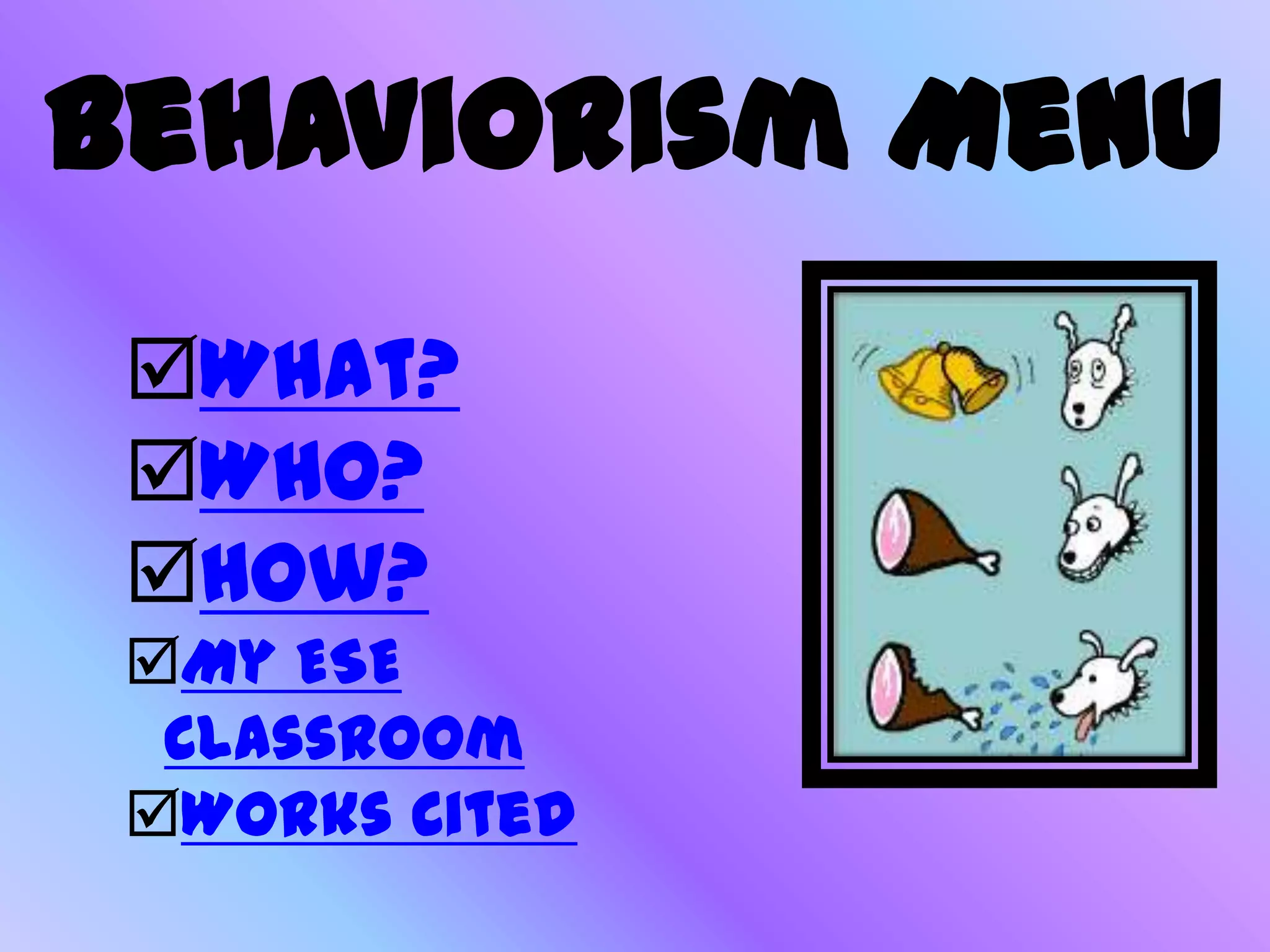
 Pavlov’s Dogs
   • Meat powder
      (Unconditioned Stimulus)
   • Dog’s salivation
      (Unconditioned
      Response)
   • Bell begins as a Neutral
      Stimulus but becomes
      the Conditioned Stimulus
   • Salivation after the bell
      (Conditioned Response)
Pavlov’s Dog
Classical Conditioning


 http://www.youtube.com/watch?v=CpoLxEN54ho
How It Would Be Used In The
        Classroom?

     Role of Teachers


     Role of Students
What Would The Teachers Do?
                  Contracts
      The relevant behavior should be
      identified, and terms discussed.

               Consequences
       Must occur immediately after
           the behavior occurs.

               Reinforcement
      Positive/Negative Reinforcement
              and Punishment.

                Extinction
        Decreases the chances of a
        response by withdrawing a
      previously reinforced stimulus.
What Would The Students Do?

                  Rewards
        Students receive rewards for
           appropriate behaviors.

                  Confidence
      Positive feedback/responses boost
         students’ confidence levels.

               Behavior Changes
      Students change their inappropriate
    behavior to behavior that is acceptable.
Behaviorism In My ESE
         Classroom
To Avoid Student Frustration
   ‐ Break down large tasks into small
     segments
   ‐ Demonstrate and explain each step in a
     new task

To Help Overcome Difficulty Processing and
Memory
   ‐ Include extra practice
   ‐ Review materials as often as necessary
Behaviorism In My ESE
         Classroom
To Keep Students on Task
   ‐ Create predictable routines
   ‐ Incorporate structure into lessons

To Make Sure Students are Absorbing the
Material
   ‐ Gather feedback throughout the lesson
Works Cited
                      Resources
  •   http://psychology.about.com/od/profilesofmajorthinkers/p/
      bio_skinner.htm
  •   http://www.nobelprize.org/nobel_prizes/medicine/laureate
      s/1904/pavlov-bio.html
  •   http://dictionary.reference.com/browse/behaviorism?s=t
  •   http://www.learning-theories.com/classical-conditioning-
      pavlov.html
  •   http://www.learning-theories.com/operant-conditioning-
      skinner.html
  •   http://cie.asu.edu/volume8/number10/index.html#behavio
      r
  •   http://projects.coe.uga.edu/epltt/index.php?title=Behaviori
      sm#Educational_Implications
  •   https://www.msu.edu/~mckin115/Matrix/theories/Behavio
      rism.htm
  •   http://www.iep.utm.edu/behavior/
  •   http://www.learning-theories.com/behaviorism.html
  •   http://plato.stanford.edu/entries/behaviorism/
Works Cited                                                    Images
•   http://www.google.com/imgres?q=behaviorism&um=1&hl=en&biw=1517&bih=741          •   http://www.google.com/imgres?q=behaviorism&um=1&hl=en&rlz=1C1
    &tbm=isch&tbnid=4WHGivrAYvW-                                                        AFAB_enUS460US466&tbm=isch&tbnid=zSxT0xn9ear_qM:&imgrefurl=h
    3M:&imgrefurl=http://academics.rmu.edu/~tomei/ed711psy/behave.htm&docid=            ttp://projects.coe.uga.edu/epltt/index.php%3Ftitle%3DBehaviorism&do
    mqnsbJw0oOhLGM&imgurl=http://academics.rmu.edu/~tomei/ed711psy/Behaviori            cid=sb1kV0ByI9G3SM&imgurl=http://projects.coe.uga.edu/epltt/images
    smcafe.gif&w=675&h=539&ei=N05-T86XOpSs8QTWzMScDg&zoom=1                             /c/cf/Behaviorism_2.gif&w=388&h=118&ei=mmJ-
•   http://www.google.com/imgres?q=behaviorism&um=1&hl=en&tbm=isch&tbnid=4              T9qKM4Sc9gTdorzsDg&zoom=1&iact=hc&vpx=321&vpy=65&dur=46&ho
    mCT6Bnhrr3H1M:&imgrefurl=http://www3.hku.hk/cogsci/wiki/pmwiki.php%3Fn%3            vh=93&hovw=310&tx=142&ty=56&sig=115527933523406624476&page
    DMain.BriefHistoryOfCognitiveScience&docid=3xSybBoa5dOTsM&imgurl=http://w
                                                                                        =3&tbnh=80&tbnw=263&start=43&ndsp=25&ved=1t:429,r:14,s:43,i:264
    ww.hku.hk/cogsci/media/philo/emergence.jpg&w=150&h=198&ei=TFB-T-
    6DHYnk9ASXmfi7Dg&zoom=1&iact=hc&vpx=197&vpy=463&dur=1527&hovh=157&                  &biw=1517&bih=741
    hovw=120&tx=110&ty=134&sig=115527933523406624476&page=3&tbnh=157&tbn            •   http://www.google.com/imgres?q=stack+of+books&um=1&hl=en&sa=N
    w=120&start=43&ndsp=25&ved=1t:429,r:19,s:43,i:275&biw=1517&bih=741                  &biw=1517&bih=701&tbm=isch&tbnid=Cj4FiFC11hOIEM:&imgrefurl=htt
•   http://www.google.com/search?um=1&hl=en&biw=1517&bih=741&tbm=isch&sa=               p://jhard.googlecode.com/svn/trunk/presentaciones/segunda%2520def
    1&q=Ivan+Pavlov&oq=Ivan+Pavlov&aq=f&aqi=g10&aql=&gs_l=img.3..0l10.5621l103          ensa/recursos/&docid=PvksV-Sn9-
    13l0l10564l11l11l0l3l3l0l187l962l2j6l8l0.frgbld.                                    QA7M&imgurl=http://jhard.googlecode.com/svn/trunk/presentaciones
•   http://www.google.com/imgres?q=B.F.+Skinner&um=1&hl=en&tbm=isch&tbnid=cb            /segunda%252520defensa/recursos/Resource%252520Center%252520-
    1UxbBMbNP45M:&imgrefurl=http://www.intropsych.com/ch05_conditioning/appli
                                                                                        %252520Books.jpg.jpg&w=720&h=960&ei=7N2BT4LrEqHa0QHj5YSTCA&
    ed_analysis_of_antecedents.html&docid=p9o89zTHVM_6JM&imgurl=http://www.i
    ntropsych.com/ch05_conditioning/05skinner.jpg&w=635&h=900&ei=N1Z-T-                 zoom=1&iact=hc&vpx=1280&vpy=3&dur=7&hovh=258&hovw=193&tx=
    O3HoWY8gSG1tGODg&zoom=1&iact=hc&vpx=515&vpy=333&dur=19&hovh=266&h                   133&ty=160&sig=115527933523406624476&page=3&tbnh=162&tbnw=
    ovw=187&tx=112&ty=135&sig=115527933523406624476&page=1&tbnh=158&tbn                 122&start=59&ndsp=35&ved=1t:429,r:8,s:59,i:282
    w=111&start=0&ndsp=23&ved=1t:429,r:10,s:0,i:143&biw=1517&bih=741                •   http://www.google.com/imgres?q=student+desks&start=27&num=10&
•   http://www.pptbackgrounds.net/blackboard-800-0.html                                 um=1&hl=en&biw=1517&bih=741&addh=140&tbm=isch&tbnid=1w7Fz
•   http://www.google.com/imgres?q=teacher&start=230&um=1&hl=en&rlz=1C1AFAB             W3TwZ6_jM:&imgrefurl=http://www.hon.com/Products/Desks/SmartLi
    _enUS460US466&biw=1517&bih=741&addh=36&tbm=isch&tbnid=mSqNsY5njQUW                  nk-Student-
    -M:&imgrefurl=http://adriaberryportfolio.blogspot.com/&docid=_km-
                                                                                        Desks.aspx&docid=lvBFMm16vdQCbM&imgurl=http://www.hon.com/g
    JHQsyiL_YM&imgurl=http://4.bp.blogspot.com/_RY127HsSwro/S6pJN9SIUOI/AAAA
    AAAAAo4/r8u9dkAAq3A/s1600/Apple%252Bbooks%252Bimage.jpg&w=380&h=294                 etfile/ee1ffcc5-7b2a-4137-ab6c-
    &ei=Q_OBT-                                                                          e35965d0bcee/.aspx%253Fmaxsidesize%253D266&w=215&h=266&ei=_
    oP5dfRAZfe3PQH&zoom=1&iact=hc&vpx=1207&vpy=150&dur=658&hovh=196&ho                  O2BT_-oCYXW0QGB-
    vw=254&tx=117&ty=130&sig=115527933523406624476&page=10&tbnh=170&tbn                 cDvBw&zoom=1&iact=hc&vpx=966&vpy=410&dur=1166&hovh=211&ho
    w=252&ndsp=24&ved=1t:429,r:11,s:230,i:144                                           vw=171&tx=93&ty=114&sig=115527933523406624476&page=2&tbnh=
•   http://www.google.com/imgres?q=types+of+behaviorism&um=1&hl=en&rlz=1C1AF            166&tbnw=116&ndsp=26&ved=1t:429,r:10,s:27,i:26
    AB_enUS460US466&biw=1517&bih=741&tbm=isch&tbnid=Fw2kX0BBEMTi1M:&img
    refurl=http://behaviorismpsychology.com/types-of-conditioning-in-behaviorism-
    psychology&docid=XMrjmDONgiMP_M&imgurl=http://behaviorismpsychology.com
    /wp-content/uploads/2011/05/Behaviorism-Psychology-2-
    300x230.jpg&w=300&h=230&ei=ysWBT4PXIbKq0AH5v6TQBw&zoom=1&iact=hc&v
    px=1083&vpy=145&dur=1281&hovh=183&hovw=240&tx=126&ty=107&sig=115527
    933523406624476&page=1&tbnh=125&tbnw=160&start=0&ndsp=31&ved=1t:429,r
    :6,s:0,i:79

Behaviorism

  • 1.
    Behaviorism By: Bianca Olmo
  • 2.
    Behaviorism Menu What? Who? How? My ESE Classroom Works Cited
  • 3.
    Behaviorism What It Is?  Human psychology can only be studied through the examination of behavioral events.  Learning is a change in behavior.  Change induced by: o Punishment (positive and negative) • Decreases the likelihood the behavior will occur again • Adding or taking away a stimulus o Reinforcement (positive and Negative) • Increases the likelihood the behavior will occur again • Action -> Reaction -> Knowledge of Appropriate Future Behavior
  • 4.
    Three Types ofBehaviorism 1. Methodological Behaviorism  Psychology is the science of behavior, not the mind.  Mental states aren’t useful for empirical study. 2. Psychological Behaviorism  Sources for behavior are external, not internal.  Behavior can be explained without mental events. 3. Analytical and Logical Behaviorism  Mental concepts should be translated into behavioral concepts.  Idea of mental state is the idea of behavioral disposition.
  • 5.
    Who Are TheKey Figures? B.F. Skinner (1904- Ivan Pavlov (1849- 1990) 1936) Operant Conditioning Classical Conditioning
  • 6.
    B.F. Skinner Operant Conditioning  Attempts to modify behavior through reinforcements.  Association between a particular behavior and a consequence.  Example • Parents rewarding a child with candy or a prize when they get good grades.
  • 7.
    Ivan Pavlov Classical Conditioning  Automatic type of learning.  A stimulus evokes a response originally evoked by a different stimulus.  Pavlov’s Dogs • Meat powder (Unconditioned Stimulus) • Dog’s salivation (Unconditioned Response) • Bell begins as a Neutral Stimulus but becomes the Conditioned Stimulus • Salivation after the bell (Conditioned Response)
  • 8.
    Pavlov’s Dog Classical Conditioning http://www.youtube.com/watch?v=CpoLxEN54ho
  • 9.
    How It WouldBe Used In The Classroom?  Role of Teachers  Role of Students
  • 10.
    What Would TheTeachers Do? Contracts The relevant behavior should be identified, and terms discussed. Consequences Must occur immediately after the behavior occurs. Reinforcement Positive/Negative Reinforcement and Punishment. Extinction Decreases the chances of a response by withdrawing a previously reinforced stimulus.
  • 11.
    What Would TheStudents Do? Rewards Students receive rewards for appropriate behaviors. Confidence Positive feedback/responses boost students’ confidence levels. Behavior Changes Students change their inappropriate behavior to behavior that is acceptable.
  • 12.
    Behaviorism In MyESE Classroom To Avoid Student Frustration ‐ Break down large tasks into small segments ‐ Demonstrate and explain each step in a new task To Help Overcome Difficulty Processing and Memory ‐ Include extra practice ‐ Review materials as often as necessary
  • 13.
    Behaviorism In MyESE Classroom To Keep Students on Task ‐ Create predictable routines ‐ Incorporate structure into lessons To Make Sure Students are Absorbing the Material ‐ Gather feedback throughout the lesson
  • 14.
    Works Cited Resources • http://psychology.about.com/od/profilesofmajorthinkers/p/ bio_skinner.htm • http://www.nobelprize.org/nobel_prizes/medicine/laureate s/1904/pavlov-bio.html • http://dictionary.reference.com/browse/behaviorism?s=t • http://www.learning-theories.com/classical-conditioning- pavlov.html • http://www.learning-theories.com/operant-conditioning- skinner.html • http://cie.asu.edu/volume8/number10/index.html#behavio r • http://projects.coe.uga.edu/epltt/index.php?title=Behaviori sm#Educational_Implications • https://www.msu.edu/~mckin115/Matrix/theories/Behavio rism.htm • http://www.iep.utm.edu/behavior/ • http://www.learning-theories.com/behaviorism.html • http://plato.stanford.edu/entries/behaviorism/
  • 15.
    Works Cited Images • http://www.google.com/imgres?q=behaviorism&um=1&hl=en&biw=1517&bih=741 • http://www.google.com/imgres?q=behaviorism&um=1&hl=en&rlz=1C1 &tbm=isch&tbnid=4WHGivrAYvW- AFAB_enUS460US466&tbm=isch&tbnid=zSxT0xn9ear_qM:&imgrefurl=h 3M:&imgrefurl=http://academics.rmu.edu/~tomei/ed711psy/behave.htm&docid= ttp://projects.coe.uga.edu/epltt/index.php%3Ftitle%3DBehaviorism&do mqnsbJw0oOhLGM&imgurl=http://academics.rmu.edu/~tomei/ed711psy/Behaviori cid=sb1kV0ByI9G3SM&imgurl=http://projects.coe.uga.edu/epltt/images smcafe.gif&w=675&h=539&ei=N05-T86XOpSs8QTWzMScDg&zoom=1 /c/cf/Behaviorism_2.gif&w=388&h=118&ei=mmJ- • http://www.google.com/imgres?q=behaviorism&um=1&hl=en&tbm=isch&tbnid=4 T9qKM4Sc9gTdorzsDg&zoom=1&iact=hc&vpx=321&vpy=65&dur=46&ho mCT6Bnhrr3H1M:&imgrefurl=http://www3.hku.hk/cogsci/wiki/pmwiki.php%3Fn%3 vh=93&hovw=310&tx=142&ty=56&sig=115527933523406624476&page DMain.BriefHistoryOfCognitiveScience&docid=3xSybBoa5dOTsM&imgurl=http://w =3&tbnh=80&tbnw=263&start=43&ndsp=25&ved=1t:429,r:14,s:43,i:264 ww.hku.hk/cogsci/media/philo/emergence.jpg&w=150&h=198&ei=TFB-T- 6DHYnk9ASXmfi7Dg&zoom=1&iact=hc&vpx=197&vpy=463&dur=1527&hovh=157& &biw=1517&bih=741 hovw=120&tx=110&ty=134&sig=115527933523406624476&page=3&tbnh=157&tbn • http://www.google.com/imgres?q=stack+of+books&um=1&hl=en&sa=N w=120&start=43&ndsp=25&ved=1t:429,r:19,s:43,i:275&biw=1517&bih=741 &biw=1517&bih=701&tbm=isch&tbnid=Cj4FiFC11hOIEM:&imgrefurl=htt • http://www.google.com/search?um=1&hl=en&biw=1517&bih=741&tbm=isch&sa= p://jhard.googlecode.com/svn/trunk/presentaciones/segunda%2520def 1&q=Ivan+Pavlov&oq=Ivan+Pavlov&aq=f&aqi=g10&aql=&gs_l=img.3..0l10.5621l103 ensa/recursos/&docid=PvksV-Sn9- 13l0l10564l11l11l0l3l3l0l187l962l2j6l8l0.frgbld. QA7M&imgurl=http://jhard.googlecode.com/svn/trunk/presentaciones • http://www.google.com/imgres?q=B.F.+Skinner&um=1&hl=en&tbm=isch&tbnid=cb /segunda%252520defensa/recursos/Resource%252520Center%252520- 1UxbBMbNP45M:&imgrefurl=http://www.intropsych.com/ch05_conditioning/appli %252520Books.jpg.jpg&w=720&h=960&ei=7N2BT4LrEqHa0QHj5YSTCA& ed_analysis_of_antecedents.html&docid=p9o89zTHVM_6JM&imgurl=http://www.i ntropsych.com/ch05_conditioning/05skinner.jpg&w=635&h=900&ei=N1Z-T- zoom=1&iact=hc&vpx=1280&vpy=3&dur=7&hovh=258&hovw=193&tx= O3HoWY8gSG1tGODg&zoom=1&iact=hc&vpx=515&vpy=333&dur=19&hovh=266&h 133&ty=160&sig=115527933523406624476&page=3&tbnh=162&tbnw= ovw=187&tx=112&ty=135&sig=115527933523406624476&page=1&tbnh=158&tbn 122&start=59&ndsp=35&ved=1t:429,r:8,s:59,i:282 w=111&start=0&ndsp=23&ved=1t:429,r:10,s:0,i:143&biw=1517&bih=741 • http://www.google.com/imgres?q=student+desks&start=27&num=10& • http://www.pptbackgrounds.net/blackboard-800-0.html um=1&hl=en&biw=1517&bih=741&addh=140&tbm=isch&tbnid=1w7Fz • http://www.google.com/imgres?q=teacher&start=230&um=1&hl=en&rlz=1C1AFAB W3TwZ6_jM:&imgrefurl=http://www.hon.com/Products/Desks/SmartLi _enUS460US466&biw=1517&bih=741&addh=36&tbm=isch&tbnid=mSqNsY5njQUW nk-Student- -M:&imgrefurl=http://adriaberryportfolio.blogspot.com/&docid=_km- Desks.aspx&docid=lvBFMm16vdQCbM&imgurl=http://www.hon.com/g JHQsyiL_YM&imgurl=http://4.bp.blogspot.com/_RY127HsSwro/S6pJN9SIUOI/AAAA AAAAAo4/r8u9dkAAq3A/s1600/Apple%252Bbooks%252Bimage.jpg&w=380&h=294 etfile/ee1ffcc5-7b2a-4137-ab6c- &ei=Q_OBT- e35965d0bcee/.aspx%253Fmaxsidesize%253D266&w=215&h=266&ei=_ oP5dfRAZfe3PQH&zoom=1&iact=hc&vpx=1207&vpy=150&dur=658&hovh=196&ho O2BT_-oCYXW0QGB- vw=254&tx=117&ty=130&sig=115527933523406624476&page=10&tbnh=170&tbn cDvBw&zoom=1&iact=hc&vpx=966&vpy=410&dur=1166&hovh=211&ho w=252&ndsp=24&ved=1t:429,r:11,s:230,i:144 vw=171&tx=93&ty=114&sig=115527933523406624476&page=2&tbnh= • http://www.google.com/imgres?q=types+of+behaviorism&um=1&hl=en&rlz=1C1AF 166&tbnw=116&ndsp=26&ved=1t:429,r:10,s:27,i:26 AB_enUS460US466&biw=1517&bih=741&tbm=isch&tbnid=Fw2kX0BBEMTi1M:&img refurl=http://behaviorismpsychology.com/types-of-conditioning-in-behaviorism- psychology&docid=XMrjmDONgiMP_M&imgurl=http://behaviorismpsychology.com /wp-content/uploads/2011/05/Behaviorism-Psychology-2- 300x230.jpg&w=300&h=230&ei=ysWBT4PXIbKq0AH5v6TQBw&zoom=1&iact=hc&v px=1083&vpy=145&dur=1281&hovh=183&hovw=240&tx=126&ty=107&sig=115527 933523406624476&page=1&tbnh=125&tbnw=160&start=0&ndsp=31&ved=1t:429,r :6,s:0,i:79