Behaviour Patterns in Poultry
WELCOME
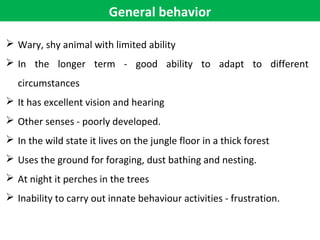
Poultry Behaviour
 Behaviour is the way
that animals respond to
the different stimuli
they encounter in their
environment.
 The stimuli may be from
other birds, their
environment, people or
any other thing or
occurrence.
General behavior
 Wary, shy animal with limited ability
 In the longer term - good ability to adapt to different
circumstances
 It has excellent vision and hearing
 Other senses - poorly developed.
 In the wild state it lives on the jungle floor in a thick forest
 Uses the ground for foraging, dust bathing and nesting.
 At night it perches in the trees
 Inability to carry out innate behaviour activities - frustration.
Social behaviour
 Fowls are a gregarious species with an elaborate social behaviour
 They maintain personal space by communication via postural
changes.
 Important signals are associated with the position of the head
and the relative angles of the head and the body to other birds.
 They maintain contact with flock mates by sight up to
intermediate distances and by vocal communication at longer
distances or if out of sight.
 The wild and/or feral male establishes a territory with his harem.
Subordinate - adopt a subordinate relationship
Breeding behaviour
 Hen is a seasonal breeder and is secretive about its nesting site.
 male mates - escort to and from the nest.
 On hatching, the chickens rapidly imprint (bond) onto the hen.
 They move about with her, initially staying quite close and
are brooded very often.
 As they grow - need for brooding diminishes
 chickens are about 10 to 12 weeks - weaning
Factors governing behaviour responses
 Genetic - Some strains are more docile - this characteristic
responds to selection pressure.
 Experience - Chickens know instinctively how to eat, but they do
not know what to eat or where to find it.
 Age - Certain behaviour is not expressed until the chickens reach
appropriate ages. Examples are development of the peck order
and reproduction behaviour.
 Environment - High light intensity tends to increase activity in very
young chickens - encouraging them to seek food and water.
 Older birds -cannibalism
Learning ability
 Individuals will copy others – imp. part of the learning process.
 When a bird sees another pecking at something, it will copy, thus
learning what to eat, and where to find food (and water).
 Fowls are highly adaptable and become conditioned to many
environmental and management situations.
 They are good at visually discriminating tasks and tend not to
generalise, i.e. they stay at the task at hand without becoming
bored or becoming side-tracked.
 This limited flexibility means that they adapt to intensive forms of
housing very easily and quickly unlike those species which do
generalise and which do get side-tracked and bored.
 Individual recognition- by appearance based on the shape of the
comb, wattles and head generally.
 Only very abrupt, major changes result in a failure to recognise
flock mates that have been altered. However, they forget each
other fairly quickly. Members of flocks that are broken up forget
each other within 3 to 4 weeks.
Communication
 variety of sounds
 Commonly used are food calls, predator alarm calls, pre- and post-
laying calls and rooster crowing.
 Chicken distress calls draw immediate attention from their broody
hen. The clucking calls of the broody hen to her brood will result in
all of the chickens gathering close to her. They will respond to
these calls even played as a recording.
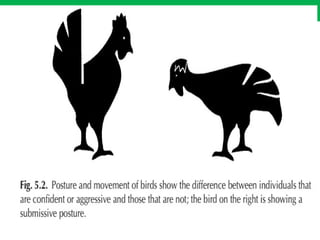
 Fowls communicate also with others by displays and changes in
posture such as head up or head down, tail up or tail down, or
feathers spread or not spread. Displays play an important part in
mating behaviour.
Pecking and the peck order
 Pecking as a skill is recognised as being species specific for fowls.
 They peck to escape from the shell, to feed, to drink, to obtain and
keep personal space etc.
 Main purpose of pecking is for eating which is a precisely tuned
movement of the head and neck.
 Beak trimming changes the relationship between the top and
bottom beak and, in so doing changes their ability to peck.
 They can no longer pick food particles from hard, flat surfaces and,
consequently, food and water troughs must carry an adequate
depth of food and water to ensure that the birds are able to obtain
a sufficient quantity of both.
 The pecking habit is used to establish a hierarchical
organisation or ranking structure in the flock of dominant and
progressively subordinate members.
 This organisation is established separately for males and
females in the same flock.
 Called the peck order, the organisation commences at an early
age and, depending on flock size and complexity, will be
established by 10 to 16 weeks.
 This process follows a well-recognised sequence:
 In the practical situation, the manager must give consideration to
the various aspects of the social organisation of his flock in order
to minimise the disturbance of established relationships at those
times when performance could be affected.
 Form new groups of hens before production starts, ie. move new
layers into the laying house before production is due to start.
 Run males together as a group before placing them in the breeding
pens.
 Place a male in with a group of females to reduce pecking (this will
produce some fertile eggs).
Roosting and perching
 Inherent protective mechanism against ground predators.
 Commercial stock do not necessarily seek to use perches
 Urge has been weakened and some managers believe it is
unnecessary to provide roosts or perches.
 Layer and breeder replacements can be trained to better use nests
thus reducing the number of floor eggs
 Inclusion of roosts or perches - reduce the number of floor eggs
 To provide a place of escape from harassment from pen-mates
during periods of light.
Preening and other behaviour
Inherent behaviour – to maintain feather condition.
These activities include dust bathing, oiling and preening with the
beak or foot.
Dust bathing is claimed to be a behaviour need of hens which both
rids them of external parasites and aligns their feathers.
Eating (maintenance) behaviour
At hatching, chickens know how to peck - do not know how to
discriminate between what they should or should not eat.
The normal practice is to place paper on the floor of their
accommodation and to sprinkle a small quantity of food on that for
the first 24 hours.
Drinking (maintenance) behaviour
 Chickens initially approach the water because they are attracted to
some physical aspect of it.
 Once they have learned where to find their water, the drinkers
should be adjusted for depth and height to ensure that spillage is
kept to a minimum.
 The recommended depth is up to 1 cm and the height of the lip of
the trough level with the bottom of the birds’ wattles.
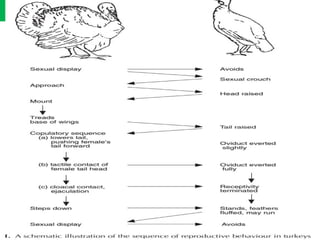
Reproduction behaviour
 ASM in Males: 16 weeks - vary with management, breed strain,
Nutrition and lighting programs.
 Females will usually crouch more frequently for younger males that,
in turn mate more often.
 Higher socially ranked males mate more frequently initially, but this
advantage is short lived.
 Most mating occurs after mid-afternoon.
 Increasing day length will stimulate semen production although
sufficient is produced on normal day length.
 Males will mate many times during the day but many of the latter
matings will be dry.
Courtship and broodiness
 Males and females have an elaborate courtship sequence prior to
mating.
 In a free-living situation females will commence mating behaviour as
young as 18 weeks although this depends also on genotype, sexual
maturity, nutrition and environmental factors.
 High status birds crouch less frequently than do lower status birds.
Broodiness describes the changed state in the hen when egg laying
ceases and the incubation of the eggs and subsequent mothering of
the chicks begins.
 Onset of broodiness controlled mainly by hormonal mechanisms
- controlled genetically.
Hatching synchronisation and vocalisation
 Detected in the incubating egg from about the 17th day.
 Just prior to hatching the chickens commence vocalisation - stimulus
for the synchronisation of the hatching
 Synchronisation enhanced if the eggs are in contact with each other.
Imprinting period
 The chicken escapes from the shell by piercing it with its beak and
then contines to break through the shell
 A hen will usually accept strange chickens in her brood during the
first 3-5 days (i.e. the more intensive part of the imprinting period).
After that she is likely to reject them.
Nesting behaviour
1. Seeking a place to lay – a quite protracted activity as she
becomes restless, and paces about giving pre-laying calls and
showing characteristic body postures. In litter houses she will
often examine the walls and corners.
2. Inspecting a number of nest sites before selecting one and
entering it.
3. Settling, squatting and forming the nest by rotating her body
several times, she usually stands to expel the egg.
4. After laying she examines the egg and leaves the nest, cackles
and joins the rest of the flock.
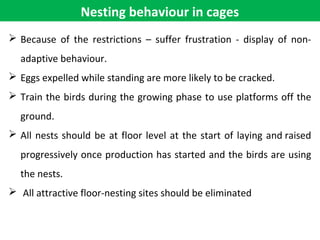
Nesting behaviour in cages
 Because of the restrictions – suffer frustration - display of non-
adaptive behaviour.
 Eggs expelled while standing are more likely to be cracked.
 Train the birds during the growing phase to use platforms off the
ground.
 All nests should be at floor level at the start of laying and raised
progressively once production has started and the birds are using
the nests.
 All attractive floor-nesting sites should be eliminated
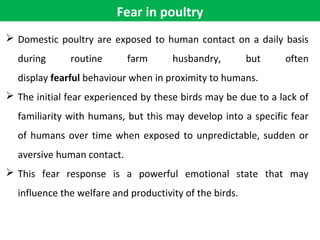
Fear in poultry
 Domestic poultry are exposed to human contact on a daily basis
during routine farm husbandry, but often
display fearful behaviour when in proximity to humans.
 The initial fear experienced by these birds may be due to a lack of
familiarity with humans, but this may develop into a specific fear
of humans over time when exposed to unpredictable, sudden or
aversive human contact.
 This fear response is a powerful emotional state that may
influence the welfare and productivity of the birds.
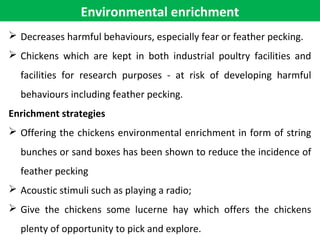
Environmental enrichment
 Decreases harmful behaviours, especially fear or feather pecking.
 Chickens which are kept in both industrial poultry facilities and
facilities for research purposes - at risk of developing harmful
behaviours including feather pecking.
Enrichment strategies
 Offering the chickens environmental enrichment in form of string
bunches or sand boxes has been shown to reduce the incidence of
feather pecking
 Acoustic stimuli such as playing a radio;
 Give the chickens some lucerne hay which offers the chickens
plenty of opportunity to pick and explore.
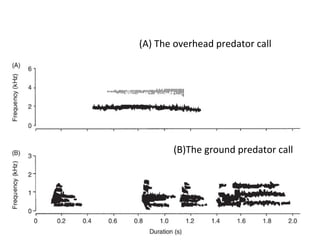
(A) The overhead predator call
(B)The ground predator call
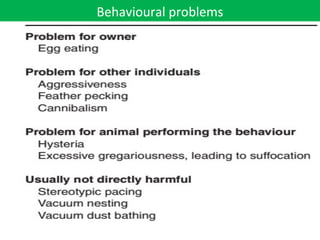
Behavioural problems
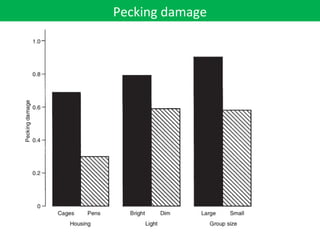
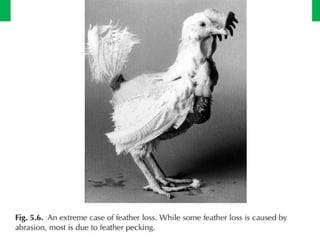
Pecking damage
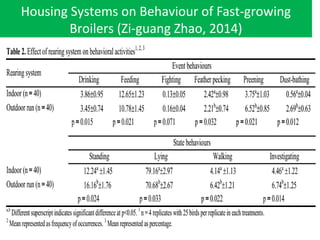
Housing Systems on Behaviour of Fast-growing
Broilers (Zi-guang Zhao, 2014)
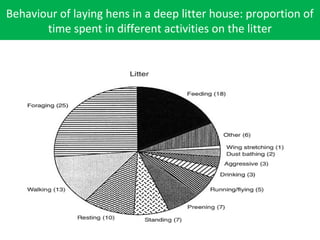
Behaviour of laying hens in a deep litter house: proportion of
time spent in different activities on the litter
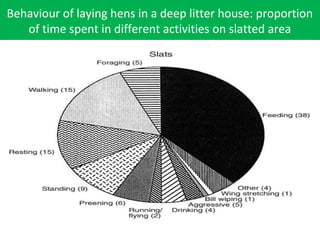
Behaviour of laying hens in a deep litter house: proportion
of time spent in different activities on slatted area
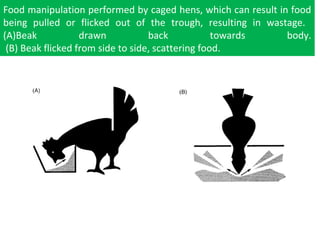
Food manipulation performed by caged hens, which can result in food
being pulled or flicked out of the trough, resulting in wastage.
(A)Beak drawn back towards body.
(B) Beak flicked from side to side, scattering food.
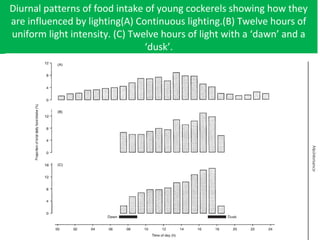
Diurnal patterns of food intake of young cockerels showing how they
are influenced by lighting(A) Continuous lighting.(B) Twelve hours of
uniform light intensity. (C) Twelve hours of light with a ‘dawn’ and a
‘dusk’.
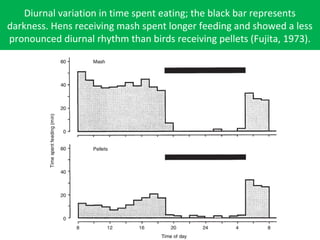
Diurnal variation in time spent eating; the black bar represents
darkness. Hens receiving mash spent longer feeding and showed a less
pronounced diurnal rhythm than birds receiving pellets (Fujita, 1973).
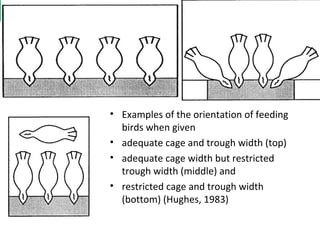
• Examples of the orientation of feeding
birds when given
• adequate cage and trough width (top)
• adequate cage width but restricted
trough width (middle) and
• restricted cage and trough width
(bottom) (Hughes, 1983)
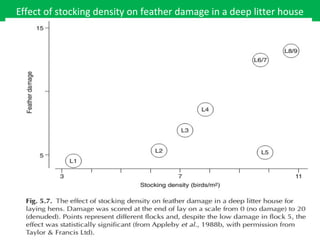
Effect of stocking density on feather damage in a deep litter house
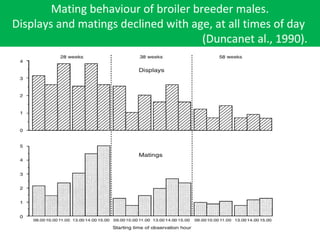
Mating behaviour of broiler breeder males.
Displays and matings declined with age, at all times of day
(Duncanet al., 1990).
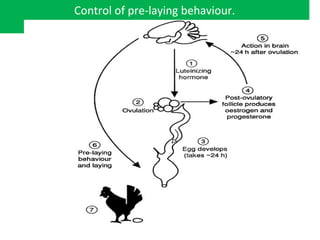
Control of pre-laying behaviour.
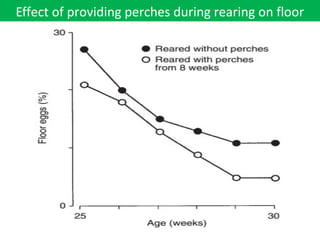
Effect of providing perches during rearing on floor
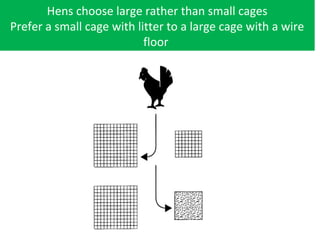
Hens choose large rather than small cages
Prefer a small cage with litter to a large cage with a wire
floor
Conclusion
 Knowledge of the behaviour of the stock and the application
of that knowledge in the care of the stock plays an important
part in the maximisation of production efficiency of a poultry
production enterprise.
Thank you …

Behaviour Patterns in Poultry

  • 1.
    Behaviour Patterns inPoultry WELCOME
  • 2.
    Poultry Behaviour  Behaviouris the way that animals respond to the different stimuli they encounter in their environment.  The stimuli may be from other birds, their environment, people or any other thing or occurrence.
  • 3.
    General behavior  Wary,shy animal with limited ability  In the longer term - good ability to adapt to different circumstances  It has excellent vision and hearing  Other senses - poorly developed.  In the wild state it lives on the jungle floor in a thick forest  Uses the ground for foraging, dust bathing and nesting.  At night it perches in the trees  Inability to carry out innate behaviour activities - frustration.
  • 4.
    Social behaviour  Fowlsare a gregarious species with an elaborate social behaviour  They maintain personal space by communication via postural changes.  Important signals are associated with the position of the head and the relative angles of the head and the body to other birds.  They maintain contact with flock mates by sight up to intermediate distances and by vocal communication at longer distances or if out of sight.  The wild and/or feral male establishes a territory with his harem. Subordinate - adopt a subordinate relationship
  • 5.
    Breeding behaviour  Henis a seasonal breeder and is secretive about its nesting site.  male mates - escort to and from the nest.  On hatching, the chickens rapidly imprint (bond) onto the hen.  They move about with her, initially staying quite close and are brooded very often.  As they grow - need for brooding diminishes  chickens are about 10 to 12 weeks - weaning
  • 6.
    Factors governing behaviourresponses  Genetic - Some strains are more docile - this characteristic responds to selection pressure.  Experience - Chickens know instinctively how to eat, but they do not know what to eat or where to find it.  Age - Certain behaviour is not expressed until the chickens reach appropriate ages. Examples are development of the peck order and reproduction behaviour.  Environment - High light intensity tends to increase activity in very young chickens - encouraging them to seek food and water.  Older birds -cannibalism
  • 7.
    Learning ability  Individualswill copy others – imp. part of the learning process.  When a bird sees another pecking at something, it will copy, thus learning what to eat, and where to find food (and water).  Fowls are highly adaptable and become conditioned to many environmental and management situations.  They are good at visually discriminating tasks and tend not to generalise, i.e. they stay at the task at hand without becoming bored or becoming side-tracked.  This limited flexibility means that they adapt to intensive forms of housing very easily and quickly unlike those species which do generalise and which do get side-tracked and bored.
  • 8.
     Individual recognition-by appearance based on the shape of the comb, wattles and head generally.  Only very abrupt, major changes result in a failure to recognise flock mates that have been altered. However, they forget each other fairly quickly. Members of flocks that are broken up forget each other within 3 to 4 weeks.
  • 9.
    Communication  variety ofsounds  Commonly used are food calls, predator alarm calls, pre- and post- laying calls and rooster crowing.  Chicken distress calls draw immediate attention from their broody hen. The clucking calls of the broody hen to her brood will result in all of the chickens gathering close to her. They will respond to these calls even played as a recording.  Fowls communicate also with others by displays and changes in posture such as head up or head down, tail up or tail down, or feathers spread or not spread. Displays play an important part in mating behaviour.
  • 10.
    Pecking and thepeck order  Pecking as a skill is recognised as being species specific for fowls.  They peck to escape from the shell, to feed, to drink, to obtain and keep personal space etc.  Main purpose of pecking is for eating which is a precisely tuned movement of the head and neck.  Beak trimming changes the relationship between the top and bottom beak and, in so doing changes their ability to peck.  They can no longer pick food particles from hard, flat surfaces and, consequently, food and water troughs must carry an adequate depth of food and water to ensure that the birds are able to obtain a sufficient quantity of both.
  • 11.
     The peckinghabit is used to establish a hierarchical organisation or ranking structure in the flock of dominant and progressively subordinate members.  This organisation is established separately for males and females in the same flock.  Called the peck order, the organisation commences at an early age and, depending on flock size and complexity, will be established by 10 to 16 weeks.  This process follows a well-recognised sequence:
  • 12.
     In thepractical situation, the manager must give consideration to the various aspects of the social organisation of his flock in order to minimise the disturbance of established relationships at those times when performance could be affected.  Form new groups of hens before production starts, ie. move new layers into the laying house before production is due to start.  Run males together as a group before placing them in the breeding pens.  Place a male in with a group of females to reduce pecking (this will produce some fertile eggs).
  • 13.
    Roosting and perching Inherent protective mechanism against ground predators.  Commercial stock do not necessarily seek to use perches  Urge has been weakened and some managers believe it is unnecessary to provide roosts or perches.  Layer and breeder replacements can be trained to better use nests thus reducing the number of floor eggs  Inclusion of roosts or perches - reduce the number of floor eggs  To provide a place of escape from harassment from pen-mates during periods of light.
  • 14.
    Preening and otherbehaviour Inherent behaviour – to maintain feather condition. These activities include dust bathing, oiling and preening with the beak or foot. Dust bathing is claimed to be a behaviour need of hens which both rids them of external parasites and aligns their feathers. Eating (maintenance) behaviour At hatching, chickens know how to peck - do not know how to discriminate between what they should or should not eat. The normal practice is to place paper on the floor of their accommodation and to sprinkle a small quantity of food on that for the first 24 hours.
  • 15.
    Drinking (maintenance) behaviour Chickens initially approach the water because they are attracted to some physical aspect of it.  Once they have learned where to find their water, the drinkers should be adjusted for depth and height to ensure that spillage is kept to a minimum.  The recommended depth is up to 1 cm and the height of the lip of the trough level with the bottom of the birds’ wattles.
  • 16.
    Reproduction behaviour  ASMin Males: 16 weeks - vary with management, breed strain, Nutrition and lighting programs.  Females will usually crouch more frequently for younger males that, in turn mate more often.  Higher socially ranked males mate more frequently initially, but this advantage is short lived.  Most mating occurs after mid-afternoon.  Increasing day length will stimulate semen production although sufficient is produced on normal day length.  Males will mate many times during the day but many of the latter matings will be dry.
  • 17.
    Courtship and broodiness Males and females have an elaborate courtship sequence prior to mating.  In a free-living situation females will commence mating behaviour as young as 18 weeks although this depends also on genotype, sexual maturity, nutrition and environmental factors.  High status birds crouch less frequently than do lower status birds. Broodiness describes the changed state in the hen when egg laying ceases and the incubation of the eggs and subsequent mothering of the chicks begins.  Onset of broodiness controlled mainly by hormonal mechanisms - controlled genetically.
  • 18.
    Hatching synchronisation andvocalisation  Detected in the incubating egg from about the 17th day.  Just prior to hatching the chickens commence vocalisation - stimulus for the synchronisation of the hatching  Synchronisation enhanced if the eggs are in contact with each other. Imprinting period  The chicken escapes from the shell by piercing it with its beak and then contines to break through the shell  A hen will usually accept strange chickens in her brood during the first 3-5 days (i.e. the more intensive part of the imprinting period). After that she is likely to reject them.
  • 19.
    Nesting behaviour 1. Seekinga place to lay – a quite protracted activity as she becomes restless, and paces about giving pre-laying calls and showing characteristic body postures. In litter houses she will often examine the walls and corners. 2. Inspecting a number of nest sites before selecting one and entering it. 3. Settling, squatting and forming the nest by rotating her body several times, she usually stands to expel the egg. 4. After laying she examines the egg and leaves the nest, cackles and joins the rest of the flock.
  • 20.
    Nesting behaviour incages  Because of the restrictions – suffer frustration - display of non- adaptive behaviour.  Eggs expelled while standing are more likely to be cracked.  Train the birds during the growing phase to use platforms off the ground.  All nests should be at floor level at the start of laying and raised progressively once production has started and the birds are using the nests.  All attractive floor-nesting sites should be eliminated
  • 21.
    Fear in poultry Domestic poultry are exposed to human contact on a daily basis during routine farm husbandry, but often display fearful behaviour when in proximity to humans.  The initial fear experienced by these birds may be due to a lack of familiarity with humans, but this may develop into a specific fear of humans over time when exposed to unpredictable, sudden or aversive human contact.  This fear response is a powerful emotional state that may influence the welfare and productivity of the birds.
  • 22.
    Environmental enrichment  Decreasesharmful behaviours, especially fear or feather pecking.  Chickens which are kept in both industrial poultry facilities and facilities for research purposes - at risk of developing harmful behaviours including feather pecking. Enrichment strategies  Offering the chickens environmental enrichment in form of string bunches or sand boxes has been shown to reduce the incidence of feather pecking  Acoustic stimuli such as playing a radio;  Give the chickens some lucerne hay which offers the chickens plenty of opportunity to pick and explore.
  • 23.
    (A) The overheadpredator call (B)The ground predator call
  • 24.
  • 25.
  • 26.
    Housing Systems onBehaviour of Fast-growing Broilers (Zi-guang Zhao, 2014)
  • 27.
    Behaviour of layinghens in a deep litter house: proportion of time spent in different activities on the litter
  • 28.
    Behaviour of layinghens in a deep litter house: proportion of time spent in different activities on slatted area
  • 29.
    Food manipulation performedby caged hens, which can result in food being pulled or flicked out of the trough, resulting in wastage. (A)Beak drawn back towards body. (B) Beak flicked from side to side, scattering food.
  • 30.
    Diurnal patterns offood intake of young cockerels showing how they are influenced by lighting(A) Continuous lighting.(B) Twelve hours of uniform light intensity. (C) Twelve hours of light with a ‘dawn’ and a ‘dusk’.
  • 31.
    Diurnal variation intime spent eating; the black bar represents darkness. Hens receiving mash spent longer feeding and showed a less pronounced diurnal rhythm than birds receiving pellets (Fujita, 1973).
  • 33.
    • Examples ofthe orientation of feeding birds when given • adequate cage and trough width (top) • adequate cage width but restricted trough width (middle) and • restricted cage and trough width (bottom) (Hughes, 1983)
  • 35.
    Effect of stockingdensity on feather damage in a deep litter house
  • 37.
    Mating behaviour ofbroiler breeder males. Displays and matings declined with age, at all times of day (Duncanet al., 1990).
  • 38.
  • 39.
    Effect of providingperches during rearing on floor
  • 42.
    Hens choose largerather than small cages Prefer a small cage with litter to a large cage with a wire floor
  • 43.
    Conclusion  Knowledge ofthe behaviour of the stock and the application of that knowledge in the care of the stock plays an important part in the maximisation of production efficiency of a poultry production enterprise.
  • 44.

Editor's Notes

  • #39 Control of pre-laying behaviour. Ovulation in the single, left ovary is underendocrine control. While the egg develops in the oviduct, there is then hormonalfeedback in the brain, which triggers the behaviour at an appropriate time. See alsoSection 1.14.